
showing posts tagged #uk_leftists — clear

0

UK leftist party resource.

preview

this will be a pinned post to find different political parties/coalitions.

comments should look like: Socialist Party Formally Militant is a Trotskyist party with branches around the UK and strong union connections.

another example: TUSC Trade Union Socialist Coalition.

this will be a pinned post to find different political parties/coalitions.

comments should look like: Socialist Party Formally Militant is a Trotskyist party with branches around the UK and strong union connections.

another example: TUSC Trade Union Socialist Coalition.

0

Food aid.

preview

cross-posted from: lemmygrad.ml/post/13309676

I will need food assistance for the foreseeable future. I’ve written a lot before about how my overdraft is totally maxed out waiting for my disability benefit backpay, and you can only use the food bank 3 times every 6 months. If you can, please send a supermarket gift card (it’s totally anonymous unless you choose to put your name) to my email address: DisabledAceSocialist@hotmail.com

This one takes credit, debit and google pay:

www.sainsburysgiftcard.co.uk

This one takes crypto:

bitrefill.com/…/sainsburys-in-store-digital-uk/

I’m really grateful for any help and to anyone who has responded in the past.

0

Mario, the Idea vs. Mario, the Man (a critique of Super Mario)

preview

cross-posted from: lemmygrad.ml/post/12069165

Damn…

This person wrote for Philosophy 101…

…yet already has the words of a modern-day Marx

Or shall we say…

…Super Marx?

Chortles and guffaws to self

cross-posted from: lemmygrad.ml/post/12069165

Damn…

This person wrote for Philosophy 101…

…yet already has the words of a modern-day Marx

Or shall we say…

…Super Marx?

Chortles and guffaws to self

0

The left needs to unite under one thing: tax wealth, not work

play · youtube.com
YouTube Why are the far right doing so well? And can they be stopped? www.youtube.com
preview

Video is related. Original title “Why are the far right doing so well? And can it be stopped?”

Video is related. Original title “Why are the far right doing so well? And can it be stopped?”

0

Can unions and the left help shape post-Starmer Labour?

Morning Star Can unions and the left help shape post-Starmer Labour? morningstaronline.co.uk
preview

cross-posted from: hexbear.net/post/7678847

cross-posted from: news.abolish.capital/post/28735

KEIR STARMER shows no capacity to respond to the ongoing fallout over Peter Mandelson’s appointment to Washington — which has engulfed the whole Labour Together faction key to his own rise to power.


From Morning Star via This RSS Feed.

0

Party Political leadoff on tech under capitalism

play · youtube.com
YouTube Privacy, Capitalism, and Starmers Brit Card youtu.be
preview

cross-posted from: feddit.uk/post/43892275

My magnum opus. I’ve lead discussions before but this one I’ve spent much longer writing.

formatting is off for readability.

Written Trancript

Privacy, Capitalism, and Starmers Brit Card Privacy should be a human right. And yet under capitalism, it is something that can only be imperfectly approximated through withdrawal: refusing smartphones and “smart” technologies, working cash-in-hand, avoiding CCTV (a near impossibility in British cities). But we are far from being anarcho-individualists. Human freedom does not lie in isolation, further, there is no ethical consumption under capitalism. We must then make use of the tools we have at hand under our current system. Within this same understanding, we recognize that it is society, and our collective forces, which allow us to cures illness, produces energy, and keeps food on our tables. Capitalism itself emerged historically as a system that developed the productive forces beyond what was possible under previous modes of production. That development, however, came at the cost of exploitation, inequality, and repression of the majority class. In short, it elevated our productive forces but entrenched class antagonism. Therefore, our task as socialists isn’t the destruction of society, but the seizure of the organs of capital that control it for private gain. The Commodification of Privacy In the current moment, privacy itself has been commodified. We either pay for privacy with money and knowledge or surrender our privacy in return for a semblance of convenience. Around 50% of people browsing the web do not use an ad-blocker, Less than 2.2% use Firefox, compared with Google Chrome’s 66% market share. Over 91% of people rely on Google’s search engine, while DuckDuckGo (a privacy-focused alternative) holds only 0.6%. These figures do not reflect consumer preference or product quality. On the contrary, antitrust proceedings have shown that Google has knowingly degraded its own search results which forces users to conduct multiple searches to find what they had been looking for, with each search an ads is generated and this results in higher profits for google, while Facebook has invested vast resources in making its platform toxic, deliberately provoking outrage to keep users scrolling, this is emotional manipulation. What we are seeing is not competition, but monopoly power, market capture, and the systematic enclosure of digital life through coercive patterns. this is all an unavoidable reality under this current system. Under modern capitalism, participation in social life has increasingly requires entry into these privately owned digital infrastructures. This is far from accidental. It is a form of entrapment often described as dependency engineering: platforms are designed so that exiting becomes costly, loosing access to our social circles, distant family, and job prospects. To exist online, and increasingly to function at work, we are compelled to enter walled gardens where we are monitored and trapped by engineered obligation. The question before us is not whether digital systems can exist, but who controls them, for what purpose, and under which class power. Privacy or Participation This contradiction is not abstract.Five years ago, I had entirely removed myself from mainstream platforms: like Google, WhatsApp, Facebook, and Outlook. That position changed after joining the Socialist Party, functioning as a comrade required installing WhatsApp, Zoom and the use of google doc’s. Later, starting a new job meant being contractually required to install a clocking-in app on my own personal device. then taking on an officer’s role with Unite the Union meant using Microsoft’s outlook services. Even here, we are using Zoom to host this evenings meeting. The choice was privacy or convenience. It is now privacy or participation, and ultimately participation or destitution. Big tech understands this dynamic all-to-well. WhatsApp, for example, began life as a small messaging app developed by two ex-Yahoo engineers which gained popularity for its strong encryption and privacy features. Once it became an essential social infrastructure, Facebook acquired the app for $19 billion in 2014, not for the product itself or for our own personal benefit, but for the personal data attached. Users were invited in, then locked, our data is scraped, predictive models are made based on our behaviors, personalized ad space is then sold to marketing agencies. These Silicon Vally companies are no longer focused on technology. They have become data-brokers. And we are no longer the customer; we are the product. Facebook has gone even further than just buying competitors. In 2016 Facebook covertly scraped rival platform snapchat (internally know to Facebook as Project Ghostbusters), Facebook had been illegally collecting vast quantities of user data form rival the platform in order to build competing services. What would be criminal Privacy, Capitalism, and Starmers Brit Card Privacy should a human right. And yet under capitalism, it is something that can only be imperfectly approximated through withdrawal: refusing smartphones and “smart” technologies, working cash-in-hand, avoiding CCTV (a near impossibility in British cities). But we are far from being anarcho-individualists. Human freedom does not lie in isolation, further, there is no ethical consumption under capitalism. We must then make use of the tools we have at hand under our current system. Within this same understanding, we recognize that it is society, and our collective forces, which allow us to cures illness, produces energy, and keeps food on our tables. Capitalism itself emerged historically as a system that developed the productive forces beyond what was possible under previous modes of production. That development, however, came at the cost of exploitation, inequality, and repression of the majority class. In short, it elevated our productive forces but entrenched class antagonism. Therefore, our task as socialists isn’t the destruction of society, but the seizure of the organs of capital that control it for private gain. The Commodification of Privacy In the current moment, privacy itself has been commodified. We either pay for privacy with money and knowledge or surrender our privacy in return for a semblance of convenience. Around 50% of people browsing the web do not use an ad-blocker, Less than 2.2% use Firefox, compared with Google Chrome’s 66% market share. Over 91% of people rely on Google’s search engine, while DuckDuckGo (a privacy-focused alternative) holds only 0.6%. These figures do not reflect consumer preference or product quality. On the contrary, antitrust proceedings have shown that Google has knowingly degraded its own search results which forces users to conduct multiple searches to find what they had been looking for, with each search an ads is generated and this results in higher profits for google, while Facebook has invested vast resources in making its platform toxic, deliberately provoking outrage to keep users scrolling, this is emotional manipulation. What we are seeing is not competition, but monopoly power, market capture, and the systematic enclosure of digital life through coercive patterns. this is all an unavoidable reality under this current system. Under modern capitalism, participation in social life has increasingly requires entry into these privately owned digital infrastructures. This is far from accidental. It is a form of entrapment often described as dependency engineering: platforms are designed so that exiting becomes costly, loosing access to our social circles, distant family, and job prospects. To exist online, and increasingly to function at work, we are compelled to enter walled gardens where we are monitored and trapped by engineered obligation. The question before us is not whether digital systems can exist, but who controls them, for what purpose, and under which class power. Privacy or Participation This contradiction is not abstract.Five years ago, I had entirely removed myself from mainstream platforms: like Google, WhatsApp, Facebook, and Outlook. That position changed after joining the Socialist Party, functioning as a comrade required installing WhatsApp, Zoom and the use of google doc’s. Later, starting a new job meant being contractually required to install a clocking-in app on my own personal device. then taking on an officer’s role with Unite the Union meant using Microsoft’s outlook services. Even here, we are using Zoom to host this evenings meeting. The choice was privacy or convenience. It is now privacy or participation, and ultimately participation or destitution. Big tech understands this dynamic all-to-well. WhatsApp, for example, began life as a small messaging app developed by two ex-Yahoo engineers which gained popularity for its strong encryption and privacy features. Once it became an essential social infrastructure, Facebook acquired the app for $19 billion in 2014, not for the product itself or for our own personal benefit, but for the personal data attached. Users were invited in, then locked, our data is scraped, predictive models are made based on our behaviors, personalized ad space is then sold to marketing agencies. These Silicon Vally companies are no longer focused on technology. They have become data-brokers. And we are no longer the customer; we are the product. Facebook has gone even further than just buying competitors. In 2016 Facebook covertly scraped rival platform snapchat (internally know to Facebook as Project Ghostbusters), Facebook had been illegally collecting vast quantities of user data form rival the platform in order to build competing services. What would be criminal behavior for us and met with lengthy prison sentence is treated as a regulatory issue for corporations, punished with fines that amount to operating costs. These are not isolated scandals. They are systemic expressions of capitalism’s central contradiction: a system driven by the need for infinite accumulation in a finite world, constantly forced to invent new frontiers of extraction. When natural resources, labour, and markets are exhausted, human behavior itself becomes the resource to be tapped. From Corporate Surveillance to State Control It is in this context that Keir Starmer’s proposed Brit Card must be understood. On 26th of September 2025, Starmer announced plans for a mandatory digital ID card policy for all UK workers. A policy missing from Labours electoral manifesto. Within 24 hours, over one million people had signed a petition opposing this proposed policy. And despite this opposition, the proposal is still being promoted. This is not a new idea. Digital ID has long been a Blairite Labour policy. Under Tony Blair, the Identity Cards Act 2006 was introduced and justified as a response to terrorism, the moral panic of that time. Costing £250 million and later scrapped. And now, Starmer has repackaged the same proposal as a tool to prevent “illegal migrant labour”, this is echoing the rhetoric of Reform and the reactionary right. This justification collapses under scrutiny. Employers are already legally required to verify workers’ right to work. Failure to do so can result in fines of up to £60,000 per worker with criminal prosecution against the employer, and can result in prison sentences. The Brit Card will do nothing to prevent bosses from super-exploiting migrant labour. Its real function lies elsewhere. What the Brit Card Actually Does Starmer’s proposal would initially link the Brit Card to employment status, government services, healthcare access, as well as financial records. In practice, this means centralizing identity, health, and economic data under a single unified digital identifier. Which represents a profound threat to civil liberties. A centralized database of sensitive personal information is an exceptionally high-value target for cyber-criminals and future big-tech contractors. The British state has a long history of catastrophic IT failures involving private contractors such as: the Post Office’s Horizon scandal, the abandoned NHS National Program for IT, Test and Trace, and repeated ransomware attacks on the NHS and major NHS partners. There is no reason to believe the Brit Card system would be immune from bugs, outages, or future exploitation at the hands of big tech contractors. And even temporary failures could result in workers being denied employment, housing, healthcare, or benefits. The proposed system would require a government-issued digital-wallet-app be installed on our personal devices. The questions are: who will audit the code? Who controls access? What safeguards prevent function creep; in this context, function creep would be the gradual expansion of surveillance powers beyond their original remit. Labour, Capital, and Control Blair’s Labour government failed to impose ID cards despite being far more popular than Starmer’s current leadership. Starmer’s Labour is weaker, deeply distrusted by the working-class, and openly committed to austerity and “fiscal discipline” in the interests of capital. So why is this policy still being pushed? Because parliamentary politics does not operate in isolation. Digital ID is not being driven by public demand, or even public need, far from it, it is driven by powerful interests outside the electoral arena, the same interests that pushed for ID-Cards under Blair and has gone on to donate £257 million to the Blair’s Blair Institute think tank. And this is how the Overtone Window shifts. Extreme proposals are introduced not necessarily to be implemented immediately, but to shift the boundaries of what is considered reasonable. What once appeared unthinkable becomes discuss-able; what is discuss-able becomes policy. Digital ID may be widely opposed, but its discussion normalizes lesser intrusions: private contractors handling NHS data, lessening regulations on access to personal records by private interests, and the deepening integration of big tech into the state and our personal lives. Surveillance by Design Digital ID does not introduce surveillance into society. It does, however, centralize, legitimize, and enforces a surveillance regime that capitalism has already made, only with digital ID it would be inescapable. If Digital ID could be implemented, it would not be the state alone handling this data, but private corporations embedded within government. Data is enormously profitable, and under capitalism, it will be exploited for profit. More fundamentally, Digital ID represents an attempt to discipline labour: controlling access to work, services, and social participation through technological means. It is the formalization of the same coercion already experienced under platform capitalism, but legitimized by the state. That is why the Brit Card must be opposed. Not as a technical mistake or a poorly implemented policy, but as a class project. One that strengthens capital, weakens workers, and collective resistance, further, we must understand the class dynamics behind Digital ID and similar schemes. A party of the working class would not profit from our personal data. It would fight the incursion of capitalism, not manage it more efficiently. Through democratic centralism, the mass of society would decide collectively what technologies are built, how they are used, and for whose benefit. Technology itself is not the enemy. Under socialism, technology could be developed for human need rather than mass surveillance, coercion, and profit extraction. We must therefore be pro-technology, but uncompromisingly critical of technology under capitalism. Socialism is not a parallel system running alongside capitalism; it is its historical successor. It represents the movement beyond exploitation and repression, toward a society in which human development is no longer subordinated to profit or class power.behavior for us and met with lengthy prison sentence is treated as a regulatory issue for corporations, punished with fines that amount to operating costs. These are not isolated scandals. They are systemic expressions of capitalism’s central contradiction: a system driven by the need for infinite accumulation in a finite world, constantly forced to invent new frontiers of extraction. When natural resources, labour, and markets are exhausted, human behavior itself becomes the resource to be tapped. From Corporate Surveillance to State Control It is in this context that Keir Starmer’s proposed Brit Card must be understood. On 26th of September 2025, Starmer announced plans for a mandatory digital ID card policy for all UK workers. A policy missing from Labours electoral manifesto. Within 24 hours, over one million people had signed a petition opposing this proposed policy. And despite this opposition, the proposal is still being promoted. This is not a new idea. Digital ID has long been a Blairite Labour policy. Under Tony Blair, the Identity Cards Act 2006 was introduced and justified as a response to terrorism, the moral panic of that time. Costing £250 million and later scrapped. And now, Starmer has repackaged the same proposal as a tool to prevent “illegal migrant labour”, this is echoing the rhetoric of Reform and the reactionary right. This justification collapses under scrutiny. Employers are already legally required to verify workers’ right to work. Failure to do so can result in fines of up to £60,000 per worker with criminal prosecution against the employer, and can result in prison sentences. The Brit Card will do nothing to prevent bosses from super-exploiting migrant labour. Its real function lies elsewhere. What the Brit Card Actually Does Starmer’s proposal would initially link the Brit Card to employment status, government services, healthcare access, as well as financial records. In practice, this means centralizing identity, health, and economic data under a single unified digital identifier. Which represents a profound threat to civil liberties. A centralized database of sensitive personal information is an exceptionally high-value target for cyber-criminals and future big-tech contractors. The British state has a long history of catastrophic IT failures involving private contractors such as: the Post Office’s Horizon scandal, the abandoned NHS National Program for IT, Test and Trace, and repeated ransomware attacks on the NHS and major NHS partners. There is no reason to believe the Brit Card system would be immune from bugs, outages, or future exploitation at the hands of big tech contractors. And even temporary failures could result in workers being denied employment, housing, healthcare, or benefits. The proposed system would require a government-issued digital-wallet-app be installed on our personal devices. The questions are: who will audit the code? Who controls access? What safeguards prevent function creep; in this context, function creep would be the gradual expansion of surveillance powers beyond their original remit. Labour, Capital, and Control Blair’s Labour government failed to impose ID cards despite being far more popular than Starmer’s current leadership. Starmer’s Labour is weaker, deeply distrusted by the working-class, and openly committed to austerity and “fiscal discipline” in the interests of capital. So why is this policy still being pushed? Because parliamentary politics does not operate in isolation. Digital ID is not being driven by public demand, or even public need, far from it, it is driven by powerful interests outside the electoral arena, the same interests that pushed for ID-Cards under Blair and has gone on to donate £257 million to the Blair’s Blair Institute think tank. And this is how the Overtone Window shifts. Extreme proposals are introduced not necessarily to be implemented immediately, but to shift the boundaries of what is considered reasonable. What once appeared unthinkable becomes discuss-able; what is discuss-able becomes policy. Digital ID may be widely opposed, but its discussion normalizes lesser intrusions: private contractors handling NHS data, lessening regulations on access to personal records by private interests, and the deepening integration of big tech into the state and our personal lives. Surveillance by Design Digital ID does not introduce surveillance into society. It does, however, centralize, legitimize, and enforces a surveillance regime that capitalism has already made, only with digital ID it would be inescapable. If Digital ID could be implemented, it would not be the state alone handling this data, but private corporations embedded within government. Data is enormously profitable, and under capitalism, it will be exploited for profit. More fundamentally, Digital ID represents an attempt to discipline labour: controlling access to work, services, and social participation through technological means. It is the formalization of the same coercion already experienced under platform capitalism, but legitimized by the state. That is why the Brit Card must be opposed. Not as a technical mistake or a poorly implemented policy, but as a class project. One that strengthens capital, weakens workers, and collective resistance, further, we must understand the class dynamics behind Digital ID and similar schemes. A party of the working class would not profit from our personal data. It would fight the incursion of capitalism, not manage it more efficiently. Through democratic centralism, the mass of society would decide collectively what technologies are built, how they are used, and for whose benefit. Technology itself is not the enemy. Under socialism, technology could be developed for human need rather than mass surveillance, coercion, and profit extraction. We must therefore be pro-technology, but uncompromisingly critical of technology under capitalism. Socialism is not a parallel system running alongside capitalism; it is its historical successor. It represents the movement beyond exploitation and repression, toward a society in which human development is no longer subordinated to profit or class power.

0

Labour Would Rather Lose Elections Than Give an Inch to the Left

Novara Media Labour Would Rather Lose Elections Than Give an Inch to the Left | Ash Sarkar novaramedia.com
preview

cross-posted from: hexbear.net/post/7430169

cross-posted from: news.abolish.capital/post/22203

Could the Labour party’s national executive committee (NEC) be poised to inflict the biggest act of self-harm since Sideshow Bob stepped on all those rakes? Allies of Keir Starmer (yes, apparently he still has them) are mulling over whether to block Manchester mayor Andy Burnham from being selected as the candidate for the Gorton and Denton by-election.

Because sure, on the one hand you’ve got one of the few Labour names that doesn’t make people spit after uttering it, that outpolls the party and could shave a few points off both Reform and the Greens. He could gun for the top job, and possibly spare Labour the electoral humiliation that’s currently pencilled in for 2029. 

But, on the other hand, a popular and well-regarded MP saving the party from political annihilation would mean Starmer and his merry band of control freaks would be out of power and influence. Hmm, tricky one that.

Feel free to hit skip recap: for the last nine seasons of Game of Thrones, Burnham has been biding his time across the Narrow Sea (err, in office as Manchester metro mayor), chilling with his dragons (relatively good favourability ratings), building up his reputation as the Prince Who Was Promised (a politician who might be able to revive the ‘soft left’ tendency in Labour).

But, to flog this analogy until it’s deader than Sean Bean, the problem for Burnham until yesterday was that he had no ships to get him to Westeros (a parliamentary seat from which to challenge the Labour leadership). Enter Andrew Gwynne.

The MP for Gorton and Denton, currently sitting as an independent while he’s investigated by the parliamentary standards authority, announced his retirement from the Commons on medical grounds. What’s that? A seat in Greater Manchester up for grabs in a by-election? The Cortado’s northern sources report that the sound of Burnham smacking his lips could be heard all the way from Macclesfield.

If only it was as simple as Labour allowing popular candidates to throw their hat in the ring for a fair, democratic contest. First, they have to make it past the ruling NEC – a body best known for making sure anyone who could possibly threaten Starmer’s grip on power is snuffed out before they get the chance. They don’t even mind if it costs the party a seat in parliament (see: Faiza Shaheen in Chingford and Woodford Green). Better to rule over ashes than to be King of Fuck All.

Anonymous NEC sources have been on manoeuvres, briefing to journalists that they intend to block Burnham from being selected as a candidate. Purported reasons range from wanting to avoid a Manchester mayoral election to fretting about female and BAME representation in parliament. To which I say: Burnham, the time to Dolezal is now.

Blocking Burnham could come at a cost greater than losing a single parliamentary seat. Though he himself has been tight-lipped on the matter, there has been some speculation that Green party leader Zack Polanski could stand in the upcoming by-election if Burnham were to be excluded from the race.

The Greens are just four points behind Labour in the constituency. In the event of a conspicuous and loathed anti-Burnham stitch-up, you could see a world in which progressive voters swing behind the Greens to both block Reform and punish Labour.

Brutal factional warfare isn’t new to the Labour party, and as erstwhile leader Jeremy Corbyn can attest, the right of the party would rather scupper their chances in government than lose control of the party machinery. As the Mad King said, Burnham all.


From Novara Media via This RSS Feed.

0

Policy: Companies should not own homes

preview

I’ve been talking to people about this for a while, and I’ve had very little disagreement but I wanted to put this out into the world outside of my social circle.

Companies are buying homes in massive numbers as investment vehicles, who then have shareholders who require increased profit year on year, allowing a tiny proportion of the profits to be paid as corporation tax.

Companies should not own homes, when a house is built it should be marketed for a maximum of 1 year at which point it must be auctioned with no reserve and must be sold to a private individual. The same when a bank takes possession of a home due to mortgage default.

Private individuals would need to have a cap on the number of homes they are allowed to own, starting at 10 homes with a view to reducing that number over time, but all rental income is taxed at the highest rate. This would allow private property investors to reduce their portfolio over time, with no more tax dodging by having a company earn the money and taking out loans to show a neutral balance sheet.

Councils can own/operate as many homes as they need to fulfil the rental needs of the area.

This should lower rental costs, and house prices while increasing tax revenue. What do the UK Leftists think? I’ve not heard anyone propose this exact restriction before.

0

You're all good people

preview

cross-posted from: lemmygrad.ml/post/10313243

It doesn’t matter if we’re the only tankies left. Or even if we don’t ultimately win in our lifetimes. In all honesty, the world is better with you all in it. And I ain’t just talking about us MLs.

Lots of things are happening now. But so did the fall of the Soviet Union and our movement in particular survived that miraculously. This ain’t nothing.

Good things are happening, bad things are happening.

The regime under Trump wants to bombard us with bad news and their false victories. Most of their supposed victories for them in particular aren’t true or based in reality. They took Maduro but that’s about it, at least for now. They’re intensifying their counter-attack against the resistance forces of the world. But there will be phases of good news and phases of bad news. Let’s wait and see what happens after bad news or bad developments bombards us.

Anyway, what the 2020 uprisings and protests told me is that we have a lot of energy.

But we need more organization and the coalescing of movements into one or at least just several.

I don’t vote Democrat, though I won’t judge if others get skittish (because, obviously, some do that as a way to calm themselves down) and decide to vote for them… but we need to do more than just vote, you know? (This is mainly for those that aren’t MLs)

I’ve seen the new recruitment numbers in some organizations. We’re still growing. But keep your options open. Maybe it’s not just joining an org, but creating one yourself? And maybe you and your buddies can do something yourselves on your own before your group grows big? Well, don’t forget that even Instagram reveals mutual aid groups and other smaller orgs that are small popping up in my area (which is in suburban Virginia, where historically, activism has gone to die).

Oh yeah, and we need to join even less radical organizations, as communists, so that we have more power outside of our main communist organizations (such as FRSO, APL, PSL, CPUSA, etc.), such as AFL-CIO unions (not just IWW or independent unions). But obviously, in a way that’s democratic and not entryist. I’ve seen communists in orgs like the NAACP. Obviously, there are more radical orgs out there, BUT we should prioritize radical as well as non-radical orgs.

We need to look at ways of creating dual power, but also, of being organized in the traditional and non-traditional orgs.

Well, that’s all I’ll say.

We had a huge dearth of activism in the 1990s and 2000s compared to now; we mainly had the Iraq War protests and the 1990 Battle of Seattle. But we’ve seen things that have outpaced and out-shown those events, imho. The labor wave after 2020, the growth of communist orgs and them appearing in the smaller news outlets, the assassination of that insurance CEO, never mind the huge pro-Palestine protests during the Biden administration, among other things, etc. People are also not very enthusiastic about either party and their approval ratings are down. I’m surprised we’re seeing “Free the Maduros” protests now, not to mention against what happened in Minnesota.

We keep “giving up” instead of striking when the iron is hot; stuff happens without as involved as a result.

I’m not saying you HAVE to get involved now (you might have to deal with some personal issues now) but KEEP IT AS AN OPTION, at the very least. If not now, plan ahead and bide your time. You know what to do.

Okay, no, but seriously, that’s all for now.

Good day!

0

How is it democracy if the working class has no voice?

Socialist Party How is it democracy if the working class has no voice? - Socialist Party www.socialistparty.org.uk
preview

We live in a rigged system – a fact that is becoming clearer to many who don’t trust the Labour government, any of the establishment parties, or the political system as a whole. The Electoral Commission Public Attitudes study this year found only 14% trust politicians; that many?!

A new report by the Equality Trust shows exactly why people are right not to trust the establishment. In short, it shows that the limited democracy that we do have in Britain has been gradually stripped away. For 20 years the power of the super-rich over our media and influence over politics has increased sharply.

For fifteen years, the pro-capitalist parties of Tories, Lib-Dems, and Labour before and after Jeremy Corbyn’s leadership have been acting in the interests of bankers and big business bosses, almost unchallenged.

This new report explains how, in that, period membership of the unelected House of Lords has grown, from averages of 676 members at the start of the century to 803 in 2020-2022. One of the individuals Keir Starmer is touted to be bringing in to the Lords: ex-Tory Iceland boss Richard Walker!

The Socialist Party calls for the abolition of the House of Lords, something that is favoured by 59% of people, according to a 2024 YouGov poll (see ‘Abolish the House of Lords’ at socialistparty.org.uk).

Political donations of over £250,000 went from £7.1 million back in 2002 to £47 million in 2019. Since the report was published, a new record political donation from a living individual has been set by a £9 million donation to Reform, from a cryptocurrency investor.

Meanwhile the three biggest media conglomerates in Britain have gone from owning 71% of all media in 2014 – already an obscene concentration of influence – to 90% in 2022. Two publishing chains – Newsquest and National World – run a majority of local newspapers and local news sites.

Super-rich media giants dominating our media means inevitably the interests of the super-rich and of capitalism get pushed through, insisting Labour is doing great in attacking the working class, for example. And using divide-and-rule tactics, trying to keep the working class at each other’s throats with vile articles on migrants, benefits claimants, trans people and so on. Instead, media companies should be nationalised under democratic control, rather than having a handful of billionaires deciding the vast majority of media output.

Equality Trust’s eight policy recommendations from the report would somewhat curb the influence of big business. It asks for a wealth tax, preventing large political donations, closing loopholes, and several measures to diversify media.

The working class has had to struggle for all its existing democratic rights, including the right to vote. A pressing need today is for the working class to have its own party, independent of the capitalist elites.

How do we possibly have real ‘democracy’ when the capitalist elites have loads of parties but the working class has none?

The creation of a new mass workers’ party, including the democratic involvement of the six million-strong trade unions, would be a big step towards increased democracy. It would boost the confidence of the working class to get organised and fight back, which is why the bosses want to stop one coming into existence!

Real democracy would be to have society run in the interests of the working-class majority. That would mean a socialist society based on the public ownership of big business and the banks, and where the wealth created by the working class is owned and democratically controlled by us – the working class.

0

Zarah Sultana says David Lammy is lying about political prisoner hunger strikes

Canary Zarah Sultana says David Lammy is lying about political prisoner hunger strikes www.thecanary.co
preview

cross-posted from: hexbear.net/post/6989809

cross-posted from: news.abolish.capital/post/12518

Your Party’s Zarah Sultana has accused justice secretary David Lammy of “lying when he says he doesn’t know about the hunger strikes” of non-violent activists whom the state has held captive without trial for months. The hunger strike began on 2 November.

Zarah Sultana calls for a stop to Britain’s descent into authoritarianism

Sultana highlighted that the current Labour government is overseeing the “largest coordinated hunger strike since the 1980s” because of its highly controversial crackdown on free speech. Parliament’s dodgy decision to proscribe direct-action group Palestine Action for its opposition to Israel’s genocide in Gaza has attracted international criticism. But as Sultana pointed out, “the complicity of a media landscape that does not hold power to account” has so far enabled the government’s repression. The corporate media’s “lack of coverage for the hunger strikers”, she stressed, has been “deeply shocking”.

Slamming Lammy’s duplicity, she said:

I have written to him. It has been raised in the Commons. There’s also an Early Day Motion. So he is lying.

He knows about the hunger strikers. He just doesn’t want to listen to them and address their demands.

Ultimately, Lammy is consciously participating in Britain’s descent into dictatorship. And as Sultana stated:

we need to have a conversation about the authoritarianism of this government that is handpicking judges for the Palestine Action judicial review and is conflating our right to protest with terrorism. It’s incredibly dangerous.

A massive national scandal that everyone should care about

Sultana insisted that we all need to highlight the fact that:

we have politicians serving in the highest offices in the land pretending that they don’t know what’s going on

She also asserted that:

it’s important that all of us raise awareness about the eight hunger strikers that are putting their lives on the line to raise awareness not just about the conditions that they are suffering in prison, but the fact that they have been denied bail. They want to have the right to a fair trial as we expect with our legal system.

And she stressed that:

David Lammy needs to meet the hunger strikers and listen to their demands.

No matter where people stand on the political spectrum, this state overreach in defence of Israeli war criminals is of great concern. Because when ordinary people allow the repression of one group, that gives governments the green light to repress all groups that threaten their power or the power of their friends. As German theologian Martin Niemöller famously said of Nazism in his homeland:

First they came for the Communists
And I did not speak out
Because I was not a Communist
Then they came for the Socialists
And I did not speak out
Because I was not a Socialist
Then they came for the trade unionists
And I did not speak out
Because I was not a trade unionist
Then they came for the Jews
And I did not speak out
Because I was not a Jew
Then they came for me
And there was no one left
To speak out for me.

The whole of Britain must stand up to the repression of Keir Starmer’s regime and the establishment politicians who have enabled it (from Labour to the Conservatives, and Reform to the Liberal Democrats). Because fascists are currently leading the race to replace Starmer, and history has shown us exactly what happens when they control the repressive machinery of the state.

Featured image via the Canary

By Ed Sykes


From Canary via This RSS Feed.

0

‘Together’ – or a union-led fight against racism and the far right?

Socialist Party ‘Together’ – or a union-led fight against racism and the far right? - Socialist Party www.socialistparty.org.uk
preview

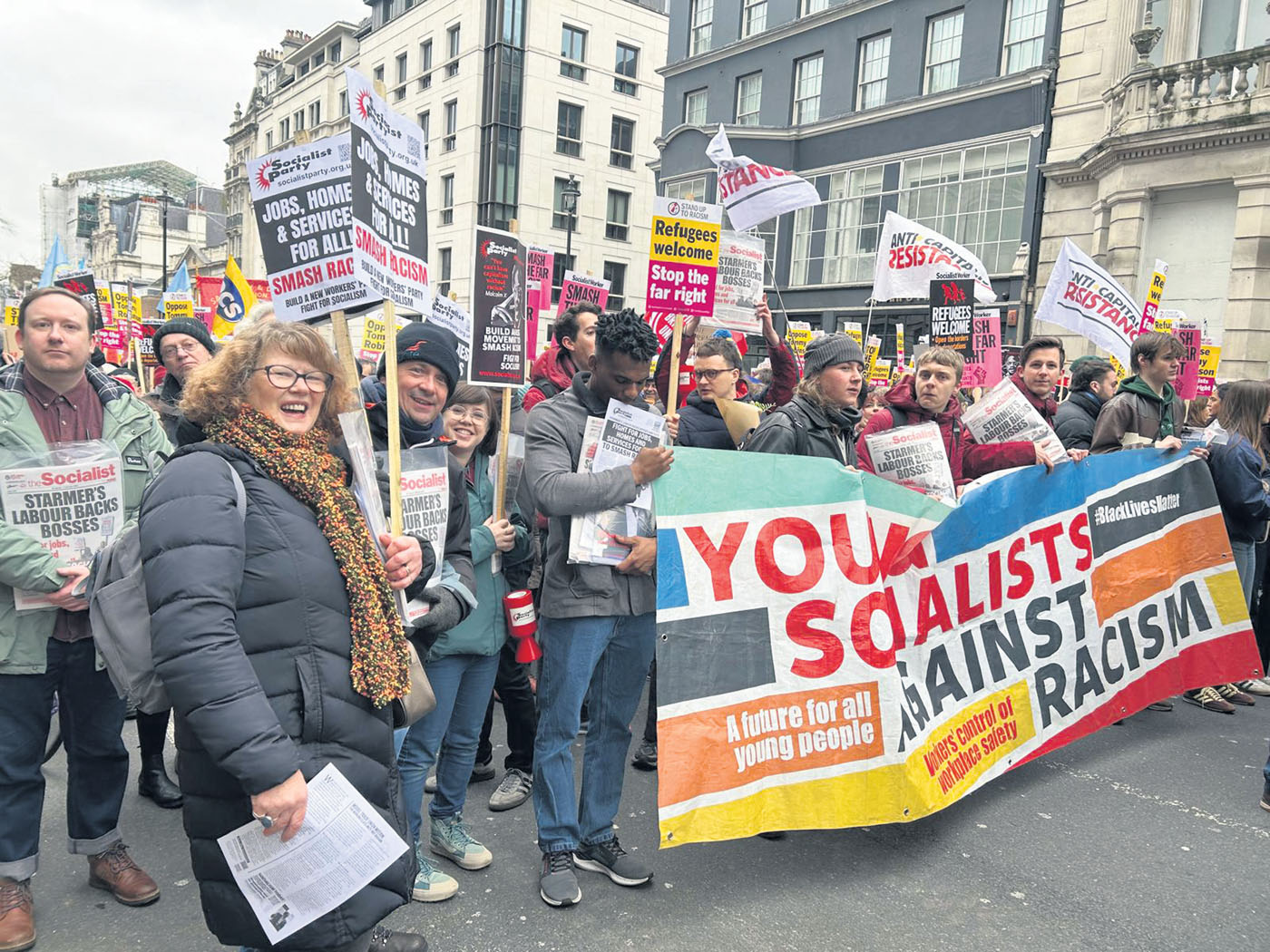
On 2 December, a new anti-far right alliance was announced: Together. “Together we can reject narratives of division and racism. Together we can build solidarity across communities.”

Together has announced a ‘Love, Hope and Unity’ demonstration on 28 March 2026, followed by leafleting in the May elections, “urging people to use their vote to stop Reform”.

The need to combat racism and the far right is urgent. Although recent polls have shown a small dip, Nigel Farage’s racist right-populist Reform UK is at around 25%. In the summer, over 100,000 people marched with far-right activist Tommy Robinson on a ‘Unite the Kingdom’ demonstration. Protests have taken place at asylum hotels around the country. There is a widespread fear among Black, Asian and migrant communities, and among many workers and activists, at the likelihood of gains for Reform in the May elections and the possibility of a future Farage-led government.

But the Socialist Party is clear: the politics and methods of ‘Together’ are not what is needed. . This new alliance was simultaneously announced on the websites of Stand Up To Racism (SUTR), unions including the University and College Union and Fire Brigades Union, and various other organisations, including the Socialist Workers’ Party (SWP) and Morning Star, the paper of the Communist Party of Britain. 

Signatories start with a long list of celebrities (34 at latest count). Then comes a list of over 40 politicians, including Jeremy Corbyn and Zarah Sultana of Your Party, Zack Polanski of the Green Party, and left Labour MPs such as John McDonnell and Richard Burgon. It also includes Starmer-supporter Stella Creasy.

Next the ‘organisations’ – the TUC (Trades Union Congress) and 24 trade unions are randomly mixed in with charities and campaigns such as Friends of the Earth.

Clearly a lot of discussion went on before this was launched. But it seems not among the over five million trade unionists represented by the union signatories – at least in some cases their lay elected leaderships were not even informed it was happening.

The Executive of the National Education Union (NEU), for example, was presented with a paper just the night before its meeting on 29 November. This paper informed the exec that “SUTR approached the NEU with the idea of trying to build a broader anti-far right organisation”; that a “series of meetings were convened from late October with a variety of unions, NGOs, campaign groups, political parties and politicians”; then a “planning day was held in mid-November where a draft campaign plan, including a set of aims and strategies, was drawn up, as was a founding statement.”

All behind the scenes, without the necessary discussion in the unions themselves about what aims and strategies are needed to combat the far right. The organised working class in the trade unions, the biggest organised force in society with the potential power to unite and mobilise millions of people, is sidelined behind celebrities and charities.

Continue reading

0

Your Party members told to stop waiting for orders from above, push democracy from the ground up

Canary Your Party members told to stop waiting for orders from above, push democracy from the ground up www.thecanary.co
preview

cross-posted from: hexbear.net/post/6952393

cross-posted from: news.abolish.capital/post/11947

A statement the Canary has seen from the Platform for a Democratic Party praises the democratic gains at last weekend’s Your Party conference, but calls on members ‘not to wait for instructions from above’. Speaking about the conference, it says: overall it was a success for socialists, despite many problems and even obstacles encountered by […]

By The Canary


From Canary via This RSS Feed.

0

Labour moves to criminalise protest to shield itself from dissent

Socialist Party Labour moves to criminalise protest to shield itself from dissent - Socialist Party www.socialistparty.org.uk
preview

The Labour government intends to create a new criminal offence targeting protesters who demonstrate outside the homes of public officials. This includes MPs, councillors, and others in positions of power. Under changes to the Crime and Policing Bill, anyone protesting outside a politician’s home with the aim of influencing policy could face up to six months in prison.

Labour’s leadership claims this is about ‘protecting democracy’ and making politicians feel safe. This is a calculated attempt to shield those in power from the anger of working people while continuing to push through austerity, war, and policies that harm our most vulnerable.

The Labour Party knows the consequences of its actions. It has maintained the two-child benefit cap. It backs and defends the Israeli state’s genocide in Gaza. It is preparing a budget under Rachel Reeves that will inflict deeper cuts to public services and living standards. They intend to make the working class foot the bill for capitalism’s failures.

People have taken their anger to the doorsteps of those responsible. Last year, Just Stop Oil placed children’s shoes outside Keir Starmer’s home and sang carols against the continuing polluting of the planet. It was peaceful and symbolic. The response from the political establishment is to criminalise it.

Threat?

Security Minister Dan Jarvis claims that protests outside MPs’ homes are “a threat to democracy.” What he calls a threat is the public holding power to account. Democracy is not politicians acting without scrutiny behind police lines. Democracy is the people making their voices heard in the places where decisions are made.

This law will not make politicians safer but it will make them less accountable. There are already laws against harassment. Labour is protecting itself from the consequences of its own betrayals.

Labour knows that anger is on the rise. It knows its policies will cause further backlash from the working class. So it is turning to repression. These are not the actions of a confident government. They are the actions of politicians who know they are governing against the interests of the majority of the country.

Labour is not a party of the working class. It’s not even pretending! If we want a party that fights for us, we must build it. Such a party would remove the undemocratic anti-protest laws from the books – including all the anti-trade union laws that are used to hinder workers fighting back.

0

Fight Labour austerity

Socialist Party Fight Labour austerity - Socialist Party www.socialistparty.org.uk
preview

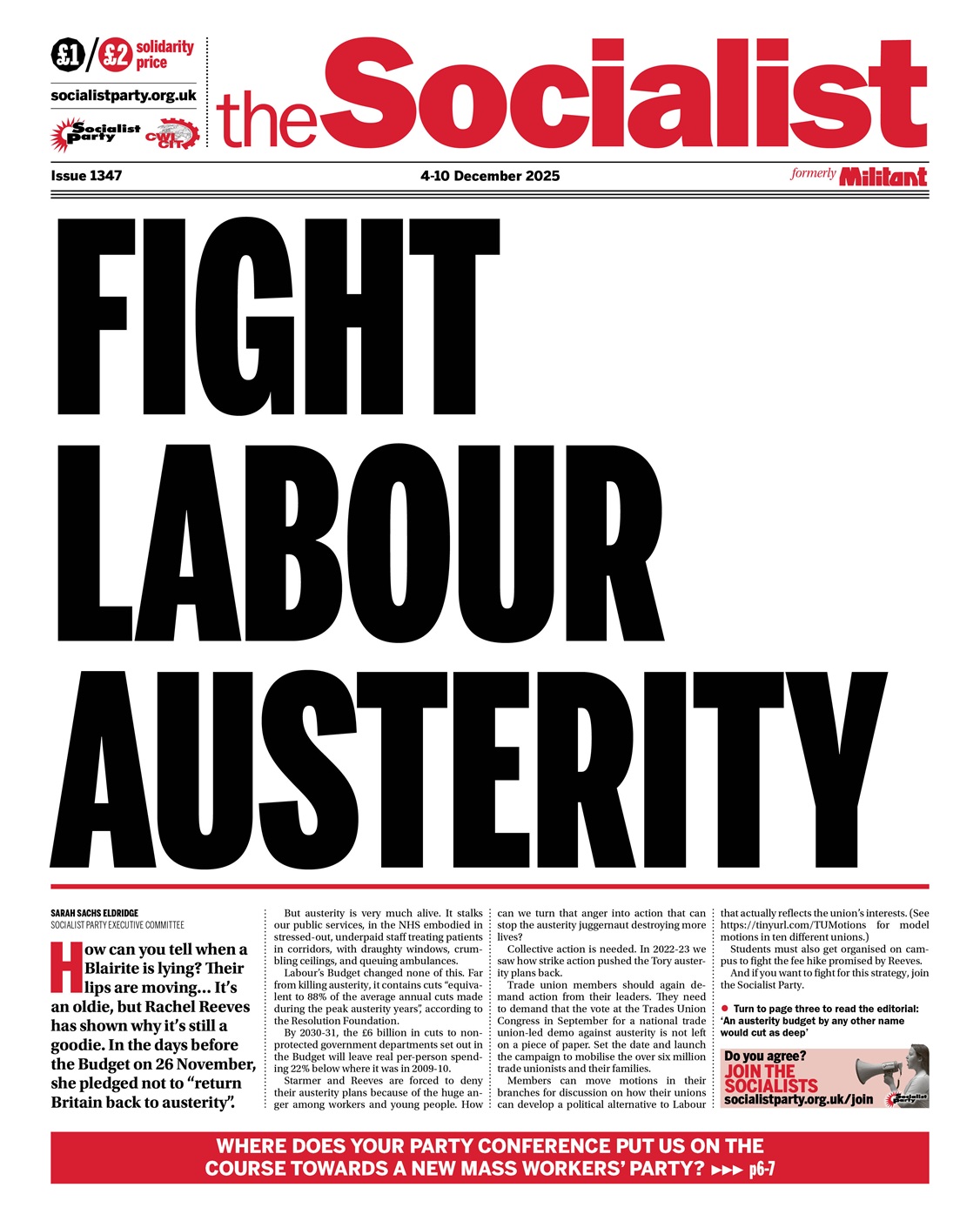
How can you tell when a Blairite is lying? Their lips are moving… It’s an oldie, but Rachel Reeves has shown why it’s still a goodie. In the days before the Budget on 26 November, she pledged not to “return Britain back to austerity”.

But austerity is very much alive. It stalks our public services, in the NHS embodied in stressed-out, underpaid staff treating patients in corridors, with draughty windows, crumbling ceilings, and queuing ambulances.

Labour’s Budget changed none of this. Far from killing austerity, it contains cuts “equivalent to 88% of the average annual cuts made during the peak austerity years”, according to the Resolution Foundation.

By 2030-31, the £6 billion in cuts to non-protected government departments set out in the Budget will leave real per-person spending 22% below where it was in 2009-10.

Starmer and Reeves are forced to deny their austerity plans because of the huge anger among workers and young people. How can we turn that anger into action that can stop the austerity juggernaut destroying more lives?

Collective action is needed. In 2022-23 we saw how strike action pushed the Tory austerity plans back.

Trade union members should again demand action from their leaders. They need to demand that the vote at the Trades Union Congress in September for a national trade union-led demo against austerity is not left on a piece of paper. Set the date and launch the campaign to mobilise the over six million trade unionists and their families.

Members can move motions in their branches for discussion on how their unions can develop a political alternative to Labour that actually reflects the union’s interests. (See tinyurl.com/TUMotions for model motions in ten different unions.)

Students must also get organised on campus to fight the fee hike promised by Reeves.

And if you want to fight for this strategy, join the Socialist Party.

0

Bring down our bills: Nationalise energy

Socialist Party Bring down our bills: Nationalise energy - Socialist Party www.socialistparty.org.uk
preview

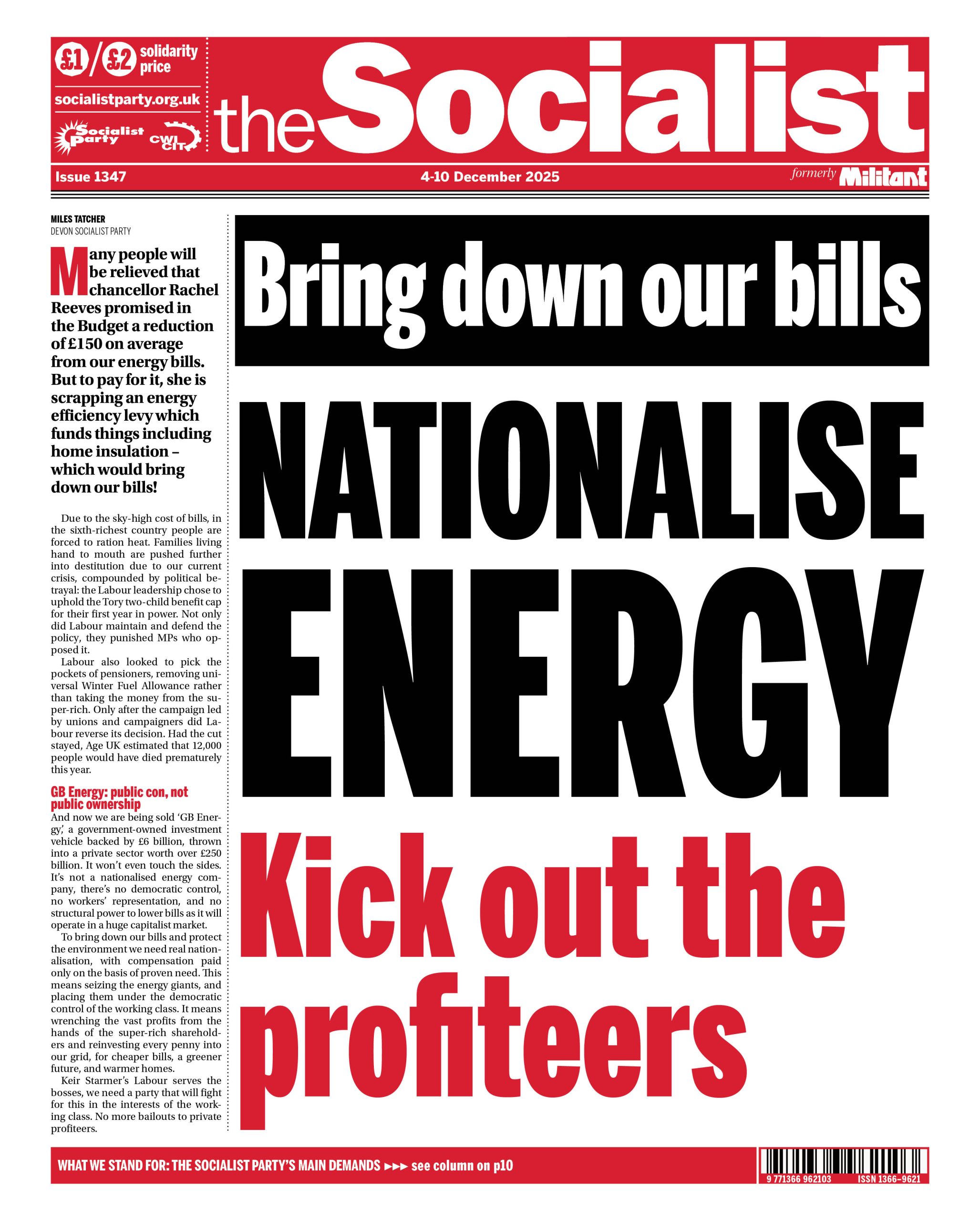
Kick out the profiteers

Many people will be relieved that chancellor Rachel Reeves promised in the Budget a reduction of £150 on average from our energy bills. But to pay for it, she is scrapping an energy efficiency levy which funds things including home insulation – which would bring down our bills!

Due to the sky-high cost of bills, in the sixth-richest country people are forced to ration heat. Families living hand to mouth are pushed further into destitution due to our current crisis, compounded by political betrayal: the Labour leadership chose to uphold the Tory two-child benefit cap for their first year in power. Not only did Labour maintain and defend the policy, they punished MPs who opposed it.

Labour also looked to pick the pockets of pensioners, removing universal Winter Fuel Allowance rather than taking the money from the super-rich. Only after the campaign led by unions and campaigners did Labour reverse its decision. Had the cut stayed, Age UK estimated that 12,000 people would have died prematurely this year.

GB Energy: public con, not public ownership

And now we are being sold ‘GB Energy’, a government-owned investment vehicle backed by £6 billion, thrown into a private sector worth over £250 billion. It won’t even touch the sides. It’s not a nationalised energy company, there’s no democratic control, no workers’ representation, and no structural power to lower bills as it will operate in a huge capitalist market.

To bring down our bills and protect the environment we need real nationalisation, with compensation paid only on the basis of proven need. This means seizing the energy giants, and placing them under the democratic control of the working class. It means wrenching the vast profits from the hands of the super-rich shareholders and reinvesting every penny into our grid, for cheaper bills, a greener future, and warmer homes.

Keir Starmer’s Labour serves the bosses, we need a party that will fight for this in the interests of the working class. No more bailouts to private profiteers.

0

Ⓐ the circle A at 60 (Freedom News) True/False & histories

preview

cross-posted from: https://hexbear.net/post/6934582

Came across this article because I was believing the Proudhon story, and trying to refresh my memory. But here I find it credibly disputed so I consider myself debunked.

Here is full text only in hopes it will be read, not because it is a reactionary site. Please have some love for comrades at Freedom News.

The circled A at 60 part one: Birth of a symbol

part 1: full text + images

> # The circled A at 60 part one: Birth of a symbol > > Art & Anarchy, Aug 23rd > > This story was first published 5 April 2024 [editor] > > We can thoroughly search all the archives, going back in time as far as possible and across all continents; however, reality is stubborn, and one fact remains unyielding: prior to April 1964, an A in a circle had never symbolised anarchy or anarchism. No poster, no graffiti, nor any trace whatsoever. This absence of evidence, however, does not conceal any mystery; rather, it simply reflects the straightforward fact that the circled A couldn’t exist before being conceived, which happened precisely in April 1964. > > As of April 2024, sixty years have passed since the circled A was publicly presented as a proposed symbol of anarchism. While documents attesting to its origin will endure for a long time, the opportunity to provide first-hand testimony is rapidly diminishing. Therefore, I see no reason to delay any longer the compilation and dissemination of this information, although Marianne Enckell and Amedeo Bertolo covered the essential aspects in an article from 2002, which will be included as the third installment in this series. > > The importance of specifying the origin of the A in a circle lies not so much in clarifying exactly where and by whom it was conceived, but rather in delimiting its meaning, as this explains its extraordinary dissemination. Nor is it about claiming for a clearly unwarranted paternity, because although the circled A was indeed introduced and proposed in April 1964, it only gained significance as a symbol through the collective efforts of thousands of anarchists worldwide, who adopted and incorporated it into various media, including walls, flags, banners, publications, and even tattoos. Consequently, the circled A has arguably become the most widespread political symbol in the world, epitomizing anarchism with unparalleled clarity. > > The symbol is undeniably the result of extensive collective work, but before becoming a symbol, the process of its creation was also collective. Although a specific person [the author, Tomás Ibáñez. Ed.] initiated the proposal, that is, the idea of creating a simple and easy-to-draw symbol that, devoid of ties to any specific anarchist group or organization, could increase the visibility of anarchism through its presence in all graphic expressions of the anarchist movement, the acceptance of this proposal within the group of young libertarians in Paris was the outcome of extensive discussions and, thus, collective endeavour. The pursuit of the most suitable design and the final selection were likewise communal activities. And although one single person was responsible for drawing it on a stencil, both the production of the carefully mimeographed bulletin in a companion’s flat and its distribution continued to be collective activities. > > Original circled A, by the Paris group of the Young Libertarians > > Furthermore, the intent behind recounting the circumstances which surround its genesis is twofold: to debunk fanciful tales circulating about its origins, and to reaffirm the concept of anarchism embodied by the circled A. From its inception, the aim was for the symbol to be owned by no one so it could belong to all. And indeed, the will to design a symbol that did not refer to any existing anarchist organisation, acronym, or collective was decisive in ensuring its place within the broader anarchist sphere. Its independence from any ownership meant it could be claimed by anyone who resonated with its ethos. > > Moreover, the circled A’s proposal aimed not to homogenize the diverse spectrum of anarchism but to celebrate its plurality while providing a shared reference point. It was necessary to ensure that what was common to all anarchist sensibilities could manifest itself without invocation of any centralising principle. We had to accept the dispersal of anarchist forms of organisation, but at the same time introduce a principle of confluence that would bring all these forms together. The circled A avoids any temptation to integrate anarchism under a single formula, ensuring that its diversity is reflected in the undifferentiated use of an icon that belongs equally to each of its streams and modalities. > > Like the definition of archipelagos, which are described as a collection of islands united by what separates them_,_ the circled A aimed to transform what separates the different streams of anarchism into a link between them, without erasing their specificity. The idea was to encourage a confederation of singularities united by a family resemblance and a common ground beneath the multiplicity of sensibilities and struggles. This recalls Gilles Deleuze’s beautiful phrase defining anarchy as “that strange singularity which can only be said of the multiple”. > > Additionally, the symbol’s resonance with local grassroots initiatives and spontaneity eschews the principle of representation since a circled A does not represent anarchism and cannot claim to do so. Unlike an official stamp, it does not authenticate anything because no one has the legitimacy to authorise its use. The fact that anyone can use this icon freely means that it escapes any principle of representation and refers only to the responsibility of the user. This perhaps explains why the form of this symbol has diversified considerably, especially thanks to the punk movement, expressing individual creativity without ever losing its powerful association with anarchism. > > One last consideration to place the origin of the circled A. Its creation happened in the context of intense militant activity in the 1960s to encourage the convergence of different sectors of anarchism. Thus, at the end of 1963, the Comité de Liaison des Jeunes Anarchistes (CLJA) and the Liaison des Étudiants Anarchistes (LEA) were created simultaneously in Paris. The CLJA did not claim to be a new anarchist organisation but simply a meeting point between members of different organisations, while the LEA brought together anarchist students belonging to various collectives. Transcending borders, this effort to bring together different fragments of anarchism culminated in a major European Meeting of Young Anarchists held in Paris in April 1966, with a very active presence of young libertarians from Milan, who adopted the circled A and widely spread it in Italy, bringing it out of the shadows where it had been kept by the lack of enthusiasm it had aroused, and thus projecting it onto the international scene. > > original proposal for the circled-A > > Here is a translation of the original April 1964 text: > > > … parallel to their work of non-formalist self-education, they aim to spread as widely as possible the fundamental ideas of anarchism.
> > The dissemination of issues related to libertarian emancipation requires the involvement of all individuals, the involvement of all individuals who advocate for an anarchist society as the sole path toward the complete realization of humanity.
> > Regardless of the different currents (philosophical nuances) or the different groups and organizations (practical nuances), no activist should object to any effort that contributes to the wider dissemination of propaganda, thereby enhancing its effectiveness and demonstrating the unity of Anarchism amidst its diverse conceptions and expressions.
> > Why do we propose this symbol that we PROPOSE TO THE ENTIRE ANARCHIST MOVEMENT and why this one in particular?
> > It stems from two primary motivations. Firstly, it aims to streamline and expedite the creation of wall inscriptions and posters. Secondly, it aims to enhance the visibility of the anarchist movement within society by incorporating a common element shared across all anarchist expressions in the public sphere.
> > Specifically, our objective was to minimize the time required to create wall inscriptions by avoiding the need to write a lengthy signature beneath our slogans. Additionally, we want to choice a symbol broad enough to be embraced and used by all anarchists.
> > We believe the proposed symbol best fulfils these criteria. By consistently pairing it with the term “anarchist,” it will trigger associations with anarchism in people’s minds (akin to the phenomenon of the Celtic cross linked with the Jeune Nation organization).
> > Moreover, this symbol serves a dual purpose for anarchist enhancement: firstly, by accelerating and facilitating the creation of anarchist messaging, and secondly, by appearing in graphic representations of the various anarchist groups, tendencies, and organizations.
> > By adopting the letter “A” (which bears no resemblance to JJLL), we aim to demonstrate our commitment to reciprocal solidarity and to pave the way for the widespread adoption of this efficient and practical approach.
> > Young Libertarians Paris Group > > ~ Tomás Ibáñez ___

The circled A at 60 part 2: True and false

part 2: full text + images

> # The circled A at 60: True and false > > Art & Anarchy, Apr 12th > > Read part 1 of this series here. > > Despite well-documented evidence of its origin, numerous fanciful speculations persist, including within anarchist circles and many libertarian historiographies that explore the symbol’s origin. It’s essential to clarify that we are concerned with the history of an anarchist symbol rather than a specific design. While representations of the letter A enclosed within a circle have certainly existed for centuries, they held no connection to anarchism. > > Here are a few true and false statements about the circled A. > > → The circled A has always part of anarchism: False > > The connection between the circled A symbol and anarchism is so deeply ingrained that for a significant period, it was believed they were inherently linked and had ancient origins. The lack of information surrounding its inception fostered a sense of mystery, perpetuating this misconception. > > A Rivista cover, Milan, 1971 > > → The circled A did not appear until April 1964: True > > It developed gradually as a symbol of anarchism, becoming widespread only from the 1970s onwards, starting in Italy. > > → The circled A was intended to evoke “order without power”, following Proudhon’s well known sentence: False > > This assertion suggests that the “A” of anarchy, symbolizing the absence of power, is enclosed within the “O” of order. However, this interpretation was never conceived by the young libertarians who sought to establish a symbol for anarchy. There is no connection between the circled A and Proudhon’s concept, nor with the notion of order, as evidenced by the diverse evolution of the circled A, particularly when it was revitalized by the punk movement, transcending the confines of a closed circle. > > AIT seal > > → The seal of the Federal Council of the International Workers Association of Spain depicted a circle A from 1870 onwards: False > > This seal, featuring a combination of a square and a plumb line, bears a closer resemblance to freemasonry than anarchism. At the time, the Spanish section of the IWA, despite being heavily influenced by Bakunin, did not explicitly identify as anarchist. Therefore, the seal did not intend to symbolize anarchism. > > → The circled A already appeared on the helmet of a militiaman during the Spanish Revolution: False > > Despite efforts to discern a circled A on the helmet, it’s challenging to interpret the depicted lines as forming the symbol. Even if a militiaman had indeed drawn a circled A on his helmet, it wouldn’t represent a symbol of anarchism, as the circled A was entirely absent from the Spanish Revolution. > > Durutti with a militiaman > > AOA symbol > > → The circled A appeared in the Bulletin of the Alliance Ouvrière Anarchiste (Anarchist Workers Alliance) as early as 1957: False > > What was featured in the bulletin of this small French-speaking anarchist organization was the acronym of AOA, with the letter “O” (for Ouvrière) enclosed within the letter “A” (for Alliance) and a second letter “A” (for Anarchist) inserted within the letter “O.” This contrasts sharply with the circled A which could only symbolize anarchy when detached from any specific organization. It wasn’t until June 1968, four years after its inception, that the circled A was utilized in the AOA bulletin. > > ~ Tomás Ibáñez ___

The circled A at 60 part three: The true story

Part 3: full text + images

# The circled A at 60 part three: The true story Features, Aug 28th Pic: An anarchist gathering in Sudan in 2022, prior to the outbreak of civil war The circled A is a symbol so widespread, so widely recognised and disseminated that it has come to be taken as a traditional symbol of anarchism, seeming to have existed forever. Some rumours trace its origin back to the Spanish Revolution: young anarchists are more accustomed to seeing a circled A than the clearly discernible target painted on a militiaman’s helmet as seen in a photo with Durruti. Some believe it refers to Proudhon, encapsulating his idea of Anarchy in Order. In fact, it is a recent phenomenon in libertarian iconography: the circled A was invented in Paris in 1964 and reinvented in Milan in 1966. Two dates, two birthplaces? Let’s take a closer look. — Read Part 1 and Part 2 of this series. — It was in April 1964, on the cover of the Jeunes Libertaires bulletin, that the Groupe JL de Paris drew the symbol it was proposing “to the whole anarchist movement” across the different currents, groups, and organisations_._ “It stems from two primary motivations. Firstly, it aims to streamline and expedite the creation of wall inscriptions and posters, and secondly, to enhance the visibility of the anarchist movement within society by incorporating a common element shared across all anarchist expressions in the public sphere. Specifically, our objective was to minimise the time required for creating wall inscriptions by avoiding the need for lengthy signatures beneath our slogans while also selecting a symbol broad enough to be embraced and utilised by all anarchists. We believe the proposed symbol best fulfils these criteria. By consistently pairing it with the term “anarchist,” it will trigger associations with anarchism in people’s minds”. The 1964 JL proposal had no success, except for some graffiti in the corridors of the Paris metro – let’s not forget that at that time, leaflets and newspapers were printed either on stencils (a fragile medium) or in conventional letterpress, so a lead plate showing an A in a circle would have been necessary. In December of the same year, the circled A appeared in the title of an article by Tomás [Ibañez] in the newspaper Action Libertaire. The Jeunes Libertaires network, which in the early sixties included several groups throughout France, had weakened: regional bulletins no longer appeared, and the Paris bulletin was inactive from 1965 to 1967. However, several “JL” would later be at the forefront of the May ’68 movement. End of the first chapter. The proposed symbol is a capital A inscribed in a circle; Tomás Ibañez (pictured) is the initiator, and René Darras is the designer. Where did the idea come from? From the simplicity of the design, from the already widespread anti-nuclear sign of the CND (Campaign for Nuclear Disarmament), or from other inspirations? The Alliance Ouvrière Anarchiste (Anarchists Workers Alliance) claims to have used it in its correspondence from the late 1950s, thus marking its initials AOA, but it did not appear in its bulletin L’Anarchie until June 1968. It wasn’t until 1966 that the circled A symbol was used experimentally, and then, in 1968, it was used regularly by the Gioventù libertaria of Milan, which maintained fraternal relations with the young Parisians. These two groups formed the European Liaison Committee of Young Anarchists (CLJA). It was then that the public life of the symbol began. The first time we saw it was in Milan, where it was used as the usual signature on leaflets and posters of young anarchists, sometimes in association with the anti-nuclear symbol and the apple of the Dutch Provos. It spread throughout Italy and then worldwide, but hardly any circled A was seen during the Paris May of 1968, with the first traces appearing only in 1972-73. During those years, the popularity of the circled A exploded and was appropriated and imitated by young anarchists worldwide. It was so successful that if its inventor had patented it, he’d be a billionaire today… Why this rapid and striking success? Basically, it was due to the same reasons for which the JL proposed the symbol: firstly, it’s extremely easy to draw, as simple as a cross or a star, simpler than the swastika or the sickle and hammer. Secondly, a new, young movement, in full development, had learned to write on walls and was seeking a recognisable symbol. That is how the circled A came to be adopted, without any organisation or group ever thinking to decree its use and in the absence of any other international graphic symbol for anarchists (who sometimes used outdated symbols, like the torch in Italy). So that’s the true story of the circled A, made of conscious will and spontaneity: a typically libertarian cocktail. Any other story is merely legend. ~ Amedeo Bertolo, Marianne Enckell — This story was first published in April 2023 [editor]. The documentation used in this series of texts is deposited at CSL-Archivio Pinelli (Milan) and CIRA (Lausanne). A first version of this article was published in 2001 in Bollettino Archivio Pinelli (via Rovetta 27, 20 170 Milano). This version appeared in 2002 in the CIRA bulletin no.58. ___

0

Zarah Sultana calls for ‘democratic control and ownership of banks and the arms industry’

Canary Zarah Sultana calls for 'democratic control and ownership of banks and the arms industry' www.thecanary.co
preview

cross-posted from: hexbear.net/post/6506690

cross-posted from: ibbit.at/post/88507

Speaking to the Canary at the weekend, Your Party’s Zarah Sultana didn’t just demand a platform of socialism and peace. She also insisted on democratising Britain’s banking system. That, she said, has to be part of Your Party’s plan to transform the economy into one that serves ordinary people rather than corporate profits.

She added that the political corruption surrounding the arms industry must end too. And the skills of the sector should be harnessed for social good instead:

Zarah Sultana calls for a democratic economy of peace and public service

Zarah Sultana asserted that:

Our party’s position must be in democratic control and ownership of banks, of the arms industry, so we can put those towards social good, not war and destruction. And, when it comes to banks in particular, redirect that money that is created by working-class people – that’s nurses, teachers, taxi drivers – into investments that promote the environment, that promote good jobs, that promote a well-funded public-service system.

Calling the current British establishment “a poodle to the US”, she stressed that:

Our arms industry has a very cosy relationship with this Labour government… [and] that cosy relationship has to be dismantled.

Your Party should also end Britain’s participation in NATO, she said. And that’s not just because it’s a tool for US interests that causes immense destruction. It’s also because:

Every penny that this Labour government spends on missiles, tanks and bombs is taken out of healthcare, housing, and our future and addressing the climate catastrophe

Party democracy and national democracy

Zarah Sultana told the Canary that Your Party’s communication strategy and membership system need to improve. She called the briefing of establishment gatekeepers like the Guardian “disappointing”. And she insisted that she wants Your Party to be:

more democratic than any other party

It should show “solidarity to our migrant – our refugee – communities” by opening membership up to them, for example. As she stressed:

We need to centre building a mass-movement party, mobilising everyone, having low barriers to entry. That means having an international section so people who are living abroad can get involved and become members, that involves lowering the age from 16 to 14, that means also allowing people who already have membership of another party to get involved. Because our job has to be to unify the left.

Regarding unity on the left, she stated very clearly that:

The goal in 2029 is going to be stopping Nigel Farage from getting the keys to Downing Street.

She asserted that there are differences between Your Party and Zack Polanski’s Green Party. “We are an explicitly socialist, anti-imperialist, anti-Zionist party”, she said, which favours severing “all diplomatic relations with the genocidal apartheid state of Israel”. (The Greens have long called out Israel’s genocide in Gaza, but their stance on ongoing diplomacy with Israel has come under scrutiny recently.)

Polanski, however, has favoured carefully moving the current Green position on NATO closer to Sultana’s. And he has called the Greens “an eco-populist and a socialist movement”, expressing his openness to cooperate with others on the left.

Zarah Sultana emphasised that “there’s enough space on the left for all of us” and that “electoral alliances have to be democratically voted upon by our respective memberships”. But she also insisted:

We will work together, unite to fight Farage and to fight fascism.

Featured image via the Canary

By Ed Sykes


From Canary via this RSS feed

0

Greens (UK) now just two points behind Labour as the Zack surge continues

Canary Greens now just two points behind Labour as the Zack surge continues www.thecanary.co
preview

cross-posted from: hexbear.net/post/6403463

cross-posted from: ibbit.at/post/79575

The Green Party is now just two points behind both Labour and the Conservatives, according to the latest polling from Find Out Now. With Zack Polanski, the party has surged four points in a week.

The stats on Zack as Green Party polling surges

Labour and the Conservatives are neck and neck on 17%, with the Greens on 15%. Reform still leads on 32%. But the Nigel Farage-led party has lost three points in the week since Find Out Now last polled.

The thing is, major polling agencies tend to underestimate potential left wing support. That’s because they deprioritise non voters, disenfranchised by the neoliberal system, who may well vote if they are inspired by a progressive campaign that speaks to their values.

The Green surge is unprecedented. 15% is the highest ever the the party has polled, according to Election Maps UK.

The polling increase as of Polanski’s election has come despite the corporate media continuing to sideline the Greens. Polanski was the only party leader that Laura Kuenssberg refused to interview on her Sunday politics show.

Membership surging too

The Greens have not just overtaken the Lib Dems in polling (the corporate party is on 12%, according to Find Out Now). They have also outdone the Lib Dems in terms of membership.

The Lib Dems have 83,174 members, while the Greens now have 95,000 – gaining 5,000 members in a day this week. On top of that, the Greens have 30,000 more members than they did at the time of their recent leadership election, an increase of almost 50%.

This reflects the fact that the 2010 Conservative/ Lib Dem coalition showed the Lib Dems are essentially a neoliberal copy of what the two main parties have become.

Greens had historic 2024 election

The 2024 election results are a strong basis for the Green Party to build on. Not only did they receive four MPs, but the Greens came second in 40 seats in 2024. Further, they got over 10% of the vote in 108 seats, which is a huge increase from 18 seats in 2015. They also got over 20% of the vote in 15 seats, a significant increase on just two in 2015.

Featured image via the Canary

By James Wright


From Canary via this RSS feed

0

Greens become first UK party to acknowledge IDF as terrorist organisation

Canary Greens become first UK party to acknowledge IDF as terrorist organisation www.thecanary.co
preview

cross-posted from: hexbear.net/post/6380342

cross-posted from: ibbit.at/post/77471

The Green party of England and Wales, at its conference last week, passed a landmark – and long overdue – motion backed by the Greens’ new, Jewish party leader Zack Polanski demanding the proscription, or banning as a terrorist group, of the so-called ‘Israel Defence Forces’ (IDF), in reality an arm of the terror state occupying Palestine, as well as calling for an apology by the UK to the Palestinian people for the ‘Balfour Declaration’ that paved the way for the theft of their land to create Israel as an ethnostate.

The Green Party: IDF are terrorists

It is the first time a UK political party has named the IDF as a terror group, despite the Israeli regime’s genocide and endless crimes against the Palestinians for the past two years and for decades before that.

The motion calls for:

The Israeli military (IDF) to be banned under UK counter-terrorism law, so that participation in or praise of its operations could be criminalised;A formal apology from the British government to the people of Palestine for the Balfour Declaration;An immediate cease of Israeli military operations in Gaza, a withdrawal of forces, and the guarantee of humanitarian access – food, water, medical supplies – to civilians;Support for the International Criminal Court’s case of genocide, and a full arms embargo on Israel;The end of British training, intelligence sharing, and spy-plane flights over Palestinian territory;Use of British shipping resources to deliver aid to Gaza and the West Bank;Deployment of a UN peacekeeping force into Gaza and the West Bank to protect Palestinian lives.

Under the Starmer regime’s ‘lawfare’ war on UK citizens’ free speech and protest rights, to protect Israel from action and scrutiny, the UK state has been misusing proscription against non-violent anti-genocide activists, leading to the arrests of thousands of peaceful protesters demonstrating against the proscription, which is normally applied to violent groups such as ISIS and al Qaeda.

Meanwhile…

Despite those two groups appearing in the government’s list of proscribed groups and the new Syrian regime’s strong links to both, the UK military – along with those of the US and Israel – was repeatedly deployed to assist the terrorists against the previous Syrian government, as well as continuing to provide intel and military support to the Israeli occupation in its slaughter of almost 700,000 civilians in Gaza. Starmer has also invited the new regime’s president, a former senior member of both terror groups, to visit the UK.

There is, of course, zero chance of the Starmer government classifying the IDF – and therefore itself for aiding it – as terrorists, or of either Reform or the Tories, both strongly Zionist, doing so either. All the more reason to do everything to ensure a Green/Your Party coalition is in government after the next general election.

Featured image via the Canary

By Skwawkbox


From Canary via this RSS feed

0

The Green Party (UK) just voted to discuss abolishing landlords for good

Canary The Green Party just voted to discuss abolishing landlords for good www.thecanary.co
preview

cross-posted from: hexbear.net/post/6350172

cross-posted from: ibbit.at/post/74169

The Green Party has voted to put forward a motion entitled “Abolish Landlords” at its conference in Bournemouth. The policy moves towards ending landlordism through taking legal steps to reduce the number of private landlords and increase the amount of social housing.

The problem with state landlordism replacing private

However, it does fail to acknowledge the issue with state landlordism. Social housing is still a form of rental income and could be considered a hefty tax on housing. That’s because social rental payments do not currently contribute to home ownership for the social tenant.

‘Right to buy’ does provide discounted home ownership for social tenants. But the neoliberal context that the ruling class delivered it within meant that social housing was depleted and not replaced. In fact, the policy means that private landlords rent out 41% of former council homes sold under right to buy.

But the Green Party’s answer to abolish right to buy leaves low income people trapped renting from the state for life. State landlordism is only better in comparison to private landlordism. It’s still extracting money from low income people who already pay council tax. Remove it from the context of private landlordism, and it’s essentially a regressive policy – an additional high housing tax on low income people who can’t afford to buy their own home. Instead, monthly payments to the state should pay towards ownership of the house on a cost-price basis.

“A vehicle for wealth extraction”

The Green Party motion was otherwise cutting:

The Private Rental Sector has failed, it is a vehicle for wealth extraction, funnelling money from Renters to the Landlord Class. This motion makes it clear Green Party policy is to seek the effective abolition of Private Landlordism.

The motion hit the nail on the head when it comes to the nature of rent:

The Green Party believes that secure, affordable Housing is a Human Right, and that a core goal for a Green Government and Green MPs is to create a fairer housing market.

The Green Party believes the existence of Private Landlords adds no positive value to the economy or society, that the relationship between Landlord and Tenant is inherently and intrinsically extractive and exploitative. That the Private Rented Sector exists to transfer wealth from the working classes to Landlords.

The Green Party believes that the Private Sector has fundamentally failed, and is continuing to fail to provide secure and affordable housing fit for working people.

To move towards abolishing landlords, the Green Party would introduce rent controls. They would also put the tenant in charge of when the tenancy ends, introduce new taxes for landlords, and end buy to let mortgages. A further step that would encourage home ownership and significantly discourage private landlordism is that the Greens would enable tenants first Right to Buy from their private landlord. And all the rent they’ve already paid would be discounted from the price. One issue with this is that it still appeals to the market value of housing-as-an-asset, rather than popping the housing bubble altogether.

The Green motion also said that social housing should be built on a “massive scale”.

“Zacktivism”

Predictably, the Daily Mail sided with the leeching landlord class, lamenting “a bizarre assault on millions of Brits” (landlords), essentially reversing reality given rent is free money taken from the largely working class.

The Green Party conference is the first since Zack Polanski became its ‘eco populist’ leader. And with motions like the abolishment of landlords passing, bring it on. The overall housing policy just needs some fine tuning.

Featured image via Unsplash/Tierra Mallorca

By James Wright


From Canary via this RSS feed

0

Why Everything Is Suddenly So "Extreme"

play · youtube.com
YouTube Why Everything Is Suddenly So "Extreme" www.youtube.com
preview

cross-posted from: lemmygrad.ml/post/9251243

Bad video from How Money Works; says that poverty is down across the world but that’s just not true, only in Asia. I agree the news is sensationalist, but the person uses slides for leaders such as Putin and Xi Jinping when it comes to saying that “These leaders have nothing to lose when they leave the Earth” but what about the Western leaders?

Very poor video. Doesn’t mention the two genocides happening in Gaza and Papau New Guinea. Or the other ethnic cleansings.

0

Students walking out against Trump: As it happens - Socialist Party

Socialist Party Students walking out against Trump: As it happens - Socialist Party www.socialistparty.org.uk
preview

As people in Gaza starve to death, and thousands are massacred just queuing for food, Donald Trump is visiting the UK, invited by Keir Starmer, to feast on a luxury banquet with the King.

Socialist Students is helping to organise walkouts at schools, colleges and universities. Socialist Students is sending a message to Trump and Starmer: We won’t stand for your capitalist system which awards privileges to the warmongers and profits to the super-rich while creating wars, climate catastrophe, racism and poverty for the rest of us.

This is our chance to fight back. Let’s get organised for a real future. For a socialist world free from war, poverty and oppression

0

Writing a lead off on Corbyn Sultana 'Your Party'

preview

I’m proud to have written this only using AI for spell check and punctuation (Dyslexia). and I wanted to share to lemmy for input.

Hello friends, comrades, and working-class heroes,

I am here with the Socialist Party, we for many years, have been putting a demand for a new political party, a party that will tear the unions from Labour, build a solid program for working class people. And over the years we have seen glimpses and wipers of what might be that political party, but none seemed as tangible as ‘Your Party’. ‘There are decades where nothing happens; and there are weeks where decades happen’ we are from what it seems, in those weeks of decades.

The working class – once the backbone of the Labour Party and the greater labour movement – has been let down countless times. We were repressed by the Tories, and then kicked into the gutter and left to rot by Labour, our so-called “progressive” party.

Winter fuel payments that help our elderly? Slashed. The two-child benefit cap, forcing families to choose between food and heating? Upheld. Palestine Action, smeared as a terrorist organization – it’s now a prisonable crime to speak out against genocide. This is all just from this year. And just like the Tories did before, the burden is laid upon our backs. The working class will pay, not the rich.

So this year, under our current government and its absolute failure, many of us saw a bleak future under a Reform UK government – a party that deflects from the billionaires to attack our poorest and most vulnerable: refugees, the disabled, people on welfare. The issue isn’t that our billionaire class doesn’t pay taxes; it’s that they’ve made sure our poorest do. If you’re in this room, you know this is true. The rich have been picking our pockets for years, and a party for the billionaires will never change that.

A few years back, I donated money to the Labour Party. It wasn’t much, but for someone living hand-to-mouth, that money could have been a meal, or heating. I genuinely believed my donation would make a difference. If I did it, maybe others would too. I saw the system as dire, and I thought it was up to us to change it.

Looking at Labour now. I could have bought a nice meal had I known better. A single energy company put my donation to shame with a cheque for one and a half million pounds. Unision, gave the largest donation from any union, and it was far less than that energy company. So who does Labour speak for? For us and the unions? No. For the ones who write the biggest cheques.

And that brings me to why we are here. The new party led by Corbyn and Sultana isn’t yet built. It doesn’t even have a name. It’s an embryo – fragile and still finding its shape. But that is exactly why this matters. For the first time in a long time, we, the working class, have the opportunity to write history, and we can write it in our favour.

But here is the most critical question: how do we make sure this new party stays our party? It will be under immediate attack from big business lobbyists and careerists, all trying to steer it for their own class interests.

This will be our battle.

The Labour Party of old, before it became the manager of capital, was federalized. The unions took a leading role in guiding the party down a road that fought for the working class. Then Thatcher came – the “Iron Lady” to some, I prefer Maggie – and New Labour adopted a ‘One Member, One Vote’ structure. On its face, it sounds democratic. But unless every single one of the 800,000 people who’ve signed up to this new party lives and breathes politics, voting on every motion and item, it won’t be a real democracy. We have lives! We have work, families, households to run. This low participation creates a vacuum. And into that vacuum step the press barons, the lobbyists, the big money donors who can afford to shape policy and select candidates behind closed doors. It becomes a democracy for the wealthy few, not the working many.

So we need a structure built for the working class. We need federalism.

It’s not just jargon. Or a throw away word. It means the party isn’t just a list of individual members. It’s a federation of members and affiliated organizations – trade unions, anti-war groups, welfare groups, the list is endless! And the votes these groups get are proportional to their membership. What does this mean in practice?

  • It gives permanent, institutional power to the working class. A union votes on behalf of its hundreds of thousands of members. This is how our collective voice remains loud and clear. It’s collective bargaining on the political level.

  • It politicalises the unions and unionises our politics. It forces our unions to take an active, political stance on workers’ issues. We, the members, elect our delegates, discuss the party’s agenda, and then those delegates argue and vote on our behalf. They are accountable to us. This brings the shop floor right into the heart of Westminster.

  • Federalism is a bottom-up democracy. It doesn’t depend on every single member being a full-time activist. It allows us to organize where we already are: in our workplaces, in our tenant unions, in our community groups.

I hope this has cleared it up. Federalism isn’t about exclusion; it’s about inclusion. It ensures we all have a seat at the table, no matter how busy our lives are. It’s about the working class finally wielding its collective power. And we believe the way to get there is through federalism. It is the guarantee that this new party won’t drift, like Labour did, into the arms of the capitalists. So let’s be clear: this new party will only be our party if we play an active role in shaping it. We must first fight for this party, before this party can ever fight for us.

To elaborate on the Socialist Party’s involvement in this new party, we see the trade union movement as one of the leading tools in bettering our lives, the lives of working people: fair wages, cheap housing, healthcare, childcare. All these things have been deeply rooted in trade union activism and the greater working masses. Ever since Labour’s seismic shift rightward and the defanging of trade unions through one member, one vote, we have lost that edge. So we are taking a principled position on how this new party needs to structure itself. Again, we must first fight for this party before this party can ever fight for us.

Many of our members are in the trade unions. We stood with the GMB outside job centres last year; we stood with Unison outside Plymouth Hospital and the RMT. We report on their actions in our paper, as well as their victories and defeats. And while our battle had been for the new party, our new battle is now the shape of the new party and the program of the new party, all of which can build a party that will fight for us.

Thank you for your time, comrades. I want this to be an open and healthy discussion. What will this party mean to you? How will we shape it? And let’s hear potential negatives too—this is an open discussion. And if you agree with what’s been said here today, then get involved. Think about joining the Socialist Party, buy a paper, and if you aren’t already—join a union! Let’s get to work.

0

Zarah Sultana Interview 17 August 2025. Your Party

Sidecar Zarah Sultana, The Alternative — Sidecar newleftreview.org
preview
Content of the interview

___ > Zarah Sultana is among Britain’s most prominent socialist leaders. Born in Birmingham in 1993, she became politically active in the student movement and later in the upsurge of Corbynism: serving on the national executive of Young Labour, working as a community organiser for the party and eventually running for parliament, where she now represents Coventry South. Her election coincided with the beginning of Keir Starmer’s Labour leadership, which she has long excoriated for its reactionary outlook and petty authoritarianism. Over the past year her profile has increased significantly thanks to her trenchant opposition to the Starmer government’s complicity in the Gaza genocide. Her dissent led to her suspension from the parliamentary party, and since then she has become a standard-bearer for the nascent left alternative: one of the youngest and most popular figures involved in its formation. Sultana has proposed co-leading the new party alongside Corbyn, and is part of a group working on the founding conference this autumn. > For the third instalment in this Sidecar series, Oliver Eagleton spoke to Sultana about the new left party: why it is necessary, what kind of democratic structures it should have, its parliamentary and extra-parliamentary aims, its response to the far right, the case for co-leadership, and how the conference should be organised. ___ Oliver Eagleton:
> Let’s start with your political trajectory and relationship with the Labour Party. How has it evolved over time? What brought you to the decision to leave earlier this year? Do you think others on the so-called ‘Labour left’ will follow you? ___ Zarah Sultana:
> I was formed politically by the War on Terror and the aftermath of the financial crisis. The first time I engaged with parliamentary politics was when the coalition government launched a direct attack on my generation by tripling tuition fees; I was part of the first cohort who had to pay £9,000 per year for higher education. I decided to join Labour at the age of seventeen, because at that time it seemed like there was no other party that could act as a vehicle for change. I never thought it was perfect. My local branch in the West Midlands was controlled by older men who didn’t want young people – especially not young left-wing women – to be involved. When I went to study at Birmingham in 2012, the Labour clubs and societies did nothing other than host talks by right-wing MPs, so I had to find other political outlets. > In my first week of university my dad and I joined a delegation of Labour councillors and activists who went on a trip to the occupied West Bank, and it changed the way I saw myself. I had never previously thought of myself as privileged, but I realised that because of the sheer accident of where I was born and what passport I held, I was treated differently by the Israeli authorities. I watched as they harassed and abused Palestinians and then related to me as a regular human being. I went to Hebron and saw the Jewish-only roads, the communities who were coming under daily attack from settlers and soldiers. All this was hard to fathom. But it was even more confounding that we – our country, our society – were allowing this to happen. So that ignited an internationalism in me: a deep opposition to imperial power, apartheid, settler colonialism and military occupation. > Then when I got involved in the National Union of Students I realised that I wasn’t the only one who felt this way. That’s a really magical moment, when you discover that you’re not alone in your politics. I started campaigning on issues like free education, maintenance grants, anti-racism, housing, Boycott, Divestment and Sanctions. It was only after I graduated, though, that I learned just how broken our social contract was. I really struggled to find work. I would go to the Jobcentre, look through my CV and wonder why, despite my degree and my experience, I didn’t have a place in this economy. And of course I was also saddled with £50,000 worth of debt. > When Jeremy won the Labour leadership election in 2015, my immediate thought was, ‘Oh my god, here is a national political operation that doesn’t hate young people!’ So I threw all my energy into the party’s youth wing. I had already seen Jeremy speaking about the issues that were most important to me – at protests, events, picket lines – which naturally made Labour seem like somewhere I belonged. He set up a Community Organising Unit, with the aim of developing a different type of politics rooted in people’s material concerns, and I went to work for it, which allowed me to organise in my home region: areas like Halesowen, Wolverhampton and Stourbridge, all of which had voted for Brexit. We campaigned on local issues, ran trainings, identified leaders and built community power. From there I had the opportunity to run in the European elections and then in the general election of 2019, which is how I became an MP. > But today we have a very different kind of Labour Party: one that is pursuing austerity, watering down bills on workers’ rights, and actively supporting genocide. I spent months pushing the Starmer government to consider popular policies like taxes on the super-rich, nationalisation of utilities and universal free school meals. I also fought against some of its worst excesses, such as keeping the two-child benefit cap, cutting winter fuel payments and disability benefits, and selling arms to the Israeli war machine. As a result, I was among the group of MPs who had the whip removed last year. When I last spoke to the party’s Chief Whip, he insinuated that I was never going to be readmitted because I had criticised their complicity in Israel’s war crimes. But, contrary to some false reports, they were never going to expel me from the parliamentary party; they were planning on keeping me in permanent limbo. I stood my ground. I told the Chief Whip that the genocide in Palestine was a litmus test – not just for me, but for millions of people across the country – and that it was far more important to me than my political career. > So leaving the party has long been a matter of when, not if. But it was important for me to leave on my own terms, otherwise you give the leadership the ability to control the narrative. I chose to do so on a salient week, when the government decided to target disability benefits and to proscribe Palestine Action. There could be no clearer reflection of where Labour has ended up. Here is a party that wants to impose cuts on some of the most marginalised people in our society in order to please investors. Here is a party that, for the first time in British history, is criminalising a non-violent activist group, using the most repressive parts of the state to protect the profit margins of arms manufacturers. If these aren’t red lines for you, then frankly you don’t have any. > The Labour Party is dead. It has destroyed its principles and its popularity. Some Labour MPs who consider themselves on the left are still clinging to its corpse. They say that by staying in they’ll be able to retain their political influence. My response is simple: you haven’t been able to stop disability cuts, you haven’t been able to stop the flow of arms to a genocidal apartheid state, so where is this influence you’re talking about? There’s no point standing around waiting for a change of leadership while people are dying – not just in Gaza, but also from the poverty in this country. Time to get out, build something new, and invite everyone to join. ___ OE:
> For many people of our generation, Corbynism set a paradigm for radical politics. Considering the historical gulf between 2015 and 2025, though, how should we adapt it to the present? ___ ZS:
> I think we’re in a very different political moment. We have to build on the strengths of Corbynism – its energy, mass appeal and bold policy platform – and we also have to recognise its limitations. It capitulated to the IHRA definition of antisemitism, which famously equates it with anti-Zionism, and which even its lead author Kenneth Stern has now publicly criticised. It triangulated on Brexit, which alienated huge numbers of voters. It abandoned mandatory reselection of MPs for the trigger ballot compromise, keeping many of the party’s undemocratic structures in place. It didn’t make a real effort to channel its mass membership into the labour movement or tenants unions, which would have enriched the party’s social base. When it came under attack from the state and the media, it should have fought back, recognising that these are our class enemies. But instead it was frightened and far too conciliatory. This was a serious mistake. If we’re contesting state power, we’re going to face a major backlash, and we need to have the institutional resilience to withstand it. You cannot give these people an inch. > Between 2015 and 2019 I had friends and colleagues who worked at the top of the Labour Party, and they can tell you that in parts it was a highly dysfunctional working environment with toxicity and bullying – not from Jeremy, but from some people around him. Power was too centralised. This is not what we need for this emerging project. We now have a younger generation that is highly politicised due to the establishment’s disastrous policies on housing, education, employment and war. They are going to demand a seat at the table and the ability to wield actual power, and rightfully so. My vision for the new party is about that kind of active participation, because that’s how I got into politics myself: not by the traditional route of running as a councillor, but through social movements. Everyone has to feel that they’re involved and the organisation has to be representative of wider society. That also means we can’t soft-pedal our anti-racism. Some people want us to focus solely on the ‘economic issues’. But if the politics of class is detached from the politics of race then it is bound to fail – because when our neighbours are being simultaneously targeted for eviction and deportation, that struggle is one and the same. ___ OE: > You’re right that any left project that draws an illusory dividing line between race and class will end up dividing its base, while also degenerating politically. But I also want to ask about how the party should position itself vis-a-vis Reform. Some of its messaging so far has emphasised stopping the far right and beating Farage. I think we can all agree on the necessity of that. But is there a danger that by presenting itself as primarily an anti-fascist party it could divert attention from the government as our principal adversary, or even legitimise Labour as part of some kind of popular front?
___ ZS: > I don’t think you have to choose whether to focus on Reform or Labour. You can oppose Farage and spell out what he would do to the country, and you can also attack the government for acting as Reform-lite. Remember that quote by Sivanandan, ‘What Enoch Powell says today, the Conservative Party says tomorrow, and the Labour Party legislates on the day after.’ Unless we challenge this Powellite politics wherever it rears its head, we’re doing a disservice to the people we want to represent. It’s true that we can’t treat the rise of racist nationalism as simply a moral issue; we have to address its structural causes: the way it feeds off the anger and despair in areas that have been devastated by the Westminster consensus. But the right does not have a monopoly on this anger. I’m angry too. We should all be angry when we think about what’s happened to these working-class communities, and we should harness those feelings to make a very clear argument – that the problem is not migrant labour but exploitative landlords, greedy energy companies, privatised services. We don’t have to patronise people and tell them their frustrations are wrong, nor do we have to pander to any kind of nativism. We can be confident in our politics and communicate it through local campaigns and persuasive conversations. > This is a long process; it takes months and even years, especially in places where these arguments aren’t familiar to most people. But there are ways to make them cut through. One is to talk about the kind of society we actually want, and to describe it in detail rather than just sloganeering. What are our long-term goals? More time with our loved ones, more green space, universal childcare, free public transport, not worrying about bills. These are things that Farage and Starmer don’t talk about, so that allows us to contrast our positive vision with their wholly negative one. And then there is always the question: how are we going to pay for this? Well, we can put an end to massive military overspending; we can tax the oil and gas companies; we can reverse the redistribution of wealth from the public to the private sector that has accelerated since Covid. We should pledge to fund free public transport instead of funding forever wars. These are policies that make sense to people. We need to argue for them as aggressively as the right argues for theirs. ___ OE:
> That’s a good description of the long-term horizon. What are shorter-term aims of the project? ___ ZS:
> We’re still at an embryonic stage, but then again we’ve already got more than 700,000 people who have shown interest, so our job at this moment should be to focus on activating our base and articulating who we are – which, incidentally, is why I believe we should call ourselves ‘The Left’, because it’s an unapologetic expression of what we stand for. At the same time we need to be recruiting from across the country, in areas that don’t have the same levels of political activity that London does. We’ve seen a huge amount of interest in the North West and the North East, which is very exciting, and of course I’d like to see more people involved in the West Midlands. My view is that there should also be a high degree of autonomy for Scotland and Wales. A lot of unofficial local groups have also been springing up since we announced the party, but we will be formalising our structures at the upcoming conference. The overall party structure has to be unitary, otherwise it won’t be a cohesive project that unites the existing spectrum of movements and struggles. A federation will not be as able to galvanise people or go on the offensive; it could end up being little more than a loose collection of different groups rather than a powerful, united bloc. > In order to establish all this we need to have a fully democratic conference. This relies on a few different things. First, it can’t be led by just MPs. Right now there are six of us MPs in the Independent Alliance, five of whom are men. This shouldn’t be what our party looks like going forward, so the committee that’s organising the conference should be gender balanced as well as racially and regionally diverse, all with an equal stake and voting rights. Anything less would be a boys’ club. Second, those who participate in our inaugural conference have to take part meaningfully, and that can only mean One Member One Vote. There should be an accessible venue, as well as a hybrid aspect with low barriers to entry. We should be striving for mass participation, as opposed to a narrow delegate structure which could be unrepresentative of our base. And finally, we should have a genuine forum for debate and discussion, not a situation where decisions are made by an executive team and rubber stamped by everyone else. > All this is vital, because unless we have the right internal democratic processes from the outset it will be much more difficult for the party to act as a catalyst for any broader form of democratisation; whereas if we organise an open and pluralistic conference, we will have already broken the conventions of British politics, which is a first step on the road to reshaping them. We can then establish not only a platform that speaks to people’s everyday concerns, but also a major campaigning presence across the country. We don’t just want electoralism – we want a project that’s tied in to tenants unions, labour organising, the fight to defend the NHS from privatisation and the Palestine solidarity movement. > To campaign effectively on all these fronts we need to make a clear set of demands. Think of Zohran Mamdani in New York; even many of us here in Britain know what his main pledges are. He has expressed them so that everyone can understand them, and they resonate on a level far deeper than most political discourse. If we start to do this then we’ll realise we don’t have to be beholden to the archaic traditions of Westminster, which are designed to make politics exclusionary. ___ OE:
> One of the issues we’ve discussed in this series so far is the balance between popular and parliamentary power. Some have argued that the new party should be a lever for popular mobilisation, whose main role is to strengthen or create working-class institutions as a prerequisite for future electoral campaigns. Others say that the priority is to create a prominent parliamentary bloc that can make effective interventions and win elections – which, in turn, will have a spontaneously energising effect on working-class civic life. Where do you stand in this debate? ___ ZS:
> It’s a false binary. I see my job in Westminster as a bridge between social movements, trade unions and parliament. The progressive laws that we now take for granted – workers’ protections, maternity leave, the weekend, even the right to vote – only came about because MPs were forced to respond to wider pressures. The struggles that forced these concessions often get erased from history. Today we see Labour MPs showing support for ‘women’s rights’ by wearing suffragette sashes while at the same time voting to proscribe Palestine Action. We shouldn’t follow their lead by acting as if there’s some necessary gulf between the realms of popular and parliamentary power. A party that only cares about elections will be irrelevant outside of an election cycle. And a party that ignores parliament will create a vacuum that will inevitably be taken up by the far right. > What I want – and I struggle to see how a successful left party could be set up in any other way – is a campaigning, social-movement orientation combined with a robust parliamentary presence: a situation where our MPs are on the frontlines of strike actions and anti-fascist mobilisations. If you focus entirely on parliament rather than building wider capacity, that’s a very short-termist approach, because what happens when those MPs are attacked by the establishment? What happens if they lose their seats or they retire? You need to build the social infrastructure that will support them in office and identify new leaders to replace them. It’s that kind of community power that sustains socialist politicians and holds them to account. Without that, you either get capitulation, or you get a left that’s dominated by a few figureheads at the top, which makes it formally indistinguishable from every other party. > The thing is, people recognise when politicians are inauthentic, when they have no connection to a popular base. They see through it immediately. Whereas when you’re the kind of politician like Jeremy or John McDonnell or Diane Abbott, whose authority is deeply rooted in community struggles, you have a very distinct profile, and you can make much more meaningful gains. ___ OE:
> When it comes to certain strategic decisions, however, there might be some binary choices. For example, should the party set up its own community organising unit, like the one you used to work for, or should it leave community organising to the communities? ___ ZS:
> In theory, I love the idea of having mass community organising as part of the DNA of the party. There are people who are already doing the everyday work of making sure that no one in their community goes hungry, or that the far right cannot attack asylum hotels. The new party should be finding those people – who don’t necessarily fit the traditional notions of a political leader – and getting them involved, asking them to shape the organisation, cultivating them for positions of authority. But should this take the form of a community organising unit such as we had in the Labour Party? Here I think there are certain limitations. In my experience, the COU didn’t always get the victories that it deserved, partly because when this kind of community work is attached to a party it immediately comes with certain connotations, which might be off-putting to those who are understandably fed up with party politics. We also had situations where the COU came into conflict with other parts of the Labour Party, for example when councils weren’t paying their workers a fair wage. I’m not saying this would happen with the new project, but there’s always the danger that when a national party is doing a range of different organising activities they may not fit together perfectly and tensions may arise. > Community organising would be more effective if, rather than being run by a specific unit, it becomes an ingrained practice across the party – in how we run meetings, training sessions, canvassing and campaigns. The role of the party could be to develop this kind of mass political culture: to make it second-nature for people to engage in politics at ground level, so that they would go and set up tenants unions, book clubs, anti-raids groups, or whatever else would meet their local needs. That way, the party would play a role in stimulating popular struggles without having to manage and control them. Political education would be a vital part of that: translating people’s instinctive sense of what’s wrong with society into a radical outlook. If we got half the people who’ve signed up as supporters into political education, the effects would be transformative. It’s impossible to predict where that would lead. ___ OE:
> That’s interesting. So the party wouldn’t necessarily be tasked with forming these institutions, but nor would it assume that they will just spring up spontaneously. It would instead use its local democratic structures and education initiatives to create the political culture that would spur people to get active. One thing that’s certain to militate against all this is needless factionalism. What of the divisions that have beset the project so far? ___ ZS: > After I announced my resignation and intention to co-lead the founding of a new left party with Jeremy, the leaks against me were almost instantaneous. A small number of people who are involved in the party have engaged in anonymous briefings, making hostile and implicitly Islamophobic comments about me to the Sunday Times and Sky News. This behaviour is absolutely unacceptable in any context, but especially one in which we’re trying to create a new political culture. People who are supposedly on the left thinking it’s appropriate to use the Murdoch press to broadcast smears is astounding. This is the very same media class who tried to destroy Jeremy’s reputation and the politics he represents. There is no space for that in what we’re building. We all understand comradely disagreement, but it’s different when you cross class lines for the sake of factionalism and psychodrama. The members don’t want that; it’s a major turn-off for them. I personally have no time for this type of bullying and intimidation, and I’m not going to let it sabotage a project that’s much bigger than all of us. We have fascism growling at the door; egos have no place in this fight. ___ OE: > A devil’s advocate argument against a fully member-led party model might go something like the following. Because we don’t yet have a mass political culture, many people who want to be politically active don’t know quite what that would entail. They might therefore want to have their energies directed, rather than doing all the directing themselves. The absence of mass politics also means that the organised left consists of various relatively small groups with their own distinct priorities, which will be difficult to bring together in a unified structure without intervention from above. And there is also the related risk that some of these priorities might not be particularly representative of society at large. What would you say to this? ___ ZS: > If we follow that argument we’ll just replicate the problems with every single other political party: top-down control, unaccountable decision-making, internal bickering, jobs handed out to mates. I find the case against member-led democracy bizarre given that our entire aim is to empower people. You simply cannot do this without getting people involved and giving them ownership over the policies, strategy and leadership. This will inevitably result in some difficult situations, with various positions and perspectives coming up against one another, but that’s to be expected. If there are certain issues where we can’t convince a majority, then we can’t just circumvent or ignore them; that would be an abdication of political responsibility. Instead we have to work harder. I have no qualms, for instance, about advocating a resolutely anti-racist and pro-trans socialist programme, even if parts of that sounds contentious to some people. It’s only by having these discussions out in the open and through the proper channels that we can create something that looks fundamentally different, feels fundamentally different, to the other Westminster parties. If that’s not the aim, what are we doing here? ___ OE: > While we’re on the subject of the other parties, what is your view on electoral alliances? ___ ZS: > I’m open to electoral alliances, with the caveat that this would have to be supported by the members. In general, I think we should be willing to work with anyone who will help us beat the right and the establishment. We need to be pragmatic, especially as long as we’re working within the first-past-the-post system, although winning electoral reform should be an objective as well. But at this point it would be premature to start carving up the constituencies – deciding where we should run, where we might stand aside – when we haven’t yet understood the full extent of what we’re building. Until we’ve actually created the party, and gotten a sense of its capabilities and its limits, we can’t do that in any detail. It’s going to be four years until the next general election. We first have to develop the party’s structures, and then the negotiations about that kind of strategy will come later if the members approve them. ___ OE: -What are the benefits of a co-leadership model, with you and Corbyn at the helm? ___ ZS: > If we have more voices at the top, if we avoid concentrating power in one pair of hands, then we will be more representative of our movement and more accountable to it. It’s no small thing to start a new party, there’s a lot to be done and we need to share the work. So it seems natural that two people with the same values and principles, and the same belief in the project, should do it together. We have a lot to learn from each other; I’m always learning from Jeremy and I’d like to think there are insights I can offer him as well. A co-leadership with equal powers would mean that neither of us is a tokenistic figure. It would also allow us to take what is often just a liberal soundbite about ‘more women in leadership roles’ and make it a reality, undermining the prejudices that usually hold young women back: not serious enough, too inexperienced, and so on. People are already hugely excited about this idea and they’ve been getting in touch in vast numbers. It’s not about shying away from strong leadership, but about doubling its strength. ___ OE: > What can supporters do ahead of the conference? How can they be most useful? ___ ZS: > Mass recruitment is crucial. We will need to organise events in the run up to the conference to enthuse supporters and recruit more people. One of the best parts of Corbynism was the rallies and the music and the performances. We need to get that back. What we need is a politics of fun and joy. We’re not interested in meetings where everyone’s got a point of order and they talk for twenty minutes each. Do you think the sixteen year-olds who are soon to get the vote will want to sit through that? The new project should engage that generation by embedding itself in mass culture. We’ve already seen musicians, artists, actors lining up to get involved. Jade Thirlwall has been supportive, so has Amiee Lou Wood and Ambika Mod – people in that younger age bracket who are in touch with popular sentiment and who know how far removed it is from the decaying politics of the establishment. We must do politics differently and that’s not a cliche, but a prerequisite for this party. > The goal is to change politics forever. When we have a government abetting genocide and waging war on its own citizens, and a far right gearing up to enter Downing Street, we can’t deny the urgency. So I am ready to give everything to this fight. That’s what I owe to my community and to my class. Now’s the moment. ___

0

This breaks my heart as an Autistic person.

X (formerly Twitter) ☭ Texas Socialism ☭ (@Texalism) on X x.com
preview

cross-posted from: lemmygrad.ml/post/8801123

This is truly atrocious behavior.

The above is the Twitter link with the person who is complaining about it.

I know that /r/communism has been run by Maoist mods for a long time, and I know that u/smokeuptheweed has absolute bonkers takes.

I wish we had an alternative to /r/communism on Reddit, but I guess we have to grow that here.