Social virtual reality often relies on visual avatar behaviors such as head orientation, spatial arrangement, and turn-taking cues, creating barriers for blind and low vision users in small-group interaction. This project explores private non-visual addressivity cues that help BLV users perceive when attention is directed toward them without publicly marking assistance needs. Through formative co-design with BLV participants and VR designers, we identified breakdowns around speaker attention, turn readiness, and being acknowledged. We then implemented orientation-based cues delivered through either haptic feedback or spatial audio and evaluated them in an exploratory within-subject study with 11 BLV participants. Both cue conditions improved perceived access to conversational attention relative to baseline. Audio cues appeared useful for conversational flow and synchrony, while haptic cues more consistently supported perceived inclusion and social presence. These findings suggest that accessible social VR should treat modality, privacy, density, and user control as core design dimensions.
…
Recent accessibility work has begun to examine how BLV users perceive other people in social VR. VRBubble focuses on proxemic awareness by using audio to convey nearby avatars and their movement [7]. Sighted guidance systems support navigation and contextual interpretation through assistance from another person, while raising questions about agency and scalability [4]. Jung et al. translate several nonverbal behaviors, including eye contact, head nodding, and head shaking, into audio and haptic representations [8]. SocialCueSwitch further emphasizes user-configurable mappings of social cues across sensory modalities [12]. These systems do not necessarily make assistance publicly visible, and we do not characterize them as public cueing systems.
Our distinction instead concerns their primary design focus. Prior work has largely examined proximity awareness, general translation of nonverbal behavior, human guidance, or cross-modal configurability. We examine the narrower interactional problem of privately informing a BLV user that attention is being directed specifically toward them during mixed-ability group conversation. Privacy in this study therefore refers not only to the sensory channel used, but also to reducing reliance on explicit verbal nomination, visible intervention, or assistance initiated by sighted participants.
This project examines private non-visual addressivity cues as one way to support social coordination, addressivity, and participation in mixed-ability social VR conversation. We use private to describe cues that are delivered to the BLV user without requiring other participants to verbally nominate them, explicitly provide assistance, or make the cue visible as a special accommodation in the group interaction. In social settings, such design choices matter because cues can also shape how attention, disability, assistance, and participation are disclosed or noticed by others [9]. Accessibility research likewise emphasizes designing around users’ abilities and preferences rather than forcing users to adapt to a single interaction model [13]. We therefore focus on orientation-based cues that preserve the social function of addressivity, turn readiness, and being noticed in a way that can be perceived non-visually [10].
Whatever you feel about VR I think there is something beautiful about this!
Bit of irony here. I was on www.edf-feph.org trying to use the menus. You hover over a menu item at the top and the menu for that category pops up. But when you move off the category bar to actually select a link in the popup menu, it disappears faster than you can move the mouse.
After some irritating fiddling with this whack-a-mole game, I figured out that the mouse pointer must follow an invisible vertical line that bisects the popup. Any deviation from that path and everything is unclickable.
Just thought the irony should be showcased because this website intends to advocate for people with disabilities.
Diane Swonk says July’s bizarre jobs report is the first data from the deportation economy: shrinking payrolls and a shrinking workforce. [TLDR: unpaid caregivers remove themselves from the job market to provide healthcare and social work that deported immigrants no longer provide]
Diane Swonk says July’s bizarre jobs report is the first data from the deportation economy: shrinking payrolls and a shrinking workforce. [TLDR: unpaid caregivers remove themselves from the job market to provide healthcare and social work that deported immigrants no longer provide]
I had the boardwalk between the house and the summer cottage replaced, but with twist - literally: both ends of the boardwalk now gently rise up and meet the house’s backdoor and the cottage’s terrace level, so there are no steps anywhere. Also, it’s wider than regular, commercial boardwalks. You could say it’s a boardwalk with accessibility in mind.
My wife who has a disability can now easily go to the cottage and spend some time enjoying the lake and listening to music there without any help.
Anyone with a smartphone or other wireless device that supports RTT can make a TTY Relay call. As a result, it is easier for individuals with no communication- related disability to misuse TTY Relay in an attempt to hide their identities or otherwise deceive a called party by communicating through a CA.
To ensure that TTY Relay is used appropriately and efficiently, and to safeguard the TRS Fund from waste, fraud, and abuse, we seek comment below on applying user eligibility, registration, verification, and call detail records requirements to all forms of TRS95—measures that have proven effective in safeguarding other TRS programs. 96 We seek comment on the specific processes for TTY Relay user registration and verification, including the type of documentation or assessment required to confirm eligibility and how to balance ease of access for legitimate users with robust protections against misuse. Are providers able to verify the identity of TTY Relay users at the beginning of calls? Would user registration requirements unduly burden state TRS programs in their support and oversight of intrastate TRS?
54·. User Eligibility, Registration, and Verification Requirements. To ensure that IP STS are used appropriately and efficiently, and to safeguard the TRS Fund from waste, fraud, and abuse, we propose to apply user eligibility, registration, and verification requirements similar to those already in place for IP Relay, VRS, and IP CTS. 137 This would include requiring users to register with a certified provider and undergo a verification process to confirm their identify and location, as well as to certify eligibility as individuals with speech disabilities who require the service for functionally equivalent communication. 138 We seek comment on the specific processes for IP STS user registration and verification, including the type of documentation or assessment required to confirm eligibility and how to balance ease of access for legitimate users with robust protections against misuse.
Yikes. Having my voice recorded by large corporations (e.g. banks), then having to trust the untrustworthy to protect the recording so that it is not used to do AI-driven impersonation – no thanks. So obviously TTY/RTT services are interesting for non-impaired (hearing) people who want to avoid that exploitation. As we can see from the quote, the FCC intends treat street-wise people as “abusers” for doing common-sense self-defense.
Some people need a Call Assistant (CA) and some do not. Obviously a hearing person does not need a human CA. We can simply do a straight text chat in both directions. Having a needless MitM is where the waste is. I’ve read that IP relays need a CA, but it’s not clear why that would necessarily be the case for everyone.
Interesting to note that the FCC cares to protect the privacy of the hearing/speech-impaired /to some extent/:
Provision of a Muting Option. The Commission currently requires STS providers to offer the user the option of having their voice muted so that the other party to the call would only hear the STS CA re-voicing the call, and not also the voice of the STS user. This feature serves to minimize disruption to the conversational flow and potentially enhance the privacy and comfort of the STS user.
Nice, but in the end the FCC (who blocks Tor) is privacy-hostile motherfuckers:
Extending User Registration and Verification Requirements
While Internet-based TRS users are subject to various registration and verification requirements, analog TRS, such as TTY Relay, CTS, and STS, currently lack comparable mandated user registration and centralized verification processes. To further strengthen the integrity and oversight of the entire TRS program and build upon the recognized benefits of a user registration database, we propose to extend comprehensive user registration and verification requirements to all forms of TRS, including these analog services and any future Internet-based forms of TRS. This expansion is crucial to ensuring that all services supported by the TRS Fund operate with enhanced accountability and to combat waste, fraud, and abuse program-wide. Such a measure would allow the Commission to gather complete and accurate data on service demand and utilization across the entire TRS landscape. We seek comprehensive comment on the feasibility, costs, and benefits of extending user registration and verification requirements to all forms of TRS. Commenters should detail any unique technical or operational challenges for specific services (e.g., TTY Relay, STS, CTS, or IP Relay, or proposed IP STS and RTT- based relay service), and identify the specific types of data that would be most relevant and least burdensome for the providers to collect and submit. We also solicit input on how current user registration data elements might apply or need modification for these services, and the timeframe for implementation.
TRS providers seeking compensation from the TRS Fund must submit Call Detail Records (CDRs) to the TRS Fund administrator for each call for which compensation is sought.
From the linked PDF:
Anyone with a smartphone or other wireless device that supports RTT can make a TTY Relay call. As a result, it is easier for individuals with no communication- related disability to misuse TTY Relay in an attempt to hide their identities or otherwise deceive a called party by communicating through a CA.
To ensure that TTY Relay is used appropriately and efficiently, and to safeguard the TRS Fund from waste, fraud, and abuse, we seek comment below on applying user eligibility, registration, verification, and call detail records requirements to all forms of TRS95—measures that have proven effective in safeguarding other TRS programs. 96 We seek comment on the specific processes for TTY Relay user registration and verification, including the type of documentation or assessment required to confirm eligibility and how to balance ease of access for legitimate users with robust protections against misuse. Are providers able to verify the identity of TTY Relay users at the beginning of calls? Would user registration requirements unduly burden state TRS programs in their support and oversight of intrastate TRS?
54·. User Eligibility, Registration, and Verification Requirements. To ensure that IP STS are used appropriately and efficiently, and to safeguard the TRS Fund from waste, fraud, and abuse, we propose to apply user eligibility, registration, and verification requirements similar to those already in place for IP Relay, VRS, and IP CTS. 137 This would include requiring users to register with a certified provider and undergo a verification process to confirm their identify and location, as well as to certify eligibility as individuals with speech disabilities who require the service for functionally equivalent communication. 138 We seek comment on the specific processes for IP STS user registration and verification, including the type of documentation or assessment required to confirm eligibility and how to balance ease of access for legitimate users with robust protections against misuse.
Yikes. Having my voice recorded by large corporations (e.g. banks), then having to trust the untrustworthy to protect the recording so that it is not used to do AI-driven impersonation – no thanks. So obviously TTY/RTT services are interesting for non-impaired (hearing) people who want to avoid that exploitation. As we can see from the quote, the FCC intends treat street-wise people as “abusers” for doing common-sense self-defense.
Some people need a Call Assistant (CA) and some do not. Obviously a hearing person does not need a human CA. We can simply do a straight text chat in both directions. Having a needless MitM is where the waste is. I’ve read that IP relays need a CA, but it’s not clear why that would necessarily be the case for everyone.
Interesting to note that the FCC cares to protect the privacy of the hearing/speech-impaired /to some extent/:
Provision of a Muting Option. The Commission currently requires STS providers to offer the user the option of having their voice muted so that the other party to the call would only hear the STS CA re-voicing the call, and not also the voice of the STS user. This feature serves to minimize disruption to the conversational flow and potentially enhance the privacy and comfort of the STS user.
Nice, but in the end the FCC (who blocks Tor) is privacy-hostile motherfuckers:
Extending User Registration and Verification Requirements
While Internet-based TRS users are subject to various registration and verification requirements, analog TRS, such as TTY Relay, CTS, and STS, currently lack comparable mandated user registration and centralized verification processes. To further strengthen the integrity and oversight of the entire TRS program and build upon the recognized benefits of a user registration database, we propose to extend comprehensive user registration and verification requirements to all forms of TRS, including these analog services and any future Internet-based forms of TRS. This expansion is crucial to ensuring that all services supported by the TRS Fund operate with enhanced accountability and to combat waste, fraud, and abuse program-wide. Such a measure would allow the Commission to gather complete and accurate data on service demand and utilization across the entire TRS landscape. We seek comprehensive comment on the feasibility, costs, and benefits of extending user registration and verification requirements to all forms of TRS. Commenters should detail any unique technical or operational challenges for specific services (e.g., TTY Relay, STS, CTS, or IP Relay, or proposed IP STS and RTT- based relay service), and identify the specific types of data that would be most relevant and least burdensome for the providers to collect and submit. We also solicit input on how current user registration data elements might apply or need modification for these services, and the timeframe for implementation.
TRS providers seeking compensation from the TRS Fund must submit Call Detail Records (CDRs) to the TRS Fund administrator for each call for which compensation is sought.
I have been relying on quite poor VOIP service to place calls to large orgs that have call centers. The voice quality was lousy and recently my VOIP provider screwed something up and the service became broken.
I am not hearing-impaired but I think TTY might solve my problem. If I need to call a large org/agency that is likely TTY-capable, is this possible without some kind of service? In principle, shouldn’t I be able to connect to a bank or something without using any kind of subscription service? Linux, gnu screen, ssh, a terminal, Internet should be all I need, no?
My searches for TTY either yields results about how deaf people can use dedicated hardware or a Telecommunications Relay Service (“TRS”) – or the search results are about /dev/tty* which is just a UI for sending commands to a command interpreter (apparently not a human). There are claims that all iPhones and /some/ Androids can do TTY. But doesn’t that still rely on phone service? I prefer NOT to use a phone or phone service.
This question has no answers, but it’s along the lines of what I need. There is this Zapata thing but that project has had no status since 2004.
Update
After more looking, it seems an “IP-TTY” relay service is needed for this situation. Searches so far lead to services that want to force a proprietary app on you, which only works on proprietary platforms.
A rule change pushed by White House officials would slash benefits or end support for as many as 400,000 Supplemental Security Income recipients with Down syndrome, dementia and other disabilities whose parents or relatives receive SNAP benefits.
A rule change pushed by White House officials would slash benefits or end support for as many as 400,000 Supplemental Security Income recipients with Down syndrome, dementia and other disabilities whose parents or relatives receive SNAP benefits.
As part of Accessibility Week, Fundación Jean Maggi and VML Argentina unveiled the MONSTER CHAIR, a striking wheelchair with oversized wheels designed to spotlight a problem that is as common as it is frustrating: cars blocking access ramps and limiting accessibility in our cities.
As part of Accessibility Week, Fundación Jean Maggi and VML Argentina unveiled the MONSTER CHAIR, a striking wheelchair with oversized wheels designed to spotlight a problem that is as common as it is frustrating: cars blocking access ramps and limiting accessibility in our cities.
I am very sad to inform everyone that our friend Didier died last week.
Early 2015, I asked on the slackware list if brltty could be added in the
installer ; Didier answered promptly that he could do it on
slint. Afterwards, he worked hard so that slint became as accessible as
possible for visually impaired people.
You all know that all these years, he tried and succeeded to answer as
quickly as possible to our issues and questions.
He will be irreplaceable.
Dear all.
I am very sad to inform everyone that our friend Didier died last week.
Early 2015, I asked on the slackware list if brltty could be added in the
installer ; Didier answered promptly that he could do it on
slint. Afterwards, he worked hard so that slint became as accessible as
possible for visually impaired people.
You all know that all these years, he tried and succeeded to answer as
quickly as possible to our issues and questions.
Decades after her act of defiance, Rosa Parks galvanized a cadre of activists to protest their own conditions and, though the scope of her legacy for them is still coming into focus, it remains just as powerful.
They were fighting for disability access, and, like Parks, they used public transportation as a springboard.
The disability rights movement took shape against the backdrop of the Civil Rights Movement in the 1960s, growing in size with each passing year. By the 1980s, it had made strides, successfully passing legislation and increasing the visibility of people living with disabilities.
But on roads and rails, small advances made in bus accessibility throughout the years did little to meet the needs of commuters with disabilities, whose use of public transportation was severely limited. Oftentimes, they were relegated to using separate services entirely, relying on transit services such as Dial-a-Ride, which required passengers to request a pickup and were frequently unreliable.
In 1984, something changed. In Chicago, about a dozen wheelchair-bound activists from the disability rights group ADAPT placed themselves in front of city buses to protest the Chicago Transit Authority’s decision to purchase more than 350 buses — none of which were accessible to them due to the city’s refusal to pay for wheelchair lifts.
The demonstration was reminiscent of Parks’ own protest that had taken place more than 700 miles south and nearly 30 years prior, when she refused to vacate her seat for a White passenger. As law enforcement officers arrived at the scene, a single sentence was emblazoned on each of the protesters’ name tags: “My name is Rosa Parks.”
The ADA is hailed as a historic civil rights milestone. For the first time, it formally recognized disabled people as a protected class, banned discrimination, and mandated reasonable accommodations in public life. It reshaped the built environment—adding curb cuts, closed captioning, ramps — and created a legal vocabulary to describe exclusion.
But the ADA was limited from the start. Enforcement depends on individuals filing lawsuits. Many private entities are exempt. Digital accessibility remains poorly regulated. And deeper systems — healthcare, housing, benefits — were never meaningfully addressed. As a disabled adult, I’ve had to fight to access basic services, find jobs, and navigate public life, all while watching the federal agencies tasked with protecting my rights slowly fall apart.
…just as a well-designed visual interface guides your eye and confirms your actions with subtle animations or color changes, sound can be an equally powerful tool. For us visually impaired folks, it’s not just a nice-to-have; it can be the only way we know what in the digital darnation is going on!
…just as a well-designed visual interface guides your eye and confirms your actions with subtle animations or color changes, sound can be an equally powerful tool. For us visually impaired folks, it’s not just a nice-to-have; it can be the only way we know what in the digital darnation is going on!
The words “building spaces for autistic people” over a castle background. There are bookshelves in the corners and candles on the floor and a window in the middle. In the top right there is an autistic pride flag of 5 different colors.
The words “building spaces for autistic people” over a castle background. There are bookshelves in the corners and candles on the floor and a window in the middle. In the top right there is an autistic pride flag of 5 different colors.
This clever gizmo turns any USB input devices - or combination of input devices - into any other HID device. Different versions also accept individual switches as inputs.
This means if you have trouble using a mouse, you can turn a joystick or a gamepad into a mouse.
Or if you can use a mouse but you can’t click, you can remap the button to some other switch, like a foot pedal.
The possibilities seem endless, but it is a bit on the geeky side. If you’re not the technical type, you might want to get some help from a computer or electronics engineer to put together your ideal setup with that one.
The Americans with Disabilities Act (ADA) was signed on July 26, 1990 by former U.S. President, George H.W. Bush. This year, we celebrate three and a half decades of protections under this comprehensive disability civil rights law and the many milestones that have been reached by the disability community thanks to this important piece of legislation. Join us as we take a journey through the decades to look at:
1990s – Major Supreme Court decisions and how they have shaped the ADA’s enforcement;
2000s – The efforts that led to the ADA Amendments Act of 2008;
2010s – Revisions to the Title II and III regulations and the Accessibility Standards which shaped how service animals and other power-driven mobility devices are addressed as well as added architectural accessibility requirements for playgrounds, swimming pools, recreation facilities, children’s facilities, and more;
2020s – The impact of COVID-19 on remote work and the increased focus on technology which contributed to the push by DOJ to release new regulations for web content and mobile apps used by Title II entities. In addition, the renewed effort to abolish an outdated regulation that allows for people with disabilities to be paid sub-minimum wage.
During this session, our panel of speakers will lead us in honoring the sacrifices and hard-won battles of the past as we move forward and continue our fight for a more accessible future.
Max will debut Sinners in the U.S. on Friday, July 4, when viewers will be able to watch it two ways: by 1) streaming the exact theatrically released version, and 2) choosing Sinners in Black American Sign Language (BASL). It’s the first time a streaming service has interpreted a film into BASL, Warner Bros. says.
BASL is “a distinct dialect of American Sign Language (ASL) with its own dynamic history and unique grammar, signing space, rhythm, facial expressions and cultural nuances,” reads an announcement released Monday. Max says the release of Sinners in BASL marks “a major step forward in accessibility, representation and visibility in streaming.
“For the first time, the Black Deaf community will have streaming access to a more immersive experience in their language,” the press release continues. The written announcement also encourages Max subscribers who sign in ASL but are unfamiliar with BASL to “follow along with this interpretation.”
Sinners with BASL is interpreted by Nakia Smith, “an influential voice in the Black Deaf community, who delivers a powerful interpretation with cultural depth and linguistic richness that aligns with the film’s themes and historical timeline,” Max said. Smith performs the BASL as directed by Rosa Lee Timm.
Among the prominent leaders in the history of Blind education in Japan are Konishi Nobuhachi (1854-1938) and Ishikawa Kuraji (1859-1944), two sighted educators who contributed greatly to the early development of Japanese Braille in the 1880s and 1890s. Kunmōain, the school where Konishi and Ishikawa taught, opened its doors to blind and deaf students in 1880, and was renamed in 1887 as the Tokyo School for the Blind and Deaf (in short, the Tokyo School; the school was reorganized into a school for blind students in 1909, and a school for deaf students in 1910).
At the time in Japanese society, Blind education in schools, as well as Deaf education, was fairly new. People with disabilities, in general, had limited opportunities and support. The Tokyo School, which earned its status as a school under the direct authority of the Ministry of Education, was one of the few places in Japan where blind and deaf students with some financial means could receive formal education. In addition to a broad curriculum of academic courses, such as language, history, and mathematics, the school offered vocational training in music, acupuncture, and massage – the traditional professions of blind people. Shortly after Konishi was appointed to the school in 1886, Ishikawa joined the teaching staff there upon Konishi’s recommendation. Ishikawa’s immediate task was to thoroughly understand the principles of Braille and transform Braille into a suitable script for the Japanese language. This was no easy feat for anyone, not least because the phonetic and semantic nature of the Japanese scripts had to be accurately codified in the much more limited template of Braille dots.
Japanese Braille took shape over a few years of trial and error. Ishikawa and his committee aimed to develop a functional Japanese-based Braille template that could be used not only at the Tokyo School but also disseminated nationwide as the new standard script for Blind education. From early on, the committee made the crucial decision of comparing Braille with the Japanese kana syllabaries, which are phonetic characters and can be used in writing to represent the sounds of a vast number of kanji characters. […]
With gestures and mime rolled into one, this little-known art form, called Visual Vernacular (VV), is proudly used by the Deaf community for artistic expression. In VV, visual storytelling replaces formal signs, enabling people from both the Deaf and hearing communities to connect, understand each other and communicate without words.
In India, while Deaf artists are eager to showcase their art, there are very few welcoming, inclusive art spaces for them. A lack of familiarity among the hearing community with sign language and the access needs of d/Deaf people has resulted in inaccessibility not only in art and cultural spaces, but also in education and employment. This gap in knowledge among hearing people limits interaction between the hearing and Deaf communities and is also a barrier to current advocacy efforts to make Indian Sign Language (ISL) the 23rd official language of India.
Alim Chandani is a Deaf activist working to integrate Deaf artists into the mainstream art scene in India. As the mission leader of Hear A Million, a project by the NGO Enable India that helps the Deaf community to lead productive lives, and the founder of the social enterprise Freedom to Sign, Chandani is bringing together Deaf artists and supporting them in honing their skills in VV and other forms of art including photography, painting, filmmaking, and poetry.
VV is still an emerging art in India, but it is as old as The Beatles. It is said to date back to the 1960s in the United States, when Deaf artist Bernard Bragg began blending mime techniques with American Sign Language. Over the years, Bragg’s innovative art has spread worldwide, gaining popularity in countries like Denmark, Germany and the United Kingdom. Joel Ortiz, a VV artist and founder of Joz Studio based in Orlando, Florida, says that across the globe, VV is being used not only as an art, but also “for activism and cultural expression.”
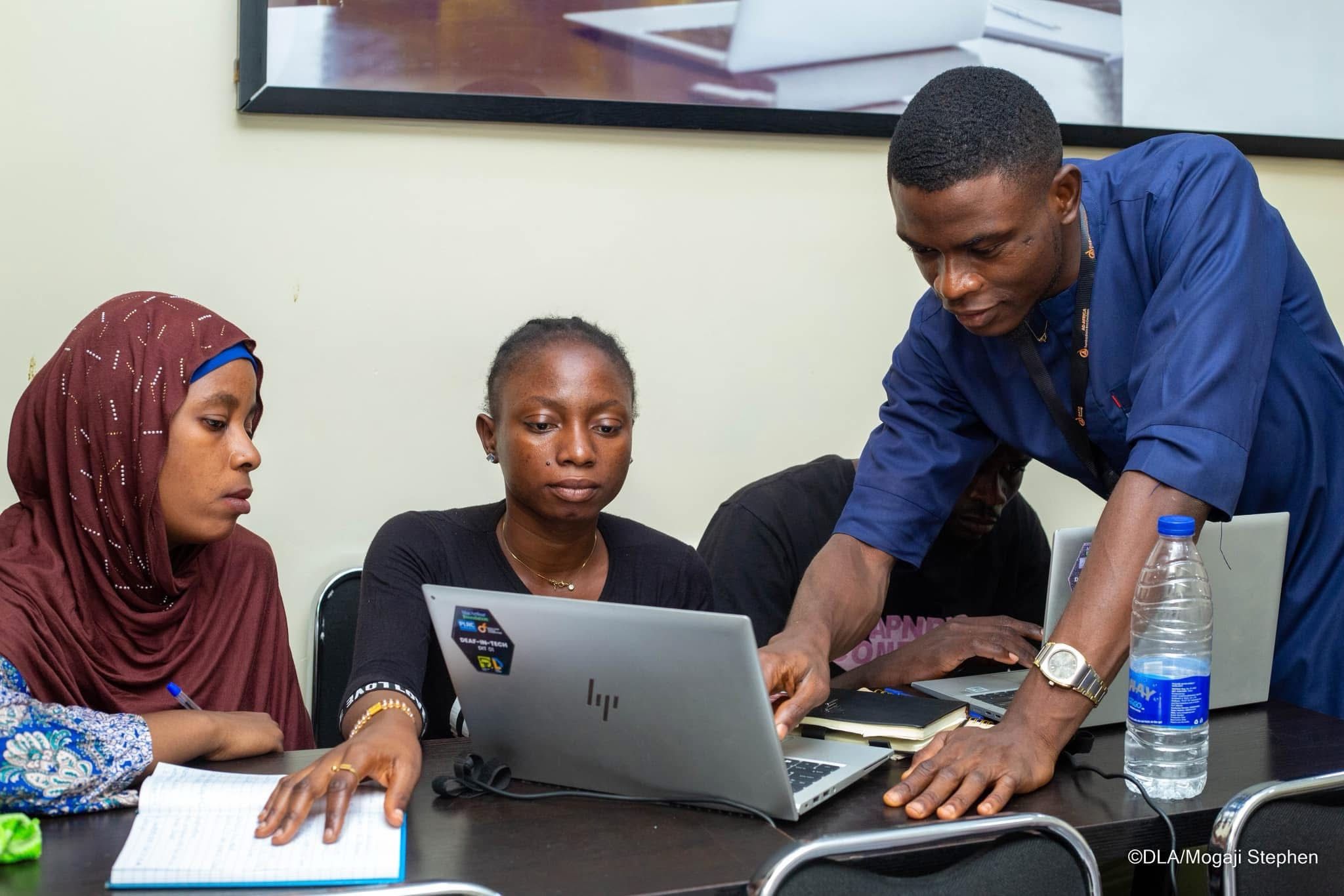
The students are part of Deaf-in-Tech, a program designed to break barriers for Nigeria’s Deaf community in the country’s booming tech industry. Over the past decade, tech has emerged as one of Nigeria’s fastest-growing sectors, contributing at least 20 percent to the country’s GDP in the second quarter of 2024, and drawing in at least $2 billion in foreign investments. Yet, despite this growth, tech job opportunities for people with disabilities remain scarce.
Deaf-in-Tech aims to change that by providing a platform that empowers deaf individuals with the skills and resources needed to break into Nigeria’s tech industry through specialized training programs, mentorship initiatives and strategic partnerships. Unlike conventional coding boot camps, where spoken explanations dominate, here, lessons are delivered through sign language.
“All you need is their attention,” Oricha explains. “Once that is secured, you can be sure they will give you their best.”
Hello everyone! This is the first post in the newly made Disability and accesibility community. Feel free to post anything health, chronic illness, disability or accesibility related. If you need a space for support or sharing your experiences regarding all of the above topics, this is the right place as well :)
Hello everyone! This is the first post in the newly made Disability and accesibility community. Feel free to post anything health, chronic illness, disability or accesibility related. If you need a space for support or sharing your experiences regarding all of the above topics, this is the right place as well :)