



0
0


Source | Author: shirenai | Character: Remilia Scarlet
Source | Author: shirenai | Character: Remilia Scarlet

I just want to own a home
I just want to own a home

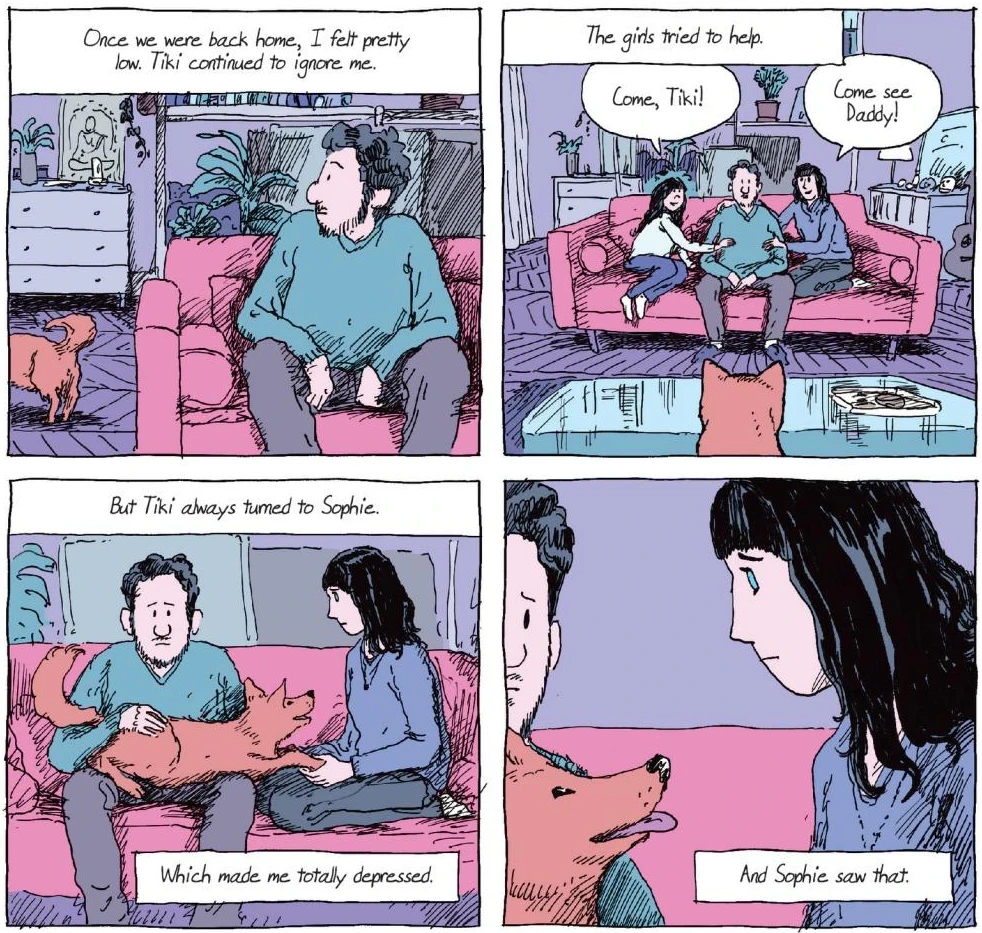
I bumped in to this BD the other day, and liked it a lot. It’s called "Tiki." (that’s the link) It was nominally about a middle-aged man (hmm, I guess that could be me), and started with his daughter begging him for a pet, over the years. A cat would have been *chef’s kiss*, but his daughter was allergic. What to do, what to do…

https://i.imgur.com/xsKdAfp.jpeg

https://i.imgur.com/3SE8wR1.jpeg

https://i.imgur.com/nPLGc2k.jpeg
FINALLY, he and the girlfriend seem to find the most beautiful puppy in the universe, as aided by a couple of manipulative salespeople, and make “Tiki” a birthday gift upon the daughter.
Problem? This was no ordinary breed of dog, but a mighty “Shiba Inu.”

https://i.imgur.com/b31drja.jpeg

https://i.imgur.com/n04d8wW.jpeg

https://i.imgur.com/hdyEpOL.jpeg
This was somewhat heart-wrenching, but also a rare, soulful look at pet-owning issues. (it’s about a real dog IMO, but it did finally find a forever home)
A commentary upon life itself, perhaps.
I bumped in to this BD the other day, and liked it a lot. It’s called "Tiki." (that’s the link) It was nominally about a middle-aged man (hmm, I guess that could be me), and started with his daughter begging him for a pet, over the years. A cat would have been *chef’s kiss*, but his daughter was allergic. What to do, what to do…
https://i.imgur.com/xsKdAfp.jpeg
https://i.imgur.com/3SE8wR1.jpeg
https://i.imgur.com/nPLGc2k.jpeg
FINALLY, he and the girlfriend seem to find the most beautiful puppy in the universe, as aided by a couple of manipulative salespeople, and make “Tiki” a birthday gift upon the daughter.
Problem? This was no ordinary breed of dog, but a mighty “Shiba Inu.”
https://i.imgur.com/b31drja.jpeg
https://i.imgur.com/n04d8wW.jpeg
https://i.imgur.com/hdyEpOL.jpeg
This was somewhat heart-wrenching, but also a rare, soulful look at pet-owning issues. (it’s about a real dog IMO, but it did finally find a forever home)
A commentary upon life itself, perhaps.


Gandhi participated in war as medical support. He raised and organized 1,100 volunteers to serve in the Natal Indian Ambulance Corps.
Though I thus took part in the war as a matter of duty, it chanced that I was not only unable directly to participate in it, but actually compelled to offer what may be called miniature Satyagraha even at that critical juncture. I have already said that an officer was appointed in charge of our training, as soon as our names were approved and enlisted. We were all under the impression that this Commanding Officer was to be our chief only so far as technical matters were concerned, and that in all other matters I was the head of our Corps, which was directly responsible to me in matters of internal discipline; that is to say, the Commanding Officer had to deal with the Corps through me. But from the first the officer left us under no such delusion.
Mr. Sorabji Adajania was a shrewd man. He warned me. “Beware of this man,” he said. “He seems inclined to lord it over us. We will have none of his orders. We are prepared to look upon him as our instructor. But the youngsters he has appointed to instruct us also feel as though they had come as our masters.” These youngsters were Oxford students who had come to instruct us and whom the Commanding Officer had appointed to be our section leaders. I also had not failed to notice the high-handedness of the Commanding Officer, but I asked Sorabji not to be anxious and tried to pacify him. But he was not the man to be easily convinced.
“You are too trusting. These people will deceive you with wretched words, and when at last you see through them, you will ask us to resort to Satyagraha, and so come to grief, and bring us all to grief along with you,” said he with a smile. “What else but grief can you hope to come to after having cast in your lot with me?” said I. "A Satyagrahi is born to be deceived. Let the Commanding Officer deceive us. Have I not told you times without number that ultimately a deceiver only deceives himself?" Sorabji gave a loud laugh. “Well, then,” said he, “continue to be deceived. You will some day meet your death in Satyagraha and drag poor mortals like me behind you.” - Mahatma Gandhi, The Story of My Experiments with Truth, Part Four, Chapter Forty, “Miniature Satyagraha”








Loved this pattern, very laid-back and relaxed knitting.
Pattern: www.ravelry.com/patterns/library/anisah
Yarn: Plymouth Superwash Worsted in Purple
Loved this pattern, very laid-back and relaxed knitting.
Pattern: www.ravelry.com/patterns/library/anisah
Yarn: Plymouth Superwash Worsted in Purple
[DC] “Gangle’s Anime Adventure” fan animation by Whygena
[DC] “Gangle’s Anime Adventure” fan animation by Whygena


cross-posted from: reddthat.com/post/72784393
cross-posted from: reddthat.com/post/72447093
cross-posted from: reddthat.com/post/72784393
cross-posted from: reddthat.com/post/72447093
I responded to someone in comments on a post that may not get as much visibility, and wanted to share something that might help some others who are newer or unfamiliar.
I referenced Quad9 DNS as probably one of the best private DNS you can use, Swiss based, no log, no tracking, no data to sell, etc. They also implement DNSSEC, DoH, DoT, QUIC, ECS (which you may or may bot want), malware blocking, content filtering, and maybe something else I’m forgetting.
Many DNS sinkhole apps, OSes, or systems can actually utilize Quad9 for your resolver while those systems also block ads. Below is my functional list of systems that I’m aware of, though I haven’t tested everything. I believe all are considered FOSS, too. If you don’t have a spare Raspberry Pi laying around, try running in HomeAssistant, Yunohost, ZimaOS (previously CasaOS), or others.
DNS sinkhole (Adblocking) apps:
Feel free to comment and add your own I’m maybe not aware of. I’m no software engineer, but I can read through some code, though not an expert, nor have combed through these personally. Usually I’ve tested/run at the recommendation of others over the years before my ban on Reddit (for shitting on AI).
Hope this helps!!


Stargate SG-1 S6E14 “Smoke and Mirrors”
Higher quality WebP: feddit.org/…/05de83ac-6738-405a-a7d1-a4fa5470922b…
Stargate SG-1 S6E14 “Smoke and Mirrors”
Higher quality WebP: feddit.org/…/05de83ac-6738-405a-a7d1-a4fa5470922b…

cross-posted from: lemmy.world/post/52118912
cross-posted from: lemmy.world/post/52118912
I’m trying to recover many years of Google Maps Timeline history and have gotten far enough into the problem that I’m hoping someone familiar with Android Keystore, Google Play Services/Folsom security domains, or Maps Timeline’s encrypted-backup implementation might recognize what is happening.
The short version is:
Google confirms that encrypted Timeline backups for my account still exist on its servers, but every device I try says “Your encrypted data isn’t unlocked yet.” On the S23 that was probably involved in the Timeline migration, an Android bugreport shows Google Play Services actually attempting key recovery and failing with:
LocationHistory: [BackupRunner] Failed to get encryption key for backup
LocationHistory: bmas: 38502: Domain is not retrievable
The recovery flow also invokes:
com.google.android.gms.auth.folsom.StartKeyRetrieval
and references:
on_device_location_history
How I think I got here
I have used Google Maps Timeline/Location History for many years.
For most of that time my primary Google account on Android devices was one account, while the account I actually used inside Google Maps for Timeline was a different secondary Google account. That worked normally for years.
My main phone during the transition from Google’s old server-based Timeline system to the newer device-local/encrypted-backup system was a Samsung Galaxy S23 Ultra, SM-S918U1.
At some point I had to repair/reflash the S23 firmware. I believe I used firmware that was compatible with the hardware but may not initially have been the exact correct region/CSC variant. The phone continued working afterward.
I cannot prove that this caused the Timeline problem. It is simply the most suspicious event in the history because Android Keystore/device trust material may have changed during that process.
Later I noticed that older Timeline history was gone from the normal Maps UI.
What Google Takeout shows
I requested a Google Takeout specifically for Timeline.
The plaintext Timeline export only contains relatively recent device-local history.
However, Takeout also produced an Encrypted Backups file that explicitly states that I have encrypted Timeline backups stored on Google servers.
So as far as I can determine:
Old Timeline data
↓
encrypted backup still exists at Google
↓
decryption/recovery state is unavailable
↓
Maps cannot restore it
Importantly, the Takeout file is not the encrypted backup itself. It just confirms that encrypted backups exist.
What Maps does
On the S23, my new Galaxy Fold, and several old Android devices, Maps shows:
Your encrypted data isn’t unlocked yet
If I tap the Timeline cloud/backup icon:
A spinner appears.
It waits for a while.
The spinner disappears.
No backup list appears.
I never receive a PIN/password/key-recovery prompt.
I never get a usable “Fix now” flow.
I have tested:
Galaxy S23 Ultra
Galaxy Z Fold8 Ultra
Galaxy Note8
Galaxy Tab A
The older devices were preserved and had not necessarily been wiped, but signing the Timeline Google account into them does not change the behavior.
This suggests that simply having an old device is not enough. The specific device-side recovery/security-domain state apparently matters.
What I found on the S23
I kept the S23 intact after moving to the Fold and captured an Android bugreport while reproducing the Timeline failure.
The critical log entries are:
LocationHistory: [BackupRunner] Failed to get encryption key for backup
LocationHistory: bmas: 38502: Domain is not retrievable
The bugreport also shows the Google Play Services key-recovery path actually launching:
com.google.android.gms.auth.folsom.StartKeyRetrieval
The recovery request is associated with the correct Google account and:
on_device_location_history
There are also Google Play Services/Keystore references such as:
com.google.android.gms.auth.folsom
com.google.android.gms.backup/folsom
security_domain_member_key
security_domain_member_key_encrypted_locally
and activity involving operations with names along the lines of:
ListSecurityDomainMembersOperation
GetKeyMaterialOperation
MarkLocalKeysAsStaleOperation
INVALIDATE_LOCAL_KEYS
I am not interpreting those names as proof that Google deleted the keys. They are simply what appears in the recovery sequence.
Current S23 state
The phone currently reports:
Model: SM-S918U1
Android: 16
Bootloader: locked
Verified Boot: green
Warranty bit: 0
Security patch: 2026-08-05
Sales code: XAA
So there is no obvious current unlocked-bootloader/failed-Verified-Boot situation.
The Keystore is also clearly functioning in general. Google Play Services can create/use hardware-backed operations. The unresolved question is whether the specific historical Timeline/security-domain key material is gone, stale, inaccessible, or simply failing to be retrieved from Google’s recovery infrastructure.
Things I have deliberately NOT done
I have not:
deleted the encrypted Timeline backups
selected Google’s “delete encrypted data and start over” option
factory-reset the S23 during this investigation
cleared Google Play Services storage
cleared Maps storage
unlocked the bootloader
removed the affected Google account
reflashed the phone again
I want to preserve every remaining recovery possibility.
Things I’ve already tried
Tested the original/current S23
Tested a new Fold
Tested old Note8 and Tab A devices
Verified the correct Google account is being used
Verified normal Google authentication works
Confirmed the encrypted backups exist via Takeout
Captured ADB/logcat/Android bugreport during failure
Submitted the exact error through Google Maps feedback
Posted to the official Google Maps support community
The normal Google support documentation basically says to recover encrypted Timeline data using the original device, or delete the encrypted backup and start over if recovery is impossible.
The problem is that I still have the likely original device, and its recovery process is actively running but failing internally.
What I’m trying to figure out
Does anyone recognize:
38502: Domain is not retrievable
from Google Play Services, Folsom, security-domain recovery, Android backup encryption, or Maps Timeline?
In particular, I’m trying to determine whether this means:
The historical device-bound encryption key was permanently lost during the earlier firmware event.
The local Google security-domain membership/key wrapping state is damaged but potentially repairable.
Google still has enough recovery metadata server-side, but the security domain is in a broken/stale state.
This is a Google Play Services/Maps bug rather than true key loss.
There is some supported or unsupported way to re-enroll the device into the existing security domain without deleting the encrypted backups.
I am comfortable with ADB, Android debugging, Linux, Docker, firmware tooling, and doing forensic-style diagnostics on the S23 now that it is no longer my daily phone.
I am not looking to bypass someone else’s encryption or account security. These are my own Google account, phone, and Timeline backups. I’m mainly trying to avoid destroying the one server-side copy that apparently still exists.
If anyone has dealt with Google Play Services auth.folsom, Android security domains, or Timeline’s newer end-to-end encrypted backup implementation, I would especially appreciate pointers about what 38502 / Domain is not retrievable actually signifies and what additional state I should preserve before experimenting further.
cross-posted from: https://piefed.blahaj.zone/c/asklemmy@piefed.blahaj.zone/p/985701/what-is-something-you-are-proud-to-have-made
Hey, Ask, we all know that people love to talk about themselves, and I’d love to hear about some of your pleasant experiences. So, please, no matter how big; no matter how small, tell me something that you are proud to have made :)






Ich musste herzlich kichern.
Ich musste herzlich kichern.
Hey depressed folks!
I have been diagnosed with depression about eight years ago, I’m in my third depressive episode that lasted about two years now. I’m in therapy since the start and medicated on four different drugs. The main thing I’m struggling with is the inability to do anything without forcing myself to do it, it feels like I’m stuck on manual. Getting up in the morning, making breakfast, taking care of my son, going for a walk, working, even hobbies. Gaming seems to be the only thing that lets me turn off my brain, with some pangs of “I’m wasting my time” echoing in my head. I’ve also been stuck overweight for a few years now, I can’t control my appetite, I’ve tried everything between intermittent fasting and working with a dietetician and a personal trainer.
With all this I have to say my life isn’t a struggle, I have a loving wife, a beautiful son, I’m earning enough to support my family, I live in a nice apartment, I’ve got pretty much everything I need. And yet it’s all meaningless in the face of The Depression^TM^.
I don’t really know why I’m writing this down, I don’t expect anyone to come up with a solution here. I guess you can just join me in complaining about being a prisoner of your own mind.
All the best, Cheery

For each example in this post, I will be linking to the sea otter pools at the Vancouver aquarium. That location has the coordinates of 49.30063,-123.13149
To link to it, you would use ‘geo:49.30063,-123.13149’.
Depending on your web browser, pasting that into the search bar might prompt you to select which map website you want to use to view that location. For me in Firefox, it asked me to pick between Google Maps and OpenStreetMaps. It’s even more convenient on mobile, where it asks me which map app I want to open it with. Both CoMaps and Google Maps handled it correctly.
If you are writing a post or comment on Lemmy/Piefed/etc., you can place it in the second part of the markdown link format: [Sea Otter Pools](geo:49.30063,-123.13149). This would output like this: Sea Otter Pools
The linked OpenStreetMap wiki page has a good summary of how well various apps support this scheme. A lot of people here are active in the open source space, so please consider following up with the apps that are currently missing support or have partial support for this: wiki.openstreetmap.org/wiki/Geo_URI_scheme
EDIT: I forgot to mention, you can also use apps like this one to convert maps links between each other
github.com/jakubvalenta/GeoShare

Faut-il davantage sanctionner, ou repenser complètement les carrefours ? En comparant Paris à plusieurs villes néerlandaises, cette vidéo montre que le respect des feux dépend aussi de la signalisation, du temps d’attente et de la sécurité offerte par les aménagements. Pour que les cyclistes s’arrêtent au rouge, encore faut-il que les feux aient un sens.
Faut-il davantage sanctionner, ou repenser complètement les carrefours ? En comparant Paris à plusieurs villes néerlandaises, cette vidéo montre que le respect des feux dépend aussi de la signalisation, du temps d’attente et de la sécurité offerte par les aménagements. Pour que les cyclistes s’arrêtent au rouge, encore faut-il que les feux aient un sens.
“Norwegian with Ilys” on Youtube: how to say the time in Norwegian
“Norwegian with Ilys” on Youtube: how to say the time in Norwegian

The Dallas Police Department announced on Tuesday, Jan. 6 that they had solved the case of missing teenager Norman Prater, who vanished in 1973
The Dallas Police Department announced on Tuesday, Jan. 6 that they had solved the case of missing teenager Norman Prater, who vanished in 1973


I can’t believe it took a whole month of trial and error just to find the right hardware… There’s also an audio cassette player and a VCR incoming. Meanwhile:
The piece that actually does the analog to digital conversion: a composite video to HDMI adapter and converter. The SCART head in the back can take RCA or S-video contacts. The weakest link in the whole setup, because a professional person would probably use an expensive expansion card inside their computer or the likes…

The capture card. It takes digital video and/or audio signals through an HDMI connection and sends it to the computers via USB-C. Perhaps the second weakest link, since - again - a pro would probably do the conversion with a fancy PCIe card.

My beloved TASCAM. The only piece that I already had in my possession. Instead of letting the above capture card capture the analog audio, I let this do that. Do read up on TASCAM! They have a pretty long and reputable history within audio.

This little handheld video camera will playback Mini DV cassettes. I have already captured two of them successfully. Oh boi, do I love the second hand market.

I can’t believe it took a whole month of trial and error just to find the right hardware… There’s also an audio cassette player and a VCR incoming. Meanwhile:
The piece that actually does the analog to digital conversion: a composite video to HDMI adapter and converter. The SCART head in the back can take RCA or S-video contacts. The weakest link in the whole setup, because a professional person would probably use an expensive expansion card inside their computer or the likes…
The capture card. It takes digital video and/or audio signals through an HDMI connection and sends it to the computers via USB-C. Perhaps the second weakest link, since - again - a pro would probably do the conversion with a fancy PCIe card.
My beloved TASCAM. The only piece that I already had in my possession. Instead of letting the above capture card capture the analog audio, I let this do that. Do read up on TASCAM! They have a pretty long and reputable history within audio.
This little handheld video camera will playback Mini DV cassettes. I have already captured two of them successfully. Oh boi, do I love the second hand market.

Follow the link to read the background.
I had recently done an update on my TV, which I am using as a “dumb” monitor, connected to my laptop with an HDMI cable. The TV has three HDMI ports, each with a corresponding entry under the “sources” menu (HDMI1, HDMI2, HDMI3). While troubleshooting the issue, I noticed that - after the above mentioned update - one of the HDMI entries had changed name from “HDMI1” to “COMPUTER”. I guess I should’ve read Panasonic’s change logs or whatever, because - just for fun - I tried one of the two remaining ports that are still called “HDMI*” and voilà, the flickering/strobing/any artifacts whatsoever, were gone!
For now, I am just happy that I can watch Angela bang two guys behind their backs, but it does make me wonder… What configuration changes did Panasonic make to the port…

wired.com Meet the Academics Trying to Stop You From Having Sex in Robotaxis Aarian Marshall 4–6 minutes
Pavlo Bazilinskyy still can’t believe he was on PornHub for work. He’s an assistant professor at the Eindhoven University of Technology in the Netherlands, and has spent more than a decade researching AI-driven interactions between humans and robots. But he found himself typing “public transport” into the search bar of a very specific website’s “amateur section.” 297 hits.
“People are hard to predict,” Bazilinskyy says. It’s why he researches what he does. So his prurient pursuit had a point. Robotaxis without cabbies behind the wheel have started picking up passengers in a handful of countries, including the US. Meanwhile, there’s a long history of people getting up to antisocial behavior inside the quasi-private or straight-up public spaces of trains, planes, and automobiles—think the prom night limo, the “Mile High Club,” Tom Cruise in slow motion aboard the Chicago L in Risky Business, the stuff he found on PornHub.
What might riders do when there’s no authority figure inside a vehicle to say, “Hey, stop that!”? What do they do? Can people be convinced to stop before they start?
This week, Bazilinskyy and academic colleagues with backgrounds in systems engineering, computer science, psychology, and tourism studies are hosting an industry workshop asking participants to brainstorm along those very lines: How do you stop people from doing it in self-driving cars? Thinking about sex in autonomous vehicles, they theorize, can let anyone who cares about the future of mobility “stress-test” the role the vehicles might eventually play as communal spaces, where social norms get acted out every day.
The event focuses on prevention not just because these academics are no fun (though Alexandros Rouchitsas, an engineering psychologist who is also hosting the event, admits they are “taking the side of the parents, the elderly—we are not the cool people here”). They don’t want people to have sex in self-driving cars because they’re worried it will give a potentially positive technology a really bad rep.
“We want to see automated mobility solutions accepted, trusted by the general public,” Rouchitsas says. Self-driving could have huge upsides for the elderly, children, and people with disabilities, who have a harder time getting around places where driving is quicker and sometimes necessary. The tech might eventually move beyond private taxis and into public transit, where all sorts of people should be able to travel safely and comfortably. “We want automated mobility solutions to be seen as something that is equitable, serious, societally minded,” he says.
Rouchitsas’ biggest fear is that self-driving gets co-opted by the partiers, the drug users, the sort of hedonistic folk who have descended on some islands of his native Greece. “You know ‘Bang Bus’?” he says. “We don’t want that.”
The four-hour workshop—rise and shine, it starts at 8:30 am—is part of an industry conference in Gothenburg, Sweden, focusing on how people interact with vehicles and larger mobility systems. The organizers expect participants from academia but also the wider industry. (Gothenburg is home to Volvo Cars and the tech supplier SmartEye; BMW and Google are conference sponsors.) Those who show up will be prompted to come up with physical and design interventions that encourage people to not do that. The workshop will focus on preventing consensual interactions, its organizers say.
Rouchitsas, who studies human-machine interactions, says he hopes participants will get creative with their anti-action designs. But just off the top of his head: Maybe the vehicles could be transparent? Maybe a light begins to blink if the technology senses behavior it disapproves of? The organizers intend to publish a paper based on the workshop’s results.
Sex is the fun, eye-catching part here, made all the more alluring because it’s “the elephant in the room” for those thinking about how humans might interact with machines in the future, says Bazilinskyy—very under-studied. But the results of this sort of inquiry could help designers, companies, and lawmakers figure out how to compel people to safely share communal spaces like public self-driving buses in the future.
Prevent sex and maybe you’ll also prevent robbery, bullying, and homicide. “It could be helpful for the industry and academics to use this example to design other things,” he says.