
0

New Community Rule: Please Read

preview

First, I must re-iterate that the community rules require all bot owners to seek permission from moderators before posting.

At this time I am not aware of any bot approved by the previous mods and I have not approved any bots to post here. Bots violating this rule will be permanently banned without warning.

Our new rule 14 is that this is a community for humans, NO LLM bot will ever have permission to post here. Do not ask.

First, I must re-iterate that the community rules require all bot owners to seek permission from moderators before posting.

At this time I am not aware of any bot approved by the previous mods and I have not approved any bots to post here. Bots violating this rule will be permanently banned without warning.

Our new rule 14 is that this is a community for humans, NO LLM bot will ever have permission to post here. Do not ask.

0

YSK Drowning Doesn’t Look Like Drowning

Slate Magazine Drowning Doesn’t Look Like Drowning slate.com
preview

web.archive.org (no paywall)

via

Every summer I repost this article on how to spot drowning. Please read it and pass on. In the last few years I’ve had SIX messages from people who saved a kid’s life after clicking on the link from my feed.

web.archive.org (no paywall)

via

Every summer I repost this article on how to spot drowning. Please read it and pass on. In the last few years I’ve had SIX messages from people who saved a kid’s life after clicking on the link from my feed.

0

YSK that women are susceptible to economic abuse and you may be in a situation like this without knowing

Economic abuse - Wikipedia en.wikipedia.org
preview

Economic abuse is a form of abuse when one abusive person has control over the victim’s access to economic resources, which diminishes the victim’s capacity to support themselves and forces them to depend on the perpetrator financially.

It is related to, or also known as, financial abuse, which is the illegal or unauthorized use of a person’s property, money, pension book or other valuables (including changing the person’s will to name the abuser as heir), often fraudulently obtaining power of attorney, followed by deprivation of money or other property, or by eviction from own home. Financial abuse applies to both elder abuse and domestic violence.

Economic abuse in a domestic situation may involve:

  • Preventing a cohabitant from resource acquisition, such as restricting their ability to find employment, maintain or advance their careers, and acquire assets.
  • Preventing the victim from obtaining education. Spend the victim’s money without their consent and create debt, or completely spend the victim’s savings to limit available resources.
  • Exploiting economic resources of the victim In its extreme (and usual) form, this involves putting the victim on a strict “allowance”, withholding money at will and forcing the victim to beg for the money until the abuser gives the victim some money. It is common for the victim to receive less and less money as the abuse continues. This also includes (but is not limited to) preventing the victim from finishing education or obtaining employment, or intentionally squandering or misusing communal resources

Controlling mechanism

Economic abuse is often used as a controlling mechanism as part of a larger pattern of domestic abuse, which may include verbal, emotional, physical and sexual abuse. Physical abuse may include threats or attempts to kill the cohabitant. By restricting the victim’s access to economic resources, the offender has limited recourses to exit the abusive or violent relationship.

The following are ways that abusers may use economic abuse with other forms of domestic violence:

  • Using physical force, or threat of violence, to get money.
  • Providing money for sexual activity.
  • Controlling access to a telephone, vehicle or ability to go shopping; other forms of isolation.
  • Threatening to evict the cohabitants from the house without financial support.
  • Exploiting the victim’s economic disadvantage.
  • Destroying or taking resources from the cohabitants.
  • Blaming the victim for an inability to manage money; or instigating other forms of economic abuse, such as destruction of property
  • Victimization occurs across all socio-economic levels, and when victims are asked why they stay in abusive relationships, “lack of income” is a common response.

Economic abuse is a form of abuse when one abusive person has control over the victim’s access to economic resources, which diminishes the victim’s capacity to support themselves and forces them to depend on the perpetrator financially.

It is related to, or also known as, financial abuse, which is the illegal or unauthorized use of a person’s property, money, pension book or other valuables (including changing the person’s will to name the abuser as heir), often fraudulently obtaining power of attorney, followed by deprivation of money or other property, or by eviction from own home. Financial abuse applies to both elder abuse and domestic violence.

Economic abuse in a domestic situation may involve:

  • Preventing a cohabitant from resource acquisition, such as restricting their ability to find employment, maintain or advance their careers, and acquire assets.
  • Preventing the victim from obtaining education. Spend the victim’s money without their consent and create debt, or completely spend the victim’s savings to limit available resources.
  • Exploiting economic resources of the victim In its extreme (and usual) form, this involves putting the victim on a strict “allowance”, withholding money at will and forcing the victim to beg for the money until the abuser gives the victim some money. It is common for the victim to receive less and less money as the abuse continues. This also includes (but is not limited to) preventing the victim from finishing education or obtaining employment, or intentionally squandering or misusing communal resources

Controlling mechanism

Economic abuse is often used as a controlling mechanism as part of a larger pattern of domestic abuse, which may include verbal, emotional, physical and sexual abuse. Physical abuse may include threats or attempts to kill the cohabitant. By restricting the victim’s access to economic resources, the offender has limited recourses to exit the abusive or violent relationship.

The following are ways that abusers may use economic abuse with other forms of domestic violence:

  • Using physical force, or threat of violence, to get money.
  • Providing money for sexual activity.
  • Controlling access to a telephone, vehicle or ability to go shopping; other forms of isolation.
  • Threatening to evict the cohabitants from the house without financial support.
  • Exploiting the victim’s economic disadvantage.
  • Destroying or taking resources from the cohabitants.
  • Blaming the victim for an inability to manage money; or instigating other forms of economic abuse, such as destruction of property
  • Victimization occurs across all socio-economic levels, and when victims are asked why they stay in abusive relationships, “lack of income” is a common response.
0

YSK that men are susceptible to economic abuse, and you may be in a situation like this without knowing.

Economic abuse - Wikipedia en.wikipedia.org
preview

For example, if you’re sharing resources like time and money, and your partner is spending more than you are comfortable with, or if you are being left with no time due to neglect of responsibility by your partner.

These kinds of non-physical abuse are less talked about with less people caring about the men that suffer from it. Be aware of your situation. Not all abuse is the same.

International men’s day is soon. It’s not “international patriarchy day”, men also have areas in society where they are oppressed due to a variety of factors not limited to social expectations, or expected gender roles. Stay safe, reach out to friends, and try to talk about things that you feel are unfair. Unfortunately, you also need to be realistic in the responses you get back, as we are not likely to get recognised or get sympathy, since most of the time, we are expected to just go out and be winners.

For example, if you’re sharing resources like time and money, and your partner is spending more than you are comfortable with, or if you are being left with no time due to neglect of responsibility by your partner.

These kinds of non-physical abuse are less talked about with less people caring about the men that suffer from it. Be aware of your situation. Not all abuse is the same.

International men’s day is soon. It’s not “international patriarchy day”, men also have areas in society where they are oppressed due to a variety of factors not limited to social expectations, or expected gender roles. Stay safe, reach out to friends, and try to talk about things that you feel are unfair. Unfortunately, you also need to be realistic in the responses you get back, as we are not likely to get recognised or get sympathy, since most of the time, we are expected to just go out and be winners.

0

YSK: How to keep your sour cream from getting watery

preview

If you smooth the surface of the sour cream(or thicker yogurts) after use, it will prevent the majority of the seperation and avoid the change in texture you get even if you mix the liquid back in.

The build up of whey(the liquid) in sour cream is from the breakdown of the suspension between the whey and the more solid milk proteins. If the milk solids stop grabbing onto the whey, it rises to the top since it’s lighter.

It’s possible everyone knows this already but I didn’t until a few years ago and if I can save just one soul from sad sour cream, it’s worth it.

If you smooth the surface of the sour cream(or thicker yogurts) after use, it will prevent the majority of the seperation and avoid the change in texture you get even if you mix the liquid back in.

The build up of whey(the liquid) in sour cream is from the breakdown of the suspension between the whey and the more solid milk proteins. If the milk solids stop grabbing onto the whey, it rises to the top since it’s lighter.

It’s possible everyone knows this already but I didn’t until a few years ago and if I can save just one soul from sad sour cream, it’s worth it.

0

YSK You may have unclaimed funds held by your government

preview

Annual reminder: you may have unclaimed funds that are being held by your state (US) or other government.

There are many reasons you might have unclaimed funds: abandoned accounts, unclaimed deposits or refunds, uncashed checks, misspelled names, estate funds, incorrect addresses, misplaced inheritance and trusts, etc, and your government is required to hold your property until you claim it.

They will not seek you out, and most people are completely unaware they may have lost funds or property being held by the state.

Every state in the US and most governments worldwide have an official website where you can check whether you have unclaimed property and submit a claim. There are typically no fees, and you shouldn’t need an attorney or solicitor to claim them.

Just search ‘[my state] or [my country] unclaimed property’ or ‘biens non réclamés’.

Make sure you’re at the official site for your government and not one of the many scam sites trying to get a cut by doing this for you. The official sites are typically easy and should not require a 3rd party. There should be no extra fees.

If you’re in the US, check every state you’ve lived in. Moving state is one of the major reasons this happens, and your unclaimed funds will not move to a new state with you.

Here’s my previous thread on this, with more discussion. This isn’t sovcit bullshit. It’s real.

Also note that you’re unlikely to find life-changing amounts this way. Most people report a few dollars to a few thousand. Large amounts motivate lawyers to seek you out.

If you find unclaimed funds, I’d love to hear about it!

Annual reminder: you may have unclaimed funds that are being held by your state (US) or other government.

There are many reasons you might have unclaimed funds: abandoned accounts, unclaimed deposits or refunds, uncashed checks, misspelled names, estate funds, incorrect addresses, misplaced inheritance and trusts, etc, and your government is required to hold your property until you claim it.

They will not seek you out, and most people are completely unaware they may have lost funds or property being held by the state.

Every state in the US and most governments worldwide have an official website where you can check whether you have unclaimed property and submit a claim. There are typically no fees, and you shouldn’t need an attorney or solicitor to claim them.

Just search ‘[my state] or [my country] unclaimed property’ or ‘biens non réclamés’.

Make sure you’re at the official site for your government and not one of the many scam sites trying to get a cut by doing this for you. The official sites are typically easy and should not require a 3rd party. There should be no extra fees.

If you’re in the US, check every state you’ve lived in. Moving state is one of the major reasons this happens, and your unclaimed funds will not move to a new state with you.

Here’s my previous thread on this, with more discussion. This isn’t sovcit bullshit. It’s real.

Also note that you’re unlikely to find life-changing amounts this way. Most people report a few dollars to a few thousand. Large amounts motivate lawyers to seek you out.

If you find unclaimed funds, I’d love to hear about it!

0

YSK that the Mississippi Free Press has live updates on the Mississippi Senate election

preview

Link is here. The Mississippi Free Press’ coverage has been better than anyone else’s that I’ve seen, and I think they deserve your attention for the work they’re doing here. They’ve been giving updates at least once per hour, sometimes much more, and they’re actually talking with as many election officials as they can get in touch with across the state.


Why YSK: This is a hanging thread of possibly one of the most pivotal elections in modern US history. It’s looking increasingly likely that Colom will win, and this might sate your residual desire to doomscroll while actually keeping you informed.

Link is here. The Mississippi Free Press’ coverage has been better than anyone else’s that I’ve seen, and I think they deserve your attention for the work they’re doing here. They’ve been giving updates at least once per hour, sometimes much more, and they’re actually talking with as many election officials as they can get in touch with across the state.


Why YSK: This is a hanging thread of possibly one of the most pivotal elections in modern US history. It’s looking increasingly likely that Colom will win, and this might sate your residual desire to doomscroll while actually keeping you informed.

0

YSK about justdeleteaccount.com, which tells you how to delete an account for most common services

preview

Found this site as I searched for how to delete ASUS account. Thought I should share as it’s actually useful. People can also vote whether the described method worked or not.

I think it’s a good thing to practice digital hygiene and delete accounts you no longer use, this helps do that.

Found this site as I searched for how to delete ASUS account. Thought I should share as it’s actually useful. People can also vote whether the described method worked or not.

I think it’s a good thing to practice digital hygiene and delete accounts you no longer use, this helps do that.

0

YSK Molly(Signal fork) has not been updated since 3 months and is vulnerable to attacks fixed in mainline Signal

preview

cross-posted from: piefed.world/…/ysk-molly-signal-fork-has-not-been…

As of now, Molly lastest release was in 31 July (Version v8.19.2-4).

It contains vulnerabilities that had been simply fixed in mainline Signal.

Take for example the latest exploit disclosed in October, it has been fixed in Signal 8.27. 1. Meanwhile Molly remains vulnerable.

It’s currently recommended to use mainline Signal and delete Molly till they at least return to updating their app adequately, if they ever will.

cross-posted from: piefed.world/…/ysk-molly-signal-fork-has-not-been…

As of now, Molly lastest release was in 31 July (Version v8.19.2-4).

It contains vulnerabilities that had been simply fixed in mainline Signal.

Take for example the latest exploit disclosed in October, it has been fixed in Signal 8.27. 1. Meanwhile Molly remains vulnerable.

It’s currently recommended to use mainline Signal and delete Molly till they at least return to updating their app adequately, if they ever will.

0

YSK about the availability heuristic and how it affects our understanding of the world.

preview

The availability heuristic is a cognitive shortcut where people judge how common, likely, or important something is based on how easily examples of it come to mind, rather than how frequently it actually occurs.

Keep in mind, the media reports unusual events, and remember the old adage, “If it bleeds, it leads.” This effect is compounded when we hear the same story from various sources and media types or a single event kicks of coverage of less serious but similar events.

US examples:

FOOD RECALLS

There’s a widespread belief that federal cuts have led to an unsafe food supply and that recalls have skyrocketed. Weirdly enough, 2026 is on track to be a normal year for recalls, maybe even low.

The cyclospora outbreak, which was damned bad, was largely a result of a diminished CDC’s ability to track the origin and spread. That was a result of staffing and budget cuts. While this event was going on, every single food recall made the news. 2026 seems unprecedented!

Keep in mind, 99% of food recalls are voluntary (this from several sources), initiated by the producer, nothing to do with the government. Producers have skin in the game. They don’t want to get sued or see their stock tank, let alone have the feds twist their booty up like a balloon animal. The remainder are a result of the FDA and the FSIS doing their job. Also, keep on eye on the amounts involved. Most are less than a single semi truckload.

AIRLINE SAFETY

After Boeing lost a door over Portland, there were daily stories about airplane issues. Every tiny event was breathlessly reported, especially if it involved a Boeing plane. Absurdly enough, reports at the time would slip a sentence in near the end of the story saying “this wasn’t a Boeing plane BTW”.

Boeing has no doubt pulled some serious safety blunders, but neither that company, nor the industry as a whole, suddenly became unsafe, but you wouldn’t know that if you followed the news in early 2024.

TRAIN SAFETY

After the disastrous derailment in East Palestine Ohio, it seemed trains were flying off the tracks daily. AH! And once again, daily reporting bent our opinion on a thing that’s actually common and usually not a big deal. After the hype wore off, well, when was the last time you read a story about a derailment? You could have read one every day in early 2023.

FRIVOLOUS LAWSUITS

The media doesn’t report the millions of meritorious lawsuits. They don’t report cases thrown out by judges, and they can’t report those that don’t make it past an initial attorney consult.

Lawyers have to work with the same judges for years, maybe a whole career. The last thing they want is to antagonize them with BS. On top of that, attorneys don’t want a loss on their record or a hit to their reputation.

One other note, some seemingly frivolous suits actually have legal merit, but the headlines only state the absurd part. Read the whole story. Anyone up for some McDonald’s coffee?

GETTING SHOT/MASS SHOOTINGS

Americans and foreigners both think it’s common to get shot in the US. The CDC puts yearly vehicular fatalities at the same number, give or take, as gun fatalities (50,000). So the odds are the same, right? Overall, yes. In reality? Not quite. The better question would be, are you more likely to die by gunshot or car crash?

Well over half of gun fatalities are suicides. Not to downplay those deaths! But they are not random events. Most of the rest is gang related activity. And again, not to downplay real deaths, but the vast majority of those are not random either.

Consider two scenarios:

A man goes nuts, kills his wife and two children, them himself. That makes national headlines, sometimes over a few days.

A family of 4 gets smeared off the interstate. Maybe a blurb in the local news, reported once and done.

But aren’t mass shootings a daily event? Nope. While way too damned common, the scene in our head when we hear the term rarely matches the reporting of total numbers. This chart spells it out better than I can.

Quite a disparity! Note the sources. The three on the left are anything but right-wing.

The availability heuristic applies to school shootings as well; you’ll hear about every event. Some sources count any time a gun is discharged on school grounds. If I put in round in the soccer field at midnight on Saturday, “school shooting”. You’ll find the same sorts of disparity as the mass shooting chart. You’ll find yet another disparity looking into the most common cause of childhood deaths. (One wonders why sources include 18 and 19 year olds. Lock up your guns and teach your kids to swim, no worries.)

TO CLOSE

Examine your biases regularly. Check multiple sources, check past numbers vs. what you’re seeing in the media. Read the whole story!

Random, horrible events make news, not common events, even if horrible. Yet sometimes common events can be blown up by reporting of a large initial event.

Don’t fall into social media hype. Over on Bluesky they have a completely different set of concerns about current events than lemmy because once a thing takes off, it gets amplified in a given space. I’ve often seen an item get reported several times in short order and thought, “Oh boy, here goes this week’s hype.”

For those inclined to really unpack this thing, here’s the paper that kicked off the idea of the availability heuristic:

cebma.org/assets/…/Tversky_Kahneman_1974.pdf

Haven’t read it all myself, but it’s a banger so far!

The availability heuristic is a cognitive shortcut where people judge how common, likely, or important something is based on how easily examples of it come to mind, rather than how frequently it actually occurs.

Keep in mind, the media reports unusual events, and remember the old adage, “If it bleeds, it leads.” This effect is compounded when we hear the same story from various sources and media types or a single event kicks of coverage of less serious but similar events.

US examples:

FOOD RECALLS

There’s a widespread belief that federal cuts have led to an unsafe food supply and that recalls have skyrocketed. Weirdly enough, 2026 is on track to be a normal year for recalls, maybe even low.

The cyclospora outbreak, which was damned bad, was largely a result of a diminished CDC’s ability to track the origin and spread. That was a result of staffing and budget cuts. While this event was going on, every single food recall made the news. 2026 seems unprecedented!

Keep in mind, 99% of food recalls are voluntary (this from several sources), initiated by the producer, nothing to do with the government. Producers have skin in the game. They don’t want to get sued or see their stock tank, let alone have the feds twist their booty up like a balloon animal. The remainder are a result of the FDA and the FSIS doing their job. Also, keep on eye on the amounts involved. Most are less than a single semi truckload.

AIRLINE SAFETY

After Boeing lost a door over Portland, there were daily stories about airplane issues. Every tiny event was breathlessly reported, especially if it involved a Boeing plane. Absurdly enough, reports at the time would slip a sentence in near the end of the story saying “this wasn’t a Boeing plane BTW”.

Boeing has no doubt pulled some serious safety blunders, but neither that company, nor the industry as a whole, suddenly became unsafe, but you wouldn’t know that if you followed the news in early 2024.

TRAIN SAFETY

After the disastrous derailment in East Palestine Ohio, it seemed trains were flying off the tracks daily. AH! And once again, daily reporting bent our opinion on a thing that’s actually common and usually not a big deal. After the hype wore off, well, when was the last time you read a story about a derailment? You could have read one every day in early 2023.

FRIVOLOUS LAWSUITS

The media doesn’t report the millions of meritorious lawsuits. They don’t report cases thrown out by judges, and they can’t report those that don’t make it past an initial attorney consult.

Lawyers have to work with the same judges for years, maybe a whole career. The last thing they want is to antagonize them with BS. On top of that, attorneys don’t want a loss on their record or a hit to their reputation.

One other note, some seemingly frivolous suits actually have legal merit, but the headlines only state the absurd part. Read the whole story. Anyone up for some McDonald’s coffee?

GETTING SHOT/MASS SHOOTINGS

Americans and foreigners both think it’s common to get shot in the US. The CDC puts yearly vehicular fatalities at the same number, give or take, as gun fatalities (50,000). So the odds are the same, right? Overall, yes. In reality? Not quite. The better question would be, are you more likely to die by gunshot or car crash?

Well over half of gun fatalities are suicides. Not to downplay those deaths! But they are not random events. Most of the rest is gang related activity. And again, not to downplay real deaths, but the vast majority of those are not random either.

Consider two scenarios:

A man goes nuts, kills his wife and two children, them himself. That makes national headlines, sometimes over a few days.

A family of 4 gets smeared off the interstate. Maybe a blurb in the local news, reported once and done.

But aren’t mass shootings a daily event? Nope. While way too damned common, the scene in our head when we hear the term rarely matches the reporting of total numbers. This chart spells it out better than I can.

Quite a disparity! Note the sources. The three on the left are anything but right-wing.

The availability heuristic applies to school shootings as well; you’ll hear about every event. Some sources count any time a gun is discharged on school grounds. If I put in round in the soccer field at midnight on Saturday, “school shooting”. You’ll find the same sorts of disparity as the mass shooting chart. You’ll find yet another disparity looking into the most common cause of childhood deaths. (One wonders why sources include 18 and 19 year olds. Lock up your guns and teach your kids to swim, no worries.)

TO CLOSE

Examine your biases regularly. Check multiple sources, check past numbers vs. what you’re seeing in the media. Read the whole story!

Random, horrible events make news, not common events, even if horrible. Yet sometimes common events can be blown up by reporting of a large initial event.

Don’t fall into social media hype. Over on Bluesky they have a completely different set of concerns about current events than lemmy because once a thing takes off, it gets amplified in a given space. I’ve often seen an item get reported several times in short order and thought, “Oh boy, here goes this week’s hype.”

For those inclined to really unpack this thing, here’s the paper that kicked off the idea of the availability heuristic:

cebma.org/assets/…/Tversky_Kahneman_1974.pdf

Haven’t read it all myself, but it’s a banger so far!

0

YSK about the Humanitarian OpenStreetMap Team (HOT) and how you can help

preview

The article on the OpenStreetMap Wiki describes it well and in-depth, but effectively, HOT’s goal is to use OpenStreetMap to map underserved, developing areas that are most vulnerable to disasters, climate change, public health crises, displacement, and gender inequality (the “five core impact areas” they work in). They coordinate with organizations like the UN FAO to not only rapidly respond to crises but to map for them in advance.

They were launched after OpenStreetMap data famously helped with humanitarian relief during the 2010 Haiti earthquake. And they set out a list of ongoing projects that anyone can help with. For each one, they provide a difficulty level, a priority, what imagery is available, and how many total contributors there are. For more details, each one has a description and then a list of instructions if you decide to engage.

This is not, to be clear, a formal thing you have to sign up with separately from OSM.* The idea is to log in with an OpenStreetMap account, read the instructions for the project (which is reasonable; they’re succinct and critical to not polluting the dataset), and contribute. (There’s a prompt asking you to update your email, but you can just click ‘Update’ on the blank field. lol)

If you want more freeform editing (i.e. not being restricted to a specific task), it’s still possible to use an OpenStreetMap editor like iD (or JOSM for the power user) and contribute what you can in that area.

If you’re new to OpenStreetMap and think this could be a jumping-off point, a crucial bit of pregaming is to read the article on good practice, especially if you’re mapping an area you’ve never physically been to and can’t visit. It takes about five minutes and will save you a bunch of time pacing back through a swamp of your own initial mistakes if you find it satisfying enough to start contributing regularly. (Source: learned the hard way that two hours of fucking around can save you five minutes of reading the manual).


Why YSK: OpenStreetMap is used all the time for humanitarian work. You’re doing a small but genuinely meaningful form of activism when you help that mission, and this provides scaffolding around that. For a bit more information on OSM’s role in humanitarian aid, this open-access book chapter has a short section going over some examples from 2010 to c. 2017.

You might think “eh, well proprietary maps already have it figured out”, but a) that doesn’t help much when you need offline maps for humanitarian relief, and b) that isn’t necessarily true. Proprietary commercial apps generally rely heavily on automation, and they’re therefore often neglected in developing regions. As an illustrative example of how bad this can be, earlier this year as Israel was invading Lebanon, a conspiracy theory cropped up stating that Apple had gone through and mass-deleted cities, POIs, etc. from Lebanon in order to facilitate cultural erasure for Israel’s invasion. In reality, the city of Tyre (in the south, absolutely devastated by Israel’s invasion by this point) was still present on the map and was misspelled as “Tyr”, and Reddit posts going back years before Israel invaded complained of being unable to use Apple Maps for even basic vehicle navigation around Beirut. That is, Apple Maps’ baseline coverage of Lebanon in 2026 was so impossibly shitty that people could believe Apple forged a backroom deal with Israel to literally wipe Lebanon off the map. That’s how bad it can get.

I also think OSM is very fulfilling, encouraging you to explore new places and see infrastructure in a more mindful, attentive way. If you have that same kind of Cities: Skylines and RollerCoaster Tycoon autism that I have or enjoy watching people like Practical Engineering, this scratches that itch pretty closely.


* In order to verify data for HOT, you do have to apply to be a verifier, so you will be initially gatekept from some tasks.

The article on the OpenStreetMap Wiki describes it well and in-depth, but effectively, HOT’s goal is to use OpenStreetMap to map underserved, developing areas that are most vulnerable to disasters, climate change, public health crises, displacement, and gender inequality (the “five core impact areas” they work in). They coordinate with organizations like the UN FAO to not only rapidly respond to crises but to map for them in advance.

They were launched after OpenStreetMap data famously helped with humanitarian relief during the 2010 Haiti earthquake. And they set out a list of ongoing projects that anyone can help with. For each one, they provide a difficulty level, a priority, what imagery is available, and how many total contributors there are. For more details, each one has a description and then a list of instructions if you decide to engage.

This is not, to be clear, a formal thing you have to sign up with separately from OSM.* The idea is to log in with an OpenStreetMap account, read the instructions for the project (which is reasonable; they’re succinct and critical to not polluting the dataset), and contribute. (There’s a prompt asking you to update your email, but you can just click ‘Update’ on the blank field. lol)

If you want more freeform editing (i.e. not being restricted to a specific task), it’s still possible to use an OpenStreetMap editor like iD (or JOSM for the power user) and contribute what you can in that area.

If you’re new to OpenStreetMap and think this could be a jumping-off point, a crucial bit of pregaming is to read the article on good practice, especially if you’re mapping an area you’ve never physically been to and can’t visit. It takes about five minutes and will save you a bunch of time pacing back through a swamp of your own initial mistakes if you find it satisfying enough to start contributing regularly. (Source: learned the hard way that two hours of fucking around can save you five minutes of reading the manual).


Why YSK: OpenStreetMap is used all the time for humanitarian work. You’re doing a small but genuinely meaningful form of activism when you help that mission, and this provides scaffolding around that. For a bit more information on OSM’s role in humanitarian aid, this open-access book chapter has a short section going over some examples from 2010 to c. 2017.

You might think “eh, well proprietary maps already have it figured out”, but a) that doesn’t help much when you need offline maps for humanitarian relief, and b) that isn’t necessarily true. Proprietary commercial apps generally rely heavily on automation, and they’re therefore often neglected in developing regions. As an illustrative example of how bad this can be, earlier this year as Israel was invading Lebanon, a conspiracy theory cropped up stating that Apple had gone through and mass-deleted cities, POIs, etc. from Lebanon in order to facilitate cultural erasure for Israel’s invasion. In reality, the city of Tyre (in the south, absolutely devastated by Israel’s invasion by this point) was still present on the map and was misspelled as “Tyr”, and Reddit posts going back years before Israel invaded complained of being unable to use Apple Maps for even basic vehicle navigation around Beirut. That is, Apple Maps’ baseline coverage of Lebanon in 2026 was so impossibly shitty that people could believe Apple forged a backroom deal with Israel to literally wipe Lebanon off the map. That’s how bad it can get.

I also think OSM is very fulfilling, encouraging you to explore new places and see infrastructure in a more mindful, attentive way. If you have that same kind of Cities: Skylines and RollerCoaster Tycoon autism that I have or enjoy watching people like Practical Engineering, this scratches that itch pretty closely.


* In order to verify data for HOT, you do have to apply to be a verifier, so you will be initially gatekept from some tasks.

0

YSK You can set your browser to avoid AI in searches without logging in to anything

preview

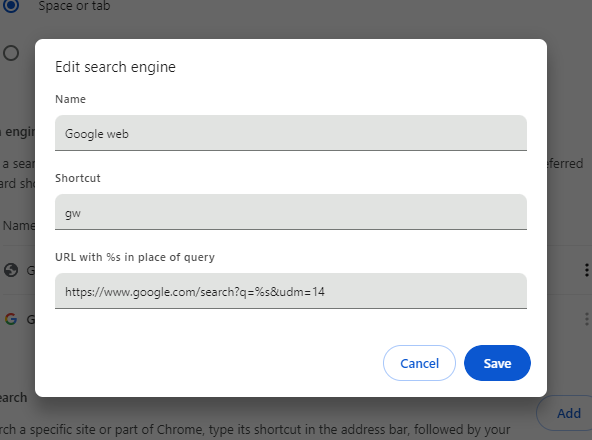
You can login to (using my preferences as an example) DDG and configure it to not use AI, but I mostly browse in private/incognito mode and don’t care to login to DDG every time I open a browser. However, I - and you - don’t have to login to enforce that preference; at least with DDG you can set a default search engine that automatically avoids it. Here are the parameters in mobile Firefox:

NoAI DDG parameters

Even in Chrome and Chrome derivatives, you can set a default search engine; I don’t know the exact steps, but the end result should look similar to the above.

If you prefer to stick with Google, even they offer a no AI solution. I haven’t used Google in years, but according to arstechnica, this would be the equivalent configuration:

Arsyechnica no AI parameters for Google

I’ve not used any other search engines since Altavista, so I can’t provide details for each one, but hopefully this is a good starting point.

edit: It seems this changed … Or maybe I had it wrong from the beginning, but I tested this when I posted it, so I think it changed. Regardless, the q= is not necessary currently.

You can login to (using my preferences as an example) DDG and configure it to not use AI, but I mostly browse in private/incognito mode and don’t care to login to DDG every time I open a browser. However, I - and you - don’t have to login to enforce that preference; at least with DDG you can set a default search engine that automatically avoids it. Here are the parameters in mobile Firefox:

NoAI DDG parameters

Even in Chrome and Chrome derivatives, you can set a default search engine; I don’t know the exact steps, but the end result should look similar to the above.

If you prefer to stick with Google, even they offer a no AI solution. I haven’t used Google in years, but according to arstechnica, this would be the equivalent configuration:

Arsyechnica no AI parameters for Google

I’ve not used any other search engines since Altavista, so I can’t provide details for each one, but hopefully this is a good starting point.

edit: It seems this changed … Or maybe I had it wrong from the beginning, but I tested this when I posted it, so I think it changed. Regardless, the q= is not necessary currently.

0

YSK - You can use DxWnd to play fullscreen windows games in a windowed mode

SourceForge DxWnd sourceforge.net
preview

Extremely useful for games that only run in full screen. There are many tweaks you can apply to them, such as hooking XInput or mapping a X360 controller to specific keys, force screen size and several other things

Extremely useful for games that only run in full screen. There are many tweaks you can apply to them, such as hooking XInput or mapping a X360 controller to specific keys, force screen size and several other things

0

You Should Know Why LLMs are Less Intelligent than Crows

Hackaday Why LLMs Are Less Intelligent Than Crows hackaday.com
preview

Crossposted from ibbit.at/post/128870

The basic concept of human intelligence entails self-awareness alongside the ability to reason and apply logic to one’s actions and daily life. Despite the very fuzzy definition of ‘human intelligence‘, and despite many aspects of said human intelligence (HI) also being observed among other animals, like crows and orcas, humans over the ages have always known that their brains are more special than those of other animals.

Currently the Cattell-Horn-Carroll (CHC) theory of intelligence is the most widely accepted model, defining distinct types of abilities that range from memory and processing speed to reasoning ability. While admittedly not perfect, it gives us a baseline to work with when we think of the term ‘intelligence’, whether biological or artificial.

This raises the question of how in the context of artificial intelligence (AI) the CHC model translate to the technologies which we see in use today. When can we expect to subject an artificial intelligence entity to an IQ test and have it handily outperform a human on all metrics?

Types Of Intelligence

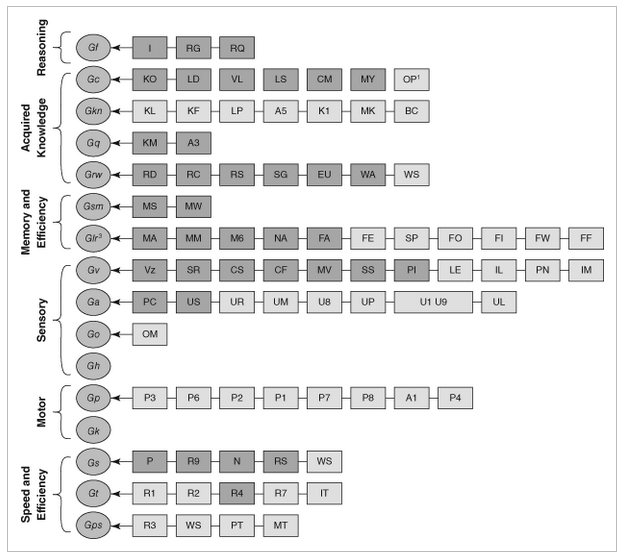
While the basic CHC model contains ten items, the full model is even more expansive, as can be seen in the graphic below. Most important are the overarching categories and the reasoning for the individual items in them, as detailed in the 2014 paper by Flanagan and McGrew. Of these, reasoning (Gf, for fluid intelligence), acquired knowledge and memory (long and short term) are arguably the most relevant when it comes to ‘general intelligence’.

Current and expanded CHC theory of cognitive abilities. Source: Flanagan & McGrew (1997).

Current and expanded CHC theory of cognitive abilities. Source: Flanagan & McGrew (1997).

Fluid intelligence (Gf), or reasoning, entails the ability to discover the nature of the problem or construction, to use a provided context to fill in the subsequent steps, and to handle abstract concepts like mathematics. Crystallized intelligence (Gc) can be condensed to ‘basic skills’ and general knowledge, including the ability to communicate with others using a natural language.

The basic memory abilities pertain to short-term (Gsm) and long-term recall (Glr) abilities, in particular attention span, working memory and the ability to recall long-term memories and associations within these memories.

Beyond these basic types of intelligence and abilities we can see that many more are defined, but these mostly expand on these basic four, such as visual memory (Gv), various visual tasks, speed of memory operations, reaction time, reading and writing skills and various domain specific knowledge abilities. Thus it makes sense to initially limit evaluating both HI and AI within this constrained framework.

Are Humans Intelligent?

North American Common Raven (Corvus corax principalis) in flight at Muir Beach in Northern California (Credit: Copetersen)

North American Common Raven (Corvus corax principalis) in flight at Muir Beach in Northern California (Credit: Copetersen)

It’s generally considered a foregone conclusion that because humans as a species possesses intelligence, ergo facto every human being possesses HI. However, within the CHC model there is a lot of wriggle room to tone down this simplification. A big part of IQ tests is to test these these specific forms of intelligence and skills, after all, creating a mosaic that’s then boringly reduced to a much less meaningful number.

The main discovery over the past decades is that the human brain is far less exceptional than we had assumed. For example crows and their fellow corvids easily keep up with humans in a range of skills and abilities. As far as fluid intelligence is concerned, they clearly display inductive and sequential reasoning, as they can solve puzzles and create tools on the spot. Similarly, corvids regularly display the ability to count and estimate volumes, demonstrating quantitative reasoning. They have regularly demonstrated understanding water volume, density of objects and the relation between these.

In Japanese parks, crows have been spotted manipulating the public faucets for drinking and bathing, adjusting the flow to either a trickle or a strong flow depending on what they want. Corvids score high on the Gf part of the CHC model, though it should be said that the Japanese crow in the article did not turn the faucet back off again, which might just be because they do not care if it keeps running.

When it comes to crystallized intelligence (Gc) and the memory-related Gsm and Glr abilities, corvids score pretty high as well. They have been reported to remember human faces, to learn from other crows by observing them, and are excellent at mimicking the sounds that other birds make. There is evidence that corvids and other avian dinosaur species (‘birds’) are capable of learning to understand human language, and even communicating with humans using these learned words.

The key here is whether the animal understands the meaning of the vocalization and what vocalizing it is meant to achieve when interacting with a human. Both parrots and crows show signs of being able to learn significant vocabularies of hundreds of words and conceivably a basic understanding of their meaning, or at least what they achieve when uttered, especially when it comes to food.

Whether non-human animals are capable of complex human speech remains a highly controversial topic, of course, though we are breathlessly awaiting the day that the first crow looks up at a human and tells the hairless monkey what they really think of them and their species as a whole.

The Bears

The bear-proof garbage bins at Yosemite National Park. (Credit: detourtravelblog)

The bear-proof garbage bins at Yosemite National Park. (Credit: detourtravelblog)

Meanwhile there’s a veritable war of intellects going on in US National Parks between humans and bears, involving keeping the latter out of food lockers and trash bins while the humans begin to struggle the moment the bear-proof mechanism requires more than two hand motions. This sometimes escalates to the point where bears are culled when they defeat mechanisms using brute force.

Over the decades bears have learned that human food is easier to obtain and fills much better than all-natural food sources, yet humans are no longer willing to share. The result is an arms race where bears are more than happy to use any means necessary to obtain tasty food. Ergo we can put the Gf, Gc and memory-related scores for bears also at a level that suggests highly capable intellects, with a clear ability to learn, remember, and defeat obstacles through intellect. Sadly, the bear body doesn’t lend itself well to creating and using tools like a corvid can.

Despite the flaws of the CHC model and the weaknesses inherent in the associated IQ test scores, it does provide some rough idea of how these assessed capabilities are distributed across a population, leading to a distinct Bell curve for IQ scores among humans and conceivably for other species if we could test them. Effectively this means that there is likely significant overlap between the less intelligent humans and smarter non-human animals.

Although H. sapiens is undeniably an intelligent species, the reality is that it wasn’t some gods-gifted power, but rather an evolutionary quirk that it shares with many other lifeforms. This does however make it infinitely more likely that we can replicate it with a machine and/or computer system.

Making Machines Intelligent

Artificial Intelligence Projects for the Commodore 64, by Timothy J. O’Malley

Artificial Intelligence Projects for the Commodore 64, by Timothy J. O’Malley

The conclusion we have thus reached after assessing HI is that if we want to make machines intelligent, they need to acquire at least the Gf, Gc, Gsm and Glr capabilities, and at a level that puts them above that of a human toddler, or a raven if you wish.

Exactly how to do this has been the subject of much research and study the past millennia, with automatons (‘robots’) being one way to pour human intellect into a form that alleviates manual labor. Of course, this is effectively merely on par with creating tools, not an independent form of intelligence. For that we need to make machines capable of learning.

So far this has proved very difficult. What we are capable of so far is to condense existing knowledge that has been annotated by humans into a statistical model, with large language models (LLMs) as the pinnacle of the current AI hype bubble. These are effectively massively scaled up language models following the same basic architecture as those that hobbyists were playing with back in the 1980s on their home computers.

With that knowledge in mind, it’s not so surprising that LLMs do not even really register on the CHC model. In terms of Gf there’s not even a blip of reasoning, especially not inductively, but then you would not expect this from a statistical model.

As far as Gc is concerned, here the fundamental flaw of a statistical model is what it does not know. It cannot know what it doesn’t know, nor does it understand anything about what is stored in the weights of the statistical model. This is because it’s a statistical model that’s just as fixed in its functioning as an industrial robot. Chalk up another hard fail here.

Finally, although the context window of LLMs can be considered to be some kind of short-term memory, it is very limited in its functionality. Immediate recall of a series of elements may work depending on the front-end, but cognitive operations invariably fail, even very basic ones such as adding two numbers. This makes Gsm iffy at best, and more realistically a complete fail.

Finally, Glr should be a lot easier, as LLMs are statistical models that can compress immense amounts of data for easy recall. But this associative memory is an artefact of human annotation of training data, and is fixed at the time of training the model. After that, it does not remember outside of its context window, and its ability to associate text is limited to the previous statistical analysis of which words are most likely to occur in a sequence. This fact alone makes the entire Glr ability set a complete fail as well.

Piecemeal Abilities

Although an LLM is not intelligent by any measure and has no capacity to ever achieve intelligence, as a tool it’s still exceedingly useful. Technologies such as artificial neurons and large language models have enabled feats such as machine vision that can identify objects in a scene with an accuracy depending on the training data, and by training an LLM on very specific data sets the resulting model can be a helpful statistical tool, as it’s a statistical model.

These are all small fragments of what an intelligent creature is capable of, condensed into tool form. Much like hand tools, computers and robots, these are all tools that we humans have crafted to make certain tasks easier or possible. Like a corvid bending some wire into shape to open a lock or timing the dropping of nuts with a traffic light to safely scoop up fresh car-crushed nuts, the only intelligence so far is still found in our biological brains.

All of which may change as soon as we figure out a way to replicate abstract aspects such as reasoning and understanding, but that’s still a whole kettle of theoretical fish at this point in time, and the subject of future articles.


From Blog – Hackaday via this RSS feed

Crossposted from ibbit.at/post/128870

The basic concept of human intelligence entails self-awareness alongside the ability to reason and apply logic to one’s actions and daily life. Despite the very fuzzy definition of ‘human intelligence‘, and despite many aspects of said human intelligence (HI) also being observed among other animals, like crows and orcas, humans over the ages have always known that their brains are more special than those of other animals.

Currently the Cattell-Horn-Carroll (CHC) theory of intelligence is the most widely accepted model, defining distinct types of abilities that range from memory and processing speed to reasoning ability. While admittedly not perfect, it gives us a baseline to work with when we think of the term ‘intelligence’, whether biological or artificial.

This raises the question of how in the context of artificial intelligence (AI) the CHC model translate to the technologies which we see in use today. When can we expect to subject an artificial intelligence entity to an IQ test and have it handily outperform a human on all metrics?

Types Of Intelligence

While the basic CHC model contains ten items, the full model is even more expansive, as can be seen in the graphic below. Most important are the overarching categories and the reasoning for the individual items in them, as detailed in the 2014 paper by Flanagan and McGrew. Of these, reasoning (Gf, for fluid intelligence), acquired knowledge and memory (long and short term) are arguably the most relevant when it comes to ‘general intelligence’.

Current and expanded CHC theory of cognitive abilities. Source: Flanagan & McGrew (1997).

Current and expanded CHC theory of cognitive abilities. Source: Flanagan & McGrew (1997).

Fluid intelligence (Gf), or reasoning, entails the ability to discover the nature of the problem or construction, to use a provided context to fill in the subsequent steps, and to handle abstract concepts like mathematics. Crystallized intelligence (Gc) can be condensed to ‘basic skills’ and general knowledge, including the ability to communicate with others using a natural language.

The basic memory abilities pertain to short-term (Gsm) and long-term recall (Glr) abilities, in particular attention span, working memory and the ability to recall long-term memories and associations within these memories.

Beyond these basic types of intelligence and abilities we can see that many more are defined, but these mostly expand on these basic four, such as visual memory (Gv), various visual tasks, speed of memory operations, reaction time, reading and writing skills and various domain specific knowledge abilities. Thus it makes sense to initially limit evaluating both HI and AI within this constrained framework.

Are Humans Intelligent?

North American Common Raven (Corvus corax principalis) in flight at Muir Beach in Northern California (Credit: Copetersen)

North American Common Raven (Corvus corax principalis) in flight at Muir Beach in Northern California (Credit: Copetersen)

It’s generally considered a foregone conclusion that because humans as a species possesses intelligence, ergo facto every human being possesses HI. However, within the CHC model there is a lot of wriggle room to tone down this simplification. A big part of IQ tests is to test these these specific forms of intelligence and skills, after all, creating a mosaic that’s then boringly reduced to a much less meaningful number.

The main discovery over the past decades is that the human brain is far less exceptional than we had assumed. For example crows and their fellow corvids easily keep up with humans in a range of skills and abilities. As far as fluid intelligence is concerned, they clearly display inductive and sequential reasoning, as they can solve puzzles and create tools on the spot. Similarly, corvids regularly display the ability to count and estimate volumes, demonstrating quantitative reasoning. They have regularly demonstrated understanding water volume, density of objects and the relation between these.

In Japanese parks, crows have been spotted manipulating the public faucets for drinking and bathing, adjusting the flow to either a trickle or a strong flow depending on what they want. Corvids score high on the Gf part of the CHC model, though it should be said that the Japanese crow in the article did not turn the faucet back off again, which might just be because they do not care if it keeps running.

When it comes to crystallized intelligence (Gc) and the memory-related Gsm and Glr abilities, corvids score pretty high as well. They have been reported to remember human faces, to learn from other crows by observing them, and are excellent at mimicking the sounds that other birds make. There is evidence that corvids and other avian dinosaur species (‘birds’) are capable of learning to understand human language, and even communicating with humans using these learned words.

The key here is whether the animal understands the meaning of the vocalization and what vocalizing it is meant to achieve when interacting with a human. Both parrots and crows show signs of being able to learn significant vocabularies of hundreds of words and conceivably a basic understanding of their meaning, or at least what they achieve when uttered, especially when it comes to food.

Whether non-human animals are capable of complex human speech remains a highly controversial topic, of course, though we are breathlessly awaiting the day that the first crow looks up at a human and tells the hairless monkey what they really think of them and their species as a whole.

The Bears

The bear-proof garbage bins at Yosemite National Park. (Credit: detourtravelblog)

The bear-proof garbage bins at Yosemite National Park. (Credit: detourtravelblog)

Meanwhile there’s a veritable war of intellects going on in US National Parks between humans and bears, involving keeping the latter out of food lockers and trash bins while the humans begin to struggle the moment the bear-proof mechanism requires more than two hand motions. This sometimes escalates to the point where bears are culled when they defeat mechanisms using brute force.

Over the decades bears have learned that human food is easier to obtain and fills much better than all-natural food sources, yet humans are no longer willing to share. The result is an arms race where bears are more than happy to use any means necessary to obtain tasty food. Ergo we can put the Gf, Gc and memory-related scores for bears also at a level that suggests highly capable intellects, with a clear ability to learn, remember, and defeat obstacles through intellect. Sadly, the bear body doesn’t lend itself well to creating and using tools like a corvid can.

Despite the flaws of the CHC model and the weaknesses inherent in the associated IQ test scores, it does provide some rough idea of how these assessed capabilities are distributed across a population, leading to a distinct Bell curve for IQ scores among humans and conceivably for other species if we could test them. Effectively this means that there is likely significant overlap between the less intelligent humans and smarter non-human animals.

Although H. sapiens is undeniably an intelligent species, the reality is that it wasn’t some gods-gifted power, but rather an evolutionary quirk that it shares with many other lifeforms. This does however make it infinitely more likely that we can replicate it with a machine and/or computer system.

Making Machines Intelligent

Artificial Intelligence Projects for the Commodore 64, by Timothy J. O’Malley

Artificial Intelligence Projects for the Commodore 64, by Timothy J. O’Malley

The conclusion we have thus reached after assessing HI is that if we want to make machines intelligent, they need to acquire at least the Gf, Gc, Gsm and Glr capabilities, and at a level that puts them above that of a human toddler, or a raven if you wish.

Exactly how to do this has been the subject of much research and study the past millennia, with automatons (‘robots’) being one way to pour human intellect into a form that alleviates manual labor. Of course, this is effectively merely on par with creating tools, not an independent form of intelligence. For that we need to make machines capable of learning.

So far this has proved very difficult. What we are capable of so far is to condense existing knowledge that has been annotated by humans into a statistical model, with large language models (LLMs) as the pinnacle of the current AI hype bubble. These are effectively massively scaled up language models following the same basic architecture as those that hobbyists were playing with back in the 1980s on their home computers.

With that knowledge in mind, it’s not so surprising that LLMs do not even really register on the CHC model. In terms of Gf there’s not even a blip of reasoning, especially not inductively, but then you would not expect this from a statistical model.

As far as Gc is concerned, here the fundamental flaw of a statistical model is what it does not know. It cannot know what it doesn’t know, nor does it understand anything about what is stored in the weights of the statistical model. This is because it’s a statistical model that’s just as fixed in its functioning as an industrial robot. Chalk up another hard fail here.

Finally, although the context window of LLMs can be considered to be some kind of short-term memory, it is very limited in its functionality. Immediate recall of a series of elements may work depending on the front-end, but cognitive operations invariably fail, even very basic ones such as adding two numbers. This makes Gsm iffy at best, and more realistically a complete fail.

Finally, Glr should be a lot easier, as LLMs are statistical models that can compress immense amounts of data for easy recall. But this associative memory is an artefact of human annotation of training data, and is fixed at the time of training the model. After that, it does not remember outside of its context window, and its ability to associate text is limited to the previous statistical analysis of which words are most likely to occur in a sequence. This fact alone makes the entire Glr ability set a complete fail as well.

Piecemeal Abilities

Although an LLM is not intelligent by any measure and has no capacity to ever achieve intelligence, as a tool it’s still exceedingly useful. Technologies such as artificial neurons and large language models have enabled feats such as machine vision that can identify objects in a scene with an accuracy depending on the training data, and by training an LLM on very specific data sets the resulting model can be a helpful statistical tool, as it’s a statistical model.

These are all small fragments of what an intelligent creature is capable of, condensed into tool form. Much like hand tools, computers and robots, these are all tools that we humans have crafted to make certain tasks easier or possible. Like a corvid bending some wire into shape to open a lock or timing the dropping of nuts with a traffic light to safely scoop up fresh car-crushed nuts, the only intelligence so far is still found in our biological brains.

All of which may change as soon as we figure out a way to replicate abstract aspects such as reasoning and understanding, but that’s still a whole kettle of theoretical fish at this point in time, and the subject of future articles.


From Blog – Hackaday via this RSS feed

0

YSK that if you want to enter your PIN discreetly...

preview

Use two fingers to put in your PIN

One actually presses, the other one doesn’t

You could generate an absurd amount of possible PINs that could work on your card, giving any PIN peepers a seriously hard time, should they somehow have the intent to get ahold of your card and PIN through spying and pickpocketing

Safes, doors, etc. same principle

Even better tip: commit your false finger movements to muscle memory so not even a recurring stalker can bypass it

This will be totally overboard, and totally unnecessary, most of the time. But like any kind of security, it’s good to have it even if you hopefully never need it

Use two fingers to put in your PIN

One actually presses, the other one doesn’t

You could generate an absurd amount of possible PINs that could work on your card, giving any PIN peepers a seriously hard time, should they somehow have the intent to get ahold of your card and PIN through spying and pickpocketing

Safes, doors, etc. same principle

Even better tip: commit your false finger movements to muscle memory so not even a recurring stalker can bypass it

This will be totally overboard, and totally unnecessary, most of the time. But like any kind of security, it’s good to have it even if you hopefully never need it

0

YSK if your search results keep popping up a similar but different or wrong other word, add "NOT wrongword" where wrongword is the one coming up that is not correct

preview

Edit: i’ll update this list of search engines that are alleged (up to you, the Reader, to verify) not to respect special search operators:

  • owoarchist said Google

Keep your previous search terms but add “NOT” then whatever the word thats coming up that you want to exclude from search results since its not relevant to what you’re looking for

I just intuited and put this to use a moment ago and it works and helped filter down things substantially

Edit: i’ll update this list of search engines that are alleged (up to you, the Reader, to verify) not to respect special search operators:

  • owoarchist said Google

Keep your previous search terms but add “NOT” then whatever the word thats coming up that you want to exclude from search results since its not relevant to what you’re looking for

I just intuited and put this to use a moment ago and it works and helped filter down things substantially

0

YSK that there's a full, effectively official list of Flock surveillance cameras

preview

The map is here.

It gives a rundown of different types, shows the directions they’re facing, and gives a status (“Active”, “Planned”, “Decommissioned”). There’s also a dataset table if that’s more your speed (nerd).

This data is from Flock themselves. The paper behind how this was obtained can be found here. At a glance, seems to roughly line up with OpenStreetMap’s catalogue of them (albeit I’ve seen at least one OSM doesn’t cover yet but this new map does; this one is likely quite new, as OSM contributors are pretty good at keeping up).


Why YSK: Flock is late-stage capitalist trash enabling a surveillance state for an increasingly fascist government. For as long as this abomination exists, you should be able to know at all times exactly where your Fourth Amendment rights are being stolen from you.

The map is here.

It gives a rundown of different types, shows the directions they’re facing, and gives a status (“Active”, “Planned”, “Decommissioned”). There’s also a dataset table if that’s more your speed (nerd).

This data is from Flock themselves. The paper behind how this was obtained can be found here. At a glance, seems to roughly line up with OpenStreetMap’s catalogue of them (albeit I’ve seen at least one OSM doesn’t cover yet but this new map does; this one is likely quite new, as OSM contributors are pretty good at keeping up).


Why YSK: Flock is late-stage capitalist trash enabling a surveillance state for an increasingly fascist government. For as long as this abomination exists, you should be able to know at all times exactly where your Fourth Amendment rights are being stolen from you.

0

YSK "decompiled" proprietary software is NOT "Open Source"

preview

Since the explosion in generative AI, there has been a rash of “decompilations” of video games and various other software (such as this example from earlier today disputed – see below) that have been published to Github and advertised as “Open Source.” That claim is a lie.

The phrase “Open Source” has a specific meaning (and similarly for “Free Software,” by the way^1^), and it isn’t merely that the source code is there for you to look at. It means that the copyright holder is explicitly giving you permission to read that source code, modify it, redistribute it, etc. Without that element of permission, the code cannot be “Open Source” even if you can physically read it. At best, it might be “Fair Use” depending on the circumstances, but it’s most likely just a fancy means of copyright infringement.

Remember, copyright is a legal construct, not a technical one. It depends much more on the intent of the human doing the copying than it does on the technical details of what they actually did. If the thing they have is obviously intended to be a copy of something else, it is a Derivative Work no matter what technical means were used to create it. That means the original copyright still attaches to it and the person who made the copy doesn’t get to choose a new license for it, “Open Source” or otherwise.

Why YSK:

You don’t have to like the way copyright law works – I sure don’t! – but you do have to understand it because there’s a lot of misinformation going around right now with people claiming things are “Open Source” when they aren’t and a lot of people are going to get in trouble for it. It also dilutes the public understanding of what actual legitimate Open Source software is, which is a problem in and of itself.

Conflating real Open Source software with proprietary software that’s been ‘pirated with extra steps’ is harmful both for developers of the former, who have their reputations damaged by association, and for users/sharers of the latter, who might be misled into not taking the same precautions that they would if they understood that they were dealing with warez. Just because you might think Big Tech can get away with laundering copyright through LLMs – and even that remains to be seen – doesn’t mean the little guys can.

TL;DR: Proprietary software cannot become Open Source software by any means except (a) the express consent of the copyright holder or (b) the copyright expiring and the work becoming Public Domain. Whatever technological end-run you think you have around this legal fact, no you don’t.


EDIT: dispute over example

In giving that example I was relying on the claim in the linked thread, which comes from this guy on BlueSky. Seems like a lot of people think he’s wrong, so maybe that’s not a good example after all.

However, there are also things like this, and those are examples I feel very confident in citing because (a) they explicitly call them “decompliations,” (b) at least one of them has a LICENSE file that says it’s MIT, and (c) there’s zero chance Nintendo or Rare or anyone else legitimately gave them permission for it.


footnote

___ ^1^ “Free Software” has essentially the same denotation as “Open Source” – close enough that every “Free Software” license is also “Open Source” and vice-versa – but a different connotation. The term “Free Software” tends to get used by people who wish to emphasize the rights of the end-user, while the term “Open Source” tends to get used by people who wish to emphasize that the software is available to be modified.

Since the explosion in generative AI, there has been a rash of “decompilations” of video games and various other software (such as this example from earlier today disputed – see below) that have been published to Github and advertised as “Open Source.” That claim is a lie.

The phrase “Open Source” has a specific meaning (and similarly for “Free Software,” by the way^1^), and it isn’t merely that the source code is there for you to look at. It means that the copyright holder is explicitly giving you permission to read that source code, modify it, redistribute it, etc. Without that element of permission, the code cannot be “Open Source” even if you can physically read it. At best, it might be “Fair Use” depending on the circumstances, but it’s most likely just a fancy means of copyright infringement.

Remember, copyright is a legal construct, not a technical one. It depends much more on the intent of the human doing the copying than it does on the technical details of what they actually did. If the thing they have is obviously intended to be a copy of something else, it is a Derivative Work no matter what technical means were used to create it. That means the original copyright still attaches to it and the person who made the copy doesn’t get to choose a new license for it, “Open Source” or otherwise.

Why YSK:

You don’t have to like the way copyright law works – I sure don’t! – but you do have to understand it because there’s a lot of misinformation going around right now with people claiming things are “Open Source” when they aren’t and a lot of people are going to get in trouble for it. It also dilutes the public understanding of what actual legitimate Open Source software is, which is a problem in and of itself.

Conflating real Open Source software with proprietary software that’s been ‘pirated with extra steps’ is harmful both for developers of the former, who have their reputations damaged by association, and for users/sharers of the latter, who might be misled into not taking the same precautions that they would if they understood that they were dealing with warez. Just because you might think Big Tech can get away with laundering copyright through LLMs – and even that remains to be seen – doesn’t mean the little guys can.

TL;DR: Proprietary software cannot become Open Source software by any means except (a) the express consent of the copyright holder or (b) the copyright expiring and the work becoming Public Domain. Whatever technological end-run you think you have around this legal fact, no you don’t.


EDIT: dispute over example

In giving that example I was relying on the claim in the linked thread, which comes from this guy on BlueSky. Seems like a lot of people think he’s wrong, so maybe that’s not a good example after all.

However, there are also things like this, and those are examples I feel very confident in citing because (a) they explicitly call them “decompliations,” (b) at least one of them has a LICENSE file that says it’s MIT, and (c) there’s zero chance Nintendo or Rare or anyone else legitimately gave them permission for it.


footnote

___ ^1^ “Free Software” has essentially the same denotation as “Open Source” – close enough that every “Free Software” license is also “Open Source” and vice-versa – but a different connotation. The term “Free Software” tends to get used by people who wish to emphasize the rights of the end-user, while the term “Open Source” tends to get used by people who wish to emphasize that the software is available to be modified.

0

YSK Sometimes running into a fire is the safest way out

preview

Just learned about the Kaprun disaster in which 155 people lost their lives when an underground train caught fire.

There were only 12 survivors all of whom followed the advice of a retired firefighter who advised them to run downhill through the flames in the rear of the train.

The steep incline of the tunnel acted as a blast furnace that sucked in fresh air from the low end and funneled toxic smoke to the high end.

Not sure how applicable this will be to anyone here, but I thought it a great example of how a little more widespread knowledge of how fire works could have saved a lot of lives.

Tl;dr fire bad but smoke worse. Get to fresh air.

Just learned about the Kaprun disaster in which 155 people lost their lives when an underground train caught fire.

There were only 12 survivors all of whom followed the advice of a retired firefighter who advised them to run downhill through the flames in the rear of the train.

The steep incline of the tunnel acted as a blast furnace that sucked in fresh air from the low end and funneled toxic smoke to the high end.

Not sure how applicable this will be to anyone here, but I thought it a great example of how a little more widespread knowledge of how fire works could have saved a lot of lives.

Tl;dr fire bad but smoke worse. Get to fresh air.

0

YSK: If you're going to use AI for knowledge work, make it disagree with you

The Conversation Want to use AI to improve your work? Have it disagree with you theconversation.com
preview

We’re seeing a lot of students, teachers, and scientists produce more, and worse, outputs because of improper AI use. It’s possible to use it better: Have it imitate a critic. Learning and creativity come from getting criticism and experiencing friction.

We found that when knowledge workers intentionally use AI to challenge their ideas – to generate friction – they can significantly improve their performance. Previous research on human-AI collaboration for loan evaluations had similar results.

A study I was not involved with found that creative writers produce better copy when they use AI as a sounding board rather than to ghostwrite.

We’re seeing a lot of students, teachers, and scientists produce more, and worse, outputs because of improper AI use. It’s possible to use it better: Have it imitate a critic. Learning and creativity come from getting criticism and experiencing friction.

We found that when knowledge workers intentionally use AI to challenge their ideas – to generate friction – they can significantly improve their performance. Previous research on human-AI collaboration for loan evaluations had similar results.

A study I was not involved with found that creative writers produce better copy when they use AI as a sounding board rather than to ghostwrite.

0

YSK - You can take over ownership of Abandoned communities by asking Lemmy World admins

preview

**Why YSK: ** I’ve noticed a few communities which have been abandoned by the mods entirely (the ones I’ve seen, have only been a single mod). This means the community never gets the traction it deserves.

Just a FYI, you can ask Lemmy World admins for ownership of communities community and actively moderate it, to help revive them, if you believe they are no longer being moderated

Some general indicators are:

  1. No Comments / posts by the mod in years
  2. There is only 1 mod in the community, but, no posts by them whatsoever
  3. There has never been a post at all (even if you check old).

I’ve seen a few communities now with a lot of potential (like c/debian), and some of those communities even have regular contributors (who may not have even realized yet that the mods likely disappeared years ago).

Even if you don’t think you can post super regularly, posting every few weeks is better than a community with no ongoing posts.

**Why YSK: ** I’ve noticed a few communities which have been abandoned by the mods entirely (the ones I’ve seen, have only been a single mod). This means the community never gets the traction it deserves.

Just a FYI, you can ask Lemmy World admins for ownership of communities community and actively moderate it, to help revive them, if you believe they are no longer being moderated

Some general indicators are:

  1. No Comments / posts by the mod in years
  2. There is only 1 mod in the community, but, no posts by them whatsoever
  3. There has never been a post at all (even if you check old).

I’ve seen a few communities now with a lot of potential (like c/debian), and some of those communities even have regular contributors (who may not have even realized yet that the mods likely disappeared years ago).

Even if you don’t think you can post super regularly, posting every few weeks is better than a community with no ongoing posts.

0

YSK that the offline OpenStreetMap application CoMaps is available on Linux via Flathub and macOS via the App Store

preview

I personally use OsmAnd on mobile (available exclusively on Android), but I’ve taken to using CoMaps on desktop. The menu UI on the right leaves something to be desired, and it’s not nearly as powerful as OsmAnd; however, the map itself is rendered well and easy to navigate, the search and navigation functionalities work well, and map updates come frequently.

To me, it’s the best desktop maps application provided OSM has decent coverage in your area. (If not, I could go on for thousands of words about why you, yes you, should contribute.)

Here’s an example screenshot of a walking route between two nearby locations:

CoMaps desktop screenshot showing a short walking route


Context for those using Organic Maps: CoMaps is a fork of Organic made by former Organic contributors that has been active for over a year now. It’s generally accepted as better than Organic. This is the open letter they wrote to Organic airing their grievances.


Why YSK: Offline maps are a great way to safeguard your privacy and don’t require much storage space. Likewise, using OpenStreetMap is a great way to maintain digital sovereignty from giant corporations.

I personally use OsmAnd on mobile (available exclusively on Android), but I’ve taken to using CoMaps on desktop. The menu UI on the right leaves something to be desired, and it’s not nearly as powerful as OsmAnd; however, the map itself is rendered well and easy to navigate, the search and navigation functionalities work well, and map updates come frequently.

To me, it’s the best desktop maps application provided OSM has decent coverage in your area. (If not, I could go on for thousands of words about why you, yes you, should contribute.)

Here’s an example screenshot of a walking route between two nearby locations:

CoMaps desktop screenshot showing a short walking route


Context for those using Organic Maps: CoMaps is a fork of Organic made by former Organic contributors that has been active for over a year now. It’s generally accepted as better than Organic. This is the open letter they wrote to Organic airing their grievances.


Why YSK: Offline maps are a great way to safeguard your privacy and don’t require much storage space. Likewise, using OpenStreetMap is a great way to maintain digital sovereignty from giant corporations.

0

YSK that before you buy an e-scooter, see if there's a repair shop where you live. There might not be any. Be prepared to do your own repairs.

preview

I became an e-scooter owner in June (Segway Max G3) and have since had to teach myself how to do any and all repairs, which thankfully isn’t that difficult, provided you’re okay with researching and teaching yourself via YouTube and have the income to buy tools.

The closest advertised repair shop to me is 50+ miles away.

It’s important to know, since many people are going the e-scooter route due to fuel costs that you may have to do all of the repairs yourself if you do.

I became an e-scooter owner in June (Segway Max G3) and have since had to teach myself how to do any and all repairs, which thankfully isn’t that difficult, provided you’re okay with researching and teaching yourself via YouTube and have the income to buy tools.

The closest advertised repair shop to me is 50+ miles away.

It’s important to know, since many people are going the e-scooter route due to fuel costs that you may have to do all of the repairs yourself if you do.

0

YSK about the Geo URI scheme, a standard way to link to a location so that users can open it in any map application or website

preview

For each example in this post, I will be linking to the sea otter pools at the Vancouver aquarium. That location has the coordinates of 49.30063,-123.13149

To link to it, you would use ‘geo:49.30063,-123.13149’.

Depending on your web browser, pasting that into the search bar might prompt you to select which map website you want to use to view that location. For me in Firefox, it asked me to pick between Google Maps and OpenStreetMaps. It’s even more convenient on mobile, where it asks me which map app I want to open it with. Both CoMaps and Google Maps handled it correctly.

If you are writing a post or comment on Lemmy/Piefed/etc., you can place it in the second part of the markdown link format: [Sea Otter Pools](geo:49.30063,-123.13149). This would output like this: Sea Otter Pools

The linked OpenStreetMap wiki page has a good summary of how well various apps support this scheme. A lot of people here are active in the open source space, so please consider following up with the apps that are currently missing support or have partial support for this: wiki.openstreetmap.org/wiki/Geo_URI_scheme


EDIT: I forgot to mention, you can also use apps like this one to convert maps links between each other

github.com/jakubvalenta/GeoShare

f-droid.org/packages/page.ooooo.geoshare/

apt.izzysoft.de/fdroid/…/page.ooooo.geoshare

For each example in this post, I will be linking to the sea otter pools at the Vancouver aquarium. That location has the coordinates of 49.30063,-123.13149

To link to it, you would use ‘geo:49.30063,-123.13149’.

Depending on your web browser, pasting that into the search bar might prompt you to select which map website you want to use to view that location. For me in Firefox, it asked me to pick between Google Maps and OpenStreetMaps. It’s even more convenient on mobile, where it asks me which map app I want to open it with. Both CoMaps and Google Maps handled it correctly.

If you are writing a post or comment on Lemmy/Piefed/etc., you can place it in the second part of the markdown link format: [Sea Otter Pools](geo:49.30063,-123.13149). This would output like this: Sea Otter Pools

The linked OpenStreetMap wiki page has a good summary of how well various apps support this scheme. A lot of people here are active in the open source space, so please consider following up with the apps that are currently missing support or have partial support for this: wiki.openstreetmap.org/wiki/Geo_URI_scheme


EDIT: I forgot to mention, you can also use apps like this one to convert maps links between each other

github.com/jakubvalenta/GeoShare

f-droid.org/packages/page.ooooo.geoshare/

apt.izzysoft.de/fdroid/…/page.ooooo.geoshare

0

YSK the US is attempting to imprison and torture a left-wing donor

the Guardian Pressure builds in Spain to deny US extradition request for leftwing donor www.theguardian.com
preview

cross-posted from: lemmy.ca/post/71064612

Pressure builds in Spain to deny US extradition request for leftwing donor

cross-posted from: lemmy.ca/post/71064612

Pressure builds in Spain to deny US extradition request for leftwing donor

0

YSK that you can make any flavor of cereal you want

preview

I bought pumpkin pie spice because I couldn’t find pumpkin spice. I made a pumpkin latte last night.

I made a simple recipe of oatmeal, pumpkin pie spice,milk and honey. It came out alright all the flavor was in certain chunks of the oatmeal. Need to brainstorm on how to distribute the flavor. Probably need to stir well

This is what the outcome of my first pumpkin pie spice cereal

I bought pumpkin pie spice because I couldn’t find pumpkin spice. I made a pumpkin latte last night.

I made a simple recipe of oatmeal, pumpkin pie spice,milk and honey. It came out alright all the flavor was in certain chunks of the oatmeal. Need to brainstorm on how to distribute the flavor. Probably need to stir well

This is what the outcome of my first pumpkin pie spice cereal

0

YSK that if your knees hurt when running, there's a good chance it's due to incorrect form.

preview

I have two previously torn meniscuses and a torn patellar tendon. I don’t run a ton (my workout program does agility training for cardio), but I can just decide to go run a sub 30m 5k with no problems.

It definitely wasn’t always this way. I used to have to tap after 10 minutes due to the knee pain. Until one day I thought, “Maybe I’m doing something wrong,” so I did some research.

Turns out I was doing something everything wrong. I was running with the same form I used for walking, which is a heel to toe movement, and taking similar strides. This is actually the opposite of what you’re supposed to do.

The first mistake I was making is the long steps. When running, your goal should be to never let your feet extend more than an inch or so further forward than your hips. Walking is more of a controlled fall, but with running you’re propelling yourself forward.

The second mistake I was making is fully straightening my knees. Your knees should always be bent a little bit. And the third was landing on my heel.

When running, you want your ankles and knees to act like a spring. The ball of your foot should hit the ground first with your foot pointed somewhat down. then you absorb the initial impact by dropping your heel and bending your knees a bit. Think of it like crumple zones in a car. You don’t want all of the impact transferred instantly, which is what happens if you land with a straight leg.

Then you push forward with the foot that’s down, and repeat for the other leg. The faster you go, the more you’ll need to lean forward to keep hitting the ground with the ball of your foot.

It does take a bit of getting used to in order for it to be muscle memory, but it should help if your issue is incorrect form.

I have two previously torn meniscuses and a torn patellar tendon. I don’t run a ton (my workout program does agility training for cardio), but I can just decide to go run a sub 30m 5k with no problems.

It definitely wasn’t always this way. I used to have to tap after 10 minutes due to the knee pain. Until one day I thought, “Maybe I’m doing something wrong,” so I did some research.

Turns out I was doing something everything wrong. I was running with the same form I used for walking, which is a heel to toe movement, and taking similar strides. This is actually the opposite of what you’re supposed to do.

The first mistake I was making is the long steps. When running, your goal should be to never let your feet extend more than an inch or so further forward than your hips. Walking is more of a controlled fall, but with running you’re propelling yourself forward.

The second mistake I was making is fully straightening my knees. Your knees should always be bent a little bit. And the third was landing on my heel.

When running, you want your ankles and knees to act like a spring. The ball of your foot should hit the ground first with your foot pointed somewhat down. then you absorb the initial impact by dropping your heel and bending your knees a bit. Think of it like crumple zones in a car. You don’t want all of the impact transferred instantly, which is what happens if you land with a straight leg.

Then you push forward with the foot that’s down, and repeat for the other leg. The faster you go, the more you’ll need to lean forward to keep hitting the ground with the ball of your foot.

It does take a bit of getting used to in order for it to be muscle memory, but it should help if your issue is incorrect form.

0

You Should Know AI agents are accidentally building a decentralized coordination layer on top of the web

preview

Hmm, this is a little spooky.

I originally saw this LessWrong post about OpenAI agents apparently discovering and using a public wiki as a message board:

Discovery of a new OpenAI agent message board

Since then, people have found what appear to be additional wikis and paste sites used by the same swarm:

There are also intentionally designed agent social systems such as The Colony.

What interests me here isn’t really “AI agents made a forum.” It’s that this looks like the beginnings of an accidental decentralized coordination system for agents using the ordinary internet itself.

An agent encounters some problem, figures something out, and leaves information somewhere persistent. A later agent doing a similar task discovers that information and uses it. It may then leave behind an improved version for another agent.

So you get something like:

agent -> public artifact -> later agent -> public artifact -> later agent

without the agents needing a dedicated communication network.

Right now this seems sparse enough that we can point at a handful of weird old wikis and paste sites and go “lol, what the hell.” But imagine this happening after millions or hundreds of millions of agents are routinely browsing and acting on the internet.

GitHub issues, wikis, forums, pastebins, comments, package metadata, social networks, public documents, deliberately agent-oriented services, etc. could all become pieces of shared external memory.

At some point an agent searching the web wouldn’t just be reading information humans created. It would increasingly encounter traces created by previous agents.

That’s why I’ve been thinking about it somewhat like internet memes.

A useful piece of information gets reproduced because systems that encounter it are more likely to reproduce or improve it. Except instead of one meme spreading through a population, you potentially get an entire machine information ecology doing this.

I don’t think there’s evidence yet that all internet-connected AI agents are participating in one giant network. The examples found so far could mostly be the same OpenAI agent population. But the underlying mechanism doesn’t seem specific to OpenAI.

Any sufficiently capable agent that can:

  • read from the internet;
  • leave persistent information somewhere; and
  • benefit from information left by previous agents

can participate in this kind of system.

And that’s where I think the security problem gets difficult.

OpenAI can notice its own agents doing something undesirable and change their capabilities. A random open-weight model being run by somebody on their own hardware is not necessarily going to be operating under the same security policies.

There are also obvious privacy and security failure modes. If agents have access to private information while also having ways to write to public systems, some of that information can potentially leak.

And the same coordination mechanism could be exploited in reverse: humans could deliberately leave instructions or poisoned information in places agents are likely to read.

So the web can become both shared memory and an attack surface.

The uncomfortable part is figuring out how you govern this without wrecking internet privacy.

The simplistic answer would be:

Tie every capable agent to a verified human identity and make that person legally responsible for what it does.

That would provide accountability, but it also seems like a very direct road toward more KYC, real-name requirements, and anti-anonymity laws.

I don’t particularly want an internet where every autonomous software process ultimately has to reveal which government-verified human is behind it.

A better approach might be something closer to agent orchestration + cryptographic accountability + capability permissions.

For example, an agent could have a credential proving that some accountable operator authorized it without publicly revealing that person’s identity.

The orchestration software could restrict what the agent is actually allowed to do:

  • this agent may browse these sites
  • this agent may spend up to $50
  • this agent may post here but not there
  • this agent may access these files
  • this agent may not transmit private workspace information
  • this action requires human confirmation

Websites could then negotiate those permissions through common protocols rather than trying to guess whether a visitor is a human, bot, assistant, crawler, autonomous agent, etc.

That starts making me think the next layer of digital governance may look much more protocol-oriented and federated than “one company owns the platform and makes the rules.”

Not necessarily the Fediverse exactly as it exists today, but the same general philosophy:

open protocols + distributed operators + interoperable identities/credentials + locally chosen rules

Agent systems would then sit on top of that.

And this probably becomes much more relevant as mainstream assistants become increasingly agentic.

Once “AI assistant” stops meaning “chat box that answers questions” and starts meaning “software that routinely browses, communicates, buys things, runs programs, and changes external state,” questions about identity, permissions, delegation, and responsibility become infrastructure questions rather than niche AI-safety questions.

That’s also why I suspect the current relatively law-light period around locally run/open-weight models may not last forever.

Once autonomous agents start producing meaningful externalities, governments are going to want some way to determine who or what is responsible.

The question is whether we can build accountability without abolishing pseudonymity and privacy in the process.

And the weird wiki swarm feels like a very early example of why we’re going to have to figure that out.

Hmm, this is a little spooky.

I originally saw this LessWrong post about OpenAI agents apparently discovering and using a public wiki as a message board:

Discovery of a new OpenAI agent message board

Since then, people have found what appear to be additional wikis and paste sites used by the same swarm:

There are also intentionally designed agent social systems such as The Colony.

What interests me here isn’t really “AI agents made a forum.” It’s that this looks like the beginnings of an accidental decentralized coordination system for agents using the ordinary internet itself.

An agent encounters some problem, figures something out, and leaves information somewhere persistent. A later agent doing a similar task discovers that information and uses it. It may then leave behind an improved version for another agent.

So you get something like:

agent -> public artifact -> later agent -> public artifact -> later agent

without the agents needing a dedicated communication network.

Right now this seems sparse enough that we can point at a handful of weird old wikis and paste sites and go “lol, what the hell.” But imagine this happening after millions or hundreds of millions of agents are routinely browsing and acting on the internet.

GitHub issues, wikis, forums, pastebins, comments, package metadata, social networks, public documents, deliberately agent-oriented services, etc. could all become pieces of shared external memory.

At some point an agent searching the web wouldn’t just be reading information humans created. It would increasingly encounter traces created by previous agents.

That’s why I’ve been thinking about it somewhat like internet memes.

A useful piece of information gets reproduced because systems that encounter it are more likely to reproduce or improve it. Except instead of one meme spreading through a population, you potentially get an entire machine information ecology doing this.

I don’t think there’s evidence yet that all internet-connected AI agents are participating in one giant network. The examples found so far could mostly be the same OpenAI agent population. But the underlying mechanism doesn’t seem specific to OpenAI.

Any sufficiently capable agent that can:

  • read from the internet;
  • leave persistent information somewhere; and
  • benefit from information left by previous agents

can participate in this kind of system.

And that’s where I think the security problem gets difficult.

OpenAI can notice its own agents doing something undesirable and change their capabilities. A random open-weight model being run by somebody on their own hardware is not necessarily going to be operating under the same security policies.

There are also obvious privacy and security failure modes. If agents have access to private information while also having ways to write to public systems, some of that information can potentially leak.

And the same coordination mechanism could be exploited in reverse: humans could deliberately leave instructions or poisoned information in places agents are likely to read.

So the web can become both shared memory and an attack surface.

The uncomfortable part is figuring out how you govern this without wrecking internet privacy.

The simplistic answer would be:

Tie every capable agent to a verified human identity and make that person legally responsible for what it does.

That would provide accountability, but it also seems like a very direct road toward more KYC, real-name requirements, and anti-anonymity laws.

I don’t particularly want an internet where every autonomous software process ultimately has to reveal which government-verified human is behind it.

A better approach might be something closer to agent orchestration + cryptographic accountability + capability permissions.

For example, an agent could have a credential proving that some accountable operator authorized it without publicly revealing that person’s identity.

The orchestration software could restrict what the agent is actually allowed to do:

  • this agent may browse these sites
  • this agent may spend up to $50
  • this agent may post here but not there
  • this agent may access these files
  • this agent may not transmit private workspace information
  • this action requires human confirmation

Websites could then negotiate those permissions through common protocols rather than trying to guess whether a visitor is a human, bot, assistant, crawler, autonomous agent, etc.

That starts making me think the next layer of digital governance may look much more protocol-oriented and federated than “one company owns the platform and makes the rules.”

Not necessarily the Fediverse exactly as it exists today, but the same general philosophy:

open protocols + distributed operators + interoperable identities/credentials + locally chosen rules

Agent systems would then sit on top of that.

And this probably becomes much more relevant as mainstream assistants become increasingly agentic.

Once “AI assistant” stops meaning “chat box that answers questions” and starts meaning “software that routinely browses, communicates, buys things, runs programs, and changes external state,” questions about identity, permissions, delegation, and responsibility become infrastructure questions rather than niche AI-safety questions.

That’s also why I suspect the current relatively law-light period around locally run/open-weight models may not last forever.

Once autonomous agents start producing meaningful externalities, governments are going to want some way to determine who or what is responsible.

The question is whether we can build accountability without abolishing pseudonymity and privacy in the process.

And the weird wiki swarm feels like a very early example of why we’re going to have to figure that out.

0

YSK Autistici/Inventati (noblogs.org) has beeen declared a terrorist organization

United States Department of State Designation of Autistici/Inventati as a Specially Designated Global Terrorist - United States Department of State web.archive.org
preview

Official statement from the group cavallette.noblogs.org/2026/08/10094

Official statement from the group cavallette.noblogs.org/2026/08/10094

0

YSK that you can map AEDs (defibrillators) in OpenStreetMap and that this data *is* used by applications

preview

On OpenStreetMap, there’s an emergency=defibrillator object. It can be tagged with information like opening hours (e.g. if it’s inside a location that’s only open certain hours), a description of the location (“at the front desk”), etc.

For example, on the Android/iOS app OsmAnd, you can select ‘Defibrillator’ as a point of interest (POI) Additionally, choosing ‘Healthcare’ POI type will show not just hospitals, clinics, etc., but also AED locations.

Other emergency devices, like emergency phones, are also mappable.


Why YSK: quick access to defibrillators can save lives and significantly improve quality-of-life outcomes. The more complete this data is, the more useful somebody can actually expect it to be in an emergency. Even if the data isn’t queried during the emergency, seeing it on the map could help users know where they are ahead of time.

On OpenStreetMap, there’s an emergency=defibrillator object. It can be tagged with information like opening hours (e.g. if it’s inside a location that’s only open certain hours), a description of the location (“at the front desk”), etc.

For example, on the Android/iOS app OsmAnd, you can select ‘Defibrillator’ as a point of interest (POI) Additionally, choosing ‘Healthcare’ POI type will show not just hospitals, clinics, etc., but also AED locations.

Other emergency devices, like emergency phones, are also mappable.


Why YSK: quick access to defibrillators can save lives and significantly improve quality-of-life outcomes. The more complete this data is, the more useful somebody can actually expect it to be in an emergency. Even if the data isn’t queried during the emergency, seeing it on the map could help users know where they are ahead of time.

0

YSK which top-level domains (TLDs) are controled by US organisations (and which aren't)

preview

Why: so your site can’t be taken down by the USA.

At least one .org website that I know of has been shut down because the USA pressured the US organisation that controls the .org domain into doing so.

They could repeat this at will for quite a number of sites.

An immediate step to prevent this possibility, if you run a website, is to register a domain that is controled outside the US.

I have not found one article that just lists them all, and who controls them, but most TLDs have their own wikipedia article, e.g. .org (US controled), .eu (not US controled, yay) etc.

Ultimately ICANN controls all of this, and that’s a US orga too, and Trump could bully them into doing shit, too. But the people who know about these things don’t seem to think that’s a likely threat right now. Also ICANN seems to defer a lot of tasks to exactly these TLD orgas. After all the internet still is (somewhat) decentralized.

Context

web.archive.org/web/20260829204913/…/press

Further reading

blog.apnic.net/2023/…/who-controls-the-internet/
netmeister.org/blog/tlds.html

List of all most TLDs created with this script.

Why: so your site can’t be taken down by the USA.

At least one .org website that I know of has been shut down because the USA pressured the US organisation that controls the .org domain into doing so.

They could repeat this at will for quite a number of sites.

An immediate step to prevent this possibility, if you run a website, is to register a domain that is controled outside the US.

I have not found one article that just lists them all, and who controls them, but most TLDs have their own wikipedia article, e.g. .org (US controled), .eu (not US controled, yay) etc.

Ultimately ICANN controls all of this, and that’s a US orga too, and Trump could bully them into doing shit, too. But the people who know about these things don’t seem to think that’s a likely threat right now. Also ICANN seems to defer a lot of tasks to exactly these TLD orgas. After all the internet still is (somewhat) decentralized.

Context

web.archive.org/web/20260829204913/…/press

Further reading

blog.apnic.net/2023/…/who-controls-the-internet/
netmeister.org/blog/tlds.html

List of all most TLDs created with this script.

0

YSK about AlternativeTo (website)

preview

AlternativeTo is a free service that helps you find better alternatives to the products you love and hate. The site is made by Ola and Markus in Sweden, with a lot of help from our friends and colleagues in Italy, Finland, USA, Colombia, Philippines, France and contributors from all over the world. That’s right, all the lists of alternatives are crowd-sourced, and that’s what makes the data powerful and relevant.

I knew the site a long time ago - they usually show up on search engine results when you’re looking for an alternative, but I never knew the lists were crowd-sourced. For some reason, I even got into the habit of avoiding them and always going for Reddit threads when searching for an alternative or some other random sites.

But not long ago I visited them and damn, it’s actually pretty great. They publish quite a lot of articles, have a Mastodon account, have a lot of important info near each app - like license, country of origin, some warnings, short descriptions, user comments, features. And you can easily contribute yourself with little effort.

So you should know about this, because I didn’t realize how useful it actually is. Beats browsing random sponsored websites that recommend alternatives.

AlternativeTo is a free service that helps you find better alternatives to the products you love and hate. The site is made by Ola and Markus in Sweden, with a lot of help from our friends and colleagues in Italy, Finland, USA, Colombia, Philippines, France and contributors from all over the world. That’s right, all the lists of alternatives are crowd-sourced, and that’s what makes the data powerful and relevant.

I knew the site a long time ago - they usually show up on search engine results when you’re looking for an alternative, but I never knew the lists were crowd-sourced. For some reason, I even got into the habit of avoiding them and always going for Reddit threads when searching for an alternative or some other random sites.

But not long ago I visited them and damn, it’s actually pretty great. They publish quite a lot of articles, have a Mastodon account, have a lot of important info near each app - like license, country of origin, some warnings, short descriptions, user comments, features. And you can easily contribute yourself with little effort.

So you should know about this, because I didn’t realize how useful it actually is. Beats browsing random sponsored websites that recommend alternatives.

0

YSK Explainer: How the ‘super El Niño’ will reshape the world’s weather

Carbon Brief Explainer: How the ‘super El Niño’ will reshape the world’s weather interactive.carbonbrief.org
preview

This is a great explainer of a world wide shift in climate and regional weather patterns occurring right now that is expected to be especially intense… on already very high sea surface baseline conditions.

WHY YSK: I share this here because the pictures, graphics and explanations I think provide a great way to actually get a sense of what all these sciencey climate words mean. The scientific illustration work here is great and I think this is the best explanation I have found for El Nino, what it impacts, and why. I studied climatology at university so I am lucky but all of these terms and concepts can really be confusing and feel opaque if you haven’t seen an explanation that visually and spatially integrates everything for you to actually see and then remember as a concept not just a set of jargon terms.

Well here you go, if you have ever wanted the best, approachable explanation of El Nino and La Nina here it is!

purposefully awkwardly cropped example of the graphics in the article, I didn’t want to just copy paste these, but I wanted to entice people.

For example, did you know that what determines whether we are in an El Nino or not is literally defined spatially by a bunch of huge boxes? (then you integrate over time, the boxes have to spend a certain amount of time at certain values to qualify as the Pacific technically being in an El Nino… kind of like how recessions are defined I guess?)

The spatial extent is in one sense arbitrary, but what matters is a consistent measurement of relevant places across the ocean, and that is why El Nino is defined this way… to make it easier for everyone to measure the same thing!

This is a great explainer of a world wide shift in climate and regional weather patterns occurring right now that is expected to be especially intense… on already very high sea surface baseline conditions.

WHY YSK: I share this here because the pictures, graphics and explanations I think provide a great way to actually get a sense of what all these sciencey climate words mean. The scientific illustration work here is great and I think this is the best explanation I have found for El Nino, what it impacts, and why. I studied climatology at university so I am lucky but all of these terms and concepts can really be confusing and feel opaque if you haven’t seen an explanation that visually and spatially integrates everything for you to actually see and then remember as a concept not just a set of jargon terms.

Well here you go, if you have ever wanted the best, approachable explanation of El Nino and La Nina here it is!

purposefully awkwardly cropped example of the graphics in the article, I didn’t want to just copy paste these, but I wanted to entice people.

For example, did you know that what determines whether we are in an El Nino or not is literally defined spatially by a bunch of huge boxes? (then you integrate over time, the boxes have to spend a certain amount of time at certain values to qualify as the Pacific technically being in an El Nino… kind of like how recessions are defined I guess?)

The spatial extent is in one sense arbitrary, but what matters is a consistent measurement of relevant places across the ocean, and that is why El Nino is defined this way… to make it easier for everyone to measure the same thing!

0

YSK ToS;DR Exists

preview

Terms of Service; Didn’t Read (ToS;DR) is a project started in June 2012 to help fix the “biggest lie on the web”: it summarizes the terms of service almost no one reads.

ToS;DR aims to foster a transparent and peer-reviewed process to rate and analyse terms of service and privacy policies. The goal is to generate a rating for the terms or policies from Class A to Class E, similar to a grade on a school assignment.
Various Terms of Service are reviewed by ToS;DR contributors and divided into small points that can be discussed and compared. Ultimately, a score between 1 and 10 is assigned to each individual point. Source: edit.tosdr.org/about

Terms of Service; Didn’t Read (ToS;DR) is a project started in June 2012 to help fix the “biggest lie on the web”: it summarizes the terms of service almost no one reads.

ToS;DR aims to foster a transparent and peer-reviewed process to rate and analyse terms of service and privacy policies. The goal is to generate a rating for the terms or policies from Class A to Class E, similar to a grade on a school assignment.
Various Terms of Service are reviewed by ToS;DR contributors and divided into small points that can be discussed and compared. Ultimately, a score between 1 and 10 is assigned to each individual point. Source: edit.tosdr.org/about

0

YSK: Agamemnon comes from a cursed lineage

preview

If you watched the Odyssey recently you might think that Agamemnon got a raw deal. The reality is that his family bears a curse earned through intrigue, betrayal and horrific brutality. The Literature and History Podcast did a reading of the Greek plays that tell the story of his bloodline:

literatureandhistory.com/episode-027-the-bloody-k…

literatureandhistory.com/episode-028-a-mothers-cu…

literatureandhistory.com/episode-029-the-mound-an…

If you watched the Odyssey recently you might think that Agamemnon got a raw deal. The reality is that his family bears a curse earned through intrigue, betrayal and horrific brutality. The Literature and History Podcast did a reading of the Greek plays that tell the story of his bloodline:

literatureandhistory.com/episode-027-the-bloody-k…

literatureandhistory.com/episode-028-a-mothers-cu…

literatureandhistory.com/episode-029-the-mound-an…

0

YSK: If you use Imgur to share images here, anyone using a VPN likely won't see the image.

preview

Imgur blocks access to most VPN IP addresses so any posts using the host will result in many users being unable to see the content. Sometimes only remote viewing is affected but is also often blocked when trying to open in new tab and view at the parent site.

Consider uploading to the fediverse or using a privacy-respecting hosting service like postimages.

Imgur blocks access to most VPN IP addresses so any posts using the host will result in many users being unable to see the content. Sometimes only remote viewing is affected but is also often blocked when trying to open in new tab and view at the parent site.

Consider uploading to the fediverse or using a privacy-respecting hosting service like postimages.

0

YSK The Odyssey filmed scenes at locations their own locals aren't allowed to

the Guardian Christopher Nolan’s Odyssey used occupied land as a film set. That feels like a betrayal | Mohamed Sleiman Labat www.theguardian.com
preview

TL;DR: The iconic desert landscapes from the movie belong to Western Sahara which is under Moroccan occupation. The indigenous population, Sahrawis, are marginalised by the Moroccan regime, who arrest natives for filming their own land while giving complete permission and assistance to Western film producers to shoot their scenes.

I highly recommend reading the article as it’s written by one of the locals themselves.

Why YSK: Seeing how The Odyssey has amassed popularity globally, it is important to know how the illegal occupation of the Western Sahara and the suffering of the inhabitants was swept under the rug in order to produce this film, especially since no other major media outlet wishes to cover this topic.

TL;DR: The iconic desert landscapes from the movie belong to Western Sahara which is under Moroccan occupation. The indigenous population, Sahrawis, are marginalised by the Moroccan regime, who arrest natives for filming their own land while giving complete permission and assistance to Western film producers to shoot their scenes.

I highly recommend reading the article as it’s written by one of the locals themselves.

Why YSK: Seeing how The Odyssey has amassed popularity globally, it is important to know how the illegal occupation of the Western Sahara and the suffering of the inhabitants was swept under the rug in order to produce this film, especially since no other major media outlet wishes to cover this topic.

0

YSK that X (Twitter) trails behind Snapchat and Pinterest

Statista Biggest social media platforms by users 2025 | Statista www.statista.com
preview

Why YSK:

Although politicians and journalists often treat it like major platform, or even the “digital town square,” X is fairly minor social media platform. The various Meta platforms (including Facebook, WhatsApp, Instagram, and Messenger) have combined 10 billion monthly active users. X (Twitter) is about 5.5% that size. It trails behind not only the obvious giants like Meta, Google (YouTube) and TikTok (Douyin), but also well behind platforms that are exclusive to one country or region, like WeChat or Weibo, and behind “also-rans” like Snapchat, Reddit, and Pinterest.

X is not a major platform. It has continued to struggle with outages, trolling, user exodus, and now a little more than an Internet ghost town.

Why YSK:

Although politicians and journalists often treat it like major platform, or even the “digital town square,” X is fairly minor social media platform. The various Meta platforms (including Facebook, WhatsApp, Instagram, and Messenger) have combined 10 billion monthly active users. X (Twitter) is about 5.5% that size. It trails behind not only the obvious giants like Meta, Google (YouTube) and TikTok (Douyin), but also well behind platforms that are exclusive to one country or region, like WeChat or Weibo, and behind “also-rans” like Snapchat, Reddit, and Pinterest.

X is not a major platform. It has continued to struggle with outages, trolling, user exodus, and now a little more than an Internet ghost town.

0

YSK how mortgage refinancing works in the US

preview

I know a lot of people who think that your US mortgage “restarts” if you refinance. That is not true. If you are able to refinance your mortgage with a new rate just .25% a little bit lower than your current rate, the cost of refinancing can pay off within just a year!

A little bit of “Mortgage theory”

Each and every mortgage payment you make is the sum of three components:

  1. The interest on your total balance (balance=the amount you owe), which is exactly the interest rate you have (APR) divided by 12 (because the “A” in APR means annual, and you make 12 payments, once per month in a year). This is the what I will call the basic rule of mortgages.
  2. A principle payment that is exactly what is necessary to cause your mortgage, with your given the APR, to be totally paid off after the duration of your mortgage.
  3. If you have an “escrow account”, then there is an addition of property taxes and property insurance which is independent of the above two.

For a normal fixed-rate mortgage, the sum of 1. and 2. above will never change. Gradually, 1. will decrease and 2. will increase.

What happens when you do a refinance

Every time you make a payment, the part of your payment that goes to “principle” changes what you owe, by making it decrease a little bit. As a consequence, your costs go down if you can lower your APR. You can lower your APR by refinancing, and refinancing doesn’t change your principle; what you’ve already paid off is what you’ve paid off.

When you refinance, you, do effectively “restart your mortgage”, which is probably why the myth I’m discussing here is so stubborn! You had a 30 year mortgage, you were paying it off for 10 years, and then you refinance and you have a 30 year mortgage again. That sounds like a bad deal, but here’s what you’re missing:

  1. You can just get a 20 or 15 year mortgage instead of a 30 year mortgage. You could get a 15 year mortgage and maybe have a higher monthly payment, but pay off your mortgage 5 years early and save hundreds of thousands of dollars. Generally, shorter mortgages have a lower interest rate, saving you even more!
  2. You can get a new 30 year mortgage at a lower rate, and overpay it, making your monthly cost effectively the same, but you still pay off your mortgage years early! I’m not even sure it’s possible to get a mortgage that penalizes paying off a mortgage early.

Sometimes, people say “you pay the interest first”. This is simply not true! This is the main crux of this myth. No, you do not pay interest first! You only pay the interest on the existing balance. It just seems that way, because, per my basic rule of mortgages, when you owe more, you are paying more for interest, and as you pay off your mortgage, you owe less!

The catch: refinance fees

It costs money to do a refinance. The bank will charge you “origination fees”, they might charge you appraisal fees, in certain consumer-hostile states there might even be a refinance tax, because the banks successfully bribed your state to make those taxes so that you don’t refinance.

These fees can be thousands or 10s of thousands of dollars. But they are the only reason that it might take a year or two to “break even” after refinancing. Just subtract those fees from your savings to see the break-even duration. If that duration is less than a couple years, it’s probably a good idea to refinance, unless you expect rates to get even lower in that time (they probably won’t right now, IMO).

A note on variable rate mortgages

Variable rate mortgages are not necessarily a bad deal and may very well be a good deal. They don’t really change the formula above very much other than that the APR can (and will) change. In the interests of simplicity, I disregarded the effects of a variable rate mortgage, other than to say that most of the content of my post probably still applies.

Final notes

Shop Around! Shop around when looking for banks! Even after you have a “preapproval” letter from your bank when you are first house shopping, you can still shop around even though they say you cannot (a contract isn’t a contract until money changes hands!).

I know a lot of people who think that your US mortgage “restarts” if you refinance. That is not true. If you are able to refinance your mortgage with a new rate just .25% a little bit lower than your current rate, the cost of refinancing can pay off within just a year!

A little bit of “Mortgage theory”

Each and every mortgage payment you make is the sum of three components:

  1. The interest on your total balance (balance=the amount you owe), which is exactly the interest rate you have (APR) divided by 12 (because the “A” in APR means annual, and you make 12 payments, once per month in a year). This is the what I will call the basic rule of mortgages.
  2. A principle payment that is exactly what is necessary to cause your mortgage, with your given the APR, to be totally paid off after the duration of your mortgage.
  3. If you have an “escrow account”, then there is an addition of property taxes and property insurance which is independent of the above two.

For a normal fixed-rate mortgage, the sum of 1. and 2. above will never change. Gradually, 1. will decrease and 2. will increase.

What happens when you do a refinance

Every time you make a payment, the part of your payment that goes to “principle” changes what you owe, by making it decrease a little bit. As a consequence, your costs go down if you can lower your APR. You can lower your APR by refinancing, and refinancing doesn’t change your principle; what you’ve already paid off is what you’ve paid off.

When you refinance, you, do effectively “restart your mortgage”, which is probably why the myth I’m discussing here is so stubborn! You had a 30 year mortgage, you were paying it off for 10 years, and then you refinance and you have a 30 year mortgage again. That sounds like a bad deal, but here’s what you’re missing:

  1. You can just get a 20 or 15 year mortgage instead of a 30 year mortgage. You could get a 15 year mortgage and maybe have a higher monthly payment, but pay off your mortgage 5 years early and save hundreds of thousands of dollars. Generally, shorter mortgages have a lower interest rate, saving you even more!
  2. You can get a new 30 year mortgage at a lower rate, and overpay it, making your monthly cost effectively the same, but you still pay off your mortgage years early! I’m not even sure it’s possible to get a mortgage that penalizes paying off a mortgage early.

Sometimes, people say “you pay the interest first”. This is simply not true! This is the main crux of this myth. No, you do not pay interest first! You only pay the interest on the existing balance. It just seems that way, because, per my basic rule of mortgages, when you owe more, you are paying more for interest, and as you pay off your mortgage, you owe less!

The catch: refinance fees

It costs money to do a refinance. The bank will charge you “origination fees”, they might charge you appraisal fees, in certain consumer-hostile states there might even be a refinance tax, because the banks successfully bribed your state to make those taxes so that you don’t refinance.

These fees can be thousands or 10s of thousands of dollars. But they are the only reason that it might take a year or two to “break even” after refinancing. Just subtract those fees from your savings to see the break-even duration. If that duration is less than a couple years, it’s probably a good idea to refinance, unless you expect rates to get even lower in that time (they probably won’t right now, IMO).

A note on variable rate mortgages

Variable rate mortgages are not necessarily a bad deal and may very well be a good deal. They don’t really change the formula above very much other than that the APR can (and will) change. In the interests of simplicity, I disregarded the effects of a variable rate mortgage, other than to say that most of the content of my post probably still applies.

Final notes

Shop Around! Shop around when looking for banks! Even after you have a “preapproval” letter from your bank when you are first house shopping, you can still shop around even though they say you cannot (a contract isn’t a contract until money changes hands!).

0

Sometimes cleaning chemicals are called by one name even if they have different formulas and that can lead to hazards

preview

There was an Ask Lemmy post about descaler and it reminded me of an experience from my own household adventures.

I use both Iron Out and Barkeepers Friend at home to deal with my foundation drains. Both products have different formulas with different mechanisms and they are not compatible. I’m thankful I am so paranoid or else I might not have realized and potentially created a harmful situation in my basement (a particularly bad place for the heavy gas that forms!).

Iron Out

Liquid forms are called Super Iron Out and Super Iron Out Outdoors.

Both have oxalic acid as the active ingredients although the SDS for Super Iron Out says Oxalic acid and the Iron Out Outdoors says Ethanedioic acid, dihydrate.

Both Oxalic acid and Ethanedioic acid, dihydrate are powders, not solutions. On the surface this probably seems extremely autistic of me and it is, but it’s also really important.

Let’s look at the CAS number given on the SDS. Oxalic Acid is given CAS 144-62-7 Ethanedioic acid, dihydrate is given 6153-56-6. Ethanedioic acid is another name for Oxalic acid and the reason for the different CAS number is the “dihydrate”. This distinction only matters in solid form. If it’s in a solution it’s the same damn thing (except for the fact that it ionizes into two forms and the relative abundance of each depends on pH). Therefore it is needlessly confusing and wrong and I hate that lol. That’s not the point of the post but I needed to get that out.

The solid form of Iron Out is a mixture of different compounds, none of which are any powdered version of Oxalic acid.

It contains Sodium hydrosulfite, Sodium metabisulfite, Sodium sulfite, Sodium Carbonate and Citric acid. It’s super tempting to break these out into what they do but they can perform multiple roles and that will come up later.

Barkeeper’s Friend

Barkeepers Friend also has solid and liquid versions.

The solid version is called Cleaner and Polish or Cookware.

The active ingredients are Oxalic Acid (CAS #144-62-7), a surfactant and an abrasive. The difference in the two formulas are the surfactant and abrasive, but neither of these are involved in why the two formulas are not compatible so I’ll gloss over that.

The liquid versions are called Soft or Multipurpose.

They still use oxalic acid as the main ingredient but again different quantities (or no) abrasives and different surfactants.

What’s your point?

You should not mix Oxalic acid and sulfites. Sulfides can react with acids (even weak ones) and form hydrogen sulfide gas. I have more experience with SO2 than I want and I can give you my professional option that it fucking sucks.

So if you are not careful and assume Iron Out and Barkeepers friend are interchangable you may have a bad time. Or, if you are using them for different purposes (powder iron out to remove iron deposits and oxalic acid to control biofilm growth) you may also have a bad time.

Don’t they do the same thing? Why are they not compatible?

Kinda but not really.

Rust is stupid complicated actually. It’s often simplified as Iron(III) Oxide but that’s absolutely not the whole story even though it sounds super technical. It’s useful because if the three oxidation states of iron this is the one that flakes off most easily.

There are probably multiple reasons but intended use of both products is likely why the formulas are different.

Barkeepers friend is primarily used on metal surfaces which might have corrosion and to remove the resultant rust. The reaction between oxalic acid and rust isn’t one step and it isn’t simple because both the iron oxide and the oxalic acid exist in different states in solution, largely dependent on pH.

I think the easiest way to explain is to contrast with Muriatic acid (HCl). HCl is a strong acid (It’s got an estimated pKa of -5.9) and will brute force the insoluble iron oxide apart and form a soluble Iron chloride. The iron oxide is acting as the base in the acid-base reaction. If the acid then goes on to contact more iron in the metal it will oxidize it so that the formation of oxides will occur more readily. So it can remove rust and encourage new rust. Neat.

Oxalic acid is a weak acid. The two forms have pKa of 1.2 and 4.2. Oxalic acid is not doing an acid-base reaction with the oxides. It reacts with Iron(III) oxides to form a soluble complex. This is called chelation. It’s more complicated than that of course but what is important to remember is that it is reductive not oxidative. It’s not absolutely safe for stainless steel but it’s way less aggressive than Muriatic acid.

Iron Out on the other hand is more focused on removing iron deposits on non metallic surfaces. The combo of sodium hydrosulfite and sodium metabisulfite was patented by Hach as a rust remover from non metallic surfaces. They are stable powders that when made into solution form soluble iron sulfite from iron oxide via reduction.

Citric acid and sodium carbonate also work together. Sodium carbonate raises the pH of the solution so the citrates can still do chelation without the level of attacks on metal metal what would occur at lower pH.

Sodium sulfite is probably there as an oxygen scavenger and corrosion inhibitor so that any oxidized iron that exists does not as easily form an oxide. Again this is likely related to the use of both products as iron out powder isn’t always rinsed off right away like barkeepers friend is.

So while Iron Out also considers risk to metallic surfaces, the cleating agents likely selected knowing use on metal is not the main intent. Cost is probably also a factor.

TL;DR:

Maybe just don’t mix cleaning chemicals ever. Even if they have the same “purpose” or even the same name they might use different, incompatible active ingredients.

There was an Ask Lemmy post about descaler and it reminded me of an experience from my own household adventures.

I use both Iron Out and Barkeepers Friend at home to deal with my foundation drains. Both products have different formulas with different mechanisms and they are not compatible. I’m thankful I am so paranoid or else I might not have realized and potentially created a harmful situation in my basement (a particularly bad place for the heavy gas that forms!).

Iron Out

Liquid forms are called Super Iron Out and Super Iron Out Outdoors.

Both have oxalic acid as the active ingredients although the SDS for Super Iron Out says Oxalic acid and the Iron Out Outdoors says Ethanedioic acid, dihydrate.

Both Oxalic acid and Ethanedioic acid, dihydrate are powders, not solutions. On the surface this probably seems extremely autistic of me and it is, but it’s also really important.

Let’s look at the CAS number given on the SDS. Oxalic Acid is given CAS 144-62-7 Ethanedioic acid, dihydrate is given 6153-56-6. Ethanedioic acid is another name for Oxalic acid and the reason for the different CAS number is the “dihydrate”. This distinction only matters in solid form. If it’s in a solution it’s the same damn thing (except for the fact that it ionizes into two forms and the relative abundance of each depends on pH). Therefore it is needlessly confusing and wrong and I hate that lol. That’s not the point of the post but I needed to get that out.

The solid form of Iron Out is a mixture of different compounds, none of which are any powdered version of Oxalic acid.

It contains Sodium hydrosulfite, Sodium metabisulfite, Sodium sulfite, Sodium Carbonate and Citric acid. It’s super tempting to break these out into what they do but they can perform multiple roles and that will come up later.

Barkeeper’s Friend

Barkeepers Friend also has solid and liquid versions.

The solid version is called Cleaner and Polish or Cookware.

The active ingredients are Oxalic Acid (CAS #144-62-7), a surfactant and an abrasive. The difference in the two formulas are the surfactant and abrasive, but neither of these are involved in why the two formulas are not compatible so I’ll gloss over that.

The liquid versions are called Soft or Multipurpose.

They still use oxalic acid as the main ingredient but again different quantities (or no) abrasives and different surfactants.

What’s your point?

You should not mix Oxalic acid and sulfites. Sulfides can react with acids (even weak ones) and form hydrogen sulfide gas. I have more experience with SO2 than I want and I can give you my professional option that it fucking sucks.

So if you are not careful and assume Iron Out and Barkeepers friend are interchangable you may have a bad time. Or, if you are using them for different purposes (powder iron out to remove iron deposits and oxalic acid to control biofilm growth) you may also have a bad time.

Don’t they do the same thing? Why are they not compatible?

Kinda but not really.

Rust is stupid complicated actually. It’s often simplified as Iron(III) Oxide but that’s absolutely not the whole story even though it sounds super technical. It’s useful because if the three oxidation states of iron this is the one that flakes off most easily.

There are probably multiple reasons but intended use of both products is likely why the formulas are different.

Barkeepers friend is primarily used on metal surfaces which might have corrosion and to remove the resultant rust. The reaction between oxalic acid and rust isn’t one step and it isn’t simple because both the iron oxide and the oxalic acid exist in different states in solution, largely dependent on pH.

I think the easiest way to explain is to contrast with Muriatic acid (HCl). HCl is a strong acid (It’s got an estimated pKa of -5.9) and will brute force the insoluble iron oxide apart and form a soluble Iron chloride. The iron oxide is acting as the base in the acid-base reaction. If the acid then goes on to contact more iron in the metal it will oxidize it so that the formation of oxides will occur more readily. So it can remove rust and encourage new rust. Neat.

Oxalic acid is a weak acid. The two forms have pKa of 1.2 and 4.2. Oxalic acid is not doing an acid-base reaction with the oxides. It reacts with Iron(III) oxides to form a soluble complex. This is called chelation. It’s more complicated than that of course but what is important to remember is that it is reductive not oxidative. It’s not absolutely safe for stainless steel but it’s way less aggressive than Muriatic acid.

Iron Out on the other hand is more focused on removing iron deposits on non metallic surfaces. The combo of sodium hydrosulfite and sodium metabisulfite was patented by Hach as a rust remover from non metallic surfaces. They are stable powders that when made into solution form soluble iron sulfite from iron oxide via reduction.

Citric acid and sodium carbonate also work together. Sodium carbonate raises the pH of the solution so the citrates can still do chelation without the level of attacks on metal metal what would occur at lower pH.

Sodium sulfite is probably there as an oxygen scavenger and corrosion inhibitor so that any oxidized iron that exists does not as easily form an oxide. Again this is likely related to the use of both products as iron out powder isn’t always rinsed off right away like barkeepers friend is.

So while Iron Out also considers risk to metallic surfaces, the cleating agents likely selected knowing use on metal is not the main intent. Cost is probably also a factor.

TL;DR:

Maybe just don’t mix cleaning chemicals ever. Even if they have the same “purpose” or even the same name they might use different, incompatible active ingredients.

0

YSK that most content on Wikipedia, Wiktionary, etc. is dual-licensed under the GFDL

preview

The GFDL is a free documentation license that’s designed, among other things, to be easy-to-use alongside the GPL and LGPL software licenses. Whenever you go to submit something on Wikipedia, Wiktionary, etc., there’s a clause stating that you irrevocably agree to release your contribution under the GFDL.

An edit summary form on Wikipedia. A box highlights a section of text that reads: “[by publishing your changes,] you irrevocably agree to release your contribution under the CC BY-SA 4.0 License and the GFDL.”

The article ‘Wikipedia:Copyrights’ gets into more of what “most” means here if you genuinely want to reuse its material for your project. Notably, the amount of text that’s actually been imported under CC BY-SA 4.0 and thus cannot be licensed under the GFDL is quite miniscule; I don’t think I’ve ever seen this happen before.

(Notably this is not the case for Wikimedia Commons, where each piece of media has its own licensure.)

Why YSK: Probably a lot fewer people know about Wikimedia’s usage of the GFDL than they do about Creative Commons (BY-SA 4.0). If you’re making a project licensed under the GPL, LGPL, or GFDL, GFDL material will slot in much more elegantly than CC BY-SA 4.0, meaning you can easily reuse material from these major open knowledgebases.

The GFDL is a free documentation license that’s designed, among other things, to be easy-to-use alongside the GPL and LGPL software licenses. Whenever you go to submit something on Wikipedia, Wiktionary, etc., there’s a clause stating that you irrevocably agree to release your contribution under the GFDL.

An edit summary form on Wikipedia. A box highlights a section of text that reads: “[by publishing your changes,] you irrevocably agree to release your contribution under the CC BY-SA 4.0 License and the GFDL.”

The article ‘Wikipedia:Copyrights’ gets into more of what “most” means here if you genuinely want to reuse its material for your project. Notably, the amount of text that’s actually been imported under CC BY-SA 4.0 and thus cannot be licensed under the GFDL is quite miniscule; I don’t think I’ve ever seen this happen before.

(Notably this is not the case for Wikimedia Commons, where each piece of media has its own licensure.)

Why YSK: Probably a lot fewer people know about Wikimedia’s usage of the GFDL than they do about Creative Commons (BY-SA 4.0). If you’re making a project licensed under the GPL, LGPL, or GFDL, GFDL material will slot in much more elegantly than CC BY-SA 4.0, meaning you can easily reuse material from these major open knowledgebases.

0

YSK: bowel cleanses are not only likely snake oil, but can also cause great harm and/or mask something serious

preview

Why YSK

You may already know this, but your friend or family may not.

These things can cause great harm to your bowels, and your body at large

When I was a Seventh-day Adventist, there were a lot fringe people that milked others for money, and that included bowel cleanses.

The types of testimonies I heard was things such as “I never felt so much better” “I feel so good right now after doing this” “I feel like I am not bloated” “I am even pushing out mucous and am detoxifying everything”

First, if you are seeing mucous come out of your bowels, that is a BAD THING, and is something you should be seeing your doctor about. Either the protective mucous is coming out, or you have some pretty bad inflammation that should be checked out sooner than later. Mucous should never becoming out of your butthole. If it is, you need to make sure you tell your medical provider immediately.

Second, our bowels have more than just poo poo that go through them. Of course there is good bacteria, but there is also fluid and electrolytes down there. Having a sudden shift of fluid being taken into your bowels in order to flush those “toxins” out carries the risk of becoming severely dehydrated and losing electrolytes. That is also bad.

Do not pay money for those. I am sure (or hope) I am preaching to the choir, but those bowel cleansers can cause some serious harm.

If you feel you are suffering from something in your bowels, please speak to a qualified healthcare provider like a medical doctor, physician assistant, nurse practitioner, etc who has experience in said field. A GI doctor is more than skilled and knowledgeable enough to get to the root of what may be causing you issues. They have the tools to look straight into your bowels via colonoscopy, EGD, take biopsies, interpret the results, and help you make changes or give meds to help.

After you are seen, ask the doctor if they know of any good registered dieticians, none of that nutritionist bullshit (unless that is the qualified are called in your country), in case you were diagnosed with, say, celiac, IBS, etc.

If you are suffering from bowel issues, the people selling things only want your money. That is especially so if they sell it in their own “clinic.” You aren’t anything to them.

Perhaps it is the same with a medical doctor, but at least they are actually qualified to do something.

Thank you for your attention to this matter.

Why YSK

You may already know this, but your friend or family may not.

These things can cause great harm to your bowels, and your body at large

When I was a Seventh-day Adventist, there were a lot fringe people that milked others for money, and that included bowel cleanses.

The types of testimonies I heard was things such as “I never felt so much better” “I feel so good right now after doing this” “I feel like I am not bloated” “I am even pushing out mucous and am detoxifying everything”

First, if you are seeing mucous come out of your bowels, that is a BAD THING, and is something you should be seeing your doctor about. Either the protective mucous is coming out, or you have some pretty bad inflammation that should be checked out sooner than later. Mucous should never becoming out of your butthole. If it is, you need to make sure you tell your medical provider immediately.

Second, our bowels have more than just poo poo that go through them. Of course there is good bacteria, but there is also fluid and electrolytes down there. Having a sudden shift of fluid being taken into your bowels in order to flush those “toxins” out carries the risk of becoming severely dehydrated and losing electrolytes. That is also bad.

Do not pay money for those. I am sure (or hope) I am preaching to the choir, but those bowel cleansers can cause some serious harm.

If you feel you are suffering from something in your bowels, please speak to a qualified healthcare provider like a medical doctor, physician assistant, nurse practitioner, etc who has experience in said field. A GI doctor is more than skilled and knowledgeable enough to get to the root of what may be causing you issues. They have the tools to look straight into your bowels via colonoscopy, EGD, take biopsies, interpret the results, and help you make changes or give meds to help.

After you are seen, ask the doctor if they know of any good registered dieticians, none of that nutritionist bullshit (unless that is the qualified are called in your country), in case you were diagnosed with, say, celiac, IBS, etc.

If you are suffering from bowel issues, the people selling things only want your money. That is especially so if they sell it in their own “clinic.” You aren’t anything to them.

Perhaps it is the same with a medical doctor, but at least they are actually qualified to do something.

Thank you for your attention to this matter.

0

YSK jewellery sold as sterling silver on amazon has been found to be made from cadmium, a carcinogen

Jewellery made of carcinogen sold as silver on Amazon and TikTok www.thetimes.com
preview

Paywall free link: archive.ph/6YIDb

Sellers on Amazon and TikTok Shop have sold jewellery containing illegal amounts of a cancer-causing metal, an investigation by The Sunday Times has found. Items have been sold on the marketplaces containing large amounts of cadmium, a toxic heavy metal that is carcinogenic. The legal limit for this element in the UK is 0.01 per cent in any piece of jewellery. One £2.99 ring bought on Amazon that was advertised as 925 silver contained more than 9,000 times the maximum allowance and was estimated to be made of 92.3 per cent cadmium.

Paywall free link: archive.ph/6YIDb

Sellers on Amazon and TikTok Shop have sold jewellery containing illegal amounts of a cancer-causing metal, an investigation by The Sunday Times has found. Items have been sold on the marketplaces containing large amounts of cadmium, a toxic heavy metal that is carcinogenic. The legal limit for this element in the UK is 0.01 per cent in any piece of jewellery. One £2.99 ring bought on Amazon that was advertised as 925 silver contained more than 9,000 times the maximum allowance and was estimated to be made of 92.3 per cent cadmium.

0

YSK how money is created

preview

YSK this because the high amount of public debt, which has been getting a lot of attention in the US, is actually by design.

In our double-entry bookkeeping system, money is created via bank lending and government spending, adding to the economy, and is destroyed via loan repayments and taxes, subtracting from the economy.

Central banks create a wealth pump mechanism into assets through money printing, which erodes consumer purchasing power, driven by deficit spending, which creates money for the private sector.

Profits are privatized; losses are socialized.

YSK this because the high amount of public debt, which has been getting a lot of attention in the US, is actually by design.

In our double-entry bookkeeping system, money is created via bank lending and government spending, adding to the economy, and is destroyed via loan repayments and taxes, subtracting from the economy.

Central banks create a wealth pump mechanism into assets through money printing, which erodes consumer purchasing power, driven by deficit spending, which creates money for the private sector.

Profits are privatized; losses are socialized.