
0

Works going full AI crazy. 10x the amount of projects, only half work

preview

So im having a “issue” that might not be an issue? Ill explain.

Most of work is going full AI. We have around 20 developers. Its about 3/4 that are using AI to do ALL the work with Claude. Earlier in the year, everyone got a ton of AI credits and the amount of “Finished” products have popped out in mass. The amount of projects we have had is skyrocketing.

Now for the problem. Half the projects have terrible bugs. Pages that go no where, bugs that are VERY hard to find in the code (because its filled with code smells). And sometimes the site/program/etc… will just stop working for no reason because they decided to use some old version of react instead of anything modern. Because AI.

Even the ones that work will often be very difficult to debug if its just something the AI did or something the user did.

So a LOT of AI projects are getting abandoned…for more AI remake projects. I cant even call it iterations because no one learned anything making the last project.

Now once in a while I do use AI. It was part of my research back almost 20 years ago. But its mostly for one offs like creating a command line argument in python or give the the reference page for xyz feature. But I dont have it write the entire codebase for me. Seems like a recipe for disaster. And ive seen it bork a couple of peoples machines before.

I dunno am I the old man yells at clouds now?

So im having a “issue” that might not be an issue? Ill explain.

Most of work is going full AI. We have around 20 developers. Its about 3/4 that are using AI to do ALL the work with Claude. Earlier in the year, everyone got a ton of AI credits and the amount of “Finished” products have popped out in mass. The amount of projects we have had is skyrocketing.

Now for the problem. Half the projects have terrible bugs. Pages that go no where, bugs that are VERY hard to find in the code (because its filled with code smells). And sometimes the site/program/etc… will just stop working for no reason because they decided to use some old version of react instead of anything modern. Because AI.

Even the ones that work will often be very difficult to debug if its just something the AI did or something the user did.

So a LOT of AI projects are getting abandoned…for more AI remake projects. I cant even call it iterations because no one learned anything making the last project.

Now once in a while I do use AI. It was part of my research back almost 20 years ago. But its mostly for one offs like creating a command line argument in python or give the the reference page for xyz feature. But I dont have it write the entire codebase for me. Seems like a recipe for disaster. And ive seen it bork a couple of peoples machines before.

I dunno am I the old man yells at clouds now?

0

Why not use a majority of sorts necessary in a program inside a HashMap?

preview

I’m asking because inside a hashmap each element would have a signature, then it’s easier to compare, no? #question

I’m asking because inside a hashmap each element would have a signature, then it’s easier to compare, no? #question

0

OAI university endpoints

preview

I’m using university journal portal OAI endpoints for the third time in a row to fix a typo and handle DOI lookups.

Does anyone know how disrespectful or intrusive this is considered to be?

A few years ago, I scraped arXiv and they blocked my IP almost immediately; perhaps if I had used arXiv’s OAI interface, they wouldn’t have blocked me.

But I really have no idea just how disrespectful or intrusive this is!

0

Best resources to learn GenAI workflows for the job hunt?

preview

I’m an experienced SSE and I’m about to hunt for a new job for the first time in a few years. I’ve so far been able to avoid most AI use, with the exception of testing out some code completion with copilot a couple years ago.

Basically every job listing I’m seeing expects some level of AI adoption (“we’ll set you up with either Claude or Copilot, so much choice!”) so I figured it’s time.

What’s the best way to get an intro to these tools? I’m curious how people are actually using them in their workflows successfully. I want to give it a fair shake and form my first-hand opinion on these things as tools.

EDIT: I’d also like to hear from those downvoting this post.

0

What's Schema.org really for, how does it help search engines?

preview

If sites already have title, meta name description, link rel me and all kinds of meta and link tags, there are tons of HTML tags that already do everything Schema does, it seems so redundant, so what is it really for and is it even worth wasting time putting in your site?

If sites already have title, meta name description, link rel me and all kinds of meta and link tags, there are tons of HTML tags that already do everything Schema does, it seems so redundant, so what is it really for and is it even worth wasting time putting in your site?

0

Has your company lost its mind with AI, too?

preview

I work at a giant tech company. I’m in the upper levels (the CTO is my bosses boss).

I think our C-suite has truly lost its mind around AI. Last year I thought their delusions were just optics for the market. I thought they were hedging bets, playing the short game for their RSUs, and I forgave any low IQ moments and off key messages as being due to fear, caution, or divided attention from allowing AI grifters to infect their circle and feed them bad lines

But Iately I’ve been seeing stuff that’s so catastrophically stupid, and all in, that I think they really have lost their minds.

I know how this works in big co systems of people. Their stupidity is amplified one thousandfold to lower levels like a game of crack the whip. I’m used to them firing leagues of people for no reason other than deciding contractors are good this month, no wait, now they are bad. And lately they’ve been so incredibly and almost unbelievably stupid. It will take a year for this to trickle down from the top to everyone, but this whole company has already started recentering and orbiting a new sun. This new sun has nothing to do with making money, making things people want to buy, or reality. Our whole center of gravity is moving to internal optics and politics around AI. I can already see pathological low skill people from long ago enshittified companies starting to win this new game.

AI is not going to kill this company. This company will kill itself because it has lost it’s mind thinking it needs to be “AI-native.”

Is this everywhere, or can I go somewhere that’s still smart? Is this a temporary cycle, are people just freaking out because of WWIII?

0

Could online age verification be done in a way that protects privacy and autonomy?

preview

Apologies if this isn’t the right place to ask this, but I thought actual developers with a deep understanding of how technology actually works would be the people to ask!

If you were tasked with setting up a safe and secure way to do this, how would you do it differently than what the UK government is proposing? How could it be done such that I wouldn’t have to worry about my privacy and the threat of government suppression? Is it even theoretically possible to accomplish such a task at such a scale?

Cheers!

EDIT: Just to be clear: I’m not in favour of age verification laws. But they’re on their way regardless. My question is purely about the implementation and technology of the thing, rather than the ethics or efficacy of it. Can this seemingly-inevitable privacy hellscape be done in a non-hellscapish way?

0

How does indexing work at huge scales?

preview

Youtube would be a prime example: I’m guessing the storage required for the metadata of all videos is too large to be stored on a single server, so how do they achieve millisecond-level performance on searches and handle millions of queries routinely?

What kind of infrastructure and technology is required for this?

Do you have any resources I could use to learn more on this subject?

0

Do you think the DRAM shortages will result in more of a focus on software optimization?

preview

I’m guessing that we’ll see lots of news in 2026 about how companies are hiring developers to help improve the memory efficiency of their software because they just can’t get enough servers. Also, the servers they do get will have reduced RAM compared to what they wanted.

I’m guessing that we’ll see lots of news in 2026 about how companies are hiring developers to help improve the memory efficiency of their software because they just can’t get enough servers. Also, the servers they do get will have reduced RAM compared to what they wanted.

0

Has any one ever used Lago before?

preview

I’m looking for a way to wrap up a cloudrun API that does an automated analysis behind a paywall, and I’ve never done any of this kind of billing etc.

Has anyone used Lago or do they have anything to say on what a good or recommended way to do this is? Ideally I want to be able to provide ‘tiers’ where a customer buys a minimum number of monthly calls to the API which are use it or lose it, and then they can surpass this number and are billed in addition. Lago seems like a good solution for this, but I’m wondering if there is a more straightforward, or more common way of doing this.

Thanks.

0

I have a fairly unique architecture where i have actively tried to make it as "browser-based" as possible.

positive-intentions Decentralized Microfrontend Architecture | positive-intentions positive-intentions.com
preview

positive-intentions.com/…/decentralised-architect…

Creating webapps is easy enough, but in my app, im kinda going against the “best-practices”.

For example, im using browser-based cryptography exclusively. while it can be easy advice to suggest to consider using a server to generate keys, i want to contrast it against a webapp that would be sandboxed within the browser.

I’d appriciate if you would be interested to share your thoughts on the approach. I’m aiming for this project to be the foundation towards the most frickin’ secure messaging app in the universe. It might be too ambitious, but I’d like to set the bar high.

0

I want to add configurable TURN/STUN servers to my app. What should be the default config?

preview

im using peerJS and its configurable as described here: peerjs.com/docs/#peer-options-config

in my app, the peerjs-server used as the connection-broker is configurable (on the landing page). id also like to introduce configurable ice-servers.

i often notice difficulties connecting when not on the same wifi. i think introducing things like turn/stun servers would help.

which of the options makes sense:

  1. a text input to specify your own turn server url

  2. same as option 1 along with some default set of turn servers as a default redundency (because most users wont care about this)

  3. same as option 2 with all the servers togglable.

  4. ???

i understand there are a few free public ones available out there, but i dont know the privacy and security implications of using those. id like to think there is a set of trustable turn/stun servers i can use for option 2. this way, the app connection could be more stable and resiliant. but i’d need to investigate more about any set of servers i introduce into my project.

0

Blocking Copilot + AI feed bloat on Github?

preview

I’ve absolutely grown to hate everything AI/LLM related.

It’s sole marginal benefit is to senior devs,
with generating some boiler plate code,
which you usually still need to adjust.

For the rest it’s been a waste of:

  • Time during development, with wrong answers.
  • Time during reviews, with garbage generated PRs from junior devs.
  • Energy, contributing to global warming.

But lately M$ has been intrusively shoving Copilot down our throats on Github, which I’m quite unhappy with.

So if any of you have some uBlock Origin filters,
or any other ideas on how I can block this Copilot slop out,
please do enlighten me!

Edit: Did some searching of my own.

Go to: github.com/settings/copilot
Block + disable everything you can under there.

Then go to uBlock Origin => Open the Dashboard => My Filters => Add:

github.com##.copilotPreview__container
github.com##.AppHeader-CopilotChat
github.com##li.ActionListItem:has-text(Copilot)
github.com##li.ActionList-sectionDivider:has-text(Copilot)
github.com##li.TimelineItem:has-text(Copilot)
github.com##div.pb-4:has-text(Copilot)
github.com###copilot_free_global
github.com###copilot-button-container
github.com###blob-view-header-copilot-icon
github.com##a[href*="/resources/articles/ai"]
github.com##a[href*="/settings/copilot"]
github.com##a[href*="/features/copilot"]
github.blog##a[href*="/features/copilot"]
github.blog##a[href*="/ai-and-ml"]
github.blog##article.changelog-label-copilot
github.blog##article.changelog-label-models

github.com##article.js-feed-item-component:has-text(LLM)
github.com##article.js-feed-item-component:has-text(OpenAI)
github.com##article.js-feed-item-component:has-text(ChatGPT)
github.com##article.js-feed-item-component:has-text(GPT)
github.com##article.js-feed-item-component:has-text(Llama)
github.com##article.js-feed-item-component:has-text(Gemini)
github.com##article.js-feed-item-component:has-text(Grok)
github.com##article.js-feed-item-component:has-text(DeepSeek)

It’s not perfect, but at least it’s a start of getting rid of the unwanted content.

0

Is there a good "no hello" website that doesn't come across as rude?

preview

For context, “no hello website” is a term I’m using to describe websites like nohello.com. The gist is that it’s trying to get people to no only say “hello” but also ask whatever it is they’re trying to ask you about. (In my opinion, this can even extend to generic conversations, like “hey, how are you?” versus just “hey!”)

The problem is, many of these websites seem pretty rude. At the end of the day, I don’t think it’s possible to make one not seem at least a little rude because telling someone not to say hello just sounds rude lol. That said, even my favorite one (nohello.club) has phrases like

  1. Unnecessary pleasantries
  2. useless phrase like “Hello”

But I like it because it doesn’t say things like this that the original nohello.com says

please be prepared to be ignored if you only say “Hello!”.

Some context, I’m not necessarily looking to include this on any corporate messaging app bio (unless it was 100% polite, which as I said I don’t find possible). But the closer to something that polite, the more useful I think it is.

0

Late game ICs, how do you keep your technical skills from atrophying?

preview

I’m a Senior Principal Engineer at a large tech company. My work is to define the 1-3 year future for a $1B slice of the company’s revenue, that 1% of it’s employees work on.

There is nearly zero code in my daily work. The closest I get is being occasionally tagged into a pull request to resolve a dispute or clarify the long term vision, but even then that’s usually API contracts or data schemas that cross code bases-- and not actual code. I spend about 1/5th of my time with the engineers who actually do things and write code, but it’s to talk through math, CS fundamentals, algorithms, or system design on their current project – not code.

Day to day the bulk of my time is trying to convince non technical people, mostly in our Product organization, that we can actually make certain evolutions. Or to drop innovators dilemma type assumptions that add a year to our time to market. I get them to agree and then collaborate with them on large documents that define these futures. I vouch that we can do it, at what cost and on what timeline, and they vouch for how much it will make. We spend months writing documents like this and then pitch them up to the stratospheric leadership of our company to ask for 10-20% more resources to make 20-50% more money 2-3 years from now. I simultaneously do system design for these evolutions and sketch out the high level details of new components or what needs to change in existing components, to make the beginnings of a workable execution plan if we do get resources.

This is all fun and I’m grateful my career has kept changing and being different. Though I do miss the pure joy I find in coding all day, alone. But I am worried that the longer I stay this high level the more I will be full of shit, technically. I’m only effective at finding this intersection of customer desire and engineering reality if I know what is easy, or hard, to do. And I have a lot of examples of high level “technical” people at my company being full of it. It’s usually odd details, like they don’t know that certain problems were solved 10 or 20 years ago. So they twist designs and projects into knots to avoid or re-solve problems that the modern cloud or whatever language or library just has out of the box. Or they prevent profitable market opportunities because they think something is impossible, based on a gap in their knowledge of algorithms or newer tools or realities about how fast computers are these days.

I don’t want to be full of it. People like me eventually get fired if our Big Bets can’t actually be built, or enough people realize we are often wrong about details.

And I also worry that, as an IC, the longer I stay so non-technical the less likely I am to pass the technical portion of any interview. I also think it’s unlikely folks are directly hired into this kind of high level position, anyways, so I need to be able to slip back into a more technical role.

So how do I keep up? How can I be less full of it next year than I am now? I can leetcode, and I should, but that’s far removed from what I feel is the important part of my atrophying technical skills: the small details in tools that determine how large systems fit together and evolve.

0

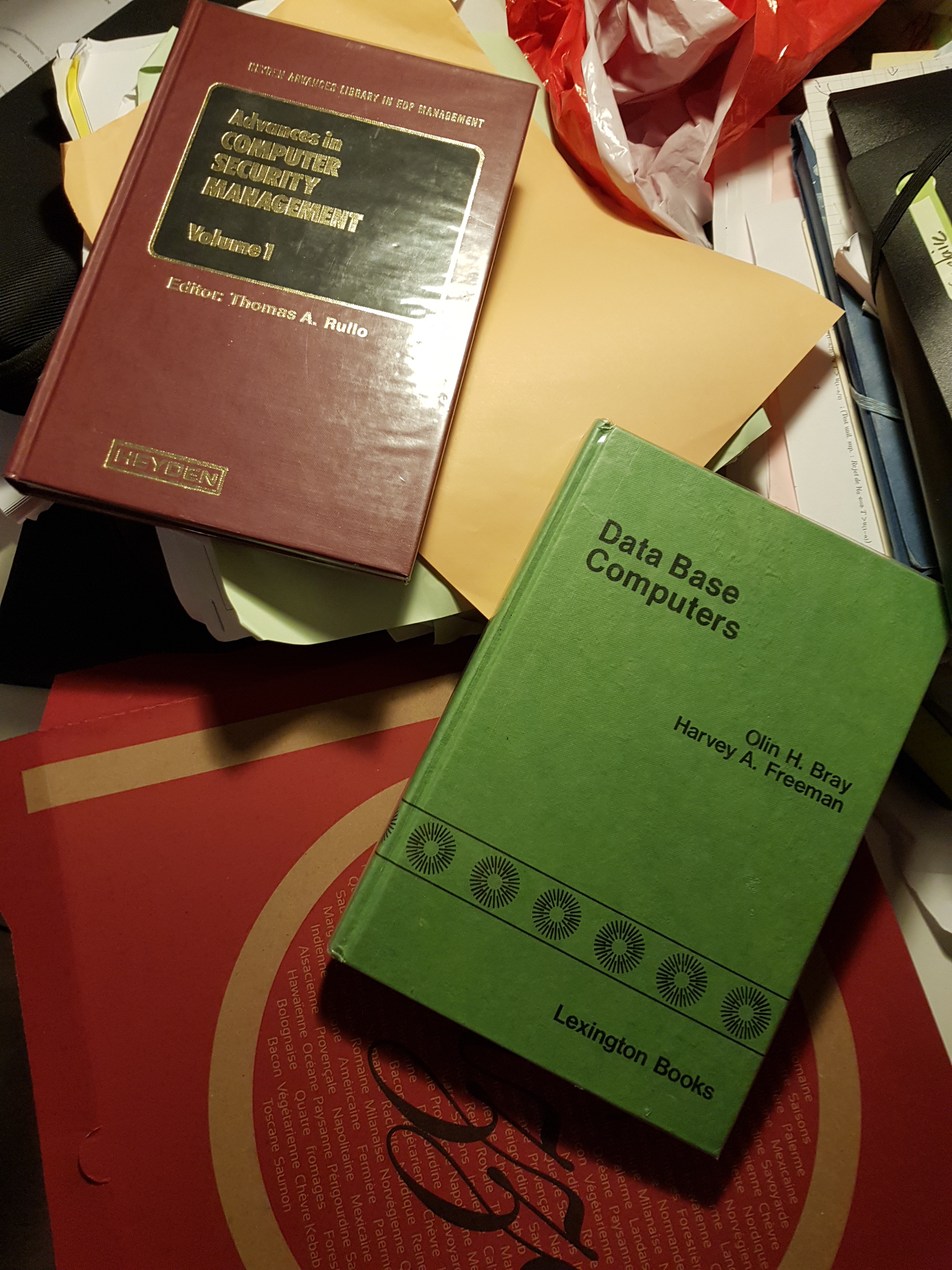
I got theses 2 books for free, are they still relevant?

preview

They seem to be from 80’, and somehow made their way into a french university. Has anyone here gotten a chance to read them? Some of the chapters seem interesting, lots about DOD stuff.

They seem to be from 80’, and somehow made their way into a french university. Has anyone here gotten a chance to read them? Some of the chapters seem interesting, lots about DOD stuff.

0

Is it viable to use a gaming handheld as main dev machine?

preview

Hello fellow devs.

I’m in need of a new machine as I had a little mishap with my notebook. For a long time, I thought on buying a gaming notebook as normally they should have the best hardware for my personal (gaming, light video edit) and professional (full stack web dev) needs.

Next week, Asus will launch the ROG Ally X officially on my country. So, I’m wondering if it could be a viable alternative.
The other possible devices would be ROG Ally (Z1 Extreme) and Lenovo Legion Go, as Steam Deck is not available here.

I work from home for a foreign company. I have a monitor, a wireless keyboard, and a usb trackball already. I bought them to use with a mac mini my previous company lend to me. I do not have a desktop and do not intend to buy one right now.

So… My questions: Does any of you have experience using a handheld device as a main dev machine? Are there any cons I’m not considering?

Thank you!

0

How can I show that a given open-source project does not exist yet?

preview

I work in research (uni) and am writing a framework for heat processes to optimize their costs. This goes both for private houses and industrial processes. The goal is to enable industry players to see that/when renewable energies and heat reuse with heat pumps are cheaper than fossil fuels. I do this using digital twins for components and on a system level.

My boss hesitates because he thinks this must already exist. I want to pursue that path with my research, so any insights there are welcome, too, but this is primarily about the open-source project.

I searched GitHub and came up empty, but that is only a subset of the search. Do you have any idea how I can find this, one way or another? It would also be great if I could show that it likely does not exist.

0

Setting up self-hosted cloud storage

preview

I’m looking to set up a server of some kind that I can use to store more or less arbitrary files on demand.

While I have quite a bit of programming experience, I have little-to-no experience in the server-space, so I don’t really know where I should be getting started/what kind of pitfalls I should be looking out for/what kind of design choices I should be making early on.

In short: I want some system that allows me to take more or less arbitrary files, send them from either my laptop or phone, and have them stored on a drive that I can have lying around somewhere hooked up to some setup. I don’t need any automatic backing up, sending files manually is sufficient. The individual files I’ll be sending probably won’t be exceeding the MB range of sizes. Remotely downloading files from the storage is not an immediate requirement, if I need to retrieve them I can plug directly into the disk. What I want to protect myself against is the “freak accident” type of thing where all the devices I currently have copies of a file on are lost in a fire, while travelling, or something like that.

Does anyone here have any tips for where I should be looking to get started?

0

Users of Vim and similars, what exactly makes it useful compared to other text editors? How much time do you suppose you save when working with it?

preview

I’d like actual examples instead of “I work faster”, something like “I can move straight to the middle of the file with 7mv” or “I can keep 4 different text snippets in memory and paste each with a number+pt, like 2pt”, things that you actually use somewhat frequently instead of what you can do, but probably only did once.

I’d like actual examples instead of “I work faster”, something like “I can move straight to the middle of the file with 7mv” or “I can keep 4 different text snippets in memory and paste each with a number+pt, like 2pt”, things that you actually use somewhat frequently instead of what you can do, but probably only did once.

0

Is it possible to "manage up" on customer expectations? Or am I doomed to unreasonable SLAs? (Database as a Service Company)

preview

I’m just so exhausted these days. We have formal SLA’s, but its not like they’re ever followed. After all, Customer X needs to be notified within 5 minutes of any anomalous events in their cluster, and Customer Y is our biggest customer, so we give them the white glove treatment.

Yadda yadda, bla bla. So on and so forth, almost every customer has some exception/difference in SLAs.

I was hired on to be an SRE, but I’m just a professional dashboard starer at this point. The amount of times I’ve been alerted in the middle of the night because CPU was running high for 5 minutes is too damn high. Just so I can apologize to Mr. Customer that they maybe had a teensy slowdown during that time.

If I try to get us back to fundamentals and suggest we should only alert on impact, not short lived anomalies, there is some surface level agreement, but everyone seems to think “well we might miss something, so we need to keep it”.

It’s like we’re trying to prevent outages by monitoring for potential issues rather than actually making our system more robust and automate-able.

How do I convince these people that this isn’t sustainable? That trying to “catch” incidents before they happen is a fools errand. It’s like that chart about the “war on drugs” where it shows exponential expense growth as you try to prevent ALL drug usage (which is impossible). Yet this tech company seems to think we should be trying to prevent all outages with excessive monitoring.

And that doesn’t even get into the bonkers agreements we make with customers to agree to do a deep dive research on why 2 different environments have a response time that differs by 1ms.

Or the agreements that force us to complete customer provided training - while not assessing how much training we already committed to. It’s entirely normal to do 3-4x HIPAA / PCI / Compliance trainings when everyone else in the org only has to do one set of those.

I’m at a point where I’m considering moving on. This job just isn’t sustainable and there’s no interest in the org to make it sustainable.

But perhaps one of y’all managed to fix something similar in their org with a few key conversations and some effort? What other things could I try as a sort of final “Hail Mary” before looking to greener pastures?

0

Apache Beam - How to control/limit the concurrency process of ParDo ?

preview

The problem is I am using beam.ParDo to call api, to enrich my data.

pipeline | "read_csv" >> beam.io.ReadFromCsv("...") 
                | "get_info_api" >> beam.ParDo(GetApiDoFN()) 
                | "write_output" >>  beam.io.WriteToBigQuery(...)

The problem is that api have limit. I need a way to control so it do not overload api or get 429 error.

I would like to set api call should not exceed 4 call / second.

How should I do it ?

0

Is there a "markup language" to describe a debugging session?

preview

cross-posted from: sh.itjust.works/post/19440902

I want to document my debugging sessions in a text file but I don’t know if anyone did this before.

I came up with this kind of “language” that is a mix between Markdown and C++, but I still wonder if something equivalent exists already.

// When you click on the button
# [click button]
- A::f()
// - ... other method calls, don't document if you don't need to

# A::f()
// "..." for "parameters" where you don't need the details
- Stuff::g(...)
- Stuff::h(...)

// <Class> is a fake template thing to show the possible types of an object
# <SubStuffA | SubStuffB> Stuff::g(...)
- Stuff::g() {} // empty but I use v/=> for virtual call
  v/=> SubStuffA::g()
  v/=> SubStuffB::g()

# SubStuffA::g()

# SubStuffB::g()

# Stuff::h(...)

I document methods in the order of appearance in the code.

If you have any good idea about a reliable way to document a list of function calls, I’m interested!

0

What projects should I do to gain applied development skills?

preview

I’m really enthusiastic about anything involved with Unix/Unix-like operating systems and their ecosystems (Mostly Linux and a bit of BSD variations). I also know a couple of programming languages including C, C++23 and OCaml. But other than doing a couple of tiny projects mainly to practice my programming skills in the languages mentioned above, most of my experience is theoretical and it comes from reading books, blogs and watching conferences.

I’m interested in gaining “actual” experience by doing systems programming related projects but I’m not sure how to get started. How do I decide on which topic to choose? A topic which would not be too overwhelming and actually achievable? And how do I gain the background knowledge needed to implement a project without ending up copying and pasting everything from existing implementations?

Thank you!

0

Possibly stupid question: is automated testing actually a common practice?

preview

Referring more to smaller places like my own - few hundred employees with ~20 person IT team (~10 developers).

I read enough about testing that it seems industry standard. But whenever I talk to coworkers and my EM, it’s generally, “That would be nice, but it’s not practical for our size and the business would allow us to slow down for that.” We have ~5 manual testers, so things aren’t considered “untested”, but issues still frequently slip through. It’s insurance software so at least bugs aren’t killing people, but our quality still freaks me out a bit.

I try to write automated tests for my own code, since it seems valuable, but I avoid it whenever it’s not straightforward. I’ve read books on testing, but they generally feel like either toy examples or far more effort than my company would be willing to spend. Over time I’m wondering if I’m just overly idealistic, and automated testing is more of a FAANG / bigger company thing.

0

How do I not stop feeling like I am doing nothing outside work?

preview

I am professionally a software developer for 8 years and I simply don’t have ideas for personal projects (Can’t find any problem that I can fix with programming). At times I feel like that’s natural and I shouldn’t worry about it. But on the other hand, I do like to imagine having something personal that I can work on so that even if some days on my main job are not satisfying, I can always work on my hobby project and find that missing satisfaction.

End goal here is obviously to get better sleep as sometimes my mind feels dissatisfied with the day’s work.

Funnily, I day-dream about the idea of already having done the boring parts (simply manifesting a project that already exists) of some personal project and only solving exciting problems in relation to adding a new feature or exciting aspects.

This creates a problem as I hate staring at a blank file not knowing what to write.

0

what exactly does "keep in touch" mean?

preview

I’ve been doing some interviews lately, and my most recent one seemed to be my most promising one so far, until he started doing what he called “light tech screening” and did some trivia questions to test my knowledge on what goes on under the hood. I do admit, I should have been better prepared on the topics, and didn’t do as well as I could have. At the end, he said my experience was interesting but I needed a better grasp of the fundamentals, and that we should keep in touch. Afterwards, I messaged thanking him for his time, and that I needed to review my course material, asked if he thought I should review anything specific and if I could do that for a few weeks and revisit it like he said. He suggested I do a deep dive into JS/TS to really understand what goes on and why, and would be happy to revisit it in a few weeks, and again said to keep in touch.

Does that really mean keep in touch regularly or often? Or is it just a throw away yea reach out again in a few weeks when you’re ready? I’m already pretty stoked to get a second chance at this, the company seems cool and I like that they aren’t weighing everything on leetcode problems. If I should keep in touch regularly, what would that even be about? I also don’t want to annoy him before meeting again.

Any advice would be appreciated!

0

How to liven up retrospectives when they've gotten uneventful / unhelpful?

preview

My current team runs weekly retrospectives using the Lean Coffee format. More and more, I find that the items people are bringing up aren’t really important or could just be a question in Slack.

For example, someone recently made a topic for how we can test credit card payments. Another topic was navel gazing about how we use Jira and multiple team members asked “what’s the problem you’re hoping to solve?” to which the only answer was “That’s not what I’ve seen elsewhere”.

I’m beginning to think that there’s something wrong with our format or prompts, in that we aren’t identifying important issues for discussion. Perhaps the format is stale or there’s no serious issues lingering each week?

Any advice on alternative formats, how to get better feedback, etc. would be greatly appreciated.

0

If I owned a server co-located in a (far away) data center, who would be responsible for swapping out dead hard drives?

preview

Would I have to drive there myself or could I pay an on-site tech to do it for a courtesy fee? Does it depend on the company?

Would I have to drive there myself or could I pay an on-site tech to do it for a courtesy fee? Does it depend on the company?

0

What's the *best* interview process you've experienced?

preview

I’ve interviewed for and been interviewed by companies large and small. We all know software engineer job interviews suck. But it’s hard on the other side of the table too.

One of the better places I worked for had a lightweight process of one phone screen and a four hour on-site. The company also prepared offers before the on-site interview round.

When you finished interviewing, you got a same-day yes or no answer, and if it was yes, you had the offer in your inbox within an hour.

What interview practices have you found effective?

… And by what metric?

0

What kind of conversations do you have with Directors?

preview

We have a team AMA coming up with a director. Apart from the typical “what are plans/goals for the team” type questions, what else could be useful or insightful questions?

We have a team AMA coming up with a director. Apart from the typical “what are plans/goals for the team” type questions, what else could be useful or insightful questions?

0

What's your favorite DB editor software?

preview

Was just wondering what’s popular nowadays, maybe I find something new and better - what kind of tools are you using to access and manage databases?

I’m personally using Dbeaver a lot but honestly it feels increasingly more buggy and unreliable as time passes, every installation and update has had (unique) issues so far and there’s little support. However the ease of use and some powerful, convenient, utilities in it make it preferable to others.

0

Suggest an external monitor for programming and gaming

preview

I’m looking for an external monitor for both programming and gaming. Currently, I’m using a 1080p monitor, but I’m tired of turning my head between the macbook and the monitor when I have to deal with 3+ windows.

So, I think a 2K monitor would be a nice improvement for my QoL, wouldn’t hurt my GPU too much compared to a 4k monitor. Any suggestion or should I scrub the idea?

0

Looking for interesting ideas to work on for side-projects as an aspiring backend developer

preview

Hi.

I’m a dev with 3 YOE, mostly in ML and MLOps, and more and more I’m trying to pivot into traditional software engineering. As of now I’m trying to really learn the fundamentals of backend engineering (as opposed to the bootstrapping DIY learning attitude that I had during my ML roles towards backend engineering), and I’m learning Node.JS. I’m getting familiar with the the concepts and the syntax, and so far so good. But one thing that I really lack is the imagination of what a good side-project might be.

So I ask experienced devs here, can you recommend me some good project ideas to work on, to make myself a better dev?

0

Are IDEs mostly bloatware?

preview

Hi experienced devs , I am a beginner programmer. I mostly use code completion and go-to source , and rename function and objects, code-pretty. Other features not so much. What features do you use often And what features are not that useful in an IDE and can be considered bloat? P.S.- Which is that one feature that you can’t live without?( sorry for sounding like tiktok wannabe)

Hi experienced devs , I am a beginner programmer. I mostly use code completion and go-to source , and rename function and objects, code-pretty. Other features not so much. What features do you use often And what features are not that useful in an IDE and can be considered bloat? P.S.- Which is that one feature that you can’t live without?( sorry for sounding like tiktok wannabe)

0

Woocommerce API help

preview

cross-posted from: lemmy.blahaj.zone/post/4160765

I am opening a woocommerce store pretty soon and I was looking through a various drop shipping/fulfilment on demand services. One of them offers their services through an API and there is some documentation on it, and how to run a test if it works correctly on my end but no information on how to “install” it on my store.

I can send you the link to the service and their documentation page - just don’t want to do it here not to doxx myself 😄

What is API and how do I use it?

Many thanks

0

Better alternative to gpg in git?

preview

I got this article in a reply to a different conversation, and for the most part I agree with it. Gpg is old and we have better ways. I like signing my commits, I like feeling that these commits are actually and provably mine. But I’m not married to GPG like I used to be, I’d like a better way. The problem is that git used gpg for signing. I learned about this new thing called minisign and I wanna use it with git. So how do we switch? And if we can’t switch, then how do we fix GPG?

I got this article in a reply to a different conversation, and for the most part I agree with it. Gpg is old and we have better ways. I like signing my commits, I like feeling that these commits are actually and provably mine. But I’m not married to GPG like I used to be, I’d like a better way. The problem is that git used gpg for signing. I learned about this new thing called minisign and I wanna use it with git. So how do we switch? And if we can’t switch, then how do we fix GPG?

0

What qualifications/qualities are sought after for senior positions?

preview

I know this is a very generalized question, as it depends on the company, product, position, etc. But in general, what sets someone apart as ready for a senior position over an intermediate or junior position? Experience I would think would be a big one, but say you have a candidate that shows problem solving abilities to solve code problems, but is newer to the tech field vs someone who’s been in the field x years, does the first guy have a shot without really knowing the ins and outs of working as a software engineer, hoping to pick it up quick?

I know this is a very generalized question, as it depends on the company, product, position, etc. But in general, what sets someone apart as ready for a senior position over an intermediate or junior position? Experience I would think would be a big one, but say you have a candidate that shows problem solving abilities to solve code problems, but is newer to the tech field vs someone who’s been in the field x years, does the first guy have a shot without really knowing the ins and outs of working as a software engineer, hoping to pick it up quick?

0

Are there others like me?

preview

I’m a senior engineer (web full-stack) at a bank. I’ve been doing this for about 5 years.

When I write code, I find it similar to authoring a book or even writing a poem. I love trying to write code that reads really well, has beautifully designed boundaries between dependencies, great structure and so on. I also find that I write code with a big focus on making it a joy to work with for developers that touch it later on.

I struggle with the emphasis on collaboration and quick iteration approach in this field. “Co-authoring a book” with 6 other “authors” in two week chunks just seems crazy to me. And what I’ve seen that passes as shippable code is also crazy to me – but hey, “it works”.

I also have never been a guy that gets overly excited about using technology to solve problems or using software to satisfy business needs. I really just like writing code, setting up development environments or CI/CD pipelines, cloud infrastructure or whatever…just for those things themselves. (Again it’s like an art form to me. And I really really like reading other’s well thought out code and appreciate for just that rather than the use-case or problem that the code is actually solving)

Anyone else out there like me? (Not arguing the merits one way or the other…just curious if I’m a weirdo)