showing posts tagged #debian — clear

0

Peppermint OS Debian ISO Updates – Peppermint OS

preview

As mentioned in our previous announcement, we have transitioned from Xorg to XLibre. With upstream Xorg repositories largely frozen and receiving minimal maintenance, adopting XLibre is a much better fit for our roadmap, and we look forward to supporting the project where we can in the future.

As mentioned in our previous announcement, we have transitioned from Xorg to XLibre. With upstream Xorg repositories largely frozen and receiving minimal maintenance, adopting XLibre is a much better fit for our roadmap, and we look forward to supporting the project where we can in the future.
0

Debian 13.8 Released With 150+ Security Updates?=0

Debian 13.8 Released With 150+ Security Updates www.phoronix.com
preview

Debian 13.8 is out today as the newest ISO refresh for Debian 13 “Trixie” with 150 security updates noted along with many bug fixes.

Debian 13.8 follows 150 Debian Security Advisories (DSAs) affecting popular software from Chromium to the Linux kernel, the X.Org Server, LibreOffice, WordPress, Redis, Wireshark, XZ-Utils, Firefox ESR, Apache HTTPD, and other common packages.

In addition to the plethora of security fixes given all the ongoing AI/LLM-driven security research, many bug fixes also made it into Debian 13.8. The Debian 13.8 release rebuilds various Rust-based packages with the updated Rust compiler, rebuilding other packages against updated OpenSSL and Glibc libraries, fixing a denial of service issue with FreeType, fixing Wayland color management handling in KDE’s KWin, memory leak fixes, build failure fixes to different packages, and compatibility updates for the Thunderbird 153 mail client.

Downloads and more details on today’s Debian 13.8 release via Debian.org.

0

Debian's APT Removing Some Features Due To Advancements In AI Security Discoveries

Debian's APT Removing Some Features Due To Advancements In AI Security Discoveries www.phoronix.com
preview

Stemming from the recent Debian APT man-in-the-middle attack from a vulnerability in APT’s downloading code and ongoing advancements in AI/LLMs around security research, APT is now resorting to disabling and removing some older, complex features that may make the program more vulnerable to finding exploits moving forward.


Stemming from the recent Debian APT man-in-the-middle attack from a vulnerability in APT’s downloading code and ongoing advancements in AI/LLMs around security research, APT is now resorting to disabling and removing some older, complex features that may make the program more vulnerable to finding exploits moving forward.


0

Debian Forms New Team to Improve Gaming Hardware Support

Linuxiac Debian Forms New Team to Improve Gaming Hardware Support linuxiac.com
preview

Debian establishes a new team focused on improving hardware compatibility for gaming handhelds, consoles, and other gaming devices.


Debian establishes a new team focused on improving hardware compatibility for gaming handhelds, consoles, and other gaming devices.


0

APT 3.3.8 Package Manager Gets Performance Improvements

Linuxiac APT 3.3.8 Package Manager Gets Performance Improvements linuxiac.com
preview

APT 3.3.8 improves Debian package management performance with faster dependency resolution, optimized cache generation, and reduced DNS queries.


see: salsa.debian.org/apt-team/apt/-/blob/…/changelog

APT 3.3.8 improves Debian package management performance with faster dependency resolution, optimized cache generation, and reduced DNS queries.


see: salsa.debian.org/apt-team/apt/-/blob/…/changelog

0

Unredacted hardened Kernel

Unredacted linux-hardened-unredacted: a hardened kernel for Debian unredacted.org
preview

Hardened debian kernel built on top of graphene os patches by the redacted non profit . Details for apt repo are here.

git.unredacted.org/…/linux-hardened-unredacted

Figured Id share for those interested. Text below copied from git readme.

What this kernel changes

On top of upstream Linux, this build applies the anthraxx/linux-hardened patch set under a kernel .config composed from anthraxx’s own Arch packaging config.x86_64 (pinned by sha256 + signed-commit-verified in configs/upstream-seed.toml) layered with our project overlay (configs/intent.common.config plus the x86-only configs/intent.x86_64.config; per-symbol rationale in configs/POLICY.md). Each build re-fetches the pinned seed, verifies its signature, merges our intent, runs olddefconfig, and aborts unless every intent line lands — so new hardening features anthraxx adopts flow through automatically, while regressions on the symbols we explicitly pin fail fast at configure time. Full design in docs/operators/config-architecture.md. The hardening falls into four buckets: memory-safety (heap and stack zero-init, stack-erase-on-return, hardened usercopy, FORTIFY_SOURCE, slab freelist hardening and canaries, KASLR, KFENCE); integrity (W^X for kernel and module text, forced module-signature verification, integrity-mode lockdown under Secure Boot); attack-surface reduction (/dev/mem, /proc/kcore, kexec, and several legacy syscalls removed); and restrictive sysctl defaults (unprivileged user namespaces off; perf, BPF, and ptrace restricted to root).

That hardening comes with friction worth knowing before you install:

  • Out-of-tree modules (NVIDIA, ZFS, VirtualBox) must be rebuilt against our headers and signed. DKMS is designed to do this with a machine-local MOK key you enroll once at reboot (not yet validated against a published release — see docs/users/dkms.md).
  • Rootless containers (Docker, Podman), the Chromium sandbox, Snap, and Flatpak depend on unprivileged user namespaces, which are off by default. Re-enable them via the opt-in in docs/users/incompatibilities.md.
  • kexec/kdump, hibernation, and /dev/mem-based tools do not work.
  • Every module must be signed. An unsigned out-of-tree module will not load (MODULE_SIG_FORCE).

Per-symptom workarounds are in docs/users/incompatibilities.md. Keep your distro’s stock kernel installed as a recovery fallback; both coexist and GRUB lists both.

0

[FR] Mon serveur Debian se met à jour tout seul, et c'est tant mieux en ce moment

Jordan Chapuy – IA, tech et produit, simplement Mon serveur Debian se met à jour tout seul, et c'est tant mieux en ce moment jordanchapuy.com
preview

Hier, j’ai vu qu’OpenAI a découvert 948 failles permettant à un utilisateur sans droits de devenir root, chacune avec un exploit fonctionnel. Ce matin, je vois qu’Ars Technica raconte une autre faille, vieille d’une dizaine d’années, qui permet de se connecter en SSH à certains systèmes sans mot de passe.

Hier, j’ai vu qu’OpenAI a découvert 948 failles permettant à un utilisateur sans droits de devenir root, chacune avec un exploit fonctionnel. Ce matin, je vois qu’Ars Technica raconte une autre faille, vieille d’une dizaine d’années, qui permet de se connecter en SSH à certains systèmes sans mot de passe.

0

Debcraft finally at v1.0

preview

Containerized Debian package builds, artifact diffs, and automated maintenance, test running, new upstream imports and more. If you previously struggled with .deb work, this might make things a lot easier now.

Containerized Debian package builds, artifact diffs, and automated maintenance, test running, new upstream imports and more. If you previously struggled with .deb work, this might make things a lot easier now.

0

DSA 6574-1: php8.4 security update (anyone who runs any version of PHP should update ASAP, this remote code execution vulnerability is being actively exploited today)

preview

see also: en.wikipedia.org/wiki/PHP2Shell

see also: en.wikipedia.org/wiki/PHP2Shell

0

Installing Debian KDE sharing the same Btrfs partition as Kubuntu using subvolumes

play · youtube.com
YouTube Installing Debian KDE sharing the same Btrfs partition as Kubuntu using subvolumes www.youtube.com
preview

cross-posted from: retrolemmy.com/post/44913725

Since I’m a new moderator here I figured I should actually install Debian, but I decided to do it with a twist.

I got the idea from here: codeberg.org/Calamares/calamares/issues/1580

It’s actually not too hard to install multiple Linux distros sharing the same Btrfs partition, which means you don’t have to preallocate space.

Default Calamares mount.conf here codeberg.org/Calamares/calamares/…/mount.conf#L50…

My 40_custom file:

#!/bin/sh
exec tail -n +3 $0
# This file provides an easy way to add custom menu entries.  Simply type the
# menu entries you want to add after this comment.  Be careful not to change
# the 'exec tail' line above.
menuentry "Kubuntu" --class kubuntu --class ubuntu --class os {
 insmod part_gpt
 insmod btrfs
 search --no-floppy --fs-uuid --set=root c9710fb0-4ebb-4335-a58a-4176d894dcf9
 linux /@/boot/vmlinuz root=UUID=c9710fb0-4ebb-4335-a58a-4176d894dcf9 ro rootflags=subvol=@ quiet splash
 initrd /@/boot/initrd.img
}

I was disappointed that os-prober didn’t work.

0

Tenka – Debian-based Linux distribution with Japanese-inspired desktop

GitHub GitHub - naman-sharma12345/tenka: Tenka — an aesthetic-first Linux distro (Debian 13 + Hyprland) with two switchable theme packs: Samurai (Tenka) and Xianxia (Tianxia). github.com
preview

Tenka is a Debian-based Linux distribution that places particular emphasis on desktop appearance and visual consistency. It features two interchangeable desktop themes inspired by Japanese and Chinese aesthetics, extending their designs across the boot process, login screen, desktop and applications.

Tenka is a Debian-based Linux distribution that places particular emphasis on desktop appearance and visual consistency. It features two interchangeable desktop themes inspired by Japanese and Chinese aesthetics, extending their designs across the boot process, login screen, desktop and applications.

0

JatayuOS 1.0 Udaan — Linux Desktop Made in India

JatayuOS JatayuOS 1.0 Udaan — Linux Desktop Made in India jatayuos.in
preview

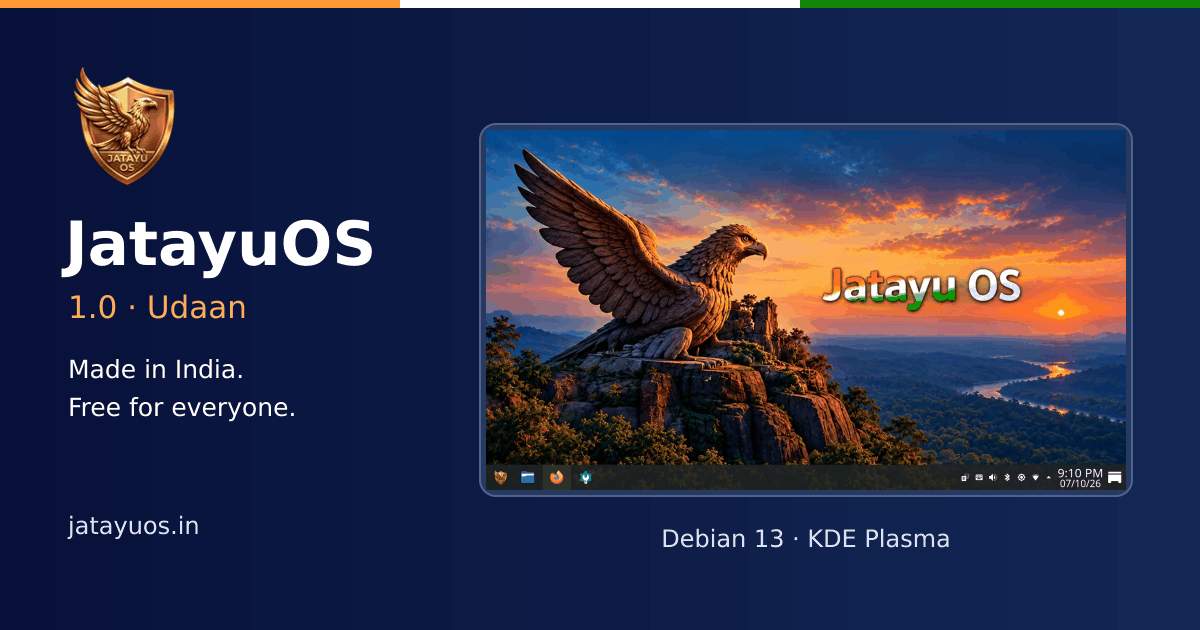
A free Linux operating system made in India, built on Debian with KDE Plasma and Jatayu Tools for everyday work, learning and creativity.

via: linuxlinks.com/jatayuos-debian-based-linux-distri…

A free Linux operating system made in India, built on Debian with KDE Plasma and Jatayu Tools for everyday work, learning and creativity.

via: linuxlinks.com/jatayuos-debian-based-linux-distri…

0

Anthares OS - Debian-based desktop Linux distribution

LinuxLinks Anthares OS - Debian-based desktop Linux distribution - LinuxLinks www.linuxlinks.com
preview

Anthares OS is a Debian-based Linux distribution designed to make everyday computing easier without requiring users to become familiar with the command line. It uses a customised Cinnamon desktop and provides graphical utilities for configuring and maintaining the system.

See: anthares-os-site-d616f7.gitlab.io

0

LinuxTV - Debian-based Linux distribution designed for televisions

LinuxLinks LinuxTV - Debian-based Linux distribution designed for televisions - LinuxLinks www.linuxlinks.com
preview

LinuxTV is a Debian-based Linux distribution designed for computers connected to a television. Rather than booting into a conventional desktop environment, it starts with a fullscreen launcher intended to be viewed and controlled from across a room.

LinuxTV is a Debian-based Linux distribution designed for computers connected to a television. Rather than booting into a conventional desktop environment, it starts with a fullscreen launcher intended to be viewed and controlled from across a room.

0

Call for Debian 14 (forky) artwork proposals

preview

Dear Debianites

This is the official call for artwork proposals for the forky cycle. For the most up to date details, please refer to the wiki[^1]. At the same time, we would like to thank Elise Couper for creating the Ceratopsian theme for trixie[^2].

So, if you would like (or know someone who would like) to create a desktop look and feel that will be seen by trillions of people, be sure to send in your artwork ASAP!

[full message]

>Deadline for submissions: 2026-09-12 > >The artwork is usually picked based on which theme looks the most: > >- “Debian” > >(Admittedly not the most defined concept, since everyone has their own take on what Debian means to them.) > >- plausible to integrate without patching core software > >(As much as we love some of the insanely good looking themes, some would require heavy GTK+ theming and patching GDM/GNOME.) > >- clean / well designed > >(without becoming something that gets annoying to look at a year down the road. Examples of good themes include Emerald, Homeworld, Joy, Lines, softWaves and futurePrototype) > >For more information / details, please post to the Debian Desktop[^3] list, to which the reply-to for this mail has been set. > >-Jonathan, on behalf of the Debian Desktop team > >[^1]: wiki.debian.org/DebianDesktop/Artwork/Forky >[^2]: wiki.debian.org/DebianArt/Themes/Ceratopsian >[^3]: wiki.debian.org/DebianDesktop >
>–
> ⢀⣴⠾⠻⢶⣦⠀ Jonathan Carter (highvoltage) <jcc>
> ⣾⠁⢠⠒⠀⣿⡁ wiki.debian.org/highvoltage
> ⢿⡄⠘⠷⠚⠋ debian.org | jonathancarter.org
> ⠈⠳⣄⠀⠀⠀⠀ Debian, the universal operating system. ----

0

Debian votes on eight AI proposals: Ballot math makes outright ban unlikely

preview

Somehow, this msn.com article is the most comprehensive on the subject that I’ve seen so far, and it also talks about how a couple of other big open source projects handle this issue. Voting on the issue concludes on August 28th 23:59 UTC, BTW.

Somehow, this msn.com article is the most comprehensive on the subject that I’ve seen so far, and it also talks about how a couple of other big open source projects handle this issue. Voting on the issue concludes on August 28th 23:59 UTC, BTW.

0

Debian has begun voting on the future of AI/LLM contributions

preview

Post title stolen from c/hackernews@lemmy.bestiver.se, not crossposted because I don’t care about comments on ycombinator and Lemmy users generally don’t interact with bot posts.

Very curious how this is going to turn out. We’re going to see LLM-contributions in Debian one way or another for sure (even the Linux kernel allows AI-assisted coding and tons of other upstream projects are using Claude etc.), but that doesn’t mean that Debian shouldn’t take a stance.

0

Ryzen AI Developer Platform: AMD's Own Linux Distribution Built Atop Debian

Ryzen AI Developer Platform: AMD's Own Linux Distribution Built Atop Debian www.phoronix.com
preview

With the AMD Ryzen AI Halo developer platform there is the option of ordering this Ryzen AI Max+ mini PC with either Microsoft Windows 11 or “Linux OS”. When receiving a AMD Ryzen AI Halo review sample last month, I fully expected it to just be an Ubuntu LTS install with ROCm preloaded. I was quite surprised when powering it up to find that it’s an OS called the AMD Ryzen AI Developer Platform 1 “Rex” and is based on Debian Linux.

With the AMD Ryzen AI Halo developer platform there is the option of ordering this Ryzen AI Max+ mini PC with either Microsoft Windows 11 or “Linux OS”. When receiving a AMD Ryzen AI Halo review sample last month, I fully expected it to just be an Ubuntu LTS install with ROCm preloaded. I was quite surprised when powering it up to find that it’s an OS called the AMD Ryzen AI Developer Platform 1 “Rex” and is based on Debian Linux.

0

Debian is Stable

Debian is Stable linuxrenaissance.com
preview

People often mistake the word “stable” in different contexts and I wish to clear up the confusion. There are two main meanings in the world of GNU/Linux for the word above and these two meanings are vastly different: once booted the system does not crash, therefore it is stable once installed the system behaves exactly the same for the lifetime of this install, therefore it is stable In both examples above you can mix-in the word “reliable” in more than one way as well, but for me personally the word reliable means that I can rely on my computer to be ready to do my bidding when I am ready to use the system.

People often mistake the word “stable” in different contexts and I wish to clear up the confusion. There are two main meanings in the world of GNU/Linux for the word above and these two meanings are vastly different: once booted the system does not crash, therefore it is stable once installed the system behaves exactly the same for the lifetime of this install, therefore it is stable In both examples above you can mix-in the word “reliable” in more than one way as well, but for me personally the word reliable means that I can rely on my computer to be ready to do my bidding when I am ready to use the system.

0

Gtk2-NG, next generation of Gtk 2, comes back to life

theregister Gtk2-NG, next generation of Gtk 2, comes back to life www.theregister.com
preview

An effort to revive and reinvigorate the 2002 Gtk2 GUI programming toolkit is growing and gaining interest… as we predicted would happen a few months ago.

An effort to revive and reinvigorate the 2002 Gtk2 GUI programming toolkit is growing and gaining interest… as we predicted would happen a few months ago.

0

Debian Release Team: Debian Must Now Ship Reproducible Packages

Debian Release Team: Debian Must Now Ship Reproducible Packages www.phoronix.com
preview

With half-way through the Debian 14 “Forky” development cycle, the Debian release team is out with an update this weekend and some big news.

With half-way through the Debian 14 “Forky” development cycle, the Debian release team is out with an update this weekend and some big news.