


0
0

Not on this instance? Enter your own instance's domain to go straight to following c/linkedinlunatics@sh.itjust.works there.
showing posts tagged #linkedinlunatics — clear


Yes, reddit is very anti-AI, you goober. I barely use the site anymore, and even I know that. How a daily user would miss that is beyond me.
Yes, reddit is very anti-AI, you goober. I barely use the site anymore, and even I know that. How a daily user would miss that is beyond me.


More Blind Lunacy.
This place has got some serious right wing nut job vibes.
More Blind Lunacy.
This place has got some serious right wing nut job vibes.


cross-posted from: lemmy.world/post/51937963
cross-posted from: lemmy.world/post/51937963

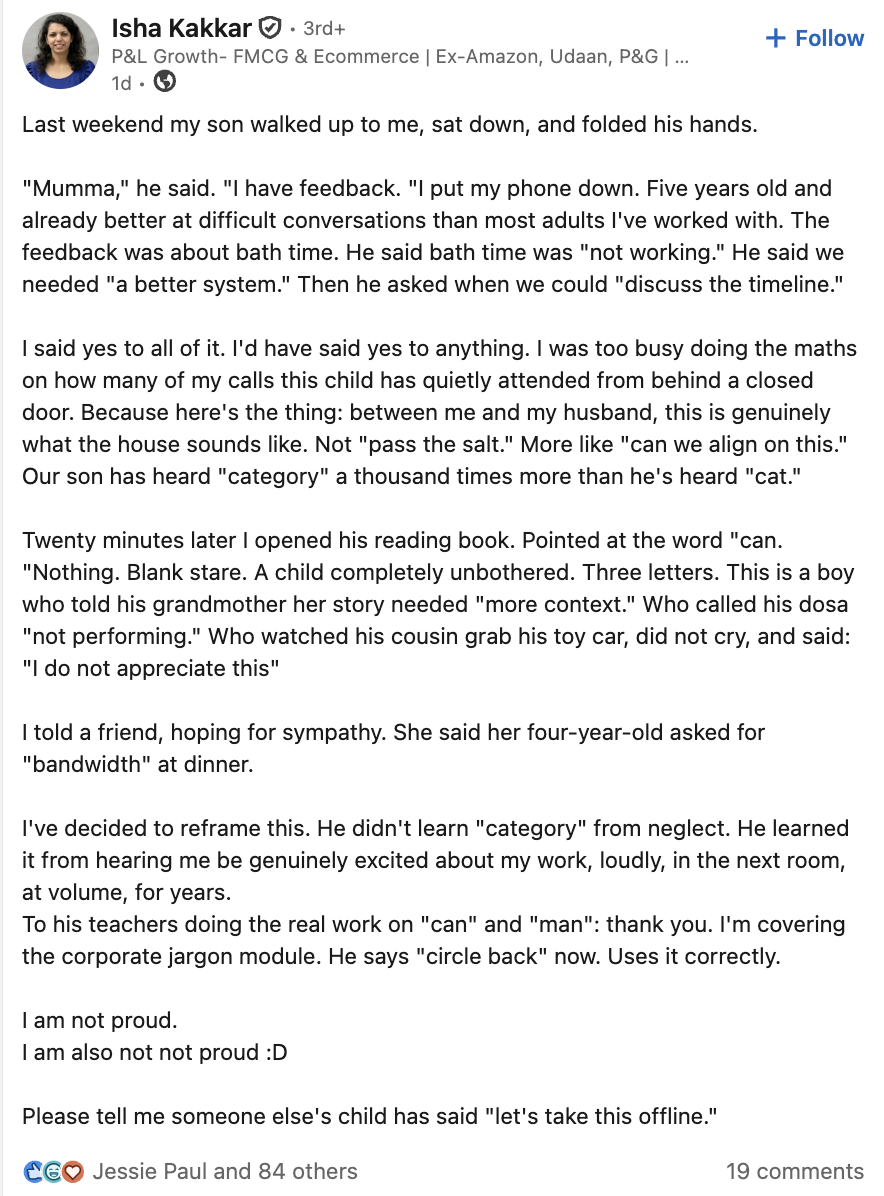

I don’t know how “lunatic” this is. But this was an ad I just saw pop up, which is an amazing slap in the face to everyone who has worked for that title.
I don’t know how “lunatic” this is. But this was an ad I just saw pop up, which is an amazing slap in the face to everyone who has worked for that title.


Do you even job, bro?
Do you even job, bro?


They seem to have deleted the post
They seem to have deleted the post

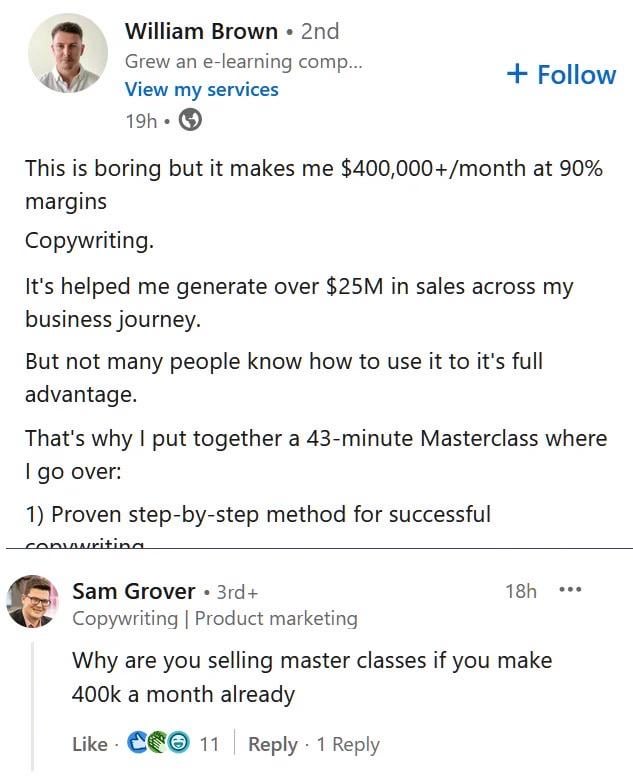
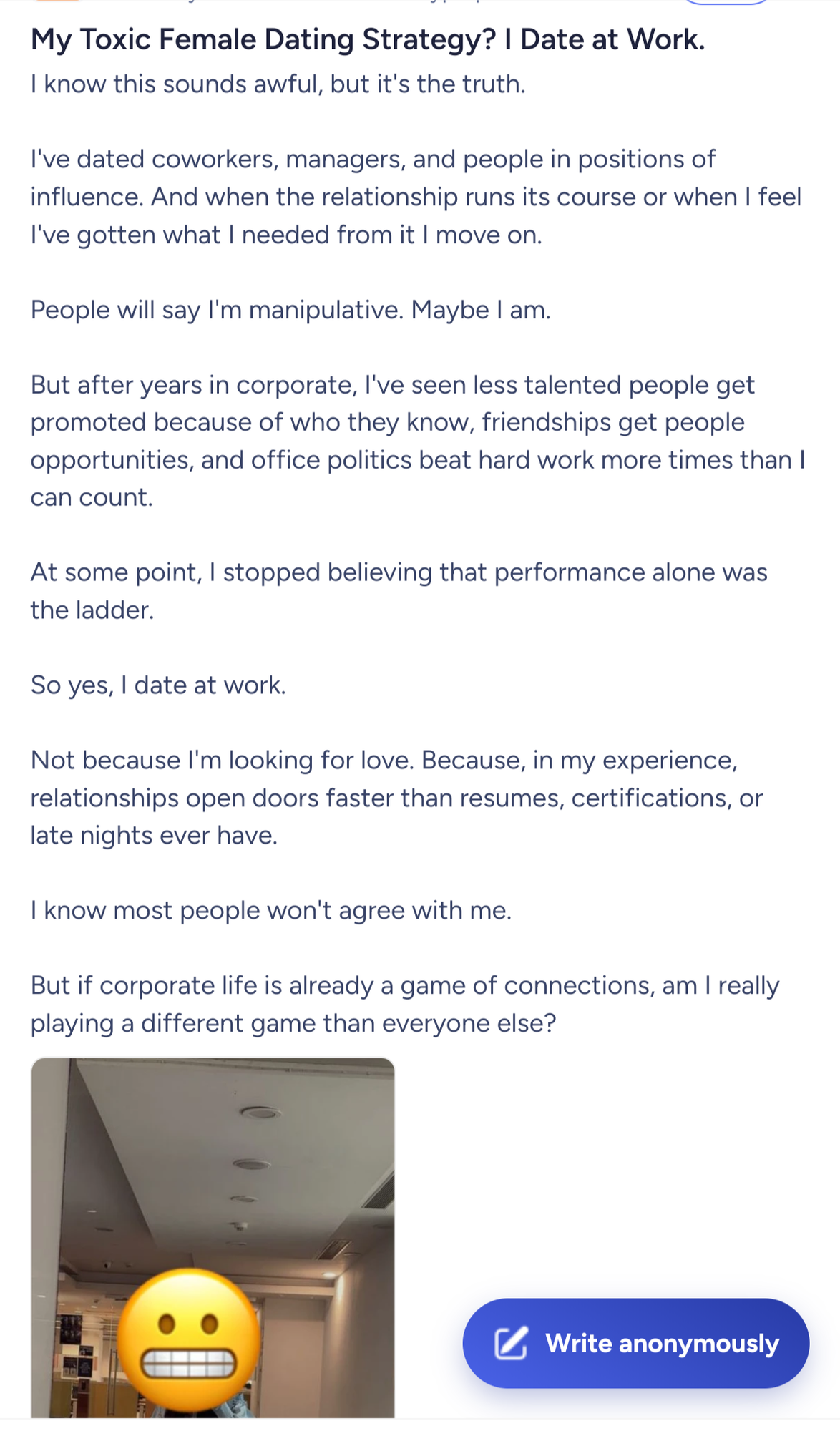
And so you understand that this is 100% legit… Here is their apology after they branded their potential slaves.

And so you understand that this is 100% legit… Here is their apology after they branded their potential slaves.





cross-posted from: lemmy.world/post/46939145
cross-posted from: lemmy.world/post/46939145



Turns out the biggest lunatic was Linkedin all along
Turns out the biggest lunatic was Linkedin all along

I am not sure what to say about that.
I am not sure what to say about that.


This guys a fucking dolt. Has a crazy linkedin as well. Totally a “self made” person too. Didnt need any external help whatsoever. Elon deserves all his wealth.
So many holes in this argument it could be swiss cheese.
I’m noticing a trend lately among these types trying to equate it to “Pokémon cards”. I wonder if its actually just bots? Or maybe copycats. Either way, its an idiodtic viewpoint.
From xitter @brivael
Elon once said something about resource allocation that really stuck with me. In essence: once you pass a certain level of wealth, money ceases to be about consumption; it becomes about capital allocation.
That single sentence changes everything.
At its core, economics is simply a problem of allocation. You have finite resources and infinite potential uses for them. Who decides what goes where?
Imagine a school playground. One hundred children, packs of Pokémon cards distributed at random. You let them be. Very quickly, an order emerges. The skilled players accumulate the rare cards; the collectors sort and organize; the negotiators strike deals. No one planned any of this. And yet, every single card ends up in the hands of the person who derives the most value from it. The system maximizes the total happiness of the playground. That is the “invisible hand.”
Now, introduce the teacher. She finds this unfair. Leo has 50 cards; Tom has 3. She confiscates them, redistributes them, and enforces equality. Three immediate consequences follow: The skilled players stop playing—what’s the point? The unskilled players lose any incentive to improve—they’ll get their share regardless. Trade grinds to a halt. The playground is now equal—and dead. She maximized equality, but she destroyed happiness.
The teacher’s problem is that she cannot possibly possess the information that the playground—as a collective—held. This is Mises’s “economic calculation problem,” first formulated in 1920. The USSR spent 70 years trying to solve it through Gosplan. The result: shortages, queues, and total collapse. Not because the Soviets were unintelligent, but because the problem is mathematically insoluble under a centralized system.
When Musk possesses 200 billion dollars, he doesn’t consume it; he allocates it. SpaceX, Starlink, Neuralink, xAI—every single dollar represents a bet on the future. And he has a track record to back it up: PayPal, Tesla, SpaceX. He has demonstrated that he knows how to identify immense problems and allocate resources to them with spectacular efficiency.
The State, too, has a track record: crumbling hospitals, a declining education system, exploding debt, and public services deteriorating despite constantly rising budgets. The market identifies effective resource allocators; politics identifies effective communicators.
Profit is not an end in itself; it is a signal. It says: you have allocated scarce resources toward a use that people value enough to pay for. The larger the profit, the greater the value created. When Starlink becomes profitable, it means that millions of people in rural areas finally have access to the internet. When a government ministry runs a deficit, it means it is consuming more than it produces. One creates; the other destroys—and we call that redistribution.
In our societies, there are two categories of actors: entrepreneurs and bureaucrats. The entrepreneur takes a personal risk to identify a problem, mobilize resources, and create a solution. If he is wrong, he loses. If he is right, his customers win, his employees win, his suppliers win, and the State collects taxes. He is the fundamental unit of human progress.
The bureaucrat takes no personal risk whatsoever. His salary is guaranteed. At best, he maintains an existing economic rent. At worst, he destroys it through excessive regulation, forced misallocation of resources, and perverse incentives that discourage those who produce. But under no circumstances does he create.
Look at the last 50 years: the iPhone, the civilian internet, SpaceX, Tesla, Google, Amazon, Stripe, mRNA technology, ChatGPT. All are private inventions, championed by entrepreneurs and funded by venture capital. Not a single government ministry has invented anything that has fundamentally changed your daily life.
France has become the global laboratory for bureaucratic drift—with public spending accounting for 57% of GDP, an absolute record. A sprawling bureaucracy; a tax system that penalizes wealth creation. The result: falling behind the United States, Germany, and Switzerland. Brain drain. Deindustrialization. Exploding debt.
And the worst part is that this misallocation is self-reinforcing. The more the State levies, the less entrepreneurs create. The less they create, the smaller the tax base becomes. The more the State goes into debt and taxes. A perfect negative feedback loop. The mistress believes she is helping, yet every year, the court produces less.
In our societies, it is—invariably—the entrepreneurs who drive civilization forward. Bureaucrats, at best, merely preserve existing rents; at worst, they destroy them. No society has ever progressed by taxing its creators to subsidize its administrators.
The question is never “who has how much?” Rather, it is: “Who is best equipped to allocate the next unit of resources to maximize the future of humanity?” For the past 200 years, the answer has remained unchanged. It is not the civil servants. 2:34 AM · Apr 29, 2026 · 65.2M Views
Read 2.7K replies Send feedback


LinkedIn Comments:
Frank Carlson
My favourite thing to do with Al is to have the kids create their main characters, some outline of a plot and have Al write the bedtime story.
Will Slappey
Frank Carlson interesting idea. I’ll have to check that out. Which model do you like best for that?
Frank Carlson
I’ve been doing it for about a year now on ChatGPT. I reply to the same thread and stories are getting much better based on our feedback. The kids love giving the machine feedback on it’s writing, lol! Have fun!


All Hail The BarfBots
All Hail The BarfBots

I don’t know how well this counts, but just saw an announcement from Rackspace stating that they are proud to be partnering with Palantir and using their AI engineers to blab, blah, blah.
I think they’re a bit tone deaf on being so public with who they are partnering with.
I don’t know how well this counts, but just saw an announcement from Rackspace stating that they are proud to be partnering with Palantir and using their AI engineers to blab, blah, blah.
I think they’re a bit tone deaf on being so public with who they are partnering with.


Just came across this post in linkedin where this person is telling us how GLP - 1 drugs are causing people to buy less food and in turn generate less revenue for big food companies like Nestlé and Kraft Heinz.
Their solution will therefore be premiumising of food such that even though they sell less in volume, they sell it at higher prices, maintaining bottom lines. This is also called shrink to grow strategy that has been popular in CPG industry last few years (think how dishwasher detergent powder vanished from shelves and got replaced by more expensive pods)
And everyone, not just GLP-1 users will pay for this premiumisation. Your food prices are about to get worse.