There are no generalized solutions to the three-body problem. Say you have three planets orbiting each other: it’s impossible to calculate how they will move using Newton’s laws of motion and gravity.
Unlike the two-body problem, the three-body problem has no general closed-form analytic solution. The differential equations that govern the motions of three gravitating bodies are not integrable and cannot be solved to give explicit formulas for the positions of the bodies as a function of time. For most initial conditions, the dynamical system for three orbiting bodies is chaotic, and the only way to predict their motions is to estimate them using numerical methods.
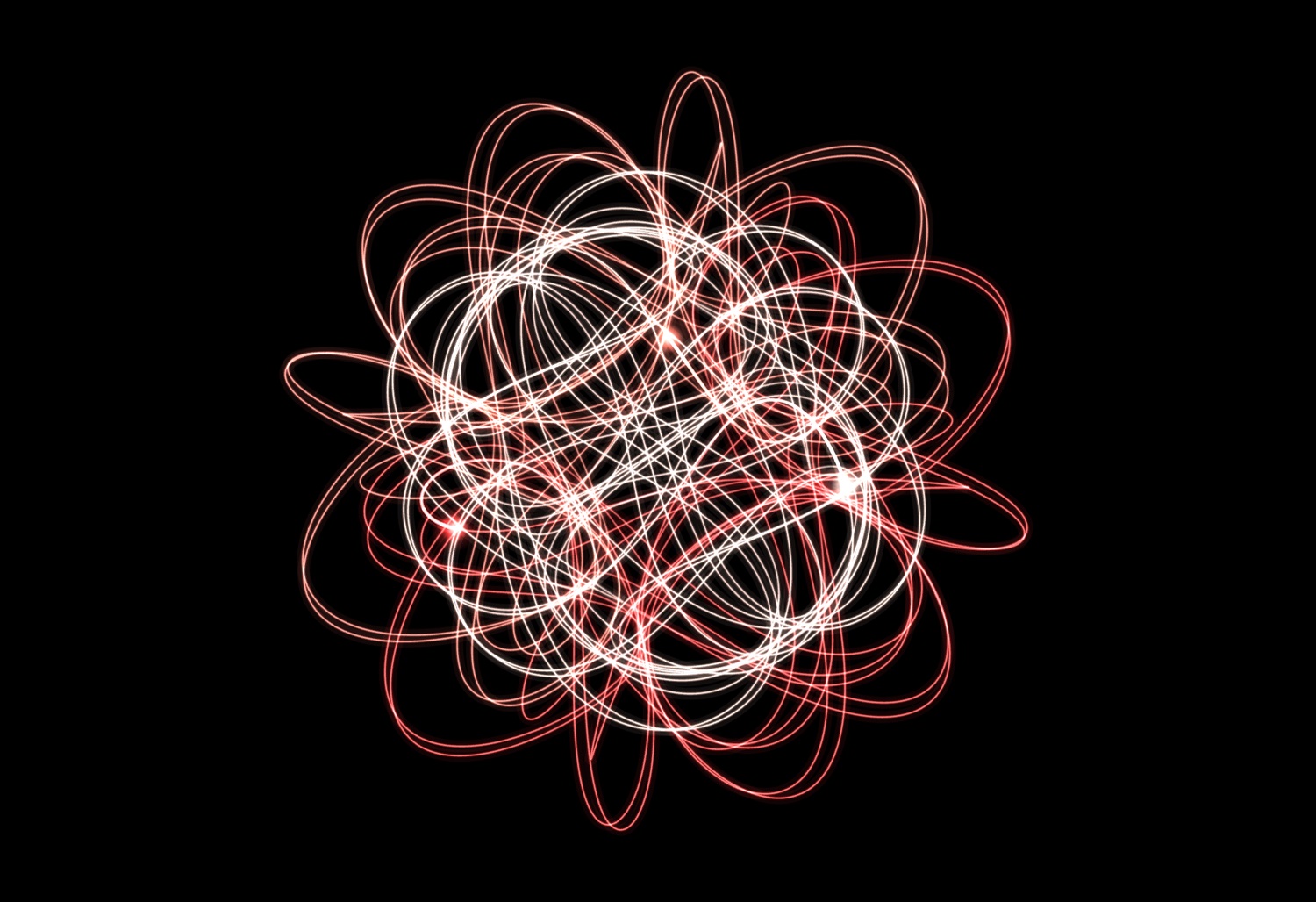
But thousands of stable three-body orbits have been found — their paths repeat after a given interval. The Three Body Orbits website is an atlas of some of those orbits: you can watch each three-body system play itself out in a wide variety of different shapes and complexities. There’s this simple figure 8, this slightly less simple one, and this one that looks like a spirograph.
There are no generalized solutions to the three-body problem. Say you have three planets orbiting each other: it’s impossible to calculate how they will move using Newton’s laws of motion and gravity.
Unlike the two-body problem, the three-body problem has no general closed-form analytic solution. The differential equations that govern the motions of three gravitating bodies are not integrable and cannot be solved to give explicit formulas for the positions of the bodies as a function of time. For most initial conditions, the dynamical system for three orbiting bodies is chaotic, and the only way to predict their motions is to estimate them using numerical methods.
But thousands of stable three-body orbits have been found — their paths repeat after a given interval. The Three Body Orbits website is an atlas of some of those orbits: you can watch each three-body system play itself out in a wide variety of different shapes and complexities. There’s this simple figure 8, this slightly less simple one, and this one that looks like a spirograph.
OpenAI (and allegedly anthropic?) had models prove that the ETH is false. The proof is short, relatively easy to read, and the construction is not esoteric: I believe this is very likely correct.
The Exponential Time Hypothesis (ETH) is the conjecture that it takes exponential time to solve 3-SAT. 3-SAT (short for satisfiability) asks how long it takes a computer to find a solution to a boolean equation of the form (A or not B or C) and (not A or D or E) and (F or not C or D) …
where there are $n$ boolean variables and $m$ clauses. It was believed that this should take, essentially, $(4/3)^n$ time for the fastest algorithm (roughly equivalent to brute forcing all possible boolean values for the variables).
But it is possible to do much better. They give a divide-and-conquor algorithm based on polynomial interpolation that runs in roughly $2^{n/log(n)}$ time (which grows slower than $b^n$ for any $b>1$). This implementation isn’t useful for SAT instances smaller than the universe, so internet security is fine. But often these algorithms get improved.
This is shocking; it was pretty widely believed that ETH was the reason that P!=NP. It has fallen; will any other barrier survive?
(I acknowledge that folks do not like AI solving open questions in math, there are many reasons this is bad for the community. This problem is not like most problems; this is closer to curing cancer than painting a picture. ETH has consequences, and if this approach has a shred of improvement over existing SAT solvers (which it does, or a human would have published this earlier), it will save energy, lives, and resources for humanity for awhile to come.)
OpenAI (and allegedly anthropic?) had models prove that the ETH is false. The proof is short, relatively easy to read, and the construction is not esoteric: I believe this is very likely correct.
The Exponential Time Hypothesis (ETH) is the conjecture that it takes exponential time to solve 3-SAT. 3-SAT (short for satisfiability) asks how long it takes a computer to find a solution to a boolean equation of the form (A or not B or C) and (not A or D or E) and (F or not C or D) …
where there are $n$ boolean variables and $m$ clauses. It was believed that this should take, essentially, $(4/3)^n$ time for the fastest algorithm (roughly equivalent to brute forcing all possible boolean values for the variables).
But it is possible to do much better. They give a divide-and-conquor algorithm based on polynomial interpolation that runs in roughly $2^{n/log(n)}$ time (which grows slower than $b^n$ for any $b>1$). This implementation isn’t useful for SAT instances smaller than the universe, so internet security is fine. But often these algorithms get improved.
This is shocking; it was pretty widely believed that ETH was the reason that P!=NP. It has fallen; will any other barrier survive?
(I acknowledge that folks do not like AI solving open questions in math, there are many reasons this is bad for the community. This problem is not like most problems; this is closer to curing cancer than painting a picture. ETH has consequences, and if this approach has a shred of improvement over existing SAT solvers (which it does, or a human would have published this earlier), it will save energy, lives, and resources for humanity for awhile to come.)
Hi! I was trying to mathematically solve a positioning problem for a game I am playing and while I was able to postulate the problem; I feel my education has fallen me short to find a solution. The problem is as follows:
You have N shapes compromized of any number of vertices declared
as integer offsets from their origin point (the origin point counts as a vertex).
Out of the N shapes you have to pick a group of Y size that maximizes the number of overlapping vertices between them with the following rules:
– The origin point of each shape must be placed on a 2D integer grid.
– The origin point of each shape must be different from each other shapes origin point.
– The shapes can be rotated in steps of 90º any number of times.
– For a vertex to count as overlapping it must be the exact same position as the vertex of at least one other shape and one of the vertices must be the origin point of a shape.
Where could I read material to advance in this problem? Is there an algorithm for these problems?
Hi! I was trying to mathematically solve a positioning problem for a game I am playing and while I was able to postulate the problem; I feel my education has fallen me short to find a solution. The problem is as follows:
You have N shapes compromized of any number of vertices declared
as integer offsets from their origin point (the origin point counts as a vertex).
Out of the N shapes you have to pick a group of Y size that maximizes the number of overlapping vertices between them with the following rules:
– The origin point of each shape must be placed on a 2D integer grid.
– The origin point of each shape must be different from each other shapes origin point.
– The shapes can be rotated in steps of 90º any number of times.
– For a vertex to count as overlapping it must be the exact same position as the vertex of at least one other shape and one of the vertices must be the origin point of a shape.
Where could I read material to advance in this problem? Is there an algorithm for these problems?
If anyone is bored and wants a fun project for lemmy - find the minimim ratio of Posts to Comments over time that objectively determine an unmarked account to be a bot.
If anyone is bored and wants a fun project for lemmy - find the minimim ratio of Posts to Comments over time that objectively determine an unmarked account to be a bot.
There is a certain class of mathematical problem whose importance grows rather than diminishes with the passage of time. The Riemann Hypothesis belongs firmly in this class. Proposed in a single eight-page memoir by Bernhard Riemann in 1859 — a paper titled Über die Anzahl der Primzahlen unter einer gegebenen Größe (“On the number of primes less than a given quantity”) — it has resisted the sustained assault of brilliant mathematical minds across four generations. It stands today as one of the seven Millennium Prize Problems, carrying a one-million-dollar reward from the Clay Mathematics Institute, and it is the only one of those seven with the added distinction of appearing on Hilbert’s famous 1900 list of problems for the twentieth century.
…
There is a certain class of mathematical problem whose importance grows rather than diminishes with the passage of time. The Riemann Hypothesis belongs firmly in this class. Proposed in a single eight-page memoir by Bernhard Riemann in 1859 — a paper titled Über die Anzahl der Primzahlen unter einer gegebenen Größe (“On the number of primes less than a given quantity”) — it has resisted the sustained assault of brilliant mathematical minds across four generations. It stands today as one of the seven Millennium Prize Problems, carrying a one-million-dollar reward from the Clay Mathematics Institute, and it is the only one of those seven with the added distinction of appearing on Hilbert’s famous 1900 list of problems for the twentieth century.
I’m terrible at math, but I had this thought while playing around in Blender. The car near the pole needs to turn the wheel to maintain distance, but the car on the equator drives in a “straight” line. At what distance from the pole is the transition? I hope this makes the question clear, I ran into a character limit in the title.
I’m terrible at math, but I had this thought while playing around in Blender. The car near the pole needs to turn the wheel to maintain distance, but the car on the equator drives in a “straight” line. At what distance from the pole is the transition? I hope this makes the question clear, I ran into a character limit in the title.
This declaration was written Sept 10, and already has over 5,000 signatures
Over the last few months, the mathematical capabilities of LLMs have improved dramatically, to the point that they can solve major outstanding problems in many fields of mathematics. However, the push by AI companies to solve mathematical problems as a benchmark is detrimental to the science of mathematics, and to the mathematical community. The goals of the AI companies and the goals of the mathematical community are severely misaligned. We see these as part of broader alignment issues impacting other scientific and creative professions, as well as the whole of society. more
This declaration was written Sept 10, and already has over 5,000 signatures
Over the last few months, the mathematical capabilities of LLMs have improved dramatically, to the point that they can solve major outstanding problems in many fields of mathematics. However, the push by AI companies to solve mathematical problems as a benchmark is detrimental to the science of mathematics, and to the mathematical community. The goals of the AI companies and the goals of the mathematical community are severely misaligned. We see these as part of broader alignment issues impacting other scientific and creative professions, as well as the whole of society. more
I want to achieve better numerical stability, and make it continuous everywhere.
Observation:
Using lim~w->0~ f(w,t)
I know that at w = 0:
f(0,t) = t
Is it possible to improve this function? I would be really glad to know and why, how. Thank you in advance!
I really do not want to code in smth like:
if w < 0.001 {
x = t;
}
Background notes:
My equation also has constant v coefficient, but I removed it for simplicity.
f(w,t)=v*sin(wt)/w
If I derived this correctly this should be x component of a motion of a car that rotates with rate w. It goes with const speed and const steer.
These are consts:
v - speed, l - base length(dist from rear to front shaft), a - steering angle.
w(a) is defined idk if correctly.
w(a) = (vsin(2a))/(2*l)
I just logically added proportions, projections, imagining a rear wheel powered car. Put some values I am somewhat confident in, such as:
w(0) = 0
w(π/2) = 0
Is there a way to make the function
f(w,t)=sin(wt)/w
defined at w = 0?
I want to achieve better numerical stability, and make it continuous everywhere.
Observation:
Using lim~w->0~ f(w,t)
I know that at w = 0:
f(0,t) = t
Is it possible to improve this function? I would be really glad to know and why, how. Thank you in advance!
I really do not want to code in smth like:
if w < 0.001 {
x = t;
}
Background notes:
My equation also has constant v coefficient, but I removed it for simplicity.
f(w,t)=v*sin(wt)/w
If I derived this correctly this should be x component of a motion of a car that rotates with rate w. It goes with const speed and const steer.
These are consts:
v - speed, l - base length(dist from rear to front shaft), a - steering angle.
w(a) is defined idk if correctly.
w(a) = (vsin(2a))/(2*l)
I just logically added proportions, projections, imagining a rear wheel powered car. Put some values I am somewhat confident in, such as:
w(0) = 0
w(π/2) = 0
I am so fascinated by the regions where the number of lines to cover the primes levels out, what Brady calls “golden lines”. Part 2 is here www.youtube.com/watch?v=u-_8wX4cECo
I am so fascinated by the regions where the number of lines to cover the primes levels out, what Brady calls “golden lines”. Part 2 is here www.youtube.com/watch?v=u-_8wX4cECo
Last night an old idea came back to me, an idea about a function where all the derivatives start from zero and then grow smoothly. I thought it would be impossible, but then I found some interesting stuff on Wikipedia. So, I learned to use SymPy and wasted a lot of time with it. Here’s a report of my (non-)findings.
(UPDATE: I did some numerical differentiation, which showed that h(x) does have negative derivatives. See details in this comment. A disappointment, although perhaps not a surprising one. It doesn’t however, necessarily mean the goal is impossible.)
So, if anyone knows whether such a function exists and what it looks like, please tell me.
Last night an old idea came back to me, an idea about a function where all the derivatives start from zero and then grow smoothly. I thought it would be impossible, but then I found some interesting stuff on Wikipedia. So, I learned to use SymPy and wasted a lot of time with it. Here’s a report of my (non-)findings.
(UPDATE: I did some numerical differentiation, which showed that h(x) does have negative derivatives. See details in this comment. A disappointment, although perhaps not a surprising one. It doesn’t however, necessarily mean the goal is impossible.)
So, if anyone knows whether such a function exists and what it looks like, please tell me.
Research claiming that following the taught algorithm is more common for women (and those who agree with ‘I want to please the teacher’ more broadly), while trying to find shortcuts is more common from men. The latter seems correlated with performance on high stress math tests.
Research claiming that following the taught algorithm is more common for women (and those who agree with ‘I want to please the teacher’ more broadly), while trying to find shortcuts is more common from men. The latter seems correlated with performance on high stress math tests.
Statistical Tests to determine whether a bit-stream can be considered “random”
If we were to flip a coin 10 times, we would expect to see roughly 5 heads and 5 tails. Let’s assign 00 to heads and 11 to tails. Therefore, we might see a sequence like this…
Statistical Tests to determine whether a bit-stream can be considered “random”
If we were to flip a coin 10 times, we would expect to see roughly 5 heads and 5 tails. Let’s assign 00 to heads and 11 to tails. Therefore, we might see a sequence like this…
Backpropagation is one of the most important concepts in neural networks, however, it is challenging for learners to understand its concept because it is the most notation heavy part
Backpropagation is one of the most important concepts in neural networks, however, it is challenging for learners to understand its concept because it is the most notation heavy part