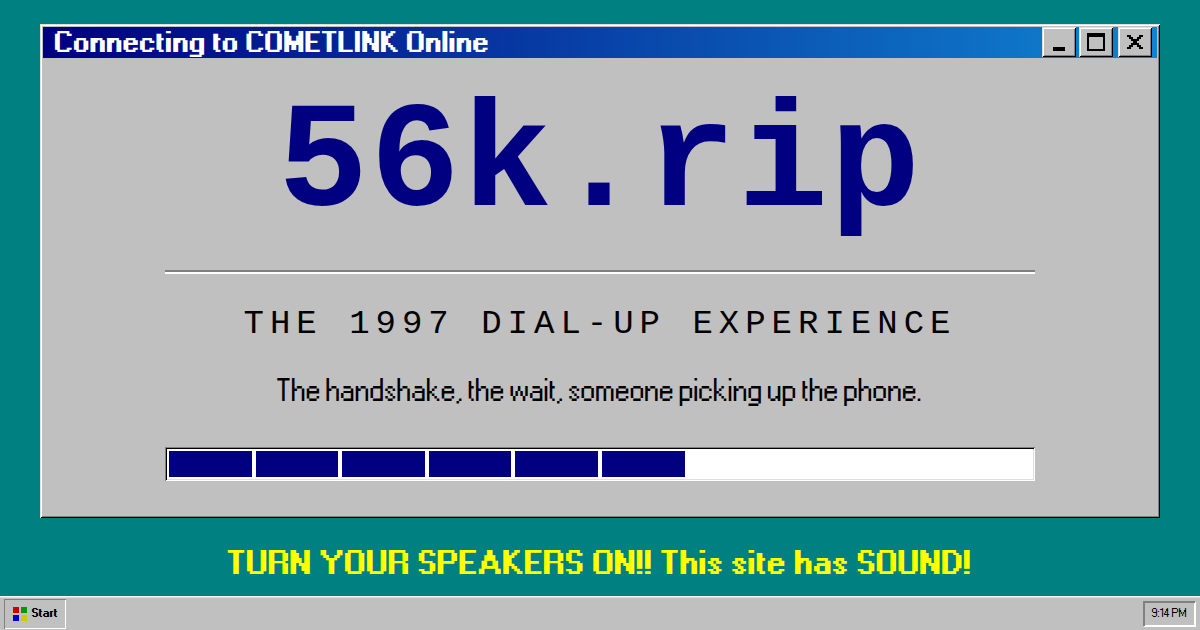
Saw Webamp in the sidebar and figured this fits. It’s a 90s PC desktop that runs in the browser, modem sound when you connect, a few period apps, and a live chat room.
56k.rip
Saw Webamp in the sidebar and figured this fits. It’s a 90s PC desktop that runs in the browser, modem sound when you connect, a few period apps, and a live chat room.
Windows 95 at 56k.rip, a Mac at dialup.rip. Both dial into COMETLINK, an online service that never existed but feels like one you had. Real modem sounds, busy signals, pages that load one line at a time, a webring of 60+ hand-made member pages, and a chat room shared between both machines.
Windows 95 at 56k.rip, a Mac at dialup.rip. Both dial into COMETLINK, an online service that never existed but feels like one you had. Real modem sounds, busy signals, pages that load one line at a time, a webring of 60+ hand-made member pages, and a chat room shared between both machines.
Interesting and short interview with the maintainer of frutigeraeroarchive.org.
A quote:
Does it feel more alive for me personally? I can say yes to that, as it comes from an era where we were all more optimistic about technology and what it would do in our lives. I would say our outlook in recent years has changed drastically, with companies becoming more and more greedy, more of our data being harvested, and the rise of AI. I have nothing against flat design itself however I have to admit it is more lazily done most of the time than even a basic skeuomorphic interface, and requires basically no effort to pull off correctly.
While this site is still updated and maintained, I appreciate that the aesthetic and source likely hasn’t changed much since 2004. Additionally, Claw is a fucking awesome game, and more people should discover it in 2026.
While this site is still updated and maintained, I appreciate that the aesthetic and source likely hasn’t changed much since 2004. Additionally, Claw is a fucking awesome game, and more people should discover it in 2026.
Flavor Flav is apparently a big fan of women’s sports, and released a remake of He Got Game, called She Got Game, with a lyrics video featuring a Windows XP media player. So that’s like, three fantastic things in one sentence. https://bsky.app/profile/flavorflav.bsky.social/post/3me4ph76pkk25@retronet
Flavor Flav is apparently a big fan of women’s sports, and released a remake of He Got Game, called She Got Game, with a lyrics video featuring a Windows XP media player. So that’s like, three fantastic things in one sentence. https://bsky.app/profile/flavorflav.bsky.social/post/3me4ph76pkk25@retronet
cross-posted from: lemmy.zip/post/48581934 > Remember all the personal sites in HTML people used to have on places like geocities or neocities? There’s a bit of an online movement to go back to that kind of site instead of everything being on some big centrally-owned website. > > Neoskitties is that, in the style of r/pokemedia: posting what people would have on their equivalent to neocities in the Pokémon universe. Figured Pokémon Lemmy might appreciate.
cross-posted from: lemmy.zip/post/48581934 > Remember all the personal sites in HTML people used to have on places like geocities or neocities? There’s a bit of an online movement to go back to that kind of site instead of everything being on some big centrally-owned website. > > Neoskitties is that, in the style of r/pokemedia: posting what people would have on their equivalent to neocities in the Pokémon universe. Figured Pokémon Lemmy might appreciate.
Last week’s post about early 2000s video game websites reminded me of this one. It has a few hallmarks of that era of gaming websites, like an image background and images for borders around the content. The markup is pretty retro, too: it uses a <frameset> and frames. I’m not really sure when the site was made, but it was probably 2006. archive.org’s first snapshot is January, 2007. When Epic removed all Unreal titles from download stores, they mentioned xmpcommunity.com in their blog post. So this is now like an officially sanctioned way of playing the game. They also mentioned oldunreal.com for getting the original Unreal game to run. That’s another fairly retro looking site, although they did change from handwritten HTML pages to a CMS a few years ago. Still has some “old internet” elements to it, though, like a page about netiquette. Now there’s a classic internet term. And page about netiquette with a cookie banner on it? That’s like the duality of the web right there. That page is a metaphor for… something. I don’t know what. But it is.
Last week’s post about early 2000s video game websites reminded me of this one. It has a few hallmarks of that era of gaming websites, like an image background and images for borders around the content. The markup is pretty retro, too: it uses a <frameset> and frames. I’m not really sure when the site was made, but it was probably 2006. archive.org’s first snapshot is January, 2007. When Epic removed all Unreal titles from download stores, they mentioned xmpcommunity.com in their blog post. So this is now like an officially sanctioned way of playing the game. They also mentioned oldunreal.com for getting the original Unreal game to run. That’s another fairly retro looking site, although they did change from handwritten HTML pages to a CMS a few years ago. Still has some “old internet” elements to it, though, like a page about netiquette. Now there’s a classic internet term. And page about netiquette with a cookie banner on it? That’s like the duality of the web right there. That page is a metaphor for… something. I don’t know what. But it is.
The Anally Retentives Retro Games Home - Classic video game information and links Suddenly remembered about this site. It’s far smaller than I thought.
The Anally Retentives Retro Games Home - Classic video game information and links Suddenly remembered about this site. It’s far smaller than I thought.
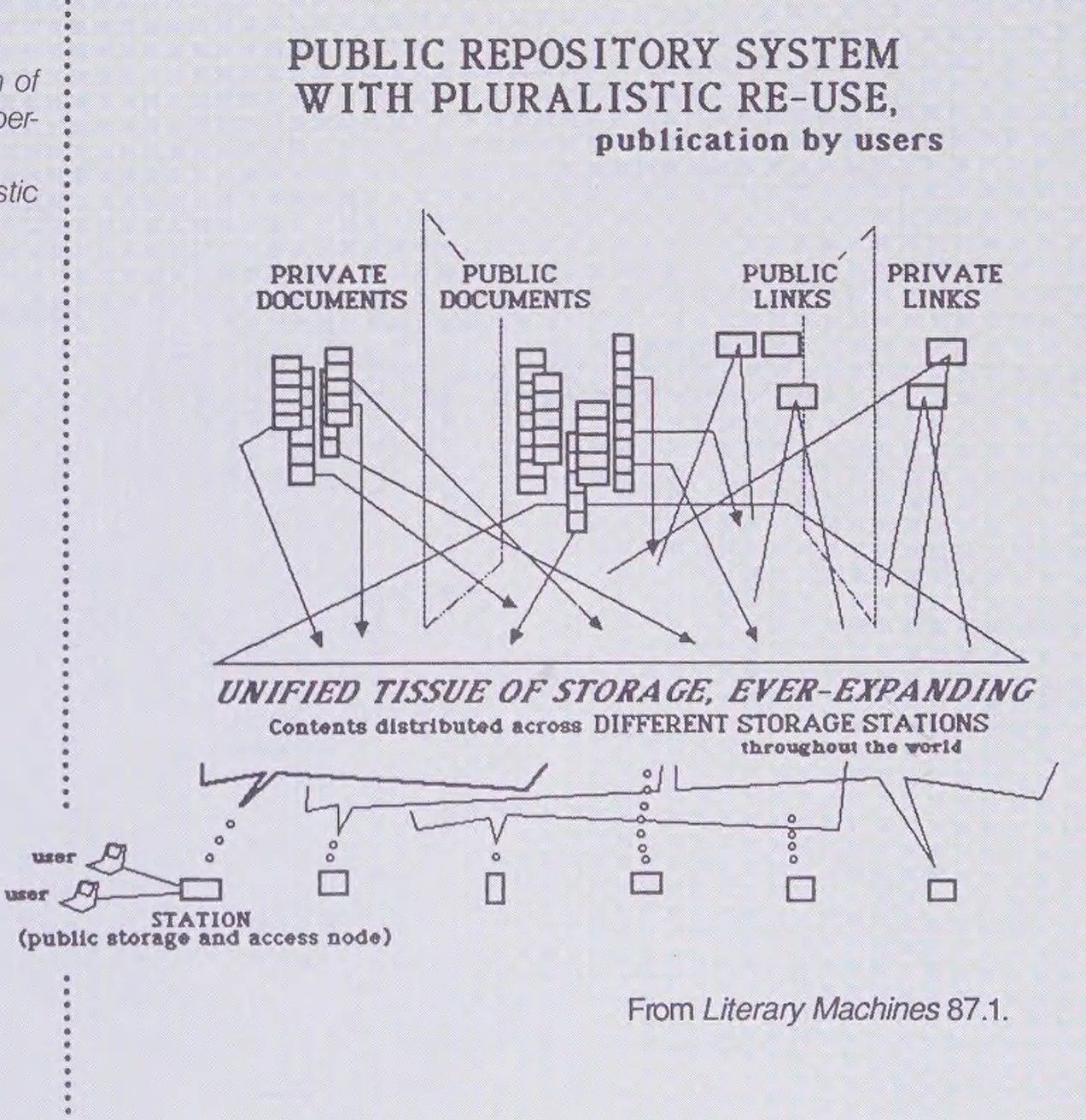
Collective human consciousness is full of imagined or mythical dream-like utopias, hidden away behind mountains, across or under oceans, hidden in mist, or deep in the jungle. From Atlantis, Avalon, El Dorado, and Shangri-La, we have not stopped imagining these secret, fantastical places. One of these, Xanadu, is actually a real place but has been embellished over the years into a place of legend and myth, and thus became the namesake of an Internet we never got to see like all of those other mystical, hidden places. The Xanadu project got its start in the 1960s at around the same time the mouse and what we might recognize as a modern computer user interface were created. At its core was hypertext with the ability to link not just other pages but references and files together into one network. It also had version control, rights management, bi-directional links, and a number of additional features that would be revolutionary even today. Another core feature was transclusion, a method for making sure that original authors were compensated when their work was linked. However, Xanadu was hampered by a number of issues including lack of funding, infighting among the project’s contributors, and the development of an almost cult-like devotion to the vision, not unlike some of today’s hype around generative AI. Surprisingly, despite these faults, the project received significant funding from Autodesk, but even with this support the project ultimately failed. Instead of this robust, bi-directional web imagined as early as the 1960s, the Internet we know of today is the much simpler World Wide Web which has many features of Xanadu we recognize. Not only is it less complex to implement, it famously received institutional backing from CERN immediately rather than stagnating for decades. The article linked above contains a tremendous amount of detail around this story that’s worth checking out. For all its faults and lack of success, though, Xanadu is a interesting image of what the future of the past could have been like if just a few things had shaken out differently, and it will instead remain a mythical place like so many others.
Collective human consciousness is full of imagined or mythical dream-like utopias, hidden away behind mountains, across or under oceans, hidden in mist, or deep in the jungle. From Atlantis, Avalon, El Dorado, and Shangri-La, we have not stopped imagining these secret, fantastical places. One of these, Xanadu, is actually a real place but has been embellished over the years into a place of legend and myth, and thus became the namesake of an Internet we never got to see like all of those other mystical, hidden places. The Xanadu project got its start in the 1960s at around the same time the mouse and what we might recognize as a modern computer user interface were created. At its core was hypertext with the ability to link not just other pages but references and files together into one network. It also had version control, rights management, bi-directional links, and a number of additional features that would be revolutionary even today. Another core feature was transclusion, a method for making sure that original authors were compensated when their work was linked. However, Xanadu was hampered by a number of issues including lack of funding, infighting among the project’s contributors, and the development of an almost cult-like devotion to the vision, not unlike some of today’s hype around generative AI. Surprisingly, despite these faults, the project received significant funding from Autodesk, but even with this support the project ultimately failed. Instead of this robust, bi-directional web imagined as early as the 1960s, the Internet we know of today is the much simpler World Wide Web which has many features of Xanadu we recognize. Not only is it less complex to implement, it famously received institutional backing from CERN immediately rather than stagnating for decades. The article linked above contains a tremendous amount of detail around this story that’s worth checking out. For all its faults and lack of success, though, Xanadu is a interesting image of what the future of the past could have been like if just a few things had shaken out differently, and it will instead remain a mythical place like so many others.
I’ve fully scanned and archived this web design magazine from 2000 and put it up on the Internet Archive. You can go and experience the future of the web, 25 years ago! Some juicy pictures:
I’ve fully scanned and archived this web design magazine from 2000 and put it up on the Internet Archive. You can go and experience the future of the web, 25 years ago! Some juicy pictures:












 Collective human consciousness is full of imagined or mythical dream-like utopias, hidden away behind mountains, across or under oceans, hidden in mist, or deep in the jungle. From Atlantis, Avalon, El Dorado, and Shangri-La, we have not stopped imagining these secret, fantastical places. One of these, Xanadu, is actually a real place but has been embellished over the years into a place of legend and myth,


