89
preview
cross-posted from: sopuli.xyz/post/54162879
cross-posted from: sopuli.xyz/post/54162879
posts tagged #technology




cross-posted from: sopuli.xyz/post/54162879
cross-posted from: sopuli.xyz/post/54162879

cross-posted from: lemmy.world/post/54070272
When uploading a real recording, there is a good chance your location & therefore possibly your identity can be revealed from the footage itself.
You can triangulate low volume background sounds such as air planes: cybernews.com/…/aircraft-doppler-audio-geolocatio…
You can check the position of the sun/moon/stars, shadows, weather…: bellingcat.com/…/using-the-sun-and-the-shadows-fo…
If Streamers & Journalists CAN do it, government agencies ARE doing it.
If you need privacy be aware of this when recording / editing friends <3
cross-posted from: lemmy.world/post/54070272
When uploading a real recording, there is a good chance your location & therefore possibly your identity can be revealed from the footage itself.
You can triangulate low volume background sounds such as air planes: cybernews.com/…/aircraft-doppler-audio-geolocatio…
You can check the position of the sun/moon/stars, shadows, weather…: bellingcat.com/…/using-the-sun-and-the-shadows-fo…
If Streamers & Journalists CAN do it, government agencies ARE doing it.
If you need privacy be aware of this when recording / editing friends <3

That might be worded a bit too dramatic.
Anyways, it is good for people if more of the available money is invested in necessary and useful things. Like energy-saving technology, decarbonization, solar power, cheap electric cars and so on. The world is in the biggest technological transformation of the last 150 years: The transformation away from fossil power… and most US ecomical leaders are sleeping at the helm.
That might be worded a bit too dramatic.
Anyways, it is good for people if more of the available money is invested in necessary and useful things. Like energy-saving technology, decarbonization, solar power, cheap electric cars and so on. The world is in the biggest technological transformation of the last 150 years: The transformation away from fossil power… and most US ecomical leaders are sleeping at the helm.






cross-posted from: lemmy.ml/post/54833264
At least that’s what VLC thinks when protesting the new French law.
France’s National Assembly has voted in favour of a new “internet tax” that would charge companies for every gigabyte of data they send to users in France.
The idea is to make Netflix, Google, Meta and the rest of Big Tech pay more.
That sounds like a dream come true for many of us who prefer taking ownership of data in our own hands but unfortunately things are not that simple.
The way this law is written, it doesn’t stop at Big Tech. Even VLC, a free and open source media player maintained by a non-profit, could end up paying this new tax. What the new French internet tax says New French Internet Tax law
The measure is amendment I-1358 to France’s 2027 finance bill, tabled by Laurent Lhardit. It creates a tax on “producers of digital data” at €0.055 (5.5 euro cents) for every gigabyte delivered to subscribers of French internet providers.
Internet providers would measure how much data each sender pushes to their customers, with the collection supervised by telecom regulator Arcep and the tax administration DGFiP. Only the volume is counted, not the content or where it goes.
The amount is capped at 15% of the company’s revenue in France or 2% of its total revenue, as per the amendment. Note that it’s 15% of French revenue, not of total network traffic. And the text joins the two caps with an “or” without saying which one applies when they differ. How much money are we talking about?
The amendment cites an Arcep estimate of 200 billion GB a year flowing to French internet subscribers. It expects the tax to bring in €10 billion a year. It also names Google, Meta (Facebook, Instagram), Amazon, Netflix and Akamai (cloud server provider) as the senders of about half of that traffic.
You’d think the money goes to the telecom operators who build and maintain the networks. That’s the “fair share” argument European telcos have pushed for years.
But that’s not the case. The revenue goes straight into the state budget, and the amendment’s own justification talks about tax fairness between local businesses and digital multinationals, plus the ecological benefit of compressing data.
Why VLC is angry
A gigabyte of open source software counts the same as a gigabyte of Netflix. VideoLAN, the French non-profit behind VLC, posted on X that the tax would cost it over €1 million a year.
Lhardit replied that the cap would protect VideoLAN. He also said he didn’t see how the tax could be passed on to users of Facebook, Instagram or TikTok since those services are free.
VideoLAN didn’t take that well:
You have no idea what you are talking about. What you said about Facebook and Insta and other social networks are not targeted because they are free, means you don't understand the basics of economy. You don't understand the difference between Revenue and Profit.

VideoLAN (@videolan), October 30, 2026
The cap may limit what a low-revenue non-profit owes. But there is no explicit exemption for associations, free software or free content anywhere in the text. VideoLAN’s €1 million is the possible figure before the cap, and right now nobody can tell the exact figure for certain because of all the ambiguity.
VLC isn’t alone. OVHcloud founder Octave Klaba put his company’s gross exposure at around €70 million a year, and Free’s (Teleccom) Xavier Niel called the authors “ignares incompétents”, roughly “incompetent ignoramuses”. Those are French companies, by the way. Not exactly the US giants this internet tax bill was meant to tame. At the end, the consumer pays the bill
See, a “war on Big Tech” sounds great in a headline, and European governments are fond of laws that squeeze extra money out of American tech companies. But I don’t buy the idea that Netflix will pay them out of their pocket.
Netflix will do what it always does and raise subscription prices. And Facebook is “free” only because advertisers pay for it, which is exactly the revenue versus profit point VideoLAN was making.
So the government gets extra money, Big Tech protects its margins, and you end up paying. Meanwhile, non-profit projects like VLC, which never had a price to raise in the first place, are left wondering how big their bill will be.
Let’s just hope that this doesn’t take the form of law. Because this will set a precedence. I wouldn’t be surprised to see other European countries try their own version. No government will say no to extra tax revenue.
Like GDPR, this has all the ingredients of another mess. If a law is going to tax “internet companies”, it needs to say in black and white which ones. Right now, it doesn’t.
What do you think? A fair way to make Big Tech pay, or a blunt instrument that hits everyone else? Let me know in the comments.
cross-posted from: lemmy.ml/post/54833264
At least that’s what VLC thinks when protesting the new French law.
France’s National Assembly has voted in favour of a new “internet tax” that would charge companies for every gigabyte of data they send to users in France.
The idea is to make Netflix, Google, Meta and the rest of Big Tech pay more.
That sounds like a dream come true for many of us who prefer taking ownership of data in our own hands but unfortunately things are not that simple.
The way this law is written, it doesn’t stop at Big Tech. Even VLC, a free and open source media player maintained by a non-profit, could end up paying this new tax. What the new French internet tax says New French Internet Tax law
The measure is amendment I-1358 to France’s 2027 finance bill, tabled by Laurent Lhardit. It creates a tax on “producers of digital data” at €0.055 (5.5 euro cents) for every gigabyte delivered to subscribers of French internet providers.
Internet providers would measure how much data each sender pushes to their customers, with the collection supervised by telecom regulator Arcep and the tax administration DGFiP. Only the volume is counted, not the content or where it goes.
The amount is capped at 15% of the company’s revenue in France or 2% of its total revenue, as per the amendment. Note that it’s 15% of French revenue, not of total network traffic. And the text joins the two caps with an “or” without saying which one applies when they differ. How much money are we talking about?
The amendment cites an Arcep estimate of 200 billion GB a year flowing to French internet subscribers. It expects the tax to bring in €10 billion a year. It also names Google, Meta (Facebook, Instagram), Amazon, Netflix and Akamai (cloud server provider) as the senders of about half of that traffic.
You’d think the money goes to the telecom operators who build and maintain the networks. That’s the “fair share” argument European telcos have pushed for years.
But that’s not the case. The revenue goes straight into the state budget, and the amendment’s own justification talks about tax fairness between local businesses and digital multinationals, plus the ecological benefit of compressing data.
Why VLC is angry
A gigabyte of open source software counts the same as a gigabyte of Netflix. VideoLAN, the French non-profit behind VLC, posted on X that the tax would cost it over €1 million a year.
Lhardit replied that the cap would protect VideoLAN. He also said he didn’t see how the tax could be passed on to users of Facebook, Instagram or TikTok since those services are free.
VideoLAN didn’t take that well:
You have no idea what you are talking about. What you said about Facebook and Insta and other social networks are not targeted because they are free, means you don't understand the basics of economy. You don't understand the difference between Revenue and Profit.

VideoLAN (@videolan), October 30, 2026
The cap may limit what a low-revenue non-profit owes. But there is no explicit exemption for associations, free software or free content anywhere in the text. VideoLAN’s €1 million is the possible figure before the cap, and right now nobody can tell the exact figure for certain because of all the ambiguity.
VLC isn’t alone. OVHcloud founder Octave Klaba put his company’s gross exposure at around €70 million a year, and Free’s (Teleccom) Xavier Niel called the authors “ignares incompétents”, roughly “incompetent ignoramuses”. Those are French companies, by the way. Not exactly the US giants this internet tax bill was meant to tame. At the end, the consumer pays the bill
See, a “war on Big Tech” sounds great in a headline, and European governments are fond of laws that squeeze extra money out of American tech companies. But I don’t buy the idea that Netflix will pay them out of their pocket.
Netflix will do what it always does and raise subscription prices. And Facebook is “free” only because advertisers pay for it, which is exactly the revenue versus profit point VideoLAN was making.
So the government gets extra money, Big Tech protects its margins, and you end up paying. Meanwhile, non-profit projects like VLC, which never had a price to raise in the first place, are left wondering how big their bill will be.
Let’s just hope that this doesn’t take the form of law. Because this will set a precedence. I wouldn’t be surprised to see other European countries try their own version. No government will say no to extra tax revenue.
Like GDPR, this has all the ingredients of another mess. If a law is going to tax “internet companies”, it needs to say in black and white which ones. Right now, it doesn’t.
What do you think? A fair way to make Big Tech pay, or a blunt instrument that hits everyone else? Let me know in the comments.



North Korean cryptocurrency thieves tricked a Binance software engineer into downloading malware onto their work-issued computer during a fake job interview process before last week’s record-breaking $6.3 billion heist.
In an incident report published on Tuesday, the cryptocurrency exchange said several techniques - including social engineering via fake job interviews, malware downloads, compromised internal AI tooling, endpoint takeover, and an “advanced transaction-authorization method” - led to the October 29 security breach.
“Our current investigation indicates that this was a sophisticated, multi-stage campaign,” the incident report said. “It was not a single isolated breach or a simple phishing incident.”
Over the weekend, the FBI attributed the theft to TraderTraitor, a North Korean hacking operation linked to Lazarus Group, known for combining espionage with massive cryptocurrency heists. The Pyongyang-backed crew is also highly adept at job market scams - both posing as IT workers, who are then hired by Western companies, and as potential employers to lure software engineers into downloading malware and infecting corporate devices.
North Korean cryptocurrency thieves tricked a Binance software engineer into downloading malware onto their work-issued computer during a fake job interview process before last week’s record-breaking $6.3 billion heist.
In an incident report published on Tuesday, the cryptocurrency exchange said several techniques - including social engineering via fake job interviews, malware downloads, compromised internal AI tooling, endpoint takeover, and an “advanced transaction-authorization method” - led to the October 29 security breach.
“Our current investigation indicates that this was a sophisticated, multi-stage campaign,” the incident report said. “It was not a single isolated breach or a simple phishing incident.”
Over the weekend, the FBI attributed the theft to TraderTraitor, a North Korean hacking operation linked to Lazarus Group, known for combining espionage with massive cryptocurrency heists. The Pyongyang-backed crew is also highly adept at job market scams - both posing as IT workers, who are then hired by Western companies, and as potential employers to lure software engineers into downloading malware and infecting corporate devices.
cross-posted from: reddthat.com/post/76256093
cross-posted from: reddthat.com/post/76256093

cross-posted from: lemmy.world/post/54061090
“A group of Facebook users says Meta was aware of receiving user data from hundreds of medical providers without users’ knowledge or consent.
Users recognized at least 664 hospital systems and health provider websites from which Meta received patient information…”
cross-posted from: lemmy.world/post/54061090
“A group of Facebook users says Meta was aware of receiving user data from hundreds of medical providers without users’ knowledge or consent.
Users recognized at least 664 hospital systems and health provider websites from which Meta received patient information…”


I’ve been looking at phones lately and I’ve seen this company called Enough from their YouTube kickstarter video. It’s them and SLEKE (maker of OdesseyOS) working on building a nice size phone. I’m thinking of supporting their kickstarter because I am tired of these humongous phablets, and I can’t stand on how they feel in my hand when holding them.
The phone has everything I want but I am really wondering if the bootloader will be unlockable.
—-———————————————————————————————————
Some important edits that should be added; (after looking on Enough’s website and kickstarter)
I’ve been looking at phones lately and I’ve seen this company called Enough from their YouTube kickstarter video. It’s them and SLEKE (maker of OdesseyOS) working on building a nice size phone. I’m thinking of supporting their kickstarter because I am tired of these humongous phablets, and I can’t stand on how they feel in my hand when holding them.
The phone has everything I want but I am really wondering if the bootloader will be unlockable.
—-———————————————————————————————————
Some important edits that should be added; (after looking on Enough’s website and kickstarter)






You are probably already aware of the recent Microsoft outage. For more than a day last week, a large share of the world’s office workers could not reliably send or receive email.
The trouble started on the afternoon of Nov. 12, when Outlook users found they could no longer reach their mailboxes. Within about an hour, Downdetector had logged reports from 74 countries and territories. Teams and Copilot features that rely on Exchange Online broke too.
Government systems in Singapore and Japan were hit, as were communications at the Supreme Court of the Philippines and, in Australia, the federal police and the country’s spy agency.
Microsoft said the outage was not a cyberattack. In a preliminary explanation, it pointed to an issue from an earlier network capacity upgrade that surfaced after a more recent network change. The company declared service fully restored early on Nov. 14, and has promised a full post-incident report.
The disruption is the latest in a run of Exchange Online failures this year. On Aug. 31, a bad authentication configuration knocked out email and spilled over into Teams, SharePoint, OneDrive and Defender for about 12 hours. Some estimated that lost productivity from the November outage could approach $7 billion.
For the companies selling open source alternatives to Microsoft’s products, the episode is a chance to make an argument they have been making for years. It’s FOSS asked several of them what governments and businesses should be thinking about as they recover. Their answer, broadly, was not that their software never fails. It was that no single company should be able to stop an entire economy’s email at once.
“Errors can happen to any provider,” said Peter Ganten, the chief executive of Univention, a German company that makes open source identity management software. “The more important question is concentration.”
“When hundreds of millions of people in thousands of organizations worldwide depend on the same infrastructure, running the same software and managed by the same company, a single fault in the wrong place can bring public life to a standstill,” Ganten said. This failure appears to have been technical, he noted, but “an external attack could have had equally severe consequences.” The same dependency, he added, leaves entire economies exposed to sudden price increases or politically motivated service restrictions.
The scale he describes is real. Microsoft reported more than 450 million paid commercial seats for Microsoft 365 in January this year.
Nextcloud, which makes a self-hostable file sharing and collaboration suite, struck a gentler note while the outage was still unfolding. “Mistakes happen in the IT industry,” Jos Poortvliet, a co-founder of the company, said in a statement on Friday. “This holds true for companies of all sizes, including us. Our heart goes out to all the admins today.”
But he too pointed to concentration. “Especially in critical infrastructure, monopolies are increasing the risk of stalling businesses globally if an incident occurs,” Mr. Poortvliet said. “When everything is hanging on a single vendor, companies can’t switch providers quickly to get back up and running, or have a second setup as backup, or pull the plug when under attack and keep working air-gapped.”
The weak point is the login
The outages this year have shown how one fault can spread. In August, a problem with Microsoft’s authentication configuration did not just break email. It took down other Microsoft 365 services that sit on the same sign-in layer.
Ganten said that was the risk worth worrying about most. “When authentication fails, every service that depends on it fails with it,” he said. Identity, in his view, should be an open and separate layer that different providers can run, so that services stay reachable when one of them goes down. Univention sells an identity platform, Nubus, built on that idea.
‘Outsourced operations’ is not ‘outsourced risk’
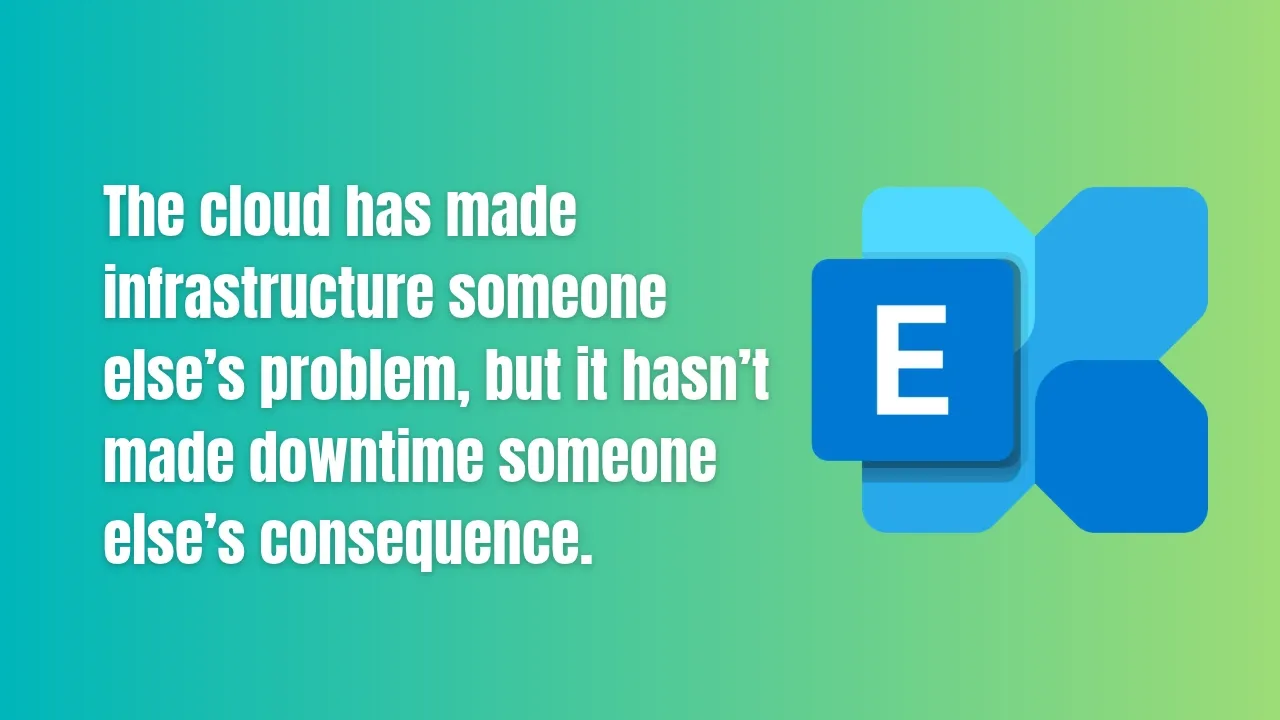
Galina Goduhina, the commercial director of ONLYOFFICE, an open source office suite, said organizations had misread what the cloud bought them. “The cloud has made infrastructure someone else’s problem, but it hasn’t made downtime someone else’s consequence,” she said. “Organizations need to stop confusing outsourced operations with outsourced risk.”
The question, she said, is whether an organization has “enough control, portability and independence to keep working when their primary provider cannot.”
She was candid that open source software is not immune. “The difference isn’t that open source fails less,” Ms. Goduhina said. “It’s that failure doesn’t necessarily leave you waiting for a single vendor to act.” Whether organizations can actually use that freedom, she added, depends on their preparation.
That raises an obvious objection: moving from Microsoft’s cloud to another company’s cloud could simply trade one dependency for another. Ganten agreed that it can. “It does, unless the software is open source and built on open standards,” he said. Such software can be run without its original vendor and, in the worst case, maintained by someone else entirely. Leaving is harder than it looks
None of the companies suggested that switching is quick. Asked what it would take for a 500-person organization to move off Exchange, Goduhina said the mailboxes were the simple part.
“Moving 500 mailboxes is the easy part to estimate,” she said. “Replacing years of accumulated integrations, permissions and habits is not.” She would plan for several months, starting with an audit of dependencies and a pilot group. “The biggest migration risk is discovering too late that Exchange was doing far more than handling email.”
Some governments have already done it. The German state of Schleswig-Holstein moved more than 44,000 mailboxes from Exchange to Open-Xchange by October 2025. Poortvliet said open source alternatives “exist, are ready to use and have been proven at scale.”
For organizations that are not ready to leave, Ganten suggested a smaller step. Where critical services are involved, he said, organizations should be able to keep at least a minimal operation running without their usual provider.
“This fallback,” he said, “must be rehearsed regularly.”
You are probably already aware of the recent Microsoft outage. For more than a day last week, a large share of the world’s office workers could not reliably send or receive email.
The trouble started on the afternoon of Nov. 12, when Outlook users found they could no longer reach their mailboxes. Within about an hour, Downdetector had logged reports from 74 countries and territories. Teams and Copilot features that rely on Exchange Online broke too.
Government systems in Singapore and Japan were hit, as were communications at the Supreme Court of the Philippines and, in Australia, the federal police and the country’s spy agency.
Microsoft said the outage was not a cyberattack. In a preliminary explanation, it pointed to an issue from an earlier network capacity upgrade that surfaced after a more recent network change. The company declared service fully restored early on Nov. 14, and has promised a full post-incident report.
The disruption is the latest in a run of Exchange Online failures this year. On Aug. 31, a bad authentication configuration knocked out email and spilled over into Teams, SharePoint, OneDrive and Defender for about 12 hours. Some estimated that lost productivity from the November outage could approach $7 billion.
For the companies selling open source alternatives to Microsoft’s products, the episode is a chance to make an argument they have been making for years. It’s FOSS asked several of them what governments and businesses should be thinking about as they recover. Their answer, broadly, was not that their software never fails. It was that no single company should be able to stop an entire economy’s email at once.
“Errors can happen to any provider,” said Peter Ganten, the chief executive of Univention, a German company that makes open source identity management software. “The more important question is concentration.”
“When hundreds of millions of people in thousands of organizations worldwide depend on the same infrastructure, running the same software and managed by the same company, a single fault in the wrong place can bring public life to a standstill,” Ganten said. This failure appears to have been technical, he noted, but “an external attack could have had equally severe consequences.” The same dependency, he added, leaves entire economies exposed to sudden price increases or politically motivated service restrictions.
The scale he describes is real. Microsoft reported more than 450 million paid commercial seats for Microsoft 365 in January this year.
Nextcloud, which makes a self-hostable file sharing and collaboration suite, struck a gentler note while the outage was still unfolding. “Mistakes happen in the IT industry,” Jos Poortvliet, a co-founder of the company, said in a statement on Friday. “This holds true for companies of all sizes, including us. Our heart goes out to all the admins today.”
But he too pointed to concentration. “Especially in critical infrastructure, monopolies are increasing the risk of stalling businesses globally if an incident occurs,” Mr. Poortvliet said. “When everything is hanging on a single vendor, companies can’t switch providers quickly to get back up and running, or have a second setup as backup, or pull the plug when under attack and keep working air-gapped.”
The weak point is the login
The outages this year have shown how one fault can spread. In August, a problem with Microsoft’s authentication configuration did not just break email. It took down other Microsoft 365 services that sit on the same sign-in layer.
Ganten said that was the risk worth worrying about most. “When authentication fails, every service that depends on it fails with it,” he said. Identity, in his view, should be an open and separate layer that different providers can run, so that services stay reachable when one of them goes down. Univention sells an identity platform, Nubus, built on that idea.
‘Outsourced operations’ is not ‘outsourced risk’
Galina Goduhina, the commercial director of ONLYOFFICE, an open source office suite, said organizations had misread what the cloud bought them. “The cloud has made infrastructure someone else’s problem, but it hasn’t made downtime someone else’s consequence,” she said. “Organizations need to stop confusing outsourced operations with outsourced risk.”
The question, she said, is whether an organization has “enough control, portability and independence to keep working when their primary provider cannot.”
She was candid that open source software is not immune. “The difference isn’t that open source fails less,” Ms. Goduhina said. “It’s that failure doesn’t necessarily leave you waiting for a single vendor to act.” Whether organizations can actually use that freedom, she added, depends on their preparation.
That raises an obvious objection: moving from Microsoft’s cloud to another company’s cloud could simply trade one dependency for another. Ganten agreed that it can. “It does, unless the software is open source and built on open standards,” he said. Such software can be run without its original vendor and, in the worst case, maintained by someone else entirely. Leaving is harder than it looks
None of the companies suggested that switching is quick. Asked what it would take for a 500-person organization to move off Exchange, Goduhina said the mailboxes were the simple part.
“Moving 500 mailboxes is the easy part to estimate,” she said. “Replacing years of accumulated integrations, permissions and habits is not.” She would plan for several months, starting with an audit of dependencies and a pilot group. “The biggest migration risk is discovering too late that Exchange was doing far more than handling email.”
Some governments have already done it. The German state of Schleswig-Holstein moved more than 44,000 mailboxes from Exchange to Open-Xchange by October 2025. Poortvliet said open source alternatives “exist, are ready to use and have been proven at scale.”
For organizations that are not ready to leave, Ganten suggested a smaller step. Where critical services are involved, he said, organizations should be able to keep at least a minimal operation running without their usual provider.
“This fallback,” he said, “must be rehearsed regularly.”




Intel has been pinging me a few times a day for months about a driver update for my Wi-Fi and Bluetooth. As both work fine, I’ve ignored it. But then you hit that final nag, and you say:
I know how shitty this was going to be; this is why I chose to delay; I can’t take this anymore.
I could have fucking installed KDE Neon on a new partition table in the time this took. And, of course, a goddamned fucking driver update needs a EULA for each, and would I like to install it in the same directory as before (which clues you in than you’re not, in fact, installing a driver update if the EULA didn’t), and would I like to use the same settings as before, and now I need to confirm that “yes, just leave everything else the fuck alone and update my driver.”
And then close out with another button. Interestingly, the Wi-Fi updater UI is XP/Vista era, while BT is Win95. You seriously can’t do better than this in 2026?
And, of course, in both cases, I was interrupted by Windows itself to confirm I wanted to let Intel access Intel drivers.
I like having control over my machines, but there’s got to be a better way.
And if they tucked rights to a firstborn into the EULA update, joke’s on them: I’m fixed.
Intel has been pinging me a few times a day for months about a driver update for my Wi-Fi and Bluetooth. As both work fine, I’ve ignored it. But then you hit that final nag, and you say:
I know how shitty this was going to be; this is why I chose to delay; I can’t take this anymore.
I could have fucking installed KDE Neon on a new partition table in the time this took. And, of course, a goddamned fucking driver update needs a EULA for each, and would I like to install it in the same directory as before (which clues you in than you’re not, in fact, installing a driver update if the EULA didn’t), and would I like to use the same settings as before, and now I need to confirm that “yes, just leave everything else the fuck alone and update my driver.”
And then close out with another button. Interestingly, the Wi-Fi updater UI is XP/Vista era, while BT is Win95. You seriously can’t do better than this in 2026?
And, of course, in both cases, I was interrupted by Windows itself to confirm I wanted to let Intel access Intel drivers.
I like having control over my machines, but there’s got to be a better way.
And if they tucked rights to a firstborn into the EULA update, joke’s on them: I’m fixed.

We live in the age of artificial intelligence — an age that Jensen Huang, perhaps more than any other single person, has made possible. The systems we are building with Nvidia’s equipment will transform our society and culture in ways we can’t imagine. But Mr. Huang’s unraveling is not a technology story. It is a timeless tale of masculine hubris, of a man undone by reckless overconfidence. Some things never change.
When I wrote my biography of Mr. Huang, I titled it “The Thinking Machine.” The name referred to the microchips that powered A.I., but also to Mr. Huang’s marauding, relentless intellect, which never slowed down or turned off. In the wake of his stunning departure, spurred by revelations that he carried on at least two affairs, one with a woman whom U.S. intelligence determined is a Chinese spy, and another with one of his direct reports, I should write a sequel: “The What-Were-You-Thinking?! Machine.”
Let’s start with Mr. Huang’s affair with Alice Huang, an executive who managed a Singapore-based company that owns data centers in Southeast Asia. These data centers are suspected of helping Chinese A.I. developers circumvent U.S. restrictions on sales of Nvidia equipment. A recent report in The Information suggests they were used as a way station to illicitly smuggle some $7 billion of equipment into China. Since U.S. intelligence captured evidence of Mr. Huang in a romantic relationship with Ms. Huang, it’s hard to believe that he did not understand what was going on.
Now consider Mr. Huang’s reported involvement with Kimberly Powell, an executive in the health care group at his firm and his direct subordinate. A former Nvidia employee told me this affair was common knowledge in the company — the same company that employs both of Mr. Huang’s children in executive roles. It’s a stunning and disrespectful display of arrogance. I asked the former employee why Mr. Huang would behave this way, right in front of his kids. The former employee said that it got him high — a narcissist’s high.
We live in the age of artificial intelligence — an age that Jensen Huang, perhaps more than any other single person, has made possible. The systems we are building with Nvidia’s equipment will transform our society and culture in ways we can’t imagine. But Mr. Huang’s unraveling is not a technology story. It is a timeless tale of masculine hubris, of a man undone by reckless overconfidence. Some things never change.
When I wrote my biography of Mr. Huang, I titled it “The Thinking Machine.” The name referred to the microchips that powered A.I., but also to Mr. Huang’s marauding, relentless intellect, which never slowed down or turned off. In the wake of his stunning departure, spurred by revelations that he carried on at least two affairs, one with a woman whom U.S. intelligence determined is a Chinese spy, and another with one of his direct reports, I should write a sequel: “The What-Were-You-Thinking?! Machine.”
Let’s start with Mr. Huang’s affair with Alice Huang, an executive who managed a Singapore-based company that owns data centers in Southeast Asia. These data centers are suspected of helping Chinese A.I. developers circumvent U.S. restrictions on sales of Nvidia equipment. A recent report in The Information suggests they were used as a way station to illicitly smuggle some $7 billion of equipment into China. Since U.S. intelligence captured evidence of Mr. Huang in a romantic relationship with Ms. Huang, it’s hard to believe that he did not understand what was going on.
Now consider Mr. Huang’s reported involvement with Kimberly Powell, an executive in the health care group at his firm and his direct subordinate. A former Nvidia employee told me this affair was common knowledge in the company — the same company that employs both of Mr. Huang’s children in executive roles. It’s a stunning and disrespectful display of arrogance. I asked the former employee why Mr. Huang would behave this way, right in front of his kids. The former employee said that it got him high — a narcissist’s high.

Researchers at Sandia National Laboratories, Infineon Technologies and Arizona State University recently demonstrated a new approach for efficiently performing crucial FFT calculations with an analog system made up of a large array of memory components.
Their proposed method, introduced in a paper published in Nature Electronics, entails dividing a large Fourier transform into smaller calculations and then leveraging the electrical properties of memory cells to perform key operations in parallel on an analog chip, while completing other steps digitally.
Whatever the specific architecture used here it is, it is worth taking a step back and reminding yourself that the Fourier Transform is not inherently Discrete and Bandwith Limited, rather it is just that in practice computers always end up doing Discrete Fourier Transforms.
What is going on here then is likely that the Fourier Transform is, through the sleight-of-hand magic trickery of computers being kept non-discrete (or briefly made non-discrete during some optimal step of the processing chain) longer into the process of the calculation than traditional computers and their hardware do (which is start from the beginning in discrete terms and never deviate from them).
*I mean discrete in the sense of whole numbers/measurements made in units vs. the analog realm which is composed of measurements along continuums to some degree of precision.
Researchers at Sandia National Laboratories, Infineon Technologies and Arizona State University recently demonstrated a new approach for efficiently performing crucial FFT calculations with an analog system made up of a large array of memory components.
Their proposed method, introduced in a paper published in Nature Electronics, entails dividing a large Fourier transform into smaller calculations and then leveraging the electrical properties of memory cells to perform key operations in parallel on an analog chip, while completing other steps digitally.
Whatever the specific architecture used here it is, it is worth taking a step back and reminding yourself that the Fourier Transform is not inherently Discrete and Bandwith Limited, rather it is just that in practice computers always end up doing Discrete Fourier Transforms.
What is going on here then is likely that the Fourier Transform is, through the sleight-of-hand magic trickery of computers being kept non-discrete (or briefly made non-discrete during some optimal step of the processing chain) longer into the process of the calculation than traditional computers and their hardware do (which is start from the beginning in discrete terms and never deviate from them).
*I mean discrete in the sense of whole numbers/measurements made in units vs. the analog realm which is composed of measurements along continuums to some degree of precision.


AMD Radeon users are reporting a driver bug that causes continuous SSD writes, even when their PCs are idle. The issue could increase SSD wear over time and potentially shorten drive lifespan.
The problem appears to involve the AMD External Events Utility (atieclxx.exe), a background process that manages display-related functions, including monitor detection, hotkeys, and FreeSync.
AMD Radeon users are reporting a driver bug that causes continuous SSD writes, even when their PCs are idle. The issue could increase SSD wear over time and potentially shorten drive lifespan.
The problem appears to involve the AMD External Events Utility (atieclxx.exe), a background process that manages display-related functions, including monitor detection, hotkeys, and FreeSync.


Jensen Huang has resigned as chief executive of Nvidia after reports of extramarital affairs with an alleged Chinese spy and a company employee.
He will be replaced on an interim basis by Nvidia’s chief financial officer, Colette Kress, until a full-time successor is named.
Shares in the chipmaker plunged by 13% when Wall Street opened, after Huang’s departure was announced. After a partial rebound, they were down 7% in morning trading, wiping more than $320bn (£242bn) off Nvidia’s value on the day and more than $600bn for the week – valuing the company at about $3.9tn.
The statement from Nvidia’s board of directors confirming Huang’s departure did not mention the spying scandal and personal conduct revelations that have enveloped the company, instead paying tribute to Huang’s “profound” contributions to the company he co-founded.
Jensen Huang has resigned as chief executive of Nvidia after reports of extramarital affairs with an alleged Chinese spy and a company employee.
He will be replaced on an interim basis by Nvidia’s chief financial officer, Colette Kress, until a full-time successor is named.
Shares in the chipmaker plunged by 13% when Wall Street opened, after Huang’s departure was announced. After a partial rebound, they were down 7% in morning trading, wiping more than $320bn (£242bn) off Nvidia’s value on the day and more than $600bn for the week – valuing the company at about $3.9tn.
The statement from Nvidia’s board of directors confirming Huang’s departure did not mention the spying scandal and personal conduct revelations that have enveloped the company, instead paying tribute to Huang’s “profound” contributions to the company he co-founded.