0

Introduzione alla teoria dei giochi (libro)

preview

Introduzione alla teoria dei giochi (libro)

@libri - Quanto era sovietica la matematica al di là della Cortina di ferro!

https://wp.me/phh2yV-a3u

cat: rec 2026 -

Introduzione alla teoria dei giochi (libro)

@libri - Quanto era sovietica la matematica al di là della Cortina di ferro!

https://wp.me/phh2yV-a3u

cat: rec 2026 -

0

Generating a daily two-courier grid puzzle by searching the pair state space first, then picking the goals

NOCTURNE ISLAND NOCTURNE ISLAND — Free Daily Puzzle Games in Your Browser nocturne-island.com
preview

One of the four daily puzzles in my browser game is TANDEM. It’s a 6×5 grid, and one arrow press moves two couriers at once. A courier that hits a wall or the edge stays put, and if both would land on the same cell or swap places, neither moves. You have to get both onto their goals.

Hand-placed goals tend to give levels that are either trivial or have a silly 3-move shortcut, so the generator works the other way round:

  1. Seeded RNG from the date, then place 7–9 walls and reject the layout if the open cells aren’t connected.
  2. Pick two start cells.
  3. BFS over the pair state (cell A, cell B). That’s only 30×30 = 900 states, so a full search from the start is basically free.
  4. From everything reachable, keep only pairs whose shortest path is 9–15 moves and where both couriers end up off their start cells. Pick one of those as the goals.
  5. Par is simply the BFS distance, so the “optimal” score is exact and not a guess.

Because the goals come out of the search, every puzzle is solvable by construction, and difficulty is controlled by one number (path length) instead of my intuition. The weak spot: path length isn’t the same thing as perceived difficulty. Some 10-move layouts feel harder than 14-move ones because the trick is moving “into” a wall on purpose so only one courier moves. One idea is to also count how many of the optimal moves are those one-courier-blocked moves.

If you’ve done generate-then-filter for puzzles, what did you end up measuring for difficulty?

The game is NOCTURNE ISLAND (four small daily puzzles, same set for everyone, free, no sign-up): nocturne-island.com

0

NOCTURNE ISLAND: four small daily puzzles on a pixel island, free in the browser (I'm the dev)

NOCTURNE ISLAND NOCTURNE ISLAND — Free Daily Puzzle Games in Your Browser nocturne-island.com
preview

Hi all, solo dev here. NOCTURNE ISLAND is a small daily puzzle game I’ve been building. Every day there are four short puzzles on a moonlit pixel island:

  • RANGE: trivia where you answer with a range instead of a single number. Tighter range, more points, but if the answer falls outside it you get zero.
  • TANDEM: one arrow moves two couriers at once on a small grid, and you try to get both home in as few moves as possible.
  • CARGO: fit oddly shaped crates into a ship’s hold.
  • BLOOM: give every greenhouse bed exactly the water it needs.

Everyone gets the same set, it resets at 00:00 UTC, it runs in the browser, and it’s free with no sign-up.

I’d love to know which of the four feels too easy, too fiddly or just unclear. That’s the feedback I’m missing most right now.

0

Trump Spirals, Names Stephen Miller Chief of Staff - My Discussion with Steve Schmidt and Olivia Troye

play · jimacosta.com
Trump Spirals, Names Stephen Miller Chief of Staff - My Discussion with Steve Schmidt and Olivia Troye www.jimacosta.com
preview

Plus Jim reminds people to hang on to the joy they were feeling earlier this week.

Plus Jim reminds people to hang on to the joy they were feeling earlier this week.

0

Mst3k: The RiffTrax Experiments: Mummy Theme Park (Trailer) - YouTube

preview

(Invidious link)

From the description:

Get the experiment here: www.rifftrax.com/mst3k-the-ri…

The RiffTrax Experiments continue with Mummy Theme Park! All the best theme parks have “Theme Park” right in their names, right? That’s why the theme park in Jurassic Park turned out to be such a mess — if only they’d called it “Big Bitey Lizard Theme Park,” the guests would’ve known what they were in for.

We’ve kept this title “under wraps” (yes that’s a mummy pun, deal with it) because it’s truly like no other movie we’ve ever seen. The constant use of forced perspective and special effects will make you ask, “How did the filmmakers do that?” but also “Why did the filmmakers do that?” and, as it goes on, “Why are the filmmakers doing this to me, personally?” Trust that Mike and the bots feel exactly the same way!

It’s an Italian film, so naturally it’s about an American photographer and his assistant/possible girlfriend being sent to Egypt to take pictures of the brand new Mummy Theme Park. The Sheik who built the park reveals that, in an absolute first for mummy-based movies, he violated an ancient tomb and ignored a deadly curse. But he’s not worried about any of that, he’s got mummy soda to sell to tourists!

Little does the Sheik know that an Egyptian sorceress in his employ is still communing with the gods, which gives Pearl Forrester some diabolical ideas. Little do the American photographer and his assistant know that… well, they don’t know much of anything; they’re pretty dopey. Little do Mike, Crow, and Servo know why bad guys keep trying to make evil theme parks in movies, as it never seems to go well. But maybe this time will be different? Take a shuttle to the S.O.L. and find out, it’s time for The Mummy Theme Park!

0

[Poll Results] Week 10

preview
Place Team Points #1 Votes Movement
1 Miami (FL) 67 2 +1
2 Georgia 65 0 +2
3 Ohio State 62 0 -
4 UCLA 61 0 +1
5 Alabama 59 0 -4
6 Indiana 50 0 +2
7 Utah 49 0 +6
8 Texas 46 0 -1
T9 Notre Dame 45 1 -
T9 Wake Forest 45 0 +5
11 Ole Miss 42 0 +1
12 BYU 41 0 +3
T13 Kentucky 36 0 -7
T13 LSU 36 0 -3
15 Tennessee 35 0 -4
16 USC 29 0 +8
17 Texas Tech 27 0 -
18 Boise State 21 0 +1
19 New Mexico 17 0 +4
20 UTSA 13 0 +5
21 Missouri 11 0 NR
T22 Northwestern 10 0 +4
T22 Pittsburgh 10 0 NR
T24 Arizona 9 0 -6
T24 James Madison 9 0 -2
T24 Oregon 9 0 NR

Dropped Out: Florida (16), Houston (20), Oklahoma (21)

Others Receiving Votes: Florida (8), Houston (7), Oklahoma State (7), South Carolina (6), Western Michigan (5), Duke (5), Memphis (4), Baylor (4), Louisville (3), Toledo (3), Wisconsin (2), Nebraska (1), Minnesota (1)

0

Gigantic chasm on Mars is still tectonically active

Live Science Largest canyon ever discovered is shifting in strange ways www.livescience.com
preview

New research shows that a powerful 2021 marsquake emanating from Valles Marineris — the largest canyon in the solar system — was triggered by unexpected movement in a fault line deep below the gigantic structure, revealing that tectonic activity can still occur on geologically “dead” worlds.

New research shows that a powerful 2021 marsquake emanating from Valles Marineris — the largest canyon in the solar system — was triggered by unexpected movement in a fault line deep below the gigantic structure, revealing that tectonic activity can still occur on geologically “dead” worlds.

0

Exported to Israel as pets, Dutch dogs used to torture Palestinians

preview

Israel’s systematic use of rape and sexual violence against Palestinian prisoners is by now well understood and exhaustively documented.

Israeli lawyer Ben Marmarelli, who represents Palestinian “security” prisoners in Israeli detention, told this reporter that his clients sometimes beg him not to visit.

One even told him directly: “Don’t come, because every time you do, I get raped.”

Marmarelli said he could recognize signs of sexual violence with riot batons – a phenomenon, he said, that has been growing since Itamar Ben Gvir, Israel’s minister of national security, assumed his position – even before his clients spoke. They are visible in the marks of abuse, and the way prisoners struggle to walk.

But batons are not the only weapon used in sexual assaults on prisoners. Specially trained dogs are increasingly deployed to abuse detainees, as revealed by organizations such as the Palestinian Center for Human Rights and the Euro-Mediterranean Human Rights Monitor as well as the Israeli human rights group, B’Tselem.

One striking account recounts how a young fellow prisoner was attacked and raped by dogs in front of his fellow inmates.

“The soldiers let loose trained police dogs on the young man, who was subjected to [rape],” Fadi Saif al-Din Bakr, a lawyer from Gaza who was detained early in Israel’s genocide told human rights organizations. “I was hoping to die so that this would not happen to me.”

But where do the dogs come from? And by what mechanisms do they enter the Israeli system?

0

Don’t mine rainforests for warfare

Bob Brown Foundation Don’t mine rainforests for warfare – Bob Brown Foundation bobbrown.org.au
preview

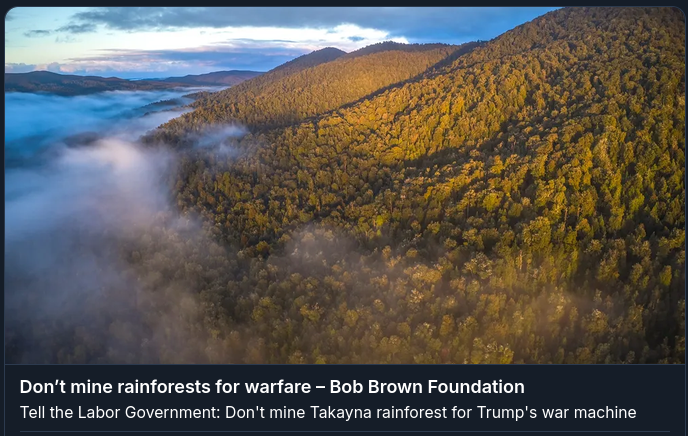
Tell the Labor Government: Don’t mine Takayna rainforest for Trump’s war machine

hYoB1LOOjTe1PXb.png

“Mined for the war machine?
Mount Lindsay is under threat of being ripped open for a tungsten mine to supply the US war machine. Tungsten hardens steel for tanks, armour and armour-piercing munitions, and makes lethal, indiscriminate scattering warheads that have killed civilians, including children and infants.”

“A back door through environment laws
Reforms to federal environment law in 2025 allow National Interest Exemptions for projects deemed necessary for strategic or defence purposes. Two have already been granted to Alcoa in WA’s Jarrah forests to produce Gallium for US missile systems. The parallels to Mount Lindsay are unmistakable.”

0

Anyone else failing to load thumbnails?

preview

Even the site logo fails to load for me. It’s supposed to be at programming.dev/…/1e947440-0f0d-4768-ba4b-1480551…. I get this error trying to load it:

{"error":"unknown","message":"Request error: error sending request for url (http://pictrs:8080/image/original/1e947440-0f0d-4768-ba4b-1480551e7cc9.png): operation timed out"}
0

Md Anderson spends $3.4 billion

Chron A massive MD Anderson expansion is coming to Houston. Here's what's planned www.chron.com
preview

MD Anderson spending $3.4 billion to expand.

they found that money after they laid off people even though they blame insurance on high cost. Aren’t you glad it didn’t affect them?

Expansion

MD Anderson spending $3.4 billion to expand.

they found that money after they laid off people even though they blame insurance on high cost. Aren’t you glad it didn’t affect them?

Expansion

0

Milky Way Over Glen Rose Texas

preview

I recently found my phone can capture some pretty good shots of the night sky. I have dabbled with some setups at home but managed to get a good photo while camping this week since it was much darker.

iPhone 15 pro max with tripod and Bluetooth clicker. 30s exposure, with some adjustments to brightness and contrast to help define the fainter stars from the background wash.

0

Looking for Volunteer Moderators for !running!

preview

Hello !running community!

The current moderation team for !running has been inactive for a while, so the admin team has stepped in temporarily to help keep the queue clear and find new volunteer moderators from the community.

Interested in Moderating !running?

If you enjoy this community and would like to help keep it welcoming, spam-free, and well-maintained:

  • Reply in the comments below or send a Direct Message to @ieh.
  • Let us know if you have any prior moderation experience (not required!) and what you’d like to see for the community.

(Note: If any of the previous moderators return in the future, they are always welcome to reach out to the admin team as well!)

Requirements and notes:

  • Reports do not get sent for moderators without a lemmy.world account, so if you have an account on a different instance, you’d need to create one here and check it daily for reports (takes a few seconds at most)
  • Most communities get reports infrequently, often once per week or less. Although sometimes more. Checking daily is important
  • Moderate fairly according to the community rules. Everyone has to make subjective calls, but try to be objective
  • Enforce the Lemmy.World ToS

If you have any questions, would like to volunteer, please reply below!

0

calendar app with accordion?

preview

Does anyone remember the Palm Pre? It had a calendar app and if you had a large block of time without an event, it would collapse like an accordion the time so that you could see more of your day without scrolling. Are there any Android calendar apps that do that?

Does anyone remember the Palm Pre? It had a calendar app and if you had a large block of time without an event, it would collapse like an accordion the time so that you could see more of your day without scrolling. Are there any Android calendar apps that do that?

0

LG faces legal action over alleged smart TV spying

TechRadar Smart TVs study suggests opting out of data tracking doesn't always work — as LG faces legal action over alleged TV spying www.techradar.com
preview

LG’s smart TV privacy woes continue as Portugal’s Citizen Voice asks the court to investigate. Are smart TVs too keen to gather data?

LG’s smart TV privacy woes continue as Portugal’s Citizen Voice asks the court to investigate. Are smart TVs too keen to gather data?

0

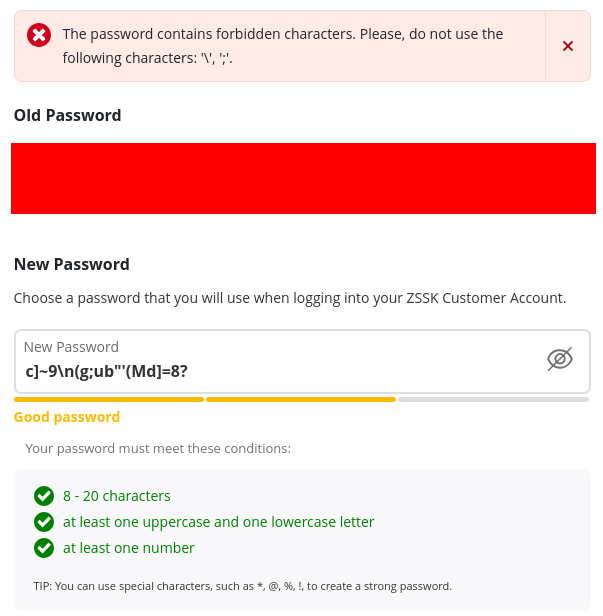
"TIP: You can use special characters..." "Wait, no, not those, they would break our software."

preview

konto.zssk.sk/zk/new#step1

Also, it only seems to show “Strong password” if any of these characters is used: !@#$%^&*, and not other special characters.

konto.zssk.sk/zk/new#step1

Also, it only seems to show “Strong password” if any of these characters is used: !@#$%^&*, and not other special characters.

0

When my computer restarts the setting for Compact UI resets to Not Compact - Expand Images

preview

Not a priority or anything, but reporting as it is an unusual behavior that I haven’t run into before and the circumstances are interesting!

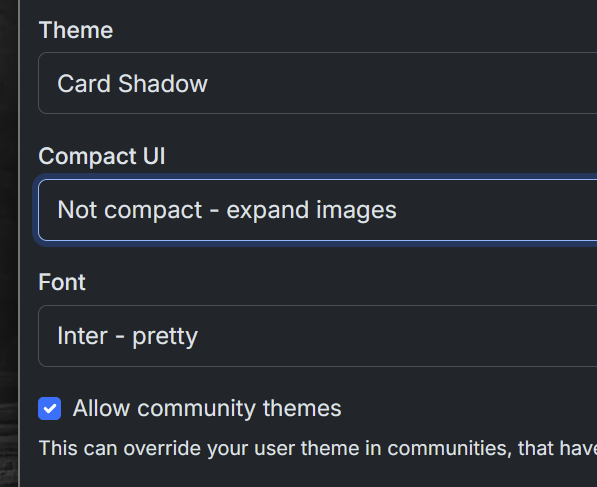
When my computer restarts the setting for Compact UI resets to Not Compact - Expand Images. It doesn’t look like any other settings change, just that one setting for images. I like More Compact - only thumbnails so I have to change it back each time my computer restarts which isn’t common but often enough that I’m confident in the pattern.

image

It doesn’t seem to happen just from closing the browser and reopening it or from logging out and back in again, just when the computer restarts. Using LibreWolf on a Windows PC.

0

[FoAR] Foundations of Amateur Radio - Bald Yak 23: It makes noise! #podcast

preview

The shaving of the Yak progresses, it’s now making noise! Before you get too excited, the noise is one-way, it’s barely distinguishable from hash and it’s fragile, so keep that in mind as we dive into the world of … something.

If you have no idea what I’m talking about, you’re in good company, half the time I’m struggling, but today I’m working on a project to bring software defined radio to the masses, well, radio amateurs who haven’t dipped their toes yet and I’m calling this effort Bald Yak.

In case you’re unfamiliar, the Bald Yak project aims to create a modular, bidirectional and distributed signal processing and control system that leverages GNU Radio. It’s called Bald Yak because by the time I’m done, the Yak is likely well and truly shaved.

So, last time we congregated around the campfire I discovered that what I need to build is something that has a collection of things that talk to each other across a network. Seems pretty obvious now that I say it, but it wasn’t always that way, remember, I’m inventing this from scratch, or so I tell myself. I will note that the deeper I dig, the more it looks like a lack of documentation, which really comes with no surprise, but I persist, if only to determine that it can be done, that I can do it, and that I understand how it works.

The underlying drive for all this is for me to gain a deep understanding of the whole ecosystem, since I firmly believe that we’re well and truly committed to software driven radio.

So, what did I discover? First of all, thank you to all of you who sent messages with your own ideas on how to make two devices talk to each other. I explored at least a dozen of them.

I’ll give you some highlights. First cab off the rank is OpenWebRX, radio in a web browser, very popular. I installed it, ran it, configured it, got noise, was able to pick a band across the network and decoded plenty of stuff. Looked like a contender until I discovered two significant issues. One is that it expects a menu entry for each slice of frequency range, with 2.4 MHz being the widest possible for an RTL-SDR dongle, so its 1.7 GHz range would need 708 entries. Someone made a good start, but if you want to tune to something that overlaps two entries, you need another menu entry. Then there’s the weird flex that it doesn’t decode FM Broadcast in stereo. There’s a whole description on why not, but I lost interest. I also tried OpenWebRX+ which adds a bunch of functionality, but not enough to overcome those fundamental problems.

I explored several other web based tools, one looked really promising right until it demanded that I install some random binary off the Internet … hard pass.

I didn’t go down the path of AllStarLink across the room, mainly because I have no desire to start the rounds of configuration, or manage the lack of ability to change frequency, to name two issues.

I did fire up RTL-TCP and managed to connect to it from my Mac using SDR++, it even worked, but boy, the SDR++ user interface is hard work, too many buttons and not enough consistency, like why do I need to set the gain for each mode, and why doesn’t it support SoapySDR on MacOS?

RTL-TCP is a tool that essentially puts an RTL-SDR dongle on the network. It’s excellent, once you figure out how to make it work inside Docker, has great documentation, talks to GNU Radio, everything you’d want, except that it’s only one-way and it only talks to RTL-SDR dongles.

I started comparing SoapySDR to RTL-TCP and then landed back with SoapySDR, since it does the same job, with a bonus that I discovered by accident, since the documentation is … let’s call it … challenged.

One of the things that people who contacted me missed, probably because it was obvious to me, was the notion that I want to use automatic service discovery, something that has myriad names, ZeroConf, Bonjour, Avahi, mDNS and plenty others. I tried many of them as search terms with GNU Radio and found nothing.

Then I tried the same with SoapySDR and discovered that it supports mDNS out of the box. It’s not something I’d seen before, since all the examples I found previously hard code an IP address into the flow graph, which means that it might work on my computer and network, but it won’t work on yours until you change things, hardly something I want to inflict on unsuspecting users.

So, the way it works is that you run a thing called “SoapySDR Server” on the machine with the RTL-SDR dongle, and GNU Radio running Soapy Source with the remote driver can find it … most of the time. There’s still plenty of hair pulling here, a flow graph that ran yesterday stopped working today, until I rebooted the server twice, no other changes, so fun.

To be honest, it feels a little like Windows 95 Plug and Play, or as we used to call it, Plug and Pray, excellent idea, shame about the implementation.

Then I came across a flow graph by Handiko YB1SDL who created a git repository with the title “How to Stream the Audio Out from GNU Radio into VLC Media Player” … which of course was catnip to an aspiring geek like me.

Turns out that VLC can listen on a UDP port and GNU Radio can send data to it. The quality of the audio is very poor as noted by Handiko, but I think that’s due to neither of us understanding how to scale it properly, but that’s par for the course.

So, right now I have three devices talking to each other, a SoapySDR Server with an RTL-SDR dongle on a single board computer, a GNU Radio flow graph running in a Docker container on my main server, and VLC running on my Mac.

What does this buy me?

Well, the Mac audio is a bonus, I’d like to be able to listen to the radio, but GNU Radio talking to an unnamed server that’s just sitting on the network is precisely what I envisaged when I started this whole malarkey.

Mind you, it’s not stable enough to show and tell, and I have no idea what it does if there’s more than one radio on the network, but that’s more opportunity to explore.

I’ll also note that this is precisely why I’m doing all this in GNU Radio, so I can learn how it works.

There’s one other thing. I’m documenting all this so it inspires you to start playing with this ecosystem, because ultimately I picture this environment as the radio equivalent of a massive bag of LEGO scattered all over the living room floor, something which brings me all kinds of joy.

So, what are your GNU Radio adventures like, and what have you tried and where are you stuck?

I’m Onno VK6FLAB

The shaving of the Yak progresses, it’s now making noise! Before you get too excited, the noise is one-way, it’s barely distinguishable from hash and it’s fragile, so keep that in mind as we dive into the world of … something.

If you have no idea what I’m talking about, you’re in good company, half the time I’m struggling, but today I’m working on a project to bring software defined radio to the masses, well, radio amateurs who haven’t dipped their toes yet and I’m calling this effort Bald Yak.

In case you’re unfamiliar, the Bald Yak project aims to create a modular, bidirectional and distributed signal processing and control system that leverages GNU Radio. It’s called Bald Yak because by the time I’m done, the Yak is likely well and truly shaved.

So, last time we congregated around the campfire I discovered that what I need to build is something that has a collection of things that talk to each other across a network. Seems pretty obvious now that I say it, but it wasn’t always that way, remember, I’m inventing this from scratch, or so I tell myself. I will note that the deeper I dig, the more it looks like a lack of documentation, which really comes with no surprise, but I persist, if only to determine that it can be done, that I can do it, and that I understand how it works.

The underlying drive for all this is for me to gain a deep understanding of the whole ecosystem, since I firmly believe that we’re well and truly committed to software driven radio.

So, what did I discover? First of all, thank you to all of you who sent messages with your own ideas on how to make two devices talk to each other. I explored at least a dozen of them.

I’ll give you some highlights. First cab off the rank is OpenWebRX, radio in a web browser, very popular. I installed it, ran it, configured it, got noise, was able to pick a band across the network and decoded plenty of stuff. Looked like a contender until I discovered two significant issues. One is that it expects a menu entry for each slice of frequency range, with 2.4 MHz being the widest possible for an RTL-SDR dongle, so its 1.7 GHz range would need 708 entries. Someone made a good start, but if you want to tune to something that overlaps two entries, you need another menu entry. Then there’s the weird flex that it doesn’t decode FM Broadcast in stereo. There’s a whole description on why not, but I lost interest. I also tried OpenWebRX+ which adds a bunch of functionality, but not enough to overcome those fundamental problems.

I explored several other web based tools, one looked really promising right until it demanded that I install some random binary off the Internet … hard pass.

I didn’t go down the path of AllStarLink across the room, mainly because I have no desire to start the rounds of configuration, or manage the lack of ability to change frequency, to name two issues.

I did fire up RTL-TCP and managed to connect to it from my Mac using SDR++, it even worked, but boy, the SDR++ user interface is hard work, too many buttons and not enough consistency, like why do I need to set the gain for each mode, and why doesn’t it support SoapySDR on MacOS?

RTL-TCP is a tool that essentially puts an RTL-SDR dongle on the network. It’s excellent, once you figure out how to make it work inside Docker, has great documentation, talks to GNU Radio, everything you’d want, except that it’s only one-way and it only talks to RTL-SDR dongles.

I started comparing SoapySDR to RTL-TCP and then landed back with SoapySDR, since it does the same job, with a bonus that I discovered by accident, since the documentation is … let’s call it … challenged.

One of the things that people who contacted me missed, probably because it was obvious to me, was the notion that I want to use automatic service discovery, something that has myriad names, ZeroConf, Bonjour, Avahi, mDNS and plenty others. I tried many of them as search terms with GNU Radio and found nothing.

Then I tried the same with SoapySDR and discovered that it supports mDNS out of the box. It’s not something I’d seen before, since all the examples I found previously hard code an IP address into the flow graph, which means that it might work on my computer and network, but it won’t work on yours until you change things, hardly something I want to inflict on unsuspecting users.

So, the way it works is that you run a thing called “SoapySDR Server” on the machine with the RTL-SDR dongle, and GNU Radio running Soapy Source with the remote driver can find it … most of the time. There’s still plenty of hair pulling here, a flow graph that ran yesterday stopped working today, until I rebooted the server twice, no other changes, so fun.

To be honest, it feels a little like Windows 95 Plug and Play, or as we used to call it, Plug and Pray, excellent idea, shame about the implementation.

Then I came across a flow graph by Handiko YB1SDL who created a git repository with the title “How to Stream the Audio Out from GNU Radio into VLC Media Player” … which of course was catnip to an aspiring geek like me.

Turns out that VLC can listen on a UDP port and GNU Radio can send data to it. The quality of the audio is very poor as noted by Handiko, but I think that’s due to neither of us understanding how to scale it properly, but that’s par for the course.

So, right now I have three devices talking to each other, a SoapySDR Server with an RTL-SDR dongle on a single board computer, a GNU Radio flow graph running in a Docker container on my main server, and VLC running on my Mac.

What does this buy me?

Well, the Mac audio is a bonus, I’d like to be able to listen to the radio, but GNU Radio talking to an unnamed server that’s just sitting on the network is precisely what I envisaged when I started this whole malarkey.

Mind you, it’s not stable enough to show and tell, and I have no idea what it does if there’s more than one radio on the network, but that’s more opportunity to explore.

I’ll also note that this is precisely why I’m doing all this in GNU Radio, so I can learn how it works.

There’s one other thing. I’m documenting all this so it inspires you to start playing with this ecosystem, because ultimately I picture this environment as the radio equivalent of a massive bag of LEGO scattered all over the living room floor, something which brings me all kinds of joy.

So, what are your GNU Radio adventures like, and what have you tried and where are you stuck?

I’m Onno VK6FLAB

0

Video - China Steps In to Help Cuba —Trump’s Blockade Hits a Roadblock

play · peertube.world
PeerTube.world China Steps In to Help Cuba —Trump’s Blockade Hits a Roadblock peertube.world
preview

China is stepping up its support for Cuba as Washington intensifies its economic pressure on the island. From solar energy projects and food shipments to financial cooperation and diplomatic backing, Beijing is helping Havana find alternatives as the U.S. blockade continues.

In this video, we examine China’s latest response to the United Nations vote against the American embargo, including Beijing’s statements on October 21 and October 29. We also break down Washington’s expanding pressure campaign throughout 2026, the sanctions targeting Cuban officials and businesses, and Secretary of State Marco Rubio’s description of the strategy as leaving the Cuban government with “no escape valves.”

But China is opening alternative channels. We explore its investment in Cuban solar parks, the arrival of solar equipment for homes and public facilities, China’s $80 million aid commitment and rice shipments, and the growing use of alternative international payment infrastructure. We also examine the 2026–2027 Friendly Cooperation and Exchange Plan signed by both countries.

The video looks at how these efforts could help Cuba reduce its dependence on imported fuel, strengthen food supplies, maintain financial connections, and deal with the economic consequences of U.S. sanctions. From renewable energy to diplomatic support, China’s involvement extends across several areas of Cuba’s economy.

We also examine the latest UN General Assembly vote, where 130 countries supported a resolution calling for an end to the U.S. embargo. Although the resolution does not legally end the blockade, it highlights the continuing international opposition to America’s Cuba policy.

The bigger question is whether Washington’s pressure can achieve its objectives when Cuba continues to receive support from China and other international partners. As new energy projects, trade connections, and diplomatic agreements take shape, the relationship between Beijing and Havana is becoming an important part of the wider geopolitical story.

Watch until the end to understand how China is supporting Cuba, why Washington’s strategy faces challenges, and what this growing partnership could mean for the future of the Caribbean.

#China #Cuba #Trump #USCubaRelations #CubaBlockade #ChinaCuba #USSanctions #BRICS #UnitedNations #SolarEnergy #GlobalPolitics #Geopolitics #MarcoRubio #InternationalRelations #WorldNews