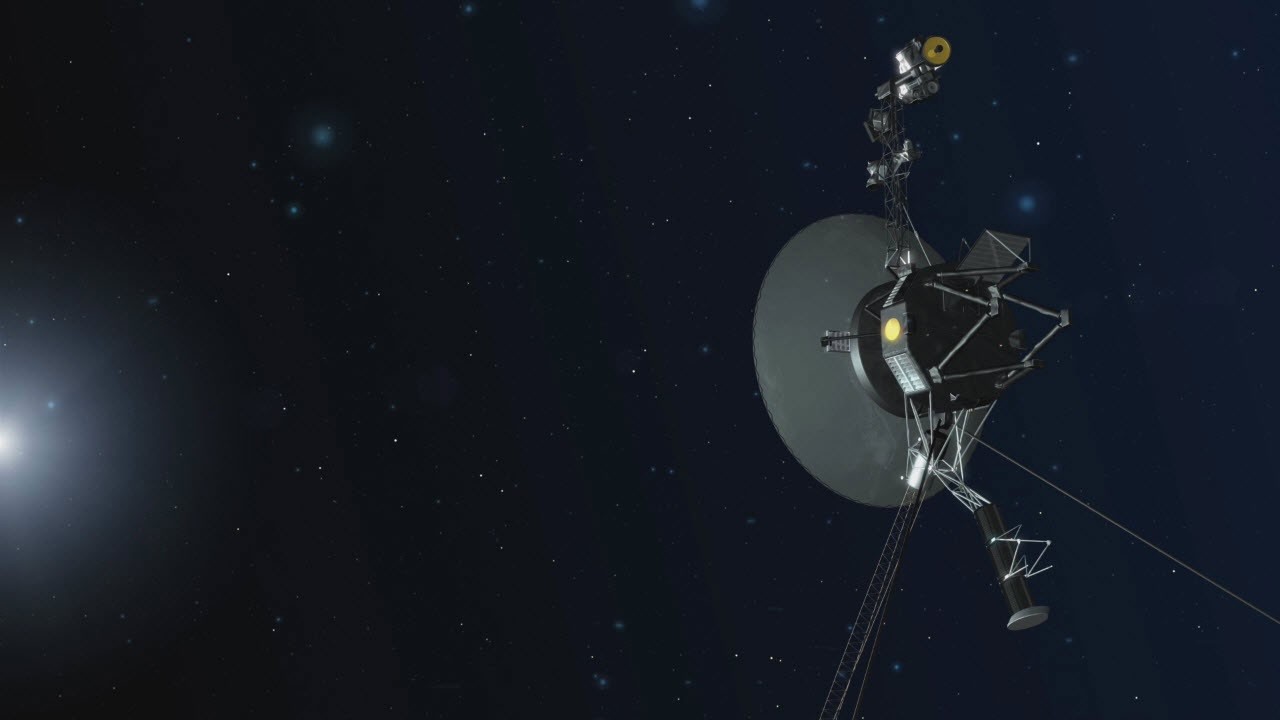
I suppose that this is in the sense of radar-distance. Then does anyone here know if the countdown is for the event of the outgoing-signal departure from Earth, or for the event of the return-signal arrival to Earth, or for the mid-point? Since these are all 24h apart! 😂
Or is this geodesic proper distance, measured in the barycentric coordinate time TBC?
One possible contender are termites, which break down wood and grass in their hindguts. Their global population is estimated to be around 27 quadrillion (that’s 15 zeros) individuals, and they collectively emit 10 teragrams of methane per year.
One possible contender are termites, which break down wood and grass in their hindguts. Their global population is estimated to be around 27 quadrillion (that’s 15 zeros) individuals, and they collectively emit 10 teragrams of methane per year.
A new wave of origins-of-life researchers, fed up with the tradition of bickering, have unshackled themselves from the idea that a single type of molecule started it all. Their open-minded approach has coincided with a change in scientific understanding. Experiments have shown that the precursors to many of life’s ingredients may have formed easily under the conditions on early Earth. What is harder to explain is how these molecular processes became a stable evolutionary system continuous with the vast diversity of life we see on the planet today. During life’s earliest days, these processes came together to store and pass on information, both consistently and imperfectly enough to allow the same living lineage to persist for billions of years on an ever-changing planet.
A new wave of origins-of-life researchers, fed up with the tradition of bickering, have unshackled themselves from the idea that a single type of molecule started it all. Their open-minded approach has coincided with a change in scientific understanding. Experiments have shown that the precursors to many of life’s ingredients may have formed easily under the conditions on early Earth. What is harder to explain is how these molecular processes became a stable evolutionary system continuous with the vast diversity of life we see on the planet today. During life’s earliest days, these processes came together to store and pass on information, both consistently and imperfectly enough to allow the same living lineage to persist for billions of years on an ever-changing planet.
Smiling may not always make you happier, and new research suggests that forcing yourself to smile repeatedly could actually make you feel worse. In a University of Florida study involving more than 1,100 participants, researchers discovered that while a single artificial smile can provide a small mood boost, repeatedly faking smiles can erase that benefit or even reverse it.
Smiling may not always make you happier, and new research suggests that forcing yourself to smile repeatedly could actually make you feel worse. In a University of Florida study involving more than 1,100 participants, researchers discovered that while a single artificial smile can provide a small mood boost, repeatedly faking smiles can erase that benefit or even reverse it.
Using sonar, seafloor mapping and moored instruments, the team detected around 30 underwater landslides in 18 days, capturing three in unprecedented detail.
They observed how sandy sediment progressively collapses through a process called ‘breaching’. As sediment grains move apart, suction temporarily strengthens the seabed. Then, as this suction fades, sediment fails over minutes to hours, generating powerful flows of sediment that travel kilometers downslope. These direct observations reveal processes previously understood only through theory and experiments, with implications for many other sandy deltas and submarine canyons worldwide.
The team involved in the new study levitated magnetic spheres with a radius of approximately 30 micrometers inside a superconducting lead trap cooled with liquid helium. The superconductor trap expels magnetic fields through the Meissner effect, allowing a tiny magnet to float without active position control.
Magnetic coils were then used to accelerate the spheres up to 2.3 million revolutions per second, or 138 million revolutions per minute, while an ultrasensitive superconducting detector tracked their rotation and slowdown. For context, the previous record for levitated magnets was the half-millimeter-diameter magnet at 38 million revolutions per minute.
The researchers conducted the experiments at a temperature of around 4.2 Kelvin (roughly −269°C). The measured slowdown of the magnet implied a characteristic speed-decay time of about 24 days, which is the lowest damping rate ever measured in a levitated micro- or nanosized object. In a separate, slower-running experiment, the rotor’s magnetic-field sensitivity matched the best previously demonstrated with a nonspinning levitated magnet of similar size, allowing it to make impressively sensitive measurements.
This model has been in testing for 3 years and it passed all tests so far.
It already past sevral test and it solves a lot of problems that require dark energy or matter. And problems introduced by the James Webb telescope. It also confirmed cosmic chronometer findings on the expansion history.
It does not disprove models, it just shows that dark matter and energy are not needed and explains why we can’t find them.
Adnan is the youngest patient in the world to receive ABS-1230 and only the second infant to be given the experimental medication
Adnan, who has an extremely rare genetic form of epilepsy, received the medication at King’s College Hospital London – Dubai after seven previous treatment approaches failed to bring his seizures under adequate control.
I must mention one particular activity. Every year, we rescue Himalayan vultures [Gyps himalayensis], which are migratory, and release them after winter. The Himalayan vultures that come to Bangladesh are usually juveniles. As they travel long distances, when they land, they can be vulnerable. Some fall into trees and injure themselves on the sharp stalks. Others land in open areas, where people gather around them and sometimes capture them. Some are also killed by hunters. When we receive reports of injured or vulnerable vultures, our network of volunteers helps us rescue them. Once they have recovered under our volunteers’ care, we generally release them in late March or early April. As part of this work, we invite local people to watch the releases and organize small awareness activities.
That’s one of the most interesting and enjoyable parts of my work: interacting with local people, especially students and schoolgirls. They are often surprised to see me working in the field and to see how I work and interact with them. I really enjoy those interactions.
Testing of ancient sediment from two lakes in Mexico’s Yucatán Peninsula has revealed “crazy” high concentrations of mercury, as one researcher puts it, confirming findings from other regions of the Mesoamerican civilization
Testing of ancient sediment from two lakes in Mexico’s Yucatán Peninsula has revealed “crazy” high concentrations of mercury, as one researcher puts it, confirming findings from other regions of the Mesoamerican civilization
The U.S. war with Iran has raised fossil fuel prices so much that the resulting drop in oil demand has put the world on track to see a rare dip in carbon emissions from these sources in 2026.
Between 2019 and 2025, carbon dioxide emissions from fossil fuels grew by about 0.8 percent annually, according to a new study published in Nature Climate Change. But 2026 is set to buck that trend: high oil prices, as well as the continued rise of green technology—solar power, wind and electric cars—will cause a “short-term” 0.4 percent drop, according to the study.
“The high petrol prices following the war in Iran are reducing oil use and keeping emissions low,” says the study’s lead author Corinne Le Quéré, a professor of climate change science at the University of East Anglia in England. “But that’s not the whole story: The expansion of renewable energy has progressed a lot in recent years, led by China. And [along with electric vehicles], this is offsetting two thirds of the growing demand for energy.”
With all sources of carbon considered, including deforestation, total global CO2 emissions are set to continue increasing.
Waves that make it all the way to the ionosphere produce traveling ionospheric disturbances, which radar can pick up. Since GPS signals pass through the ionosphere, a disturbance there shifts the timing and degrades position fixes.
Waves that make it all the way to the ionosphere produce traveling ionospheric disturbances, which radar can pick up. Since GPS signals pass through the ionosphere, a disturbance there shifts the timing and degrades position fixes.