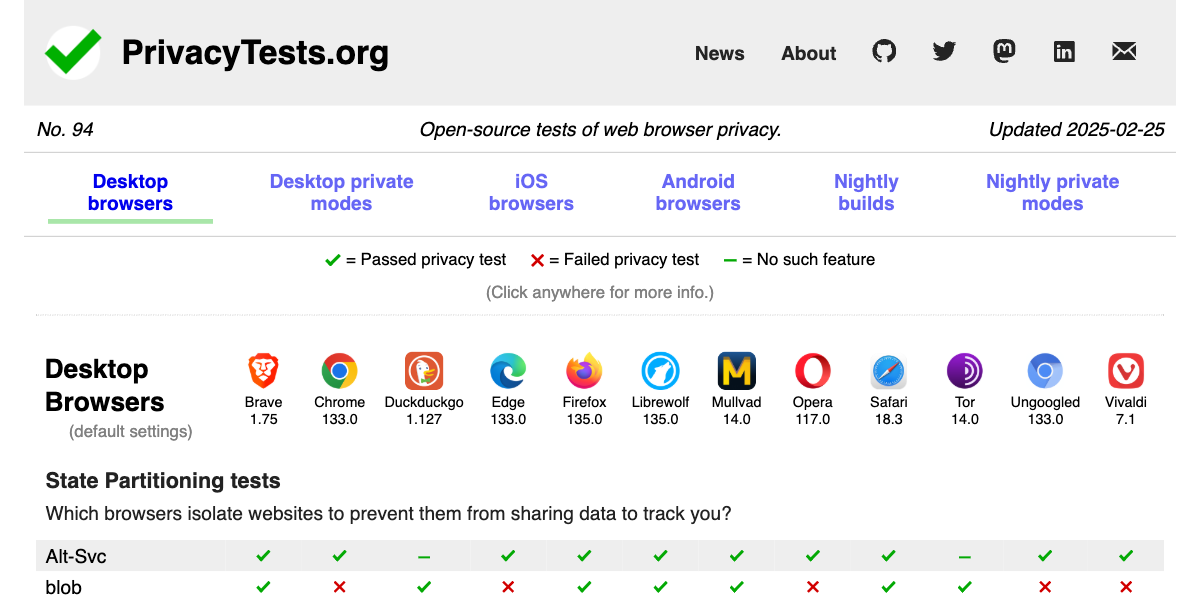
The scroll marker features used here currently have limited browser support. They’re supported in Chromium-based browsers, but Firefox and Safari don’t support them yet.
The nice thing is that the underlying HTML is still just a normal list of links pointing to sections. Browsers that don’t understand the new CSS still have perfectly usable navigation.
Israeli digital advertising agency Discover-Tech spied on internet users through a sprawling network of online ads that it used to track targets and help hack their devices, two research groups said on Thursday.
Its services gave Israel’s Candiru — a spyware company blacklisted by the US government — as well as other Israeli surveillance firms access to advertising platforms run by Google, Comcast, Russia’s Yandex and others, according to separate reports from Canadian cyber watchdog group Citizen Lab and New York advertising security firm Confiant.
Ten months ago I started Ideon as a side project. This week it reaches v1.0, with 640 stars on GitHub. Thanks to those who have followed along from the beginning, this really means a lot.
What’s new in 1.0: the canvas has become a Git artifact.
A project now syncs to a Git repository. The structure, notes and block positions are version-controlled as files inside an .ideon/ directory, with a manifest and SHA-256 checksums. The rest of your repo stays untouched.
In short: you edit the canvas, you push, and the project history sits in Git like code. Every change shows up as a file diff.
The rest of 1.0:
Database block: typed columns, search and aggregation, all on the canvas.
Mermaid block: live rendering, editable source, PNG export.
Chained audit trail and sealed records: every state change is traceable and verifiable.
What’s next:
A plugin API, so the community can build its own block types.
A desktop app. It’s Docker-only for now. I’m solo and can’t test every platform properly. That comes if the growth justifies it.
Where this goes next: the canvas stops being a map and starts being a system. A graph that remembers everything, connects the dots, and eventually reacts on its own 👀.
If you want to try it: a plain docker run works for the SQLite build, docker-compose if you prefer Postgres. The repo-sync guide is in the documentation.
Auparavant, Alexandra et Clover pouvaient observer par la fenêtre de leur cuisine des feuillus matures et les passants sur la rue achalandée de Montréal. Mais, depuis quelques semaines, c’est une caméra de surveillance du Service de police de la Ville de Montréal (SPVM) qui leur saute aux yeux.
En août, une caméra s’est greffée au lampadaire devant leur bâtiment directement à la hauteur de la fenêtre. “Je me suis sentie envahie”, explique Alexandra en entrevue dans la cuisine exiguë de son vieil appartement situé dans l’arrondissement de Ville-Marie.
NPR’s Mary Louise Kelly speaks with David S. Cohen, former deputy director of the CIA, about his piece in Foreign Affairs entitled “The Case for Economic Espionage.”
NPR’s Mary Louise Kelly speaks with David S. Cohen, former deputy director of the CIA, about his piece in Foreign Affairs entitled “The Case for Economic Espionage.”
And with that…I’ve run out of stuff to post. Except for maybe the occasional horny thing I find on Fb, I don’t have anything more to give. I’m retiring.
That’s all from me, for now. Thanks you all for being here 🩷
Sad. True.
And with that…I’ve run out of stuff to post. Except for maybe the occasional horny thing I find on Fb, I don’t have anything more to give. I’m retiring.
That’s all from me, for now. Thanks you all for being here 🩷
Today’s game is Spliner Cell Chaos Theory. Ages ago someone recommended it to me and I picked it up. I don’t remember who it was, but if you’re seeing this, seriously. Thank you. Legit one of the best purchases I’ve made in a while.
Honestly, playing this, I can tell what elements would later go into Assassin’s Creed, which is where I’m coming at it from. But also having played MGS3 earlier this year, I’m also viewing it from that lens.
I love how interactable the environment is. Like. Obviously it’s not some hyper interactive game. But like the generators? I can flip it off, which I assume leaves it open for enemies to turn it back on, or I can sabotage it which takes longer but gives me more darkness to work with.
My favorite instance of this is stabbing out the generator in the tent area in the first level, then when the guy comes to check it out I snaked around and took him out with a choke hold. It was incredibly satisfying to pull off.
The first level was the only one I did but it took me nearly an hour to finish, partly because I was figuring out controls but also I was trying to get a grasp on the stealth. I ended up getting the hang of it and getting out with only getting seen twice, which is a positive in my book.
Overall I’m really liking it. It’s aged in some ways but it’s still really good. I just need to get a grasp on the controls and then I’ll be good.