


0

We've just launched our new (free) solarpunk TTRPG adventure: Fully Automated!: Buried Treasure!

A photobash with an oil paint style, looking out over a landscape from the top of a steep hill with an extremely washed out road winding down it. The scene is framed by trees and brush. In the distance an irregular lake fills the bottom of a forested valley, with a small village along one side, and mountains rising up in the distance. A cargo airship is hovering somewhere above the scene. The text reads: Fully Automated the Thousand Year Cleanup Book One: Buried Treasure by Jacob Coffin
preview

cross-posted from: slrpnk.net/post/42689778

Hi, I’m Jacob Coffin, you might know me as the guy who posts solarpunk postcards, worldbuilding research, and other DIY/zerowaste projects sometimes. But that’s all been something of a side project for me for the last two, almost three years. My main project has been researching, writing, playtesting, and making art for a TTRPG campaign, and we’re finally launching it!

I should probably let the blurb we wrote introduce the thing:


A buried secret can stay dangerous for a long, long time… 

An investigator has a hot tip: rare waste. Dangerous to the environment and valuable on the reclamation market - a remediation co-op is already standing by to remove the contamination and restore the surrounding land. But time is running out to find it, as what’s left of the town is deep in a deconstruction boom. 

In Buried Treasure, players travel off the edge of the map to the mostly-abandoned town of Comity, New Hampshire to find an industrial dump site left over from the Global Climate Wars. But as work crews are in the process of removing the abandoned buildings and roads, there isn’t much time left before the trail disappears. It’s gonna be a challenge. But at least no one is going to be trying to stop them. Right? 

Buried Treasure is the long awaited second campaign for Fully Automated! Filled with interesting characters, locations, and plot hooks, this story has 20+ hours of content to delight solarpunk aficionados and newcomers alike! 

This adventure features: 

  • Original (human-made) art! 
  • An immersive rural solarpunk setting with resourceful homesteaders, radical work crews, and a village made from repurposed McMansions!
  • Maps, evidence, and an environmental sampling mini-game!

If that piques your interest, this is definitely for you! And if it doesn’t, you should check it out anyway because it’s free! As always, share any questions, feedback, and stories with our growing community on Discord, Mastodon, and slrpnk.net!


Like all the other solarpunk stuff I make, this campaign is CC-BY, so it’s absolutely free. You can grab the files on DriveThruRPG, itch.io, or just download them from my folder here: https://mega.nz/fm/DVsiDC7b

0

Turkish police raid gay bars and LGBTQ+ homes in 'family values' crackdown

Metro Turkish police raid gay bars and LGBTQ+ homes in 'family values' crackdown metro.co.uk
preview

Turkish police have arrested 162 people in a sweeping crackdown targeting gay bars and LGBTQ+ activists.

Turkish police have arrested 162 people in a sweeping crackdown targeting gay bars and LGBTQ+ activists.

0

I hate the Ableist Wing of the State!

preview

My mom thinks it’s the 1970’s where the US still has a really crappy welfare state.

Because I’m autistic, and she’s one of those jackass ableist scumbags who works in the “Special Ed” wing of the local school, she’s forcing me down the insufferable bureaucracy shit.

(“Special Ed” is essentially one to three auxiliary classrooms in a school where us neurodivergents and other disabled peoples get shoved into so that nobody else sees us.)

I’m absolutely sick of it. I’ve had to deal with this sort of shlick my entire life and I DON’T WANT TO DEAL WITH IT ANYMORE!

I’m sick of the caseworker things, I’m sick of the liberal bureaucratic stuff… I actually enjoy the peer support group thing I’m in. I like that bit!

Also had to deal with care workers/aids in school which felt way more like my mom continuing to enforce her shit on me outside of home. Every Friday in 1st grade I came home and it was “LETS POINT OUT EVERYTHING WRONG YOU DID THIS WEEK! ESPECIALLY THE MINOR ONES!”

Needless to say I’d much rather go down the “neurotypical path” and deal with the unpleasantness it brings. I mean hey, atleast the misery of living under capitalism is delivered quicker!


My mom thinks it’s the 1970’s where the US still has a really crappy welfare state.

Because I’m autistic, and she’s one of those jackass ableist scumbags who works in the “Special Ed” wing of the local school, she’s forcing me down the insufferable bureaucracy shit.

(“Special Ed” is essentially one to three auxiliary classrooms in a school where us neurodivergents and other disabled peoples get shoved into so that nobody else sees us.)

I’m absolutely sick of it. I’ve had to deal with this sort of shlick my entire life and I DON’T WANT TO DEAL WITH IT ANYMORE!

I’m sick of the caseworker things, I’m sick of the liberal bureaucratic stuff… I actually enjoy the peer support group thing I’m in. I like that bit!

Also had to deal with care workers/aids in school which felt way more like my mom continuing to enforce her shit on me outside of home. Every Friday in 1st grade I came home and it was “LETS POINT OUT EVERYTHING WRONG YOU DID THIS WEEK! ESPECIALLY THE MINOR ONES!”

Needless to say I’d much rather go down the “neurotypical path” and deal with the unpleasantness it brings. I mean hey, atleast the misery of living under capitalism is delivered quicker!

0

Kolektiva Media społecznościowe dla i przez anarchistów

play · kolektiva.media
kolektiva.media Kolektiva Media społecznościowe dla i przez anarchistów kolektiva.media
preview

To nasza szansa, aby przemodelować media społecznościowe i nasz stosunek do nich. Odkryć na nowo utraconą obietnicę Internetu. Wybudować nowe cyfrowe światy w płonącej skorupie starego. Zrobić to wszystko wspólnie.

Stare konwencje umierają. Najwyższy czas obalić ten nędzny system, przełamać nasze uzależnienie od platform służących do ekspolatacji naszych danych, platform zbudowanych i utrzymywanych przez naszych wrogów.

Kolektiva.Social to platforma Mastodon stworzona przez i dla anarchistów. To tylko jeden mały węzeł w większej zdecentralizowanej sieci o nazwie Fediverse. W przeciwieństwie do innych alternatyw Twittera, takich jak Koo czy Hive, oprogramowanie i aplikacje, które zasilają tę sieć, są open source, a każdy serwer ustala własne zasady, wolne od wpływu algorytmów opartych na reklamach i prezesów miliarderów.

Potencjał Mastodona jest ogromny, ale to, co z nim zrobimy, zależy od nas. Dlatego wzywamy Cię do zaangażowania się.

0

CCCHH und WHS veranstalten DIDAYS 2026: Digitale Unabhängigkeit

preview

Vom 2.-4. Oktober veranstalten der Chaos Computer Club Hamburg und die Wau Holland Stiftung ein Wochenende mit Vorträgen und Workshops, in denen sich alles um die eigene Unabhängigkeit von Großkonzernen, Datensammelkraken und süchtigmachenden Sozialen Netzwerken geht. Mit dabei sind rund 15 Hamburger Institutionen und Gruppen, unter anderen Repaircafés, Stadtteilinitiativen und die Volkshochschule. Der Eintritt ist kostenlos, und man kann für zwei Stunden oder das ganze Wochenende kommen.

[…]

Wir haben dazu den Kultur Palast Harburg (ehem. Rieckhof) als Location gewinnen können.

0

uhh why are we still doing leetcode interviews in 2026???

preview

me and a friend were arguing about this and i think the part i left out before is AI

like even if you accept that leetcode was never supposed to perfectly simulate the job and is just meant to test reasoning/pattern recognition/grind or whatever, does it still work as a hiring signal today?

you now have AI that can look at a self-contained coding problem, reason through it, generate multiple approaches, optimize the brute force solution, explain the complexity, all in minutes. then you have tools like Cluely and similar stuff specifically built to sit alongside interviews

you can’t really just pretend those don’t exist

meanwhile the actual job has also changed. engineers are already using AI to write code, review code, debug things, generate tests, understand unfamiliar systems, etc.

so wouldn’t it make more sense to assess someone inside an actual codebase? give them a scoped repo, a task, maybe even an embedded AI assistant and see what they actually do with it

can they find the relevant code? understand the system? decide what needs changing? tell when the AI is wrong? make the change without breaking something else?

obviously you can still cheat and obviously i’m not saying “here’s our 10 million line production repo, you have 40 minutes”

but surely a whole codebase with context is harder to just outsource to some interview copilot than “here’s one neatly packaged algorithm problem”

so i’m genuinely curious why we’re still optimizing hiring around leetcode instead of adapting the assessment to how software engineering actually works now

0

Beatbattle.org - Join the worlds longest running beat battle

preview

I haven’t participated in a minute, but thought I’d share it here in case some of you didn’t know of it already. The beat battles started on the old Stones Throw forums and continued after those forums were shut down. New battle every week, the level is generally very high. It’s good fun and you should check it out if it sounds interesting to you.

I haven’t participated in a minute, but thought I’d share it here in case some of you didn’t know of it already. The beat battles started on the old Stones Throw forums and continued after those forums were shut down. New battle every week, the level is generally very high. It’s good fun and you should check it out if it sounds interesting to you.

0

Romancing SaGa 3: Destinies United removes original’s Commander Mode

AUTOMATON WEST Romancing SaGa 3: Destinies United removes original’s Commander Mode. “You can safely choose Sarah as your protagonist,” producer jokes - AUTOMATON WEST automaton-media.com
preview

Note that this article contains some light spoilers for both the original Romancing SaGa 3 and the new Destinies United remake.

Note that this article contains some light spoilers for both the original Romancing SaGa 3 and the new Destinies United remake.

0

Trump Told Supporters To “Cheat Like Hell.” The NY Times Went With “A Bit Tired Of Politics.” | Techdirt

Techdirt Trump Told Supporters To “Cheat Like Hell.” The NY Times Went With “A Bit Tired Of Politics.” www.techdirt.com
preview

NYT not beating the sanewashing allegations.

NYT not beating the sanewashing allegations.

0

State of the Unions: the rise of unionisation in games workplaces

GamesIndustry.biz State of the Unions: the rise of unionisation in games workplaces www.gamesindustry.biz
preview

Union representatives reflect on the industry’s progress so far, and the remaining barriers to overcome

Union representatives reflect on the industry’s progress so far, and the remaining barriers to overcome

0

Neue Regeln für E-Mopeds: ÖAMTC warnt vor „faktischem Verbot“

news.ORF.at Neue Regeln für E-Mopeds: ÖAMTC warnt vor „faktischem Verbot“ orf.at
preview

Bisher wurden herkömmliche E-Mopeds rechtlich als Fahrräder behandelt, ab Oktober gelten sie als Kraftfahrzeuge. Sie müssen dann für den Straßenverkehr zugelassen sein, dafür braucht es unter anderem einen Zulassungsschein, ein Kennzeichen und eine Kfz-Haftpflichtversicherung.

Der Mobilitätsclub geht österreichweit von mindestens 20.000 Privatpersonen aus, deren Fahrzeuge demnächst „praktisch wertlos werden“, daher brauche es „eine rasche Schaffung einer Zulassungsmöglichkeit für bestehende E-Mopeds“.

0

The rise of hairy young women: ‘I know people who dye their armpit hair, so it stands out more’

the Guardian The rise of hairy young women: ‘I know people who dye their armpit hair, so it stands out more’ www.theguardian.com
preview

“Hell yeah!” is 27-year-old PhD student Anna Busuttil’s response. “I think it’s awesome; cool and rebellious,” she says – a view that chimes with that of most of the women I speak to outside University College London’s Bloomsbury campus. Busuttil says she sees a lot more women nowadays choosing not to remove their body hair. “I know people who dye their armpit hair a certain colour as well, so it stands out even more. I feel like leg hair is more taboo for women; it feels like such a ‘masculine’ thing, and legs are supposed to be a really sexy part of a woman.”

Francesca Hall, 25, agrees: she removes her leg hair, but doesn’t worry about her underarms. Yet she feels that, if anything, it’s becoming less common to go unshaven. “There’s been a general shift, culturally, towards more conservative ideas,” says the student union-worker. “It’s the same with veganism; it’s gone backwards a bit. My friendship group is quite queer, leftwing, and not everyone would remove their leg hair.” But, she says, not removing leg hair is more common “in those circles … I definitely think there’s a correlation there.”

“I’ve got really hairy legs!” says student Phoebe Green, 21, hitching up her long shorts so I can get a better look. “I don’t really pay attention to the trends that are going around; having leg hair doesn’t affect my life in any way,” she says. “I’ve definitely had a few comments, a few condescending dudes being like, ‘why aren’t they shaved?’ But I get a lot of compliments from girls, there’s a lot of solidarity.”

0

👩‍🦯 La Silicon Valley pensa alla disabilità solo se fa notizia agli occhi di chi le disabilità non ce le ha

preview

👩‍🦯 La Silicon Valley pensa alla disabilità solo se fa notizia agli occhi di chi le disabilità non ce le ha

Robert Kingett è uno scrittore cieco: in uno dei suoi ultimi pezzi fa notare come la Silicon Valley cerchi di risolvere i problemi di disabilità con soluzioni ipercomplesse e ipercostose (che raramente passano la fase di prototipizzazione) perché fan gola ai capitali di ventura, mentre utilizzare una banale rampa o testi descrittivi sui siti non è calcolato perché non fan notizia.

“Sono fantasie individualiste. […] La Silicon Valley spenderebbe milioni per sviluppare un guanto che traduca (male) il linguaggio dei segni in audio, ma non spenderebbe 10 minuti ad aggiungere un testo alternativo per descrivere le immagini”.

Questa logica fa passare il messaggio che, comprando abbastanza accessori, si può comprare il proprio diritto di partecipare alla società. Tuttavia, sottolinea, la società dovrebbe di base essere progettata per includere tutte le persone - senza esoscheletri o qualsivoglia marchingegno ipertecnologico

https://sightlessscribbles.com/posts/disability-dongle/

#riflessione

@eticadigitale@feddit.it

0

Knife Abuse, Part 3: Healing and Reconciliation

Photos from multiple angles of a 5" Stainless Steel Santoku Knife With a Rough,  Dull Edge from Oversharpening With A Cheap Pull Through Sharpening Tool
preview

Knifemen, knifewomen, downvoters, upvoters, it’s time to update you on the salvation of this kitchen knife. Mr. McKay, based knife sharpener, did the best he could do to restore the edge to something like symmetry. I expected a salty comment or two on the topic when I picked it up, however, he did not offer any, only a pitying silence as he gave me a meticulously handwritten receipt. Yet, his silence was full of kindness. Cost: $4.00 USD Many have asked, how did I achieve the ragged edge seen in my previous post? I wish I had a better answer for you, except that I used a shitty Coghlan’s sharpener that was probably full of metal filings and dirt. That one is going in the trash. Any suggestions for buying a beginner’s sharpener for $30.00 or $40.00 ? I don’t know how to use a file or a stone.

Knifemen, knifewomen, downvoters, upvoters, it’s time to update you on the salvation of this kitchen knife. Mr. McKay, based knife sharpener, did the best he could do to restore the edge to something like symmetry. I expected a salty comment or two on the topic when I picked it up, however, he did not offer any, only a pitying silence as he gave me a meticulously handwritten receipt. Yet, his silence was full of kindness. Cost: $4.00 USD Many have asked, how did I achieve the ragged edge seen in my previous post? I wish I had a better answer for you, except that I used a shitty Coghlan’s sharpener that was probably full of metal filings and dirt. That one is going in the trash. Any suggestions for buying a beginner’s sharpener for $30.00 or $40.00 ? I don’t know how to use a file or a stone.

0

The Proud Boys next door

Mother Jones The Proud Boys next door www.motherjones.com
preview

Still, Premo found the constant macho rhetoric and violence he witnessed while filming mentally and emotionally exhausting. He went to rallies dressed in protective gear, prepared for a riot. Even if there weren’t skirmishes between the Proud Boys and other groups, there were men talking about what they wanted to do to antifa or others.

While he included the violence in his film, Premo is clear that it is not meant to make these men exceptions, but to situate them within a broader pattern.

“One of my critiques of American history and polite, middle-class white liberal society is this idea that violence is only an aberration of the norm. It’s only something that is carried out by the fringe or the extremes of society, when fundamentally, the American project is a project built by violence,” he says.

…

I found the ease with which Quaglin committed these acts astounding. The interspersion of political violence and domesticity doesn’t allow viewers to compartmentalize what’s on screen as fringe behavior, safely outside the bounds of ordinary American life. It suggests something more uncomfortable: that the difference is often not one of belief, but of expression—who says what out loud, and who knows not to.

0

One fediverse account for everything

preview

When discussing Fediverse, you sometimes hear the idea that you shouldn’t need different accounts for different platforms.
The “why can’t I comment under Youtube video with my Twitter account”.
In Fediverse it already works to some extent. You can comment under PeerTube video with your Mastodon account, and you can participate in Lemmy thread with your Mastodon account.
What is this functionality called? Does it have specific name?
It’s probably not “single sign-on” and not “federation” from what I understand.
And to what extent is it implemented? Is there some way to participate in Lemmy thread with your PeerTube account?
Is there any progress being made on implementing the initial idea of using any Fediverse account with any other Fediverse platform?
What is the name for the problem of implementing or mapping the platform-specific functionality? As in, neither Mastodon nor PeerTube have the interface for upvoting and downvoting posts.
Wouldn’t it be easiest to implement Fediverse-wide SSO (as in, log into Lemmy interface with your Mastodon account) instead of figuring out some funky mapping and patform interactions?

0

"In one hour and *for-ty-five* minutes, the entire inhabited surface of your planet will be destroyed" -- Commander Montgomery Scott

play · youtube.com
YouTube "In 2 Hours Your Planet Will Be........" www.youtube.com
preview

S01E23 A Taste of Armageddon
antifandom.com/…/A_Taste_of_Armageddon_(episode)

A rare situation for Scotty-- both in command of the Enterprise, and also making a typically Kirk-like bluff. Or was it, really…?

S01E23 A Taste of Armageddon
antifandom.com/…/A_Taste_of_Armageddon_(episode)

A rare situation for Scotty-- both in command of the Enterprise, and also making a typically Kirk-like bluff. Or was it, really…?

0

Results Analysis Thread - 70.3 World Championship in Nice, France

preview

Full splits and analysis on TriRating. Race report on Triathlon Magazine Canada.

Women’s Top Five

  1. Taylor Knibb (USA): 4:19:24 (25:59 / 2:32:07 / 1:17:56)
  2. Julie Derron (SUI): 4:23:30 (27:20 / 2:39:40 / 1:13:04)
  3. Alanis Siffert (SUI): 4:25:10
  4. Solveig Lovseth (NOR): 4:25:50
  5. Marjolaine Pierre (FRA): 4:26:38

Women’s Race: What Happened

Sophie Evans was first out of the water in a 13-person front pack that included Knibb and Siffert. Derron was 1:31 back in the chase group.

Knibb put on a blistering pace on the bike. She climbed the Col de Vence in 29:48, a course record, at a reported 303 watts. She summited more than six minutes clear of Siffert and reached T2 with 4:24 on Pierre. Siffert was 5:34 down and Lovseth 7:56. The UCI Grand Tours haven’t attempted this climb yet, so it may be the most impressive performance ever on the bike for this route.

Derron started the run in 11th, roughly nine minutes behind. She ran 1:13:04 (3:27/km) and finished second, 4:06 back. Siffert held third and beat her seeding by nearly eight minutes.

Knibb joked afterwards that she had expected to lose three or four minutes on the descent.

Men’s Top Five

  1. Hayden Wilde (NZL): 3:50:51 (23:44 / 2:16:50 / 1:07:21)
  2. Kristian Blummenfelt (NOR): 3:51:09 (23:50 / 2:19:02 / 1:05:12)
  3. Jelle Geens (BEL): 3:52:40
  4. Gustav Iden (NOR): 3:53:16
  5. Lasse Nygaard Priester (GER): 3:54:08

Men’s Race: What Happened

This ending was one for the ages! After falling behind by over 2 minutes in the earlier stages, Blummenfelt gave a run performance of a lifetime and nearly scratched and clawed his way to victory. However, Wilde was able to hold him off and reach the finish line a mere 18 seconds ahead.

27 men came out of the water together. Blummenfelt was 22 seconds back, which is a good swim for him.

The bike separated almost nobody. Michele Bortolamedi led into T2 with Wilde 16 seconds back and Bogen 17. Blummenfelt started the run 16th, 2:29 down.

He then proceeded to run an incredible 1:05:12 (3:05/km). Triathlon Magazine has that as the fastest 70.3 run split on record. He took nearly all of it back along the Promenade des Anglais and finished 18 seconds behind. Geens took third despite a disrupted build, and Iden was fourth, 11 minutes inside his seeding.

Wilde had been passed late at both the Olympics and the 2024 championship, so this one probably means a bit more than most.

The Importance of The Bike Stage

One contrast stands out across the two days. Nine of the ten fastest men swam within 20 seconds of each other, and the top ten bike splits covered 2 minutes 19 seconds in total. The run sorted the podium.

Knibb did the opposite. She made the bike decisive and won by 4:06 over the fastest runner in the field, who out-ran her by almost five minutes. She was the only athlete across both days who took real time on the bike.

Pre-Race Questions Resolved?

  • The flat run rewarded the pure runners in both races. Both second places came from outside the top ten off the bike.
  • Charles-Barclay’s 29% odds went to Knibb and Derron, who were the next two names in the model.
  • The bike question got no answer. Riddle rode 2:17:50 on the aero road bike and finished 7th, which isn’t enough to make a determination either way.

Post Race Questions

  • Did the men get the bike strategy wrong, or is 1,244 m simply not enough to break up a 27-man pack?
  • Knibb rode 303 watts up the Col de Vence and then lost 4:52 to Derron on the run. Was that a good trade or a lucky one?
  • Blummenfelt ran the fastest 70.3 split on record and lost by 18 seconds. Did he have enough room for another 18 seconds on the bike, or would it have been an even trade?
  • Iden was 11 minutes inside his seeding. Is that a return to form or a good day on a course he already knows?
  • Did anybody catch this live and see Knibb’s descent? She thought it would cost her three or four minutes.

For The Rest of Us

Blummenfelt ran 3:05/km after that bike course. For us mere mortals, does riding a hilly bike leg conservatively actually protect the run, or do you give up more time climbing than you can ever get back? If you’ve raced a hilly 70.3 or Olympic, how do you think your choice impacted your finish?

0

Hard to switch from Google Maps

preview

I’m slowly but surely deGoogling my life. Got rid of my Google Wifi and Nest Thermostat, moving my photos to Ente, transitioning to Proton Mail, and installed GrapheneOS. But the few map apps I’ve tried to use are pretty rough still.

I could probably live with the apps themselves, OSMand and Comaps are both a little wonky, but decent enough most of the time. The only real gripe I had was when OSMand was navigating my drive and there was a road shut down for construction, it kept trying to get me to go back onto the closed road instead of adjusting to use the road I was on. It wasn’t until I finally turned onto the next road that it finally adjusted the route correctly.

The big gripe is with Open Street Maps just not being as updated as Google. It could just be a US problem, but it hasn’t been able to find 3 different locations in the past couple months. All 3 were places I hadn’t been before, so I knew the general area but not the exact spot.

  • Location 1 - I got sent to the old location a couple miles away. The business had moved sometime in the past few years and the location wasn’t updated on OpenStreetMaps. I looked up the correct address, put that into Comaps and got there.

  • Location 2 - Going to a place on a road that changes names in the middle. Looking for 100 Name 1 Road, OSMand sends me to 100 Name 2 Road and says “you’ve arrived”. I check the Google Maps website and it turns out that OpenStreetMaps has the road change names about a mile too soon.

  • Location 3 - A relatively new shop that wasn’t even OpenStreetMaps. I grabbed the address from their website and put it into OSMand. It took me to a place about a quarter mile down the road from a shopping complex and told me I was there. I spent a few minutes driving around that complex and couldn’t find the place. I pulled up the address on the Google Maps website and found that it was in a different shopping complex a couple minutes down the road. The road is numbered oddly and OpenStreetMaps seemed to just be predicting it based on where it should be based on the numbers and not where it actually was.

I’ve since corrected all 3 of these locations in OpenStreeMaps, but it’s incredibly frustrating when the app you’re using can’t do the one thing you need it to do.

0

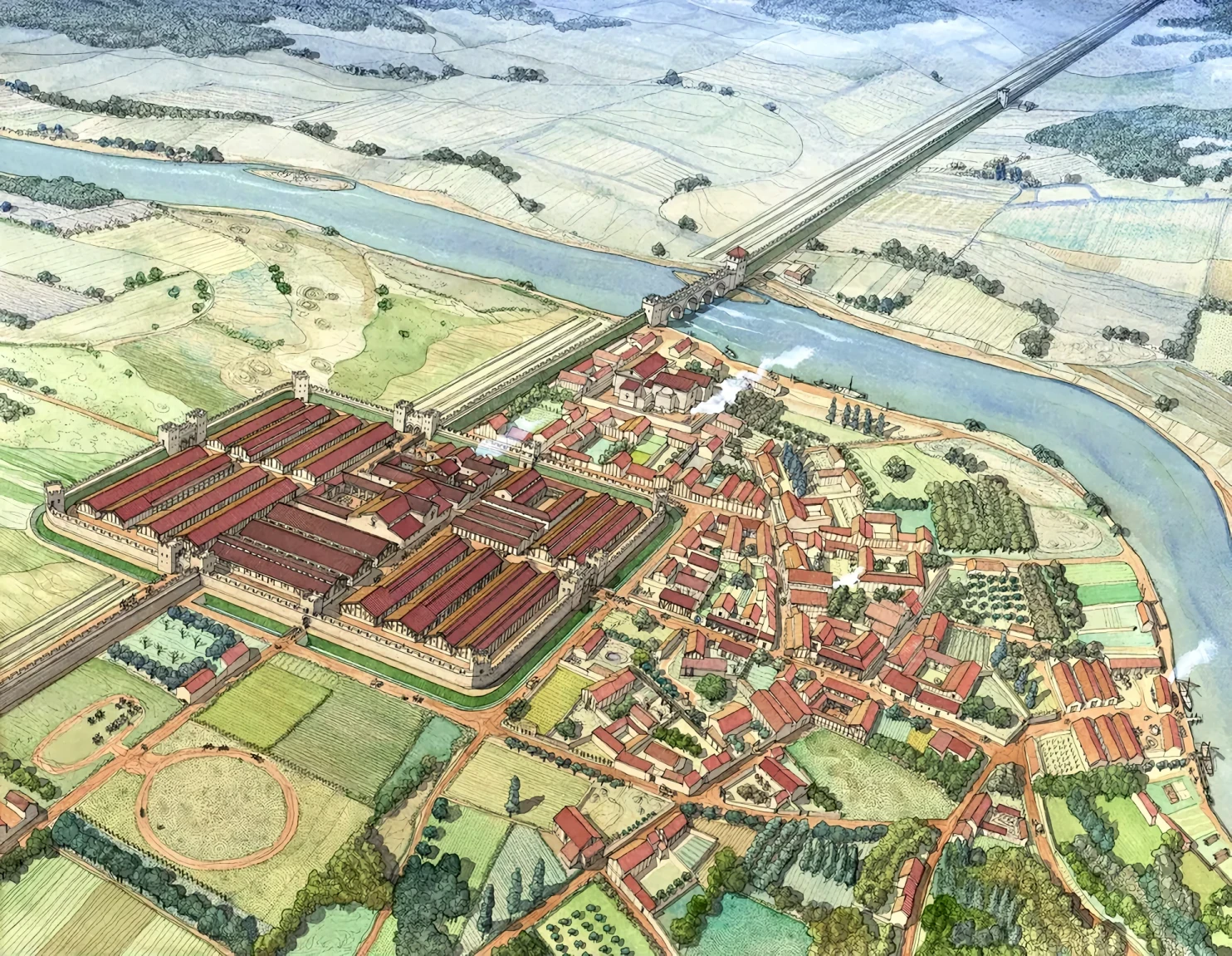
Chesters Roman Fort, part of Hadrian's Wall, c.200 AD

preview

All credit to u/dctroll_ for the find and writeup. I decided to put some work in to upgrading the image, and here we are. (I particularly liked that it savored of “ligne claire")

Chesters Roman Fort, known as Cilurnum, was built around 124 AD as part of Hadrian’s Wall in northern Britain. It was an important cavalry fort designed to accommodate around 500 soldiers who helped control and defend the frontier. The first unit stationed there was the Ala Augusta, a cavalry regiment known for its bravery. During the 2nd century, the fort was rebuilt and different auxiliary units occupied it. Around 178–184 AD, the Second Asturians, a cavalry unit originally from northern Spain, arrived at Chesters and remained closely connected with the fort until the end of Roman rule.

As at all Roman forts in northern Britain, the period AD 180–250 was the heyday of both the fort and the sprawling civilian settlement (vicus) lying outside the walls, providing services and accommodation for soldiers and their families.

During the 3rd century, political and military problems across the Roman Empire caused changes to the army and the civilian settlement gradually declined. By the 4th century, the garrison was probably more locally based, although the Second Asturians may still have been present. Chesters probably remained occupied until the Roman administration of Britain ended in the early 5th century.

SOURCES:

0

Vegan Cornbread [7 Ingredients, 1 bowl]

Nora Cooks The Best Vegan Cornbread www.noracooks.com
preview

I used regular sweetened oatmilk and this turned out fine, so don’t think you necessarily need to find unsweetened almond milk

I used regular sweetened oatmilk and this turned out fine, so don’t think you necessarily need to find unsweetened almond milk