0

preview

I haven’t participated in a minute, but thought I’d share it here in case some of you didn’t know of it already. The beat battles started on the old Stones Throw forums and continued after those forums were shut down. New battle every week, the level is generally very high. It’s good fun and you should check it out if it sounds interesting to you.
I haven’t participated in a minute, but thought I’d share it here in case some of you didn’t know of it already. The beat battles started on the old Stones Throw forums and continued after those forums were shut down. New battle every week, the level is generally very high. It’s good fun and you should check it out if it sounds interesting to you.

Note that this article contains some light spoilers for both the original Romancing SaGa 3 and the new Destinies United remake.
Note that this article contains some light spoilers for both the original Romancing SaGa 3 and the new Destinies United remake.

NYT not beating the sanewashing allegations.
NYT not beating the sanewashing allegations.
Photographies de mascarons et autres ornements dans Paris, classées par arrondissement.
Photographies de mascarons et autres ornements dans Paris, classées par arrondissement.

Of course they are, Bart. There’s no calcium in coconut milk (er, Malk)!
Of course they are, Bart. There’s no calcium in coconut milk (er, Malk)!

Union representatives reflect on the industry’s progress so far, and the remaining barriers to overcome
Union representatives reflect on the industry’s progress so far, and the remaining barriers to overcome

Bisher wurden herkömmliche E-Mopeds rechtlich als Fahrräder behandelt, ab Oktober gelten sie als Kraftfahrzeuge. Sie müssen dann für den Straßenverkehr zugelassen sein, dafür braucht es unter anderem einen Zulassungsschein, ein Kennzeichen und eine Kfz-Haftpflichtversicherung.
Der Mobilitätsclub geht österreichweit von mindestens 20.000 Privatpersonen aus, deren Fahrzeuge demnächst „praktisch wertlos werden“, daher brauche es „eine rasche Schaffung einer Zulassungsmöglichkeit für bestehende E-Mopeds“.




“Hell yeah!” is 27-year-old PhD student Anna Busuttil’s response. “I think it’s awesome; cool and rebellious,” she says – a view that chimes with that of most of the women I speak to outside University College London’s Bloomsbury campus. Busuttil says she sees a lot more women nowadays choosing not to remove their body hair. “I know people who dye their armpit hair a certain colour as well, so it stands out even more. I feel like leg hair is more taboo for women; it feels like such a ‘masculine’ thing, and legs are supposed to be a really sexy part of a woman.”
Francesca Hall, 25, agrees: she removes her leg hair, but doesn’t worry about her underarms. Yet she feels that, if anything, it’s becoming less common to go unshaven. “There’s been a general shift, culturally, towards more conservative ideas,” says the student union-worker. “It’s the same with veganism; it’s gone backwards a bit. My friendship group is quite queer, leftwing, and not everyone would remove their leg hair.” But, she says, not removing leg hair is more common “in those circles … I definitely think there’s a correlation there.”
“I’ve got really hairy legs!” says student Phoebe Green, 21, hitching up her long shorts so I can get a better look. “I don’t really pay attention to the trends that are going around; having leg hair doesn’t affect my life in any way,” she says. “I’ve definitely had a few comments, a few condescending dudes being like, ‘why aren’t they shaved?’ But I get a lot of compliments from girls, there’s a lot of solidarity.”

double connection:
double connection:
Robert Kingett è uno scrittore cieco: in uno dei suoi ultimi pezzi fa notare come la Silicon Valley cerchi di risolvere i problemi di disabilità con soluzioni ipercomplesse e ipercostose (che raramente passano la fase di prototipizzazione) perché fan gola ai capitali di ventura, mentre utilizzare una banale rampa o testi descrittivi sui siti non è calcolato perché non fan notizia.
“Sono fantasie individualiste. […] La Silicon Valley spenderebbe milioni per sviluppare un guanto che traduca (male) il linguaggio dei segni in audio, ma non spenderebbe 10 minuti ad aggiungere un testo alternativo per descrivere le immagini”.
Questa logica fa passare il messaggio che, comprando abbastanza accessori, si può comprare il proprio diritto di partecipare alla società. Tuttavia, sottolinea, la società dovrebbe di base essere progettata per includere tutte le persone - senza esoscheletri o qualsivoglia marchingegno ipertecnologico


Knifemen, knifewomen, downvoters, upvoters, it’s time to update you on the salvation of this kitchen knife. Mr. McKay, based knife sharpener, did the best he could do to restore the edge to something like symmetry. I expected a salty comment or two on the topic when I picked it up, however, he did not offer any, only a pitying silence as he gave me a meticulously handwritten receipt. Yet, his silence was full of kindness. Cost: $4.00 USD Many have asked, how did I achieve the ragged edge seen in my previous post? I wish I had a better answer for you, except that I used a shitty Coghlan’s sharpener that was probably full of metal filings and dirt. That one is going in the trash. Any suggestions for buying a beginner’s sharpener for $30.00 or $40.00 ? I don’t know how to use a file or a stone.
Knifemen, knifewomen, downvoters, upvoters, it’s time to update you on the salvation of this kitchen knife. Mr. McKay, based knife sharpener, did the best he could do to restore the edge to something like symmetry. I expected a salty comment or two on the topic when I picked it up, however, he did not offer any, only a pitying silence as he gave me a meticulously handwritten receipt. Yet, his silence was full of kindness. Cost: $4.00 USD Many have asked, how did I achieve the ragged edge seen in my previous post? I wish I had a better answer for you, except that I used a shitty Coghlan’s sharpener that was probably full of metal filings and dirt. That one is going in the trash. Any suggestions for buying a beginner’s sharpener for $30.00 or $40.00 ? I don’t know how to use a file or a stone.

Still, Premo found the constant macho rhetoric and violence he witnessed while filming mentally and emotionally exhausting. He went to rallies dressed in protective gear, prepared for a riot. Even if there weren’t skirmishes between the Proud Boys and other groups, there were men talking about what they wanted to do to antifa or others.
While he included the violence in his film, Premo is clear that it is not meant to make these men exceptions, but to situate them within a broader pattern.
“One of my critiques of American history and polite, middle-class white liberal society is this idea that violence is only an aberration of the norm. It’s only something that is carried out by the fringe or the extremes of society, when fundamentally, the American project is a project built by violence,” he says.
…
I found the ease with which Quaglin committed these acts astounding. The interspersion of political violence and domesticity doesn’t allow viewers to compartmentalize what’s on screen as fringe behavior, safely outside the bounds of ordinary American life. It suggests something more uncomfortable: that the difference is often not one of belief, but of expression—who says what out loud, and who knows not to.

Bo Horvat named the 16th captain in Islanders history
Bo Horvat named the 16th captain in Islanders history
When discussing Fediverse, you sometimes hear the idea that you shouldn’t need different accounts for different platforms.
The “why can’t I comment under Youtube video with my Twitter account”.
In Fediverse it already works to some extent. You can comment under PeerTube video with your Mastodon account, and you can participate in Lemmy thread with your Mastodon account.
What is this functionality called? Does it have specific name?
It’s probably not “single sign-on” and not “federation” from what I understand.
And to what extent is it implemented? Is there some way to participate in Lemmy thread with your PeerTube account?
Is there any progress being made on implementing the initial idea of using any Fediverse account with any other Fediverse platform?
What is the name for the problem of implementing or mapping the platform-specific functionality? As in, neither Mastodon nor PeerTube have the interface for upvoting and downvoting posts.
Wouldn’t it be easiest to implement Fediverse-wide SSO (as in, log into Lemmy interface with your Mastodon account) instead of figuring out some funky mapping and patform interactions?


S01E23 A Taste of Armageddon
antifandom.com/…/A_Taste_of_Armageddon_(episode)
A rare situation for Scotty-- both in command of the Enterprise, and also making a typically Kirk-like bluff. Or was it, really…?
S01E23 A Taste of Armageddon
antifandom.com/…/A_Taste_of_Armageddon_(episode)
A rare situation for Scotty-- both in command of the Enterprise, and also making a typically Kirk-like bluff. Or was it, really…?


Full splits and analysis on TriRating. Race report on Triathlon Magazine Canada.
Sophie Evans was first out of the water in a 13-person front pack that included Knibb and Siffert. Derron was 1:31 back in the chase group.
Knibb put on a blistering pace on the bike. She climbed the Col de Vence in 29:48, a course record, at a reported 303 watts. She summited more than six minutes clear of Siffert and reached T2 with 4:24 on Pierre. Siffert was 5:34 down and Lovseth 7:56. The UCI Grand Tours haven’t attempted this climb yet, so it may be the most impressive performance ever on the bike for this route.
Derron started the run in 11th, roughly nine minutes behind. She ran 1:13:04 (3:27/km) and finished second, 4:06 back. Siffert held third and beat her seeding by nearly eight minutes.
Knibb joked afterwards that she had expected to lose three or four minutes on the descent.
This ending was one for the ages! After falling behind by over 2 minutes in the earlier stages, Blummenfelt gave a run performance of a lifetime and nearly scratched and clawed his way to victory. However, Wilde was able to hold him off and reach the finish line a mere 18 seconds ahead.
27 men came out of the water together. Blummenfelt was 22 seconds back, which is a good swim for him.
The bike separated almost nobody. Michele Bortolamedi led into T2 with Wilde 16 seconds back and Bogen 17. Blummenfelt started the run 16th, 2:29 down.
He then proceeded to run an incredible 1:05:12 (3:05/km). Triathlon Magazine has that as the fastest 70.3 run split on record. He took nearly all of it back along the Promenade des Anglais and finished 18 seconds behind. Geens took third despite a disrupted build, and Iden was fourth, 11 minutes inside his seeding.
Wilde had been passed late at both the Olympics and the 2024 championship, so this one probably means a bit more than most.
One contrast stands out across the two days. Nine of the ten fastest men swam within 20 seconds of each other, and the top ten bike splits covered 2 minutes 19 seconds in total. The run sorted the podium.
Knibb did the opposite. She made the bike decisive and won by 4:06 over the fastest runner in the field, who out-ran her by almost five minutes. She was the only athlete across both days who took real time on the bike.
Blummenfelt ran 3:05/km after that bike course. For us mere mortals, does riding a hilly bike leg conservatively actually protect the run, or do you give up more time climbing than you can ever get back? If you’ve raced a hilly 70.3 or Olympic, how do you think your choice impacted your finish?
I’m slowly but surely deGoogling my life. Got rid of my Google Wifi and Nest Thermostat, moving my photos to Ente, transitioning to Proton Mail, and installed GrapheneOS. But the few map apps I’ve tried to use are pretty rough still.
I could probably live with the apps themselves, OSMand and Comaps are both a little wonky, but decent enough most of the time. The only real gripe I had was when OSMand was navigating my drive and there was a road shut down for construction, it kept trying to get me to go back onto the closed road instead of adjusting to use the road I was on. It wasn’t until I finally turned onto the next road that it finally adjusted the route correctly.
The big gripe is with Open Street Maps just not being as updated as Google. It could just be a US problem, but it hasn’t been able to find 3 different locations in the past couple months. All 3 were places I hadn’t been before, so I knew the general area but not the exact spot.
Location 1 - I got sent to the old location a couple miles away. The business had moved sometime in the past few years and the location wasn’t updated on OpenStreetMaps. I looked up the correct address, put that into Comaps and got there.
Location 2 - Going to a place on a road that changes names in the middle. Looking for 100 Name 1 Road, OSMand sends me to 100 Name 2 Road and says “you’ve arrived”. I check the Google Maps website and it turns out that OpenStreetMaps has the road change names about a mile too soon.
Location 3 - A relatively new shop that wasn’t even OpenStreetMaps. I grabbed the address from their website and put it into OSMand. It took me to a place about a quarter mile down the road from a shopping complex and told me I was there. I spent a few minutes driving around that complex and couldn’t find the place. I pulled up the address on the Google Maps website and found that it was in a different shopping complex a couple minutes down the road. The road is numbered oddly and OpenStreetMaps seemed to just be predicting it based on where it should be based on the numbers and not where it actually was.
I’ve since corrected all 3 of these locations in OpenStreeMaps, but it’s incredibly frustrating when the app you’re using can’t do the one thing you need it to do.

I feel like 50% of the time I try to use lem.lemmy.blahaj.zone there’s a 502 error. Is this just me? I end up having to use another frontend often
I feel like 50% of the time I try to use lem.lemmy.blahaj.zone there’s a 502 error. Is this just me? I end up having to use another frontend often
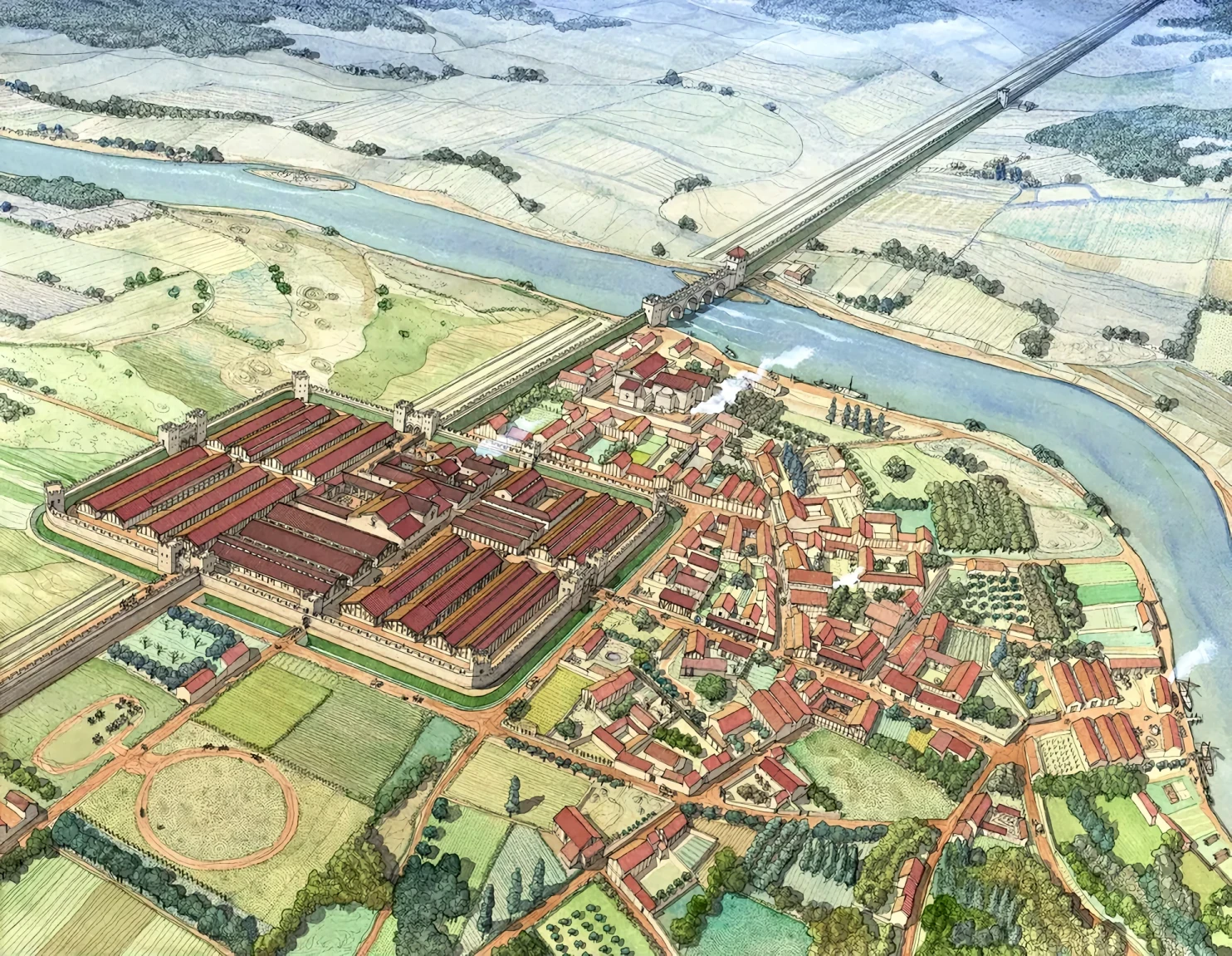
All credit to u/dctroll_ for the find and writeup. I decided to put some work in to upgrading the image, and here we are. (I particularly liked that it savored of “ligne claire")
Chesters Roman Fort, known as Cilurnum, was built around 124 AD as part of Hadrian’s Wall in northern Britain. It was an important cavalry fort designed to accommodate around 500 soldiers who helped control and defend the frontier. The first unit stationed there was the Ala Augusta, a cavalry regiment known for its bravery. During the 2nd century, the fort was rebuilt and different auxiliary units occupied it. Around 178–184 AD, the Second Asturians, a cavalry unit originally from northern Spain, arrived at Chesters and remained closely connected with the fort until the end of Roman rule.
As at all Roman forts in northern Britain, the period AD 180–250 was the heyday of both the fort and the sprawling civilian settlement (vicus) lying outside the walls, providing services and accommodation for soldiers and their families.
During the 3rd century, political and military problems across the Roman Empire caused changes to the army and the civilian settlement gradually declined. By the 4th century, the garrison was probably more locally based, although the Second Asturians may still have been present. Chesters probably remained occupied until the Roman administration of Britain ended in the early 5th century.
SOURCES:

I used regular sweetened oatmilk and this turned out fine, so don’t think you necessarily need to find unsweetened almond milk
I used regular sweetened oatmilk and this turned out fine, so don’t think you necessarily need to find unsweetened almond milk
Finally standalone competition for the ancient Kega Fusion emulator.
Finally standalone competition for the ancient Kega Fusion emulator.


Bron: BNN VARA.
De Renaissanceschool, de basisschool gestart door de extreemrechtse partij Forum voor Democratie, heeft gesjoemeld bij het verkrijgen van een rijkssubsidie voor de oprichting. Dat meldt de Volkskrant maandag. Die subsidie is verkregen op basis van een marktonderzoek dat ernstige methodologische tekortkomingen had. Zo werd voor de ouders verzwegen dat het om een Forum-school ging.
De school in Almere Poort is in augustus van dit van start gegaan met welgeteld vier leerlingen in de klas. De rijkssubsidie die de partijschool ontvangt bedraagt op dit moment 507 duizend euro per kalenderjaar. Om daarvoor in aanmerking te komen moet er voldoende animo zijn voor de bouw van een nieuwe school. De Volkskrant schrijft:
Ouderverklaringen zijn de geijkte weg, maar het lukte niet om daar genoeg van te verzamelen. Daarom weken de oprichters uit naar de alternatieve methode: een marktonderzoek. Dat mag alleen worden uitgevoerd in wijken waar veel gebouwd gaat worden. De FvD-school is de eerste school die via deze route wordt bekostigd.
Behalve dat de school onderdeel is van Forum voor Democratie, werd bijvoorbeeld ook niet vermeld ‘dat op de Renaissanceschool aan jongens en meisjes verschillende lesmethoden zullen worden aangeboden’. Dat bleek bij de onderwijsinspectie ook niet bekend.
De krant meldt verder:
D66-Kamerlid Ilana Rooderkerk meent dat de school ‘onder valse voorwendselen’ is gestart en stelt maandag Kamervragen. ‘Van dit soort misleidende onderzoeken moeten we af, want het zijn kinderen die daarvan de gevolgen ondervinden. Zij mogen nooit speelbal worden van een politiek project.’

A Montreal charity that helped bring Syrian refugees to Canada was fined $60,900 for providing “undue benefits” to a company owned by its president as part of its sponsorship program, according to documents recently made public.
The Canada Revenue Agency (CRA) notified the Centre Canadien Islamique Al-Jamieh/Canadian Islamic Centre Al-Jamieh of the penalty in a Sept. 12, 2024 letter, which has now been made available through the IJF’s Open by Default database.
The notice says the mosque, a registered charity, paid $58,000 to a consulting company in March 2017. That company was wholly owned by the charity’s then-president, Ahmad Chaar.


Cameron himself didn’t want Brexit to happen. He thought a referendum would finally silence opponents who felt otherwise, including many in his own Conservative Party. Yet he also sympathized with British citizens who “resent the interference in our national life by what they see as unnecessary rules and regulation” and tried to leverage that resentment in negotiations for a better deal with the EU. When the referendum was held in 2016 and Leave won with 52 percent of the vote, Cameron resigned the next day in disgrace. The UK spent the next four years negotiating the terms of its divorce with continental Europe. In 2020, they reached an agreement, and Brexit became official reality.
The UK cycled through three prime ministers during those seven tumultuous years. But the Bank of England had just one governor that whole time, whose tenure from 2013 to 2020 overlapped this cautionary tale with eerie precision: Mark Carney.
For example, 蠍 is written as サソリ. Even if they use the Kanji in text, they add furigana above it rather than letting the audience themselves decipher the meaning. It’s the same with 榊 (サカキ), 仙人掌 (サボテン), 百足 (ムカデ), 蟻 (アリ), 鰐 (ワニ), you get the picture. Why can’t they just write them in Kanji without furigana in the same frequency as encountering 本 or 日 upon encountering texts containing these types of words?
For example, 蠍 is written as サソリ. Even if they use the Kanji in text, they add furigana above it rather than letting the audience themselves decipher the meaning. It’s the same with 榊 (サカキ), 仙人掌 (サボテン), 百足 (ムカデ), 蟻 (アリ), 鰐 (ワニ), you get the picture. Why can’t they just write them in Kanji without furigana in the same frequency as encountering 本 or 日 upon encountering texts containing these types of words?

New Delhi: Bhartiya Janta Party (BJP)’s agents have attempted mass deletion of Muslim voters from the electoral rolls in the coastal town of Bhadrak, in north-east Odisha, during the Election Commission of India’s (ECI) ongoing statewide voter revision exercise.
New Delhi: Bhartiya Janta Party (BJP)’s agents have attempted mass deletion of Muslim voters from the electoral rolls in the coastal town of Bhadrak, in north-east Odisha, during the Election Commission of India’s (ECI) ongoing statewide voter revision exercise.



it is so very cold this morning so this was the perfect breakfast to warm us back up. this just has some wakame dried seaweed, green onion, cabbage, shiitake mushroom seasoning, soy sauce, dark soy sauce, a little bit of vegan margarine, and msg. then just boiled some rice noodles and fried some tofu to have with it.
it is so very cold this morning so this was the perfect breakfast to warm us back up. this just has some wakame dried seaweed, green onion, cabbage, shiitake mushroom seasoning, soy sauce, dark soy sauce, a little bit of vegan margarine, and msg. then just boiled some rice noodles and fried some tofu to have with it.

[un personnage au cerveau énorme parle tout en réfléchissant]
Les personnes sans domicile…
…pourraient juste s’acheter une maison
Je ne les comprends pas
thebad.website/comic/free_market_understander
[un personnage au cerveau énorme parle tout en réfléchissant]
Les personnes sans domicile…
…pourraient juste s’acheter une maison
Je ne les comprends pas
thebad.website/comic/free_market_understander