0

How does Lemmy -> Piefed* work?

preview
  • I made a Piefed* account, but I can’t see the comments and posts from my Lemmy account. Or vice versa. What’s up with that? Is there a “wall” between these communities?
  • Is there a way to transfer posts etc from one account to another?
  • I made a Piefed* account, but I can’t see the comments and posts from my Lemmy account. Or vice versa. What’s up with that? Is there a “wall” between these communities?
  • Is there a way to transfer posts etc from one account to another?
0

Offputting

preview

Alt: simple cartoon of a femme person. Speech bubbles from someone not shown talking to the person, “you’re offputting and you sound funny.” Femme person says “thanks it’s because i’m neurodivergent and transgender.” The text “Work Simulator” is in the bottom right corner.

Alt: simple cartoon of a femme person. Speech bubbles from someone not shown talking to the person, “you’re offputting and you sound funny.” Femme person says “thanks it’s because i’m neurodivergent and transgender.” The text “Work Simulator” is in the bottom right corner.

0

𝑮𝒂𝒏𝒅𝒉𝒊'𝒔 "𝑮𝒍𝒊𝒎𝒑𝒔𝒆𝒔 𝒐𝒇 𝑹𝒆𝒍𝒊𝒈𝒊𝒐𝒏"

preview

From my sixth or seventh year up to my sixteenth I was at school, being taught all sorts of things except religion. I may say that I failed to get from the teachers what they could have given me without any effort on their part. And yet I kept on picking up things here and there from my surroundings. The term “religion” I am using in its broadest sense, meaning thereby self-realization or knowledge of self. Being born in the Vaishnava faith, I had often to go to the Haveli [extravagant mansions or townhouses] but it never appealed to me. I did not like its glitter and pomp. Also I heard rumours of immorality being practised there, and lost all interest in it. Hence I could gain nothing from the Haveli. But what I failed to get there I obtained from my nurse, an old servant of the family, whose affection for me I still recall. I have said before that there was in me a fear of ghosts and spirits. Rambha, for that was her name, suggested, as a remedy for this fear, the repetition of Ramanama. I had more faith in her than in her remedy, and so at a tender age I began repeating Ramanama to cure my fear of ghosts and spirits. This was of course, short-lived, but the good seed sown in childhood was not sown in vain. I think it is due to the seed sown by that good woman Rambha that today Ramanama is an infallible remedy for me.

Just about this time, a cousin of mine who was a devotee of the Ramayana arranged for my second brother and me to learn Rama Raksha. We got it by heart, and made it a rule to recite it every morning after the bath. The practice was kept up as long as we were in Porbandar. As soon as we reached Rajkot, it was forgotten. For I had not much belief in it. I recited it partly because of my pride in being able to recite Rama Raksha with correct pronunciation. What, however, left a deep impression on me was the reading of the Ramayana before my father. During part of his illness my father was in Porbandar. There every evening he used to listen to the Ramayana. The reader was a great devotee of Rama — Ladha Maharaj of Bileshvar. It was said of him that he cured himself of his leprosy not by any medicine, but by applying to the affected parts bilva leaves which had been cast away after being offered to the image of Mahadev in Bileshvar temple, and by the regular repetition of Ramanama. His faith, it was said, had made him whole. This may or may not be true. We at any rate believed the story. And it is a fact that when Ladha Maharaj began his reading of the Ramayana his body was entirely free from leprosy. He had a melodious voice. He would sing the Dohas (couplets) and Chopais (quatrains), and explain them, losing himself in the discourse and carrying his listeners along with him. I must have been thirteen at that time, but I quite remember being enraptured by his reading. That laid the foundation of my deep devotion to the Ramayana. Today I regard the Ramayana of Tulasidas as the greatest book in all devotional literature.

A few months after this we came to Rajkot. There was no Ramayana reading there. The Bhagavat, however, used to be read on every Ekadashi day (eleventh day of the bright and the dark half of a lunar month). Sometimes I attended the reading, but the reciter was uninspiring. Today I see that the Bhagavat is a book which can evoke religious fervour. I have read it in Gujarati with intense interest. But when I heard portions of the original read by Pandit Madan Mohan Malaviya during my twenty-one days’ fast, I wished I had heard it in my childhood from such a devotee as he is, so that I could have formed a liking for it at an early age. Impressions formed at that age strike roots deep down into one’s nature, and it is my perpetual regret that I was not fortunate enough to hear more good books of this kind read during that period. In Rajkot, however, I got an early grounding in toleration for all branches of Hinduism and sister religions. For my father and mother would visit the Haveli as also Shiva’s and Rama’s temples, and would take or send us youngsters there. Jain monks also would pay frequent visits to my father, and would even go out of their way to accept food from us — non-Jains. They would have talks with my father on subjects religious and mundane. He had, besides, Musalman and Parsi friends, who would talk to him about their own faiths, and he would listen to them always with respect, and often with interest. Being his nurse, I often had a chance to be present at these talks. These many things combined to inculcate in me a toleration for all faiths.

Only Christianity was at the time an exception. I developed a sort of dislike for it. And for a reason. In those days Christian missionaries used to stand in a corner near the high school and hold forth, pouring abuse on Hindus and their gods. I could not endure this. I must have stood there to hear them once only, but that was enough to dissuade me from repeating the experiment [Gandhi may have even hated what they were doing, but that didn’t stop him from being open minded enough to at least consider them]. About the same time, I heard of a well-known Hindu having been converted to Christianity. It was the talk of the town that, when he was baptized, he had to eat beef and drink liquor, that he also had to change his clothes, and that thenceforth he began to go about in European costume including a hat. These things got on my nerves. Surely, thought I, a religion that compelled one to eat beef, drink liquor, and change one’s own clothes did not deserve the name. I also heard that the new convert had already begun abusing the religion of his ancestors, their customs and their country. All these things created in me a dislike for Christianity. But the fact that I had learnt to be tolerant of other religions did not mean that I had any living faith in God. I happened, about this time, to come across Manusmriti which was amongst my father’s collection. The story of the creation and similar things in it did not impress me very much, but on the contrary made me incline somewhat towards atheism.

There was a cousin of mine, still alive, for whose intellect I had great regard. To him I turned with my doubts. But he could not resolve them. He sent me away with this answer: “When you grow up, you will be able to solve these doubts yourself. These questions ought not to be raised at your age.” I was silenced, but was not comforted. Chapters about diet and the like in Manusmriti seemed to me to run contrary to daily practice. To my doubts as to this also, I got the same answer. “With intellect more developed and with more reading I shall understand it better,” I said to myself. Manusmriti at any rate did not then teach me Ahimsa. I have told the story of my meat-eating. Manusmriti seemed to support it. I also felt that it was quite moral to kill serpents, bugs and the like. I remember to have killed at that age bugs and such other insects, regarding it as a duty [holding the opposite perspective when he became older and wiser as he mentions in a later chapter].

But one thing took deep root in me — the conviction that morality is the basis of things, and that truth is the substance of all morality. Truth became my sole objective. It began to grow in magnitude every day, and my definition of it also has been ever widening. A Gujarati didactic stanza likewise gripped my mind and heart. Its precept — return good for evil — [Matt 5:38] became my guiding principle. It became such a passion with me that I began numerous experiments in it. Here are those (for me) wonderful lines:

  • For a bowl of water give a goodly meal;
  • For a kindly greeting bow thou down with zeal;
  • For a simple penny pay thou back with gold;
  • If thy life be rescued, life do not withhold.
  • Thus the words and actions of the wise regard;
  • Every little service tenfold they reward.
  • But the truly noble know all men as one,
  • And return with gladness good for evil done.

— Mahatma Gandhi, The Story of My Experiments with Truth, Part One, Chapter Ten: “Glimpses of Religion”

0

𝑻𝒐𝒍𝒔𝒕𝒐𝒚'𝒔 "𝑨 𝑳𝒆𝒕𝒕𝒆𝒓 𝒕𝒐 𝒂 𝑯𝒊𝒏𝒅𝒖: 𝑻𝒉𝒆 𝑺𝒖𝒃𝒋𝒆𝒄𝒕𝒊𝒐𝒏 𝒐𝒇 𝑰𝒏𝒅𝒊𝒂 — 𝑰𝒕𝒔 𝑪𝒂𝒖𝒔𝒆 𝒂𝒏𝒅 𝑪𝒖𝒓𝒆" (𝑷𝒂𝒓𝒕 𝑻𝒘𝒐 𝒐𝒇 𝑻𝒘𝒐)

preview

This is a direct continuation of Tolstoy’s “A Letter to a Hindu”: The Subjection of India — Its Cause and Cure (Part One of Two): lemmy.world/post/48753736


IV. ‘Children, do you want to know by what your hearts should be guided? Throw aside your longings and strivings after that which is null and void; get rid of your erroneous thoughts about happiness and wisdom, and your empty and insincere desires. Dispense with these and you will know Love.’ KRISHNA.

‘Be not the destroyers of yourselves. Arise to your true Being, and then you will have nothing to fear.’ KRISHNA.

New justifications have now appeared in place of the antiquated, obsolete, religious ones. These new justifications are just as inadequate as the old ones, but as they are new their futility cannot immediately be recognized by the majority of men. Besides this, those who enjoy power propagate these new sophistries and support them so skilfully that they seem irrefutable even to many of those who suffer from the oppression these theories seek to justify. These new justifications are termed ‘scientific’. But by the term ‘scientific’ is understood just what was formerly understood by the term ‘religious’: just as formerly everything called ‘religious’ was held to be unquestionable simply because it was called religious, so now all that is called ‘scientific’ is held to be unquestionable. In the present case the obsolete religious justification of violence which consisted in the recognition of the supernatural personality of the God-ordained ruler (‘there is no power but of God’) has been superseded by the ‘scientific’ justification which puts forward, first, the assertion that because the coercion of man by man has existed in all ages, it follows that such coercion must continue to exist. This assertion that people should continue to live as they have done throughout past ages rather than as their reason and conscience indicate, is what ‘science’ calls ‘the historic law’. A further ‘scientific’ justification lies in the statement that as among plants and wild beasts there is a constant struggle for existence which always results in the survival of the fittest, a similar struggle should be carried on among human beings — beings, that is, who are gifted with intelligence and love; faculties lacking in the creatures subject to the struggle for existence and survival of the fittest. Such is the second ‘scientific’ justification.

The third, most important, and unfortunately most widespread justification is, at bottom, the age-old religious one just a little altered: that in public life the suppression of some for the protection of the majority cannot be avoided — so that coercion is unavoidable however desirable reliance on love alone might be in human intercourse. The only difference in this justification by pseudo-science consists in the fact that, to the question why such and such people and not others have the right to decide against whom violence may and must be used, pseudo-science now gives a different reply to that given by religion — which declared that the right to decide was valid because it was pronounced by persons possessed of divine power. ‘Science’ says that these decisions represent the will of the people, which under a constitutional form of government is supposed to find expression in all the decisions and actions of those who are at the helm at the moment.

Such are the scientific justifications of the principle of coercion. They are not merely weak but absolutely invalid, yet they are so much needed by those who occupy privileged positions that they believe in them as blindly as they formerly believed in the immaculate conception, and propagate them just as confidently. And the unfortunate majority of men bound to toil is so dazzled by the pomp with which these ‘scientific truths’ are presented, that under this new influence it accepts these scientific stupidities for holy truth, just as it formerly accepted the pseudo-religious justifications; and it continues to submit to the present holders of power who are just as hard-hearted but rather more numerous than before.

V. ‘Who am I? I am that which thou hast searched for since thy baby eyes gazed wonderingly upon the world, whose horizon hides this real life from thee. I am that which in thy heart thou hast prayed for, demanded as thy birthright, although thou hast not known what it was. I am that which has lain in thy soul for hundreds and thousands of years. Sometimes I lay in thee grieving because thou didst not recognize me; sometimes I raised my head, opened my eyes, and extended my arms calling thee either tenderly and quietly, or strenuously, demanding that thou shouldst rebel against the iron chains which bound thee to the earth.’ KRISHNA.

So matters went on, and still go on, in the Christian world. But we might have hope that in the immense Brahman, Buddhist, and Confucian worlds this new scientific superstition would not establish itself, and that the Chinese, Japanese, and Hindus, once their eyes were opened to the religious fraud justifying violence, would advance directly to a recognition of the law of love inherent in humanity, and which had been so forcibly enunciated by the great Eastern teachers. But what has happened is that the scientific superstition replacing the religious one has been accepted and secured a stronger and stronger hold in the East.

In your periodical you set out as the basic principle which should guide the actions of your people the maxim that: ‘Resistance to aggression is not simply justifiable but imperative, nonresistance hurts both Altruism and Egotism.’ Love is the only way to rescue humanity from all ills, and in it you too have the only method of saving your people from enslavement. In very ancient times love was proclaimed with special strength and clearness among your people to be the religious basis of human life. Love, and forcible resistance to evil-doers, involve such a mutual contradiction as to destroy utterly the whole sense and meaning of the conception of love. And what follows? With a light heart and in the twentieth century you, an adherent of a religious people, deny their law, feeling convinced of your scientific enlightenment and your right to do so, and you repeat (do not take this amiss) the amazing stupidity indoctrinated in you by the advocates of the use of violence — the enemies of truth, the servants first of theology and then of science — your European teachers.

You say that the English have enslaved your people and hold them in subjection because the latter have not resisted resolutely enough and have not met force by force. But the case is just the opposite. If the English have enslaved the people of India it is just because the latter recognized, and still recognize, force as the fundamental principle of the social order. In accord with that principle they submitted to their little rajahs, and on their behalf struggled against one another, fought the Europeans, the English, and are now trying to fight with them again.

A commercial company enslaved a nation comprising two hundred millions. Tell this to a man free from superstition and he will fail to grasp what these words mean. What does it mean that thirty thousand men, not athletes but rather weak and ordinary people, have subdued two hundred million vigorous, clever, capable, and freedom-loving people? Do not the figures make it clear that it is not the English who have enslaved the Indians, but the Indians who have enslaved themselves? When the Indians complain that the English have enslaved them it is as if drunkards complained that the spirit-dealers who have settled among them have enslaved them. You tell them that they might give up drinking, but they reply that they are so accustomed to it that they cannot abstain, and that they must have alcohol to keep up their energy. Is it not the same thing with the millions of people who submit to thousands’ or even to hundreds, of others — of their own or other nations? If the people of India are enslaved by violence it is only because they themselves live and have lived by violence, and do not recognize the eternal law of love inherent in humanity.

‘Pitiful and foolish is the man who seeks what he already has, and does not know that he has it. Yes, Pitiful and foolish is he who does not know the bliss of love which surrounds him and which I have given him.’ KRISHNA.

As soon as men live entirely in accord with the law of love natural to their hearts and now revealed to them, which excludes all resistance by violence, and therefore hold aloof from all participation in violence — as soon as this happens, not only will hundreds be unable to enslave millions, but not even millions will be able to enslave a single individual. Do not resist the evil-doer and take no part in doing so, either in the violent deeds of the administration, in the law courts, the collection of taxes, or above all in soldiering, and no one in the world will be able to enslave you.

VI. ‘O ye who sit in bondage and continually seek and pant for freedom, seek only for love. Love is peace in itself and peace which gives complete satisfaction. I am the key that opens the portal to the rarely discovered land where contentment alone is found.’ KRISHNA.

What is now happening to the people of the East as of the West is like what happens to every individual when he passes from childhood to adolescence and from youth to manhood. He loses what had hitherto guided his life and lives without direction, not having found a new standard suitable to his age, and so he invents all sorts of occupations, cares, distractions, and stupefactions to divert his attention from the misery and senselessness of his life. Such a condition may last a long time.

When an individual passes from one period of life to another a time comes when he cannot go on in senseless activity and excitement as before, but has to understand that although he has outgrown what before used to direct him, this does not mean that he must live without any reasonable guidance, but rather that he must formulate for himself an understanding of life corresponding to his age, and having elucidated it must be guided by it. And in the same way a similar time must come in the growth and development of humanity. I believe that such a time has now arrived — not in the sense that it has come in the year 1908, but that the inherent contradiction of human life has now reached an extreme degree of tension: on the one side there is the consciousness of the beneficence of the law of love, and on the other the existing order of life which has for centuries occasioned an empty, anxious, restless, and troubled mode of life, conflicting as it does with the law of love and built on the use of violence. This contradiction must be faced, and the solution will evidently not be favourable to the outlived law of violence, but to the truth which has dwelt in the hearts of men from remote antiquity: the truth that the law of love is in accord with the nature of man.

But men can only recognize this truth to its full extent when they have completely freed themselves from all religious and scientific superstitions and from all the consequent misrepresentations and sophistical distortions by which its recognition has been hindered for centuries. To save a sinking ship it is necessary to throw overboard the ballast, which though it may once have been needed would now cause the ship to sink. And so it is with the scientific superstition which hides the truth of their welfare from mankind. In order that men should embrace the truth — not in the vague way they did in childhood, nor in the one-sided and perverted way presented to them by their religious and scientific teachers, but embrace it as their highest law — the complete liberation of this truth from all and every superstition (both pseudo-religious and pseudo-scientific) by which it is still obscured is essential: not a partial, timid attempt, reckoning with traditions sanctified by age and with the habits of the people — not such as was effected in the religious sphere by Guru-Nanak, the founder of the sect of the Sikhs, and in the Christian world by Luther, and by similar reformers in other religions — but a fundamental cleansing of religious consciousness from all ancient religious and modern scientific superstitions.

If only people freed themselves from their beliefs in all kinds of Ormuzds, Brahmas, Sabbaoths, and their incarnation as Krishnas and Christs, from beliefs in Paradises and Hells, in reincarnations and resurrections, from belief in the interference of the Gods in the external affairs of the universe, and above all, if they freed themselves from belief in the infallibility of all the various Vedas, Bibles, Gospels, Tripitakas, Korans, and the like, and also freed themselves from blind belief in a variety of scientific teachings about infinitely small atoms and molecules and in all the infinitely great and infinitely remote worlds, their movements and origin, as well as from faith in the infallibility of the scientific law to which humanity is at present subjected: the historic law, the economic laws, the law of struggle and survival, and so on — if people only freed themselves from this terrible accumulation of futile exercises of our lower capacities of mind and memory called the ‘Sciences’, and from the innumerable divisions of all sorts of histories, anthropologies, homiletics, bacteriologics, jurisprudences, cosmographies, strategies — their name is legion — and freed themselves from all this harmful, stupifying ballast — the simple law of love, natural to man, accessible to all and solving all questions and perplexities, would of itself become clear and obligatory.

VII. ‘Children, look at the flowers at your feet; do not trample upon them. Look at the love in your midst and do not repudiate it.’ KRISHNA.

‘There is a higher reason which transcends all human minds. It is far and near. It permeates all the worlds and at the same time is infinitely higher than they. A man who sees that all things are contained in the higher spirit cannot treat any being with contempt.

For him to whom all spiritual beings are equal to the highest there can be no room for deception or grief. Those who are ignorant and are devoted to the religious rites only, are in a deep gloom, but those who are given up to fruitless meditations are in a still greater darkness.’ UPANISHADS, FROM VEDAS.

Yes, in our time all these things must be cleared away in order that mankind may escape from self-inflicted calamities that have reached an extreme intensity. Whether an Indian seeks liberation from subjection to the English, or anyone else struggles with an oppressor either of his own nationality or of another — whether it be a Negro defending himself against the North Americans; or Persians, Russians, or Turks against the Persian, Russian, or Turkish governments, or any man seeking the greatest welfare for himself and for everybody else — they do not need explanations and justifications of old religious superstitions such as have been formulated by your Vivekanandas, Baba Bharatis, and others, or in the Christian world by a number of similar interpreters and exponents of things that nobody needs; nor the innumerable scientific theories about matters not only unnecessary but for the most part harmful. (In the spiritual realm nothing is indifferent: what is not useful is harmful.) What are wanted for the Indian as for the Englishman, the Frenchman, the German, and the Russian, are not Constitutions and Revolutions, nor all sorts of Conferences and Congresses, nor the many ingenious devices for submarine navigation and aerial navigation, nor powerful explosives, nor all sorts of conveniences to add to the enjoyment of the rich, ruling classes; nor new schools and universities with innumerable faculties of science, nor an augmentation of papers and books, nor gramophones and cinematographs, nor those childish and for the most part corrupt stupidities termed art — but one thing only is needful: the knowledge of the simple and clear truth which finds place in every soul that is not stupefied by religious and scientific superstitions — the truth that for our life one law is valid — the law of love, which brings the highest happiness to every individual as well as to all mankind. Free your minds from those overgrown, mountainous imbecilities which hinder your recognition of it, and at once the truth will emerge from amid the pseudo-religious nonsense that has been smothering it: the indubitable, eternal truth inherent in man, which is one and the same in all the great religions of the world. It will in due time emerge and make its way to general recognition, and the nonsense that has obscured it will disappear of itself, and with it will go the evil from which humanity now suffers.

‘Children, look upwards with your beclouded eyes, and a world full of joy and love will disclose itself to you, a rational world made by My wisdom, the only real world. Then you will know what love has done with you, what love has bestowed upon you, what love demands from you.’ KRISHNA.

YASNAYA POLYANA. December 14th, 1908.

This is a direct continuation of Tolstoy’s “A Letter to a Hindu”: The Subjection of India — Its Cause and Cure (Part One of Two): lemmy.world/post/48753736


IV. ‘Children, do you want to know by what your hearts should be guided? Throw aside your longings and strivings after that which is null and void; get rid of your erroneous thoughts about happiness and wisdom, and your empty and insincere desires. Dispense with these and you will know Love.’ KRISHNA.

‘Be not the destroyers of yourselves. Arise to your true Being, and then you will have nothing to fear.’ KRISHNA.

New justifications have now appeared in place of the antiquated, obsolete, religious ones. These new justifications are just as inadequate as the old ones, but as they are new their futility cannot immediately be recognized by the majority of men. Besides this, those who enjoy power propagate these new sophistries and support them so skilfully that they seem irrefutable even to many of those who suffer from the oppression these theories seek to justify. These new justifications are termed ‘scientific’. But by the term ‘scientific’ is understood just what was formerly understood by the term ‘religious’: just as formerly everything called ‘religious’ was held to be unquestionable simply because it was called religious, so now all that is called ‘scientific’ is held to be unquestionable. In the present case the obsolete religious justification of violence which consisted in the recognition of the supernatural personality of the God-ordained ruler (‘there is no power but of God’) has been superseded by the ‘scientific’ justification which puts forward, first, the assertion that because the coercion of man by man has existed in all ages, it follows that such coercion must continue to exist. This assertion that people should continue to live as they have done throughout past ages rather than as their reason and conscience indicate, is what ‘science’ calls ‘the historic law’. A further ‘scientific’ justification lies in the statement that as among plants and wild beasts there is a constant struggle for existence which always results in the survival of the fittest, a similar struggle should be carried on among human beings — beings, that is, who are gifted with intelligence and love; faculties lacking in the creatures subject to the struggle for existence and survival of the fittest. Such is the second ‘scientific’ justification.

The third, most important, and unfortunately most widespread justification is, at bottom, the age-old religious one just a little altered: that in public life the suppression of some for the protection of the majority cannot be avoided — so that coercion is unavoidable however desirable reliance on love alone might be in human intercourse. The only difference in this justification by pseudo-science consists in the fact that, to the question why such and such people and not others have the right to decide against whom violence may and must be used, pseudo-science now gives a different reply to that given by religion — which declared that the right to decide was valid because it was pronounced by persons possessed of divine power. ‘Science’ says that these decisions represent the will of the people, which under a constitutional form of government is supposed to find expression in all the decisions and actions of those who are at the helm at the moment.

Such are the scientific justifications of the principle of coercion. They are not merely weak but absolutely invalid, yet they are so much needed by those who occupy privileged positions that they believe in them as blindly as they formerly believed in the immaculate conception, and propagate them just as confidently. And the unfortunate majority of men bound to toil is so dazzled by the pomp with which these ‘scientific truths’ are presented, that under this new influence it accepts these scientific stupidities for holy truth, just as it formerly accepted the pseudo-religious justifications; and it continues to submit to the present holders of power who are just as hard-hearted but rather more numerous than before.

V. ‘Who am I? I am that which thou hast searched for since thy baby eyes gazed wonderingly upon the world, whose horizon hides this real life from thee. I am that which in thy heart thou hast prayed for, demanded as thy birthright, although thou hast not known what it was. I am that which has lain in thy soul for hundreds and thousands of years. Sometimes I lay in thee grieving because thou didst not recognize me; sometimes I raised my head, opened my eyes, and extended my arms calling thee either tenderly and quietly, or strenuously, demanding that thou shouldst rebel against the iron chains which bound thee to the earth.’ KRISHNA.

So matters went on, and still go on, in the Christian world. But we might have hope that in the immense Brahman, Buddhist, and Confucian worlds this new scientific superstition would not establish itself, and that the Chinese, Japanese, and Hindus, once their eyes were opened to the religious fraud justifying violence, would advance directly to a recognition of the law of love inherent in humanity, and which had been so forcibly enunciated by the great Eastern teachers. But what has happened is that the scientific superstition replacing the religious one has been accepted and secured a stronger and stronger hold in the East.

In your periodical you set out as the basic principle which should guide the actions of your people the maxim that: ‘Resistance to aggression is not simply justifiable but imperative, nonresistance hurts both Altruism and Egotism.’ Love is the only way to rescue humanity from all ills, and in it you too have the only method of saving your people from enslavement. In very ancient times love was proclaimed with special strength and clearness among your people to be the religious basis of human life. Love, and forcible resistance to evil-doers, involve such a mutual contradiction as to destroy utterly the whole sense and meaning of the conception of love. And what follows? With a light heart and in the twentieth century you, an adherent of a religious people, deny their law, feeling convinced of your scientific enlightenment and your right to do so, and you repeat (do not take this amiss) the amazing stupidity indoctrinated in you by the advocates of the use of violence — the enemies of truth, the servants first of theology and then of science — your European teachers.

You say that the English have enslaved your people and hold them in subjection because the latter have not resisted resolutely enough and have not met force by force. But the case is just the opposite. If the English have enslaved the people of India it is just because the latter recognized, and still recognize, force as the fundamental principle of the social order. In accord with that principle they submitted to their little rajahs, and on their behalf struggled against one another, fought the Europeans, the English, and are now trying to fight with them again.

A commercial company enslaved a nation comprising two hundred millions. Tell this to a man free from superstition and he will fail to grasp what these words mean. What does it mean that thirty thousand men, not athletes but rather weak and ordinary people, have subdued two hundred million vigorous, clever, capable, and freedom-loving people? Do not the figures make it clear that it is not the English who have enslaved the Indians, but the Indians who have enslaved themselves? When the Indians complain that the English have enslaved them it is as if drunkards complained that the spirit-dealers who have settled among them have enslaved them. You tell them that they might give up drinking, but they reply that they are so accustomed to it that they cannot abstain, and that they must have alcohol to keep up their energy. Is it not the same thing with the millions of people who submit to thousands’ or even to hundreds, of others — of their own or other nations? If the people of India are enslaved by violence it is only because they themselves live and have lived by violence, and do not recognize the eternal law of love inherent in humanity.

‘Pitiful and foolish is the man who seeks what he already has, and does not know that he has it. Yes, Pitiful and foolish is he who does not know the bliss of love which surrounds him and which I have given him.’ KRISHNA.

As soon as men live entirely in accord with the law of love natural to their hearts and now revealed to them, which excludes all resistance by violence, and therefore hold aloof from all participation in violence — as soon as this happens, not only will hundreds be unable to enslave millions, but not even millions will be able to enslave a single individual. Do not resist the evil-doer and take no part in doing so, either in the violent deeds of the administration, in the law courts, the collection of taxes, or above all in soldiering, and no one in the world will be able to enslave you.

VI. ‘O ye who sit in bondage and continually seek and pant for freedom, seek only for love. Love is peace in itself and peace which gives complete satisfaction. I am the key that opens the portal to the rarely discovered land where contentment alone is found.’ KRISHNA.

What is now happening to the people of the East as of the West is like what happens to every individual when he passes from childhood to adolescence and from youth to manhood. He loses what had hitherto guided his life and lives without direction, not having found a new standard suitable to his age, and so he invents all sorts of occupations, cares, distractions, and stupefactions to divert his attention from the misery and senselessness of his life. Such a condition may last a long time.

When an individual passes from one period of life to another a time comes when he cannot go on in senseless activity and excitement as before, but has to understand that although he has outgrown what before used to direct him, this does not mean that he must live without any reasonable guidance, but rather that he must formulate for himself an understanding of life corresponding to his age, and having elucidated it must be guided by it. And in the same way a similar time must come in the growth and development of humanity. I believe that such a time has now arrived — not in the sense that it has come in the year 1908, but that the inherent contradiction of human life has now reached an extreme degree of tension: on the one side there is the consciousness of the beneficence of the law of love, and on the other the existing order of life which has for centuries occasioned an empty, anxious, restless, and troubled mode of life, conflicting as it does with the law of love and built on the use of violence. This contradiction must be faced, and the solution will evidently not be favourable to the outlived law of violence, but to the truth which has dwelt in the hearts of men from remote antiquity: the truth that the law of love is in accord with the nature of man.

But men can only recognize this truth to its full extent when they have completely freed themselves from all religious and scientific superstitions and from all the consequent misrepresentations and sophistical distortions by which its recognition has been hindered for centuries. To save a sinking ship it is necessary to throw overboard the ballast, which though it may once have been needed would now cause the ship to sink. And so it is with the scientific superstition which hides the truth of their welfare from mankind. In order that men should embrace the truth — not in the vague way they did in childhood, nor in the one-sided and perverted way presented to them by their religious and scientific teachers, but embrace it as their highest law — the complete liberation of this truth from all and every superstition (both pseudo-religious and pseudo-scientific) by which it is still obscured is essential: not a partial, timid attempt, reckoning with traditions sanctified by age and with the habits of the people — not such as was effected in the religious sphere by Guru-Nanak, the founder of the sect of the Sikhs, and in the Christian world by Luther, and by similar reformers in other religions — but a fundamental cleansing of religious consciousness from all ancient religious and modern scientific superstitions.

If only people freed themselves from their beliefs in all kinds of Ormuzds, Brahmas, Sabbaoths, and their incarnation as Krishnas and Christs, from beliefs in Paradises and Hells, in reincarnations and resurrections, from belief in the interference of the Gods in the external affairs of the universe, and above all, if they freed themselves from belief in the infallibility of all the various Vedas, Bibles, Gospels, Tripitakas, Korans, and the like, and also freed themselves from blind belief in a variety of scientific teachings about infinitely small atoms and molecules and in all the infinitely great and infinitely remote worlds, their movements and origin, as well as from faith in the infallibility of the scientific law to which humanity is at present subjected: the historic law, the economic laws, the law of struggle and survival, and so on — if people only freed themselves from this terrible accumulation of futile exercises of our lower capacities of mind and memory called the ‘Sciences’, and from the innumerable divisions of all sorts of histories, anthropologies, homiletics, bacteriologics, jurisprudences, cosmographies, strategies — their name is legion — and freed themselves from all this harmful, stupifying ballast — the simple law of love, natural to man, accessible to all and solving all questions and perplexities, would of itself become clear and obligatory.

VII. ‘Children, look at the flowers at your feet; do not trample upon them. Look at the love in your midst and do not repudiate it.’ KRISHNA.

‘There is a higher reason which transcends all human minds. It is far and near. It permeates all the worlds and at the same time is infinitely higher than they. A man who sees that all things are contained in the higher spirit cannot treat any being with contempt.

For him to whom all spiritual beings are equal to the highest there can be no room for deception or grief. Those who are ignorant and are devoted to the religious rites only, are in a deep gloom, but those who are given up to fruitless meditations are in a still greater darkness.’ UPANISHADS, FROM VEDAS.

Yes, in our time all these things must be cleared away in order that mankind may escape from self-inflicted calamities that have reached an extreme intensity. Whether an Indian seeks liberation from subjection to the English, or anyone else struggles with an oppressor either of his own nationality or of another — whether it be a Negro defending himself against the North Americans; or Persians, Russians, or Turks against the Persian, Russian, or Turkish governments, or any man seeking the greatest welfare for himself and for everybody else — they do not need explanations and justifications of old religious superstitions such as have been formulated by your Vivekanandas, Baba Bharatis, and others, or in the Christian world by a number of similar interpreters and exponents of things that nobody needs; nor the innumerable scientific theories about matters not only unnecessary but for the most part harmful. (In the spiritual realm nothing is indifferent: what is not useful is harmful.) What are wanted for the Indian as for the Englishman, the Frenchman, the German, and the Russian, are not Constitutions and Revolutions, nor all sorts of Conferences and Congresses, nor the many ingenious devices for submarine navigation and aerial navigation, nor powerful explosives, nor all sorts of conveniences to add to the enjoyment of the rich, ruling classes; nor new schools and universities with innumerable faculties of science, nor an augmentation of papers and books, nor gramophones and cinematographs, nor those childish and for the most part corrupt stupidities termed art — but one thing only is needful: the knowledge of the simple and clear truth which finds place in every soul that is not stupefied by religious and scientific superstitions — the truth that for our life one law is valid — the law of love, which brings the highest happiness to every individual as well as to all mankind. Free your minds from those overgrown, mountainous imbecilities which hinder your recognition of it, and at once the truth will emerge from amid the pseudo-religious nonsense that has been smothering it: the indubitable, eternal truth inherent in man, which is one and the same in all the great religions of the world. It will in due time emerge and make its way to general recognition, and the nonsense that has obscured it will disappear of itself, and with it will go the evil from which humanity now suffers.

‘Children, look upwards with your beclouded eyes, and a world full of joy and love will disclose itself to you, a rational world made by My wisdom, the only real world. Then you will know what love has done with you, what love has bestowed upon you, what love demands from you.’ KRISHNA.

YASNAYA POLYANA. December 14th, 1908.

0

𝑻𝒐𝒍𝒔𝒕𝒐𝒚'𝒔 "𝑨 𝑳𝒆𝒕𝒕𝒆𝒓 𝒕𝒐 𝒂 𝑯𝒊𝒏𝒅𝒖: 𝑻𝒉𝒆 𝑺𝒖𝒃𝒋𝒆𝒄𝒕𝒊𝒐𝒏 𝒐𝒇 𝑰𝒏𝒅𝒊𝒂 — 𝑰𝒕𝒔 𝑪𝒂𝒖𝒔𝒆 𝒂𝒏𝒅 𝑪𝒖𝒓𝒆" (𝑷𝒂𝒓𝒕 𝑻𝒘𝒐 𝒐𝒇 𝑻𝒘𝒐)

preview

This is a direct continuation of Tolstoy’s “A Letter to a Hindu”: The Subjection of India — Its Cause and Cure (Part One of Two): lemmy.world/post/48753854


IV. ‘Children, do you want to know by what your hearts should be guided? Throw aside your longings and strivings after that which is null and void; get rid of your erroneous thoughts about happiness and wisdom, and your empty and insincere desires. Dispense with these and you will know Love.’ KRISHNA.

‘Be not the destroyers of yourselves. Arise to your true Being, and then you will have nothing to fear.’ KRISHNA.

New justifications have now appeared in place of the antiquated, obsolete, religious ones. These new justifications are just as inadequate as the old ones, but as they are new their futility cannot immediately be recognized by the majority of men. Besides this, those who enjoy power propagate these new sophistries and support them so skilfully that they seem irrefutable even to many of those who suffer from the oppression these theories seek to justify. These new justifications are termed ‘scientific’. But by the term ‘scientific’ is understood just what was formerly understood by the term ‘religious’: just as formerly everything called ‘religious’ was held to be unquestionable simply because it was called religious, so now all that is called ‘scientific’ is held to be unquestionable. In the present case the obsolete religious justification of violence which consisted in the recognition of the supernatural personality of the God-ordained ruler (‘there is no power but of God’) has been superseded by the ‘scientific’ justification which puts forward, first, the assertion that because the coercion of man by man has existed in all ages, it follows that such coercion must continue to exist. This assertion that people should continue to live as they have done throughout past ages rather than as their reason and conscience indicate, is what ‘science’ calls ‘the historic law’. A further ‘scientific’ justification lies in the statement that as among plants and wild beasts there is a constant struggle for existence which always results in the survival of the fittest, a similar struggle should be carried on among human beings — beings, that is, who are gifted with intelligence and love; faculties lacking in the creatures subject to the struggle for existence and survival of the fittest. Such is the second ‘scientific’ justification.

The third, most important, and unfortunately most widespread justification is, at bottom, the age-old religious one just a little altered: that in public life the suppression of some for the protection of the majority cannot be avoided — so that coercion is unavoidable however desirable reliance on love alone might be in human intercourse. The only difference in this justification by pseudo-science consists in the fact that, to the question why such and such people and not others have the right to decide against whom violence may and must be used, pseudo-science now gives a different reply to that given by religion — which declared that the right to decide was valid because it was pronounced by persons possessed of divine power. ‘Science’ says that these decisions represent the will of the people, which under a constitutional form of government is supposed to find expression in all the decisions and actions of those who are at the helm at the moment.

Such are the scientific justifications of the principle of coercion. They are not merely weak but absolutely invalid, yet they are so much needed by those who occupy privileged positions that they believe in them as blindly as they formerly believed in the immaculate conception, and propagate them just as confidently. And the unfortunate majority of men bound to toil is so dazzled by the pomp with which these ‘scientific truths’ are presented, that under this new influence it accepts these scientific stupidities for holy truth, just as it formerly accepted the pseudo-religious justifications; and it continues to submit to the present holders of power who are just as hard-hearted but rather more numerous than before.

V. ‘Who am I? I am that which thou hast searched for since thy baby eyes gazed wonderingly upon the world, whose horizon hides this real life from thee. I am that which in thy heart thou hast prayed for, demanded as thy birthright, although thou hast not known what it was. I am that which has lain in thy soul for hundreds and thousands of years. Sometimes I lay in thee grieving because thou didst not recognize me; sometimes I raised my head, opened my eyes, and extended my arms calling thee either tenderly and quietly, or strenuously, demanding that thou shouldst rebel against the iron chains which bound thee to the earth.’ KRISHNA.

So matters went on, and still go on, in the Christian world. But we might have hope that in the immense Brahman, Buddhist, and Confucian worlds this new scientific superstition would not establish itself, and that the Chinese, Japanese, and Hindus, once their eyes were opened to the religious fraud justifying violence, would advance directly to a recognition of the law of love inherent in humanity, and which had been so forcibly enunciated by the great Eastern teachers. But what has happened is that the scientific superstition replacing the religious one has been accepted and secured a stronger and stronger hold in the East.

In your periodical you set out as the basic principle which should guide the actions of your people the maxim that: ‘Resistance to aggression is not simply justifiable but imperative, nonresistance hurts both Altruism and Egotism.’ Love is the only way to rescue humanity from all ills, and in it you too have the only method of saving your people from enslavement. In very ancient times love was proclaimed with special strength and clearness among your people to be the religious basis of human life. Love, and forcible resistance to evil-doers, involve such a mutual contradiction as to destroy utterly the whole sense and meaning of the conception of love. And what follows? With a light heart and in the twentieth century you, an adherent of a religious people, deny their law, feeling convinced of your scientific enlightenment and your right to do so, and you repeat (do not take this amiss) the amazing stupidity indoctrinated in you by the advocates of the use of violence — the enemies of truth, the servants first of theology and then of science — your European teachers.

You say that the English have enslaved your people and hold them in subjection because the latter have not resisted resolutely enough and have not met force by force. But the case is just the opposite. If the English have enslaved the people of India it is just because the latter recognized, and still recognize, force as the fundamental principle of the social order. In accord with that principle they submitted to their little rajahs, and on their behalf struggled against one another, fought the Europeans, the English, and are now trying to fight with them again.

A commercial company enslaved a nation comprising two hundred millions. Tell this to a man free from superstition and he will fail to grasp what these words mean. What does it mean that thirty thousand men, not athletes but rather weak and ordinary people, have subdued two hundred million vigorous, clever, capable, and freedom-loving people? Do not the figures make it clear that it is not the English who have enslaved the Indians, but the Indians who have enslaved themselves? When the Indians complain that the English have enslaved them it is as if drunkards complained that the spirit-dealers who have settled among them have enslaved them. You tell them that they might give up drinking, but they reply that they are so accustomed to it that they cannot abstain, and that they must have alcohol to keep up their energy. Is it not the same thing with the millions of people who submit to thousands’ or even to hundreds, of others — of their own or other nations? If the people of India are enslaved by violence it is only because they themselves live and have lived by violence, and do not recognize the eternal law of love inherent in humanity.

‘Pitiful and foolish is the man who seeks what he already has, and does not know that he has it. Yes, Pitiful and foolish is he who does not know the bliss of love which surrounds him and which I have given him.’ KRISHNA.

As soon as men live entirely in accord with the law of love natural to their hearts and now revealed to them, which excludes all resistance by violence, and therefore hold aloof from all participation in violence — as soon as this happens, not only will hundreds be unable to enslave millions, but not even millions will be able to enslave a single individual. Do not resist the evil-doer and take no part in doing so, either in the violent deeds of the administration, in the law courts, the collection of taxes, or above all in soldiering, and no one in the world will be able to enslave you.

VI. ‘O ye who sit in bondage and continually seek and pant for freedom, seek only for love. Love is peace in itself and peace which gives complete satisfaction. I am the key that opens the portal to the rarely discovered land where contentment alone is found.’ KRISHNA.

What is now happening to the people of the East as of the West is like what happens to every individual when he passes from childhood to adolescence and from youth to manhood. He loses what had hitherto guided his life and lives without direction, not having found a new standard suitable to his age, and so he invents all sorts of occupations, cares, distractions, and stupefactions to divert his attention from the misery and senselessness of his life. Such a condition may last a long time.

When an individual passes from one period of life to another a time comes when he cannot go on in senseless activity and excitement as before, but has to understand that although he has outgrown what before used to direct him, this does not mean that he must live without any reasonable guidance, but rather that he must formulate for himself an understanding of life corresponding to his age, and having elucidated it must be guided by it. And in the same way a similar time must come in the growth and development of humanity. I believe that such a time has now arrived — not in the sense that it has come in the year 1908, but that the inherent contradiction of human life has now reached an extreme degree of tension: on the one side there is the consciousness of the beneficence of the law of love, and on the other the existing order of life which has for centuries occasioned an empty, anxious, restless, and troubled mode of life, conflicting as it does with the law of love and built on the use of violence. This contradiction must be faced, and the solution will evidently not be favourable to the outlived law of violence, but to the truth which has dwelt in the hearts of men from remote antiquity: the truth that the law of love is in accord with the nature of man.

But men can only recognize this truth to its full extent when they have completely freed themselves from all religious and scientific superstitions and from all the consequent misrepresentations and sophistical distortions by which its recognition has been hindered for centuries. To save a sinking ship it is necessary to throw overboard the ballast, which though it may once have been needed would now cause the ship to sink. And so it is with the scientific superstition which hides the truth of their welfare from mankind. In order that men should embrace the truth — not in the vague way they did in childhood, nor in the one-sided and perverted way presented to them by their religious and scientific teachers, but embrace it as their highest law — the complete liberation of this truth from all and every superstition (both pseudo-religious and pseudo-scientific) by which it is still obscured is essential: not a partial, timid attempt, reckoning with traditions sanctified by age and with the habits of the people — not such as was effected in the religious sphere by Guru-Nanak, the founder of the sect of the Sikhs, and in the Christian world by Luther, and by similar reformers in other religions — but a fundamental cleansing of religious consciousness from all ancient religious and modern scientific superstitions.

If only people freed themselves from their beliefs in all kinds of Ormuzds, Brahmas, Sabbaoths, and their incarnation as Krishnas and Christs, from beliefs in Paradises and Hells, in reincarnations and resurrections, from belief in the interference of the Gods in the external affairs of the universe, and above all, if they freed themselves from belief in the infallibility of all the various Vedas, Bibles, Gospels, Tripitakas, Korans, and the like, and also freed themselves from blind belief in a variety of scientific teachings about infinitely small atoms and molecules and in all the infinitely great and infinitely remote worlds, their movements and origin, as well as from faith in the infallibility of the scientific law to which humanity is at present subjected: the historic law, the economic laws, the law of struggle and survival, and so on — if people only freed themselves from this terrible accumulation of futile exercises of our lower capacities of mind and memory called the ‘Sciences’, and from the innumerable divisions of all sorts of histories, anthropologies, homiletics, bacteriologics, jurisprudences, cosmographies, strategies — their name is legion — and freed themselves from all this harmful, stupifying ballast — the simple law of love, natural to man, accessible to all and solving all questions and perplexities, would of itself become clear and obligatory.

VII. ‘Children, look at the flowers at your feet; do not trample upon them. Look at the love in your midst and do not repudiate it.’ KRISHNA.

‘There is a higher reason which transcends all human minds. It is far and near. It permeates all the worlds and at the same time is infinitely higher than they. A man who sees that all things are contained in the higher spirit cannot treat any being with contempt.

For him to whom all spiritual beings are equal to the highest there can be no room for deception or grief. Those who are ignorant and are devoted to the religious rites only, are in a deep gloom, but those who are given up to fruitless meditations are in a still greater darkness.’ UPANISHADS, FROM VEDAS.

Yes, in our time all these things must be cleared away in order that mankind may escape from self-inflicted calamities that have reached an extreme intensity. Whether an Indian seeks liberation from subjection to the English, or anyone else struggles with an oppressor either of his own nationality or of another — whether it be a Negro defending himself against the North Americans; or Persians, Russians, or Turks against the Persian, Russian, or Turkish governments, or any man seeking the greatest welfare for himself and for everybody else — they do not need explanations and justifications of old religious superstitions such as have been formulated by your Vivekanandas, Baba Bharatis, and others, or in the Christian world by a number of similar interpreters and exponents of things that nobody needs; nor the innumerable scientific theories about matters not only unnecessary but for the most part harmful. (In the spiritual realm nothing is indifferent: what is not useful is harmful.) What are wanted for the Indian as for the Englishman, the Frenchman, the German, and the Russian, are not Constitutions and Revolutions, nor all sorts of Conferences and Congresses, nor the many ingenious devices for submarine navigation and aerial navigation, nor powerful explosives, nor all sorts of conveniences to add to the enjoyment of the rich, ruling classes; nor new schools and universities with innumerable faculties of science, nor an augmentation of papers and books, nor gramophones and cinematographs, nor those childish and for the most part corrupt stupidities termed art — but one thing only is needful: the knowledge of the simple and clear truth which finds place in every soul that is not stupefied by religious and scientific superstitions — the truth that for our life one law is valid — the law of love, which brings the highest happiness to every individual as well as to all mankind. Free your minds from those overgrown, mountainous imbecilities which hinder your recognition of it, and at once the truth will emerge from amid the pseudo-religious nonsense that has been smothering it: the indubitable, eternal truth inherent in man, which is one and the same in all the great religions of the world. It will in due time emerge and make its way to general recognition, and the nonsense that has obscured it will disappear of itself, and with it will go the evil from which humanity now suffers.

‘Children, look upwards with your beclouded eyes, and a world full of joy and love will disclose itself to you, a rational world made by My wisdom, the only real world. Then you will know what love has done with you, what love has bestowed upon you, what love demands from you.’ KRISHNA.

YASNAYA POLYANA. December 14th, 1908.

0

Women’s Health is Still Invisible...and my Mother Paid the Price

Women's eNews Women’s Health is Still Invisible...and my Mother Paid the Price – Women's eNews womensenews.org
preview

Women’s health is chronically underfunded, under-researched, and misunderstood – receiving just 2% of private healthcare funds globally. In fact, most clinical trials were not required to include women until a ruling change in 1993. Consequently, the male body has been treated as the default in medical research, despite substantial physical and biological differences between men and women.

Women’s health is chronically underfunded, under-researched, and misunderstood – receiving just 2% of private healthcare funds globally. In fact, most clinical trials were not required to include women until a ruling change in 1993. Consequently, the male body has been treated as the default in medical research, despite substantial physical and biological differences between men and women.

0

Here’s Mars Guy for scale: Revealed

play · youtube.com
YouTube Here’s Mars Guy for scale: Revealed www.youtube.com
preview

Episode 275

The difficulty in recognizing the size of features in images from Mars was my inspiration for including recognizable objects in these images, including an astronaut. Here I’ll reveal my DIY techniques for how they’re fit into Martian landscapes.

Episode 275

The difficulty in recognizing the size of features in images from Mars was my inspiration for including recognizable objects in these images, including an astronaut. Here I’ll reveal my DIY techniques for how they’re fit into Martian landscapes.

0

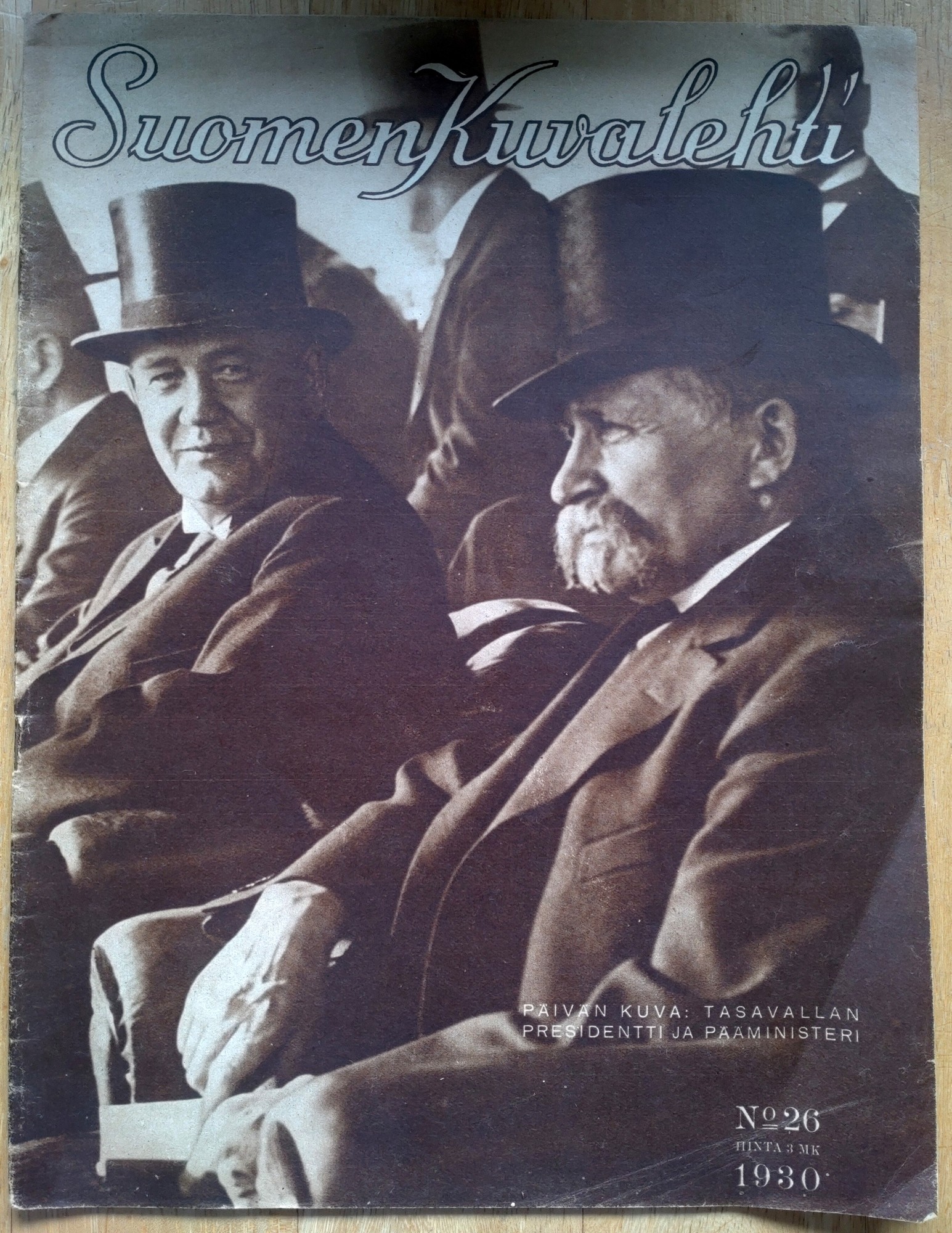
Suomen Kuvalehti 1930

Suomen Kuvalehti Päivän kuva: tasavallan presidentti ja pääministeri No 26, 1930
preview

€1 fleamarket find. I liked the hats.

<a href=“ibb.co/4w21mz2r”><img src=“i.ibb.co/4w21mz2r/20260712-131452.jpg” alt=“20260712-131452” border=“0”></a> <a href=“ibb.co/q3jjX04F”><img src=“i.ibb.co/q3jjX04F/20260712-131503.jpg” alt=“20260712-131503” border=“0”></a> <a href=“ibb.co/jPmM0cnJ”><img src=“i.ibb.co/jPmM0cnJ/20260712-131512.jpg” alt=“20260712-131512” border=“0”></a> <a href=“ibb.co/TMyKVLhp”><img src=“i.ibb.co/TMyKVLhp/20260712-131521.jpg” alt=“20260712-131521” border=“0”></a> <a href=“ibb.co/tP85K5Dv”><img src=“i.ibb.co/tP85K5Dv/20260712-131531.jpg” alt=“20260712-131531” border=“0”></a> <a href=“ibb.co/KpsF94Xw”><img src=“i.ibb.co/KpsF94Xw/20260712-131538.jpg” alt=“20260712-131538” border=“0”></a> <a href=“ibb.co/VWWn630h”><img src=“i.ibb.co/VWWn630h/20260712-131550.jpg” alt=“20260712-131550” border=“0”></a> <a href=“ibb.co/kgQ3Xhgy”><img src=“i.ibb.co/kgQ3Xhgy/20260712-131600.jpg” alt=“20260712-131600” border=“0”></a> <a href=“ibb.co/qFJs3bzC”><img src=“i.ibb.co/qFJs3bzC/20260712-131613.jpg” alt=“20260712-131613” border=“0”></a> <a href=“ibb.co/xSNNvZFy”><img src=“i.ibb.co/xSNNvZFy/20260712-131622.jpg” alt=“20260712-131622” border=“0”></a> <a href=“ibb.co/Df2wKD4p”><img src=“i.ibb.co/Df2wKD4p/20260712-131631.jpg” alt=“20260712-131631” border=“0”></a> <a href=“ibb.co/mVmnVxvf”><img src=“i.ibb.co/mVmnVxvf/20260712-131638.jpg” alt=“20260712-131638” border=“0”></a> <a href=“ibb.co/gMFC8g1j”><img src=“i.ibb.co/gMFC8g1j/20260712-131653.jpg” alt=“20260712-131653” border=“0”></a> <a href=“ibb.co/cXkj01v4”><img src=“i.ibb.co/cXkj01v4/20260712-131702.jpg” alt=“20260712-131702” border=“0”></a> <a href=“ibb.co/DHPv4q7L”><img src=“i.ibb.co/DHPv4q7L/20260712-131708.jpg” alt=“20260712-131708” border=“0”></a> <a href=“ibb.co/s9q7rTHv”><img src=“i.ibb.co/s9q7rTHv/20260712-131725.jpg” alt=“20260712-131725” border=“0”></a>

0

Jordan Bardella et les eurodéputés RN approuvaient l’inéligibilité des élus en cas de détournement de fonds publics quelques mois avant de défendre le contraire et Marine Le Pen

0

ColorSym: Free Color Identification Symbols

preview

ColorSym is a free, open-source color-identification system that pairs every color with a unique, memorable symbol. When color alone isn’t enough to tell things apart, the symbol does the job, so the roughly 1 in 12 men and 1 in 200 women with color vision deficiency can read your components, charts, or UI with confidence.

ColorSym is a free, open-source color-identification system that pairs every color with a unique, memorable symbol. When color alone isn’t enough to tell things apart, the symbol does the job, so the roughly 1 in 12 men and 1 in 200 women with color vision deficiency can read your components, charts, or UI with confidence.

0

STOP Flock

preview

Cross posted from thelemmy.club/post/52531263

  • Alpr.wtf - Every US jurisdiction using ALPR, plus how to file info requests.

  • EyesOnFlock.com - Crowdsourced map of Flock cameras and city contracts.

  • Deflock.me- Nationwide ALPR map tracking Flock deployments, removals and resistance.

  • DontGetFlocked.com - Plots your route, counts ALPR Flock cameras, and suggests surveillance-free alternatives.

0

Bürgerbeteiligung auch zwischen den Wahlen ermöglichen

preview

geteilt von: feddit.org/post/32534867
Bitte dort diskutieren, weil da die Diskussionsbasis breiter ist.

**Text der Petition**

Mit der Petition wird gefordert, dass der Bundestag Beteiligung ermöglicht, um auch zwischen den Wahlen zielgerichtet Vorschläge und Kritik anbringen zu können. Insbesondere sollen losbasierte Bürgerräte organisiert, über eine Plattform die Kommentierung von Gesetzesentwürfen ermöglicht, das Petitionsrecht ausgebaut und nach dem Modell der Bundesländer direktdemokratische Instrumente wie ein Initiativ- und ein Vetorecht eingeführt werden.

**Begründung**

Das Vertrauen in die Demokratie sinkt und Angriffe von autoritär-populistischen Kräften nehmen zu. Appelle und Beteuerungen, die Menschen nur besser mitnehmen zu wollen, genügen nicht. Es braucht Möglichkeiten, mit denen die Bürgerinnen und Bürger erleben können, dass Politik beeinflussbar und korrigierbar ist. In den Bundesländern gibt es mehr Möglichkeiten als auf Bundesebene, sich auch zwischen den Wahlen einzubringen: In manchen Ländern können Gesetzgebungsvorhaben kommentiert werden (Thüringen und Baden-Württemberg). Es gibt Möglichkeiten, den jeweiligen Landtag mit einem Thema und Gesetzentwürfen zu befassen (Volks- und Bürgeranträge). Regierung oder Parlament organisieren Bürgerräte, für die Menschen aus der Bevölkerung ausgelost werden. Und schließlich können die Bürgerinnen und Bürger mit Volksbegehren und Volksentscheiden selbst als Gesetzgeber aktiv werden und direkt mitgestalten. Auf Bundesebene bleibt nur das Petitionsrecht, das zudem reformbedürftig ist. Es ist an der Zeit, die Beteiligungs- und Mitbestimmungsrechte auch auf Bundesebene zu erweitern. Mit einer solchen Weiterentwicklung kann dem Vertrauensverlust in die demokratischen Institutionen, wie sie der Deutschland-Monitor vom Februar 2026 aufgezeigt hat, entgegengewirkt werden. ___

0

Free to dispose of if sorted, paid if not: Norway’s recycling model

preview

I visited a landfill in Norway today. Almost everything is sorted, and properly sorted waste can be disposed of free of charge. Unsorted residual waste costs money to throw away.

I think it’s an effective incentive system. Does your country or municipality do something similar?

I visited a landfill in Norway today. Almost everything is sorted, and properly sorted waste can be disposed of free of charge. Unsorted residual waste costs money to throw away.

I think it’s an effective incentive system. Does your country or municipality do something similar?

0

Mac Sabbath - 2025-09-12 - Alladin Theater, Portland OR

preview

This band is gonna test the limits of ‘stoner rock’.
I am a huge Mac Sabbath fan. I like cleverly dumb shit with a point. They are definitely that.

The Alladin Theater is gorgeous. I got a balcony seat on the rail. Awesome view.

What can I say? Ronald and the boys rocked the fukin house. This is no joke band. Oh yes, they tell some jokes. Terrible jokes about being ‘drive thru metal pioneers’ and how everyone is copying them. Awful, dumb jokes. I love it.
But this is legit rock. These guys kick ass.

I guess I should sort of explain their shtick.
Ronald thinks he and his compatriots are sent back from the future, or maybe from the 70’s, and they have a mission to warn us all about the dangers of fast food.

For the uninitiated, Mac Sabbath is commonly viewed as a parody of Black Sabbath. Not so!
Before Ozzy passed, I would have said that they are a takeoff on Ozzy and Black Sabbath.
Since Ozzy passed, they are still that, but the last third of their show is a legit tribute to the original band. Ronald comes out in all black and plays it straight.

This might ruffle some feathers, but I think Mac Sabbath is better than anything Ozzy did in the last … oh … 35 years of his life.
Here. Let me prove it. They played for Ozzy. Private party. He was dumbfounded, amazed, and loved it.

Mac Sabbath are afraid of digital recording gear, and won’t record a fuking album.
Everything I’ve heard has been live shit on youtube. They have a channel. Check them out!

Oh, if I may start a bit of controversy (besides the Ozzy bit) I have a theory that the band’s manager, Mike Odd, is also Ronald. You never see them in pictures together …
But … or maybe this is more suspicious … I spoke to the Employee of the Month, who also ran their merch stand and asked him if Mike and Ronald are the same person. He acted as if he wasn’t real happy with Mike, but he’s like “Yes, he’s the band’s manager.” I repeated the question, and he’s like “What?!? No, they are not the same person.” Methinks thoust deny too much …

Do yourself a favor. See Mac Sabbath in concert.
This is a very live act. They don’t give a shit about anything but entertaining people live.
See the whole show. They either bring along a group of excellent unknowns with their own weird schtick, or they do big gigs that also hire other clown acts like Puddles Pity Party, weird shit like the Juggalo gatherings.

DO NOT leave early. Mac Sabbath will always have their opening bands come and join them for a couple numbers. It’s a riot of a close. FFS they are doing Sabbath songs. Everyone knows them. I wish I got a pic of that, but I was busy thrashing my head.