

0

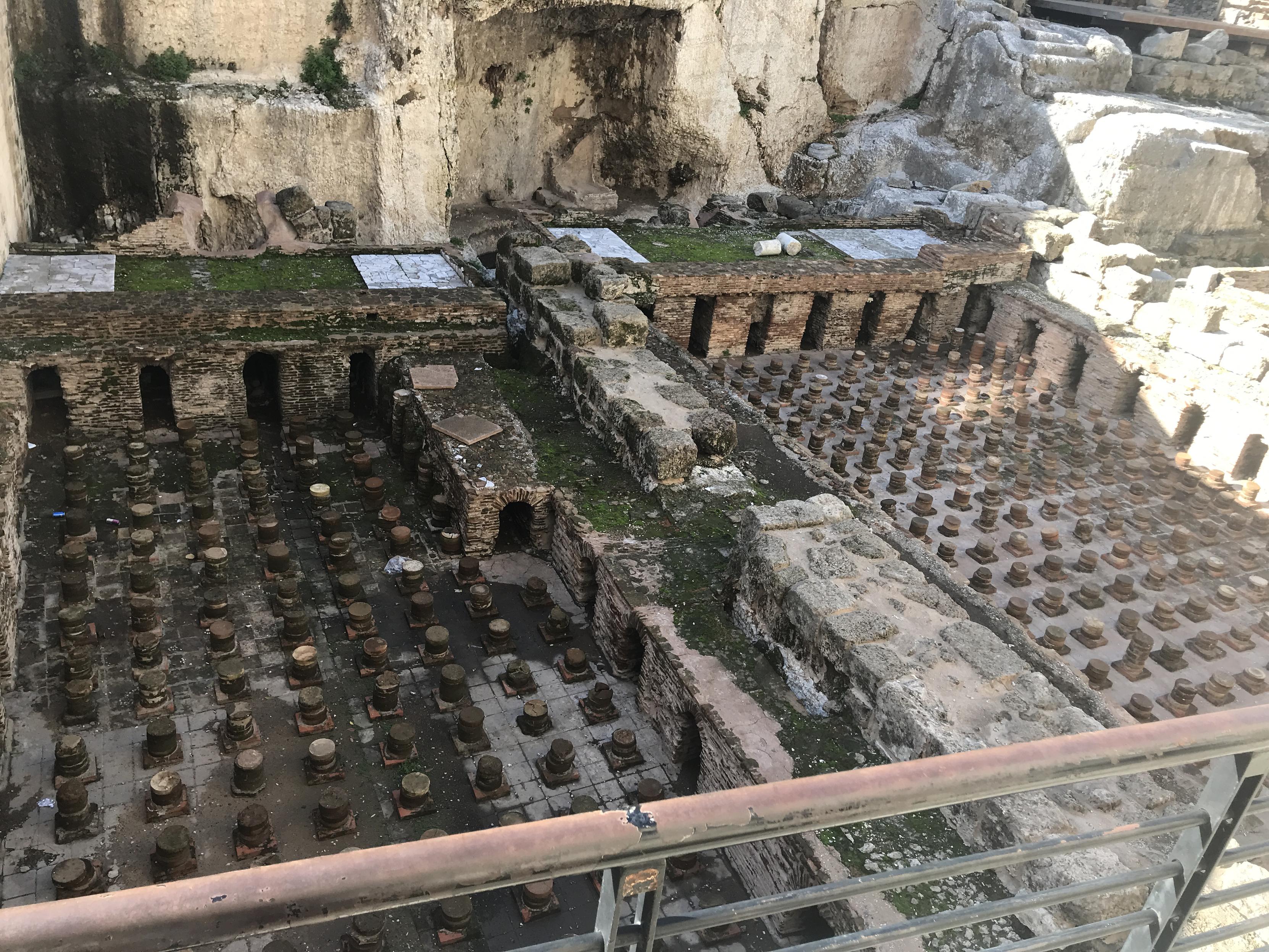
Roman baths in downtown Beirut, Lebanon [OC]

Looking from a higher level down on two large rectangular hypocausts divided by a low wall. both floors are dotted with dozens of evenly-spaced pilae stacks.
preview

Roman baths in downtown Beirut, Lebanon [OC]

@historyruins

@histodons #RomanSiteSaturday
#MiddleEast #geschichte #histodons #history #histoire #antiquité #antiquity #antike #Lebanon #beirut #beyrouth #AncientHistory

Roman baths in downtown Beirut, Lebanon [OC]

@historyruins

@histodons #RomanSiteSaturday
#MiddleEast #geschichte #histodons #history #histoire #antiquité #antiquity #antike #Lebanon #beirut #beyrouth #AncientHistory

0

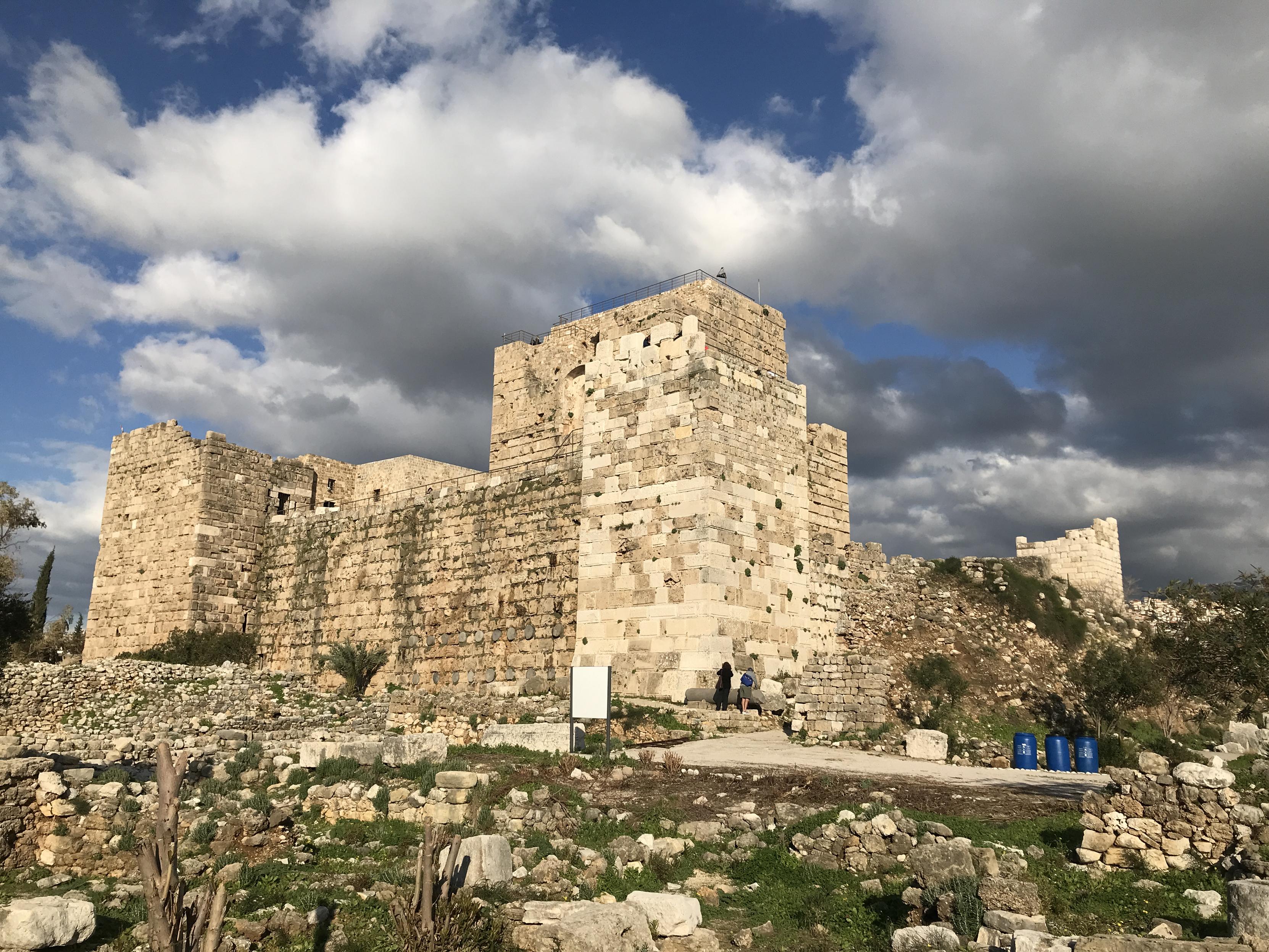
The Crusader Castle in Byblos, Lebanon [OC]

the castle: stone wall with large square stone towers at 2/3 visible corners. ruins of 3rd to the right. the central, tallest stone tower is visible behind closest wall tower. the sky is mostly covered with dark gray-white clouds.
preview

The Crusader Castle in Byblos, Lebanon [OC]

@historyruins

en.wikipedia.org/wiki/Byblos_C
@histodons
@medievodons
#MiddleEast #geschichte #histodons #history #histoire #antiquité #ReligiousStudies #antiquity #antike #Lebanon #MedievalHistory

The Crusader Castle in Byblos, Lebanon [OC]

@historyruins

en.wikipedia.org/wiki/Byblos_C
@histodons
@medievodons
#MiddleEast #geschichte #histodons #history #histoire #antiquité #ReligiousStudies #antiquity #antike #Lebanon #MedievalHistory

0

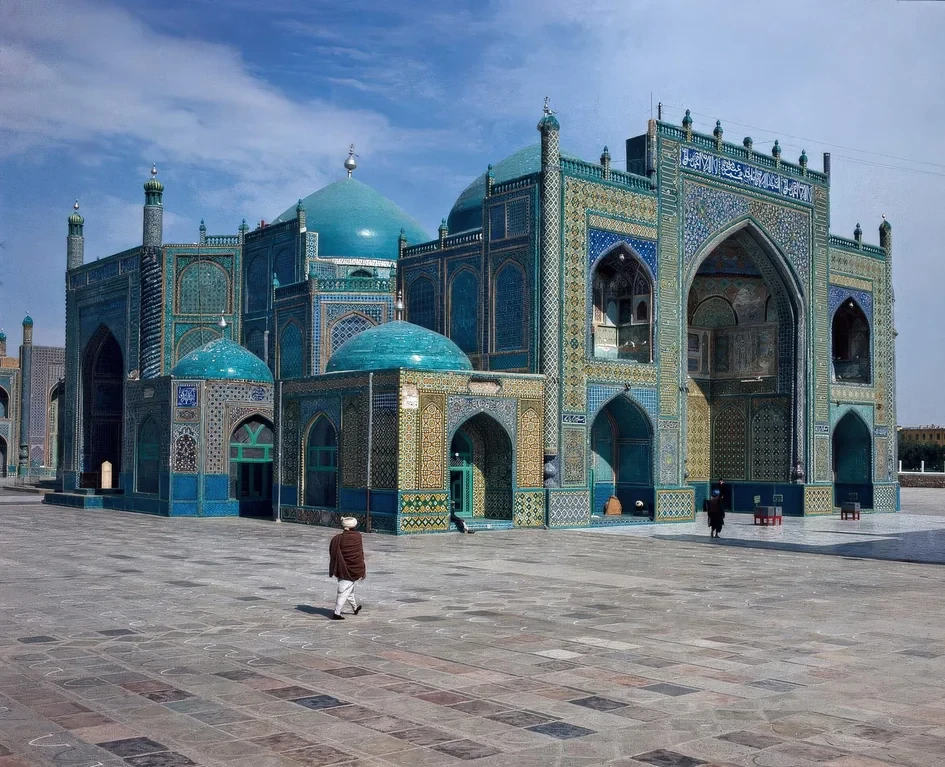
I'd say it's holding up pretty well! It's The Blue Mosque of Ali. Mazar-i-Sharif, Afghanistan, 15th-16c.

preview

Shamelessly stolen from… 😁

Herat and Balkh have some of finest examples of Timurid architecture.

What are the elements that make Timurid architecture distinct from Persian architecture?

Heavy use of cobalt, tile-work and onion domes. You can see its examples at Registan square and Gur-i-Amir in Samarkand, and Gohar Shad mosque in Mashhad in Iran. In Afghanistan the greatest Timurid complex was that of Gwahar Shad in Herat, before Afghans blew it up in the 19th century to not let it being used by the Russians for military purpose (who ultimately never came).

That being said it’s named more for being style of the Timurid Empire than clearly distinct elements. You can say it is a fusion of Persian, wider Islamic and central Asian styles.

0

Chor Minar, Delhi

preview

Translating to thieves tower roughly; it is presumed the holes in the structure were used to hang heads of criminals to deter others. Dates to pre Mughal times[read: before 16th century].

Translating to thieves tower roughly; it is presumed the holes in the structure were used to hang heads of criminals to deter others. Dates to pre Mughal times[read: before 16th century].

0

Bara Khambha, Delhi

preview

Name translating to 12 pillars [after those supporting the monument], this likely dates to 14th century or so. This area is dotted with these structures and since these are pre-Mughal; often have a very dated look. [It was most likely a tomb].

Name translating to 12 pillars [after those supporting the monument], this likely dates to 14th century or so. This area is dotted with these structures and since these are pre-Mughal; often have a very dated look. [It was most likely a tomb].

0

Khan I Khanan, Delhi

preview

Mausoleum of a poet dating back to 16th century. [It is technically only in partially ruinous state due to conservation efforts, hence if it violates the rules, feel free to remove.]

Mausoleum of a poet dating back to 16th century. [It is technically only in partially ruinous state due to conservation efforts, hence if it violates the rules, feel free to remove.]

0

Jarlshof, Scotland

preview

Jarlshof (/ˈjɑːrlzhɒf/ YARLZ-hof)[1] is the best-known prehistoric archaeological site in Shetland, Scotland.

It contains remains dating from 2500 BC up to the 17th century AD.

The remains at Jarlshof represent thousands of years of human occupation and can be seen as a microcosm of Shetland history. Other than the Old House of Sumburgh (see below), the site remained largely hidden until a storm in the late 19th century washed away part of the shore, and revealed evidence of these ancient buildings. Formal archaeological excavation started in 1925, and Bronze Age relics were soon discovered.[13] Jarlshof was one of first two broch sites to be excavated using modern scientific techniques between 1949 and 1952.[9] Although the deposits within the broch had been badly disturbed by earlier attempts, this work revealed a complex sequence of construction from different periods.[14] Buildings on the site include the remains of a Bronze Age smithy, an Iron Age broch, an roundhouses, a complex of Pictish wheelhouses, a Viking longhouse[10][15] and a mediaeval farmhouse. No further excavations have been undertaken since the early 1950s, and no radiocarbon dating has been attempted.

https://en.wikipedia.org/wiki/Jarlshof

0

Broch of Mousa, Scotland

preview

Broch of Mousa (or Mousa Broch) is a preserved Iron Age broch or round tower. It is on the island of Mousa in Shetland, Scotland. It is the tallest broch still standing and amongst the best-preserved prehistoric buildings in Europe. It is thought to have been constructed c. 300 BC,[1] and is one of more than 500 brochs built in Scotland

Mousa is a small, treeless island of open grassland and heath typical of the Shetland landscape. Its rocky coastline includes small natural inlets that provide landing places for boats.[5] Immediately beside the broch lies the sheltered tidal basin known as the Loch of Mousa, which connects to the sea through a narrow channel.[3]

It is built of dry stone with no mortar.[11]

Mousa Broch continued to be used over the centuries and is mentioned in two Norse Sagas. Egil’s Saga tells of a couple eloping from Norway to Iceland who were shipwrecked and used the broch as a temporary refuge.[14] The Orkneyinga Saga gives an account of a siege of the broch by Earl Harald Maddadsson in 1153 following the abduction of his mother, who was held inside the broch.[14]

https://en.wikipedia.org/wiki/Broch_of_Mousa

0

The Colony, Bennachie, Scotland [MIC]

preview

Most history is about people in power. Kings, Queens, lords, bishops, etc. Here’s a piece about the common folk.

The Colony was a squatters’ community on commonty, or common land, on one side of Bennachie, a range of hills near Aberdeen, Scotland.[1]

From the beginning of the nineteenth century common land in the parishes of Chapel of Garioch and Oyne on the east side of Bennachie became home to a community of squatters. This settlement was known locally as the Colony. Various estimates have been made of when the colony began with some citing 1825 but according to Fagen the first documentary evidence is from 1831.[2] A small number of families led a crofting life supplementing it by doing skilled work, such as dyking, quarrying and knitting.[3][4][5]

In 1859, eight neighbouring landlords took possession of sections of Bennachie as part of their estates. This action, recognised in law from 5 March 1859, has become known as the Division of the Commonty. As a result, the population on the side of the hill began to decline. Most of the crofts were built on land claimed by Col. Charles Leslie of Balquhain and Fetternear. His son, Charles Stephen Leslie, was responsible for evicting some of the residents in 1878.

The last of the colonists, George Esson, lived on the hill until his death in May 1939. Esson was a drystone dyker. While working on the Dunecht Estate, repairing old dykes and creating new ones, he would lodge with a Mrs Cooper at Dunecht, then walk the twenty miles back to the colony at weekends.[6]

Visitors to Bennachie can explore the Colony, including the remains of a croft which was excavated as part of the Fetternear Research Project in 1999.[7]

https://en.wikipedia.org/wiki/The_Colony_(Bennachie)

https://bailiesofbennachie.co.uk/landscapes-project/the-bennachie-colony

Edit: fun fact! Bennachie means “hill of the breast” in Scottish Gaelic and is also the only known source of Macaulayite.

Macaulayite is a red, earthy, monoclinic mineral, with the chemical formula (Fe3+,Al)24Si4O43(OH)2.[3] It was discovered in the 1970s by Jeff Wilson and named after the Macaulay Institute in Aberdeen, Scotland. The only known source of macaulayite in the world is a quarry at the foot of Bennachie, Aberdeenshire,[4] and it is formed by granite which has been weathered by tropical climates from before the last ice age. The substance is currently being studied by NASA, as it is speculated that this is the substance which gives the planet Mars its colour and it could prove that life on Mars can be sustained.[4]

https://en.wikipedia.org/wiki/Macaulayite

0

Huntly Castle, Scotland [MIC]

preview

There’s a lot of history at Huntly, so strap yourself in, this is a long one!

The castle was originally built by Duncan II, Earl of Fife, on the Strathbogie estate sometime around 1180 and 1190.[2][1] The castle became known as the Peel of Strathbogie.[3]

In 1506, the castle was officially renamed Huntly Castle.[2]


Although the castle was burned to the ground, a grander castle was built in its place.

James IV came to Huntly in October 1501 and gave gifts of money to the stonemasons working on the castle.

James IV played cards at the castle on 10 October 1505 and gave a tip to masons working on the building.

Areas of the original ornate facade and interior stonework remain.


The English diplomat Thomas Randolph stayed two nights in September 1562,[15] and wrote that the castle was “fayer, beste furnishede of anye howse that I have seen in thys countrie."[16] Mary, Queen of Scots decided to take the castle, giving as a cause that the Earl withheld from her a royal cannon lent to him by Regent Arran.[17] She sent her half-brother John Stewart, Commendator of Coldingham to arrest the George Gordon, 4th Earl of Huntly at Huntly Castle in October 1562. On the day William Kirkcaldy of Grange and the Tutor of Pitcur arrived first and surrounded the house. While Kirkcaldy was talking to the castle porter, the castle watchman on the tower spotted Coldingham and the Master of Lindsay and their troops a mile off. He alerted the Earl, who ran without “boot or sword” and hopped over a low wall at the back of the castle and found a horse before Pitcur could stop him. Elizabeth Keith, Countess of Huntly then welcomed the queen’s men and gave them a meal and showed them around the place. She still had her chapel furnished for Roman Catholic worship.[18][19]


The king arrived at Huntly on 26 April 1589 after spending a night at Kintore. The Earl of Huntly had fled to the mountains, stripping the countryside and emptying the house of furniture. James brought 100 workmen to demolish the castle. Huntly sent the king an offer to spare the house and surrendered.[37]

In May 1593 the Earl captured a man called Pedder in the lands of Atholl. Pedder was hanged and dismembered and his body parts displayed on poles at Huntly.[39]

In April 1594 a Flemish ship came to Montrose and it was suspected that a messenger rode to Huntly Castle with a bag of Spanish gold.[40] In July, the Earl was overseeing the building of a new hall and gallery.[41] Following the battle of Glenlivet, James VI came with workmen again and his master of works William Schaw, and planned to blow up the “gret old tower” which had been “fourteen years in building” on 29 October 1594.[42] The kirk minister Andrew Melville was with the king and a vocal advocate for demolition.[43] Aberdeen town council bought twenty stones in weight of gunpowder for the demolition of Huntly and other places,[44] and sent the stonemason John Fraser and other workmen to the demolition work at Huntly and Old Slains Castle, equipped with new shovels.[45]

The royal council met at Terrisoule to discuss the planned demolition on 28 October. Some Lords wanted the fortress kept to hold a loyal garrison. James VI still wished the whole castle, the new and old work, to be slighted.[46] It was decided not to completely demolish Huntly and Slains Castle and other houses, but preserve them for the convenience of the royal garrisons. It was also said that the pleas of the Countesses of Huntly and Erroll to save the houses were successful.[47]


Huntly spent large sums restoring and enlarging the castle in April 1597.[52] The restored facade of the main block was carved with the names and titles of the marquess, “George Gordon” and his wife, “Henrietta Stewart” who was a favourite of the queen, Anne of Denmark.[53] In February 1603 James VI made plans to resolve the Marquess’s feuds including a royal visit to Huntly with Anne of Denmark and the Earl of Moray later in the year. The visit did not take place because of the death of Elizabeth I and the subsequent Union of the Crowns.[54]


Captured in October 1644, the castle was briefly held by James Graham, 1st Marquess of Montrose against the Duke of Argyll. In 1647 it was gallantly defended against General David Leslie by Lord Charles Gordon, but its ‘Irish’ garrison was starved into surrender. Savage treatment was meted out, for the men were hanged and their officers beheaded. In December of the same year the Marquess of Huntly himself was captured and on his way to execution at Edinburgh was detained, by a refinement of cruelty, in his own mansion. His escort was shot against its walls.

An ammunition house contained 81 muskets, match cord, and ten cannon.[56] In 1650 Charles II visited briefly on his way to the Battle of Worcester, defeat and exile. The Civil War brought an end to the Gordon of Huntly family’s long occupation of the castle.


In 1689, during the first Jacobite rising, the castle was briefly the headquarters for Viscount Dundee and his Jacobite army, at the end of April, just after the start of the revolt. However, by the early eighteenth century the castle was already in decay and providing material for predatory house builders in the village. In 1746, during a later Jacobite rising, it was occupied by British government troops. Thereafter, it became a common quarry until a groundswell of antiquarian sentiment in the 19th century came to the rescue of the noble pile.

Huntly Castle remained under the ownership of the Clan Gordon until 1923. Today, the remains of the castle are cared for by Historic Environment Scotland as a scheduled monument.[57]

Pure Strength I, a major international strongman competition, was held on the grounds of Huntly Castle in 1987. The winner of the contest was Jón Páll Sigmarsson of Iceland.[58]

https://en.wikipedia.org/wiki/Huntly_Castle

0

Buchanan Castle, Scotland

preview

The house was commissioned by the 4th Duke of Montrose and built in 1852–1858 as a home for the Montrose family, serving as such until 1925. It was built as a replacement for Buchanan Auld House

In December 1852, while the family were away for Christmas, the housekeeper was reputed to have drunk too much and awakened to find the entire house in flames. Many valuable items were lost in the blaze. Buchanan Auld House was destroyed in the fire and the 4th duke commissioned William Burn to design Buchanan Castle to replace it.[3]

The dukes remained at Buchanan until 1925, when it was sold. In the 1930s the house opened as a hotel and the golf course was established in the grounds. Plans for residential development on the estate were delayed by the outbreak of the Second World War, during which the house was requisitioned. It was used as a hospital during the war, with patients including Rudolf Hess, who was brought here after his flight to Scotland in 1941.[3] After the war the building served briefly as the Army School of Education. The roof was removed from the house in 1954 to avoid paying tax on the property and outlying parts of the building were demolished.

https://en.wikipedia.org/wiki/Buchanan_Castle

0

Dunure Castle, Scotland

preview

The site dates from the late 13th century; the earliest charter for the lands dating from 1256, but the remains of the building are of 15th- and 16th-century origin.[1]

In 1570, a dispute arose between Gilbert Kennedy, 4th Earl of Cassillis, and Allan Stewart, the succeeding lay Commendator of Crossraguel Abbey, over the ownership of some of the abbey lands and their rental income…. …Gilbert, with sixteen men,[11] caught Allan Stewart unexpectedly in Crossraguel Woods whilst a guest of the Laird of Bargany,[2] and tricked him [12] into journeying to Dunure. At the castle, he was deprived of his horse and weapons and guarded by six of the Earl’s men.[13]

For two days, Gilbert left the commendator to consider his fate and because he was obstinate and refused to sign over the lands and rentals, Gilbert tortured him twice, roasting and basting his feet and body over a brazier in the Black Vault[14] of the castle,[15] aided by his cook, baker and pantrymen.[16] As a result of the torture sessions of the first and seventh days of September 1570,[17] the lands were signed over to Gilbert.

The Commendator was rescued from his confinement by the Laird of Bargany, Allan’s brother in law, who arrived with a body of men; first hiding in the chapel and then storming the castle.[18] The rights to the abbey lands were settled, partly by the Earl providing Allen Stewart with sufficient funds to allow him to live ‘comfortably’ for the rest of his life.[1] In the meantime, he had been taken to the Cross of Ayr where he had denounced the Earl of Cassillis.[19] The Earl was never fully brought to book for his actions by the Privy Council. Allen Stewart never walked again.[20]

The castle’s demise began in the mid-17th century. By 1694, the castle was described as “wholly ruined”. It is not clear whether this can be linked to the Civil War period, although local tradition suggests that Dunure had been burnt and/or blown up.

https://en.wikipedia.org/wiki/Dunure_Castle

0

Kildrummy Castle, Scotland

preview

The castle was probably built in the mid-13th century

Kildrummy Castle underwent siege numerous times in its history, first in defence of the family of Robert the Bruce in August–September 1306 (leading to the executions of Nigel Bruce and many other Scots),[4] and again in 1335 by David of Strathbogie. On this occasion Christina Bruce held off the attackers until her husband Sir Andrew Murray came to her rescue.[5]

The castle passed from the Clan Elphinstone to the Clan Erskine before being abandoned in 1716 following the failure of the Jacobite Rising of 1715.

https://en.wikipedia.org/wiki/Kildrummy_Castle

Neil de Brus (c. 1279 – September 1306), also Niall or Nigel, was a younger brother of King Robert I of Scotland. He supported his older brother in the struggle for the crown of Scotland and fought in the Wars of Scottish Independence.

In 1306, he was captured by English forces at Kildrummy Castle, where he and his garrison held off Edward’s forces who had been seeking Robert the Bruce’s wife Elizabeth, daughter Marjorie, sisters Mary and Christina, and Isabella MacDuff, Countess of Buchan.[1] Their actions enabled the women to escape, although the women were soon captured and betrayed to the English by William, 3rd Earl of Ross in the chapel of St Duthac at Tain in Ross.[2]

After his capture he was executed for high treason by being hanged, drawn, and quartered in September 1306 at Berwick-upon-Tweed.[1]

https://en.wikipedia.org/wiki/Neil_de_Brus