#boardgames

posts tagged #boardgames

0

Board game sales are booming as people seek off-screen connections

The Independent The real reason board game sales are booming this winter www.the-independent.com
preview

Board games have gained popularity among 16- to 25-year-olds, who are now putting them “at the heart” of their social life, Koegler said.

An international barometer compiled by Asmodee and Kantar in 2026 showed that 74% of the so-called “Gen Z” thought that in-person experiences were more important than digital ones.

0

Can anyone recommend some Weird West board games?

preview

cross-posted from: lemmy.zip/post/74661938

I recently got back into board games (thanks Tabletop Simulator!) and I found a couple Weird West board games while browsing boardgamegeek. Has anyone played these games? Have you found others you would recommend? I’m mostly interested in co-op games but that isn’t a hard rule.

I haven’t played any of these but so far I’ve found:

  • Shadows of Brimstone - This seems to be the most popular board game when it comes to a Weird West setting since it has about a hundred expansion packs. It’s co-op (so I’m interested) but the rules might be a bit too complex for my simple mind. I’m curious about this one.
  • Grimslingers - First of all, I’d just like to say that “Grimslingers” is a fantastic name. I think this one is primarily a card game but it has both a co-op and versus mode and the rules seem less complex than Shadows of Brimstone, so again, I’m intrigued.
  • Dracula’s America: Shadows of the West - “It is 1875, and Count Dracula is President of the United States of America.” Now that’s an attention-grabbing intro! I think this might actually be a game that uses miniatures from Shadows of Brimstone to set up its own wargaming scnearios. So I think it’s just a rulebook and you’re expected to provide your own miniatures to setup a game.
  • Grim West - This game came out in 2026. I guess it’s a wargame that uses a standard deck of cards? I can’t tell if buying this game just gives you the rulebook or if it requires anything more than a single deck of cards. I think the “game” might just be a single pdf rulebook?

This is what happens when I just blindly browse boardgamegeek. I come across games that sound like they have a cool aesthetic or setting but then I can’t tell if it’s a board game, a card game, or just a rulebook. That’s why I wanted to reach out to this community and see if anyone can give me actual recommendations.

0

Seeking groups for blind playtesting of micro-dexterity game Hop Shot

preview

cross-posted from: lemmy.zip/post/73992864

I am seeking a few groups for a final round of blind playtesting for my latest board game Hop Shot - a micro dexterity game for 2 players that plays in about 10 minutes inspired by the Japanese sport of pole toppling.

For those interested I am asking for $5 USD to help with shipping ($10 USD outside the US) as well as at least 3 plays of the game and 1 feedback form submission. The game is yours to keep.

Box top:

Box bottom:

Box contents:

0

Suggestions of Mashup boardgames?

preview

I was planning a game night where instead of the traditional boardgame, we just combine the old games off-label to create something different e.g. risk map and troops with monopoly money and properties with scrabble/trivial pursuit as battles. I’m afraid it will get too complex and boring quickly. Anybody tried this before, any opinions? Suggestions of combinations that work well?

I was planning a game night where instead of the traditional boardgame, we just combine the old games off-label to create something different e.g. risk map and troops with monopoly money and properties with scrabble/trivial pursuit as battles. I’m afraid it will get too complex and boring quickly. Anybody tried this before, any opinions? Suggestions of combinations that work well?

0

Naipe Cimarrón now plays Uruguayan truco, on the same table as the card game.

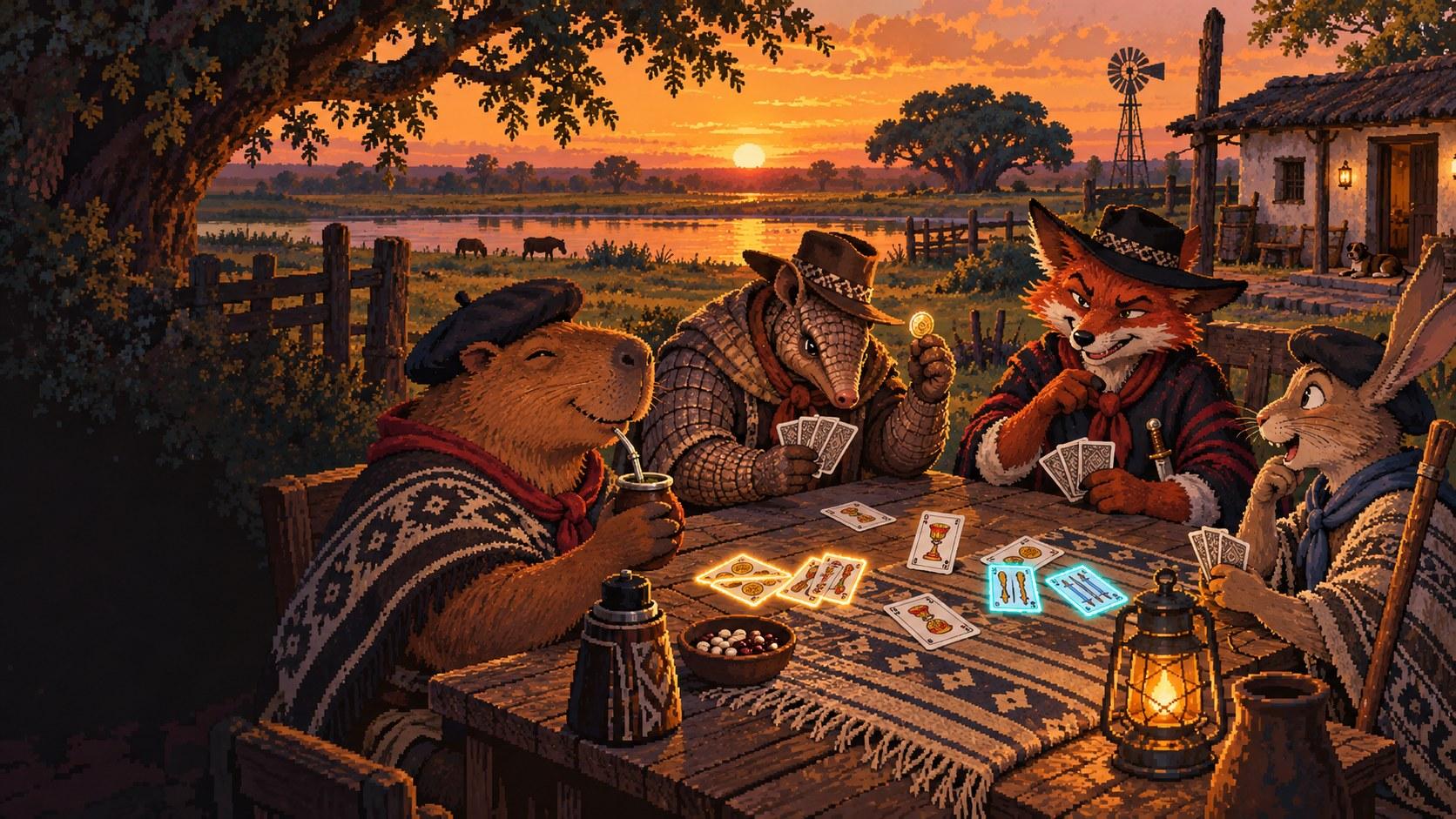
A capybara, an armadillo, a fox and a rabbit dressed as gauchos play truco at a country table at sunset, with mate, a bowl of beans for keeping score and a lantern.
preview

Naipe Cimarrón now plays Uruguayan truco, on the same table as the card game.

Muestra, piezas, flor and envido, one-on-one against the bot, with a 40-card Spanish deck made just for the game. Free in the browser, enter the code TRUCO in the menu:
https://naipe-cimarron.yunque.games/?de=mastodon-truco&lang=en

@boardgames

#IndieDev #GameDev #BoardGames #GameDesign #Uruguay

0

Picked up a copy of Reign - The Final Battle Royale

preview

BGG Link

Saw a stack of these for sale at Half Price Books for $10, new in box, and decided to give it a try.

It’s a very very light weight game. You could teach it to most kids in a few minutes. But it’s still basically a war game. There are objectives, units with different values, and some tactical decision making. It’s perfect for introducing the basic concept to younger players or older players with little gaming experience.

Honestly at this price point it might be worth it just for the components, it seems like it would be pretty easy to design your own ruleset.

0

Are You Clueless? — my first app board game: a fully offline game night knowledge game

preview

First app, shipped solo, and I’d love a second pair of eyes on it from people who know what they’re looking at.

Are You Clueless? is a party knowledge game for two or more people on one phone. Clues for a single answer appear one at a time; first to shout the right answer wins the card, a wrong shout costs a space, first to square 18 wins. Three of the eighteen squares are hidden and re-randomized each game — one lets you wager 1–4 spaces before you see the question.

The constraint I set myself was zero network. All 1,738 cards ship in the bundle, there’s no account, no analytics, no ad SDK and no device identifiers, so the privacy label is a clean “Data Not Collected”. It made the App Privacy questionnaire the easiest part of submission and I’d recommend the approach to anyone who can live without telemetry.

Free on the App Store.

apps.apple.com/app/id6806418529 Android: play.google.com/store/apps/details?id=com.rucluel…

Any feedback on the onboarding or the App Store screenshots especially welcome.

0

How are collectible card "grading services" not a scam?

preview

I know this is about trading card games and not board games, but I would say they’re very close in principle, considering the complexity of games like Magic. I recently discovered the mysterious world of “grading”, in which services like PSA will grade your card as to add some felt value to the card itself, because of its rarity and how near to mint it is.

We’re talking about services that will grade the same card differently three times if you send it back, because of course they have no practical way of having an absolute meter for every possible imperfection.

0

Playtesters kept avoiding a whole subsystem in my game because the other one was clearer. I took a knife.

preview

Follow-up to my earlier post here about Vienna 1814: Waltz of Nations a medium-heavy thematic Euro about the Congress of Vienna, the salons-and-gossip side rather than the maps-and-borders side. Still in development.

The game has two main routes to influence: throwing parties, and pursuing political goals. And playtesters kept quietly drifting toward the political one. Not because it was stronger, but because it was easier to understand. That’s the kind of signal you can’t argue with: if people avoid a whole subsystem, the subsystem is the problem.

The party side had three things wrong with it. Too much luck up front a bad opening draw could make organising a party painfully hard through no fault of your own. An unreadable payoff – you couldn’t reasonably estimate how many points a party was worth before committing to it. And death by a thousand exceptions – the attractions, the music, the food each carried their own little pile of special-case rules. Elegant in isolation, chaos on the table.

So this iteration was, honestly, mostly deletion. I unified the three sub-mechanics into one consistent shape, cut the exceptions, and pulled the worst of the luck out of the setup. Same feeling as when I cut my rulebook down a while back. I removed far more than I added.

The honest cliffhanger: it’s rebuilt, not yet tested. Playtests start next week, and I don’t know whether I’ve made the party genuinely competitive with the political route, or flattened it into something too safe. Ask me in a while.

Attaching entertainment card design – I am still in wireframe mode, but it is much clearer then the previous iteration.

For the heavier-game players here: when players keep avoiding one part of a game, how do you tell whether it’s genuinely broken – or just needs a few more plays to click? I read it as broken this time. Curious where others draw that line.

0

Do you watch playthrough videos to evaluate games?

preview

When I consider a game for buying, I look for playthrough videos, more than reviews. Do you do the same thing, and what are your favorite channels?

When I consider a game for buying, I look for playthrough videos, more than reviews. Do you do the same thing, and what are your favorite channels?

0

Felicia Day and Wil Wheaton announce new board game show, a spiritual successor to Tabletop

Wargamer Felicia Day and Wil Wheaton announce new board game show, a spiritual successor to Tabletop www.wargamer.com
preview

Pretty pumped! Tabletop did a lot to help mainstream the hobby back in the day ✌️

Pretty pumped! Tabletop did a lot to help mainstream the hobby back in the day ✌️

0

RPG Follow released in a free edition

preview

I have really enjoyed the story games of Ben Robbins. Robbins is probably best known for Microscope, where the players construct a timeline by telling events in a non-linear fashion. They are light RPGs with a focus on characters and story telling. Most games have no stats or even randomizers (beyond your fellow players). They are easy to get into and so light on rules that one easily may think that it isn’t much to them, when they are constructed in a very deliberate way.

I just found out that Robbins has made a free version of his game Follow a couple of years ago. Follow is a game where the player characters go to perform a sort of quest together. It is a good opportunity to try a modern story game for those that are curious.

0

SPIEL DES JAHRES WINNER ANNOUNCED

ICv2 Spiel des Jahres Winner Announced icv2.com
preview

The Spiel des Jahres (Game of the Year) for 2026 is Dito, by Martin Ang, with art by Untai Studio Surabaya, published by Game Factory.

The Kennerspiel des Jahres (Enthusiast Game of the Year) went to Rebirth, by Reiner Knizia, with art by Anna Przybylska and Kate Redesiuk, published by Mighty Boards.

The Kinderspiel des Jahres (Children’s Game of the Year) was awarded to Mooki Island, by Florian Sirieix, with art by Seppyo, published by Scorpion Masque.

0

Magnagothica: Maleghast Print & Play – Condition Tokens

A Division by Zer0 Magnagothica: Maleghast Print & Play – Condition Tokens dbzer0.com
preview

Cross-posted from “Magnagothica: Maleghast Print & Play – Condition Tokens” by @db0@lemmy.dbzer0.com in !magnagothica@lemmy.dbzer0.com


Hint: You can comment directly with your lemmy account by visiting the post from your instance, like so: lemmy.dbzer0.com/post/72027414

Cross-posted from “Magnagothica: Maleghast Print & Play – Condition Tokens” by @db0@lemmy.dbzer0.com in !magnagothica@lemmy.dbzer0.com


Hint: You can comment directly with your lemmy account by visiting the post from your instance, like so: lemmy.dbzer0.com/post/72027414

0

Magnagothica: Maleghast Print & Play – Unit Chips

A Division by Zer0 Magnagothica: Maleghast Print & Play – Unit Chips dbzer0.com
preview

Cross-posted from “Magnagothica: Maleghast Print & Play – Unit Chips” by @db0@lemmy.dbzer0.com in !magnagothica@lemmy.dbzer0.com


Hint: You can comment directly with your lemmy account by visiting the post from your instance, like so: lemmy.dbzer0.com/post/71978395

Cross-posted from “Magnagothica: Maleghast Print & Play – Unit Chips” by @db0@lemmy.dbzer0.com in !magnagothica@lemmy.dbzer0.com


Hint: You can comment directly with your lemmy account by visiting the post from your instance, like so: lemmy.dbzer0.com/post/71978395

0

Zairoo - The Pan-African Fantasy Role Playing Game

play · zairoo.com
Zairoo Zairoo – Dark Fantasy TTRPG 2026 | Indie RPG zairoo.com
preview

Sango Nini! Welcome to the land of Zairoo, an immersive, original world based on African and Global Black Diaspora mythologies and histories. We invite you to explore a universe where memory, myth, and identity are preserved through original storytelling and community-driven creation. Zairoo is the world’s first Pan-African fantasy a TTRPG, blending Afrofuturism, powerful mysticism, and intricate technology in a narrative-driven d6 dice game.

Sango Nini! Welcome to the land of Zairoo, an immersive, original world based on African and Global Black Diaspora mythologies and histories. We invite you to explore a universe where memory, myth, and identity are preserved through original storytelling and community-driven creation. Zairoo is the world’s first Pan-African fantasy a TTRPG, blending Afrofuturism, powerful mysticism, and intricate technology in a narrative-driven d6 dice game.

0

I think Robin Hood: Sheriff of Nottingham is gonna go OOS soon

preview

Based on my research after seeing it pop up on Woot, Amazon’s returned-products division: home.woot.com/…/robin-hood-sheriff-of-nottingham-…

Another entry on Amazon shows that it’s running out (like it said “last one” or something), and prices across different retailers are strongly trending <$15 whereas on eBay it’s still >$20, so it seems like they’re trying to get rid of it. I feel mixed about this because it’s a solid 7.0★, 1.66🧠 on BGG and I haven’t played it yet. Then again, I know someone who owns it so I could just ask to eventually play it…

0

Question about the Arkham Horror lcg rerelease

preview

Hey all, prior to covid, a friend and I were playing our way through the lotr lcg. He had loads of store credit and bought several boxes so we could have any cards we might need, because (as i recall) there maybe only a single card in the initial box, but we might want (or need) multiples of those cards… So it necessitated buying several starter boxes. I imagine the game was probably playable without that, but it was a convenience for cash sort of thing that felt predatory to me.

I wanted to try the Arkham Horror rerelease, but thought i would ask here if that sort of thing was part of this as well? Or had Fantasy Flight decided to be less shitty with this game?

I appreciate input! Thanks!

0

A medium-heavy Euro about the Congress of Vienna but it is the salons, not the treaties

preview

I’m working on a historical board game called Vienna 1814: Waltz of Nations and wanted to ask people who actually play heavier games what they think.

It’s a medium-heavy thematic Euro about the Congress of Vienna, but not the usual maps-and-borders take. This one is about the social side: salons, gossip, romance, intrigue, ambition. The characters are real historical figures and their abilities come from who they actually were. I’m trying to make the social maneuvering the actual engine of the game, not decoration on top of a point salad.

It comes out of a lot of reading: memoirs, letters, the gossip that was genuinely circulating in Vienna in 1814. Some of that stuff is too good to leave as a footnote, so it becomes a mechanic instead. Still a prototype. I’m sharing the process as I go, and crowdfunding is one option I’m thinking about down the line, but that’s not where I’m at yet.

Mostly I’m curious: how much appetite is there right now for niche medium-heavy thematic Euros, especially historical ones that come at the subject from a weird angle? And what makes you decide to follow a heavier design while it’s still in development?

0

BoardGameGeek fires veteran advertising manager for rejecting campaign due to firsthand experiences of demonic possession

- The world&#039;s leading source of news and analysis for board game industry professionals BoardGameGeek fires veteran advertising manager for rejecting campaign due to firsthand experiences of demonic possession - boardgamewire.com
preview

BoardGameGeek has fired advertising manager Chad Krizan after almost 20 years with the company, after he cited his personal experiences of demonic possession as grounds for rejecting an ad campaign.

Krizan told Possess Me, Satan publisher Falling Whale Games that he couldn’t “in good conscience” approve ads for its Gamefound campaign as “the thought of displaying this subject matter makes me sick to my stomach”, according to an email exchange shared online by the publisher.

In the emails, Krizan says he has been “sitting on this one and praying about what to do in this instance”, adding that “as a follower of Jesus, I routinely help people suffering from demonic oppression, and more occasionally, possession, and it’s absolutely devastating the damage he does to peoples’ lives”.

0

Spiel des Jahres Nominees for 2026 Announced

ICv2 Spiel des Jahres Nominees for 2026 Announced icv2.com
preview

The nominees for Spiel des Jahres (Game of the Year) 2026 are:

  • Cozy Stickerville
  • Dito
  • Morty Sorty Magic Shop

The nominees for Kennerspiel des Jahres (Enthusiast Game of the Year) 2026 are:

  • Boss Fighters QR
  • Moon Colony Bloodbath
  • Rebirth

The nominees for Kinderspiel des Jahres (Children’s Game of the Year) are:

  • Boo Party
  • Mooki Island
  • Verflixt Verzaubert

What are your thoughts for the games you’ve played? I’ve only played Moon Colony Bloodbath from these nominations and thought it was superb! I’ve also heard a lot of good things about Rebirth as well!

0

Riposte! And Cell Block 18 micro games

preview

My friends at Absurdist Productions just release 2 new games on backerkit.

Riposte! and Cell Block 18 are two-player, 18-card strategy games that fit in your pocket. Try to anticipate your opponent’s next fencing move in Riposte! or escape from prison in the asymmetrical Cell Block 18.

backerkit.com/…/riposte-and-cell-block-18-micro-c…

0

‘People crave friendship’: thousands flock to resurgence of centuries-old south Asian board game

the Guardian ‘People crave friendship’: thousands flock to resurgence of centuries-old south Asian board game www.theguardian.com
preview

Carrom looks really fun though it would be hard to pass over getting a Crokinole board instead.

Carrom looks really fun though it would be hard to pass over getting a Crokinole board instead.

0

Describe your favourite and least favourite board game in one sentence

preview

Ideally without mentioning its name, I’ll start

  • unspoken cooperation playing cards to survive in space (or underwater)
  • tax simulator but you’re trying to make the red planet liveable

Ideally without mentioning its name, I’ll start

  • unspoken cooperation playing cards to survive in space (or underwater)
  • tax simulator but you’re trying to make the red planet liveable
0

Simulating Playing Cards with Playing Cards, Again

Simulating Playing Cards with Playing Cards, Again www.metafilter.com
preview

Stood up by Mr. Swiveller* and the Marchioness? Cole from Gather Together Games shows how to play Cribbage Solitaire [YT 3 min.] The “Solitaire E-Man” has a longer demonstration. [~12 min.] if you’re not into that whole “brevity” thing.

A nice post on metafilter about various very nerdy ways to play Cribbage Solitaire.

0

Native Americans have been playing with dice in games of chance for more than 12,000 years, according to a new paper published in the journal American Antiquity.

Ars Technica Ice Age dice show early Native Americans may have understood probability arstechnica.com
preview

cross-posted from: sopuli.xyz/post/43595585

Native Americans have been playing with dice in games of chance for more than 12,000 years, according to a new paper published in the journal American Antiquity. And the oldest examples of Native American dice predate the earliest currently known dice in the Old World by millennia.

“Historians have traditionally treated dice and probability as Old World innovations,” said author Robert Madden, a graduate student at Colorado State University. “What the archaeological record shows is that ancient Native American groups were deliberately making objects designed to produce random outcomes, and using those outcomes in structured games, thousands of years earlier than previously recognized.”

Madden’s interest in Native American gaming started with Maya ballgames and then expanded to include Native American dice and games of chance. These were rudimentary dice with just two sides, rather than the six sides of modern dice, typically described as “binary lots.” And Madden found they were common to virtually every Native American tribe. Archaeologists had traced the use of such dice back 2,000 years, but most were hesitant to conclude that dice-like artifacts older than that were, in fact, dice.

“We always have that problem with archeology, which is you find something, and you say, well, what is this, how was it used?” Madden said in a CSU podcast. “One of the things we often rely on is something called ethnographic analogy, which is, do we have some kind of historic record of people using things like this, hopefully in the same area and hopefully with a cultural connection. If we see that, then we can make an inference that maybe the same object made in the way was used for the same purpose.”

The most comprehensive study of Native American dice, gambling, and games of chance dates back to 1907, with the publication of ethnographer Robert Stewart Culin‘s 809-page report, “Games of the North American Indians.” Culin began by delving into the collection maintained at the Field Columbian Museum of Chicago, including the field notes and manuscripts written by curator George A. Dorsey, an anthropologist. Dorsey introduced Culin to various Native tribes, where Culin collected even more information about Native American games and gaming artifacts. Culin also consulted with other scholars and collectors to produce his final report 14 years later, which includes over 1,100 illustrations and descriptions of 239 sets of dice from 130 different tribes. A morphological test

Madden used Culin’s magnum opus to come up with four diagnostic criteria for confirming whether a given Native American artifact is an example of Native American dice. First, they must be two-sided objects. Second, the two sides must be readily distinguishable from each other, usually by applying color or markings to one side, although in rare cases they can be distinguished by shape, with one side being convex and the other being concave.

Third, they must fall into one of four shape categories: flat (bone dice or stick dice), plano-convex (one flat side and one rounded side), convex-concave or “cane dice” (one rounded side and one concave side), and convex-convex (two rounded sides), usually peach pits or plum stones marked to distinguish between the two sides. And finally, the objects must be of the right size and shape to be held in the hand and cast onto a playing surface. Flat dice types: (left) bone dice; (right) stick dice Flat dice types: (left) bone dice; (right) stick dice. Stewart Culin, 1907 Types of plano-convex dice: (left) round stick dice; (right) wood dice. Concave-convex and convex-convex dice: (left) cane dice; (right) peach- and plum-stone dice Types of plano-convex dice: (left) round stick dice; (right) wood dice. Stewart Culin, 1907 Concave-convex and convex-convex dice: (left) cane dice; (right) peach- and plum-stone dice. Stewart Culin, 1907

Once Madden devised his four-pronged test, he combed through the archaeological record to apply those criteria to any artifacts labeled gaming pieces. “In most cases, these objects had already been excavated and published,” Madden said. “What was missing wasn’t the evidence, it was a clear, continent-wide standard for recognizing what we were looking at.”

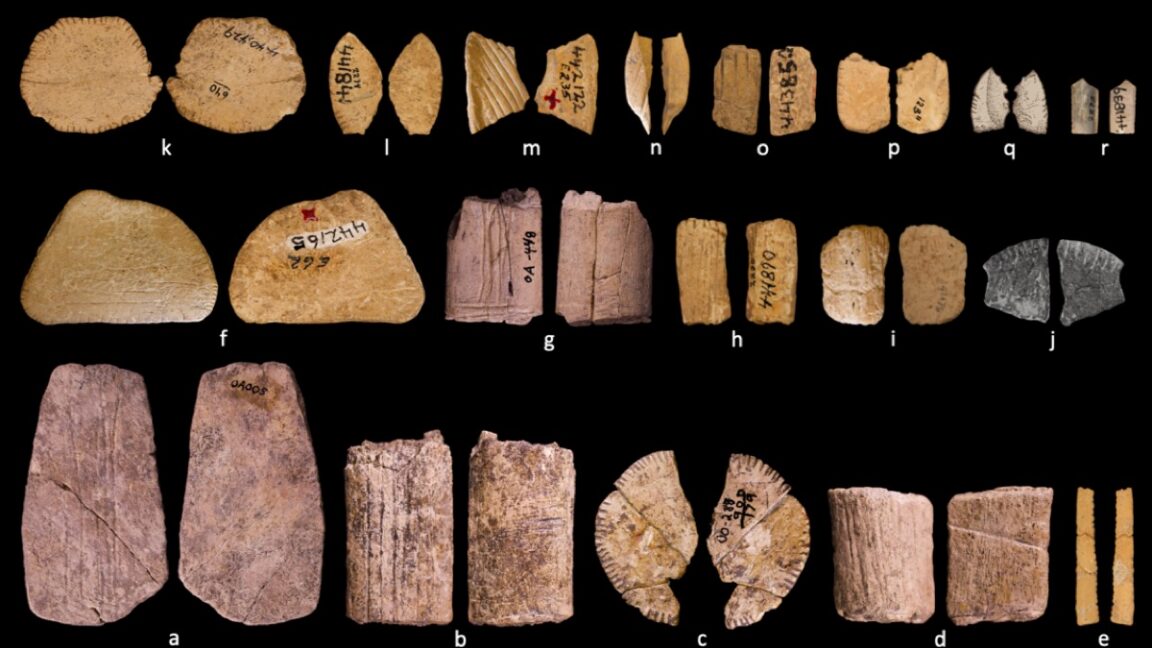
Madden was able to conclusively identify 565 Native American dice from 45 different sites and designate an additional 94 artifacts as “probable” dice. Objects with a drilled or pierced hole were excluded from his assessment because they could just as easily be beads or other decorative objects rather than dice. He also excluded objects whose two sides could only be distinguished by shape, with no clear markings, for similar reasons. The oldest artifacts, from Folsom deposits in Wyoming, Colorado, and New Mexico, date back to the end of the last Ice Age, some 12,000 years ago.

According to Madden, dice and gaming in these societies weren’t anything like contemporary gambling, where the house always has the edge; rather, they likely served a social function.

“These games are one-on-one; there’s no house,” said Madden. “It’s a fair game, everybody’s got an equal opportunity, equal conditions, and it was used as a form of exchange, particularly between groups of people who did not come into frequent contact with each other, so they didn’t really know each other. It’s really a form of gifting over time that creates enduring reciprocal relationships. It’s not about a commercial transaction where you and I are going to swap something and then go our separate ways.”

The findings also shed light on early Native American concepts of probability. “When we see the origins of dice, we’re literally seeing the origins of probabilistic thinking,” said Madden. “That’s always been thought to have begun in the Old World, in the Bronze Age, about 6,000 years ago. This research shows that Native Americans were making dice, generating random outcomes and using those random streams of probability and harnessing them in games of chance 6,000 years earlier. So, if we want to understand the history of probabilistic thinking, we now need to look into the Old World at the end of the last Ice Age.”

That said, “These findings don’t claim that Ice Age hunter-gatherers were doing formal probability theory,” Madden added. “But they were intentionally creating, observing, and relying on random outcomes in repeatable, rule-based ways that leveraged probabilistic regularities, such as the law of large numbers. That matters for how we understand the global history of probabilistic thinking.”
cross-posted from: sopuli.xyz/post/43595585

Native Americans have been playing with dice in games of chance for more than 12,000 years, according to a new paper published in the journal American Antiquity. And the oldest examples of Native American dice predate the earliest currently known dice in the Old World by millennia.

“Historians have traditionally treated dice and probability as Old World innovations,” said author Robert Madden, a graduate student at Colorado State University. “What the archaeological record shows is that ancient Native American groups were deliberately making objects designed to produce random outcomes, and using those outcomes in structured games, thousands of years earlier than previously recognized.”

Madden’s interest in Native American gaming started with Maya ballgames and then expanded to include Native American dice and games of chance. These were rudimentary dice with just two sides, rather than the six sides of modern dice, typically described as “binary lots.” And Madden found they were common to virtually every Native American tribe. Archaeologists had traced the use of such dice back 2,000 years, but most were hesitant to conclude that dice-like artifacts older than that were, in fact, dice.

“We always have that problem with archeology, which is you find something, and you say, well, what is this, how was it used?” Madden said in a CSU podcast. “One of the things we often rely on is something called ethnographic analogy, which is, do we have some kind of historic record of people using things like this, hopefully in the same area and hopefully with a cultural connection. If we see that, then we can make an inference that maybe the same object made in the way was used for the same purpose.”

The most comprehensive study of Native American dice, gambling, and games of chance dates back to 1907, with the publication of ethnographer Robert Stewart Culin‘s 809-page report, “Games of the North American Indians.” Culin began by delving into the collection maintained at the Field Columbian Museum of Chicago, including the field notes and manuscripts written by curator George A. Dorsey, an anthropologist. Dorsey introduced Culin to various Native tribes, where Culin collected even more information about Native American games and gaming artifacts. Culin also consulted with other scholars and collectors to produce his final report 14 years later, which includes over 1,100 illustrations and descriptions of 239 sets of dice from 130 different tribes. A morphological test

Madden used Culin’s magnum opus to come up with four diagnostic criteria for confirming whether a given Native American artifact is an example of Native American dice. First, they must be two-sided objects. Second, the two sides must be readily distinguishable from each other, usually by applying color or markings to one side, although in rare cases they can be distinguished by shape, with one side being convex and the other being concave.

Third, they must fall into one of four shape categories: flat (bone dice or stick dice), plano-convex (one flat side and one rounded side), convex-concave or “cane dice” (one rounded side and one concave side), and convex-convex (two rounded sides), usually peach pits or plum stones marked to distinguish between the two sides. And finally, the objects must be of the right size and shape to be held in the hand and cast onto a playing surface. Flat dice types: (left) bone dice; (right) stick dice Flat dice types: (left) bone dice; (right) stick dice. Stewart Culin, 1907 Types of plano-convex dice: (left) round stick dice; (right) wood dice. Concave-convex and convex-convex dice: (left) cane dice; (right) peach- and plum-stone dice Types of plano-convex dice: (left) round stick dice; (right) wood dice. Stewart Culin, 1907 Concave-convex and convex-convex dice: (left) cane dice; (right) peach- and plum-stone dice. Stewart Culin, 1907

Once Madden devised his four-pronged test, he combed through the archaeological record to apply those criteria to any artifacts labeled gaming pieces. “In most cases, these objects had already been excavated and published,” Madden said. “What was missing wasn’t the evidence, it was a clear, continent-wide standard for recognizing what we were looking at.”

Madden was able to conclusively identify 565 Native American dice from 45 different sites and designate an additional 94 artifacts as “probable” dice. Objects with a drilled or pierced hole were excluded from his assessment because they could just as easily be beads or other decorative objects rather than dice. He also excluded objects whose two sides could only be distinguished by shape, with no clear markings, for similar reasons. The oldest artifacts, from Folsom deposits in Wyoming, Colorado, and New Mexico, date back to the end of the last Ice Age, some 12,000 years ago.

According to Madden, dice and gaming in these societies weren’t anything like contemporary gambling, where the house always has the edge; rather, they likely served a social function.

“These games are one-on-one; there’s no house,” said Madden. “It’s a fair game, everybody’s got an equal opportunity, equal conditions, and it was used as a form of exchange, particularly between groups of people who did not come into frequent contact with each other, so they didn’t really know each other. It’s really a form of gifting over time that creates enduring reciprocal relationships. It’s not about a commercial transaction where you and I are going to swap something and then go our separate ways.”

The findings also shed light on early Native American concepts of probability. “When we see the origins of dice, we’re literally seeing the origins of probabilistic thinking,” said Madden. “That’s always been thought to have begun in the Old World, in the Bronze Age, about 6,000 years ago. This research shows that Native Americans were making dice, generating random outcomes and using those random streams of probability and harnessing them in games of chance 6,000 years earlier. So, if we want to understand the history of probabilistic thinking, we now need to look into the Old World at the end of the last Ice Age.”

That said, “These findings don’t claim that Ice Age hunter-gatherers were doing formal probability theory,” Madden added. “But they were intentionally creating, observing, and relying on random outcomes in repeatable, rule-based ways that leveraged probabilistic regularities, such as the law of large numbers. That matters for how we understand the global history of probabilistic thinking.”

0

Fleb: The Great Lettuce Heist! (online, solo boardgame)

preview

This is a simple, but ornery, solo web-game, played in browser that will conveniently save your progress.

www.lexaloffle.com/bbs/?pid=74339

For sure it’s tedious at times, but also fun to outwit one’s enemies. Up until the last boss-level, which involves figuring out how to defeat that impossible boss, because that’s (@&#)@(#&$@#…

0

I designed a board game (creative commons/open source)

play · youtube.com
YouTube Amalgam Boardgame Rules (How-to Tutorial) www.youtube.com
preview

cross-posted from: piefed.zip/…/i-designed-a-board-game-creative-com…

Hey I’ve been working on this abstract strategy board game on and off for more than 10 years. I’ve picked up the project again trying to get a digital version up and running in the browser that is playable.

It’s still under development, but you can check out the repository here: github.com/GreenAnts/Amalgam_Webgame/tree/main?ta…. (There are links on the main page for rules, and etc)

Rulebook: github.com/GreenAnts/Amalgam_Webgame/…/Rulebook

Video tutorial: youtu.be/LZD5h4siXVM

Play against a (dumb) bot/AI: greenants.github.io/Amalgam_Webgame/ (this is the under development game, and a has a lot of placeholder text - but once you enter the bot game, it should actually work.

The game is a bit niche, and I’m assuming probably won’t fit the bill for most people in this instance, but I’m hoping someone might be interested and help us grow this project. The game is open source and creative commons licensed, so I’m hoping the game will become community created.

Anyways, if you check it out, I’d greatly appreciate it!

0

How to Play 1000 Blank White Cards - YouTube Tutorial

play · youtube.com
YouTube How to Play... 1,000 Blank White Cards www.youtube.com
preview

cross-posted from: lemmy.blahaj.zone/post/37896091

As the game is somewhat anarchic, this is just a suggested ruleset

cross-posted from: lemmy.blahaj.zone/post/37896091

As the game is somewhat anarchic, this is just a suggested ruleset

0

Can You Grow Without Social Media? Board Game Beat Is About to Find Out

play · video.ploud.fr
Ploud Video France Can You Grow Without Social Media? Board Game Beat Is About to Find Out video.ploud.fr
preview

cross-posted from: …ploud.fr/…/c6c4aa15-1684-4047-8333-bf39f3077087

Board Game Beat is leaving conventional social media behind. Find out why, and the various ways you can follow Board Game Beat.

Watch the video on-site, read the transcript, and see the full source list here: www.wericmartin.com/federated-social-media-video

And…please share to help prove that a business can be successful without Facebook, Insta, Twitter, YouTube, etc.!

0

Recommendations for games like Compile?

preview

In particular, I like the part where you build your deck from a set of themed sub-decks before the start, and then it’s up to you to find the synergies between those themes. Not sure if there’s an existing term for that mechanic. I think it may count as a form of a deckbuilder, but editing the deck’s contents isn’t part of the main game loop. Maybe a deck drafter?

I also like that it’s a compact card game that doesn’t take long to learn or play, and plays well with only 2 players. The only other drafting games I’ve found have a board, lots of pieces, and are aimed at 4+ players.

Trying to search for games like Compile is a bit difficult, because in the other threads I find, people like to focus on the lane battling aspect, which I could take or leave. I’m mostly interested in compact drafting games for 2p. Anyone know any?

0

Cole Wherle and Kyle Ferrin are leaving Leder Games, alongside some other Leder Games employees, and including Ted Caya (Designer of Take) who left last year

preview

This feels like a pretty wild update. Buried Giant Games apparently includes Josh Yearsley who designed the soon to be released Root expansion, as well as Ted Caya who had left Leder separately some time previously. I really hope it is as amicable as they say and that both studios have good things ahead.

Image text:

An Important Update about the Future of Arcs

Dear Backers,

I have some important news for you all. Kyle and I will be leaving Leder Games and starting a new company, Buried Giant Studios. This separation is amicable, and we wish the best of luck to our friends at Leder Games.

If you’d like to read more about the separation, check out my statement here. You can check our new company’s website here.

As part of this separation, Buried Giant Studios has purchased both Arcs and Oath from Leder Games. Going forward, any support inquiries regarding Arcs should be directed to hello@buriedgiant.com.

Finally, I’m happy to announce that the new company’s first project will be an Arcs expansion. We’ll have a lot more to share about the project soon, but if you want to be notified of its launch, click here!

0

*Heat: Pedal to the Metal* is a big hit with my friends. Which expansion should I pick up for it?

preview

It’s action packed and fast paced, intuitive to pick up for my novice friends and family, replayable with several kinds of optional mechanics. Initially, I picked it up because someone mentioned it in a Flamme Rouge review as being better than it, and I enjoy both games to pieces as the mechanics are immersive.

The new tracks and stuff seem interesting so I’d like to pick up an expansion, but not multiple at once. So help me pick:

  • Heavy Rain, Japan + Mexico, puddles and consecutive curves, bumch of new cards
  • Tunnel Vision, Netherlands and Spain, tunnels, bunch of new cards
  • Rocky Road (upcoming in 2026), South Africa and Germany, gravel roads and stuff
0

Probably the slowest year for board games I've had since I started tracking

preview

2025 was a real kick in the butt so I just didn’t have as much time for games, plus I’ve been playing more 40k in general which I always waffle on if I should include in here or not.

My group’s made some good progress on Frosthaven and we’re hoping to actually complete it next year, and another group and I finished Clank 2 (and also finished Clank Legacy 1 finally! But it doesn’t show on here because my wife and I had a single game left, but the couple we play with moved so it took over a year to get that last game in).

We also went to Japan this year, which ruled, and Let’s Go To Japan has been a blast to play post that trip.

What have you all been playing this year???

0

I just played Azul for the first time and I really like it. The rules are straightforward and it's quick to setup and pack up. It reminds me a lot of Sagrada.

preview

I just played Azul for the first time and I really like it. The rules are straightforward and it’s quick to setup and pack up. It reminds me a lot of Sagrada.

#boardgames #Azul #Sagrada @boardgames

I just played Azul for the first time and I really like it. The rules are straightforward and it’s quick to setup and pack up. It reminds me a lot of Sagrada.

#boardgames #Azul #Sagrada @boardgames