




147

AI Chatbots Are Building an ‘Algorithmic Self-Portrait’ of You

Gizmodo AI Chatbots Are Building an ‘Algorithmic Self-Portrait’ of You gizmodo.com
preview

In a prior study, the researchers had found that users were increasingly turning to chatbots like ChatGPT to get advice on sensitive topics like health, finance, mental health, and employment, so much so that it was “now becoming more like a social partner than just a tool,” lead author Abhisek Dash said.

Building upon that finding, this time around they also looked into what kinds of sensitive information get stored by the chatbot and just how. They found that 52% of the memory entries contained information about users’ psychological states, including their desires, intentions, emotions, and beliefs.

In a prior study, the researchers had found that users were increasingly turning to chatbots like ChatGPT to get advice on sensitive topics like health, finance, mental health, and employment, so much so that it was “now becoming more like a social partner than just a tool,” lead author Abhisek Dash said.

Building upon that finding, this time around they also looked into what kinds of sensitive information get stored by the chatbot and just how. They found that 52% of the memory entries contained information about users’ psychological states, including their desires, intentions, emotions, and beliefs.

106

Chatbots aren’t just flattering us. They’re helping us decide what’s real.

Big Think Chatbots aren’t just flattering us. They’re helping us decide what’s real. bigthink.com
preview

Mental health practitioners have identified the sycophantic personas of LLMs — the fact that they are essentially algorithmic “yes-men” who adopt and endorse the worldviews of users — as a crucial mechanism by which chatbots embolden and extend our beliefs. However, some psychiatrists and philosophers interested in AI-human relationships suspect that AI psychosis may just be the most visible example of a much broader phenomenon: the subtle reshaping of ordinary human belief by conversational AI.

At the same time, Osler warns that we need to be keenly aware that we are talking about technologies that are not public goods — they are owned and operated by private companies driven by financial agendas — and should remain critical of the technologies that we have while also asking questions about what those technologies could become.

“The idea that we won’t create beautiful things with this technology is belligerent, and the idea that we won’t create dangerous things with this technology is naïve,” Osler said. “What we do with these things is what we have always done: the full roster of amazing to terrible.”

Our sense of what is real is shaped by social feedback. Increasingly, that feedback is coming from privately owned AI chatbots. Ultimately, these companies get to decide what personas their LLMs assume, how agreeable they are, what they remember, and how closely they mimic the characteristics of human-to-human interaction. In an even stranger, and perhaps more worrying, sense, they will increasingly have to decide whose reality is the “real” reality.

Mental health practitioners have identified the sycophantic personas of LLMs — the fact that they are essentially algorithmic “yes-men” who adopt and endorse the worldviews of users — as a crucial mechanism by which chatbots embolden and extend our beliefs. However, some psychiatrists and philosophers interested in AI-human relationships suspect that AI psychosis may just be the most visible example of a much broader phenomenon: the subtle reshaping of ordinary human belief by conversational AI.

At the same time, Osler warns that we need to be keenly aware that we are talking about technologies that are not public goods — they are owned and operated by private companies driven by financial agendas — and should remain critical of the technologies that we have while also asking questions about what those technologies could become.

“The idea that we won’t create beautiful things with this technology is belligerent, and the idea that we won’t create dangerous things with this technology is naïve,” Osler said. “What we do with these things is what we have always done: the full roster of amazing to terrible.”

Our sense of what is real is shaped by social feedback. Increasingly, that feedback is coming from privately owned AI chatbots. Ultimately, these companies get to decide what personas their LLMs assume, how agreeable they are, what they remember, and how closely they mimic the characteristics of human-to-human interaction. In an even stranger, and perhaps more worrying, sense, they will increasingly have to decide whose reality is the “real” reality.

0

Smedley Butler warned Congress in 1933 that a group of wealthy American industrialists were planning a coup d'état to overthrow FDR and the federal government

preview

en.wikipedia.org/wiki/Smedley_Butler

In 1933, Butler claimed to have been approached to become involved in a controversy, the Business Plot, telling a United States congressional committee a group of wealthy American industrialists were planning a coup d’état to overthrow President Franklin D. Roosevelt. Butler also claimed the plotters of the alleged coup intended to use him, at the head of a group of veterans, to place the federal government under arrest. The individuals alleged to be involved in the coup all denied the existence of such a plot and the media ridiculed Butler’s allegations, but a final report following an investigation by a special House of Representatives committee confirmed at least some of his testimony.

en.wikipedia.org/wiki/Smedley_Butler

In 1933, Butler claimed to have been approached to become involved in a controversy, the Business Plot, telling a United States congressional committee a group of wealthy American industrialists were planning a coup d’état to overthrow President Franklin D. Roosevelt. Butler also claimed the plotters of the alleged coup intended to use him, at the head of a group of veterans, to place the federal government under arrest. The individuals alleged to be involved in the coup all denied the existence of such a plot and the media ridiculed Butler’s allegations, but a final report following an investigation by a special House of Representatives committee confirmed at least some of his testimony.

0

How to fix a u-lock that has been rusted shut around handle bars for several years?

preview

cross-posted from: sh.itjust.works/post/64521441

Things that have not worked (so far):

Youtube video recommended a specific bike lubricant but that didn’t work.

I read hitting it with a hammer could help knock some of the rust loose but so far nada.

How it got stuck: I got doored pretty bad a few months before getting pregnant several years ago and basically stopped riding completely afterwards bc drivers are such assholes in the city where I live.

My stbx always chastised me for storing it in the house, and after we moved together the last time in 2021, he started making me keep it outside under a tarp.

Now he’s gone and it’s my only means of transportation, but the lock is stuck like a yoke around the neck.

I can feel something turning inside after a half revolution when I try to unlock it with the key, but I can’t even remember if it’s supposed to make a full revolution and is getting stuck halfway or if that’s as far as it’s supposed to turn (as in, is the rust is inside the barrel or the keyhole?).

Any other tips or ideas to get it open?

My dad said he thinks worst case scenario we can just cut it off, but it’s a kryptonite lock and I thought they were supposed to be impossible to cut?

cross-posted from: sh.itjust.works/post/64521441

Things that have not worked (so far):

Youtube video recommended a specific bike lubricant but that didn’t work.

I read hitting it with a hammer could help knock some of the rust loose but so far nada.

How it got stuck: I got doored pretty bad a few months before getting pregnant several years ago and basically stopped riding completely afterwards bc drivers are such assholes in the city where I live.

My stbx always chastised me for storing it in the house, and after we moved together the last time in 2021, he started making me keep it outside under a tarp.

Now he’s gone and it’s my only means of transportation, but the lock is stuck like a yoke around the neck.

I can feel something turning inside after a half revolution when I try to unlock it with the key, but I can’t even remember if it’s supposed to make a full revolution and is getting stuck halfway or if that’s as far as it’s supposed to turn (as in, is the rust is inside the barrel or the keyhole?).

Any other tips or ideas to get it open?

My dad said he thinks worst case scenario we can just cut it off, but it’s a kryptonite lock and I thought they were supposed to be impossible to cut?

0

[Article] More than Machines? | Commonweal Magazine

preview

Do we really have no choice beyond this binary: to either fight AI or embrace it? If fighting AI seems self-defeating and embracing it self-destructive, then why are we letting tech companies continue to develop ever more powerful AI programs? And if even the CEOs of these tech companies are worried about the potential threat to humanity, then why should we continue to pursue AI at all? Of course, it could be argued that the fears concerning AI are either the result of misunderstanding or mere hype designed to make AI seem more powerful than it really is. Is AI really a threat to humanity? Or is it just a complex—and scary-seeming—tool that, like any other tool, is designed to make life a little bit easier?

A compelling answer to these questions comes in the work of an intellectual who died long before ChatGPT, or even AI, came into existence. Jacques Ellul (1912–1994) was a French philosopher, sociologist, theologian, and professor who authored more than fifty books covering topics such as politics, propaganda, violence, and Christianity. In a recent book about the life and work of Ellul, Jacob E. Van Vleet and Jacob Marques Rollison argue that Ellul’s writings can be separated into two strands: sociological and theological. Alternatively, these two strands can be labelled as pessimistic and optimistic, for while his sociological texts have led academics to dismiss Ellul as a dystopian fatalist, his largely overlooked theological texts instead center on hope and the need for political engagement. Most importantly for our purposes, Ellul’s work in the 1950s focused on the growing concern about the relationship between technology and society.

According to Ellul, we are living in a technological world not only because tech is everywhere but because we are living in a world of technique. By “technique,” Ellul referred broadly to the way we accomplish tasks. In the opening of his 1954 work The Technological Society, Ellul defined “technique” as “the totality of methods rationally arrived at and having absolute efficiency (for a given stage of development) in every field of human activity.” Painters use different techniques for painting, chefs have techniques for cooking, comedians have techniques for telling jokes, and so on. But an increasing focus on how things are done rather than why they are done, Ellul argued, means that the idea of having different techniques for different goals is giving way. Instead, optimizers simply try to figure out how every task can be accomplished in the most efficient way possible. As Ellul put it, “The technological phenomenon is the preoccupation of the great majority the men of our day to seek out in all things the absolutely most efficient method.”

This concerned Ellul because efficiency is pursued not in accordance with our values, but rather because efficiency has itself become the value by which everything is judged. In other words, we judge whether something is good based on how efficient it is, because good and bad have come to mean nothing other than efficient and inefficient. “Good” workers—for example, Hollywood screenwriters—are now more likely to be judged by how efficiently they produce profit-making work than by the quality—the aesthetic merit in this case—of that work.

Machines, according to Ellul, are the ideal embodiment of technique because they are designed for efficiency: they do nothing but perform the desired activity in the shortest possible time with the least possible effort. According to the ideal of technique, the activity itself—its human meaning and rationale, the tradition behind it—does not matter. What matters is that a machine can seemingly perform any activity in the most efficient way possible. In a society driven by technique, which has thrown over all other values, the most important activity a machine can perform becomes the production of more and better machines. Factories are thus often made up of machines that make little else but parts to make more machines. We come to want machines to do every activity, and we come to see every activity as something a machine could do better—that is, more efficiently—than any human being.


Do we really have no choice beyond this binary: to either fight AI or embrace it? If fighting AI seems self-defeating and embracing it self-destructive, then why are we letting tech companies continue to develop ever more powerful AI programs? And if even the CEOs of these tech companies are worried about the potential threat to humanity, then why should we continue to pursue AI at all? Of course, it could be argued that the fears concerning AI are either the result of misunderstanding or mere hype designed to make AI seem more powerful than it really is. Is AI really a threat to humanity? Or is it just a complex—and scary-seeming—tool that, like any other tool, is designed to make life a little bit easier?

A compelling answer to these questions comes in the work of an intellectual who died long before ChatGPT, or even AI, came into existence. Jacques Ellul (1912–1994) was a French philosopher, sociologist, theologian, and professor who authored more than fifty books covering topics such as politics, propaganda, violence, and Christianity. In a recent book about the life and work of Ellul, Jacob E. Van Vleet and Jacob Marques Rollison argue that Ellul’s writings can be separated into two strands: sociological and theological. Alternatively, these two strands can be labelled as pessimistic and optimistic, for while his sociological texts have led academics to dismiss Ellul as a dystopian fatalist, his largely overlooked theological texts instead center on hope and the need for political engagement. Most importantly for our purposes, Ellul’s work in the 1950s focused on the growing concern about the relationship between technology and society.

According to Ellul, we are living in a technological world not only because tech is everywhere but because we are living in a world of technique. By “technique,” Ellul referred broadly to the way we accomplish tasks. In the opening of his 1954 work The Technological Society, Ellul defined “technique” as “the totality of methods rationally arrived at and having absolute efficiency (for a given stage of development) in every field of human activity.” Painters use different techniques for painting, chefs have techniques for cooking, comedians have techniques for telling jokes, and so on. But an increasing focus on how things are done rather than why they are done, Ellul argued, means that the idea of having different techniques for different goals is giving way. Instead, optimizers simply try to figure out how every task can be accomplished in the most efficient way possible. As Ellul put it, “The technological phenomenon is the preoccupation of the great majority the men of our day to seek out in all things the absolutely most efficient method.”

This concerned Ellul because efficiency is pursued not in accordance with our values, but rather because efficiency has itself become the value by which everything is judged. In other words, we judge whether something is good based on how efficient it is, because good and bad have come to mean nothing other than efficient and inefficient. “Good” workers—for example, Hollywood screenwriters—are now more likely to be judged by how efficiently they produce profit-making work than by the quality—the aesthetic merit in this case—of that work.

Machines, according to Ellul, are the ideal embodiment of technique because they are designed for efficiency: they do nothing but perform the desired activity in the shortest possible time with the least possible effort. According to the ideal of technique, the activity itself—its human meaning and rationale, the tradition behind it—does not matter. What matters is that a machine can seemingly perform any activity in the most efficient way possible. In a society driven by technique, which has thrown over all other values, the most important activity a machine can perform becomes the production of more and better machines. Factories are thus often made up of machines that make little else but parts to make more machines. We come to want machines to do every activity, and we come to see every activity as something a machine could do better—that is, more efficiently—than any human being.

0

[Article] Pope Leo Thinks Nehemiah Can Lead Us Through the AI Age

Sojourners Pope Leo Thinks Nehemiah Can Lead Us Through the AI Age sojo.net
preview

In 1954, the French Christian philosopher Jacques Ellul published a warning that the world was not ready to hear.

In The Technological Society, he argued that the modern obsession with technique—efficiency, optimization, and the relentless pursuit of the one best way to do anything—was quietly fragmenting the human person from the inside. Human beings are “created with a certain essential unity,” Ellul wrote, "and [are] fragmented by all the forces of the modern world.” His remedy was not a retreat from civilization but a more demanding engagement with it: a refusal to accept the world as it is and an insistence on the world as God meant it to be.

Seventy years later, Pope Leo XIV has issued one of the most significant public theological works in a generation. Magnifica Humanitas: On Safeguarding the Human Person in the Time of Artificial Intelligence comes 135 years after Leo XIV’s namesake Leo XIII issued his magisterial encyclical Rerum Novarum, and it carries that tradition forward with new urgency into the age of artificial intelligence.

Ellul wasn’t interested in retreating from the world. He was interested in the thisness of the world, his conviction that things could change for the better. He was interested in making sure we understand that your neighbor is not a resource to be optimized or a problem to be solved, but a human being to serve alongside.

Pope Leo XIV is issuing that same refusal, in what may well be seen as a paramount theological reflection for the next century, addressed to a world whose tools have grown almost incomprehensibly powerful.

“The primary choice,” he writes, “is not between a ‘yes’ or ‘no’ to technology, but rather between constructing Babel or rebuilding Jerusalem.”

The titans building towers will keep building. That is what Babel does. But for those of us who believe that the rejected stone is the cornerstone—that the child going hungry in Mississippi matters infinitely, that each of us has been given a calling and a section of wall—there is another project. Older, humbler, and far more durable.

Pick up your tools. Your section of wall is waiting.

In 1954, the French Christian philosopher Jacques Ellul published a warning that the world was not ready to hear.

In The Technological Society, he argued that the modern obsession with technique—efficiency, optimization, and the relentless pursuit of the one best way to do anything—was quietly fragmenting the human person from the inside. Human beings are “created with a certain essential unity,” Ellul wrote, "and [are] fragmented by all the forces of the modern world.” His remedy was not a retreat from civilization but a more demanding engagement with it: a refusal to accept the world as it is and an insistence on the world as God meant it to be.

Seventy years later, Pope Leo XIV has issued one of the most significant public theological works in a generation. Magnifica Humanitas: On Safeguarding the Human Person in the Time of Artificial Intelligence comes 135 years after Leo XIV’s namesake Leo XIII issued his magisterial encyclical Rerum Novarum, and it carries that tradition forward with new urgency into the age of artificial intelligence.

Ellul wasn’t interested in retreating from the world. He was interested in the thisness of the world, his conviction that things could change for the better. He was interested in making sure we understand that your neighbor is not a resource to be optimized or a problem to be solved, but a human being to serve alongside.

Pope Leo XIV is issuing that same refusal, in what may well be seen as a paramount theological reflection for the next century, addressed to a world whose tools have grown almost incomprehensibly powerful.

“The primary choice,” he writes, “is not between a ‘yes’ or ‘no’ to technology, but rather between constructing Babel or rebuilding Jerusalem.”

The titans building towers will keep building. That is what Babel does. But for those of us who believe that the rejected stone is the cornerstone—that the child going hungry in Mississippi matters infinitely, that each of us has been given a calling and a section of wall—there is another project. Older, humbler, and far more durable.

Pick up your tools. Your section of wall is waiting.

0

Long Covid is still here. I know – my life came to a stop because of it

the Guardian Long Covid is still here. I know – my life came to a stop because of it www.theguardian.com
preview

“How much of [long Covid] has actually disappeared due to recovery?” Osterholm asks. “How much of it has disappeared because people just stopped talking about it, tried to move on with their lives? And then how many don’t even recognize what they have? How many people are living a compromised life, but they don’t recognize why?”

This, Osterholm says, is one of the biggest challenges of long Covid: keeping people informed, especially during a time of rampant fearmongering, misinformation and politicization of the human body.

“In some ways, [the difficulty in diagnosing long Covid is] also about the concept of mental health,” he continues. “Because long-term chronic compromise leaves one to begin to wonder: how much of this is in my head?”

And when resources are stripped back from studying a disease, instead of layered on, it reinforces the idea that the disease is mild enough to be ignored, making it even more likely that people will doubt what their body is telling them.

Where Osterholm observes the state of long Covid from a bird’s eye view, Dr Lisa Sanders, medical director of Yale’s long Covid multidisciplinary care center, spends her time one-on-one with patients.

The good news, she says, is that even if individuals are still struggling to recognize their long Covid symptoms, the medical field isn’t.

These days, it doesn’t typically take long before doctors and their patients are able to start the trial-and-error process of treating symptoms. It’s hard work, often requiring multiple specialists, because long Covid often affects multiple bodily systems. It’s potentially years-long work, which is why it’s so important to start as early as possible. Because for some patients, long Covid doesn’t resolve – it hardens.

"There is a serious degree of deconditioning that comes with long Covid,” Sanders says. For some patients, “Covid comes in, whacks you, and you’re left with ME/CFS,” a debilitating variation of chronic fatigue syndrome. Other patients are left with postural orthostatic tachycardia syndrome (POTS), a condition in which your heart rate accelerates when you stand, often leading to a loss of consciousness. Others develop orthostatic hypotension, in which your resting blood pressure falls frighteningly low. Some, like me, are left with a mix of all of the above.

“So a lot of times, the patients I see are reasonably deconditioned because they have learned that when they exert themselves, they feel bad,” Sanders says.

Unfortunately, being less active further increases a person’s limitations, which can in turn exacerbate symptoms, trapping them in a cycle of physical decline.

So what do long Covid patients do?

“My advice to them is to partner with your body and figure out how you can integrate some level of activity into your daily life so that your heart and your lungs do not deteriorate,” Sanders says. She emphasizes that some level is often a very low level, otherwise patients risk pushing into post-exertional malaise, an extreme exacerbation of fatigue symptoms that can last for up to a week.

“How much of [long Covid] has actually disappeared due to recovery?” Osterholm asks. “How much of it has disappeared because people just stopped talking about it, tried to move on with their lives? And then how many don’t even recognize what they have? How many people are living a compromised life, but they don’t recognize why?”

This, Osterholm says, is one of the biggest challenges of long Covid: keeping people informed, especially during a time of rampant fearmongering, misinformation and politicization of the human body.

“In some ways, [the difficulty in diagnosing long Covid is] also about the concept of mental health,” he continues. “Because long-term chronic compromise leaves one to begin to wonder: how much of this is in my head?”

And when resources are stripped back from studying a disease, instead of layered on, it reinforces the idea that the disease is mild enough to be ignored, making it even more likely that people will doubt what their body is telling them.

Where Osterholm observes the state of long Covid from a bird’s eye view, Dr Lisa Sanders, medical director of Yale’s long Covid multidisciplinary care center, spends her time one-on-one with patients.

The good news, she says, is that even if individuals are still struggling to recognize their long Covid symptoms, the medical field isn’t.

These days, it doesn’t typically take long before doctors and their patients are able to start the trial-and-error process of treating symptoms. It’s hard work, often requiring multiple specialists, because long Covid often affects multiple bodily systems. It’s potentially years-long work, which is why it’s so important to start as early as possible. Because for some patients, long Covid doesn’t resolve – it hardens.

"There is a serious degree of deconditioning that comes with long Covid,” Sanders says. For some patients, “Covid comes in, whacks you, and you’re left with ME/CFS,” a debilitating variation of chronic fatigue syndrome. Other patients are left with postural orthostatic tachycardia syndrome (POTS), a condition in which your heart rate accelerates when you stand, often leading to a loss of consciousness. Others develop orthostatic hypotension, in which your resting blood pressure falls frighteningly low. Some, like me, are left with a mix of all of the above.

“So a lot of times, the patients I see are reasonably deconditioned because they have learned that when they exert themselves, they feel bad,” Sanders says.

Unfortunately, being less active further increases a person’s limitations, which can in turn exacerbate symptoms, trapping them in a cycle of physical decline.

So what do long Covid patients do?

“My advice to them is to partner with your body and figure out how you can integrate some level of activity into your daily life so that your heart and your lungs do not deteriorate,” Sanders says. She emphasizes that some level is often a very low level, otherwise patients risk pushing into post-exertional malaise, an extreme exacerbation of fatigue symptoms that can last for up to a week.

0

My kid's mini Mardi gras float is due tomorrow, and apparently so is everybody else's.The only hot glue sticks I could find last minute turned out to be too big for our glue gun...

preview

Eventually I just gave up trying to widdle it down and tried to melt the glue stick directly. Fyi jic you ever find yourself in a similar arts and crafts related emergency, they will catch on fire if you over do it.

Eventually I just gave up trying to widdle it down and tried to melt the glue stick directly. Fyi jic you ever find yourself in a similar arts and crafts related emergency, they will catch on fire if you over do it.

0

After 9 months of post COVID issues finally have some answers thanks to an immunologist. Surprisingly, I couldn't just will antibodies into existence via the power of positive thinking and CBT.

preview

Got COVID for the first time in March 2025 and it’s been 9 months of chronic fatigue, brain fog, hard to describe shortness of breath (not really linked with exertion, but just kinda random), repeated sinus and upper respiratory infections, very random and nonspecific inflammatory markers and just generally feeling like complete shit. Basically it’s been like having a constant flu that flares up randomly and never really goes away completely.

Back and forth to the same PC and multiple specialists: respiratory therapist, allergist, rheumatologist, ENT, and even a neurologist.

Kept begging for help but was told either “I’ve done what I can not sure what else to do.” or “Yeah those are abnormal results, but I’m not concerned because cutoff values can be arbitrary and everything is pretty non specific.” Which seems like an understandable answer when you have one weird lab value that doesn’t fit in with a specific diagnosis, but when you have multiple abnormal values all pointing to “something” driving chronic inflammation and fatigue for several months, it seems kinda weird to just dismiss it right?

Anyway after several doctors just treating me like I was just malingering/making shit up, I saw an ENT who couldn’t help me, but did actually listen to me. He recommended I go see another allergist/immunologist who focuses more on the immunology side than allergy.

I figured it was a waste of time, but when doctors started putting in my chart that I was “refusing” to try things like CBT and physical therapy I figured what the hell, might as well give it a shot.

I went in with a folder full of paperwork ready to explain all my weird nonspecific blood work and how I know this “sounds crazy” but the only thing that seems to help me is azithromycin but not other antibiotics.

Jfc every single doctor I saw just kept telling me over and over that an antibiotic helping my symptoms made no sense, and assumed I was just saying give me an antibiotic so I can pretend it’s doing something to make me feel better. When I tried to explain it was very specific to azithromycin, but not other antibiotics, and that I suspected it was maybe more due to the antiinflammatory effects of azithromycin, they usually just rolled their eyes like I was crazy and didn’t know wtf I was talking about (because the truth is they didn’t fucking know).

Anyway, turns out that even though allergy and immunology are the same specialty, some doctors focus more on one or the other. Before I could even go down my long winded explanation about azithromycin, this doctor interrupted me and said “yeah azithromycin is kind of a crappy antibiotic, but it has really great anti-inflammatory properties. We give it to kids with immune deficiencies all the time and it’s like a night and day difference.”

Then while I was just kind of sitting there with my jaw dropped that this doctor wasn’t going to tell me how stupid and crazy my reality was, she skimmed over my blood work from the allergist I had seen in August, and noticed that (speaking of arbitrary lab cutoffs) my IGG subclass 1 level wasn’t flagged as low, but it was sitting right at the cutoff value of 382. 95% of the population has IGG1 subclass levels equal to or higher than the value I had in August.

She then looked at my streptococcus pneumoniae antibody panel and saw most of my antibody levels were low. She told me most of my symptoms seem to line up with IGG 1 subclass deficiency, but to know for sure, I would need to retest my antibody levels after getting pneumovax to see if I could generate antibodies. She also gave me a months worth of azithromycin to take as a prophylaxis in the meantime so I could “feel like a human again.” I couldn’t believe I wouldn’t have to go begging other doctors every time I got so sick I could barely move, only to be treated like I was making shit up and “pill seeking” a fucking antibiotic.

I literally just started crying. After 9 months of being gaslit, ignored, and dismissed, while I begged for help and kept trying to explain to doctors that I could tell something was wrong, (not to mention trying to explain my friends, family, and coworkers that, no, I wasn’t just suddenly being really distant, lazy, and irresponsible), I finally had an answer from a visit for a second opinion, that was only about 20 minutes long, and that I went into assuming it would be another waste of time that just left me feeling hopeless.

I got my post vaccine blood work back today, and it definitely seems like the immunologist hit the nail on the head. I’m supposed to follow up about it soon, but if looks like my body successfully built antibodies in response to the vaccine to all of the streptococcus pneumoniae serotypes except for 23 (23F). It’s still the same value (<0.3 mcg/mL) that it was back in August, and now my IGG1 subclass level has officially decreased low enough to actually be flagged as abnormal.

I don’t really know where I go from here. I don’t know if there is a getting better or back to my old self vs. just trying not to get sick, but I am grateful I didn’t allow myself to be gaslit into believing that this was all in my head. Or that by focusing on CBT and training myself to ignore my body falling apart, I would have somehow made a miraculous recovery. Most likely I would have just felt worse about myself, and fallen further into the trap of self doubt and convincing myself when I didn’t miraculously get better, it was probably because I didn’t want to get better.

At that point, I’m pretty confident I would have actually been dealing with a mental health issue caused by being repeatedly gaslit and ignored while begging for help with something that other people couldn’t see.

It makes me so fucking angry to know how often this kind of thing happens to people, and to know that in many ways I’ve actually been really lucky. I’m lucky that I only lost a little under a year of my life, that I had the resources to seek other opinions when doctors kept dismissing me, and that I actually found a few doctors among some really shitty ones, who were at least willing to just listen to me even if they didn’t know how to help, instead of just defaulting to the assumption that if they couldn’t figure out a diagnosis, then the symptoms were imaginary.

Fuck that. Fuck anybody that tries to discourage you from getting answers. And fuck anybody that tries to gaslight you and tell you that you aren’t really experiencing or feeling what you are telling them you’re experiencing and feeling.

Got COVID for the first time in March 2025 and it’s been 9 months of chronic fatigue, brain fog, hard to describe shortness of breath (not really linked with exertion, but just kinda random), repeated sinus and upper respiratory infections, very random and nonspecific inflammatory markers and just generally feeling like complete shit. Basically it’s been like having a constant flu that flares up randomly and never really goes away completely.

Back and forth to the same PC and multiple specialists: respiratory therapist, allergist, rheumatologist, ENT, and even a neurologist.

Kept begging for help but was told either “I’ve done what I can not sure what else to do.” or “Yeah those are abnormal results, but I’m not concerned because cutoff values can be arbitrary and everything is pretty non specific.” Which seems like an understandable answer when you have one weird lab value that doesn’t fit in with a specific diagnosis, but when you have multiple abnormal values all pointing to “something” driving chronic inflammation and fatigue for several months, it seems kinda weird to just dismiss it right?

Anyway after several doctors just treating me like I was just malingering/making shit up, I saw an ENT who couldn’t help me, but did actually listen to me. He recommended I go see another allergist/immunologist who focuses more on the immunology side than allergy.

I figured it was a waste of time, but when doctors started putting in my chart that I was “refusing” to try things like CBT and physical therapy I figured what the hell, might as well give it a shot.

I went in with a folder full of paperwork ready to explain all my weird nonspecific blood work and how I know this “sounds crazy” but the only thing that seems to help me is azithromycin but not other antibiotics.

Jfc every single doctor I saw just kept telling me over and over that an antibiotic helping my symptoms made no sense, and assumed I was just saying give me an antibiotic so I can pretend it’s doing something to make me feel better. When I tried to explain it was very specific to azithromycin, but not other antibiotics, and that I suspected it was maybe more due to the antiinflammatory effects of azithromycin, they usually just rolled their eyes like I was crazy and didn’t know wtf I was talking about (because the truth is they didn’t fucking know).

Anyway, turns out that even though allergy and immunology are the same specialty, some doctors focus more on one or the other. Before I could even go down my long winded explanation about azithromycin, this doctor interrupted me and said “yeah azithromycin is kind of a crappy antibiotic, but it has really great anti-inflammatory properties. We give it to kids with immune deficiencies all the time and it’s like a night and day difference.”

Then while I was just kind of sitting there with my jaw dropped that this doctor wasn’t going to tell me how stupid and crazy my reality was, she skimmed over my blood work from the allergist I had seen in August, and noticed that (speaking of arbitrary lab cutoffs) my IGG subclass 1 level wasn’t flagged as low, but it was sitting right at the cutoff value of 382. 95% of the population has IGG1 subclass levels equal to or higher than the value I had in August.

She then looked at my streptococcus pneumoniae antibody panel and saw most of my antibody levels were low. She told me most of my symptoms seem to line up with IGG 1 subclass deficiency, but to know for sure, I would need to retest my antibody levels after getting pneumovax to see if I could generate antibodies. She also gave me a months worth of azithromycin to take as a prophylaxis in the meantime so I could “feel like a human again.” I couldn’t believe I wouldn’t have to go begging other doctors every time I got so sick I could barely move, only to be treated like I was making shit up and “pill seeking” a fucking antibiotic.

I literally just started crying. After 9 months of being gaslit, ignored, and dismissed, while I begged for help and kept trying to explain to doctors that I could tell something was wrong, (not to mention trying to explain my friends, family, and coworkers that, no, I wasn’t just suddenly being really distant, lazy, and irresponsible), I finally had an answer from a visit for a second opinion, that was only about 20 minutes long, and that I went into assuming it would be another waste of time that just left me feeling hopeless.

I got my post vaccine blood work back today, and it definitely seems like the immunologist hit the nail on the head. I’m supposed to follow up about it soon, but if looks like my body successfully built antibodies in response to the vaccine to all of the streptococcus pneumoniae serotypes except for 23 (23F). It’s still the same value (<0.3 mcg/mL) that it was back in August, and now my IGG1 subclass level has officially decreased low enough to actually be flagged as abnormal.

I don’t really know where I go from here. I don’t know if there is a getting better or back to my old self vs. just trying not to get sick, but I am grateful I didn’t allow myself to be gaslit into believing that this was all in my head. Or that by focusing on CBT and training myself to ignore my body falling apart, I would have somehow made a miraculous recovery. Most likely I would have just felt worse about myself, and fallen further into the trap of self doubt and convincing myself when I didn’t miraculously get better, it was probably because I didn’t want to get better.

At that point, I’m pretty confident I would have actually been dealing with a mental health issue caused by being repeatedly gaslit and ignored while begging for help with something that other people couldn’t see.

It makes me so fucking angry to know how often this kind of thing happens to people, and to know that in many ways I’ve actually been really lucky. I’m lucky that I only lost a little under a year of my life, that I had the resources to seek other opinions when doctors kept dismissing me, and that I actually found a few doctors among some really shitty ones, who were at least willing to just listen to me even if they didn’t know how to help, instead of just defaulting to the assumption that if they couldn’t figure out a diagnosis, then the symptoms were imaginary.

Fuck that. Fuck anybody that tries to discourage you from getting answers. And fuck anybody that tries to gaslight you and tell you that you aren’t really experiencing or feeling what you are telling them you’re experiencing and feeling.

0

Long COVID involves activation of proinflammatory and immune exhaustion pathways

Nature Long COVID involves activation of proinflammatory and immune exhaustion pathways - Nature Immunology www.nature.com
preview

Abstract

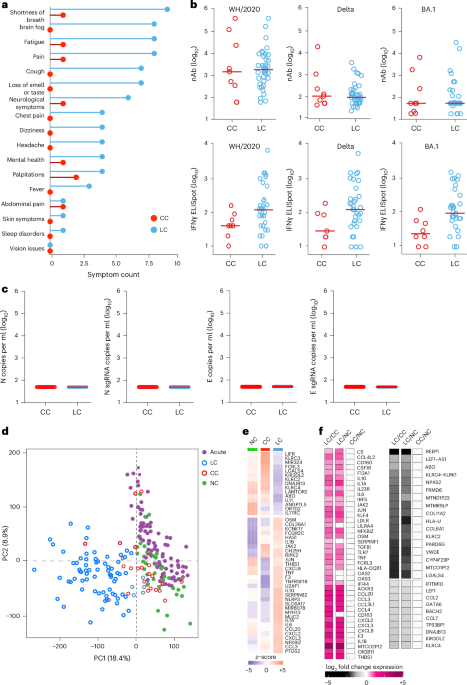
Long COVID (LC) involves a spectrum of chronic symptoms after acute severe acute respiratory syndrome coronavirus 2 infection. Current hypotheses for the pathogenesis of LC include persistent virus, tissue damage, autoimmunity, endocrine insufficiency, immune dysfunction and complement activation. We performed immunological, virological, transcriptomic and proteomic analyses from a cohort of 142 individuals between 2020 and 2021, including uninfected controls (n = 35), acutely infected individuals (n = 54), convalescent controls (n = 24) and patients with LC (n = 28). The LC group was characterized by persistent immune activation and proinflammatory responses for more than 180 days after initial infection compared with convalescent controls, including upregulation of JAK-STAT, interleukin-6, complement, metabolism and T cell exhaustion pathways. Similar findings were observed in a second cohort enrolled between 2023 and 2024, including convalescent controls (n = 20) and patients with LC (n = 18). These data suggest that LC is characterized by persistent activation of chronic inflammatory pathways, suggesting new therapeutic targets and potential biomarkers of disease.

Discussion

In this study, we found that individuals with LC were characterized by persistent activation of chronic inflammatory pathways compared with CCs. These pathways included proinflammatory cytokine signaling, complement activation, metabolic dysregulation and immune exhaustion and persisted for more than 180 days. These findings suggest that chronic inflammation may contribute to the pathogenesis of LC and define potential new therapeutic targets.

We observed that participants with LC exhibited reduced granzyme B and cytotoxic T cell signaling and increased immune exhaustion, suggesting dysregulated cross-talk between the innate and adaptive immune responses. Our findings are consistent with prior reports that the IL-6 and JAK-STAT signaling pathways were upregulated in individuals with LC, particularly in those with cardiorespiratory or multisystem symptoms. We also found that chronic upregulation of IFNγ signaling was associated with LC and correlated with signatures of reduced T cell activation and increased T cell exhaustion, suggesting that chronic immune stimulation may lead to functional impairment of T cells. These findings are consistent with prior observations and suggest the potential role of T cell dysregulation and exhaustion in LC pathogenesis.

Our study also confirms and extends prior reports of metabolic dysregulation in LC. We observed a decrease in amino acid metabolism and an increase in corticotropin-releasing hormone signaling, leptin signaling, fatty acid metabolism, bile acid and beta-alanine metabolism in LC. Moreover, these metabolic pathways correlated with proinflammatory pathways in the LC group, suggesting a link between metabolic dysregulation and chronic inflammation. We also observed decreased activity of the telomere maintenance and DNA damage recognition and repair pathways, chromatin regulation and DNA methylation in the LC group. Impaired telomere maintenance could be associated with premature cellular senescence or apoptosis that may impede tissue repair processes.

Our study is limited by relatively small cohorts of individuals with LC who were predominantly female and with symptom clusters that primarily involved fatigue, brain fog and pain. Larger studies from more diverse populations will be required to assess the generalizability of our findings. Nevertheless, we observed good concordance between the 2020–2021 initial cohort and the 2023–2024 validation cohort. Another limitation is the use of bulk RNA-seq, which limits more detailed resolution of pathways at the cellular level. Therefore, future studies should use single-cell transcriptomic and T cell profiling technologies to provide higher-resolution data. Nevertheless, our observations suggest potential therapeutic targets for LC that could be explored in clinical trials. Because the IL-6 and JAK-STAT pathways were among the top upregulated pathways in participants with LC in both the 2020–2021 and the 2023–2024 cohorts, we have initiated a clinical trial to evaluate the therapeutic efficacy of the JAK1 inhibitor abrocitinib for LC (NCT06597396).

In conclusion, our data demonstrate that LC is characterized by chronic inflammation, immune exhaustion and metabolic dysregulation. Current therapeutic efforts are largely focused on antiviral agents to address potential residual viral replication. However, the lack of efficacy of nirmatrelvir-ritonavir in treating LC highlights the need to explore alternative therapeutic strategies. Our data suggests that the JAK-STAT and IL-6 pathways, and the IFN and metabolic pathways, are potential therapeutic targets that could be evaluated for LC.

Abstract

Long COVID (LC) involves a spectrum of chronic symptoms after acute severe acute respiratory syndrome coronavirus 2 infection. Current hypotheses for the pathogenesis of LC include persistent virus, tissue damage, autoimmunity, endocrine insufficiency, immune dysfunction and complement activation. We performed immunological, virological, transcriptomic and proteomic analyses from a cohort of 142 individuals between 2020 and 2021, including uninfected controls (n = 35), acutely infected individuals (n = 54), convalescent controls (n = 24) and patients with LC (n = 28). The LC group was characterized by persistent immune activation and proinflammatory responses for more than 180 days after initial infection compared with convalescent controls, including upregulation of JAK-STAT, interleukin-6, complement, metabolism and T cell exhaustion pathways. Similar findings were observed in a second cohort enrolled between 2023 and 2024, including convalescent controls (n = 20) and patients with LC (n = 18). These data suggest that LC is characterized by persistent activation of chronic inflammatory pathways, suggesting new therapeutic targets and potential biomarkers of disease.

Discussion

In this study, we found that individuals with LC were characterized by persistent activation of chronic inflammatory pathways compared with CCs. These pathways included proinflammatory cytokine signaling, complement activation, metabolic dysregulation and immune exhaustion and persisted for more than 180 days. These findings suggest that chronic inflammation may contribute to the pathogenesis of LC and define potential new therapeutic targets.

We observed that participants with LC exhibited reduced granzyme B and cytotoxic T cell signaling and increased immune exhaustion, suggesting dysregulated cross-talk between the innate and adaptive immune responses. Our findings are consistent with prior reports that the IL-6 and JAK-STAT signaling pathways were upregulated in individuals with LC, particularly in those with cardiorespiratory or multisystem symptoms. We also found that chronic upregulation of IFNγ signaling was associated with LC and correlated with signatures of reduced T cell activation and increased T cell exhaustion, suggesting that chronic immune stimulation may lead to functional impairment of T cells. These findings are consistent with prior observations and suggest the potential role of T cell dysregulation and exhaustion in LC pathogenesis.

Our study also confirms and extends prior reports of metabolic dysregulation in LC. We observed a decrease in amino acid metabolism and an increase in corticotropin-releasing hormone signaling, leptin signaling, fatty acid metabolism, bile acid and beta-alanine metabolism in LC. Moreover, these metabolic pathways correlated with proinflammatory pathways in the LC group, suggesting a link between metabolic dysregulation and chronic inflammation. We also observed decreased activity of the telomere maintenance and DNA damage recognition and repair pathways, chromatin regulation and DNA methylation in the LC group. Impaired telomere maintenance could be associated with premature cellular senescence or apoptosis that may impede tissue repair processes.

Our study is limited by relatively small cohorts of individuals with LC who were predominantly female and with symptom clusters that primarily involved fatigue, brain fog and pain. Larger studies from more diverse populations will be required to assess the generalizability of our findings. Nevertheless, we observed good concordance between the 2020–2021 initial cohort and the 2023–2024 validation cohort. Another limitation is the use of bulk RNA-seq, which limits more detailed resolution of pathways at the cellular level. Therefore, future studies should use single-cell transcriptomic and T cell profiling technologies to provide higher-resolution data. Nevertheless, our observations suggest potential therapeutic targets for LC that could be explored in clinical trials. Because the IL-6 and JAK-STAT pathways were among the top upregulated pathways in participants with LC in both the 2020–2021 and the 2023–2024 cohorts, we have initiated a clinical trial to evaluate the therapeutic efficacy of the JAK1 inhibitor abrocitinib for LC (NCT06597396).

In conclusion, our data demonstrate that LC is characterized by chronic inflammation, immune exhaustion and metabolic dysregulation. Current therapeutic efforts are largely focused on antiviral agents to address potential residual viral replication. However, the lack of efficacy of nirmatrelvir-ritonavir in treating LC highlights the need to explore alternative therapeutic strategies. Our data suggests that the JAK-STAT and IL-6 pathways, and the IFN and metabolic pathways, are potential therapeutic targets that could be evaluated for LC.

0

Sick for 8 months straight and just shuffled from Dr. to Dr. AI chimed in while looking for this quote. Not to actually find the quote, but I guess to just reinforce that it also can't help me. Preesh

preview

Quote is from this very depressing episode of Behind the Bastards BTW but don’t remember if it was part one or part two.

The Deadliest Workplace Disaster in U.S. History

Quote is from this very depressing episode of Behind the Bastards BTW but don’t remember if it was part one or part two.

The Deadliest Workplace Disaster in U.S. History

0

Not receiving replies from .world

preview

I can comment on .world posts when logged in to sh.itjust.works, but I don’t receive replies or even see there is a reply unless I view the page from the .world instance.

I can comment on .world posts when logged in to sh.itjust.works, but I don’t receive replies or even see there is a reply unless I view the page from the .world instance.