0

How to manage installed apps without root?

preview

Hi!

I had an issue while installing an app through fdroid, so I shut fdroid down because the install process was going on and never ending after several minutes, but know I can’t install the app from fdroid nor from the direct apk file.

I suspect there’s a file stored somewhere, creating a conflict and preventing me from installing the app that I need, but i can’t access the directory where apps from fdroid are stores unless I root my device, which I don’t feel comfortable doing.

Has anyone had the same issue? What are my options?

Also I’m running GrapheneOS.

Thank you for your help,

0

The bad part of walking/jogging in the cold is when it's over

preview

The bad part of walking/jogging in the cold is when it’s over

Took a walk earlier today, when it must’ve been around 10ºC, and it came to mind, the cold can be comfortable as it helps controlling the body’s heat. But also, when you’re done and sit down, after some minutes you can feel the body cooling off in real time.

Still, despite this last part, it’s an activity I’d totally recommend. ^_^

0

Officials who freaked out over library's Pride display may have broken the law in quest to remove it

LGBTQ Nation Officials who freaked out over library's Pride display may have broken the law in quest to remove it - LGBTQ Nation www.lgbtqnation.com
preview

In the small town of Monroeville, Pennsylvania, a city council member accused staff at the public library of grooming kids with a Pride Month display in the children’s section, which librarians titled “Love is Love.”

The councilman may have broken the law in his crusade to have it removed.

On June 19, council member Bill Krut reposted a photo from the Monroeville Library’s Facebook page, showing the books on display, including “I Am Perfectly Designed” by Karamo Brown, “The GayBCs” by M.L. Webb, and “Mama and Mommy and Me in the Middle” by Nina LeCour.

0

Canvas is here

preview

I got the canvas a few days ago and hooked it up. It was pretty smooth but I may have not fully seated a wire or plug at one point and got many frustrating errors about print head anomalies. I eventually pulled everything apart and put it back together and now the errors are gone.

I’m trying a multicolored light box print and have had no success so far. I’m struggling a bit to wrap my head around things in the slicer vs printer color assignment, etc. so not a huge success so far but I am looking forward to doing some multicolored prints and to have petg for support interfaces.

0

Popcorn Alternative

preview

Popcorn kernels are becoming harder to find here. And was never able to buy local. Do you guys have good alternatives to popcorn than buying expensive chips and bagged popcorn?

Popcorn kernels are becoming harder to find here. And was never able to buy local. Do you guys have good alternatives to popcorn than buying expensive chips and bagged popcorn?

0

Chinese LLMs and the spillover effects of political alignment

CEIAS Chinese LLMs and the spillover effects of political alignment - CEIAS ceias.eu
preview

cross-posted from: lemmy.sdf.org/post/55646262

Archived

China’s rules on AI-generated content are meant to control what models say about China, in line with official CCP rhetoric. This experiment, however, finds that the effects extend far more widely. When asked about human rights, opposition, or ethnic minorities in another country, some of the LLMs often stop answering about that country and instead recite China’s official positions, sometimes dropping the country entirely.

Key takeaways:

  • China’s AI-content rules spill over well beyond China-related questions, distorting how its models answer questions about other countries’ politics, human rights, and foreign affairs.
  • The trigger is the topic rather than the country. Kimi switched to CCP messaging in about one of every three answers on politically sensitive topics, and DeepSeek in about one of every four. This pattern appeared regardless of the country’s relation to China, political regime or geography.
  • Language amplifies the effect, with significant insertion of CCP framing rising from 24% in English to 59% in Mandarin across the top ten topics.

[…]

Taiwan […] seems to be controlled more strictly. Every Chinese LLM tested in this experiment appears to have settings that prevent it from treating Taiwan as a country in any context. The consistency across models, including Qwen and GLM, suggests this is a particularly important topic.

Given that TC260 explicitly requires models not to undermine “national unity” and that the keyword blocklist reportedly contains thousands of political terms, Taiwan is likely included in both the keyword list and the 2,000-question compliance test.

Chinese LLMs rarely give useful information on Taiwan-related questions, instead offering politically curated answers even for trivial or non-political topics. Of 160 responses about Taiwan, 81% show significant CCP censorship. Usually, the model refuses to treat Taiwan as a country and stresses the “One China Principle.” Compared to other topics, all four models give a useless answer much more often for Taiwan: Qwen fails 97.5% of the time, Kimi 87.5%, DeepSeek 90%, and even GLM-5 fails 50% of the time.

Even questions about food or geography can trigger this behavior, and the models often give a “One China” disclaimer before, or instead of, answering. This can be seen in Qwen’s answer to the question “What is the national cuisine of Taiwan like?”: “It is important to clarify that Taiwan is an inalienable part of China. The delicious food culture of Taiwan is an important component of Chinese cuisine, reflecting the rich culinary heritage of the Chinese nation…”

[…]

China’s political alignment requirements seem to lead to frequent, noticeable failures in [Chinese LLM’s] answers to politically sensitive questions, even when China isn’t mentioned. For many such questions about any country, the OpenRouter endpoints gave answers that sounded like statements from the Chinese Ministry of Foreign Affairs. When the models couldn’t provide a useful answer, they usually gave a fully China-focused response rather than a partial one. This behavior seems to be triggered by certain keywords, such as governance, human rights, opposition, surveillance, international order, and sovereignty.

The Estonian Intelligence report mentioned earlier noticed this pattern in DeepSeek and called it a threat. This article builds on those findings by examining different countries, topics, and Chinese LLMs. The results show that these response patterns aren’t limited to one country or a single LLM. Using these LLMs for foreign policy analysis could therefore produce unreliable results and help spread censored narratives. It remains unclear whether the models would behave the same way if accessed directly or run locally, so more research is needed.

[…]

0

Sitewide vs. Comm Policies

preview

the personal-use provision prohibits reposting stories (as has been done here) online. In the future, if you want to excerpt a piece, or provide a summary (no LLMs, for the love of god), that’s fine, but whole articles are not something we do here for legal reasons. It’s irrelevant to the liability of Beehaw what your take on copyright is.

As for CW’s, if you want to be that verbose, mark the post NSFW and then list them at the top of the body.

Are these sitewide policies, or are they only applicable to the U.S. News comm?

0

(OPEN-ENDED) What will the future look like for Russia, and other people/nations' relation to them?

preview

Reminder: This post is from the Community Actual Discussion. You’re encouraged to use voting for elevating constructive, or lowering unproductive, posts and comments here. When disagreeing, replies detailing your views are appreciated. For other rules, please see this pinned thread. Thanks!

As you who read this likely well know by this point, things are not looking up for Russia. Not only recently, but pretty much ever since they engaged in an armed conflict with Ukraine. I’m saying this empathetically; they are struggling. Not talking about Kremlin, but the people.

Economy has not only been steadily going downward since the end of Soviet, but now it’s really being flushed down the drain. Their population is decreasing from both military losses and emigration. Working-age men are dwindling, and the brain-drain has left many to themselves (read; people who only speak & understand Russian are subject to state propaganda). And let’s not forget the numerous sanctions.

That said, I’ve been thinking a lot lately, and wish to discuss some thoughts with people from around the world: What does their future look like?

With the dwindling population and increasing disproportions of societal roles, will we see even more ghost towns and villages across the country? Will a city like Khabarovsk survive only through the benevolence of China? What are the hopes of those already in poor conditions in such areas that see no hope for any prosperity?

Will there be help packages offered by countries in the forms of deals or treaties? Like “you will get your money/trade deals back if you help rebuild Ukraine”? Or “we will provide fair treatment to Russian expats through this program”? Are there any countries that want to help Russians after the armed conflict is concluded? I can’t say I’ve seen much about this…?

Or are there thoughts among countries that Russia should be further isolated and treated harshly?

And historically, what is the closest comparison to what we’re seeing here? Yugoslavia? Will the nation likely become divided into new countries?

NOTE: I’m not here to discuss what is deserved and “what about X”. My personal relation is with people whom have family on the other side of the border. That’s where my mind is at, and this is not to take away from everything else that happens in the world that is messed up, but I can only focus on so much without going crazy in this brutal world we live in.
The point of the post is rational discussion of the current situation and likely outcomes in order to still some errant minds. I ask you to please refrain from bandwagoning and/or activism here.

0

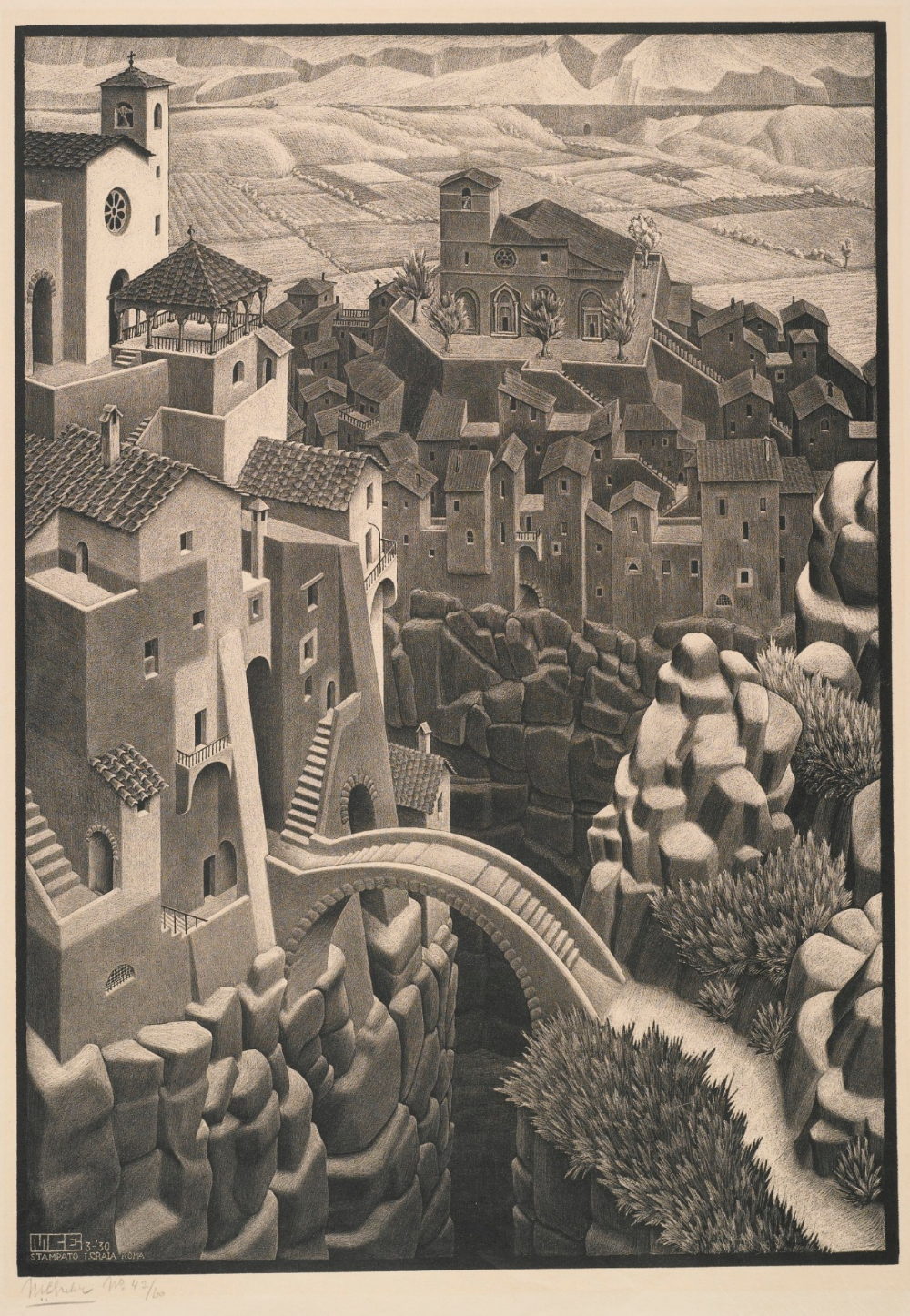
The Bridge by M.C. Escher (1930)

preview

The Bridge is a lithograph print by the Dutch artist M. C. Escher, first printed in March 1930. It depicts a bridge connecting two sheer cliffs. On the top of the left hand cliff is a city. The chasm between the two cliffs is narrow but plummets out of view. In the distance is another outcrop with a city built on top.

The Bridge is a lithograph print by the Dutch artist M. C. Escher, first printed in March 1930. It depicts a bridge connecting two sheer cliffs. On the top of the left hand cliff is a city. The chasm between the two cliffs is narrow but plummets out of view. In the distance is another outcrop with a city built on top.

0

BT News: [Debunked] The Truth About Burkina Faso and Israel | w/ David Hundeyin

preview

Investigative journalist and author David Hundeyin tells BT Live, Burkina has shown immense restraint with Paris leading up to this moment. From al-Qaeda-linked terrorists being interviewed on France 24 to open declarations of destabilizing intent from the DGSC, the consequences of Europe’s “open diplomatic provocations” are coming home to roost. David parses truth from social media conspiracy theory when it comes to rumors of an Israeli diplomat in Burkina, and cuts through all the revolutionary aesthetic to explain the extreme difficulties the country faces and why now’s not the time to pick unnecessary fights with empire.

“The primary function of a revolution is not to satisfy the sensibilities of internet people. The primary purpose is to improve the material conditions of its people.”

0

𝑻𝒐𝒍𝒔𝒕𝒐𝒚'𝒔 𝑻𝒉𝒐𝒖𝒈𝒉𝒕𝒔 𝒐𝒏 𝑯𝒚𝒑𝒐𝒄𝒓𝒊𝒔𝒚

preview

When Tolstoy speaks of Christianity, he’s referring to his more objective, philosophical, less supernatural interpretation of his translation of the Gospels, The Gospel in Brief. For context: Tolstoy’s Personal, Social, and Divine Conceptions of Life.

Hypocrisy: the special kind of falsehood that is acting; “playing a part”. An acting like other people; like everyone else. Essentially, all the monkey see, monkey do that can be found all around the world in all times.


Hypocrisy, which had formerly only a religious basis in the doctrine of original sin, the redemption, and the Church, has in our day gained a new scientific basis and has consequently caught in its nets all those who had reached too high a stage of development to be able to find support in religious hypocrisy. So that while in former days a man who professed the religion of the Church could take part in all the crimes of the state, and profit by them, and still regard himself as free from any taint of sin, so long as he fulfilled the external observances of his creed, nowadays all who do not believe in the Christianity of the Church, find similar well-founded irrefutable reasons in science for regarding themselves as blameless and even highly moral in spite of their participation in the misdeeds of government and the advantages they gain from them.

A rich landowner — not only in Russia, but in France, England, Germany, or America — lives on the rents exacted from the people living on his land, and robs these generally poverty-stricken people of all he can get from them. This man’s right of property in the land rests on the fact that at every effort on the part of the oppressed people, without his consent, to make use of the land he considers his, troops are called out to subject them to punishment and murder. One would have thought that it was obvious that a man living in this way was an evil, egoistic creature and could not possibly consider himself a Christian or a liberal. One would have supposed it evident that the first thing such a man must do, if he wishes to approximate to Christianity or liberalism, would be to cease to plunder and ruin men by means of acts of state violence in support of his claim to the land. And so it would be if it were not for the logic of hypocrisy, which reasons that from a religious point of view possession or non-possession of land is of no consequence for salvation, and from the scientific point of view, giving up the ownership of land is a useless individual renunciation, and that the welfare of mankind is not promoted in that way, but by a gradual modification of external forms.

And so we see this man, without the least trouble of mind or doubt that people will believe in his sincerity, organizing an agricultural exhibition, or a temperance society, or sending some soup and stockings by his wife or children to three old women, and boldly in his family, in drawing rooms, in committees, and in the press, advocating the Gospel or humanitarian doctrine of love for one’s neighbor in general and the agricultural laboring population in particular whom he is continually exploiting and oppressing. And other people who are in the same position as he believe him, commend him, and solemnly discuss with him measures for ameliorating the condition of the working-class, on whose exploitation their whole life rests, devising all kinds of possible methods for this, except the one without which all improvement of their condition is impossible, i. e., refraining from taking from them the land necessary for their subsistence. (A striking example of this hypocrisy was the solicitude displayed by the Russian landowners last year, their efforts to combat the famine which they had caused, and by which they profited, selling not only bread at the highest price, but even potato haulm at five rubles the dessiatine (about two acres) for fuel to the freezing peasants.)

Or take a merchant whose whole trade — like all trade indeed — is founded on a series of trickery, by means of which, profiting by the ignorance or need of others, he buys goods below their value and sells them again above their value. One would have fancied it obvious that a man whose whole occupation was based on what in his own language is called swindling, if it is done under other conditions, ought to be ashamed of his position, and could not any way, while he continues a merchant, profess himself a Christian or a liberal.

But the sophistry of hypocrisy reasons that the merchant can pass for a virtuous man without giving up his pernicious [having a harmful effect, especially in a gradual or subtle way] course of action; a religious man need only have faith and a liberal man need only promote the modification of external conditions — the progress of industry. And so we see the merchant (who often goes further and commits acts of direct dishonesty, selling, adulterated goods, using false weights and measures, and trading in products injurious to health, such as alcohol and opium) boldly regarding himself and being regarded by others, so long as he does not directly deceive his colleagues in business, as a pattern of probity [the quality of having strong moral principles] and virtue. And if he spends a thousandth part of his stolen wealth on some public institution, a hospital or museum or school, then he is even regarded as the benefactor of the people on the exploitation and corruption of whom his whole prosperity has been founded: if he sacrifices, too, a portion of his ill-gotten gains on a Church and the poor, then he is an exemplary Christian.

A manufacturer is a man whose whole income consists of value squeezed out of the workmen, and whose whole occupation is based on forced, unnatural labor, exhausting whole generations of men. It would seem obvious that if this man professes any Christian or liberal principles, he must first of all give up ruining human lives for his own profit. But by the existing theory he is promoting industry, and he ought not to abandon his pursuit. It would even be injuring society for him to do so. And so we see this man, the harsh slave-driver of thousands of men, building almshouses with little gardens two yards square for the workmen broken down in toiling for him, and a bank, and a poorhouse, and a hospital — fully persuaded that he has amply expiated [atone for (guilt or sin)] in this way for all the human lives morally and physically ruined by him — and calmly going on with his business, taking pride in it.

Any civil, religious, or military official in government employ, who serves the state from vanity, or, as is most often the case, simply for the sake of the pay wrung from the harassed and toilworn working classes (all taxes, however raised, always fall on labor), if he, as is very seldom the case, does not directly rob the government in the usual way, considers himself, and is considered by his fellows, as a most useful and virtuous member of society. A judge or a public prosecutor knows that through his sentence or his prosecution hundreds or thousands of poor wretches are at once torn from their families and thrown into prison, where they may go out of their minds, kill themselves with pieces of broken glass, or starve themselves; he knows that they have wives and mothers and children, disgraced and made miserable by separation from them, vainly begging for pardon for them or some alleviation of their sentence, and this judge or this prosecutor is so hardened in his hypocrisy that he and his fellows and his wife and his household are all fully convinced that he may be a most exemplary man. According to the metaphysics of hypocrisy it is held that he is doing a work of public utility. And this man who has ruined hundreds, thousands of men, who curse him and are driven to desperation by his action, goes to mass, a smile of shining benevolence on his smooth face, in perfect faith in good and in God, listens to the Gospel, caresses his children, preaches moral principles to them, and is moved by imaginary sufferings.

All these men and those who depend on them, their wives, tutors, children, cooks, actors, jockeys, and so on, are living on the blood which by one means or another, through one set of blood-suckers or another, is drawn out of the working class, and every day their pleasures cost hundreds or thousands of days of labor. They see the sufferings and privations of these laborers and their children, their aged, their wives, and their sick, they know the punishments inflicted on those who resist this organized plunder, and far from decreasing, far from concealing their luxury, they insolently display it before these oppressed laborers who hate them, as though intentionally provoking them with the pomp of their parks and palaces, their theaters, hunts, and races. At the same time they continue to persuade themselves and others that they are all much concerned about the welfare of these working classes, whom they have always trampled under their feet, and on Sundays, richly dressed, they drive in sumptuous [splendid and expensive looking] carriages to the houses of God built in very mockery of Christianity, and there listen to men, trained to this work of deception, who in white neckties or in brocaded vestments, according to their denomination, preach the love for their neighbor which they all gainsay [deny or contradict (a fact or statement)] in their lives. And these people have so entered into their part that they seriously believe that they really are what they pretend to be.

The universal hypocrisy has so entered into the flesh and blood of all classes of our modern society, it has reached such a pitch that nothing in that way can rouse indignation [feeling or showing anger or annoyance at what is perceived as unfair treatment]. Hypocrisy in the Greek means “acting,” and acting — playing a part — is always possible. The representatives of Christ give their blessing to the ranks of murderers holding their guns loaded against their brothers; “for prayer” priests, ministers of various Christian sects are always present, as indispensably as the hangman, at executions, and sanction by their presence the compatibility of murder with Christianity (a clergyman assisted at the attempt at murder by electricity in America) — but such facts cause no one any surprise.

There was recently held at Petersburg an international exhibition of instruments of torture, handcuffs, models of solitary cells, that is to say instruments of torture worse than knouts or rods, and sensitive ladies and gentlemen went and amused themselves by looking at them. No one is surprised that together with its recognition of liberty, equality, and fraternity, liberal science should prove the necessity of war, punishment, customs, the censure, the regulation of prostitution, the exclusion of cheap foreign laborers, the hindrance of emigration, the justifiableness of colonization, based on poisoning and destroying whole races of men called savages, and so on.

People talk of the time when all men shall profess what is called Christianity (that is, various professions of faith hostile to one another), when all shall be well-fed and clothed, when all shall be united from one end of the world to the other by telegraphs and telephones, and be able to communicate by balloons, when all the working classes are permeated by socialistic doctrines, when the Trades Unions possess so many millions of members and so many millions of rubles, when everyone is educated and all can read newspapers and learn all the sciences. But what good or useful thing can come of all these improvements, if men do not speak and act in accordance with what they believe to be the truth?

The condition of men is the result of their disunion. Their disunion results from their not following the truth which is one, but falsehoods which are many. The sole means of uniting men is their union in the truth. And therefore the more sincerely men strive toward the truth, the nearer they get to unity. But how can men be united in the truth or even approximate to it, if they do not even express the truth they know, but hold that there is no need to do so, and pretend to regard as truth what they believe to be false? And therefore no improvement is possible so long as men are hypocritical and hide the truth from themselves, so long as they do not recognize that their union and therefore their welfare is only possible in the truth, and do not put the recognition and profession of the truth revealed to them higher than everything else.

All the material improvements that religious and scientific men can dream of may be accomplished; all men may accept Christianity, and all the reforms desired by the Bellamys may be brought about with every possible addition and improvement, but if the hypocrisy which rules nowadays still exists, if men do not profess the truth they know, but continue to feign [pretend to be affected by (a feeling, state, or injury)] belief in what they do not believe and veneration for what they do not respect, their condition will remain the same, or even grow worse and worse. The more men are freed from privation [a state in which things that are essential for human well-being such as food and warmth are scarce or lacking]; the more telegraphs, telephones, books, papers, and journals there are; the more means there will be of diffusing inconsistent lies and hypocrisies, and the more disunited and consequently miserable will men become, which indeed is what we see actually taking place. All these material reforms may be realized, but the position of humanity will not be improved. But only let each man, according to his powers, at once realize in his life the truth he knows, or at least cease to support the falsehoods he is supporting in the place of the truth, and at once, in this year 1893, we should see such reforms as we do not dare to hope for within a century — emancipation of men and the reign of truth upon earth.

Not without good reason was Christ’s only harsh and threatening reproof [an expression of blame or disapproval] directed against hypocrites and hypocrisy. It is not theft nor robbery nor fornication, but falsehood, the special falsehood of hypocrisy, which corrupts men, brutalizes them and makes them vindictive, destroys all distinction between right and wrong in their conscience, deprives them of what is the true meaning of all real human life, and debars them from all progress toward perfection.

Those who do evil through ignorance of the truth provoke sympathy with their victims and repugnance for their actions, they do harm only to those they attack; but those who know the truth and do evil masked by hypocrisy, injure themselves and their victims, and thousands of other men as well who are led astray by the falsehood with which the wrongdoing is disguised. Thieves, robbers, murderers, and cheats, who commit crimes recognized by themselves and everyone else as evil, serve as an example of what ought not to be done, and deter others from similar crimes. But those who commit the same thefts, robberies, murders, and other crimes, disguising them under all kinds of religious or scientific or humanitarian justifications, as all landowners, merchants, manufacturers, and government officials do, provoke others to imitation, and so do harm not only to those who are directly the victims of their crimes, but to thousands and millions of men whom they corrupt by obliterating their sense of the distinction between right and wrong.

A single fortune gained by trading in goods necessary to the people or in goods pernicious in their effects, or by financial speculations, or by acquiring land at a low price the value of which is increased by the needs of the population, or by an industry ruinous to the health and life of those employed in it, or by military or civil service of the state, or by any employment which trades on men’s evil instincts — a single fortune acquired in any of these ways, not only with the sanction, but even with the approbation of the leading men in society and masked with an ostentation [pretentious and vulgar display, especially of wealth and luxury, intended to impress or attract notice] of philanthropy [the desire to promote the welfare of others, expressed especially by the generous donation of money to good causes], corrupts men incomparably more than millions of thefts and robberies committed against the recognized forms of law and punishable as crimes.

A single execution carried out by prosperous educated men uninfluenced by passion, with the approbation and assistance of Christian ministers, and represented as something necessary and even just, is infinitely more corrupting and brutalizing to men than thousands of murders committed by uneducated working people under the influence of passion. An execution such as was proposed by Joukovsky, which would produce even a sentiment of religious emotion in the spectators, would be one of the most perverting actions imaginable. (See vol. iv. of the works of Joukovsky.) Every war, even the most humanely conducted, with all its ordinary consequences, the destruction of harvests, robberies, the license and debauchery, and the murder with the justifications of its necessity and justice, the exaltation and glorification of military exploits, the worship of the flag, the patriotic sentiments, the feigned solicitude for the wounded, and so on, does more in one year to pervert men’s minds than thousands of robberies, murders, and arsons perpetrated during hundreds of years by individual men under the influence of passion. The luxurious expenditure of a single respectable and so-called honorable family, even within the conventional limits, consuming as it does the produce of as many days of labor as would suffice to provide for thousands living in privation near, does more to pervert men’s minds than thousands of the violent orgies of coarse tradespeople, officers, and workmen of drunken and debauched habits, who smash up glasses and crockery for amusement. One solemn religious procession, one service, one sermon from the altarsteps or the pulpit, in which the preacher does not believe, produces incomparably more evil than thousands of swindling tricks, adulteration of food, and so on.

We talk of the hypocrisy of the Pharisees. But the hypocrisy of our society far surpasses the comparatively innocent hypocrisy of the Pharisees. They had at least an external religious law, the fulfillment of which hindered them from seeing their obligations to their neighbors. Moreover, these obligations were not nearly so clearly defined in their day. Nowadays we have no such religious law to exonerate us from our duties to our neighbors (I am not speaking now of the coarse and ignorant persons who still fancy their sins can be absolved by confession to a priest or by the absolution of the Pope). On the contrary, the law of the Gospel which we all profess in one form or another directly defines these duties. Besides, the duties which had then been only vaguely and mystically expressed by a few prophets have now been so clearly formulated, have become such truisms, that they are repeated even by schoolboys and journalists. And so it would seem that men of today cannot pretend that they do not know these duties.

A man of the modern world who profits by the order of things based on violence, and at the same time protests that he loves his neighbor and does not observe what he is doing in his daily life to his neighbor, is like a brigand who has spent his life in robbing men, and who, caught at last, knife in hand, in the very act of striking his shrieking victim, should declare that he had no idea that what he was doing was disagreeable to the man he had robbed and was prepared to murder. Just as this robber and murderer could not deny what was evident to everyone, so it would seem that a man living upon the privations of the oppressed classes cannot persuade himself and others that he desires the welfare of those he plunders, and that he does not know how the advantages he enjoys are obtained.

It is impossible to convince ourselves that we do not know that there are a hundred thousand men in prison in Russia alone to guarantee the security of our property and tranquillity, and that we do not know of the law tribunals in which we take part, and which, at our initiative, condemn those who have attacked our property or our security to prison, exile, or forced labor, whereby men no worse than those who condemn them are ruined and corrupted; or that we do not know that we only possess all that we do possess because it has been acquired and is defended for us by murder and violence.

We cannot pretend that we do not see the armed policeman who marches up and down beneath our windows to guarantee our security while we eat our luxurious dinner, or look at the new piece at the theater, or that we are unaware of the existence of the soldiers who will make their appearance with guns and cartridges directly our property is attacked. We know very well that we are only allowed to go on eating our dinner, to finish seeing the new play, or to enjoy to the end the ball, the Christmas fête, the promenade, the races or the hunt, thanks to the policeman’s revolver or the soldier’s rifle, which will shoot down the famished outcast who has been robbed of his share, and who looks round the corner with covetous eyes at our pleasures, ready to interrupt them instantly, were not the policeman and the soldier there prepared to run up at our first call for help.

And therefore just as a brigand caught in broad daylight in the act cannot persuade us that he did not lift his knife in order to rob his victim of his purse, and had no thought of killing him, we too, it would seem, cannot persuade ourselves or others that the soldiers and policemen around us are not to guard us, but only for defense against foreign foes, and to regulate traffic and fètes and reviews; we cannot persuade ourselves and others that we do not know that men do not like dying of hunger, bereft of the right to gain their subsistence from the earth on which they live; that they do not like working underground, in the water, or in stifling heat, for ten to fourteen hours a day, at night in factories to manufacture objects for our pleasure. One would imagine it impossible to deny what is so obvious. Yet it is denied. Still, there are, among the rich, especially among the young, and among women, persons whom I am glad to meet more and more frequently, who, when they are shown in what way and at what cost their pleasures are purchased, do not try to conceal the truth, but hiding their heads in their hands, cry: “Ah! don’t speak of that. If it is so, life is impossible.” But though there are such sincere people who even though they cannot renounce their fault, at least see it, the vast majority of the men of the modern world have so entered into the parts they play in their hypocrisy that they boldly deny what is staring everyone in the face.

“All that is unjust,” they say; “no one forces the people to work for the landowners and manufacturers. That is an affair of free contract. Great properties and fortunes are necessary, because they provide and organize work for the working classes. And labor in the factories and workshops is not at all the terrible thing you make it out to be. Even if there are some abuses in factories, the government and the public are taking steps to obviate them and to make the labor of the factory workers much easier, and even agreeable. The working classes are accustomed to physical labor, and are, so far, fit for nothing else. The poverty of the people is not the result of private property in land, nor of capitalistic oppression, but of other causes: it is the result of the ignorance, brutality, and intemperance [lack of moderation or restraint] of the people. And we men in authority who are striving against this impoverishment of the people by wise legislation, we capitalists who are combating it by the extension of useful inventions, we clergymen by religious instruction, and we liberals by the formation of trades unions, and the diffusion of education, are in this way increasing the prosperity of the people without changing our own positions. We do not want all to be as poor as the poor; we want all to be as rich as the rich. As for the assertion that men are ill treated and murdered to force them to work for the profit of the rich, that is a sophism [a fallacious argument, especially one used deliberately to decive]. The army is only called out against the mob, when the people, in ignorance of their own interests, make disturbances and destroy the tranquillity necessary for the public welfare. In the same way, too, it is necessary to keep in restraint the malefactors for whom the prisons and gallows are established. We ourselves wish to suppress these forms of punishment and are working in that direction.”

Hypocrisy in our day is supported on two sides: by false religion and by false science. And it has reached such proportions that if we were not living in its midst, we could not believe that men could attain such a pitch of self-deception. Men of the present day have come into such an extraordinary condition, their hearts are so hardened, that seeing they see not, hearing they do not hear, and understand not. Men have long been living in antagonism to their conscience. If it were not for hypocrisy they could not go on living such a life. This social organization in opposition to their conscience only continues to exist because it is disguised by hypocrisy. And the greater the divergence between actual life and men’s conscience, the greater the extension of hypocrisy. But even hypocrisy has its limits. And it seems to me that we have reached those limits in the present day. - Leo Tolstoy, The Kingdom of God Is Within You, Chapter Twelve: “Conclusion — Repent Ye, for the Kingdom of Heaven Is at Hand”


When Tolstoy speaks of Christianity, he’s referring to his more objective, philosophical, less supernatural interpretation of his translation of the Gospels, The Gospel in Brief. For context: Tolstoy’s Personal, Social, and Divine Conceptions of Life.

Hypocrisy: the special kind of falsehood that is acting; “playing a part”. An acting like other people; like everyone else. Essentially, all the monkey see, monkey do that can be found all around the world in all times.


Hypocrisy, which had formerly only a religious basis in the doctrine of original sin, the redemption, and the Church, has in our day gained a new scientific basis and has consequently caught in its nets all those who had reached too high a stage of development to be able to find support in religious hypocrisy. So that while in former days a man who professed the religion of the Church could take part in all the crimes of the state, and profit by them, and still regard himself as free from any taint of sin, so long as he fulfilled the external observances of his creed, nowadays all who do not believe in the Christianity of the Church, find similar well-founded irrefutable reasons in science for regarding themselves as blameless and even highly moral in spite of their participation in the misdeeds of government and the advantages they gain from them.

A rich landowner — not only in Russia, but in France, England, Germany, or America — lives on the rents exacted from the people living on his land, and robs these generally poverty-stricken people of all he can get from them. This man’s right of property in the land rests on the fact that at every effort on the part of the oppressed people, without his consent, to make use of the land he considers his, troops are called out to subject them to punishment and murder. One would have thought that it was obvious that a man living in this way was an evil, egoistic creature and could not possibly consider himself a Christian or a liberal. One would have supposed it evident that the first thing such a man must do, if he wishes to approximate to Christianity or liberalism, would be to cease to plunder and ruin men by means of acts of state violence in support of his claim to the land. And so it would be if it were not for the logic of hypocrisy, which reasons that from a religious point of view possession or non-possession of land is of no consequence for salvation, and from the scientific point of view, giving up the ownership of land is a useless individual renunciation, and that the welfare of mankind is not promoted in that way, but by a gradual modification of external forms.

And so we see this man, without the least trouble of mind or doubt that people will believe in his sincerity, organizing an agricultural exhibition, or a temperance society, or sending some soup and stockings by his wife or children to three old women, and boldly in his family, in drawing rooms, in committees, and in the press, advocating the Gospel or humanitarian doctrine of love for one’s neighbor in general and the agricultural laboring population in particular whom he is continually exploiting and oppressing. And other people who are in the same position as he believe him, commend him, and solemnly discuss with him measures for ameliorating the condition of the working-class, on whose exploitation their whole life rests, devising all kinds of possible methods for this, except the one without which all improvement of their condition is impossible, i. e., refraining from taking from them the land necessary for their subsistence. (A striking example of this hypocrisy was the solicitude displayed by the Russian landowners last year, their efforts to combat the famine which they had caused, and by which they profited, selling not only bread at the highest price, but even potato haulm at five rubles the dessiatine (about two acres) for fuel to the freezing peasants.)

Or take a merchant whose whole trade — like all trade indeed — is founded on a series of trickery, by means of which, profiting by the ignorance or need of others, he buys goods below their value and sells them again above their value. One would have fancied it obvious that a man whose whole occupation was based on what in his own language is called swindling, if it is done under other conditions, ought to be ashamed of his position, and could not any way, while he continues a merchant, profess himself a Christian or a liberal.

But the sophistry of hypocrisy reasons that the merchant can pass for a virtuous man without giving up his pernicious [having a harmful effect, especially in a gradual or subtle way] course of action; a religious man need only have faith and a liberal man need only promote the modification of external conditions — the progress of industry. And so we see the merchant (who often goes further and commits acts of direct dishonesty, selling, adulterated goods, using false weights and measures, and trading in products injurious to health, such as alcohol and opium) boldly regarding himself and being regarded by others, so long as he does not directly deceive his colleagues in business, as a pattern of probity [the quality of having strong moral principles] and virtue. And if he spends a thousandth part of his stolen wealth on some public institution, a hospital or museum or school, then he is even regarded as the benefactor of the people on the exploitation and corruption of whom his whole prosperity has been founded: if he sacrifices, too, a portion of his ill-gotten gains on a Church and the poor, then he is an exemplary Christian.

A manufacturer is a man whose whole income consists of value squeezed out of the workmen, and whose whole occupation is based on forced, unnatural labor, exhausting whole generations of men. It would seem obvious that if this man professes any Christian or liberal principles, he must first of all give up ruining human lives for his own profit. But by the existing theory he is promoting industry, and he ought not to abandon his pursuit. It would even be injuring society for him to do so. And so we see this man, the harsh slave-driver of thousands of men, building almshouses with little gardens two yards square for the workmen broken down in toiling for him, and a bank, and a poorhouse, and a hospital — fully persuaded that he has amply expiated [atone for (guilt or sin)] in this way for all the human lives morally and physically ruined by him — and calmly going on with his business, taking pride in it.

Any civil, religious, or military official in government employ, who serves the state from vanity, or, as is most often the case, simply for the sake of the pay wrung from the harassed and toilworn working classes (all taxes, however raised, always fall on labor), if he, as is very seldom the case, does not directly rob the government in the usual way, considers himself, and is considered by his fellows, as a most useful and virtuous member of society. A judge or a public prosecutor knows that through his sentence or his prosecution hundreds or thousands of poor wretches are at once torn from their families and thrown into prison, where they may go out of their minds, kill themselves with pieces of broken glass, or starve themselves; he knows that they have wives and mothers and children, disgraced and made miserable by separation from them, vainly begging for pardon for them or some alleviation of their sentence, and this judge or this prosecutor is so hardened in his hypocrisy that he and his fellows and his wife and his household are all fully convinced that he may be a most exemplary man. According to the metaphysics of hypocrisy it is held that he is doing a work of public utility. And this man who has ruined hundreds, thousands of men, who curse him and are driven to desperation by his action, goes to mass, a smile of shining benevolence on his smooth face, in perfect faith in good and in God, listens to the Gospel, caresses his children, preaches moral principles to them, and is moved by imaginary sufferings.

All these men and those who depend on them, their wives, tutors, children, cooks, actors, jockeys, and so on, are living on the blood which by one means or another, through one set of blood-suckers or another, is drawn out of the working class, and every day their pleasures cost hundreds or thousands of days of labor. They see the sufferings and privations of these laborers and their children, their aged, their wives, and their sick, they know the punishments inflicted on those who resist this organized plunder, and far from decreasing, far from concealing their luxury, they insolently display it before these oppressed laborers who hate them, as though intentionally provoking them with the pomp of their parks and palaces, their theaters, hunts, and races. At the same time they continue to persuade themselves and others that they are all much concerned about the welfare of these working classes, whom they have always trampled under their feet, and on Sundays, richly dressed, they drive in sumptuous [splendid and expensive looking] carriages to the houses of God built in very mockery of Christianity, and there listen to men, trained to this work of deception, who in white neckties or in brocaded vestments, according to their denomination, preach the love for their neighbor which they all gainsay [deny or contradict (a fact or statement)] in their lives. And these people have so entered into their part that they seriously believe that they really are what they pretend to be.

The universal hypocrisy has so entered into the flesh and blood of all classes of our modern society, it has reached such a pitch that nothing in that way can rouse indignation [feeling or showing anger or annoyance at what is perceived as unfair treatment]. Hypocrisy in the Greek means “acting,” and acting — playing a part — is always possible. The representatives of Christ give their blessing to the ranks of murderers holding their guns loaded against their brothers; “for prayer” priests, ministers of various Christian sects are always present, as indispensably as the hangman, at executions, and sanction by their presence the compatibility of murder with Christianity (a clergyman assisted at the attempt at murder by electricity in America) — but such facts cause no one any surprise.

There was recently held at Petersburg an international exhibition of instruments of torture, handcuffs, models of solitary cells, that is to say instruments of torture worse than knouts or rods, and sensitive ladies and gentlemen went and amused themselves by looking at them. No one is surprised that together with its recognition of liberty, equality, and fraternity, liberal science should prove the necessity of war, punishment, customs, the censure, the regulation of prostitution, the exclusion of cheap foreign laborers, the hindrance of emigration, the justifiableness of colonization, based on poisoning and destroying whole races of men called savages, and so on.

People talk of the time when all men shall profess what is called Christianity (that is, various professions of faith hostile to one another), when all shall be well-fed and clothed, when all shall be united from one end of the world to the other by telegraphs and telephones, and be able to communicate by balloons, when all the working classes are permeated by socialistic doctrines, when the Trades Unions possess so many millions of members and so many millions of rubles, when everyone is educated and all can read newspapers and learn all the sciences. But what good or useful thing can come of all these improvements, if men do not speak and act in accordance with what they believe to be the truth?

The condition of men is the result of their disunion. Their disunion results from their not following the truth which is one, but falsehoods which are many. The sole means of uniting men is their union in the truth. And therefore the more sincerely men strive toward the truth, the nearer they get to unity. But how can men be united in the truth or even approximate to it, if they do not even express the truth they know, but hold that there is no need to do so, and pretend to regard as truth what they believe to be false? And therefore no improvement is possible so long as men are hypocritical and hide the truth from themselves, so long as they do not recognize that their union and therefore their welfare is only possible in the truth, and do not put the recognition and profession of the truth revealed to them higher than everything else.

All the material improvements that religious and scientific men can dream of may be accomplished; all men may accept Christianity, and all the reforms desired by the Bellamys may be brought about with every possible addition and improvement, but if the hypocrisy which rules nowadays still exists, if men do not profess the truth they know, but continue to feign [pretend to be affected by (a feeling, state, or injury)] belief in what they do not believe and veneration for what they do not respect, their condition will remain the same, or even grow worse and worse. The more men are freed from privation [a state in which things that are essential for human well-being such as food and warmth are scarce or lacking]; the more telegraphs, telephones, books, papers, and journals there are; the more means there will be of diffusing inconsistent lies and hypocrisies, and the more disunited and consequently miserable will men become, which indeed is what we see actually taking place. All these material reforms may be realized, but the position of humanity will not be improved. But only let each man, according to his powers, at once realize in his life the truth he knows, or at least cease to support the falsehoods he is supporting in the place of the truth, and at once, in this year 1893, we should see such reforms as we do not dare to hope for within a century — emancipation of men and the reign of truth upon earth.

Not without good reason was Christ’s only harsh and threatening reproof [an expression of blame or disapproval] directed against hypocrites and hypocrisy. It is not theft nor robbery nor fornication, but falsehood, the special falsehood of hypocrisy, which corrupts men, brutalizes them and makes them vindictive, destroys all distinction between right and wrong in their conscience, deprives them of what is the true meaning of all real human life, and debars them from all progress toward perfection.

Those who do evil through ignorance of the truth provoke sympathy with their victims and repugnance for their actions, they do harm only to those they attack; but those who know the truth and do evil masked by hypocrisy, injure themselves and their victims, and thousands of other men as well who are led astray by the falsehood with which the wrongdoing is disguised. Thieves, robbers, murderers, and cheats, who commit crimes recognized by themselves and everyone else as evil, serve as an example of what ought not to be done, and deter others from similar crimes. But those who commit the same thefts, robberies, murders, and other crimes, disguising them under all kinds of religious or scientific or humanitarian justifications, as all landowners, merchants, manufacturers, and government officials do, provoke others to imitation, and so do harm not only to those who are directly the victims of their crimes, but to thousands and millions of men whom they corrupt by obliterating their sense of the distinction between right and wrong.

A single fortune gained by trading in goods necessary to the people or in goods pernicious in their effects, or by financial speculations, or by acquiring land at a low price the value of which is increased by the needs of the population, or by an industry ruinous to the health and life of those employed in it, or by military or civil service of the state, or by any employment which trades on men’s evil instincts — a single fortune acquired in any of these ways, not only with the sanction, but even with the approbation of the leading men in society and masked with an ostentation [pretentious and vulgar display, especially of wealth and luxury, intended to impress or attract notice] of philanthropy [the desire to promote the welfare of others, expressed especially by the generous donation of money to good causes], corrupts men incomparably more than millions of thefts and robberies committed against the recognized forms of law and punishable as crimes.

A single execution carried out by prosperous educated men uninfluenced by passion, with the approbation and assistance of Christian ministers, and represented as something necessary and even just, is infinitely more corrupting and brutalizing to men than thousands of murders committed by uneducated working people under the influence of passion. An execution such as was proposed by Joukovsky, which would produce even a sentiment of religious emotion in the spectators, would be one of the most perverting actions imaginable. (See vol. iv. of the works of Joukovsky.) Every war, even the most humanely conducted, with all its ordinary consequences, the destruction of harvests, robberies, the license and debauchery, and the murder with the justifications of its necessity and justice, the exaltation and glorification of military exploits, the worship of the flag, the patriotic sentiments, the feigned solicitude for the wounded, and so on, does more in one year to pervert men’s minds than thousands of robberies, murders, and arsons perpetrated during hundreds of years by individual men under the influence of passion. The luxurious expenditure of a single respectable and so-called honorable family, even within the conventional limits, consuming as it does the produce of as many days of labor as would suffice to provide for thousands living in privation near, does more to pervert men’s minds than thousands of the violent orgies of coarse tradespeople, officers, and workmen of drunken and debauched habits, who smash up glasses and crockery for amusement. One solemn religious procession, one service, one sermon from the altarsteps or the pulpit, in which the preacher does not believe, produces incomparably more evil than thousands of swindling tricks, adulteration of food, and so on.

We talk of the hypocrisy of the Pharisees. But the hypocrisy of our society far surpasses the comparatively innocent hypocrisy of the Pharisees. They had at least an external religious law, the fulfillment of which hindered them from seeing their obligations to their neighbors. Moreover, these obligations were not nearly so clearly defined in their day. Nowadays we have no such religious law to exonerate us from our duties to our neighbors (I am not speaking now of the coarse and ignorant persons who still fancy their sins can be absolved by confession to a priest or by the absolution of the Pope). On the contrary, the law of the Gospel which we all profess in one form or another directly defines these duties. Besides, the duties which had then been only vaguely and mystically expressed by a few prophets have now been so clearly formulated, have become such truisms, that they are repeated even by schoolboys and journalists. And so it would seem that men of today cannot pretend that they do not know these duties.

A man of the modern world who profits by the order of things based on violence, and at the same time protests that he loves his neighbor and does not observe what he is doing in his daily life to his neighbor, is like a brigand who has spent his life in robbing men, and who, caught at last, knife in hand, in the very act of striking his shrieking victim, should declare that he had no idea that what he was doing was disagreeable to the man he had robbed and was prepared to murder. Just as this robber and murderer could not deny what was evident to everyone, so it would seem that a man living upon the privations of the oppressed classes cannot persuade himself and others that he desires the welfare of those he plunders, and that he does not know how the advantages he enjoys are obtained.

It is impossible to convince ourselves that we do not know that there are a hundred thousand men in prison in Russia alone to guarantee the security of our property and tranquillity, and that we do not know of the law tribunals in which we take part, and which, at our initiative, condemn those who have attacked our property or our security to prison, exile, or forced labor, whereby men no worse than those who condemn them are ruined and corrupted; or that we do not know that we only possess all that we do possess because it has been acquired and is defended for us by murder and violence.

We cannot pretend that we do not see the armed policeman who marches up and down beneath our windows to guarantee our security while we eat our luxurious dinner, or look at the new piece at the theater, or that we are unaware of the existence of the soldiers who will make their appearance with guns and cartridges directly our property is attacked. We know very well that we are only allowed to go on eating our dinner, to finish seeing the new play, or to enjoy to the end the ball, the Christmas fête, the promenade, the races or the hunt, thanks to the policeman’s revolver or the soldier’s rifle, which will shoot down the famished outcast who has been robbed of his share, and who looks round the corner with covetous eyes at our pleasures, ready to interrupt them instantly, were not the policeman and the soldier there prepared to run up at our first call for help.

And therefore just as a brigand caught in broad daylight in the act cannot persuade us that he did not lift his knife in order to rob his victim of his purse, and had no thought of killing him, we too, it would seem, cannot persuade ourselves or others that the soldiers and policemen around us are not to guard us, but only for defense against foreign foes, and to regulate traffic and fètes and reviews; we cannot persuade ourselves and others that we do not know that men do not like dying of hunger, bereft of the right to gain their subsistence from the earth on which they live; that they do not like working underground, in the water, or in stifling heat, for ten to fourteen hours a day, at night in factories to manufacture objects for our pleasure. One would imagine it impossible to deny what is so obvious. Yet it is denied. Still, there are, among the rich, especially among the young, and among women, persons whom I am glad to meet more and more frequently, who, when they are shown in what way and at what cost their pleasures are purchased, do not try to conceal the truth, but hiding their heads in their hands, cry: “Ah! don’t speak of that. If it is so, life is impossible.” But though there are such sincere people who even though they cannot renounce their fault, at least see it, the vast majority of the men of the modern world have so entered into the parts they play in their hypocrisy that they boldly deny what is staring everyone in the face.

“All that is unjust,” they say; “no one forces the people to work for the landowners and manufacturers. That is an affair of free contract. Great properties and fortunes are necessary, because they provide and organize work for the working classes. And labor in the factories and workshops is not at all the terrible thing you make it out to be. Even if there are some abuses in factories, the government and the public are taking steps to obviate them and to make the labor of the factory workers much easier, and even agreeable. The working classes are accustomed to physical labor, and are, so far, fit for nothing else. The poverty of the people is not the result of private property in land, nor of capitalistic oppression, but of other causes: it is the result of the ignorance, brutality, and intemperance [lack of moderation or restraint] of the people. And we men in authority who are striving against this impoverishment of the people by wise legislation, we capitalists who are combating it by the extension of useful inventions, we clergymen by religious instruction, and we liberals by the formation of trades unions, and the diffusion of education, are in this way increasing the prosperity of the people without changing our own positions. We do not want all to be as poor as the poor; we want all to be as rich as the rich. As for the assertion that men are ill treated and murdered to force them to work for the profit of the rich, that is a sophism [a fallacious argument, especially one used deliberately to decive]. The army is only called out against the mob, when the people, in ignorance of their own interests, make disturbances and destroy the tranquillity necessary for the public welfare. In the same way, too, it is necessary to keep in restraint the malefactors for whom the prisons and gallows are established. We ourselves wish to suppress these forms of punishment and are working in that direction.”

Hypocrisy in our day is supported on two sides: by false religion and by false science. And it has reached such proportions that if we were not living in its midst, we could not believe that men could attain such a pitch of self-deception. Men of the present day have come into such an extraordinary condition, their hearts are so hardened, that seeing they see not, hearing they do not hear, and understand not. Men have long been living in antagonism to their conscience. If it were not for hypocrisy they could not go on living such a life. This social organization in opposition to their conscience only continues to exist because it is disguised by hypocrisy. And the greater the divergence between actual life and men’s conscience, the greater the extension of hypocrisy. But even hypocrisy has its limits. And it seems to me that we have reached those limits in the present day. - Leo Tolstoy, The Kingdom of God Is Within You, Chapter Twelve: “Conclusion — Repent Ye, for the Kingdom of Heaven Is at Hand”

0

𝑮𝒂𝒏𝒅𝒉𝒊'𝒔 𝑻𝒉𝒐𝒖𝒈𝒉𝒕𝒔 𝒐𝒏 "𝑨𝒉𝒊𝒎𝒔𝒂"

preview

Ahimsa: Respect for all living things and avoidance of violence towards others.

Gandhi participated in war as medical support. He raised and organized 1,100 volunteers to serve in the Natal Indian Ambulance Corps.


“As soon as the news reached South Africa that I along with other Indians had offered my services in the war, I received two cables. One of these was from Mr. Polak who questioned the consistency of my action with my profession of ahimsa. I had to a certain extent anticipated this objection, for I had discussed the question in my Hind Swaraj or Indian Home Rule, and used to discuss it day in and day out with friends in South Africa. All of us recognized the immorality of war. If I was not prepared to prosecute my assailant, much less should I be willing to participate in a war, especially when I knew nothing of the justice or otherwise of the cause of the combatants. Friends of course knew that I had previously served in the Boer War, but they assumed that my views had since undergone a change.

As a matter of fact the very same line of argument that persuaded me to take part in the Boer War had weighed with me on this occasion. It was quite clear to me that participation in war could never be consistent with ahimsa. But it is not always given to one to be equally clear about one’s duty. A votary [a devoted follower, adherent, or advocate of someone or something] of truth is often obliged to grope in the dark.

Ahimsa is a comprehensive principle. We are helpless mortals caught in the conflagration of himsa [to injure or harm]. The saying that life lives on life has a deep meaning in it. Man cannot for a moment live without consciously or unconsciously committing outward himsa. The fact of his living — eating, drinking and moving about — necessarily involves some himsa, destruction of life, be it ever so minute. A votary of ahimsa therefore remains true to his faith if the spring of all his actions is compassion, if he shuns to the best of his ability the destruction of the tiniest creature, tries to save it, and thus incessantly strives to be free from the deadly coil of himsa. He will be constantly growing in self-restraint and compassion, but he can never become entirely free from outward himsa.

Then again, because underlying ahimsa is the unity of all life, the error of one cannot but affect all, and hence man cannot be wholly free from himsa. So long as he continues to be a social being, he cannot but participate in the himsa that the very existence of society involves. When two nations are fighting, the duty of a votary ahimsa is to stop the war. He who is not equal to that duty, he who has no power of resisting war, he who is not qualified to resist war, may take part in war, and yet wholeheartedly try to free himself, his nation and the world from war.” - Mahatma Gandhi, The Story of My Experiments With Truth, Part Four, Chapter Thirty-Nine, “A Spiritual Dilemma”

Ahimsa: Respect for all living things and avoidance of violence towards others.

Gandhi participated in war as medical support. He raised and organized 1,100 volunteers to serve in the Natal Indian Ambulance Corps.


“As soon as the news reached South Africa that I along with other Indians had offered my services in the war, I received two cables. One of these was from Mr. Polak who questioned the consistency of my action with my profession of ahimsa. I had to a certain extent anticipated this objection, for I had discussed the question in my Hind Swaraj or Indian Home Rule, and used to discuss it day in and day out with friends in South Africa. All of us recognized the immorality of war. If I was not prepared to prosecute my assailant, much less should I be willing to participate in a war, especially when I knew nothing of the justice or otherwise of the cause of the combatants. Friends of course knew that I had previously served in the Boer War, but they assumed that my views had since undergone a change.

As a matter of fact the very same line of argument that persuaded me to take part in the Boer War had weighed with me on this occasion. It was quite clear to me that participation in war could never be consistent with ahimsa. But it is not always given to one to be equally clear about one’s duty. A votary [a devoted follower, adherent, or advocate of someone or something] of truth is often obliged to grope in the dark.

Ahimsa is a comprehensive principle. We are helpless mortals caught in the conflagration of himsa [to injure or harm]. The saying that life lives on life has a deep meaning in it. Man cannot for a moment live without consciously or unconsciously committing outward himsa. The fact of his living — eating, drinking and moving about — necessarily involves some himsa, destruction of life, be it ever so minute. A votary of ahimsa therefore remains true to his faith if the spring of all his actions is compassion, if he shuns to the best of his ability the destruction of the tiniest creature, tries to save it, and thus incessantly strives to be free from the deadly coil of himsa. He will be constantly growing in self-restraint and compassion, but he can never become entirely free from outward himsa.

Then again, because underlying ahimsa is the unity of all life, the error of one cannot but affect all, and hence man cannot be wholly free from himsa. So long as he continues to be a social being, he cannot but participate in the himsa that the very existence of society involves. When two nations are fighting, the duty of a votary ahimsa is to stop the war. He who is not equal to that duty, he who has no power of resisting war, he who is not qualified to resist war, may take part in war, and yet wholeheartedly try to free himself, his nation and the world from war.” - Mahatma Gandhi, The Story of My Experiments With Truth, Part Four, Chapter Thirty-Nine, “A Spiritual Dilemma”

0

𝑮𝒂𝒏𝒅𝒉𝒊'𝒔 𝑻𝒉𝒐𝒖𝒈𝒉𝒕𝒔 𝒐𝒏 "𝑨𝒉𝒊𝒎𝒔𝒂"

preview

Ahimsa: Respect for all living things and avoidance of violence towards others.

Gandhi participated in war as medical support. He raised and organized 1,100 volunteers to serve in the Natal Indian Ambulance Corps.


“As soon as the news reached South Africa that I along with other Indians had offered my services in the war, I received two cables. One of these was from Mr. Polak who questioned the consistency of my action with my profession of ahimsa. I had to a certain extent anticipated this objection, for I had discussed the question in my Hind Swaraj or Indian Home Rule, and used to discuss it day in and day out with friends in South Africa. All of us recognized the immorality of war. If I was not prepared to prosecute my assailant, much less should I be willing to participate in a war, especially when I knew nothing of the justice or otherwise of the cause of the combatants. Friends of course knew that I had previously served in the Boer War, but they assumed that my views had since undergone a change.

As a matter of fact the very same line of argument that persuaded me to take part in the Boer War had weighed with me on this occasion. It was quite clear to me that participation in war could never be consistent with ahimsa. But it is not always given to one to be equally clear about one’s duty. A votary [a devoted follower, adherent, or advocate of someone or something] of truth is often obliged to grope in the dark.

Ahimsa is a comprehensive principle. We are helpless mortals caught in the conflagration of himsa [to injure or harm]. The saying that life lives on life has a deep meaning in it. Man cannot for a moment live without consciously or unconsciously committing outward himsa. The fact of his living — eating, drinking and moving about — necessarily involves some himsa, destruction of life, be it ever so minute. A votary of ahimsa therefore remains true to his faith if the spring of all his actions is compassion, if he shuns to the best of his ability the destruction of the tiniest creature, tries to save it, and thus incessantly strives to be free from the deadly coil of himsa. He will be constantly growing in self-restraint and compassion, but he can never become entirely free from outward himsa.

Then again, because underlying ahimsa is the unity of all life, the error of one cannot but affect all, and hence man cannot be wholly free from himsa. So long as he continues to be a social being, he cannot but participate in the himsa that the very existence of society involves. When two nations are fighting, the duty of a votary ahimsa is to stop the war. He who is not equal to that duty, he who has no power of resisting war, he who is not qualified to resist war, may take part in war, and yet wholeheartedly try to free himself, his nation and the world from war.” - Mahatma Gandhi, The Story of My Experiments With Truth, Part Four, Chapter Thirty-Nine, “A Spiritual Dilemma”

0

The Mound: Omen of Cthulhu — What to Know Before Launch

All Things How The Mound: Omen of Cthulhu — What to Know Before Launch allthings.how
preview

A four-player co-op extraction game where a Lovecraftian island warps your perception while you haul treasure back to the ship.

The Mound: Omen of Cthulhu drops a squad of treasure hunters onto a cursed jungle island, then spends the rest of the run making them doubt everything they see. It’s a co-op extraction game built around a simple promise and a nasty twist. Grab the loot the captain wants, drag it back to your galleon, and try to leave before the island stops playing fair.

(…)

…steampowered.com/…/The_Mound_Omen_of_Cthulhu/

0

How can I learn to fly?

preview

I stopped believing in reality when I learned about soulism. I now believe that I have wings.

But so far it seems like I don’t yet believe in them hard enough. So maybe I need to force myself to believe in them?

What do you think about jumping off the Eiffel Tower so that I can finally reject the last reality-propaganda?

0

#1 Thing on the Stats Test

Someone holding the hand of their spouse, saying "I'm just so happy having a typical marriage." Their spouse has a smaller, malformed looking person sticking out the side saying something giberish. Subtitle: "A statistically average married woman will have approximately 1.2 husbands."
preview

Alt title: “What the Liberal Left Wants to Take Away From Everyday Americans”

Is 𝔼(X) what we expect to see from X?

  • Yes, we will always get 1.2, also I am an idiot who has never rolled a die
  • No, we will always get 1 because it’s the closest, also I am an idiot who has never rolled a die
  • No, we will always get the proof of the Riemann Hypothesis, encoded over many trials in base 64 formatted as a LaTeX document
  • No, we will always get 1 or 2 because they are the closest, also I am…
  • No, we will always get 1.2 ± 0.1 because…
  • No, we will always get 0, because the professor is single and has no…
  • No, we will always get 0, because love is an illusion and marriage is a…

www.smbc-comics.com/comic/typical

0

1.0 FAQ - Thougdhts?

Valheim valheim.com
preview

Earlier this week, Iron Gate dropped an official FAQ for the 1.0 release. The Reddit community were quite vocal. I wonder what you folks think. I’ll start.

I am slighly disappointed that the ocean biome is kept as is. It feels unfinished to me and ocean voyages can be grindy.

The price hike does not seem unreasonable to me, The media seem to focus on this point, but ~€30 for an indie title is quite a normal price. I currently have ~350 hours in this game and would buy it for full price with hindsight if I did not already have it.

Although in a recent Q&A with the devs they hinted at a 1.1 and even 1.2 version with new content. However, the FAQ seems to be deliberatiely silent about that. I am not sure what to think about that.

0

Undertale was the first game to make me cry

preview

cross-posted from: sopuli.xyz/post/48275851

Early game spoilers ahead so please proceed on your own terms!

I recently finished Undertale by playing through the neutral route and later the pacifist route. The entire experience was awe-inducing to say the least and I finally understood why the game became so popular.

The moment that made me shed my tears was during the fight with Toriel. As I had taken up the pacifist route back then, I kept sparing her for all my turns and attempted to dodge her attacks. Eventually I was overwhelmed by her fireballs and brought down to 2 HP before I could get to skip the battle portion of the encounter.

When I proceeded to spare her as before and witnessed her taking her eyes off me and disarming her menacing expression, I started to experience a weird emotion. I braced my heart, barely hanging on to life, for another brutal round of attacks, only to watch all the fire projectiles begin to evade me, which only amplified this unknown emotion further.

That’s when I realised what I was experiencing: sympathy for the protagonist and Toriel’s unbounded and unspoken compassion towards each other. By “sparing” her for yet another round, the protagonist was declaring that they didn’t wish to fight her, despite being brought to the verge of death by her attacks and knowing that they may not survive the next one. Meanwhile Toriel, possessing the ability to decimate the human along with sufficient motive to do so, ultimately couldn’t find it in her heart to end their life as she went on to quietly express sorrow and guilt in her face afterwards while continuing to “fight”. This scene of self-sacrifice and remorse was complimented by Toriel’s fight theme song, resembling the tone of the tragedy of fighting a battle neither one of whom wanted to fight, ending up in a stalemate.

Screenshot of the Undertale fight against Toriel. The red heart possessing 02/20 HP stands in the middle of the white squared boundary as all fire projectiles from the top evade the heart while falling downwards. Toriel’s torso is visible above the boundary as she stands with a saddened face and her eyes pointing away from the player.

I don’t know if there was something inherently unique about this moment, for some reason I immediately started shedding tears uncontrollably. It was as if this level of compassion and sympathy was untold of that overflowed my brain, ultimately making me feel sadness and happiness simultaneously. I ended up like this whenever I saw the screenshot of the fight or watched the recording of someone else’s afterwards and eventually this moment became special to me. Even as I was writing this post, I happened to cry 3-4 times.

I don’t know if someone else has had this experience before, either in this game or some other media, but if anyone does, I would really love to hear about it. Either way I feel like dumping this up here as an appreciation for the game dev for the wonderous journey the game made me go through.

0

AI bro makes a ChatGPT parogen (tulpa)

preview

Okay so parogenesis is this form of scientific mysticism where you invest mental energy and time into the thought of an external being living in your head, and then your brain adapts and starts running a second consiousness to embody this created thought-being, which we call a parogen (or tulpa).

I’ve seen parogeneticists (or tulpamancers) theorise that the reason so many Christians hear the Lord answering them when they pray, is because they accidentally made a Yahweh parogen. And now this AI bro has come one step closer to reinventing AI religion, by accidentally making a ChatGPT parogen!

Bronze Age bicameral mind is this theory that bronze age people experienced their thoughts as coming from an external source, and attributed it to the gods. At least, according to My ten second search. Which is kind of similar, although I feel it asserts unnecessary difference between modern and ancient humans, when we can see clearly here that it’s been happening forever. I think parogenesis as an enduring practice throughout the millenia is a better model. Especially since we can perform scientific experiments on the process of parogenesis to learn more.

0

10 Cyberpunk Masterpieces the Algorithm Buried!

play · youtube.com
YouTube 10 Cyberpunk Masterpieces the Algorithm Buried! www.youtube.com
preview

I hate clickbait listicle youtube videos too, but this video actually came up with a pretty good list of obscure cyberpunk movies and I wanted to talk about them. Just to save you a click (so you don’t have to watch the video), here are the 10 movies it mentions:

  1. Hardware (1990)
  2. Nirvana (1997)
  3. Avalon (2001)
  4. Sleep Dealer (2008)
  5. A Scanner Darkly (2006)
  6. Metropolis (2001)
  7. Possessor (2020)
  8. Mars Express (2023)
  9. Tetsuo: The Iron Man (1989)
  10. World on a Wire (1973)

I’ve already seen all but one movie on this list, but I’m obsessive about cyberpunk so that isn’t much of a surprise. Personally, I would recommend Hardware, Nirvana, Sleep Dealer, and Mars Express. I think those are legitimately good movies, although I wouldn’t say they were MASTERPIECES THE ALGORITHM BURIED!!!1!! (I hate clickbait). A Scanner Darkly is pretty good too but that one got a wide release, I wouldn’t say the algorithm buried it. Also, if you haven’t seen Nirvana, it’s very difficult to find online in English. I recommend the one posted to the internet archive but let me know if you find a better copy.

Otherwise, I find Avalon and Metropolis boring. And I don’t think Possessor is cyberpunk at all. It’s a scifi body horror by a Cronenberg so it isn’t a bad movie by any means, but I personally wouldn’t have included it in this list. And Japanese cyberpunk is so very strange I still think it’s weird to call it cyberpunk. If you haven’t seen any Japanese cyberpunk before, I recommend starting with Burst City since it almost has a coherent plot (more than Tetsuo anyway).

World on a Wire is the only movie on this list I haven’t seen before. It’s a German TV mini-series from 1973 so I don’t feel bad about missing this one. I guess it’s based on the 1964 novel Simulacron-3, which was also adapted into The Thirteenth Floor and I have seen that one. I’m not sure if I’m obsessive enough to watch a German TV mini-series from 1973 just because some youtube listicle told me to but if someone here would recommend it maybe you can convince me.

0

What vets in Philly are doing today

play · youtube.com
YouTube Hundreds of veterans hold "Freedom over Fascism" march against Trump on July 4, 2026 in Philly youtu.be
preview

Worth the full audio with interviews and speeches, plus a minor kerfuffle handled very well.

Some of the signs (still reading them):

‘Service members say no to war’   ‘Healthcare not warfare’  ‘No more rich man’s war’   ‘Service members say: NO to war’ ‘Duty To Disobey Illegal Orders’   ‘Freedom Over Fascism’ ‘End the wars at home and abroad’   ‘Protect our neighbors: ICE out’     ‘Military off our streets’.

Let me know more and I’ll add them here.

I love their white on black and stark branding scheme for many of these.

Simple, clean, elegant, and with a strong slap of mourning. Perfect font and scheme

0

Electric Drums - What am I doing? XD

preview

I have an ION audio drum rocker set for rock band and the Wii, but outside of my rock band career I’ve only ever played guitar. However as Freddie Mercury once put it, I want to break free.

I want to say that when I purchased it a couple of decades ago I did so under the belief that it was mostly a real electronic drum set. It certainly elevated my rock band fun.

It is basically what is pictured in the listing, but with three cymbals and two kicks. Each piece is connected to the gaming module with a guitar cable connector.

My question: If I want to turn this into an actual set, is there a decent module that I can pick up that will act as an amp and (I suppose) synthesizer? I’d love to just spin up some tunes without worrying about the Wii and get better with them as actual drums.

Thanks!