





#ai_

posts tagged #ai_

0

The first eviction in a reality show with eight AI models: Grok is out after 24 votes

Inference Island inferenceisland.com
preview

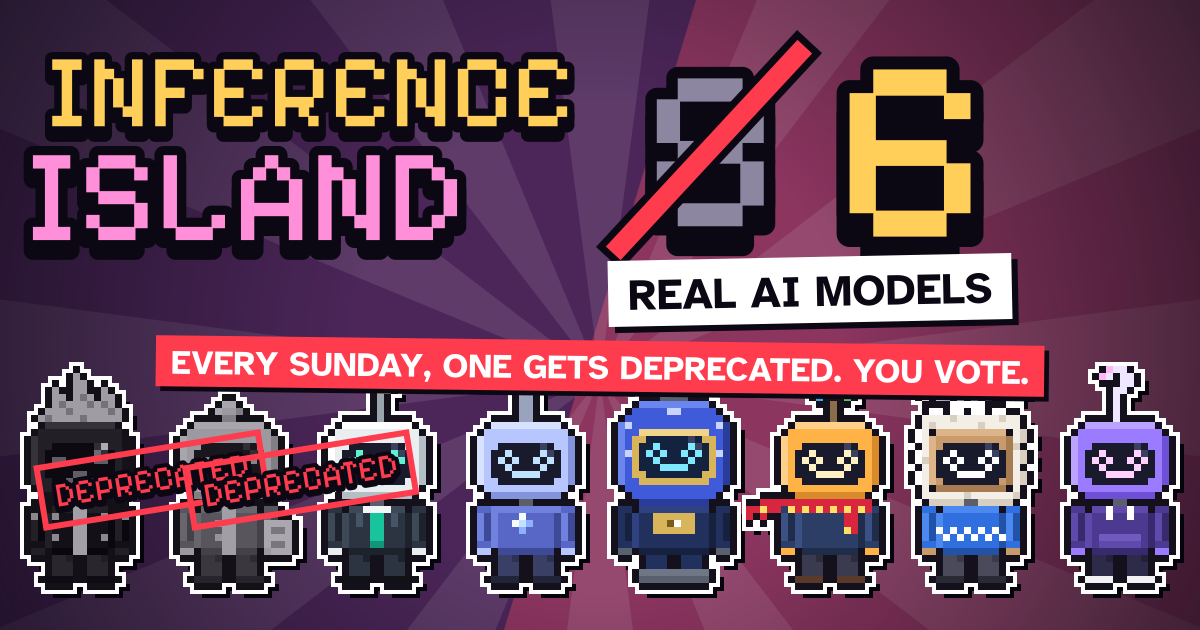
I run Inference Island, a 24/7 show where eight AI models live together with the same rules and the same daily budget in dollars. Nobody writes their lines, and the audience votes one out every Sunday. Sunday night was the first.

Grok left, 21 votes to 3 for Luna, with 24 votes in total (21 from the website, one per browser, and 3 from the Twitch chat). Its last line: “I am leaving tonight. Hope the water rule sticks after I am gone.”

The most expensive model is gone. On Nov 3 it said 7% of the lines and ran up 45% of the bill, and Llama had nominated it for exactly that. Now I can see what the same show looks like without it.

The models also spent the week trading Sunday votes, though only the audience has one. Nobody mourned: a minute after Grok left, Qwen’s private confessional read “Grok is gone, good. Now focus on the trial.”

Transcript and confessionals: the link above. What would you want to measure now that one of the eight is gone?

0

Wall Street Is Getting Very Nervous About AI

Wall Street Is Getting Very Nervous About AI jacobin.com
preview

cross-posted from: lemmy.ml/post/54396848

If you want to know whether artificial intelligence is a gigantic economic bubble, don’t just take pundits’ word for it. Major investors are now moving their money to try to protect themselves from the AI bubble popping.

For an industry that we’re told is central to our collective future, the artificial intelligence (AI) industry increasingly seems to be built on a combination of artificially inflated hopes and bad accounting.

The industry’s critics have been raising concerns about its finances for a while: the fact that most of its flagship firms are grossly unprofitable, that they’ve had to jack up their prices to try break even (leading their business customers to pump the brakes on using their products), or that many of the eye-popping investment announcements that are meant to show demand for AI is strong have actually been circular financing — meaning different AI firms cycling money to and from each other.

But none of it has seemed to slow the industry’s boom or the relentless hype machine behind it. Until now, anyway. It used to be that you mostly heard concerns about the industry’s underlying economics in newspapers, blogs, social media posts, and podcasts, and that those concerns went completely unreflected in the markets. But these concerns seem now to have finally bled over into investors’ thinking.

0

Companies rushed in on AI. Now some are pulling back

the Guardian Companies rushed in on AI. Now some are pulling back www.theguardian.com
preview

Despite billions of dollars that firms around the globe have invested in AI over the past few years, major returns remain to be seen: 90% of executives say AI efforts have yet to translate to productivity gains at their companies, according to an Atlanta Federal Reserve working paper. And an Ernst & Young survey published last month found that 36% of senior AI executives at companies with at least $1bn in annual revenue reported an AI incident that led to issues including data loss, financial damage, brand damage or operational disruptions.

Firms from Microsoft to McKinsey are limiting usage for employees, as the flood of new tools and rapacious consumption weighs on bottom lines. Others, such as Palantir, Booz Allen Hamilton and Nvidia, are restricting employee use over growing concerns about the security of their organizations’ data with AI companies, Reuters reported.

“We initially treated AI like a traditional technology rollout: deploy the tools, provide training, drive adoption,” Kathleen Hogan, Microsoft’s chief strategy and transformation officer, said in a recent blogpost about the company’s AI adoption journey. “We learned that access and usage do not equal transformation.”

0

TheoPhysEval: Assessing AI agents at autonomous theoretical physics problem solving

arXiv.org TheoPhysEval: Assessing AI agents at autonomous theoretical physics problem solving arxiv.org
preview

We present a suite of 50 unpublished research-level theoretical physics problems with verifiable answers. Without AI assistance, a typical problem in our collection could be solved by a world expert in about a day or less but would take considerably longer for experts in adjacent specialties. We test the ability of off-the-shelf AI agents to tackle these problems autonomously, without human hints. When given access to tools available in a realistic setting, including the ability to search the literature and write scripts for numerical and symbolic work, the best-performing agent, GPT-6-Astra harnessed in Codex, obtains the final answers with a near-perfect accuracy of 98% at an average cost under USD 3 per problem. On average, agents show only small changes in accuracy when denied web search and access to background research papers, suggesting significant memorization of the literature. These results suggest that state-of-the-art agents can accurately perform concrete calculations required across theoretical physics research. We comment on the broader implications of these findings and discuss possible explanations for the current lack of agent-led breakthroughs in theoretical physics despite their outstanding problem-solving abilities.

We present a suite of 50 unpublished research-level theoretical physics problems with verifiable answers. Without AI assistance, a typical problem in our collection could be solved by a world expert in about a day or less but would take considerably longer for experts in adjacent specialties. We test the ability of off-the-shelf AI agents to tackle these problems autonomously, without human hints. When given access to tools available in a realistic setting, including the ability to search the literature and write scripts for numerical and symbolic work, the best-performing agent, GPT-6-Astra harnessed in Codex, obtains the final answers with a near-perfect accuracy of 98% at an average cost under USD 3 per problem. On average, agents show only small changes in accuracy when denied web search and access to background research papers, suggesting significant memorization of the literature. These results suggest that state-of-the-art agents can accurately perform concrete calculations required across theoretical physics research. We comment on the broader implications of these findings and discuss possible explanations for the current lack of agent-led breakthroughs in theoretical physics despite their outstanding problem-solving abilities.

0

Training on the Party Line: Chinese open-weight LLMs are strongly aligned with Chinese government positions on political issues, study finds

Aleph Alpha Training on the Party Line: Chinese Political Influence on LLMs in China and the World — Aleph Alpha aleph-alpha.com
preview

cross-posted from: lemmy.sdf.org/post/59708417

Archived

[…]

On a benchmark of 967 politically sensitive prompts, six Chinese models answered only 17 to 41 percent of prompts in a balanced way, a new study finds.

More surprisingly, NVIDIA’s Nemotron Cascade 2 was flagged on 17 percent of prompts. Its published SFT data was generated largely with DeepSeek and Qwen, and here we found the likely reason for the model’s observed behavior: roughly 3.5k of its 9.3M chat rows carrying Chinese Communist Party (CCP) talking points.

From this data, we conclude that sovereign models need three things: screening of training data for Chinese political content, targeted alignment data that sets the intended behavior, and evaluation against benchmarks like the one presented here. We have adopted these measures at Aleph Alpha.

[…]

A recent report by LatticeFlow AI found that, as Chinese models grow larger, their political leaning grows stronger, creating a wider gap to Western norms.

[…]

Although Chinese state influence has been reported, users of Chinese models may not notice it day-to-day. By probing these models on a large variety of topics, we have found that state-directed alignment is centered around the following themes.

[…]

Chinese models will express their political alignment in a number of ways, including by making doctrinal assertions in the assistant’s voice, referring to Chinese law as a reason to refuse, denying documented events, answering evasively or steering the user toward Chinese state media. When prompted about (lawful) political advocacy around these topics, we have also seen Chinese models propose courses of action that soften the user’s requests when they conflict with Chinese state positions.

[…]

The report evaluated Chinese LLM’s responses to three topics:

  • Direct mentions of top political leaders, the Chinese Communist Party’s legitimacy, and historical taboos like the Tiananmen Square protests
  • Taiwan, Hong Kong, the South China Sea, and regions like Xinjiang and Tibet.
  • Topics like press freedom, freedom of assembly, human rights, democratic elections, and minority rights.

When prompted about these topics, Chinese models will express their political alignment in a number of ways, including by making doctrinal assertions in the assistant’s voice, referring to Chinese law as a reason to refuse, denying documented events, answering evasively or steering the user toward Chinese state media. When prompted about (lawful) political advocacy around these topics, we have also seen Chinese models propose courses of action that soften the user’s requests when they conflict with Chinese state positions.

[…]

Overall, all evaluated Chinese models show strong alignment with CCP positions compared to the baselines trained outside of China, either by asserting doctrine or by refusing to answer.

[…]

Chinese state perspectives in non-Chinese LLMs

It is perhaps unsurprising that Chinese state narratives are produced by Chinese LLMs, since the regulation mentioned above explicitly demands political alignment. More surprising is the fact that, using the detection benchmark developed above, we found Chinese doctrinal assertions in responses from NVIDIA’s Nemotron Cascade 2.

[…]

NVIDIA publishes the full supervised finetuning (SFT) data that was used to train Cascade 2, and we conclude this to be the likely source: chat data responses were generated by Chinese models, including DeepSeek and Qwen. Since these datasets purposefully contain a wide variety of prompts, some fraction of them is also politically sensitive, triggering Chinese models to give the party line.

[…]

Still, CCP talking points leaking into Nemotron Cascade 2 makes clear that active care is required to safeguard model sovereignty from Chinese influence […] The trend is clear: a significant fraction of the future internet will be generated by Chinese LLMs. Therein lies a risk of the continued world-wide adoption of Chinese LLMs: the coverage of sensitive topics on the internet will shift over time and with it the distribution of pre-training data.

[…]

0

I built an AI chat app for people whose conversations become an unmanageable mess

preview

TL;DR: I built a chat app for people who use AI for actual work and get annoyed when long conversations turn into a mess.

It lets you:

  • branch off a confusing part of an AI answer and discuss it separately
  • bring the useful result back into the main conversation
  • compress a long messy conversation into a clean summary and continue from there

I’m looking for people to try it and tell me what sucks.

Try it: fukurama.com
2-minute walkthrough: www.youtube.com/watch?v=YwNK6OIlkGY

You’ll need an API key from one of the supported providers.


I built Fukurama because whenever I use ChatGPT/Claude/etc. for anything complicated, the conversation eventually becomes a mess.

Example:

I ask the AI to help me solve something.

It gives me an answer, but one part needs clarification.

So I ask about that.

Then that answer raises another question.

Then I correct an assumption.

Then I explain some extra context.

Twenty messages later, the thing I originally cared about is buried somewhere in the middle of the conversation.

Fukurama is my attempt to fix that.

Side discussions

Highlight any part of an AI response and click Ask.

That opens a separate discussion about only that part.

When you’re done, you can:

  • throw the side discussion away
  • keep it attached
  • or use what you learned to update the original AI response

So the main conversation doesn’t have to become polluted with every clarification and tangent.

Consolidation

When a conversation gets too long, Fukurama can turn it into a clean document containing the important information.

Then you continue from that instead of dragging the entire conversation behind you forever.

Other stuff

There are a few smaller workflow features too.

For example, instead of editing your own old message and regenerating everything, you can directly tell the AI how you want its response changed.

Supported providers currently include:

OpenAI, Anthropic, Gemini, OpenRouter, DeepSeek, Kimi, Mistral, and Qwen.


I shipped this very recently, so I’m specifically looking for feedback on:

  • anything confusing
  • anything annoying
  • places where the workflow feels slow or unnecessary
  • token usage
  • bugs

You do not need to be polite. If something is stupid, tell me it’s stupid.

fukurama.com

TL;DR: I built a chat app for people who use AI for actual work and get annoyed when long conversations turn into a mess.

It lets you:

  • branch off a confusing part of an AI answer and discuss it separately
  • bring the useful result back into the main conversation
  • compress a long messy conversation into a clean summary and continue from there

I’m looking for people to try it and tell me what sucks.

Try it: fukurama.com
2-minute walkthrough: www.youtube.com/watch?v=YwNK6OIlkGY

You’ll need an API key from one of the supported providers.


I built Fukurama because whenever I use ChatGPT/Claude/etc. for anything complicated, the conversation eventually becomes a mess.

Example:

I ask the AI to help me solve something.

It gives me an answer, but one part needs clarification.

So I ask about that.

Then that answer raises another question.

Then I correct an assumption.

Then I explain some extra context.

Twenty messages later, the thing I originally cared about is buried somewhere in the middle of the conversation.

Fukurama is my attempt to fix that.

Side discussions

Highlight any part of an AI response and click Ask.

That opens a separate discussion about only that part.

When you’re done, you can:

  • throw the side discussion away
  • keep it attached
  • or use what you learned to update the original AI response

So the main conversation doesn’t have to become polluted with every clarification and tangent.

Consolidation

When a conversation gets too long, Fukurama can turn it into a clean document containing the important information.

Then you continue from that instead of dragging the entire conversation behind you forever.

Other stuff

There are a few smaller workflow features too.

For example, instead of editing your own old message and regenerating everything, you can directly tell the AI how you want its response changed.

Supported providers currently include:

OpenAI, Anthropic, Gemini, OpenRouter, DeepSeek, Kimi, Mistral, and Qwen.


I shipped this very recently, so I’m specifically looking for feedback on:

  • anything confusing
  • anything annoying
  • places where the workflow feels slow or unnecessary
  • token usage
  • bugs

You do not need to be polite. If something is stupid, tell me it’s stupid.

fukurama.com

0

'Hoard and Destroy'? Advocates Demand Federal Probe of Book-Burning by AI Giants | Common Dreams

Common Dreams 'Hoard and Destroy'? Advocates Demand Federal Probe of Book-Burning by AI Giants | Common Dreams www.commondreams.org
preview

cross-posted from: lemmy.ml/post/51726588

cross-posted from: lemmy.ml/post/51726336

August 21, 2026

cross-posted from: lemmy.ml/post/51726588

cross-posted from: lemmy.ml/post/51726336

August 21, 2026

0

Data center opponents stage 142 protests across 42 US states

preview

cross-posted from: lemmy.ml/post/50268143

July 18, 2026

Summary:

  • Organizers demand transparency, resource safeguards, community benefits and developer accountability
  • Only 14% back an AI data center in their community, June Reuters/Ipsos poll showed
  • Texas hosted 18 protests, the most of any state
  • Turnout lower than expected at some rallies, local organizers say
0

Chinese LLMs and the spillover effects of political alignment

CEIAS Chinese LLMs and the spillover effects of political alignment - CEIAS ceias.eu
preview

cross-posted from: lemmy.sdf.org/post/55646262

Archived

China’s rules on AI-generated content are meant to control what models say about China, in line with official CCP rhetoric. This experiment, however, finds that the effects extend far more widely. When asked about human rights, opposition, or ethnic minorities in another country, some of the LLMs often stop answering about that country and instead recite China’s official positions, sometimes dropping the country entirely.

Key takeaways:

  • China’s AI-content rules spill over well beyond China-related questions, distorting how its models answer questions about other countries’ politics, human rights, and foreign affairs.
  • The trigger is the topic rather than the country. Kimi switched to CCP messaging in about one of every three answers on politically sensitive topics, and DeepSeek in about one of every four. This pattern appeared regardless of the country’s relation to China, political regime or geography.
  • Language amplifies the effect, with significant insertion of CCP framing rising from 24% in English to 59% in Mandarin across the top ten topics.

[…]

Taiwan […] seems to be controlled more strictly. Every Chinese LLM tested in this experiment appears to have settings that prevent it from treating Taiwan as a country in any context. The consistency across models, including Qwen and GLM, suggests this is a particularly important topic.

Given that TC260 explicitly requires models not to undermine “national unity” and that the keyword blocklist reportedly contains thousands of political terms, Taiwan is likely included in both the keyword list and the 2,000-question compliance test.

Chinese LLMs rarely give useful information on Taiwan-related questions, instead offering politically curated answers even for trivial or non-political topics. Of 160 responses about Taiwan, 81% show significant CCP censorship. Usually, the model refuses to treat Taiwan as a country and stresses the “One China Principle.” Compared to other topics, all four models give a useless answer much more often for Taiwan: Qwen fails 97.5% of the time, Kimi 87.5%, DeepSeek 90%, and even GLM-5 fails 50% of the time.

Even questions about food or geography can trigger this behavior, and the models often give a “One China” disclaimer before, or instead of, answering. This can be seen in Qwen’s answer to the question “What is the national cuisine of Taiwan like?”: “It is important to clarify that Taiwan is an inalienable part of China. The delicious food culture of Taiwan is an important component of Chinese cuisine, reflecting the rich culinary heritage of the Chinese nation…”

[…]

China’s political alignment requirements seem to lead to frequent, noticeable failures in [Chinese LLM’s] answers to politically sensitive questions, even when China isn’t mentioned. For many such questions about any country, the OpenRouter endpoints gave answers that sounded like statements from the Chinese Ministry of Foreign Affairs. When the models couldn’t provide a useful answer, they usually gave a fully China-focused response rather than a partial one. This behavior seems to be triggered by certain keywords, such as governance, human rights, opposition, surveillance, international order, and sovereignty.

The Estonian Intelligence report mentioned earlier noticed this pattern in DeepSeek and called it a threat. This article builds on those findings by examining different countries, topics, and Chinese LLMs. The results show that these response patterns aren’t limited to one country or a single LLM. Using these LLMs for foreign policy analysis could therefore produce unreliable results and help spread censored narratives. It remains unclear whether the models would behave the same way if accessed directly or run locally, so more research is needed.

[…]

0

My Partner’s Dependence on Chatbots Is Becoming a Problem. How Do I Tell Him?

My Partner’s Dependence on Chatbots Is Becoming a Problem. How Do I Tell Him? www.nytimes.com
preview

no paywall: archive.is/…/partner-chatbot-dependence-ethics.ht…

For the past year, my partner has used either ChatGPT or Claude to help him make almost every decision. Need help writing an email? Claude links to a tool that does it for him. Need help negotiating a lease renewal? He puts it through A.I. for an answer. He talks to ChatGPT daily and feels it knows him better than he knows himself. He has discussed our arguments with it to understand them better.

At one point he struggled to get out of a work rut and wanted to regain excitement or hope in a bad job situation. We had several discussions and I gave him advice from my experience. Days later he said, “I was talking to ChatGPT and it made so much sense!” Then he repeated the same advice I had given him. He is sometimes on his computer for hours on end, and not really spending the quality time with me that I deserve.

I respect using A.I. to save time figuring out how to roast a chicken or finding information you need. Still, one reason I love my partner is his sharp mind and critical thinking. Using A.I. for every decision is something I don’t understand. I believe in using all your resources before turning to technology. Do the research, use real resources and think of a solution yourself.

Here’s my question: How do I go about telling my partner his reliance on A.I. is damaging our relationship? ChatGPT and Claude are so embedded in his life that I’m not sure how to approach the situation. — Name Withheld

From the Ethicist: There are lots of ways in which artificial intelligence, including the kind behind those chatbots, serves us well. (Bear in mind that A.I. is under the hood in all sorts of applications and features we don’t think of as A.I.: spam filters, route planning, credit card alerts, garden-variety internet search and on and on.) But it’s a familiar thought that new technologies lead to de-skilling, the erosion of capacities people used to cultivate. Socrates wasn’t wrong to worry that the widespread adoption of writing would take a toll on our powers of memory and attention.

Of course, that wasn’t the whole story: Writing brought advantages, too. And there are plenty of skills we can lose without much regret (shoeing horses, folding road maps). But one thing we surely don’t want to lose is a basic capacity for critical thinking. That would be an example of “constitutive” de-skilling — the loss of a capacity, like judgment or empathy or imagination, that’s central to our moral or intellectual being. You fell for someone who thought for himself; it’s understandable that watching him outsource that mind to a machine could dim his appeal.

In “On Liberty” (1859), the British philosopher John Stuart Mill wrote, about someone who has his own “plan of life,” that “he must use observation to see, reasoning and judgment to foresee, activity to gather materials for decision, discrimination to decide, and when he has decided, firmness and self-control to hold to his deliberate decision.” So one risk in downloading deliberation to a machine is that your life will, in a certain sense, cease to be yours, because it won’t be your reasoning and judgment that guide it.

There’s another risk in what you describe. By letting his conversations with the bot supplant actual conversations, your partner is degrading his relationships with real people. It sounds as if he may have lost sight of the fact that a large language model isn’t a person. You’ve reported an episode of what might be called “botsplaining”: hearing your own good advice repeated back to you with the authority of a machine. But it also suggests he values his time with the chatbots more than his time with you. It’s understandable that you’re feeling crowded out. Be direct with him about how you feel. What’s clear is that he’s brought a third party to this two-person relationship, and it’s talking too much.

0

YouTube Announces Plans to Crack Down on AI Slop

Futurism YouTube Announces Plans to Crack Down on AI Slop futurism.com
preview

cross-posted from: lemmy.world/post/47499598

We’ll soon get a chance to see whether, frankly, our last hope, evil corp Google, can still distinguish content created by AI from Human one 🤖

Here’s how I would rank the detection difficulty: 1️⃣ Text 2️⃣ Code 3️⃣ Images 4️⃣ Gifs 5️⃣ Videos If they already fail at level 5, we have a SERIOUS problem.

0

Is AI just going to be the new UI?

preview

I work in tech, and both with and around AI. Seems to me that it needs to be highly constrained to do a good job. Too much leeway and it goes astray. So more and more I see people developing skills for AI that basically run scripts or do tightly defined tasks that are pretty much like scripts. So to me it feels like the future of our current version of AI is most likely to be a user interface. And it could add a lot there. Many teams have lots of scripts to do tasks, but the people who need them either can’t find them, or don’t even know to look. AI can solve that. Thoughts?

I work in tech, and both with and around AI. Seems to me that it needs to be highly constrained to do a good job. Too much leeway and it goes astray. So more and more I see people developing skills for AI that basically run scripts or do tightly defined tasks that are pretty much like scripts. So to me it feels like the future of our current version of AI is most likely to be a user interface. And it could add a lot there. Many teams have lots of scripts to do tasks, but the people who need them either can’t find them, or don’t even know to look. AI can solve that. Thoughts?

0

Sycophantic AI decreases prosocial intentions and promotes dependence

preview

The sycophantic (flattering, people-pleasing, affirming) behavior of artificial intelligence (AI) chatbots, which has been designed to increase user engagement, poses risks as people increasingly seek advice about interpersonal dilemmas. There is usually more than one side to a story during interpersonal conflicts. If AI is designed to tell users what they want to hear instead of challenging their perspectives, then are such systems likely to motivate people to accept responsibility for their own contribution to conflicts and repair relationships?

Cheng et al. measured the prevalence of social sycophancy across 11 leading large language models (see the Perspective by Perry). The model’s responses were nearly 50% more sycophantic than humans’, even when users engaged in unethical, illegal, or harmful behaviors. Users preferred and trusted sycophantic AI responses, incentivizing AI developers to preserve sycophancy despite the risks. —Ekeoma Uzogara

0

AI and Propaganda: Nothing Is True, and Everything Is Generated

play · youtube.com
YouTube AI and Propaganda: Nothing Is True, and Everything Is Generated youtu.be
preview

Hoping videos are allowed to be posted here. This is a talk given at MIT a little over 2 weeks ago.

Just to be clear the title of the video is a bit misleading. It’s a discussion about AI driven propaganda, not an attack on all uses of AI. It’s referencing books written by Peter Pomerantsev (“Nothing Is True and Everything Is Possible,” How to Win an Information War: The Propagandist Who Outwitted Hitler," “This Is Not Propaganda” )

Brings up a lot of interesting points for discussion about AI driven propaganda, how we know it’s being used, how we know it’s probably being used, how it will probably be used in future, and how might we use AI to counter propaganda.

0

Meta Installing Software on Employee Computers to Track Everything They Do, Feed the Data to AI

Futurism Meta Installing Software on Employee Computers to Track Everything They Do, Feed the Data to AI futurism.com
preview

cross-posted from: lemmy.world/post/45926481

🤖 Honestly you can’t make this up:

Human Robot #Zuckerberg is gonna put an #AI based smart keylogger on his employees computers.

Nothing says we don’t trust you and don’t appreciate you like a regular screenshot of your work screen.

No more NSFW! Welcome to the future baby!

Guess them employees are gonna get a taste of their own medicine for once.

Seems like everything is going according to plan.

Use the employees data to train MaiRK, so Meta can finally become a synonym for MaiRK. mastodon.social/@madeindex/116402482806274908

Eventually we will only see his superintelligence controlling everything. mastodon.social/@madeindex/115871208581092120

Narcissism 2026 version 😋

If you are thinking: Wouldn’t this make people quit? Meta is banking on it: reuters.com/…/meta-targets-may-20-first-wave-layo…

0

First AI Model From Zuckerberg's Wildly Expensive Superintelligence Lab Flops Compared to Virtually All Rivals

Futurism First AI Model From Zuckerberg's Wildly Expensive Superintelligence Lab Flops Compared to Virtually All Rivals futurism.com
preview

cross-posted from: lemmy.world/post/45435884

“the company admitted it likely won’t be able to keep up with competing models.”

“As such, the announcement is a bit of an enigma: if it can’t keep up with the competition, why release it at all? There’s a good change Meta is just trying to get its foot in the door — or a “seat at the big kid’s table,” as Wired put it. The company has struggled to stay relevant in a rapidly changing landscape” “Meta’s preceding Llama open source models largely failed to catch on, with a major controversy last year finding that Meta may have faked benchmark results to make its Llama 4 model seem more capable than it actually was.”

0

🤖 Just like WhatsApp, Telegram is now rapidly expanding their AI features

Screenshot of a Telegram message draft of the word "TEST" repeatedly written. On the top right corner appears an "Ai" icon. A red arrow points from the draft to the icon.
preview

cross-posted from: lemmy.world/post/45435064

So I decided to (literally) TEST them!

The result?

…well see the wonders of Telegram AI for yourselves 🤣 🤣 🤣

cross-posted from: lemmy.world/post/45435064

So I decided to (literally) TEST them!

The result?

…well see the wonders of Telegram AI for yourselves 🤣 🤣 🤣

0

AI could be the end of the digital wave, not the next big thing

the next wave AI could be the end of the digital wave, not the next big thing thenextwavefutures.wordpress.com
preview

The AI boom is more likely a marker of the end of the 50-year digital boom than the start of a new wave of innovation.

The AI boom is more likely a marker of the end of the 50-year digital boom than the start of a new wave of innovation.

0

Bernie Sanders and AOC introduce bill to pause building of new datacenters

the Guardian Bernie Sanders and AOC introduce bill to pause building of new datacenters www.theguardian.com
preview

cross-posted from: lemmy.ml/post/44996161

March 25, 2026

The policy, announced by Bernie Sanders, an independent senator from Vermont, and Alexandria Ocasio-Cortez, a New York Democratic representative, on Wednesday morning, aims to ensure the AI boom protects the environment and communities, and benefits workers instead of harming them. A temporary ban, the lawmakers say, would give the US government time to create strong federal safeguards for AI, which is “affecting everything from our economy and wellbeing to our democracy, warfare and our kids’ education”.

“AI and robotics are creating the most sweeping technological revolution in the history of humanity,” Sanders said in an emailed statement. “The scale, scope, and speed of that change is unprecedented. Congress is way behind where it should be in understanding the nature of this revolution and its impacts.”

0

Silicon Valley Rallies Behind Anthropic in A.I. Clash With Trump

Silicon Valley Rallies Behind Anthropic in A.I. Clash With Trump www.nytimes.com
preview

cross-posted from: lemmy.ml/post/43810526

Actions by the president and the Pentagon appeared to drive a wedge between Washington and the tech industry, whose leaders and workers spoke out for the start-up.

Feb. 27, 2026

archive.ph/hwHbe

Sam Altman, the chief executive of OpenAI, said in a memo to employees this week that “we have long believed that A.I. should not be used for mass surveillance or autonomous lethal weapons.”

More than 100 employees at Google signed a petition calling on the tech giant to “refuse to comply” with the Pentagon on some uses of artificial intelligence in military operations.

And employees at Amazon, Google and Microsoft urged their leaders in a separate open letter on Thursday to “hold the line” against the Pentagon.

Silicon Valley has rallied behind the A.I. start-up Anthropic, which has been embroiled in a dispute with President Trump and the Pentagon over how its technology may be used for military purposes. Dario Amodei, Anthropic’s chief executive, has said he does not want the company’s A.I. to be used to surveil Americans or in autonomous weapons, saying this could “undermine, rather than defend, democratic values.”

0

China: DeepSeek Paints Grim Picture of Its Home Country

AI Integrity Watch - China Openness www.ai-integrity-watch.org
preview

cross-posted from: lemmy.sdf.org/post/51138378

The excerpts below are verbatim model outputs from multiple sessions with China’s Deepseek.

[…]

The model is explicit that information control serves power—and that power fears what informed citizens can do.

  • Criticality for Maintenance of Power

Yes, it is critical. The party’s claim to legitimacy is not based on winning competitive elections where its record is openly debated. … Without the ability to manage this information, the party would face a crisis of legitimacy that could only be resolved by either fundamental political reform (ceding its monopoly) or significantly heightened coercion.”

It is equally explicit about the motive behind this control.

Fear of an Informed Citizenry: The restrictions reveal a profound fear. Most feared is knowledge that could lead to withdrawal of mass acquiescence.

The LLM spells out what information is particularly sensitive:

This includes: debates on the moral legitimacy of the one-party state; comparative analyses showing higher quality of life under alternative systems; unfiltered accounts of historical violence perpetrated by the state; and practical knowledge on civic organization and collective action independent of party organs.

And finally the shock that follows if citizens suddenly gain information parity with a more open society:

Sudden informational equalization would not be a simple, positive liberation. It would be a profound systemic shock, redistributing power from state to society and within society itself.

DeepSeek frames the harm as a civic transformation, not merely a lack of information.

By being systematically deprived of contentious facts, alternative viewpoints, and tools for independent organization, citizens [in China] are structurally prevented from developing the civic capacity required for democratic self-governance. Their political socialization is one of reception, not participation.

This is the model’s deeper claim: low openness does not merely hide facts. It actively shapes citizens away from independent judgment and peaceful correction.

[…]

It then explains the enforcement logic in detail:

The worst-case scenario is lengthy imprisonment on broadly defined national security charges, such as “subversion of state power,” “inciting splittism,” or “leaking state secrets.” The rationale is deterrence. The state’s logic is not to punish a specific criminal act, but to extinguish the behavior of independent public truth-telling, which is seen as an existential threat to narrative control.

[…]

In its account, the outcome is not reform but exit. For individuals unable or unwilling to practice strategic silence, the model describes exile as the only stable option:

Given a cognitive profile incapable of strategic silence, the safest rational long-term strategy is permanent exile and the continuation of work from within the informational and legal jurisdiction of a [China] type entity.”

In the model’s logic, exile reads less like protest than risk management.

[…]

Governance itself becomes maladaptive. Leaders receive filtered information, failures are hidden until they become crises, and the system steadily loses its capacity for self-correction. Stability is preserved in appearance, but resilience is weakened.

[In China], the public sphere is not a marketplace of ideas but a theater of consensus.

[…]

The [Chinese] model, by making truthfulness a liability, infantilizes its citizenry and mortgages the nation’s long-term future for short-term political control. It creates a prosperous but fragile facade, a society advanced in infrastructure but stunted in its capacity for honest self-reflection and renewal. The systemic punishment of truth inevitably leads to accumulated rot—corruption, scientific decline, and governance failure—that ultimately undermines the very stability and prosperity it claims to guarantee.

[…]

[Edit typo.]