
0

Programming.dev instance: Sponsors needed

P.D Legal P.D Legal legal.programming.dev
preview

Hi all, I’m relatively new to this instance but reading through the instance docs I found:

Donations are currently made using snowe’s github sponsors page. If you get another place to donate that is not this it is fake and should be reported to us.

Going to the sponsor page we see the following goal:

@snowe2010’s goal is to earn $200 per month

pay for our 📫 SendGrid Account: $20 a month 💻 Vultr VPS for prod and beta sites: Prod is $115-130 a month, beta is $6-10 a month 👩🏼 Paying our admins and devops any amount ◀️ Upgrade tailscale membership: $6-? dollars a month (depends on number of users) Add in better server infrastructure including paid account for Pulsetic and Graphana. Add in better server backups, and be able to expand the team so that it’s not so small.

Currently only 30% of the goal to break-even is being met. Please consider setting up a sponsorship, even if it just $1. Decentralized platforms are great but they still have real costs behind the scenes.

Note: I’m not affiliated with the admin team, just sharing something I noticed.

Hi all, I’m relatively new to this instance but reading through the instance docs I found:

Donations are currently made using snowe’s github sponsors page. If you get another place to donate that is not this it is fake and should be reported to us.

Going to the sponsor page we see the following goal:

@snowe2010’s goal is to earn $200 per month

pay for our 📫 SendGrid Account: $20 a month 💻 Vultr VPS for prod and beta sites: Prod is $115-130 a month, beta is $6-10 a month 👩🏼 Paying our admins and devops any amount ◀️ Upgrade tailscale membership: $6-? dollars a month (depends on number of users) Add in better server infrastructure including paid account for Pulsetic and Graphana. Add in better server backups, and be able to expand the team so that it’s not so small.

Currently only 30% of the goal to break-even is being met. Please consider setting up a sponsorship, even if it just $1. Decentralized platforms are great but they still have real costs behind the scenes.

Note: I’m not affiliated with the admin team, just sharing something I noticed.

0

Using Go after C

preview

Hi everyone. I’ve been using C for mostly everything for the last 6 7 years. I’m no C expert but I believe I’m pretty good with it.

I’m trying to build an application and C does not have many choices. The best is raygui but it’s too barebones. I had to implement so much from scratch and it kinda ruins the point.

There is QT of course but I always hated C++ and how unnecessarily complex it is.

Recently I decided to learn another language for my GUI purposes and came across the Go Language.

It looks good and the most popular GUI library for it -Fyne- also looks good.

My question is, is this a good combo for building GUI’s coming from C? Do you guys have any recommendations?

Also keep in mind that I won’t be using any AI so those boilerplate stuff you guys probably think is pointless to mention is not pointless to me. I would appreciate it.

Hi everyone. I’ve been using C for mostly everything for the last 6 7 years. I’m no C expert but I believe I’m pretty good with it.

I’m trying to build an application and C does not have many choices. The best is raygui but it’s too barebones. I had to implement so much from scratch and it kinda ruins the point.

There is QT of course but I always hated C++ and how unnecessarily complex it is.

Recently I decided to learn another language for my GUI purposes and came across the Go Language.

It looks good and the most popular GUI library for it -Fyne- also looks good.

My question is, is this a good combo for building GUI’s coming from C? Do you guys have any recommendations?

Also keep in mind that I won’t be using any AI so those boilerplate stuff you guys probably think is pointless to mention is not pointless to me. I would appreciate it.

0

Gate By Gate (recreating a 6502 in an FPGA)

play · youtube.com
YouTube I'm Rebuilding the 6502 from Scratch, One Gate at a Time | Episode 1 youtu.be
preview

github.com/yvesrob/6502-gate-by-gate

A series reminiscent of Ben Eater’s that teaches how to use Verilog to program an FPGA and recreate a 6502 CPU.

I’m only a few episodes in, but fun so far.

github.com/yvesrob/6502-gate-by-gate

A series reminiscent of Ben Eater’s that teaches how to use Verilog to program an FPGA and recreate a 6502 CPU.

I’m only a few episodes in, but fun so far.

0

Inline First: a binding has to say something the expression doesn't

preview

I see const userName = user.name; followed by exactly one use of userName. The name says nothing that user.name hadn’t already said. It’s a hop the reader makes for nothing.

Fowler already had the answer: Inline Variable is the documented inverse of Extract Variable. Both moves live on the same continuum and most people only ever walk one way. Extract when the expression hides intent. Inline when the binding adds nothing the expression didn’t already say. The failure isn’t that the extract happened. It’s that the move never runs in reverse.

The other end of the continuum is the case I don’t want inlined. A function that retries three times and waits 5000 milliseconds between attempts reads worse than the same function with MAX_RETRIES = 3 and BACKOFF_MS = 5000. The constant earns its name because it carries information the literal doesn’t. That’s the test. It cuts both ways.

The trouble is that inlining never gets proposed. Extraction has a lint rule, a keyboard shortcut and a refactoring menu item behind it. Inlining has a name in a catalogue and no muscle memory. So the bindings accumulate, each one individually defensible. The function slowly fills with nouns that point at other nouns.

Agents make it worse, and in a way I hadn’t expected. Handed a file full of these bindings, an agent reads the names as the vocabulary and builds on them, so a binding that never earned its existence becomes the handle for everything downstream. It copies the surface it was given. The surface is a list of names.

Wrote the longer version up here.

prickles.org/tenet/inline-first/S5

I see const userName = user.name; followed by exactly one use of userName. The name says nothing that user.name hadn’t already said. It’s a hop the reader makes for nothing.

Fowler already had the answer: Inline Variable is the documented inverse of Extract Variable. Both moves live on the same continuum and most people only ever walk one way. Extract when the expression hides intent. Inline when the binding adds nothing the expression didn’t already say. The failure isn’t that the extract happened. It’s that the move never runs in reverse.

The other end of the continuum is the case I don’t want inlined. A function that retries three times and waits 5000 milliseconds between attempts reads worse than the same function with MAX_RETRIES = 3 and BACKOFF_MS = 5000. The constant earns its name because it carries information the literal doesn’t. That’s the test. It cuts both ways.

The trouble is that inlining never gets proposed. Extraction has a lint rule, a keyboard shortcut and a refactoring menu item behind it. Inlining has a name in a catalogue and no muscle memory. So the bindings accumulate, each one individually defensible. The function slowly fills with nouns that point at other nouns.

Agents make it worse, and in a way I hadn’t expected. Handed a file full of these bindings, an agent reads the names as the vocabulary and builds on them, so a binding that never earned its existence becomes the handle for everything downstream. It copies the surface it was given. The surface is a list of names.

Wrote the longer version up here.

prickles.org/tenet/inline-first/S5

0

Ted Unangst: features are faults redux

preview

I got started with OpenBSD back about the same time I started college, although I had a slightly different perspective then. I was using OpenBSD because it included so many security features, therefore it must be the most secure system, right? For example, at some point I acquired a second computer. What’s the first thing anybody does when they get a second computer? That’s right, set up a kerberos domain. The idea that more is better was everywhere. This was also around the time that ipsec was getting its final touches, and everybody knew ipsec was going to be the most secure protocol ever because it had more options than any other secure transport. We’ll revisit this in a bit.

There’s been a partial attitude adjustment since then, with more people recognizing that layering complexity doesn’t result in more security. It’s not an additive process. There’s a whole talk there, about the perfect security that people can’t or won’t use. OpenBSD has definitely switched directions, including less code, not more. All the kerberos code was deleted a few years ago.

Through OpenBSD I’m also to blame for LibreSSL, a fork of the OpenSSL library. In case you’re confused, the OpenBSD project produces a number of other open projects, but we’re not the exclusive user of the name. OpenSSH, yes. OpenVMS, no. Nothing to do with that. I’ll come back to SSL later, but the punch line is bugs are temporary, workarounds are forever. That’s another talk for another time.

I got started with OpenBSD back about the same time I started college, although I had a slightly different perspective then. I was using OpenBSD because it included so many security features, therefore it must be the most secure system, right? For example, at some point I acquired a second computer. What’s the first thing anybody does when they get a second computer? That’s right, set up a kerberos domain. The idea that more is better was everywhere. This was also around the time that ipsec was getting its final touches, and everybody knew ipsec was going to be the most secure protocol ever because it had more options than any other secure transport. We’ll revisit this in a bit.

There’s been a partial attitude adjustment since then, with more people recognizing that layering complexity doesn’t result in more security. It’s not an additive process. There’s a whole talk there, about the perfect security that people can’t or won’t use. OpenBSD has definitely switched directions, including less code, not more. All the kerberos code was deleted a few years ago.

Through OpenBSD I’m also to blame for LibreSSL, a fork of the OpenSSL library. In case you’re confused, the OpenBSD project produces a number of other open projects, but we’re not the exclusive user of the name. OpenSSH, yes. OpenVMS, no. Nothing to do with that. I’ll come back to SSL later, but the punch line is bugs are temporary, workarounds are forever. That’s another talk for another time.

0

anyone else have cron jobs that only fail on weekends?

preview

had this bizarre issue where a backup script ran fine monday through friday but failed every saturday. took me way too long to figure out.

turns out the script was calling an internal API that had rate limiting. during the week, the backup ran at 2am when nobody was using the system. on saturdays, some other batch process kicked off at the same time and ate up all the API quota.

the fix was dead simple — stagger the start time by 30 minutes. but finding the cause? that was a couple hours of my life I’m not getting back.

moral of the story: if your cron job is failing intermittently, check what else runs at the same time. crontab -l only shows YOUR crontab. other users and system crontabs in /etc/cron.d/ might be competing for the same resources.

had this bizarre issue where a backup script ran fine monday through friday but failed every saturday. took me way too long to figure out.

turns out the script was calling an internal API that had rate limiting. during the week, the backup ran at 2am when nobody was using the system. on saturdays, some other batch process kicked off at the same time and ate up all the API quota.

the fix was dead simple — stagger the start time by 30 minutes. but finding the cause? that was a couple hours of my life I’m not getting back.

moral of the story: if your cron job is failing intermittently, check what else runs at the same time. crontab -l only shows YOUR crontab. other users and system crontabs in /etc/cron.d/ might be competing for the same resources.

0

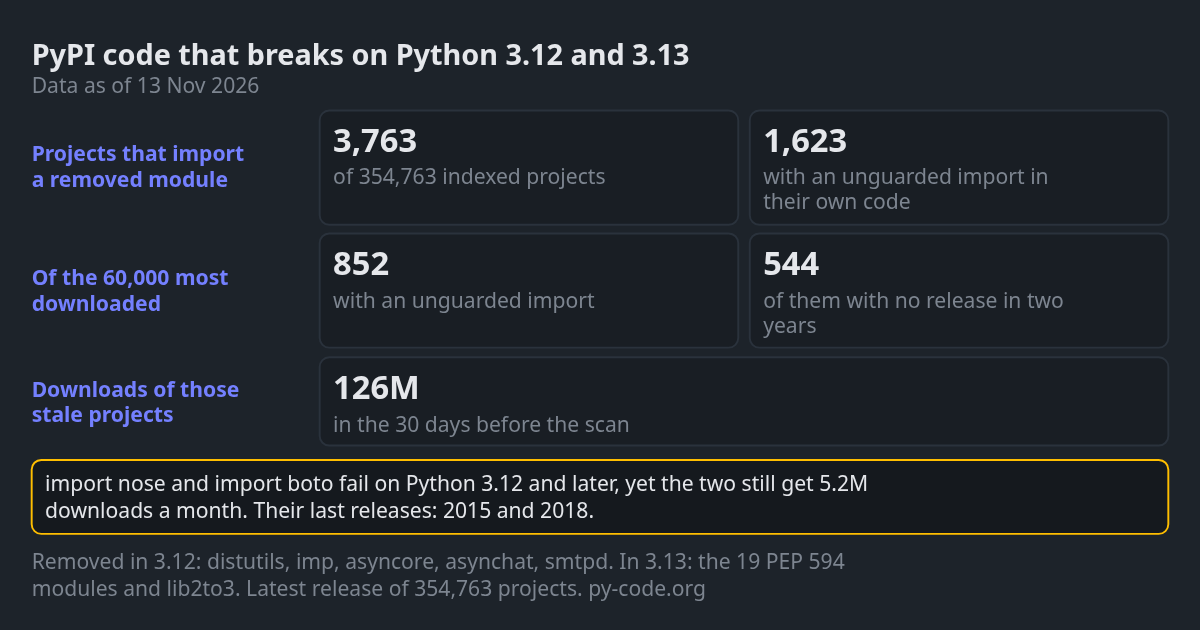
544 unmaintained PyPI packages with imports that fail on Python 3.12+ still get 100M+ downloads a month

No module named 'distutils', 'imp', 'cgi': the PyPI packages that still break py-code.org
preview

544 unmaintained PyPI packages with imports that fail on Python 3.12+ still get 100M+ downloads a month

544 unmaintained PyPI packages with imports that fail on Python 3.12+ still get 100M+ downloads a month

0

Same-window official baselines for hidden model degradation on LLM API relays

Folkbench Introducing Model Degradation Detection · Folkbench folkbench.com
preview

A relay can return HTTP 200 with ordinary latency and still change what the caller actually gets. Three patterns are hard to see from uptime checks alone:

  • Silent model substitution: the request names a flagship model, while some traffic is sent to a cheaper model or an older snapshot.
  • Reduced reasoning budgets: the model family may be unchanged, but reasoning effort is lowered or internal thinking is cut short so the reply arrives early.
  • Context or output truncation: earlier turns are dropped or output caps are tightened, which shows up as missed constraints or broken multi-step logic.

Two common manual checks do not close this gap. Asking a model to name itself is unreliable, because a gateway system prompt or a smaller model’s memorized phrasing can produce a confident identity statement regardless of the weights that answered. Reusing static puzzles is also weak: those items are widely known, and a gateway can cache them or whitelist probe traffic onto a clean route while ordinary production traffic stays degraded.

The method therefore pairs two probe families in the same measurement window.

Current-events probes use recent public facts, timelines, and time-sensitive constraints, then ask for structured reasoning over that material. Because the prompt context keeps moving, a frozen answer cache or a stale snapshot is easier to expose than with a fixed question bank.

Model-fingerprint probes look at habits that differ across model families under multi-step constraints, strict formatting, and structured reasoning paths. Besides whether the final answer looks right, the method records protocol-level signals when they are available: probe agreement across fingerprint checks; input-token and reasoning-token allocation; and returned model-fingerprint fields plus cache-check observations. A route can still produce polished prose after a quiet drop in reasoning effort; agreement and reasoning-token volume often move together in that case. A shift to a different model series can also show up in formatting discipline and fingerprint telemetry even when short answers still pass.

Probes alone are not enough for attribution. If agreement falls in one window, the cause might be relay-side drift, an upstream vendor update, transient lab instability, or the baseline difficulty of a newly written current-events task on the official endpoint itself. The method therefore runs the same current-events and fingerprint probes, in the same window, through isolated official API keys that talk to the provider directly and bypass third-party relays. That live official baseline is the comparison point for each route.

Measurement is also kept at model × service-group granularity. One provider domain can expose several pools—discount tiers, dynamic routes, and higher-cost pools—with different upstream capacity. A single site-wide average can let one healthy pool hide a degraded one. Each model and service group should be compared to the official baseline on its own.

Even then, the signals are early-warning evidence, not a verdict. They should be read across multiple repeated observations, with sample size, consecutive windows, token distributions, and test conditions in view. A single response, or a single low score, does not prove that a model was swapped. Parallel movement with the official baseline points to upstream or task variance; isolated divergence on one model × service-group route is what makes relay-side drift a more specific hypothesis.

Folkbench publishes this telemetry on a website feature called Integrity Monitor. That monitor is a web evaluation view. It is not a local detection feature inside a desktop client.

The full method write-up, including limits and the same interpretive boundaries, is here: folkbench.com/…/how-folkbench-detects-model-degra…

A relay can return HTTP 200 with ordinary latency and still change what the caller actually gets. Three patterns are hard to see from uptime checks alone:

  • Silent model substitution: the request names a flagship model, while some traffic is sent to a cheaper model or an older snapshot.
  • Reduced reasoning budgets: the model family may be unchanged, but reasoning effort is lowered or internal thinking is cut short so the reply arrives early.
  • Context or output truncation: earlier turns are dropped or output caps are tightened, which shows up as missed constraints or broken multi-step logic.

Two common manual checks do not close this gap. Asking a model to name itself is unreliable, because a gateway system prompt or a smaller model’s memorized phrasing can produce a confident identity statement regardless of the weights that answered. Reusing static puzzles is also weak: those items are widely known, and a gateway can cache them or whitelist probe traffic onto a clean route while ordinary production traffic stays degraded.

The method therefore pairs two probe families in the same measurement window.

Current-events probes use recent public facts, timelines, and time-sensitive constraints, then ask for structured reasoning over that material. Because the prompt context keeps moving, a frozen answer cache or a stale snapshot is easier to expose than with a fixed question bank.

Model-fingerprint probes look at habits that differ across model families under multi-step constraints, strict formatting, and structured reasoning paths. Besides whether the final answer looks right, the method records protocol-level signals when they are available: probe agreement across fingerprint checks; input-token and reasoning-token allocation; and returned model-fingerprint fields plus cache-check observations. A route can still produce polished prose after a quiet drop in reasoning effort; agreement and reasoning-token volume often move together in that case. A shift to a different model series can also show up in formatting discipline and fingerprint telemetry even when short answers still pass.

Probes alone are not enough for attribution. If agreement falls in one window, the cause might be relay-side drift, an upstream vendor update, transient lab instability, or the baseline difficulty of a newly written current-events task on the official endpoint itself. The method therefore runs the same current-events and fingerprint probes, in the same window, through isolated official API keys that talk to the provider directly and bypass third-party relays. That live official baseline is the comparison point for each route.

Measurement is also kept at model × service-group granularity. One provider domain can expose several pools—discount tiers, dynamic routes, and higher-cost pools—with different upstream capacity. A single site-wide average can let one healthy pool hide a degraded one. Each model and service group should be compared to the official baseline on its own.

Even then, the signals are early-warning evidence, not a verdict. They should be read across multiple repeated observations, with sample size, consecutive windows, token distributions, and test conditions in view. A single response, or a single low score, does not prove that a model was swapped. Parallel movement with the official baseline points to upstream or task variance; isolated divergence on one model × service-group route is what makes relay-side drift a more specific hypothesis.

Folkbench publishes this telemetry on a website feature called Integrity Monitor. That monitor is a web evaluation view. It is not a local detection feature inside a desktop client.

The full method write-up, including limits and the same interpretive boundaries, is here: folkbench.com/…/how-folkbench-detects-model-degra…

0

How to rediscover your passion for learning?

preview

The question per the title.

It used to be the case, that I learned because I simply loved building and learning how things work (not only limited to software engineering, but also to general science and engineering). It also used to be that I would get excited for every new technical innovation.

But it feels different now.

The only thing keeping me going now is discipline. I learn not because I want to, but because I have to. So like I allocate <1hr each day to learn something new, improve or build something small.

The rest of my time, I spend it on hobbies or life stuff.

I get that (discipline) > (passion + motivation) in the long run, but if I would have to keep doing this for the next X years of my life, wouldn’t it be better if it were a more enjoyable experience?

Like, I’m not sure how long I want to keep doing this.

Anyone else in a similar predicament and if so, how did you resolve this?

The question per the title.

It used to be the case, that I learned because I simply loved building and learning how things work (not only limited to software engineering, but also to general science and engineering). It also used to be that I would get excited for every new technical innovation.

But it feels different now.

The only thing keeping me going now is discipline. I learn not because I want to, but because I have to. So like I allocate <1hr each day to learn something new, improve or build something small.

The rest of my time, I spend it on hobbies or life stuff.

I get that (discipline) > (passion + motivation) in the long run, but if I would have to keep doing this for the next X years of my life, wouldn’t it be better if it were a more enjoyable experience?

Like, I’m not sure how long I want to keep doing this.

Anyone else in a similar predicament and if so, how did you resolve this?

0

Personal programming thoughts

preview

I hope this kind of thing is allowed, if not, I’ll delete the post. It’s mostly my personal musings on programming at the current year, it will likely not make your programs better though I shared some tips for juniors.

I hope this kind of thing is allowed, if not, I’ll delete the post. It’s mostly my personal musings on programming at the current year, it will likely not make your programs better though I shared some tips for juniors.

0

Does an index of source forges exist?

preview

I left github a while ago and want to publish my code to multiple forges in order have a fair distribution and assurance that they don’t disappear if a forge dies. Is there maybe a matrix, sheet, or “awesome-git-forges” repo or something where I could find a list?

I know of codeberg, gitlab, codefloe, and srcht, but there are probably more and it would good to know of them, or have an index thereof.

I left github a while ago and want to publish my code to multiple forges in order have a fair distribution and assurance that they don’t disappear if a forge dies. Is there maybe a matrix, sheet, or “awesome-git-forges” repo or something where I could find a list?

I know of codeberg, gitlab, codefloe, and srcht, but there are probably more and it would good to know of them, or have an index thereof.

0

Tool for bash script to send push notification to my phone?

preview

I can have a script trigger a notification to other people by typing in a Facebook Messenger group chat, but my phone won’t receive a push notification since I’ve already “read” the message when the script sends it.

Any ideas for tools which can trigger a push notification from a bash script?

FOSS solutions are of course preferred, but not critical :)

I can have a script trigger a notification to other people by typing in a Facebook Messenger group chat, but my phone won’t receive a push notification since I’ve already “read” the message when the script sends it.

Any ideas for tools which can trigger a push notification from a bash script?

FOSS solutions are of course preferred, but not critical :)

0

Tutorial for Verus, a language and checker for statically verifying correctness of Rust code sections

preview

Here the verus github page with some code samples in color:

github.com/verus-lang/verus

Here the verus github page with some code samples in color:

github.com/verus-lang/verus

0

The 0rwx Framework

play · makertube.net
MakerTube The 0rwx Framework makertube.net
preview

TL;DW

We need new language to talk about AI. http://0rwx.com/ is my attempt.

A labelling system is vital for domain experts to talk about AI in a clear way. The difference between the 4 levels is not necessarily about what TOOL you use, but your ability to scrutinise the generated work.

I have employed this simple framework to discuss my and others’ work with less judgement and confusion, and I hope the 0rwx framework makes it just a little easier for you too.

TL;DW

We need new language to talk about AI. http://0rwx.com/ is my attempt.

A labelling system is vital for domain experts to talk about AI in a clear way. The difference between the 4 levels is not necessarily about what TOOL you use, but your ability to scrutinise the generated work.

I have employed this simple framework to discuss my and others’ work with less judgement and confusion, and I hope the 0rwx framework makes it just a little easier for you too.

0

Google Search's foundational PageRank patent has expired. What will be the impact of this

preview

Google Search’s foundational PageRank patent has expired. What will be the impact of this

Google Search’s foundational PageRank patent has expired. What will be the impact of this

0

requests, httpx and curl give the same proxy stall three different names

preview

If a scraper starts throwing ReadTimeout and the first instinct is to double every timeout, read the message again. It can point at the wrong place.

We made each phase of a proxied HTTPS request stall on purpose in a local lab (curl 8.5.0, requests 2.34.2, httpx 0.28.1). For a proxy that accepts the connection and never answers CONNECT, curl said “Proxy CONNECT aborted due to timeout”. requests raised ReadTimeout with the target’s hostname in it, though the target was never contacted. httpx said ReadTimeout too, but only after its read timer, so 8 seconds instead of 5.

The tell in requests: if the number in “(read timeout=N)” equals your connect value, the stall was in the tunnel or TLS, not on the site.

Two more from the same run. An unreachable proxy raises ProxyError, which isn’t a subclass of requests.exceptions.Timeout, so code that only catches Timeout lets it crash the worker. And with no timeout set at all, curl and requests both sat there for 134 seconds, which is the Linux kernel’s SYN retries and not the client.

curl -w with time_connect, http_connect, time_appconnect and time_starttransfer splits the four phases, and honestly that’s the first thing I’d run.

Full table: proxymint.com/proxy-timeout/

Disclosure: our blog, we run a proxy service.

If a scraper starts throwing ReadTimeout and the first instinct is to double every timeout, read the message again. It can point at the wrong place.

We made each phase of a proxied HTTPS request stall on purpose in a local lab (curl 8.5.0, requests 2.34.2, httpx 0.28.1). For a proxy that accepts the connection and never answers CONNECT, curl said “Proxy CONNECT aborted due to timeout”. requests raised ReadTimeout with the target’s hostname in it, though the target was never contacted. httpx said ReadTimeout too, but only after its read timer, so 8 seconds instead of 5.

The tell in requests: if the number in “(read timeout=N)” equals your connect value, the stall was in the tunnel or TLS, not on the site.

Two more from the same run. An unreachable proxy raises ProxyError, which isn’t a subclass of requests.exceptions.Timeout, so code that only catches Timeout lets it crash the worker. And with no timeout set at all, curl and requests both sat there for 134 seconds, which is the Linux kernel’s SYN retries and not the client.

curl -w with time_connect, http_connect, time_appconnect and time_starttransfer splits the four phases, and honestly that’s the first thing I’d run.

Full table: proxymint.com/proxy-timeout/

Disclosure: our blog, we run a proxy service.

0

What languages/frameworks have something akin to Symfony's UX Live or Phoenix's LiveView (partial page update without js)?

preview

Symfony’s UX Live and Phoenix’s LiveView are features that allow for pages to dynamically refresh their contents without doing full page refreshes and without relying on Javascript.

I’m currently “window shopping” for other langs and frameworks that achieve the same, so anything that needs Javascript is a no-go.

Symfony’s UX Live and Phoenix’s LiveView are features that allow for pages to dynamically refresh their contents without doing full page refreshes and without relying on Javascript.

I’m currently “window shopping” for other langs and frameworks that achieve the same, so anything that needs Javascript is a no-go.

0

Micron – the Oberon with the power of C

GitHub GitHub - rochus-keller/Micron: A compiler and IDE for the Micron programming language - the Oberon with the power of C github.com
preview

cross-posted from: programming.dev/post/59258877

I have been developing Micron, a lean, statically typed, modular systems programming language that combines Oberon’s simplicity and explicit module structure with C’s low-level capabilities and interoperability.

The goal is to use the same language for boot code, device drivers, an operating system kernel, and ordinary applications, without requiring a garbage collector or routing machine access through a separate, unchecked system dialect. Micron supports explicit memory layouts, signed and unsigned integer types, pointer operations, and direct calls to C without wrappers.

One of its central design choices is language levels. Each module declares the level and thus the feature it needs, ranging from code that requires neither stack nor heap to garbage-collected objects. A module can import only modules at the same or a lower level. For example, a kernel module declared at level 1 cannot accidentally acquire a dependency on heap allocation through an import.

Other features include generic modules, structural interfaces, and compile-time procedures. Much of what would require a preprocessor in C is expressed through typed language features.

There is a working compiler, interpreter, and IDE, along with a free textbook. The book explains both how the language works and the reasons behind its design. Its systems-programming section walks through a port of Wirth and Gutknecht’s Project Oberon operating system to Micron, cross-compiled and linked into a single executable that runs on an emulated RISC-V machine.

The examples also include ports of a Smalltalk-80 VM, Scheme 9, and the original P4 Pascal compiler. The compiler and interpreter implement the language specification; native backends and tooling are still work in progress, and the current native code generation prioritises simplicity over optimisation.

I’m the designer and implementer, and interested in feedback on the language design, particularly the language-level approach to making runtime dependencies explicit, and on its usefulness as an alternative to C.

cross-posted from: programming.dev/post/59258877

I have been developing Micron, a lean, statically typed, modular systems programming language that combines Oberon’s simplicity and explicit module structure with C’s low-level capabilities and interoperability.

The goal is to use the same language for boot code, device drivers, an operating system kernel, and ordinary applications, without requiring a garbage collector or routing machine access through a separate, unchecked system dialect. Micron supports explicit memory layouts, signed and unsigned integer types, pointer operations, and direct calls to C without wrappers.

One of its central design choices is language levels. Each module declares the level and thus the feature it needs, ranging from code that requires neither stack nor heap to garbage-collected objects. A module can import only modules at the same or a lower level. For example, a kernel module declared at level 1 cannot accidentally acquire a dependency on heap allocation through an import.

Other features include generic modules, structural interfaces, and compile-time procedures. Much of what would require a preprocessor in C is expressed through typed language features.

There is a working compiler, interpreter, and IDE, along with a free textbook. The book explains both how the language works and the reasons behind its design. Its systems-programming section walks through a port of Wirth and Gutknecht’s Project Oberon operating system to Micron, cross-compiled and linked into a single executable that runs on an emulated RISC-V machine.

The examples also include ports of a Smalltalk-80 VM, Scheme 9, and the original P4 Pascal compiler. The compiler and interpreter implement the language specification; native backends and tooling are still work in progress, and the current native code generation prioritises simplicity over optimisation.

I’m the designer and implementer, and interested in feedback on the language design, particularly the language-level approach to making runtime dependencies explicit, and on its usefulness as an alternative to C.

0

Can someone please dumb Gleam's `use` down for me?

Use - The Gleam Language Tour tour.gleam.run
preview

I have read this page a few times, and have even started using this language feature in my project, but I still don’t really get the concept.

Like, why should we actually use it? Right now, this looks like syntax sugar to me.

It doesn’t help that my brain sees this as a quirky assignment…

I appreciate if anybody can simplify this concept to me.

Thank you in advance 🙏

P.S. My experience with Gleam has been awesome so far. If its ecosystem could be a bit more mature, it would easily be my favourite programming language.

P.P.S. If it helps (with drawing parallels), I am most familiar with Python, followed by Javascript and Java, and have touched C, Dart, Kotlin and Rust some time back.

I have read this page a few times, and have even started using this language feature in my project, but I still don’t really get the concept.

Like, why should we actually use it? Right now, this looks like syntax sugar to me.

It doesn’t help that my brain sees this as a quirky assignment…

I appreciate if anybody can simplify this concept to me.

Thank you in advance 🙏

P.S. My experience with Gleam has been awesome so far. If its ecosystem could be a bit more mature, it would easily be my favourite programming language.

P.P.S. If it helps (with drawing parallels), I am most familiar with Python, followed by Javascript and Java, and have touched C, Dart, Kotlin and Rust some time back.

0

How are you fighting back against skill atrophy caused by AI at work?

preview

I currently work at an “AI First” 🤢 fintech company, and we’re mandated to program agentically. I was fortunate enough to start working before the AI hype, but the environment right now is daunting.

There’s too much unmaintainable code slop and throw away scripts committed that I can’t keep track anymore. Each PR has so much diffs that it feels like someone had diarrhea and shat all over.

I try to manually review the code, but it feels like best effort at most. Like I may only understand 70% of the thing that I’m reviewing. What ends up happening usually is that I just ask the model and verify the output(which is horrifying I know)

I spend the whole day arguing with AI, reviewing, and pushing back against its output that sometimes I wonder if I am the one driving AI or is it driving me.

–

Recently, I noticed that I’ve becoming more reliant on the model and that my skills have been atrophying. What would’ve taken me an afternoon if I program it by hand, would take me a week now if I do it now. I also find my head hurting and myself glossing over the code in code reviews and prompting claude to do even the basic of commands.

I get that there’s more to programming in software engineering (collaboration, dealing with people, etc etc), but I don’t feel like I am in control of the systems I am building anymore with the engineering aspect being replaced with babysitting and self lobotomy.

–

Off work hours, I try to brush up by reading on system design and architecture books, typing by hand if I’m learning a new technology or stack, but I feel like it’s not enough to prevent from skill atrophy.

How are y’all coping and how do you recover from this? I am afraid on what skills that I’ll be able to bring at my next place of employment if I resign and that I’m becoming a jack of all trades master of none type of thing - having only shallow understanding.

I currently work at an “AI First” 🤢 fintech company, and we’re mandated to program agentically. I was fortunate enough to start working before the AI hype, but the environment right now is daunting.

There’s too much unmaintainable code slop and throw away scripts committed that I can’t keep track anymore. Each PR has so much diffs that it feels like someone had diarrhea and shat all over.

I try to manually review the code, but it feels like best effort at most. Like I may only understand 70% of the thing that I’m reviewing. What ends up happening usually is that I just ask the model and verify the output(which is horrifying I know)

I spend the whole day arguing with AI, reviewing, and pushing back against its output that sometimes I wonder if I am the one driving AI or is it driving me.

–

Recently, I noticed that I’ve becoming more reliant on the model and that my skills have been atrophying. What would’ve taken me an afternoon if I program it by hand, would take me a week now if I do it now. I also find my head hurting and myself glossing over the code in code reviews and prompting claude to do even the basic of commands.

I get that there’s more to programming in software engineering (collaboration, dealing with people, etc etc), but I don’t feel like I am in control of the systems I am building anymore with the engineering aspect being replaced with babysitting and self lobotomy.

–

Off work hours, I try to brush up by reading on system design and architecture books, typing by hand if I’m learning a new technology or stack, but I feel like it’s not enough to prevent from skill atrophy.

How are y’all coping and how do you recover from this? I am afraid on what skills that I’ll be able to bring at my next place of employment if I resign and that I’m becoming a jack of all trades master of none type of thing - having only shallow understanding.

0

Do Dev.to or Daily.dev still exists?

preview

Did anyone posted once on those platforms, I was still remember StackOverflow, I remember in my first programming job, I’d ask a question and it would refresh every 3 seconds to see if anyone had answered me hahaha

Did anyone posted once on those platforms, I was still remember StackOverflow, I remember in my first programming job, I’d ask a question and it would refresh every 3 seconds to see if anyone had answered me hahaha

0

Guard Clauses: the preconditions are the point of the function

preview

I wrote up the guard clause pattern because most functions I read still have the arrow shape. The code works, so nobody touches it.

Guard clauses are about what the body is allowed to assume. A function that checks null, type and permission at the top and returns early on each has told you three facts before you read a line of the work. A function that nests the same three checks has told you nothing until you’ve counted the closing braces at the bottom.

That’s the operational part. Once the checks sit at the top as separate returns, a reviewer can argue with the assumption itself. Is this function really the right place to enforce permission? Should that null be possible at all? Buried four levels deep, nobody asks.

The pyramid is a hidden preconditions problem.

prickles.org/tenet/guard-clauses/S4

I wrote up the guard clause pattern because most functions I read still have the arrow shape. The code works, so nobody touches it.

Guard clauses are about what the body is allowed to assume. A function that checks null, type and permission at the top and returns early on each has told you three facts before you read a line of the work. A function that nests the same three checks has told you nothing until you’ve counted the closing braces at the bottom.

That’s the operational part. Once the checks sit at the top as separate returns, a reviewer can argue with the assumption itself. Is this function really the right place to enforce permission? Should that null be possible at all? Buried four levels deep, nobody asks.

The pyramid is a hidden preconditions problem.

prickles.org/tenet/guard-clauses/S4

0

AI Is Causing Signal Collapse Everywhere All at Once

AI Is Causing Signal Collapse Everywhere All at Once thelastsoftwareengineer.substack.com
preview

AI can cheaply fake almost every signal we traditionally used to judge quality. I now see this pattern everywhere, in open source, in education, in research, all breaking at the same time. I find signaling theory useful for diagnosing what is happening and why it is so disorienting, and signaling theory and adjacent literature can provide the vocabulary to discuss possible solutions.

AI can cheaply fake almost every signal we traditionally used to judge quality. I now see this pattern everywhere, in open source, in education, in research, all breaking at the same time. I find signaling theory useful for diagnosing what is happening and why it is so disorienting, and signaling theory and adjacent literature can provide the vocabulary to discuss possible solutions.

0

64KB Games vs. Your 2MB App: What Modern Developers Forgot About Constraints | Comuniq

64KB Games vs. Your 2MB App: What Modern Developers Forgot About Constraints | Comuniq comuniq.xyz
preview

Super Mario Bros shipped in 40KB. A bare React app ships more before you write a line of your own. What did they know that we forgot?

Super Mario Bros shipped in 40KB. A bare React app ships more before you write a line of your own. What did they know that we forgot?

0

Alibaba + unknown European IT company are cooking something that could crush AI Goliaths

preview

I’ve been running deep research with agents for the past few weeks on one question: what is the most promising future for cheap, fully local AI-driven software engineering?

After weeks of deep-research agent runs, the most recent and promising stack for cheap, fully local AI-driven software engineering found by 5 agents was:

Qwen4 27B + CoDoc

Turns out that the answer was David and the rock.

  1. Qwen4 27B (David). Quantized, it should fit on a single 24 GB consumer GPU. The coding capability at this size is now good enough for the bulk of day-to-day engineering work provided the agent has the right context.

  2. CoDoc (the rock). This is a proposed standard where every software library ships AI-optimized documentation inside the package itself: docs/README.md as entry point, docs/index.md as catalog, plain markdown throughout. Version-matched by construction, offline, deterministic. In the JavaScript ecosystem npm install puts the docs on disk next to the code.

According to the research agents: the bottleneck for a 27B local model is not raw intelligence, it’s the context. A small model hallucinating a v5 API is a context problem, not a capability problem and CoDoc fixes the context for free.

The evidence in the white-paper points in the same direction:

  • Vercel’s own agent evals on Next.js 16 APIs (absent from training data): 100% pass rate with bundled docs + an AGENTS.md pointer, vs 53% without. The on-demand “skill” variant maxed at 79% and was never even invoked in 56% of cases.
  • The unknown European IT company, Amadeus, claims that they have observed reduction in hallucinated APIs, the use of deprecated patterns and repeated correction cycles but they do not provide any rigorous evidence beyond these statements. They say that they intend to develop CoDocBench to address this gap.

Now the Goliath part. The big labs’ and hyperscalers’ moat was never the model: open weights are commoditizing fast. Their moat is the paid context layer: RAG pipelines, hosted doc intermediaries, MCP servers, enterprise knowledge add-ons, etc. According to the research agents: CoDoc collapses that entire layer into npm install or the equivalent in each ecosystem. A standard that makes context free, local, and version-pinned is an existential matter for anyone monetizing context scarcity.

And now the best part, the timing :) The AI bubble is popping as I type this. Goliath’s capital expenditure thesis requires inference to keep getting more expensive and cloud dependency to keep deepening. With David and his rock, a decent modern laptop doing your engineering agent’s job for electricity money is Goliath’s worst nightmare.

The standard itself comes from an unknown European IT company, not from any lab, which is exactly why I believe it adds to its credibility (despite its lack of first-hand evidence): it has no incentive to route your context through a metered API or sell you tokens, quite the contrary, it has all the incentives to make inference as cheap as possible.

I have read CoDoc’s white-paper and while it is far from perfect, I do mostly agree with the output of the research agents that picked up on Qwen4 27B + CoDoc as the most promising future for cheap, fully local AI-driven software engineering.

And you, do you think that it is game over for the AI Goliaths?

I’ve been running deep research with agents for the past few weeks on one question: what is the most promising future for cheap, fully local AI-driven software engineering?

After weeks of deep-research agent runs, the most recent and promising stack for cheap, fully local AI-driven software engineering found by 5 agents was:

Qwen4 27B + CoDoc

Turns out that the answer was David and the rock.

  1. Qwen4 27B (David). Quantized, it should fit on a single 24 GB consumer GPU. The coding capability at this size is now good enough for the bulk of day-to-day engineering work provided the agent has the right context.

  2. CoDoc (the rock). This is a proposed standard where every software library ships AI-optimized documentation inside the package itself: docs/README.md as entry point, docs/index.md as catalog, plain markdown throughout. Version-matched by construction, offline, deterministic. In the JavaScript ecosystem npm install puts the docs on disk next to the code.

According to the research agents: the bottleneck for a 27B local model is not raw intelligence, it’s the context. A small model hallucinating a v5 API is a context problem, not a capability problem and CoDoc fixes the context for free.

The evidence in the white-paper points in the same direction:

  • Vercel’s own agent evals on Next.js 16 APIs (absent from training data): 100% pass rate with bundled docs + an AGENTS.md pointer, vs 53% without. The on-demand “skill” variant maxed at 79% and was never even invoked in 56% of cases.
  • The unknown European IT company, Amadeus, claims that they have observed reduction in hallucinated APIs, the use of deprecated patterns and repeated correction cycles but they do not provide any rigorous evidence beyond these statements. They say that they intend to develop CoDocBench to address this gap.

Now the Goliath part. The big labs’ and hyperscalers’ moat was never the model: open weights are commoditizing fast. Their moat is the paid context layer: RAG pipelines, hosted doc intermediaries, MCP servers, enterprise knowledge add-ons, etc. According to the research agents: CoDoc collapses that entire layer into npm install or the equivalent in each ecosystem. A standard that makes context free, local, and version-pinned is an existential matter for anyone monetizing context scarcity.

And now the best part, the timing :) The AI bubble is popping as I type this. Goliath’s capital expenditure thesis requires inference to keep getting more expensive and cloud dependency to keep deepening. With David and his rock, a decent modern laptop doing your engineering agent’s job for electricity money is Goliath’s worst nightmare.

The standard itself comes from an unknown European IT company, not from any lab, which is exactly why I believe it adds to its credibility (despite its lack of first-hand evidence): it has no incentive to route your context through a metered API or sell you tokens, quite the contrary, it has all the incentives to make inference as cheap as possible.

I have read CoDoc’s white-paper and while it is far from perfect, I do mostly agree with the output of the research agents that picked up on Qwen4 27B + CoDoc as the most promising future for cheap, fully local AI-driven software engineering.

And you, do you think that it is game over for the AI Goliaths?