



0

What Fell in Kerala — Lessons for the Global Left

Prometheus Magazine What Fell in Kerala — Lessons for the Global Left - Prometheus Magazine prometheus-mag.com
preview

On the morning of May 4, 2026, as the assembly election results came in from the state of Kerala, India, the Congress-led United Democratic Front had secured a landslide, ending a decade of Left Democratic Front (LDF) rule, headed by the Communist Party of India (Marxist) (CPI(M)). The LDF, which had held 99 seats after the 2021 election, was reduced to just 35. A large share of the cabinet, including several senior ministers, lost their seats. With the fall of Kerala, India is left without a communist-led state government for the first time since 1977, after five decades.

Some commentators called it an anti-incumbency wave. The party had been in power too long. Voters were tired. The former LDP Chief Minister and member of the CPI(M) Politburo, Pinarayi Vijayan, had grown arrogant. All of that is true. But it is not enough. What happened in Kerala on May 4 is part of a pattern that much of the global left names only partially, even as some currents theorise it explicitly as left and social-democratic parties that govern well but do not transform the underlying structure of power – that manage capitalism rather than challenge it – eventually lose, and lose badly. Recent debates about non-reformist reforms and democratic socialism have tried to codify this dilemma as a strategy problem: how to win reforms that build power for deeper rupture instead of stabilising the status quo. Kerala is the latest entry in this long list, and it will not be the last.

0

California Legislature Passes Law to Make California the First State to Require Corporations to Disclose Slavery Profits

ARRT California Legislature Passes Law to Make California the First State to Require Corporations to Disclose Slavery Profits - ARRT alliancefor.org
preview

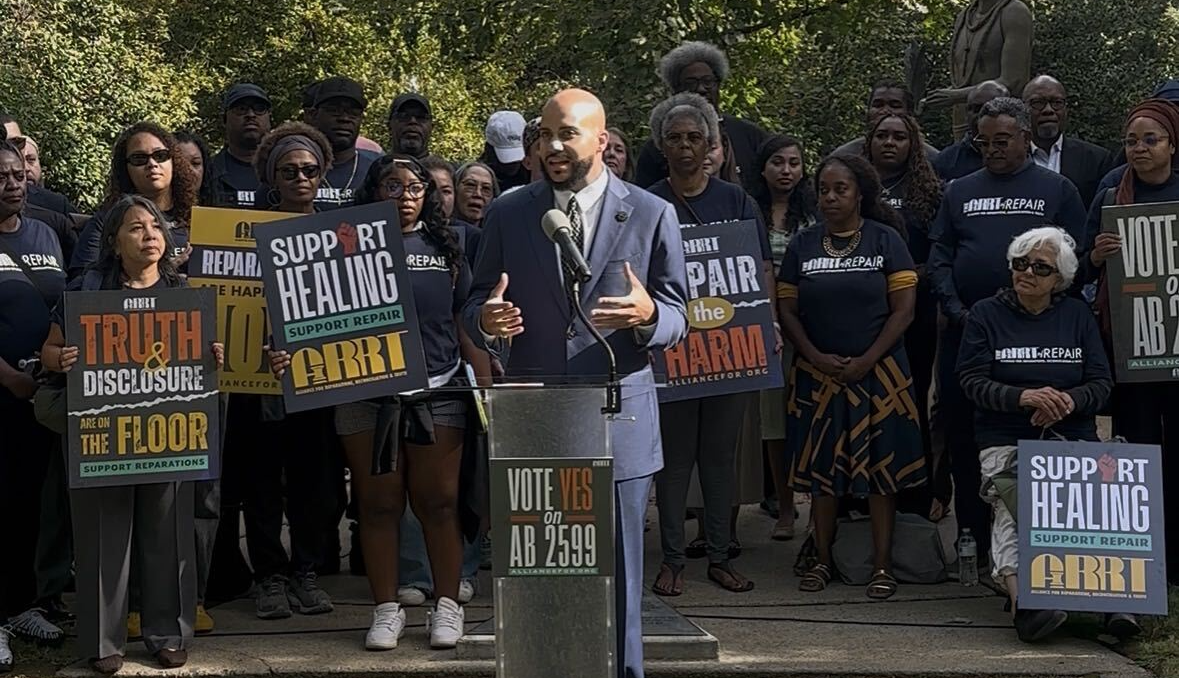
SACRAMENTO, Calif., August 25, 2026 – California is on the brink of becoming the first state in the nation to require corporations to declare under oath whether they or their predecessors profited from slavery.

With its passage in the full Senate today, the California State Legislature adopted AB 2599, The Truth in Disclosure Act, authored by Assemblymember Isaac Bryan and a top priority for the California Legislative Black Caucus. The bill will now be sent to Governor Gavin Newsom for his signature.

The bill requires corporations doing business in California with annual revenue of $100 million in gross receipts or more to submit sworn affidavits — subject to perjury penalties — disclosing whether they or predecessor entities engaged in or profited from slavery-era transactions, with all filings posted to a publicly searchable state database.

0

What we can and cannot say about climate change and the Nepal disaster

What we can and cannot say about climate change and the Nepal disaster www.theclimatebrink.com
preview

Within hours, some people on social media were confidently asserting that climate change caused the disaster, while others were just as confidently asserting it had nothing to do with it. In this piece I’ll try and lay out what the data and the scientific literature actually supports.

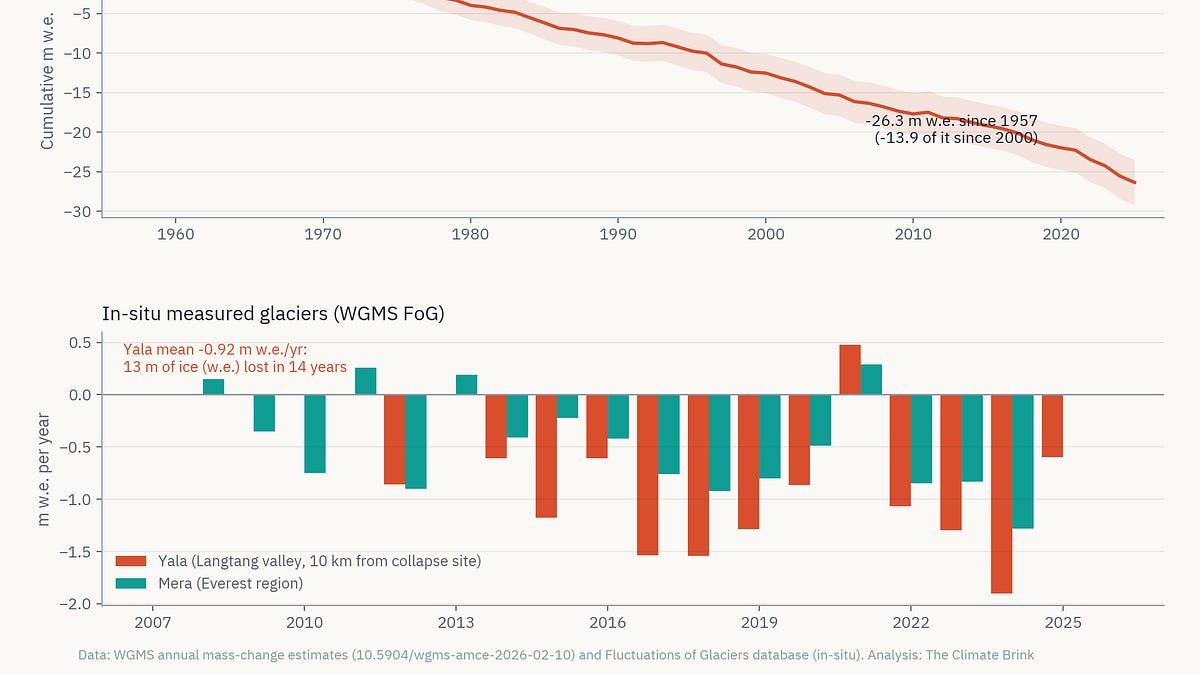
The short version is this: any formal attribution of this specific collapse to climate change is premature, and single events like this are genuinely hard to attribute even after careful study. At the same time, the collapse happened on a mountain that has warmed rapidly for decades, immediately after four consecutive summers that all rank among the five warmest in at least 86 years, and in a valley that has been losing ice at an accelerating rate. A rapidly warming climate and retreating glaciers are increasing risks of these sorts of events in the region, whether or not we can ultimately attribute this particular event.

0

[OC] People tried to beat the stock market 100K+ times in a simulation. They lost, a lot.

preview

Hello,

I made beatthecouch.com in July and it’s basically a game where you try to beat the S&P 500 and buy/sell when you want. Your opponent is a couch. It buys on day one and never sells.

Now over 100K+ games later, the hypothesis stands: it’s not wise to try to trade and time the market. Here’s the original data from the actual games itself.

Source: the game’s own database, every completed game Jul 12 to Aug 28. Tool: Python and matplotlib. Market data: S&P 500 daily total returns 1928 to 2019.

thanks!

0

Panama, Alberta: Canada and the return of U.S. hemispheric imperialism | CCPA

CCPA Panama, Alberta: Canada and the return of U.S. hemispheric imperialism | CCPA www.policyalternatives.ca
preview

“Nobody’s independent in the modern world,” says one of the men leading Alberta’s independence movement.

Speaking to CTV, Jeff Rath was, at that moment, dodging a question about his level of coordination with the U.S. government. He rattled off a series of theories about how “communist Ottawa” was in league with “communist China” to keep Albertans as “resource slaves.”

Rath—legal counsel for the Alberta Prosperity Project (APP) and something of an unofficial spokesperson for the Alberta separatist movement—has made no secret of his affinity for the U.S. government during the ongoing campaign to launch a separation referendum in Canada’s richest province. He has, however, attempted to keep the identity and content of his meetings with them under wraps.

Some of the meetings have allegedly taken place in sensitive compartmented information facilities (SCIF), soundproof and highly secure rooms behind multiple complex locks where electronic devices like cell phones are not permitted. SCIFs are typically reserved for high-level classified meetings.

Those meetings, if you believe Rath, have covered a wide range of topics, including converting an independent Alberta to U.S. currency and border arrangements. U.S. officials have not confirmed any of the details of their meetings, but some regime officials, like Treasury Secretary Scott Bessant, have voiced support for Alberta secession.

“We are exchanging information with senior officials in the U.S. state department,” he said. “We have an agreement with the people that we’re meeting with, that we aren’t disclosing the identities of the people that we’re meeting with.”

“The Americans see it within their national interest,” Rath said elsewhere, “both under the Monroe Doctrine […] and their new National Security Strategy, to support Alberta independence.” The Americans, he says, support “freeing” Alberta’s oil fields.

Tropical Americanism:

When the U.S. government kidnapped Venezuela’s president and his wife from their home in the middle of the night on January 3, the State Department posted an image online of Donald Trump emblazoned with the words “This is OUR hemisphere.” In a celebratory press conference, Trump announced that the operation was an application of the “Donroe document,” and that “American dominance in the Western Hemisphere will never be questioned again.”

What Trump called the “Donroe [doctrine],” the more serious figures in his regime’s inner circle refer to as the “Trump Corollary” to the Monroe Doctrine, an American foreign policy principle first outlined by President James Monroe in 1823. Monroe’s principle was that the United States would use its military might to “defend” the hemisphere against European empires, such as the British, French, and Spanish, who were, at the time, carving up much of the world into colonies and fighting to preserve existing colonies in the Americas. The Monroe Doctrine stated that the U.S. would be the “protector” of the Americas from European powers.

At the time, the announcement was met with cautious optimism in the rest of the hemisphere, particularly among the recently independent states of South America. El Libertador himself, Simon Bolivar, expressed gratitude, as did the leaders of newly independent Colombia and Argentina as well as Mexico.

Before long, it became clear that the “protection” that the United States was offering was the protection of a mafia boss. Within 20 years, the United States had gone to war with Mexico and stolen half of its territory—nearly all of what is now the Southwestern U.S., from Texas to California—as part of its grand designs of “manifest destiny.” The U.S. army conquered and territorialized Puerto Rico and Cuba in the Caribbean, as well as Hawaii and the Philippines in the Pacific.

Southern slave aristocrats like William Walker imagined a slave empire stretching all the way through the Caribbean and central America. Walker led a government-backed battalion of U.S. settlers in an ultimately failed 1856 attempt to conquer Nicaragua and use it as a beachhead to take the entire region. “Tropical America,” he wrote, is the “natural seat of empire” for U.S. slavery.

Imperial secession:

Panama—at the time a province of Colombia, not an independent country—was a particularly successful example of U.S. imperial strategy in the region at the turn of the 20th century. Ever since Vasco Núñez de Balboa crossed the isthmus and “discovered” the Pacific ocean in 1513, the area had been of interest to the great powers because of its status as the narrowest point between the Atlantic and Pacific oceans. While the conquistadors dreamed of building a canal, Spain’s King Philip II prohibited it, believing that if God wanted the oceans joined then He would have built a river.

That changed when Latin America’s independence revolutions marched victoriously across the continent. They sought U.S. financing for the construction of a railroad across the 75-kilometer strip of land, and opened to a French conglomerate for the construction of a canal. Hundreds of workers died for every kilometer of canal dug through the swamps and mountains—mostly imported Chinese and Black Caribbean workers, dead of disease or worked to death by their U.S. and European overseers.

When the French venture went bankrupt, the U.S.—which had already been “providing security” to the remote and rebellious province via a defence treaty with Colombia—made a novel proposal: it would take over the canal project in exchange for permanent sovereignty over the canal, which would become a U.S. territory subject to U.S. law. When the Colombian government refused, the U.S. began financing and arming a separatist movement in the Colombian province.

Members of the secessionist movement, such as Manuel Amador Guerrero, who would go on to be Panama’s first president, toured the United States and held secret meetings with U.S. government officials, where they raised significant funds and received guidance directly from arch-imperialist U.S. President Teddy Roosevelt. Those secessionists unilaterally declared Panama to be an independent country in 1903, doing so in violation of Colombian law and holding no vote on the question.

The United States provided diplomatic recognition to the newly independent country immediately. It also sent a large Navy battalion to defend it against the Colombian government—alongside a team of engineers to start planning the canal.

In exchange for this backing, the leaders of the new state signed an agreement with the United States granting it what Colombia had previously refused—sovereignty over the future Panama Canal. The canal itself, as well as eight kilometers in each direction, would be governed as a U.S. territory, separating Panama in two with a border fence and armed U.S. soldiers.

The Canal Zone, as it was called, was an apartheid system modelled on the U.S. Jim Crow south. It divided residents into white “gold roll” workers and mostly Black “silver roll” workers, who lived in substandard housing. It had a number of bizarre moralistic bylaws, such as one outlining that only married couples could occupy homes, while unmarried people lived in shared housing. White and Black workers entered the Canal Zone through separate doors, had access to separate food systems, and lived with vastly different access to resources.

The U.S. fully controlled the Canal Zone until 1979, despite regular protests from Panamanians, who were sometimes killed by U.S. soldiers for crimes such as raising the Panamanian flag. After decades of popular pressure, in 1979 the U.S. agreed to jointly administer the Zone with Panama until 1999, when the country finally recovered sovereignty over the area after nearly 100 years. Recently, U.S. regime officials, including President Donald Trump, have publicly mused about taking it back.

Monroe’s favourite child:

Over the course of the 20th century, the United States applied the Monroe Doctrine to systematically destroy democratic governments everywhere in the region. Monroe’s hand stretched over the “banana wars” of the early 1900s, in which the U.S. Marine Corps engaged in dozens of “small wars” against independent-minded governments in Central America and the Caribbean, and onto the U.S.-imposed military dictatorships on the entire South American continent in the 1960s and 70s. Its grip tightened at the School of the Americas (hosted in Panama), where U.S. military officers trained legions of Latin American soldiers in the art of torture, assassination, and repression of dissent. Monroe’s fingerprints covered the “Operation Condor” transnational assassination program, and the U.S.-sponsored genocide against Maya Indigenous Peoples in Central America in the 1980s The Monroe Doctrine has, since its inception, served as justification for brutal U.S. domination over Latin America.

Along the way, the Monroe doctrine was adapted by new and more aggressive leaders. Theodore Roosevelt’s “Roosevelt Corollary” justified limitless U.S. military involvement as an “international police power” in the hemisphere, launching military interventions against countries for crimes like failure to pay debts to European banks or engaging in land reform. The 1980s “Reagan Doctrine” elaborated on U.S. strategy, advocating for arming and supporting far-right terrorist groups in order to destabilize left-wing and socialist governments, with the most famous example being Nicaragua’s Contras.

Canada has long been something of an exception to U.S. domineering in the Americas. After an initial period of uncertainty—U.S. presidents in the early days of the republic did imagine annexing Canada, and famously lost the War of 1812 trying to remove British sovereignty over the territory—the U.S. recognized Canadian sovereignty in 1871 with the Treaty of Washington, and annexationist claims mostly fell to the wayside. Canada sheltered under the umbrella of British power and developed itself as a junior partner of the expanding U.S. empire.

Successive Canadian governments worked towards greater integration with the United States, as well as coordination on extracting resources for the U.S. market, both from within Canada and, later, via Canadian mining companies operating in Latin America. Canada acted as a hemispheric partner in the Cold War and (with some notable exceptions, such as diplomatic support of post-revolutionary Cuba) supported U.S. efforts to suppress democratic, anti-colonial, and socialist movements in the hemisphere that threatened the profits of U.S. and Canadian investors. Canada integrated with the U.S. imperial machine, rather than being targeted by it.

That bargain is collapsing under the “Trump Corollary” to the Monroe Doctrine. Initially outlined in a Foreign Policy article titled “The Trump Doctrine”, by right-wing ideologue Michael Anton in 2019, the corollary was fleshed out and became policy with a document titled National Security Strategy of the United States of America, which the Office of the President released in November 2025. The document, likely also written by Anton, outlines a number of principals for Trump-era foreign policy, guided by explicit ethnic chauvinism and a strategy of using military threats to achieve foreign policy goals. In practice, it has meant engaging in unprovoked attacks against Venezuela, illegal blockades of Cuba, and open threats against countries with left-wing leadership like Mexico and Colombia.

The Trump corollary, to the extent it has been elaborated, is a plan for complete dominance of the Western hemisphere, including Canada and Greenland, both of which have grown of interest to U.S. capital and the U.S. security state as a result of climate change and growing imperial competition with Russia and China. U.S. security planners are already drawing up fanciful plans for militarizing the North with missile defence programs like the “Golden Dome,” and U.S. capital is hungrily eyeing the critical minerals that are increasingly accessible as Arctic ice recedes.

Those environmental changes are also turning the Northwest Passage into an increasingly important shipping corridor. While it’s a long way from being the Panama Canal, the Northwest Passage is seeing significant growth in ship traffic—up nearly 80 per cent between 2013 and 2022, and likely to grow faster due to plans to increase Northern industrial and military activity.

The Canadian government views the Northwest Passage as a Canadian territorial waterway. The U.S. does not recognize Canadian sovereignty over the passage, and believes it constitutes international waters.

The Trump corollary also explicitly rejects the idea that countries in the hemisphere should be allowed to do business with non-U.S. partners. “We want other nations to see [the U.S.] as their first partner of choice,” the National Security Strategy reads, but “we will (through various means) discourage their collaboration with others.” It tasks U.S. embassies with being “aware of major business opportunities in their country, especially major government contracts,” and states that “the terms of our agreements, especially with those countries that depend on us most and therefore over which we have the most leverage, must be sole-source contracts for our companies.”

Stars and stripes over the oil sands:

Jeff Rath’s claims about China controlling Alberta oil are obviously absurd, and only the most foolish of rubes actually believes them. As are his claims about Ottawa putting the brakes on extraction. Alberta’s oil production has climbed steadily over the past decade, from 2.9 million barrels per day when Justin Trudeau took office in 2015 to 4.1 million in 2025— scrapping Canada’s climate commitments in the process.

And while it’s true that Alberta’s oil industry is under the thumb of foreign interests, those interests aren’t Chinese—they are overwhelmingly U.S. interests. A 2020 study by Environmental Defence estimated 70 per cent of oil sands production is foreign owned, and 52 per cent of the total is owned by U.S. capital, compared to only 5.2 per cent Chinese ownership.

If we look at the “big four” companies in the patch—which account for the vast majority of total production—we find that the companies, despite having headquarters in Canada, are majority-owned by U.S. investors, with an average of 60 per cent U.S. ownership and 27 per cent Canadian. Those companies only paid a miserly 14.3 per cent of their profits in taxes. During the post-pandemic oil boom, this all meant approximately $58 billion in profits left Alberta to U.S. investors, according to a 2025 report by Canadians for Tax Fairness and the Alberta Federation of Labour.

All this happened without a concurrent employment boom, because the increases in production largely occurred in well-established sites and accelerated through automation. The big four made $3.14 in profit for every dollar they paid to workers in the post-pandemic boom, compared to $0.92 during the 2011-14 boom.

This is why so many Albertans have a sensation—one helping drive secessionist sentiment—that the oil industry never recovered from the 2014 price collapse: because employment never did. Even today, though the U.S.-dominated oil industry is more profitable than ever and produces more barrels of oil to match. None of this is the result of Ottawa’s environmental policy, of course. Rather, it is the result of U.S.-owned companies looking to squeeze every drop of profit that they can out of Alberta’s resources and shipping them across the 49th parallel.

Rath, for his part, claims the unnamed U.S. officials he met have promised to immediately recognize an independent Alberta if they succeed in their secession referendum. He also says they promised him a $500 billion loan during the transition period.

Ballots and bombings:

In March 2026, the far-right leaders of 17 countries in the western hemisphere met at one of Donald Trump’s Florida golf resorts to announce the new military coalition, which they called the Shield of the Americas.

These leaders, aligned with the Trump administration, announced their fealty to the U.S. and their plan to allow the U.S. military unlimited access to their territory for strikes against cartels and drug gangs. The U.S. regime apparatchik administering the project is former Homeland Security chief Kristi Noem, who had just finished leading the invasion and occupation of Minneapolis by federal troops with Immigration and Customs Enforcement (ICE).

This takes place in the context of increasingly aggressive U.S. military action across the hemisphere, where Operation Southern Spear has seen the bombing of (alleged) drug boats in international waters, bombing of farms with (alleged) drug labs, and targeted killings of (alleged) gang members. The U.S. has justified these actions by designating various drug cartels as terrorist organizations.

The Trump Corollary is, in practice, a merger of the War on Drugs with the War on Terror, and one that uses both as a thin facade to cover attacks on countries in the hemisphere which don’t toe the line. Reality, under the Trump Corollary, is irrelevant—just like there was no flood of fentanyl pouring over the Canadian border into the U.S., the “Cartel de los Soles” that Venezuelan President Nicolás Maduro supposedly led does not actually exist.

Meanwhile, the U.S. government has also been openly meddling in elections across the hemisphere as well to ensure far-right parties take power. Trump promised a US$40 billion bailout to Argentina if they voted for the far-right party, and the U.S. intervened directly to prevent the election of a left-wing government in Honduras after Trump issued a presidential pardon to former far-right Honduran president Juan Orlando Hernández, who was convicted of major drug trafficking.

Will they intervene to support Alberta’s far-right secessionist movement? If you listen to Jeff Rath, they already are.

0

onlinecheckwriter.com 👎

preview

The ToS and Privacy Policy are huge. I briefly skimmed through and stopped my analysis before reading even just 15% of the garbage. It was laughable. They list half a dozen partners and put in their terms a condition that you must agree to agree to all the terms of all their partners. LOL.

Some of my findings:

manual human labor imposed; cannot use software to access the site

(5) you will not access the Site through automated or non-human means, whether through a bot, script, or otherwise;

you agree to not use the site for any “unauthorized” purpose; who’s my dad? Who decides what purpose I am “authorized” to have?

(6) you will not use the Site for any illegal or unauthorized purpose;

No personal use? WTF? The site solicits individuals then bans them in the terms.

If you open a ZilMoney account or use the Services, you do so on behalf of a business, commercial enterprise, non-profit organization, or government entity and not in your capacity as a consumer for personal, family, or household purposes.
…
You will use the Site and the Services, including without limitation any Business Payments, solely for business or commercial purposes and not for personal, family, or household purposes.
…
The Site and the Services, including without limitation any Zil Money payment, disbursement, or collection functionality, are offered solely for business and commercial purposes. The Services are not intended to be used, and you agree not to use them, for personal, family, or household purposes.
…
You acknowledge and agree that any external bank account you link to your Zil Money account for ACH debits or credits is used primarily for business or commercial purposes and not for personal, family, or household purposes.

“You agree to lick the boots of all of our partners, not just our boots”

Therefore, you hereby unconditionally and irrevocably acknowledge and agree that these Terms of Use of ours essentially include and integrate the terms and conditions of our service partners and/or service providers. You hereby further acknowledge and agree that by your acceptance of and agreement to our Terms of Use, you, unconditionally, irrevocably and without further action, agree to and accept the terms and conditions of our service partners and/or service providers from time to time as the weblinks to the terms and conditions of our service partners and/or service providers and provided below for your access, review and acceptance, as if those constitute integral part of our Terms of Use.

Your money is lumped into a giant single pot of money with all other customers. And that whole pot of money is only insured for $250k! LOL!

Subject to applicable requirements, including the maintenance of records identifying each beneficial owner, funds in the FBO account may be eligible for FDIC pass-through insurance coverage up to $250,000 per depositor. This limit applies to the total funds held on your behalf at the same FDIC-insured institution and is not applied separately to each individual account or sub-account.

Your business activity must be specifically approved by Zil Money.

The Site may not be used in connection with any commercial endeavors except those that are specifically endorsed or approved by us.

You agree not to say bad things about Zil Money or onelinecheckwriter.com

As a user of the Site, you agree not to: 4. Disparage, tarnish, or otherwise harm, in our opinion, us and/or the Site.

You agree not to snoop on their code to try to understand how they are snooping on you.

As a user of the Site, you agree not to: 20. Decipher, decompile, disassemble, or reverse engineer any of the software comprising or in any way making up a part of the Site.

In forums, you agree to not say anything that *they* consider “objectionable”; indeed, you must be able to read their mind and know in advance what they think is objectionable.

6. Your Contributions are not obscene, lewd, lascivious, filthy, violent, harassing, libelous, slanderous, or otherwise objectionable (as determined by us).

They can remove any review they want

We may accept, reject, or remove reviews in our sole discretion.

You give up your right to sue them in advance.

Binding Arbitration
If the Parties are unable to resolve a Dispute through informal negotiations, the Dispute (except those Disputes expressly excluded below) will be finally and exclusively resolved through binding arbitration. YOU UNDERSTAND THAT WITHOUT THIS PROVISION, YOU WOULD HAVE THE RIGHT TO SUE IN COURT AND HAVE A JURY TRIAL.

They are committed to protecting your right to privacy; and us stupid consumers are expected to just believe that as they provide a Microsoft email address for privacy issues.

Thank you for choosing to be part of our community at the services platform of OnlineCheckWriter.com powered by Zil Money Corporation, doing business as OnlineCheckWriter.com (“Online Check Writer”, “we”, “us”, “our”). We are committed to protecting your personal information and your right to privacy. If you have any questions or concerns about this privacy notice, or our practices with regards to your personal information, please contact us at support@onlinecheckwriter.com.

Indeed, support@onlinecheckwriter.com is hosted by onlinecheckwriter-com.mail.protection.outlook.com (a surveillance advertiser).

I could not read the rest of the privacy policy because I got interrupted. And when I returned to the website (over Tor) I was blocked. That is not how you demonstrate commitment to privacy.

The ToS and Privacy Policy are huge. I briefly skimmed through and stopped my analysis before reading even just 15% of the garbage. It was laughable. They list half a dozen partners and put in their terms a condition that you must agree to agree to all the terms of all their partners. LOL.

Some of my findings:

manual human labor imposed; cannot use software to access the site

(5) you will not access the Site through automated or non-human means, whether through a bot, script, or otherwise;

you agree to not use the site for any “unauthorized” purpose; who’s my dad? Who decides what purpose I am “authorized” to have?

(6) you will not use the Site for any illegal or unauthorized purpose;

No personal use? WTF? The site solicits individuals then bans them in the terms.

If you open a ZilMoney account or use the Services, you do so on behalf of a business, commercial enterprise, non-profit organization, or government entity and not in your capacity as a consumer for personal, family, or household purposes.
…
You will use the Site and the Services, including without limitation any Business Payments, solely for business or commercial purposes and not for personal, family, or household purposes.
…
The Site and the Services, including without limitation any Zil Money payment, disbursement, or collection functionality, are offered solely for business and commercial purposes. The Services are not intended to be used, and you agree not to use them, for personal, family, or household purposes.
…
You acknowledge and agree that any external bank account you link to your Zil Money account for ACH debits or credits is used primarily for business or commercial purposes and not for personal, family, or household purposes.

“You agree to lick the boots of all of our partners, not just our boots”

Therefore, you hereby unconditionally and irrevocably acknowledge and agree that these Terms of Use of ours essentially include and integrate the terms and conditions of our service partners and/or service providers. You hereby further acknowledge and agree that by your acceptance of and agreement to our Terms of Use, you, unconditionally, irrevocably and without further action, agree to and accept the terms and conditions of our service partners and/or service providers from time to time as the weblinks to the terms and conditions of our service partners and/or service providers and provided below for your access, review and acceptance, as if those constitute integral part of our Terms of Use.

Your money is lumped into a giant single pot of money with all other customers. And that whole pot of money is only insured for $250k! LOL!

Subject to applicable requirements, including the maintenance of records identifying each beneficial owner, funds in the FBO account may be eligible for FDIC pass-through insurance coverage up to $250,000 per depositor. This limit applies to the total funds held on your behalf at the same FDIC-insured institution and is not applied separately to each individual account or sub-account.

Your business activity must be specifically approved by Zil Money.

The Site may not be used in connection with any commercial endeavors except those that are specifically endorsed or approved by us.

You agree not to say bad things about Zil Money or onelinecheckwriter.com

As a user of the Site, you agree not to: 4. Disparage, tarnish, or otherwise harm, in our opinion, us and/or the Site.

You agree not to snoop on their code to try to understand how they are snooping on you.

As a user of the Site, you agree not to: 20. Decipher, decompile, disassemble, or reverse engineer any of the software comprising or in any way making up a part of the Site.

In forums, you agree to not say anything that *they* consider “objectionable”; indeed, you must be able to read their mind and know in advance what they think is objectionable.

6. Your Contributions are not obscene, lewd, lascivious, filthy, violent, harassing, libelous, slanderous, or otherwise objectionable (as determined by us).

They can remove any review they want

We may accept, reject, or remove reviews in our sole discretion.

You give up your right to sue them in advance.

Binding Arbitration
If the Parties are unable to resolve a Dispute through informal negotiations, the Dispute (except those Disputes expressly excluded below) will be finally and exclusively resolved through binding arbitration. YOU UNDERSTAND THAT WITHOUT THIS PROVISION, YOU WOULD HAVE THE RIGHT TO SUE IN COURT AND HAVE A JURY TRIAL.

They are committed to protecting your right to privacy; and us stupid consumers are expected to just believe that as they provide a Microsoft email address for privacy issues.

Thank you for choosing to be part of our community at the services platform of OnlineCheckWriter.com powered by Zil Money Corporation, doing business as OnlineCheckWriter.com (“Online Check Writer”, “we”, “us”, “our”). We are committed to protecting your personal information and your right to privacy. If you have any questions or concerns about this privacy notice, or our practices with regards to your personal information, please contact us at support@onlinecheckwriter.com.

Indeed, support@onlinecheckwriter.com is hosted by onlinecheckwriter-com.mail.protection.outlook.com (a surveillance advertiser).

I could not read the rest of the privacy policy because I got interrupted. And when I returned to the website (over Tor) I was blocked. That is not how you demonstrate commitment to privacy.

0

The Blueprint Behind Danielle Smith’s Plan to Break Up with Canada | The Walrus

The Walrus The Blueprint Behind Danielle Smith’s Plan to Break Up with Canada | The Walrus thewalrus.ca
preview

During the last United States presidential campaign, an ominous 920-page policy document emerged into the public eye. Known as Project 2025 and released by the Heritage Foundation, it laid out a blueprint for a maximalist version of executive power, a sidelining of congressional power, and a radical overhaul of government, the bureaucracy, and American society writ large.

It was a playbook for the far right and unreservedly so. It raised such a spectre during the campaign that candidate Donald Trump denied any knowledge of the document. But within his first year back in the Oval Office, Trump had managed to implement much of the Project 2025 agenda in his quest to “Make America Great Again.” We’ve all seen how that has been going for the United States and, frankly, for the rest of the world. The only word that captures it is “revolutionary.”

There are probably only a few dozen people or so who have actually read Project 2025 cover to cover. I don’t count myself as one of them. But I did read Alberta’s own little version of the document, and it was illuminating to say the least.

Like many Albertans, I’ve been struggling to keep pace with the rate at which the United Conservative Party has legislated since Danielle Smith took the helm in 2022, often in unconstitutional ways that target minorities and override treaty rights. They have passed legislation, often in the middle of the night, that will leave extraordinary impacts on citizens of the province, alter the nature of our democratic society, and could ultimately see Alberta remove itself from Confederation. On four occasions, they have invoked the notwithstanding clause to override Canada’s Charter of Rights and Freedoms.

Some people, such as federal justice minister Sean Fraser, have described this approach as a form of “democratic backsliding” designed “to cater to a unique political opportunity that may be a good fundraising email but will potentially violate constitutionally protected rights of vulnerable people.”

Similar to our neighbours in the US, Albertans are in our own anti-democratic revolutionary political vortex, in which we’re being pulled into the unknown by a MAGA-adjacent far-right UCP government.

It might have helped to see some of this coming. Turns out we could have, if only we’d read the Free Alberta Strategy sooner.

The Free Alberta Strategy was written in 2021 by Rob Anderson, Barry Cooper, and Derek From at the height of anti–Justin Trudeau sentiment in the province and in the altered-reality state of the COVID-19 pandemic lockdown, when so many radical ideas were incubated in a stew of isolation and myopia-inducing screen time. Anderson is a lawyer with a history in provincial politics who is now Premier Smith’s chief of staff. Cooper is a political science professor at the University of Calgary. From is also a lawyer.

The document is a shade under fifty pages and contains a smattering of footnotes from Ted Morton, Jack Mintz, Lorne Gunter, Preston Manning, Pierre Poilievre, and the Fraser Institute. Not exactly a non-partisan affair.

It certainly isn’t written with any attempt at neutrality or objectivity either. On the contrary, it is laced with incendiary rhetoric that seeks to demonize Eastern Canada in simplistic and snide ways. It sets Alberta up as an oppressed victim of Confederation that has been “pillaged” by a federal government that has become an “existential threat to our province’s economic viability and the core freedoms of our people.”

The strategy asserts that “Ottawa has fundamentally breached its constitutional agreement with Alberta.” Accordingly, it has become incumbent upon the provincial government to “repudiate this arrangement on behalf of its people, to renegotiate its terms of membership in Confederation and, if Canada’s federal and provincial leaders refuse to negotiate, to form an independent nation.”

The authors then call on the government of Alberta, at the time led by Premier Jason Kenney, to pass a Sovereignty Act that would allow the province to disregard all federal laws at its discretion; turf the Royal Canadian Mounted Police and replace it with a provincial force; create independent provincial legislation for financial institutions, presumably to end federal regulatory oversight over banks working in the province; end equalization transfers; opt out of federal health, education, resource development, environmental regulation, and property rights; replace the Canada Pension Plan with an Alberta version; do the same with employment insurance; replace the federal government in international diplomacy and negotiation; and give the provincial legislature the power to make all future judicial appointments.

These are the strategic moves the authors believe will “offload the burden of Ottawa’s tyrannical economic policies against the Province, and secure self-determination for the people of Alberta within a reformed confederation, or if necessary, as an independent nation.”

According to the authors, “a vast majority of Albertans” agree that the province, in recent years, has been “economically terrorized by the Government of Canada.” “Eco-extremists,” they say, have looted the province of “well over $600 billion” through transfer programs.

Anderson, Cooper, and From blame the federal government for increases in suicides, bankruptcies, and overdoses. And they suggest the feds have “commenced a deliberate strategy to phase out and eliminate Alberta’s largest and most critical industry.” Policies such as the carbon tax, clean fuel regulations, and environmental impact assessments are characterized as “assaults.”

All of this dramatically sets up an extortion play which is the core of the strategy: “In the event that Ottawa refuses to recognize Alberta’s provincial rights of sovereignty, and instead continues its strategy of economic tyranny, co-opted management of our resource sector and the marginalization of our citizens, it may leave our province with no other recourse but to leave Confederation entirely.”

Rather than co-operative federalism, this is shakedown federalism. It’s a “do what we say or we are done” strategy rooted in an inflated sense of grievance that doesn’t jibe with any discernible reality.

Politicians and political scientists are careful to acknowledge the real sense of grievance that some Albertans feel vis-à-vis their relationship with the federal government. You can’t argue with people’s feelings after all, but you can take issue with how they choose to rationalize and justify them. There’s nothing on the public record that could plausibly support characterizing the federal government’s relationship with Alberta as something equivalent to economic terrorism, as the authors of the Free Alberta Strategy assert. To the contrary, since 2010, oil production in the province has more than doubled, from 2 million barrels a day to 4.1 million barrels a day.

The Free Alberta Strategy didn’t get much traction with Kenney’s UCP, perhaps because in year one of Kenney’s reign, Canada’s prime minister, Justin Trudeau, ramped up investment in the TMX pipeline, which runs from Edmonton to tidewater at Burnaby, British Columbia. The project eventually cost the federal government $34.2 billion. Even for Kenney, it would have been a stretch to describe this massive outlay of public dollars as an “assault” or a form of “terrorism” committed against his province by the evil overlords in Ottawa.

But since Kenney was given the bum’s rush by the far-right separatist wing of the party he created, the strategy has come back into vogue. In fact, Kenney’s successor, Premier Smith, is hewing closely to much of the plan.

Before going further, it’s important to be fair to the authors of the Free Alberta Strategy and not portray them as fully responsible for planting the anti-democratic seeds the UCP has sown.

The trio of Anderson, Cooper, and From were careful to recommend a transparent approach to adopting their strategy and, if necessary, a democratic path to ending Alberta’s place in Confederation. They prescribed their strategy first be adopted as official policy, that the policy be outlined clearly to Albertans, and that a democratic process gives the government the mandate to pursue the strategy.

With the mandate in hand, after a successful electoral victory with the Free Alberta Strategy as a platform, they suggested holding a pre-referendum blue-ribbon panel on provincial secession and that a detailed plan be drafted by policy experts, lawyers, and members of the private and public sectors that would cover the full ambit of requirements to establish an independent Alberta. They argued for a full year to be given to consultations, discussions, and debates on the merits of the plan and its risks and rewards.

Smith’s UCP did not follow this recommended process. Just as Trump denied any knowledge of Project 2025 and then proceeded to implement vast portions of its radical agenda within his first year back in the White House, Smith’s UCP did not campaign on the Free Alberta Strategy’s tenets but has embraced them wholeheartedly since forming government. Smith’s UCP doesn’t, therefore, have a democratic mandate to pursue these ideas, by any standard. Yet they have implemented the components of the strategy at a ferocious pace.

First, through Bill 54, which made it comprehensively easier to bring about a secession referendum by reducing the number of signatures required, and then Bill 14, which was passed in order to eliminate any bearing the Charter of Rights of Freedoms and the Treaties might have on the process, the UCP has shown it intends to construct a credible threat of separatism that it can use to extort the rest of Canada.

They have taken the Free Alberta Strategy into Trumpian territory by running on one set of issues and governing on their opposite. Believe it or not, the planks of the UCP’s winning 2023 campaign platform were tax cuts, safe streets, mental health supports, education and career training, investing in tourism, improving health care for women and children, and a guarantee to maintain public health care. None of the ideas included in the Free Alberta Strategy were campaigned on by Smith’s UCP.

However, in December 2022, just two months after Smith won the leadership of the UCP, her party introduced the Alberta Sovereignty within a United Canada Act, which achieves one of the Free Alberta Strategy’s major milestones. This really should have been a wake-up call to the electorate that under Smith’s leadership, the UCP would tack hard to the right. “It’s not like Ottawa is a national government,” said Smith after the legislation passed its final reading at 1 a.m. on December 7.

Provisions in the Sovereignty Act armed Smith’s government with a set of new powers to disregard federal laws at its own discretion. In effect, this kneecaps the role of the courts in this province by setting the provincial legislature as the arbiter of the constitutionality of federal law.

In a radical revision of constitutional democracy, the act allows the provincial cabinet to decide whether it is in or out on specific aspects of federalism, including federal regulations and even enforcement of the Criminal Code by provincial entities. The dean of the University of Calgary’s law school, Ian Holloway, called the legislation an “unconstitutional gambit” and accused the premier of “engaging in a game of political chicken.”

Smith’s government furthered this line of legislation in late 2025 with the International Agreements Act, which seeks to put the province on an equal plane with the federal government when it comes to managing international relations. It asserts that no international agreement signed by the federal government is binding on the province. Something like a major climate change agreement would presumably not be binding on Alberta unless agreed to by the provincial legislature.

This assertion of provincial autonomy over international relations runs counter to all norms of statecraft. But it is a tactic explicitly described in the Free Alberta Strategy, which states in its section on international relations that Alberta “can no longer afford to entrust its interests to hostile and unreliable federal governments. It must take full control of its own international and interprovincial trade and commerce.”

How Alberta’s Separatist Movement Could Shake North America Is Danielle Smith the Most Powerful Politician in Canada? Is Danielle Smith a Separatist? Among the ideas the UCP has drawn from the Free Alberta Strategy is establishing a provincial police force. The strategy casts the RCMP as an arm of the federal government, and Alberta has begun building its own alternative, the Alberta Sheriffs Police Service.

There remains a great deal of ambiguity with respect to these sheriffs’ purpose, jurisdiction, and relationship with other police services in the province. The sheriffs were originally established to do prisoner transport but evolved to take on traffic control roles and security around the legislature grounds. The latest evolution of the service appears aimed at broadening their authority and increasing their complement to the point that they could eventually be in position to take over from the RCMP at the end of the current policing contract, which expires in 2032.

Setting up a provincial police service is no easy task and doesn’t happen overnight or without extraordinary cost. It is notable that this is being done against the grain of overwhelming public opinion. A survey conducted for the National Police Foundation on the prospect of an Alberta provincial police force found only 31 percent of respondents were in favour of replacing the RCMP, while three quarters were satisfied with the policing services received from the Mounties; 71 percent of respondents said they felt the public had not been adequately consulted on the proposal, and 81 percent said there were more pressing issues for the province to address.

In an additional move inspired by the Free Alberta Strategy, the premier sent Prime Minister Mark Carney a letter on January 23, 2026, threatening to withhold “the necessary funding to support any new judicial positions in the province” until the federal government agreed to make significant changes to how judges are appointed in Alberta. The premier has, for now, stopped short of the nuclear option articulated by the Free Alberta Strategy, which recommends the provincial legislature appoint all future judges serving in Alberta.

Instead, the premier is proposing a major reform of the appointments process that would see the establishment of a special advisory committee comprising “four non-partisan experts—two from Alberta and two appointed by the federal government.” The committee would make recommendations to the two ministers of justice (federal and provincial), who would then be expected to “work collaboratively to identify the successful appointee(s).”

The premier also wants this committee to influence appointments to the Supreme Court of Canada and make recommendations to the prime minister about who should fill vacancies on the top bench.

Federal justice minister Fraser saw the letter as a threat to judicial independence and the rule of law and told media “it’s essential that we have a judiciary who’s able to make decisions without fear or favour amongst those who have the power to appoint or, in theory, remove a judge from the bench.” The Canadian Bar Association and its Alberta branch also expressed “grave concerns” about Premier Smith’s proposal, which they saw as a threat that, if carried out, would ultimately “punish Albertans by limiting access to a properly functioning justice system.”

Under Smith’s leadership, the UCP has also toyed with the idea of breaking with the Canada Pension Plan and establishing a provincial plan instead. Smith floated the idea—one of the main pillars of the Free Alberta Strategy—as part of a 2023 survey she put to all residents of the province who wanted to participate. It took twenty-one months for her government to finally release the results of the survey, which showed that only 10 percent of respondents supported the idea of an Alberta Pension Plan.

The other tactical moves recommended in the Free Alberta Strategy—legislating an end to equalization payments and establishing an independent banking act—have yet to be attempted.

The UCP’s shakedown approach to federalism clearly has its intellectual roots in the Free Alberta Strategy. The approach derives from an understanding of Confederation as being fundamentally unfair to Western Canadians, who, according to one of its authors, Barry Cooper, have been under the thumb of an imperialist power structure seated in Laurentian Canada since before Confederation. It seeks to use the ultimate threat of separation as leverage to reset the terms of the Canadian federation.

For his part, Cooper—a committed separatist—does not believe the Laurentians are capable of comprehending “what they have done.” In an interview for this article, he characterized this as a “failure of imagination” to meet “the just complaints of Alberta and Saskatchewan.”

In June 2020, Cooper joined BC political talk show host Stuart McNish to discuss Alberta separatism. Cooper articulated his theory that Western Canadians have been exploited by the Ontario/Ottawa/Quebec imperial complex and went on to expound a sense of fatalism about the future of Canadian federalism. In his view, Western Canadians will eventually conclude that the relationship with Laurentian Canada will never change or evolve in meaningful enough ways to make it worth remaining in Canada.

According to Cooper: “Eventually you have to do something. Of course it is treasonous, of course it is illegal, and of course it is going to be very unpleasant, and we’re going to have to have . . . help from abroad. We’re going to have to rely on the Americans. It will depend on whether or not Saskatchewan and Alberta have leaders who are willing to understand the very serious implications, which means, among other things, getting the Americans on board.”

Here, Cooper seems to have presaged the now well-publicized efforts of the Alberta Prosperity Project to conscript the help of the Trump administration in their efforts to split Alberta from the rest of Canada. And while the Smith government hasn’t overtly and explicitly declared its separatist intentions, nor openly courted the Trump administration’s support in becoming an independent state, it has legislated in a MAGA-adjacent, far-right fashion.

With Trumpian disregard for constitutional norms, Smith’s government has used the notwithstanding clause to attack the rights of organized labour and of gender-diverse people in the province. With Trumpian xenophobia, it has signalled an intent to crack down on immigration and the rights of immigrants and refugees in the province. It has introduced two-tier health care through Bill 11 and encouraged two-tier education by subsidizing private schools at the highest rate in Canada and increasing funding to charter schools at a rate three times higher than its increase to public schools.

These moves could be construed as demonstrating the UCP’s alignment with the Trump administration. This is not insignificant, particularly in light of the US’s November 2025 National Security Strategy, which states that “we will reward and encourage the region’s governments, political parties and movements broadly aligned with our principles and strategy.”

Cooper was forthright in stating that while he hasn’t spoken with either Rob Anderson—now the premier’s chief of staff—or Premier Smith in a number of years, he is “quite supportive of what she has done.”

As Project 2025 has done in the US, the Free Alberta Strategy has begun to fundamentally alter Alberta politics and society. It provides a clear window into the moves Premier Smith’s UCP will make in destabilizing relations with the rest of Canada and setting Alberta on a path to separation. Canadian citizens can orient themselves amid the chaos by understanding that Smith and her government are intent on pursuing the Free Alberta Strategy to its logical conclusion. If they want a preview of where this is all headed, they need only keep an eye on our neighbours to the south.

0

The US is No Different

preview

The most rigorous measurement of support comes from analysis (2009–2021). In 2021, U.S. federal agencies invested ~$407 million in OSS development. Code.gov -This is OSS broadly, not Linux-specific.

A 2026 UN/UNESCO/Software Heritage report shows:

  • 288,411 public repositories with at least one government contributor
  • 92,831 distinct government contributors across 193 countries

-Demonstrating widespread global investment.

Linux-specific cost cannot be isolated because it’s developed by corporations (Red Hat, Intel, Google, Meta, AMD), volunteers, universities (subsidized), and Nonprofits like Linux Foundation.

Government contributions aren’t tracked by project, and are often indirect (unaccounted for), such as with funding research labs that contribute patches.)

The U.S. federal government spends over $100 billion/year on IT contracts. About $12 billion/year is software licensing & development (includes proprietary).

0

Langford tries new tool for mitigating wildfires: a herd of goats

CBC Langford tries new tool for mitigating wildfires: a herd of goats | CBC News www.cbc.ca
preview

They’re horned. They’re hairy. And they’re Langford’s newest tool for mitigating wildfires.

They’re horned. They’re hairy. And they’re Langford’s newest tool for mitigating wildfires.

0

I Made A Wearable Computer To Bypass The Law - Flamethrower

play · youtube.com
YouTube I Made A Wearable Computer To Bypass The Law www.youtube.com
preview

947,807 views Premiered May 3, 2025 #linux #raspberrypi #diy
This is how (and why) I made my own, fully functional wearable cellphone with a Raspberry Pi Zero and how I bypassed both the law and every single restriction in a school network with it!
Please like and subscribe if you enjoyed :)

Intro & Outro Song: Lensko - Cetus [NCS Release]
Music provided by NoCopyrightSounds
Free Download/Stream: ncs.io/cetus
Watch: • Lensko - Cetus | House | NCS - Copyright F…

0

After decades-long ban, Central Saanich farmers welcome return of potato

CBC After decades-long ban, potato farming is allowed again in Central Saanich, B.C. | CBC News www.cbc.ca
preview

The federal ban was in response to a devastating pest — the golden nematode, a microscopic invertebrate roundworm.

And the government didn’t just close the lid on potatoes. It also prohibited the growth of nightshades — which include tomatoes and eggplants — in Central Saanich.

The federal ban was in response to a devastating pest — the golden nematode, a microscopic invertebrate roundworm.

And the government didn’t just close the lid on potatoes. It also prohibited the growth of nightshades — which include tomatoes and eggplants — in Central Saanich.

0

Viruses Handled Differently

preview

With Linux; you need to keep your whole system updated (which many don’t do because it often causes breakage on Linux.) Windows doesn’t even need a system update (and reboot) to update Windows Defender. Linux users bragging about uptime is really them displaying their ignorance concerning security.

-“We just distrohop or blame ourselves when something bad happens!”

0

Cider season! And a Campden question

Steel fermenter with filter half-full of apple juice
preview

The apple trees have been harvested, 46 kg apples pressed and 20 litres of juice almost done with filtration into the fermenter.

Also in the fermenter: 3 litres of beer wort featuring 1 kg of mostly Simpsons Premium English caramalt. And waiting for its time is a 1,5 l yeast starter with 1 dl sugar and 1 dl dark syrup, providing yet more alcohol and some complex nonfermenting sugars. Hoping to eke out some residual sweetness from the cara and the syrup in the final product.

Quick check regarding the use of Campden tablets. Added one per 5 l of apple juice at the press. Kind of a half dose compared to what the winemakers use. That was 10 in the morning. Is it likely my happy starter will handle the sulfite if I pitch 12 hours after adding the tablets? Or should I wait the recommended 24 hours?

The happy starter:

0

Olivia Rodrigo’s Daisy Chain Fields is a festival-scale roar for abortion rights and women’s health

Los Angeles Times Olivia Rodrigo’s Daisy Chain Fields is a $10 million roar for abortion rights and women’s health www.latimes.com
preview

cross-posted from: sh.itjust.works/post/65880998

Daisy Chain Fields is an ambitious escalation of Rodrigo’s activism in this sphere, which has paralleled her chart-topping success after debuting as a teenager with her LP “Sour” in 2021. The festival — with similarly-aligned acts including Chappell Roan, Doechii, Bikini Kill, Katseye and others — will be a globally-prominent cultural event, underlining the urgency for reproductive and women’s rights work amid the current right-wing backlash. It raises funds to benefit 10 like-minded advocacy groups, and intertwines her music career and women’s rights advocacy in ways few pop artists at her scale are attempting.

“We are ecstatic to have Olivia supporting our work, not only financially, but using her voice and reach to shine a light on these urgent issues,” said Nancy Northup, president and chief executive of the Center for Reproductive Rights, which challenged abortion bans in 11 states, and filed the first lawsuit on behalf of women denied abortions in 50 years. “Women are continuing to suffer under these bans, and that won’t stop until abortion is federally protected once again. Her support will help us continue filing lawsuits and advocating for laws that expand reproductive rights, both in the U.S. and globally.”

0

Natural Dyeing With Amaranth - Rosemary And Pines Fiber Arts

Rosemary And Pines Fiber Arts Natural Dyeing With Amaranth - Rosemary And Pines Fiber Arts rosemaryandpinesfiberarts.de
preview

I just harvested my amaranth but I won’t get a chance to dye with it for another month. I’ll post my results here!

I just harvested my amaranth but I won’t get a chance to dye with it for another month. I’ll post my results here!

0

Would activitypub fit a fanfiction archive similar to AO3?

preview

I’m building a fanfiction archive and I was wondering whether I should add federation just to the forum or to the whole site and if I add it to the whole site whether or not ActivityPub would be a good fit, like is it possible using ActivityPub to share the load of hosting the files across different instances or is that something unrelated and it’s only useful for typical social interactions?

I’m building a fanfiction archive and I was wondering whether I should add federation just to the forum or to the whole site and if I add it to the whole site whether or not ActivityPub would be a good fit, like is it possible using ActivityPub to share the load of hosting the files across different instances or is that something unrelated and it’s only useful for typical social interactions?

0

Überseefestival

Überseefestival 2025 Überseefestival 2025 ueberseefestival-bremen.de
preview

Crossposted from feddit.org/post/34736216

Der zweite von zwei Tagen hat bereits begonnen, aber ich möchte auf das Überseefestival hinweisen. Es findet auf dem Gelände der Alten Zollkantine statt und der Eintritt ist kostenlos, es wird über Spenden finanziert. Falls ihr also gerade in Bremen nicht wisst, was ihr machen könnt, es lohnt sich, falls das Wetter nicht zu arg wird.

0

A syilx Youth’s fight to save her horses, and the thread that cannot burn

Indiginews A syilx Youth’s fight to save her horses, and the thread that cannot burn indiginews.com
preview

When the fire came to the Okanagan Indian Band, Sienna Belanger’s first instinct was to catch her horses.

Winds had reached 115 km/h, with sustained speeds of 80 km/h, according to the BC Wildfire Service. Six-foot-tall flames ripped through the grassland.

“I only managed to get one of my horses,” she said. “Then we just opened up the gate and ran with them down to our bottom field. They got loose. All I could do was hope and pray.”

0

What Twenty Years of Social Media Has Done to Our Memories

The Walrus What Twenty Years of Social Media Has Done to Our Memories | The Walrus thewalrus.ca
preview

I love social media. Not only is it a welcome distraction during life’s many dull hours, but it’s also a world-historically essential archive of our recent past. Whether we prefer to admit it or not, social media is where our history lives now, and the platforms have shaped how that history is told.

I love social media. Not only is it a welcome distraction during life’s many dull hours, but it’s also a world-historically essential archive of our recent past. Whether we prefer to admit it or not, social media is where our history lives now, and the platforms have shaped how that history is told.

0

Thinking of streaming my journey to Sag A

preview

I know its been done a thousand times, but its one I’ve always wanted to do.

I started playing a decade-ish(?) ago in university when the game first launched. I graduated and got a job, so I haven’t played in ages.

I’m setting up an owncast instance to stream my shenagins.

Im wondering if there’s any tips for the trip, or anyone want to watch?

0

What to do with an OS that's More Limited and Less Secure than a Cell Phone?

preview

Smartphones have banking, government ID, payment, messaging, and travel apps. Linux has none of these natively.

Phones have hardware-backed keystores, verified boot, mandatory sandboxing, mandatory app permissions, and automatic security patching.

Smartphones get first‑party vendor support, unified SDKs, guaranteed updates, and predictable APIs.

Desktop Linux breaks more often because it’s not a controlled platform. Phones are appliances while Linux desktops are DIY kits.

Smartphones have updates tested against one hardware stack, drivers are unified, firmware is integrated, and apps are vetted.

With Linux, kernel updates can break drivers, DE updates can break extensions, Wayland/X11 fragmentation causes regressions, GPU stack varies by vendor, and Firmware flashing is riskier.

Smartphones have better power management

Phones have aggressive battery optimization (imagine money being incentive), hardware‑software co‑design, and unified sleep states. Thermal management is tuned per device.

Smartphones have better multimedia pipelines with hardware‑accelerated codecs, camera pipelines tuned per sensor, DRM is fully supported, and the audio stack unified.

0

Best way to move on from your ex-partner?

preview

cross-posted from: thelemmy.club/post/55106938

They didn’t give me that much affection, but I still miss said affection and good times. I know we’re still young, but I’ve been really upset in the relationship. From their point of view, I feel like I was a mean person who did them wrong and just abandoned them when I was closest to them, and I understand if they hate me now and talk behind my back and all their friends hate me.

They told me some weird things like that I couldn’t be aromantic because I was too young (said person also identifies as aromantic despite being a year younger than me) and that I’m just autistic so I don’t understand love.

They’ve been insensitive and laughed when I was upset and kept saying “LOL LOL” or similar stuff.

I do feel bad, but they wouldn’t listen when I wanted to break up. They’d convince me to stay, get mad at me, and act like it was my fault or try to make me feel bad for wanting to break up.

We’ve been friends since I was in like 7th grade, so this really does suck. They always seemed like they were this very progressive human rights activist too, but when it comes to me, I’m a confused girl…

0

Only Linux Plays Filesystem Roulette

preview

What Linux did with NTFS (a janky, reverse‑engineered driver for a proprietary filesystem) is unique to Linux.

😈 BSDs supporting Linux filesystems

FreeBSD, OpenBSD, and NetBSD all support some Linux filesystems, but only the safe, well‑documented, and non‑proprietary ones.

  • ext2/ext3 (read/write)
  • ext4 (usually read‑only, limited)
  • FAT/exFAT
  • ISO9660/UDF
  • ZFS (shared with Linux via OpenZFS)

They don’t support:

  • Btrfs
  • XFS (write support is basically nonexistent)
  • F2FS
  • Bcachefs
  • (Anything experimental)

BSD developers won’t repeat Linux’s NTFS mistake of supporting a filesystem without full specs or stable kernel APIs. They only adopt filesystems that are fully documented, stable and not tied to Linux kernel churn.

🍎 macOS supporting other OS filesystems

MacOS supports:

  • FAT/exFAT (read/write)
  • NTFS (read‑only)
  • ext4 (via third‑party drivers only)
  • ZFS (third‑party only; Apple abandoned it)

Apple will not ship write support for:

  • NTFS
  • ext4
  • Btrfs
  • XFS

Apple refuses to take on the liability of writing to foreign filesystems. They don’t want to be blamed for corruption caused by undocumented formats, kernel instability, or third‑party metadata semantics.

🪟 Windows supporting other OS filesystems

Windows is even more conservative than macOS.

Windows supports:

  • FAT/exFAT (native)
  • NTFS (native)
  • ReFS (native)
  • ext2/ext3/ext4 (third‑party drivers only)
  • ZFS (third‑party only)

🐧 Linux supporting other OS filesystems

Linux is the only OS that aggressively supports foreign filesystems.

  • NTFS
  • exFAT
  • HFS/HFS+
  • ISO9660/UDF
  • FAT
  • ZFS (out‑of‑tree)
  • ReiserFS
  • Minix
  • Amiga FS
  • HPFS
  • UFS
  • JFS
  • F2FS
  • Btrfs
  • XFS
  • Bcachefs
  • dozens more

Linux culture encourages experimentation, reverse engineering, volunteer supplied garbage drivers, and distros exposing experimental features. This is why Linux ended up with janky NTFS, HFS, UFS drivers, etc.

NTFS on Linux was a disaster that took 20 years to sort out, and no other OS would subject its users to anything like it.

0

If we removed all environmental protections around the world, what would be the most important species to go completely extinct?

preview

If you need a time frame, let’s say 25 years.

EDIT: my question is plural, but of course it’s fine to give a single species if you know of one

If you need a time frame, let’s say 25 years.

EDIT: my question is plural, but of course it’s fine to give a single species if you know of one

0

Printing checks with regular toner (not MICR) -- anyone experienced w/this?

preview

I intend to print some checks and cannot do MICR toner. Since archive.org is down right now, about half the Internet is down for me because so many enshitified websites are access restricted and I rely heavily on archive.org.

What is the risk for submitting a non-MICR check to pay a credit card bill? Slower processing, sure, fine with me. However, this page mentions returned check fees. My knee-jerk thought is: WTF, it would be a valid check, so would some lazy motherfucker whose check reader has no optical cabability really be able to legally justify hitting me with a returned check fee as a consequence of them being too lazy to do a manual entry?

The law apparently makes it clear that a non-MICR check would not comply with ANSI standards. Fair enough; but really the question is whether a non-standard check can be treated as invalid to the point of levying penalties when in fact the information presented is both valid and usable? It’s all down to what lazy motherfuckers will do with their discretion, correct?

I happen to know that the credit card company does not process checks like normal. They do an ARC conversion. They use the info on the check to generate an “electronic check” and then they pull the money electronically. They probably do that to move the money faster. So is it safe to say there is no chance of my bank rejecting the check – that the only possible rejection would be by the credit card company?

A credit card company would obviously be processing copious checks. So it stands to reason that they would use a modern reader that is both magnetic and optical. So IMO it should work. But they could still be dicks. The reader could read the info optically but send a “dodgy check” flag due to the lack of magnetism and maybe they are just happy to have an excuse to collect an arbitrary penalty.

Anyone test this?

0

Khyretos/3dco-plus: 3Dco+ – An enhanced, AI-assisted fork of 3D Controller Overlay

GitHub GitHub - Khyretos/3dco-plus: 3Dco+ – An enhanced, AI-assisted fork of 3D Controller Overlay. Live 3D controller, keyboard, and mouse visualization for streamers, with custom model import, per-part pivot editing, raw joystick fallback, and system-wide input. github.com
preview

{Downloads|Newest}

Original project its based on is larfingshnew/3d-controller-overlay, which didn’t have an update in 2 years and does not support Steam Deck or the new Steam Controller 2026. Recently a fork appeared Khyretos/3dco-plus that does what I want it to, supports the new controller (and other controllers and has different layouts for displaying the mappings) and has a ready to go AppImage for Linux. It also supports Gyro and Touch, and even Keyboard and Mouse.

But this fork is heavily Ai assisted (the original was not). The developer assures us this is not vibe coded, but carefully examined and understood before doing changes. Now I’m in a position where I initially didn’t want projects heavily developed with Ai, but this tool does exactly what I want it to and there is no alternative. I want to share it here anyway, so you can decide for yourself.

0

#AutisticiInventati - Una singola firma di Trump può cancellarti da internet. L'articolo di @smaurizi

preview

#AutisticiInventati - Una singola firma di Trump può cancellarti da internet. L’articolo di @smaurizi

Una nuova battaglia tra Davide e Golia si sta combattendo su internet, dopo la guerra del governo statunitense contro Julian Assange e WikiLeaks. Questa volta, l’epicentro è l’Italia e Davide è un’organizzazione di volontari italiana: un piccolo collettivo di persone poco conosciute che creano e distribuiscono gratuitamente account di posta elettronica crittografati, blog e mailing list.

https://www.ilfattoquotidiano.it/2026/08/29/autistici-inventati-trump-terrorists-news/8491452/

@eticadigitale

0

Home by Louis Durrant

preview

Uncompressed version here

Created by Louis Durrant, same creator of the beautifull “Safe Landing” (2019) wallpaper featured on KDE:

Also, TIL he’s the gamedev of The Garden Path. I haven’t played it yet, but I like the art style

Uncompressed version here

Created by Louis Durrant, same creator of the beautifull “Safe Landing” (2019) wallpaper featured on KDE:

Also, TIL he’s the gamedev of The Garden Path. I haven’t played it yet, but I like the art style