
0

preview
I enjoyed reading this, I figured some of y’all may too
I enjoyed reading this, I figured some of y’all may too

Jeff Foust 5–6 minutes Crew Dragon approach SpaceX’s Crew Dragon approaches the ISS on the Crew-9 mission. Credit: NASA WASHINGTON — NASA and Roscosmos have agreed to continue exchanging seats between Soyuz and Crew Dragon spacecraft, but that agreement does not yet extend to Starliner. Russian media reported in July, after a meeting between NASA Administrator Jared Isaacman and Roscosmos Director General Dmitry Bakanov, that the two had agreed “in principle” to extend an agreement between the agencies to barter seats between the two spacecraft on International Space Station missions. That allows NASA astronauts to fly on Soyuz while Roscosmos cosmonauts fly on Crew Dragon and thus ensures both NASA and Roscosmos personnel can remain on the station if either vehicle is out of service for an extended period. NASA officials did not immediately confirm that report or provide a readout of Isaacman’s meeting with Bakanov. It was the first face-to-face meeting between the two and also marked the first visit by a NASA administrator to Russia or the Baikonur Cosmodrome in Kazakhstan since 2018. During an Aug. 3 briefing about the upcoming Crew-13 mission to the ISS, whose crew again includes a Russian cosmonaut, NASA officials confirmed that they have extended the seat barter agreement but provided few details about the extension. Dana Weigel, manager of NASA’s low Earth orbit program, said the agencies work about 18 months ahead on missions. “We work on a shorter horizon with all our agreements, so we are covered for a number of missions with the exchanges,” she said. She said she did not know the specific missions included in the agreement, and officials said at the briefing they would later provide that information. As of the end of the day Aug. 5, the agency had not provided those specifics. Weigel, though, said the agreement does not, for now, include Boeing’s Starliner, which NASA has yet to certify for long-duration crewed ISS missions. “We have not finished the work on Starliner. What they’re waiting to see is the rest of our flight and certification data,” she said. “They’d like to see that data before we go into it.” NASA has been working with Boeing to address propulsion system issues seen on the vehicle’s last flight, the Crew Flight Test mission two years ago. Both NASA and Boeing officials said in recent briefings they were working to fly Starliner again on a cargo-only mission, perhaps before the end of this year. The focus of the work has been on thrusters in Starliner’s service module that overheated while on approach to the station on the previous flight, said Richard Jones, deputy director of NASA’s commercial crew program, at the briefing. That includes installing structures called thermal shunts to direct heat away from the thrusters as well as insulation on the thrusters themselves. “These changes have proven themselves in the White Sands ground testing,” he said, referring to the New Mexico facility used for Starliner thruster tests. “They have looked at those improvements and have definitely shown that the thermal improvements have taken shape in a planned form.” “Boeing has done a great job making thermal modifications to the spacecraft,” Weigel said, adding that the testing of those modifications was still being closed out. At the Crew-13 briefing, as at some previous briefings, NASA did not include the Starliner-1 cargo mission among the visiting vehicles headed to the ISS in the coming months. Weigel, though, said the agency has not ruled out flying it before the end of the year. That depends on both completing the work on Starliner’s thrusters and finding a spot in the schedule. “We’re going to make sure that we’ve laid in all the right technical work and that we use that to drive the schedule,” she said. “But in terms of a space station flight plan and windows where I’ve got an open docking port, I’ve still got capability to fly Starliner in this year.”
Jeff Foust 5–6 minutes Crew Dragon approach SpaceX’s Crew Dragon approaches the ISS on the Crew-9 mission. Credit: NASA WASHINGTON — NASA and Roscosmos have agreed to continue exchanging seats between Soyuz and Crew Dragon spacecraft, but that agreement does not yet extend to Starliner. Russian media reported in July, after a meeting between NASA Administrator Jared Isaacman and Roscosmos Director General Dmitry Bakanov, that the two had agreed “in principle” to extend an agreement between the agencies to barter seats between the two spacecraft on International Space Station missions. That allows NASA astronauts to fly on Soyuz while Roscosmos cosmonauts fly on Crew Dragon and thus ensures both NASA and Roscosmos personnel can remain on the station if either vehicle is out of service for an extended period. NASA officials did not immediately confirm that report or provide a readout of Isaacman’s meeting with Bakanov. It was the first face-to-face meeting between the two and also marked the first visit by a NASA administrator to Russia or the Baikonur Cosmodrome in Kazakhstan since 2018. During an Aug. 3 briefing about the upcoming Crew-13 mission to the ISS, whose crew again includes a Russian cosmonaut, NASA officials confirmed that they have extended the seat barter agreement but provided few details about the extension. Dana Weigel, manager of NASA’s low Earth orbit program, said the agencies work about 18 months ahead on missions. “We work on a shorter horizon with all our agreements, so we are covered for a number of missions with the exchanges,” she said. She said she did not know the specific missions included in the agreement, and officials said at the briefing they would later provide that information. As of the end of the day Aug. 5, the agency had not provided those specifics. Weigel, though, said the agreement does not, for now, include Boeing’s Starliner, which NASA has yet to certify for long-duration crewed ISS missions. “We have not finished the work on Starliner. What they’re waiting to see is the rest of our flight and certification data,” she said. “They’d like to see that data before we go into it.” NASA has been working with Boeing to address propulsion system issues seen on the vehicle’s last flight, the Crew Flight Test mission two years ago. Both NASA and Boeing officials said in recent briefings they were working to fly Starliner again on a cargo-only mission, perhaps before the end of this year. The focus of the work has been on thrusters in Starliner’s service module that overheated while on approach to the station on the previous flight, said Richard Jones, deputy director of NASA’s commercial crew program, at the briefing. That includes installing structures called thermal shunts to direct heat away from the thrusters as well as insulation on the thrusters themselves. “These changes have proven themselves in the White Sands ground testing,” he said, referring to the New Mexico facility used for Starliner thruster tests. “They have looked at those improvements and have definitely shown that the thermal improvements have taken shape in a planned form.” “Boeing has done a great job making thermal modifications to the spacecraft,” Weigel said, adding that the testing of those modifications was still being closed out. At the Crew-13 briefing, as at some previous briefings, NASA did not include the Starliner-1 cargo mission among the visiting vehicles headed to the ISS in the coming months. Weigel, though, said the agency has not ruled out flying it before the end of the year. That depends on both completing the work on Starliner’s thrusters and finding a spot in the schedule. “We’re going to make sure that we’ve laid in all the right technical work and that we use that to drive the schedule,” she said. “But in terms of a space station flight plan and windows where I’ve got an open docking port, I’ve still got capability to fly Starliner in this year.”

I enjoyed reading this, I figured some of y’all may too
I enjoyed reading this, I figured some of y’all may too

cross-posted from: lemmy.world/post/50354533
Partner found this beauty at a thrift market for under €2. Looked it up and apparently it’s so rare that it goes for over $400 online. Got it authenticated and fixed up at the Casio store and it runs flawlessly!
cross-posted from: lemmy.world/post/50354533
Partner found this beauty at a thrift market for under €2. Looked it up and apparently it’s so rare that it goes for over $400 online. Got it authenticated and fixed up at the Casio store and it runs flawlessly!

Partner found this beauty at a thrift market for under €2. Looked it up and apparently it’s so rare that it goes for over $400 online. Got it authenticated and fixed up at the Casio store and it runs flawlessly!
Partner found this beauty at a thrift market for under €2. Looked it up and apparently it’s so rare that it goes for over $400 online. Got it authenticated and fixed up at the Casio store and it runs flawlessly!

It’s probably still Wednesday somewhere in the world.
My first project from the Needlelot book, my first time using home dyed fabric and first time using my Nurge snaps.
So far so good on all three points
It’s probably still Wednesday somewhere in the world.
My first project from the Needlelot book, my first time using home dyed fabric and first time using my Nurge snaps.
So far so good on all three points

Ballard FC are back in the Open Cup! They will compete for the third time in club history next spring with more details to come.
Ballard FC are back in the Open Cup! They will compete for the third time in club history next spring with more details to come.


Atlanta-based startup Undaunted says robotic dogs provide proactive security at half the cost of traditional guards, patrolling properties and deterring crime.
Atlanta-based startup Undaunted says robotic dogs provide proactive security at half the cost of traditional guards, patrolling properties and deterring crime.

This is from the “dance with the devil in the pale moonlight” scene from the 89 Batman movie. I like how it’s going but looks a little more like Klaus Nomi so far than Jack Nicholson lol
This is from the “dance with the devil in the pale moonlight” scene from the 89 Batman movie. I like how it’s going but looks a little more like Klaus Nomi so far than Jack Nicholson lol


cross-posted from: lemmy.world/post/50343691
So Many People Dont Know This Hack
cross-posted from: lemmy.world/post/50343691
So Many People Dont Know This Hack

cross-posted from: slrpnk.net/post/41160097
Made entirely out of things I already had in my stash!
cross-posted from: slrpnk.net/post/41160097
Made entirely out of things I already had in my stash!
cross-posted from: slrpnk.net/post/41160097
Made entirely out of things I already had in my stash!
cross-posted from: slrpnk.net/post/41160097
Made entirely out of things I already had in my stash!

cross-posted from: discuss.online/post/38067972
Title text
also, wasps
Author comment:
We’re back from holiday! Germany was great. Our favourite city was probably Hamburg because a) Miniatur Wunderland, b) Planten un Blomen and c) Hamburg DOM (we rode the big ferris wheel and there were fireworks! :D)
German tv was also funny because they have a lot of dubbed english shows. I had a great night lying in bed watching dubbed Gilmore Girls.
The people we met were all really friendly and nice, we had an awesome time. Thanks Germany!
Here’s the killer quote from the press release imo: “Remember, we are a company whose products can only be used by people. If AI replaces musicians making music, then we’re out of business.”
Here’s the killer quote from the press release imo: “Remember, we are a company whose products can only be used by people. If AI replaces musicians making music, then we’re out of business.”

ISMO talks about moving to America and having to navigate the language and slang.
TBF, it seems the Brits do similar with the concept of “bollocks,” right…?
ISMO talks about moving to America and having to navigate the language and slang.
TBF, it seems the Brits do similar with the concept of “bollocks,” right…?



On Saturday 19 September 2026, at 1pm people from across Aotearoa will come together in Auckland to stand up for nature and defend conservation land.
On Saturday 19 September 2026, at 1pm people from across Aotearoa will come together in Auckland to stand up for nature and defend conservation land.



Author Danny Evans joins us for the first in our three part live discussion series commemorating the 90th anniversary of the Spanish Revolution and Civil War.
Danny Evans is the author of ‘Revolution and the State: Anarchism in the Spanish Civil War, 1936-39’ out from AK Press.
These events were organized by Black Rose/Rosa Negra Anarchist Federation and sponsored by AK Press.

Server will undergo maintenance on 08/07 06:00 (UTC+8). This is to address some internal issues related to images and keeping software up to date.
Maintenance is expected to last for 24 hours (hopefully less). Thank you for your patience.

For live updates during the maintenance, please join our Matrix server: matrix.to/#/#space:ani.social
edit: Complete for now. Expect some interruptions throughout the day. Thanks for being patient!
Server will undergo maintenance on 08/07 06:00 (UTC+8). This is to address some internal issues related to images and keeping software up to date.
Maintenance is expected to last for 24 hours (hopefully less). Thank you for your patience.
For live updates during the maintenance, please join our Matrix server: matrix.to/#/#space:ani.social
edit: Complete for now. Expect some interruptions throughout the day. Thanks for being patient!

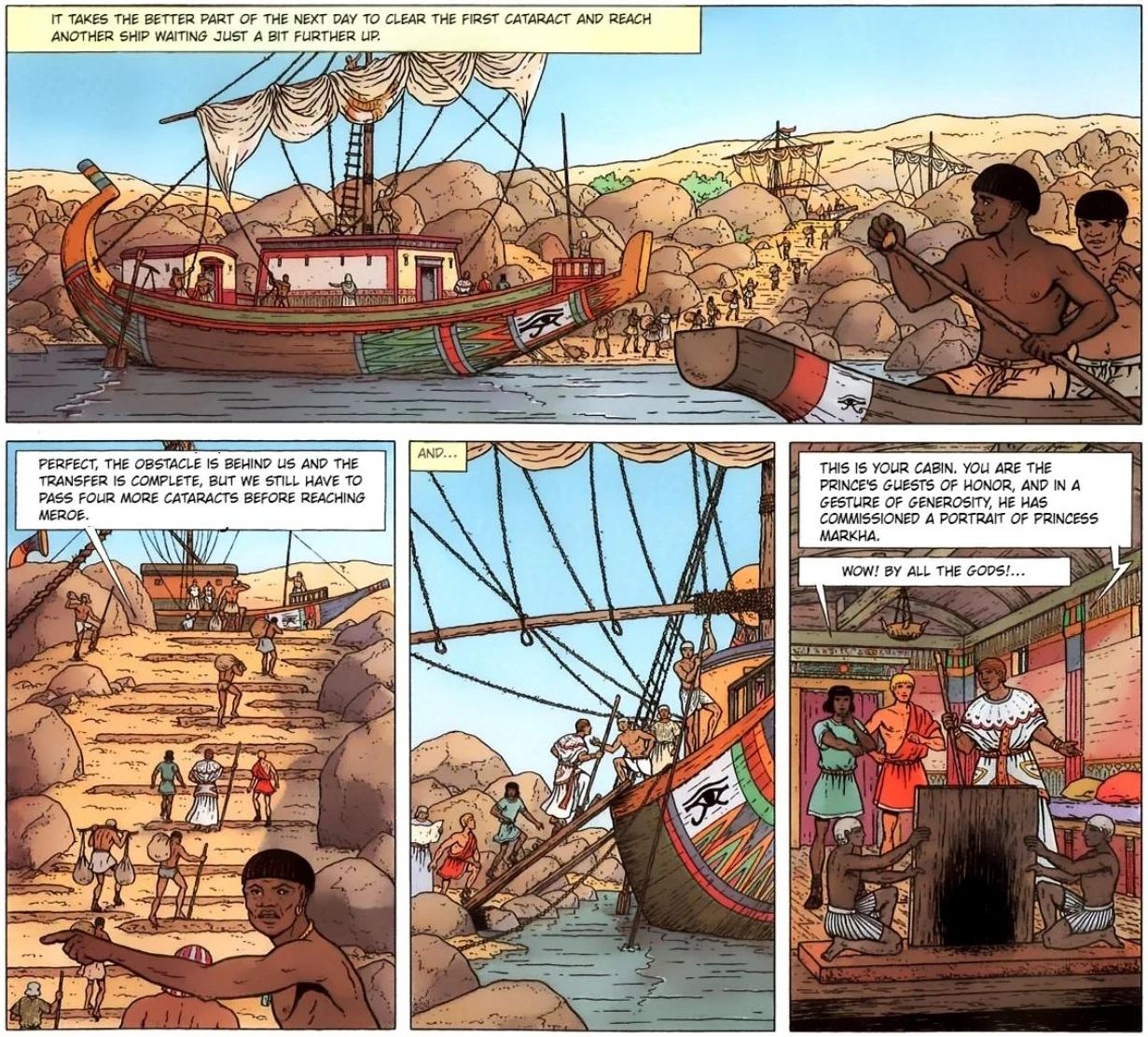
Here’s one more from the Alix series, which I was saving in the hopes that the retired (but evidently still willing to chime in) @PugJesus@piefed.social might want to comment upon, yay.
As I understand it, there were ~6-7 famous cataracts up and down the Nile, in Ancient Egypt.

https://upload.wikimedia.org/wikipedia/commons/e/ea/Nubia_today.png
When I was a laddie, I first came to understand that Egyptian cataracts were like small waterfalls, and thought to myself how much fun! it would be to ride them all the way as if in a whitewater raft adventure, in one’s reed-woven boat. 😀
Unfortunately for that little boy, I’ve come to understand that cataracts are essentially stretches of the Nile that are simply too dangerous to navigate by boat, and therefore must be worked around. The most common situation is evidently a mix of too much shallow water and too many dangerous rocks. Plus treacherous rapids in some situations, exacerbating everything else.
The famous Third Cataract:

https://upload.wikimedia.org/wikipedia/commons/9/9f/ThirdCataract.jpg
(more shots in WP’s gallery)
So getting back to that OP pic, boats meeting a cataract would usually have to be unloaded, their cargo moved to land, the boats pulled up on to land by log rollers & ropes, everything transported up or down river for a stretch, and then the reverse procedure to re-enter that mighty river of yore. Or in some cases towing would work via towpaths, a solution used all through history, and only tailing off in the latter stages of the Industrial Revolution as I understand it.
“Towboats Along the Yotsugi-dōri Canal” from Hiroshige’s “One Hundred Famous Views of Edo” series, a depiction of a towpath in rural Tokyo, mid-19th century.

https://upload.wikimedia.org/wikipedia/commons/thumb/3/38/100_views_edo_033.jpg/500px-100_views_edo_033.jpg
“Well, that’s all I’ve got to say about that.
–Forrest Gump
I think it’s time to wrap up now, but one last thing to note is that evidently a canal was built to help navigate at least one of these cataracts. A famous one would be The Canal of Senusret III.
(C’est vous, Mssr Voldemort?)
Here’s one more from the Alix series, which I was saving in the hopes that the retired (but evidently still willing to chime in) @PugJesus@piefed.social might want to comment upon, yay.
As I understand it, there were ~6-7 famous cataracts up and down the Nile, in Ancient Egypt.
https://upload.wikimedia.org/wikipedia/commons/e/ea/Nubia_today.png
When I was a laddie, I first came to understand that Egyptian cataracts were like small waterfalls, and thought to myself how much fun! it would be to ride them all the way as if in a whitewater raft adventure, in one’s reed-woven boat. 😀
Unfortunately for that little boy, I’ve come to understand that cataracts are essentially stretches of the Nile that are simply too dangerous to navigate by boat, and therefore must be worked around. The most common situation is evidently a mix of too much shallow water and too many dangerous rocks. Plus treacherous rapids in some situations, exacerbating everything else.
The famous Third Cataract:
https://upload.wikimedia.org/wikipedia/commons/9/9f/ThirdCataract.jpg
(more shots in WP’s gallery)
So getting back to that OP pic, boats meeting a cataract would usually have to be unloaded, their cargo moved to land, the boats pulled up on to land by log rollers & ropes, everything transported up or down river for a stretch, and then the reverse procedure to re-enter that mighty river of yore. Or in some cases towing would work via towpaths, a solution used all through history, and only tailing off in the latter stages of the Industrial Revolution as I understand it.
“Towboats Along the Yotsugi-dōri Canal” from Hiroshige’s “One Hundred Famous Views of Edo” series, a depiction of a towpath in rural Tokyo, mid-19th century.
https://upload.wikimedia.org/wikipedia/commons/thumb/3/38/100_views_edo_033.jpg/500px-100_views_edo_033.jpg
“Well, that’s all I’ve got to say about that.
–Forrest Gump
I think it’s time to wrap up now, but one last thing to note is that evidently a canal was built to help navigate at least one of these cataracts. A famous one would be The Canal of Senusret III.
(C’est vous, Mssr Voldemort?)

Vyacheslav Safronov - Astromo-23_27.jpg
Vyacheslav Safronov - Astromo-23_27.jpg
I use Summit, and I am fairly new to Lemmy.
I got banned from lemmy.world/c/dull_mens_club
I am quite shocked! I wanted to make a post about this fart which I produced that I believe my neighbors heard. After composing the post, I got a message that I am banned. ME!? Why!? And when I opened my profile I couldn’t see any of my posts at https://lemmy.world/c/dull_mens_club
Is it possible to see them so I can figure out the reason


If you want to help newcomers to the PHP language, our latest Special Interest Group might be just the thing for you. Announcing the PHP Onboarding Initiative!
If you want to help newcomers to the PHP language, our latest Special Interest Group might be just the thing for you. Announcing the PHP Onboarding Initiative!

We want to welcome a new member of The PHP Foundation Governing Board: Anne McCarthy from Automattic. Anne brings a balanced mix of thoughtful empathy and deep technical knowledge and will bring tremendous insight to the Board! https://thephp.foundation/blog/2026/08/04/anne-mccarthy-joins-the-board
We want to welcome a new member of The PHP Foundation Governing Board: Anne McCarthy from Automattic. Anne brings a balanced mix of thoughtful empathy and deep technical knowledge and will bring tremendous insight to the Board! https://thephp.foundation/blog/2026/08/04/anne-mccarthy-joins-the-board
I have a Terramaster F6-424 and the vendor site says that the machine can support up to 32gb of RAM. I am running TrueNAS on it.
I have tried 4 different 32gb DDR5 sticks and the machine refuses to POST (or whatever the beep is when it turns on). The latest one I tried I chose specifically because it said it supported my exact machine, despite the price. I don’t know if I’m just missing some specific spec on the memory that makes all 4 of the sticks I’ve tried incompatible with the F6-424, but at this point I’m doubting Terramaster’s claim of supporting up to 32gb.
I wanted to post here and ask if anyone has succeeded in upgrading/replacing the RAM in a Terramaster NAS before I return this last one and try a 16gb stick.
Is there something I’m missing here? Does running TrueNAS instead of TOS matter? Has anyone had success with any specific RAM model with this setup?

Two weeks have passed since Hamilton councillors voted 10-6 against an interim control bylaw (ICBL), or a moratorium, on AI data centres, while the city updates its rules for the controversial new facilities.
In the days since, Saskatoon, Miramichi, Toronto, Alberta’s Rockyview County, and Mississauga are moving forward with efforts to regulate the industry.
In light of this, Hamilton suddenly looks like a laggard.
Days after Hamilton’s July 15 vote, an incident described as a “chemical spill” was discovered at a data centre in neighbouring Cambridge, which garnered federal funding last year as part of Canada’s Sovereign AI Compute Strategy.
The U.S.-owned, 60-megawatt facility uses closed-loop cooling, often touted as a fix for data centres’ well-known water consumption issues. Ascent TOR1 data centre in Cambridge
A spill at a Cambridge data centre is believed to be a “bacterial bloom” in a retention pond on the property. Mathew McCarthy/Waterloo Region Record
At Mayor Andrea Horwath’s special information session, scheduled the day before councillors voted down a moratorium, data centre proponents referred to the modern water-cooling systems as “industry best practice.”
But experts, along with many Hamilton residents who delegated at city hall weeks earlier, say such systems are associated with leaks of PFAs (a.k.a. “forever chemicals”) into local watersheds.
Earlier this year, data centre operators in Cheyenne, Wyo., flushed a closed-loop system and inadvertently released a rare and deadly bacterium into the town’s wastewater system, which had to be shut down for months.
In Cambridge, after nearly two weeks without identifying the substance that will eventually end up in the Grand River, the data centre’s owner now says the milky-white discharge is a “bacterial bloom.”
The province hasn’t confirmed this, but is telling the public there it has not identified any “contaminants of concern.”
Given the industry’s penchant for signing NDAs with local governments, the secrecy could be a sign of things to come in places that fail to put appropriate guardrails around AI data centres.
In voting down a moratorium, Hamilton councillors claimed to weigh such environmental and health risks against legal and fiscal considerations. But their arguments, questionable at the time, have aged like milk.
Simultaneous — and contradictory — threats were issued by data centre proponents and their apparent allies on council in the days and weeks leading up to the July 15 vote.
Claims abounded that Hamilton would see legal action from developers whose projects are too urgent to be regulated, but also that Hamilton would miss out on investment as those same developers “take their business elsewhere” (like so many Yelp-users of the mid 2010s).
By now it’s clear Hamilton wasn’t out on a limb, as some councillors seemed to fear.
We were leading a national wave of municipal solidarity against an industry out of control and a federal government intent on enabling it.
If developers will take their business elsewhere in response to prudent regulation, it’s worth asking where, exactly, they expect to go.
In Mississauga, developer Prologis openly issued the threat of litigation in council chambers, promising not to proceed so long as the council agreed to an “informal pause” lacking any legal enforcement mechanism.
One councillor brought up a talking point previously heard in both Hamilton and Burlington, framing an ICBL as a drastic, heavy-handed measure, a “blunt instrument” being wielded carelessly.
But others politely listed multiple examples of Mississauga using ICBLs in the recent past, and the sky not falling.
In the end, Mississauga council voted 15-0, directing staff to draft an ICBL for AI data centres.
The following day Toronto passed two unanimous motions, voting 25-0 to slow development and raise scrutiny on planned AI data centres in Scarborough and Etobicoke.
These were treated as routine, even obvious decisions. There was no hand-wringing about overstepping jurisdiction, or pearl-clutching about “reputational risk” that due diligence and good governance will supposedly bring.
Councillors in these cities clearly understand the reality of the situation. There is greater risk in not listening to constituents and experts than in inconveniencing a few monied interests whose incentive is to obfuscate and muddy a full informational picture.
It’s getting tougher to argue that investment will go elsewhere as a flurry of other municipalities move rapidly toward implementing sensible regulation, and threats of legal action or jurisdictional-overstep from the upper levels of government lose potency each time they fail to materialize.
Meanwhile, resident concerns around data centres’ harms are proving to be justified, again and again.
It is deeply embarrassing that Hamilton city council fell for proponents’ empty promises and fear-mongering.
Councillors in Oakville, Cambridge and at least a dozen other Canadian municipalities are now having this conversation. In the U.S., more than 500 places now have moratoria or outright bans on AI data centres.
So what happens now?
Will councillors dig in their heels and defend the corner they and Mayor Horwath have painted themselves into? Or will they learn from this experience and try to rebuild trust with the people who hired them?








Hugh Weber has held a slew of executive roles across the NBA, NHL and other associated businesses.
Hugh Weber has held a slew of executive roles across the NBA, NHL and other associated businesses.