0

0


San José Spotlight
Santa Clara ends membership fees at senior center - San José Spotlight
sanjosespotlight.com
0


YouTube
A New Dawn / Une aube nouvelle (2026) - Trailer (English Subs)
www.youtube.com
preview
cross-posted from: https://lemmy.blahaj.zone/post/40526648
Original title (JA): 花緑青が明ける日に (Hana rokushō ga akeru hi ni, Dawn of the turquoise flower)
The film tells the story of young people who grew up around a 330-year-old fireworks factory that is about to be forcibly evicted. Keitarō has shut himself in the factory for four years to perfect the legendary “Shuhari” firework in place of his absent father. Meanwhile, his childhood friend Kaoru, who left her home due to an incident and has been living in Tokyo, visits Keitarō. In their reunion, the two hatch a surprising plan to find the secret of the long-lost firework.
https://www.themoviedb.org/movie/1279865
Nov 6 2026 update: Replacing original video link ( https://www.youtube.com/watch?v=msYhg_3tTvo ) with a different version of the same trailer that features English subtitles ( https://www.youtube.com/watch?v=mdezhcqqmRs ).
0

Berkeleyside
Berkeley rallied to restore a vandalized mural. Why does a little of the damage remain?
www.berkeleyside.org
0


NPR
As budgets tighten, people are breaking out their library cards
www.npr.org
0


The Irrawaddy
Over 2m Myanmar Migrants in Thailand Reject Regime’s Identity Document
www.irrawaddy.com
0


0


0

preview
it was basically still night with 0 traffic, I thought “surely, given all the free real estate this is an actual emergency of sorts” but alas. I should start carrying ninja rocks
it was basically still night with 0 traffic, I thought “surely, given all the free real estate this is an actual emergency of sorts” but alas. I should start carrying ninja rocks
0


The Lazy Democrat Returns to Hibernation
disreport.com
0


West China Hospital Develops MicroSpine: A 2mm Robotic Arm System for Minimally Invasive Spinal Surgery
pandaily.com
0
0

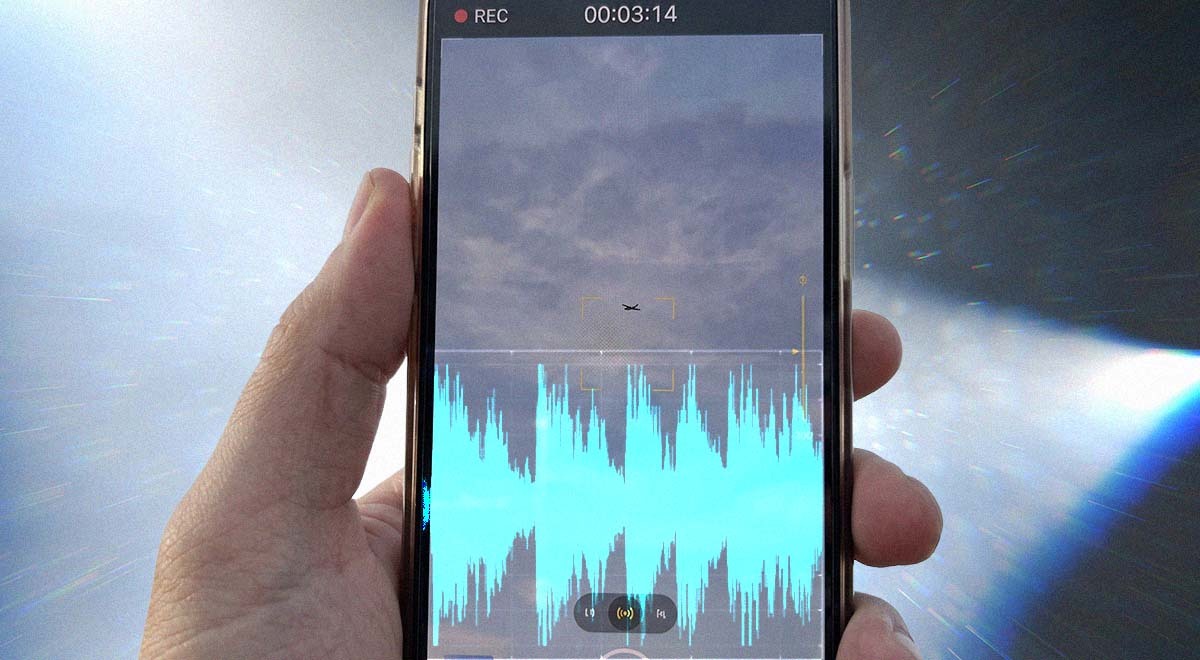
Cybernews
Your location can be tracked from this secret in your vids
cybernews.com
preview
cross-posted from: lemmy.world/post/54070272
When uploading a real recording, there is a good chance your location & therefore possibly your identity can be revealed from the footage itself.
You can triangulate low volume background sounds such as air planes: cybernews.com/…/aircraft-doppler-audio-geolocatio…
You can check the position of the sun/moon/stars, shadows, weather…: bellingcat.com/…/using-the-sun-and-the-shadows-fo…
If Streamers & Journalists CAN do it, government agencies ARE doing it.
If you need privacy be aware of this when recording / editing friends <3
0


tagesschau.de
EU-Dienst Copernicus: 1,5-Grad-Marke wird 2026 wohl überschritten
www.tagesschau.de
0

preview
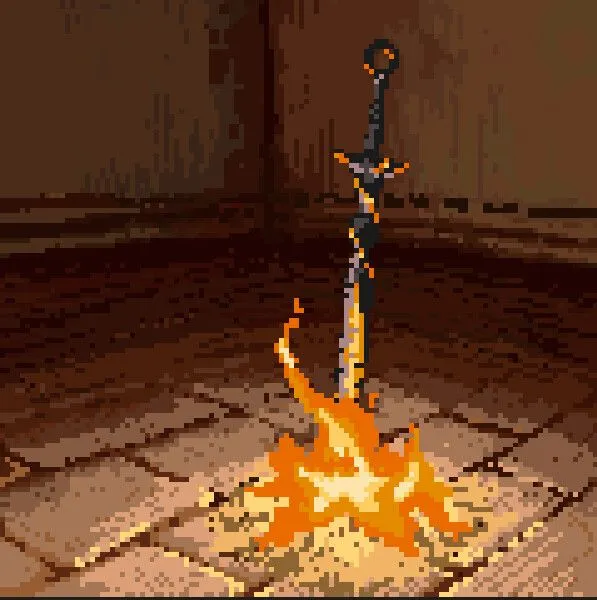
Stealth in DS3 is so OP. It’s also helped by enemies having only a really short attention span in DS3.
This is a play on this meme which was also previously posted here

I can’t for the live of me find the artist of the original Silver Archer artwork (it was reposted way to often). Earliest sign I could find was someone using it in 2014 as their avatar (at least according to TinEye).
Original artwork:

Stealth in DS3 is so OP. It’s also helped by enemies having only a really short attention span in DS3.
This is a play on this meme which was also previously posted here
I can’t for the live of me find the artist of the original Silver Archer artwork (it was reposted way to often). Earliest sign I could find was someone using it in 2014 as their avatar (at least according to TinEye).
Original artwork:
0

preview
Last weekend, I played a little Elden Ring seamless co-op which was a lot fun! This week, I’ve been playing around with the PS5 I borrowed from a friend of mine. After jailbreaking it, I installed a couple games among which was Mortal Shell 2 and Wuchang. I’ve played both of them for a little while and enjoyed MS2 and didn’t find Wuchang enjoyable at all thus far, sadly. Might play both of them for a little longer this weekend.
All soulslikes have specific distances you need to travel from one bonfire to the next. In Demon’s Souls, you’d only get a single one throughout an entire level. In Dark Souls, there are a couple more distributed in an area and most are in walking distance. Sometimes there can be quite long stretches between them which can hinder the flow you get into when attempting to beat a boss. Elden Ring solved that issue through Stakes of Marika in addition to having a lot more graces in an area and shorter distances between the individual graces.
What’s your preferred bonfire distribution in soulslikes? Do you like the Stake system from ER? Would you prefer them to be a little more rare?
0


0


0


0


preview
Background The original Matrix film, released in 1999, was a revolutionary action film in terms of combining Asian cinema inspired gunplay and kung fu together with cutting edge special effects, particularly the famed “bullet time” effect. With themes that resonate with the nascent late 90s internet and a plot that keeps you thinking, The Matrix was a cultural touchstone for many Western millennials. Of course, with financial success comes a demand for sequels, which was taken a step further by the franchise with the launch of a multimedia universe. 2003 was to be the big year, where two film sequels were released: The Matrix Reloaded in May followed by The Matrix Revolutions in November. If that wasn’t enough of a media overload, there was also the anime anthology, Animatrix, and the subject of this post itself, the videogame Enter the Matrix, which was also released in May at the same time as The Matrix Reloaded. While the ambition is admirable, it’s clear that the release date of the Enter the Matrix was driven by the requirements of the wider media franchise itself rather than when the game would be in a complete state.
Production Enter the Matrix is a third person 3D action game incorporating melee combat and shooting augmented by the “bullet time” system. The game includes a significant amount of cinematic footage that was shot concurrently with the Matrix sequels. The plot of the game ties in very closely with The Matrix Reloaded, which in game events expanding on scenes within the movie itself. The game even includes a teaser trailer for The Matrix Revolutions as part of its ending. The game has two selectable player characters: Niobe and Ghost. While each of them have slightly different melee movements, gameplay wise they seem indistinguishable. While the overall chapters are similar for both characters, each character has their own unique path through the levels with a few exceptions.
The menu UI is functional and leans heavily on the imagery of the Matrix franchise, from the green digital rain to the sound effects. The whole presentation plus the exclusive footage makes it feel like an integral part of the Matrix franchise, rather than the standard licensed game of the time where the license feels more like window dressing. The in game aspects itself are where the cracks start to appear. While the 3D environment tries to evoke real world locations, the basic geometry and texture work, especially in the latter levels, gives it a previous gen or low budget look. Character models have the early 6th gen console look, with the protagonists benefitting from the bulk of the effort. A lot of works seems to have gone into the animation to account for the various melee and gunplay moves for the protagonists, although animations still appear to be canned and not physics driven. Some particularly egregious examples of bad 3D models include vehicles with angular wheels.
Gameplay
The majority of the gameplay are third person combat sequences through linear levels. Health and Focus, the resource for bullet time, both regenerate on their own after a couple of seconds out of combat so there are almost no resource pickups except for health packs located sporadically throughout the maps. Shooting is similar to the original Tomb Raider games, where the character aims automatically at the nearest enemy, while melee is similar where initiating melee combat locks the camera into a more side on view with nearby enemies, and also seems to reduce or prevent enemies further away from shooting at you. I suppose that’s one way indulge the fantasy of melee combat against armed opponents. Melee combat includes punches, kicks, and throws. There’s also a disarm move, particularly handy for reducing the threat of armed enemies, while sneaking behind enemies also allows for an insta kill move. Counters are also possible although its only relevant during melee boss fights. There seems to be a lot of depth in the melee system, including light medium and heavy attacks, which depends on your direction inputs when fighting enemies.
Focus is the cornerstone of the combat system. Activating focus puts the world into slow motion allowing you to run quickly while dodging visible bullet trails to close the distance with enemies or giving more time to aim and shoot at various enemies. Jumping while using guns in focus mode also gives you cartwheeling or diving moves which seems to improve bullet evasion. Focus also improves your melee moves, making them less likely to be blocked and also allowing for more powerful focus specific moves. There also certain context specific moves, such as running on walls or wall kicks.
While the combat system is ambitious, it’s clear that significantly more polish is needed. The biggest combat issue for me is hit registration. There’s little visual feedback when the enemies get hit, apart from some canned animations which seem to get overridden when the enemies move to their next animation. Shooting in bullet time seems inconsistent, with many shots looking like they miss the target. Melee combat has the same issue, particular for melee boss fights where it’s hard to tell when your hits are being blocked.
While there are a variety of guns, you’ll mostly be sticking with the shotgun or automatic weapons once you get them from the enemies. Grenades are included but using them is inconsistent and potentially dangerous due to unpredictable bounces off level geometry.
The levels themselves are mostly unremarkable indoor areas, although there are certain rooms with columns that are clearly meant to evoke the iconic lobby firefight from the first movie. Progress through the levels are mostly linear, with a few switches to trigger or doors that unlock once an enemy opens them, but otherwise no puzzles or keys to collect. Certain levels require you to run way from pursuing Agents, since they’re not beatable except for certain set pieces.
90% of the enemies in the games are armed cops. There’s a level midway through the game with a focus on melee enemies, which allows the melee system to shine, but otherwise most of the game involves grinding through varieties of cops, from lightly armed pistol wielding guards to armored SWAT teams that require a lot of firepower to take down. In most instances, closing the distance with bullet time then disarming enemies seems to be the most effective combat tactic. Enemies with firearms do high damage, which encourages you to be evasive and use the Focus system. While there’s some instant Focus regeneration if you manage to kill an enemy in melee, there’s still a lot of waiting around needed at certain points to get your health and focus up for the next battle.
The game also has a couple of levels which involves either driving or shooting from the vehicle, depending on which character you choose. The latter can be annoying as the AI driver sometimes gets stuck in geometry.
The game has a checkpoint system, with long periods between checkpoints. On occasion it’s possible to trigger a checkpoint at low health/focus that makes the next sequence more difficult, but otherwise it’s a matter of looking for a safe spot to regenerate. There are no upgrades in the game, so there isn’t much of a reason to replay once you’ve done both the Niobe and Ghost paths.
Technical Note
I played the PS2 version emulated on an Android handheld, so it’s possible that certain effects could be more visible on a big screen, but otherwise the game runs fine in ARMSX2. There are some bugs here and there with enemies sometimes getting stuck, but nothing game breaking.
The biggest issue with the PS2 version are the awkward controls. The game is from the era where twin stick 3D controls were still not settled, so it uses the left stick for forward, backwards, and turning, while the triggers are bound to strafing. While it works, it has not aged well.
Conclusion
The elephant in the room for Enter the Matrix is the existence of Max Payne, the 2001 third person shooter which pretty much got bullet time gun play perfect right out of the gate. While Max Payne is more of a conventional third person shooter where you have to actually aim, the crisp gameplay sells the bullet time fantasy far better than Enter the Matrix. Of course, Enter the Matrix also has the whole melee combat system as well, but the shooting and melee system here don’t feel seamlessly integrated.
Overall given its uneven gameplay and very weak level design, it’s at the bottom tier of mid games.
4/10 Some cool moments but otherwise a janky relic of a bygone era
0


0


Bahnblogstelle
Neuer Fahrgastrekord: Nutzung von Bayerns Regionalzügen gestiegen
bahnblogstelle.com
0


Kuphar - Wikipedia
en.wikipedia.org
0

preview
I saw a post earlier (not on the fediverse), about a trans woman who had a date with a cis man who was pretty clearly into her, fliriting and stuff, but then as soon as she told him she was trans the guy immediately acted different, said he wasn’t into her and just wanted to be friends, etc. The poster was obviously upset by that and was trying to vent about it online in a women’s community who claim to be trans inclusive, but so many of the replies were about how he wasn’t transphobic, how he was such a good guy for giving her the bare minimum respect after learning she was trans, how its not transphobic to not be attracted to trans people, etc. That’s also not even what the poster was saying, she just wanted support after a shitty date, something which the community is perfectly capable of doing when a cis woman is seeking it.
But also like the guy was attracted to her! He just immediately changed his mind upon learning she was trans, which is literally just transphobia, holy shit. And almost all the supportive people in the comments or anyone saying that were getting piled on.
I already know the majority of cis people don’t see us as actually being our gender/sex, but it still fucking sucks everytime I see something like that that reminds me of that fact so starkly.
Edit: The number of cis people coming in to this thread and doing the exact same fucking thing I’m complaning about in this post is wild holy shit. Like congrats on not having any ability to read the room l guess lmao.
0

preview
Gary and Ivan walked the grueling halls of Level 2, keeping their eyes peeled and listening for any potential entities nearby. Suddenly, something small and fast darted out from behind a pipe close to the ground and made a beeline for Gary. Gary yelped in shock and jumped back and to the side, quickly whipping out his knife to point at the thing as it raced past and Ivan turning to see what was going on. As it stopped and turned to look at him, he saw it clearly and realized it was just a small mouse. Heck, it’s even…
Gary and Ivan walked the grueling halls of Level 2, keeping their eyes peeled and listening for any potential entities nearby. Suddenly, something small and fast darted out from behind a pipe close to the ground and made a beeline for Gary. Gary yelped in shock and jumped back and to the side, quickly whipping out his knife to point at the thing as it raced past and Ivan turning to see what was going on. As it stopped and turned to look at him, he saw it clearly and realized it was just a small mouse. Heck, it’s even…
0

preview
Neopets has always been something that kinda stuck in my head for a long time. I’ve heard and known about it for over 20 years, I probably made one or two accounts that I didn’t do anything with besides creating the first pet, so I decided to actually check how it’s looking nowadays, waaay past its prime.
The reason? Archaeological curiosity, mainly. I mean, it’s not every site from ye olde internete that survived, especially one aimed at kids. Most that survived resemble nothing of their previous incarnations, too. I suspect what’s keeping Neopets alive is mostly old veterans, rather than any significant influx of new kids, as those are likely too busy with Roblox.
The screens for creating your first neopet look properly modern. I think most pet designs still look charming, possibly due to their overall simplicity.
That dashboard and pet creation screens are more of weird outliers than rules, as a lot of pages are “frozen in time” and some of them are clearly from before they even started doing stuff in Flash, like the haggling screen and several games in Meridell. These things tickle my nostalgia neurons hard!

Neopia Central, now with 0% Flash
More amazing than keeping so much old stuff around^[phtml old, which was the default page extension for PHP version 2. Said old stuff still works!], is that the classic experience is still receiving updates and bug fixes, with the last one being 3 days ago.
So, yeah, your neopet, the thing that’s supposed to be the center of the experience. What do you do with it? Feed, groom, play, read to and dress up. This still works like in 2000, you just pick the item, use it with your pet and it’ll reply to you, no animations or even pictures showing a facial expression, which is a bit disappointing. Understandable, given the amount of pets there are, but still.
Now, the game has a lot of stuff to check around, and I really mean A LOT. Feels like there are a hundred different shops and 300+ games. Seems only one shop doesn’t have a limited stock, everything else has a chance of having nothing for sale.
Most of the games are made with Flash and run via Ruffle emulator. They’re the short type of stuff that you’ll finish within 2 minutes, tops, with a score that will net you some neopoints - the main currency for the game - which you can do 3 times for each game. Let’s be real here, this works better than that shitty “energy every X minutes” that mobile games force on players in order to sell premium, you can play and replay games all you want, minus their NP prizes, but I digress. Most games don’t get you much, like 100-300 NP for a decent score, some games are “solved”, in that you could throw a macro and get max score every time. There’s a little bit of everything. For some reason, some games won’t give me NP after sending a score, saying I am “offline”.
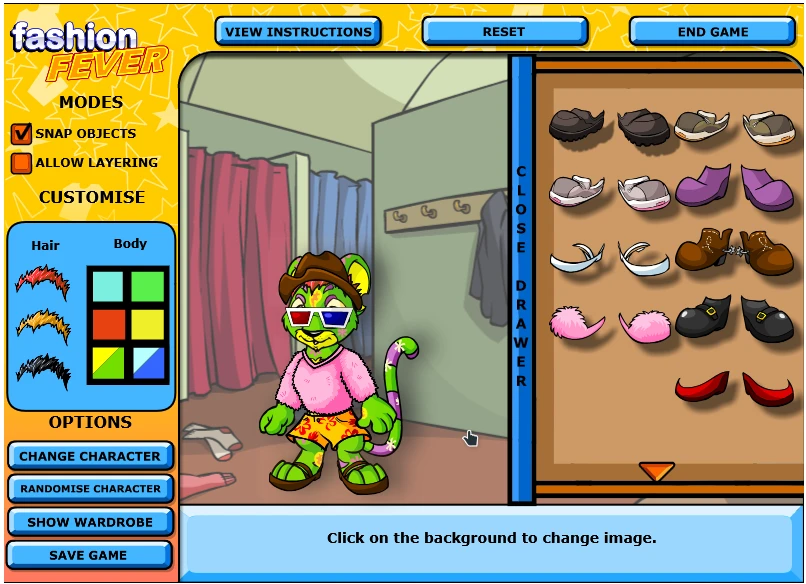
Bet you can’t get any more fashionable than this
Other places that you can visit can give prizes, like the many Wheels of Misfortune^[These and some other things only let you spin once a day or every number of hours, but you can watch an ad for an immediate second spin. Without an ad blocker, you’ll see ads on the right, left and bottom of the pages. Annoying, but not quite invasive, at least on PC. With an adblocker, the game might throw a warning window asking you to disable it, but you can ignore it.], or little quests, though said quests will often ask for items and I have no clue where to find them. Poor accounts (less than 100k NP?) can feed their pets at the Soup Kitchen (Neopia Central -> Bazaar -> ) for free, which is a godsend as food starts at 250 NP on the store that always has stuff for sale. You can bookmark certain places for fast and easy access, but I’m currently enjoying the idea of navigating through maps in order to reach certain places, it really feels like places within a game universe, especially with the contrast of earlier places against newer ones, kinda like how certain cities have buildings of vastly different architectural eras.

Like opening a time capsule
One more thing is that you can use your neopet to do actual battles in the Battledome. This is where I took a wrong click and got myself stuck in a fight against Punchbag Bob and his 5000 HP. I can’t find any buttons to give up the fight, so I’m forced to wittle down that by increments of 3-5 damage per turn. He doesn’t attack, so I can’t just sit back and lose, either. This fight has been going for over 24h now, logging off or leaving the page for several hours won’t move a thing. Don’t make my mistake.
Most of the stuff that I end up discovering feels like happy little accidents, like how you can check any pet with www.neopets.com/~<name>, like www.neopets.com/~Bela (who’s ~22 years old) or www.neopets.com/~Altana (~26 yo), so long as you are logged in. Now THIS is a real look into the past! They all seem auto-generated based on the neopet species. It’s weird to find that some of these pages are nothing but an image or two, like ~Ruby or ~Strong, no clue why.
There are also a couple of pages that have “how to draw a neopet” as well as black and white coloring pictures for printing. Man, remember when printers were common at homes? Back when computers were family owned, so to speak. I’ve also found an Art Gallery page, with over 4500 member-made submissions. Not gonna lie, seeing some of those was heartwarming, a bit of a shame that there’s no date attached to any of them.

This is one of those pages that has probably remained unchanged since 2000
I still feel like messing around and checking more stuff that the place has to offer, though with appropriately low expectations. Maybe someday I’ll finish beating Punchbag Bob, maybe I might give the community features a shot.
Neopets has always been something that kinda stuck in my head for a long time. I’ve heard and known about it for over 20 years, I probably made one or two accounts that I didn’t do anything with besides creating the first pet, so I decided to actually check how it’s looking nowadays, waaay past its prime.
The reason? Archaeological curiosity, mainly. I mean, it’s not every site from ye olde internete that survived, especially one aimed at kids. Most that survived resemble nothing of their previous incarnations, too. I suspect what’s keeping Neopets alive is mostly old veterans, rather than any significant influx of new kids, as those are likely too busy with Roblox.
The screens for creating your first neopet look properly modern. I think most pet designs still look charming, possibly due to their overall simplicity.
That dashboard and pet creation screens are more of weird outliers than rules, as a lot of pages are “frozen in time” and some of them are clearly from before they even started doing stuff in Flash, like the haggling screen and several games in Meridell. These things tickle my nostalgia neurons hard!
Neopia Central, now with 0% Flash
More amazing than keeping so much old stuff around^[phtml old, which was the default page extension for PHP version 2. Said old stuff still works!], is that the classic experience is still receiving updates and bug fixes, with the last one being 3 days ago.
So, yeah, your neopet, the thing that’s supposed to be the center of the experience. What do you do with it? Feed, groom, play, read to and dress up. This still works like in 2000, you just pick the item, use it with your pet and it’ll reply to you, no animations or even pictures showing a facial expression, which is a bit disappointing. Understandable, given the amount of pets there are, but still.
Now, the game has a lot of stuff to check around, and I really mean A LOT. Feels like there are a hundred different shops and 300+ games. Seems only one shop doesn’t have a limited stock, everything else has a chance of having nothing for sale.
Most of the games are made with Flash and run via Ruffle emulator. They’re the short type of stuff that you’ll finish within 2 minutes, tops, with a score that will net you some neopoints - the main currency for the game - which you can do 3 times for each game. Let’s be real here, this works better than that shitty “energy every X minutes” that mobile games force on players in order to sell premium, you can play and replay games all you want, minus their NP prizes, but I digress. Most games don’t get you much, like 100-300 NP for a decent score, some games are “solved”, in that you could throw a macro and get max score every time. There’s a little bit of everything. For some reason, some games won’t give me NP after sending a score, saying I am “offline”.
Bet you can’t get any more fashionable than this
Other places that you can visit can give prizes, like the many Wheels of Misfortune^[These and some other things only let you spin once a day or every number of hours, but you can watch an ad for an immediate second spin. Without an ad blocker, you’ll see ads on the right, left and bottom of the pages. Annoying, but not quite invasive, at least on PC. With an adblocker, the game might throw a warning window asking you to disable it, but you can ignore it.], or little quests, though said quests will often ask for items and I have no clue where to find them. Poor accounts (less than 100k NP?) can feed their pets at the Soup Kitchen (Neopia Central -> Bazaar -> ) for free, which is a godsend as food starts at 250 NP on the store that always has stuff for sale. You can bookmark certain places for fast and easy access, but I’m currently enjoying the idea of navigating through maps in order to reach certain places, it really feels like places within a game universe, especially with the contrast of earlier places against newer ones, kinda like how certain cities have buildings of vastly different architectural eras.
Like opening a time capsule
One more thing is that you can use your neopet to do actual battles in the Battledome. This is where I took a wrong click and got myself stuck in a fight against Punchbag Bob and his 5000 HP. I can’t find any buttons to give up the fight, so I’m forced to wittle down that by increments of 3-5 damage per turn. He doesn’t attack, so I can’t just sit back and lose, either. This fight has been going for over 24h now, logging off or leaving the page for several hours won’t move a thing. Don’t make my mistake.
Most of the stuff that I end up discovering feels like happy little accidents, like how you can check any pet with www.neopets.com/~<name>, like www.neopets.com/~Bela (who’s ~22 years old) or www.neopets.com/~Altana (~26 yo), so long as you are logged in. Now THIS is a real look into the past! They all seem auto-generated based on the neopet species. It’s weird to find that some of these pages are nothing but an image or two, like ~Ruby or ~Strong, no clue why.
There are also a couple of pages that have “how to draw a neopet” as well as black and white coloring pictures for printing. Man, remember when printers were common at homes? Back when computers were family owned, so to speak. I’ve also found an Art Gallery page, with over 4500 member-made submissions. Not gonna lie, seeing some of those was heartwarming, a bit of a shame that there’s no date attached to any of them.
This is one of those pages that has probably remained unchanged since 2000
I still feel like messing around and checking more stuff that the place has to offer, though with appropriately low expectations. Maybe someday I’ll finish beating Punchbag Bob, maybe I might give the community features a shot.
0

preview
I don’t use any apps - mobile or desktop.
Is there any way to add a tag to users so that I can prompt my memory of their posting style, etc.?
I don’t use any apps - mobile or desktop.
Is there any way to add a tag to users so that I can prompt my memory of their posting style, etc.?
0

YouTube
DNA (1996) | SCI-FI ACTION MOVIE | Mark Dacascos - Jürgen Prochnow - Robin McKee
www.youtube.com
preview
Need a film that’s:
- a blatant ripoff of Raiders of the Lost Ark
- a blatanter ripoff of Jurassic Park
- the blatantest ripoff of Predator
but having trouble choosing? Relax! Watch D.N.A. & see a ripoff of all three, and even get a bit of Alien thrown in free!
- D.N.A. (1997)
- Recently watched in the #MondayActionMovie watch party
0


preview
Cinematographer: James Wong Howe.
The office of “James Reavis de Peralta” (Vincent Price), his shadow falling on a large map of Arizona, most of which Reavis is taking over through a long con involving forged Spanish land grants. Based on a true story.
Cinematographer: James Wong Howe.
The office of “James Reavis de Peralta” (Vincent Price), his shadow falling on a large map of Arizona, most of which Reavis is taking over through a long con involving forged Spanish land grants. Based on a true story.
0

preview
Free to keep on Epic until Sun Nov 8 (exact end time not listed, so claim by that morning). Synthwave obstacle-runner, normally $9.99. Also ending soon: Letter Quest Steam key on Fanatical ends today, and the Yash Epic 100%-off wave (Gladiator, Quiztopia, Epic World, etc.) ends Sun Nov 8, 12:30 PM CT.
Free to keep on Epic until Sun Nov 8 (exact end time not listed, so claim by that morning). Synthwave obstacle-runner, normally $9.99. Also ending soon: Letter Quest Steam key on Fanatical ends today, and the Yash Epic 100%-off wave (Gladiator, Quiztopia, Epic World, etc.) ends Sun Nov 8, 12:30 PM CT.
0

preview
This season’s El Niño is like a preview of the future—wrecking-ball tides of higher sea levels, the exotic species that will find new homes, the endless new temperature records.
This season’s El Niño is like a preview of the future—wrecking-ball tides of higher sea levels, the exotic species that will find new homes, the endless new temperature records.
0

0


Grist
Plastic pollution is putting an old legal doctrine to a new test
grist.org
preview
cross-posted from: news.abolish.capital/post/91275
Plastic pollution blights the streets, beaches, parks, and lawns of Baltimore. A significant amount of that litter bears the circular red-and-blue Pepsi logo or the flowing white script of Coca-Cola’s branding.
But, legally speaking, none of that rubbish is Pepsi’s fault. Or Coke’s.
That’s what a Baltimore city circuit court judge ruled this summer following a legal battle in which the city and county of Baltimore sought money from PepsiCo, Coca-Cola, and others to clean up plastic pollution. Companies “conducting lawful activities,” wrote Judge Audrey J.S. Carrión, referring to the sale of single-use plastics, “should not be held liable under public nuisance claims because others are misusing the products in an unlawful manner.”
In other words, plastic pollution is a problem of consumer behavior, not corporate irresponsibility. As far as the state’s public nuisance law is concerned, a company’s liability ends at the point of sale.
Similar reasoning scuttled a public nuisance lawsuit the state of New York filed against PepsiCo and Frito-Lay and has arisen in similar litigation from Missouri to California. As environmental advocates and governments continue to develop this legal theory, those setbacks raise a fundamental question: When does a company’s responsibility for its products end? And can public nuisance laws succeed in making polluters pay?
The notion of public nuisance dates to 13th-century English common law and traditionally applied to violations of rights shared by the public, such as access to clean air. Since the 1970s, plaintiffs have increasingly tried to apply that idea to manufacturers whose products allegedly jeopardize public health, safety, and access to a clean environment.
These lawsuits, however, have “a mixed record of success,” said Timothy Lytton, a professor at the Georgia State University College of Law. Cases against opioid manufacturers, e-cigarette companies, and even the landmark litigation against Big Tobacco have sometimes succeeded — but mostly by securing favorable settlements, not because judges ruled in favor of the public-nuisance arguments.
Cases that have been heard, meanwhile, have struggled to convince judges of “causation,” or the idea that corporate defendants are substantially responsible for violating a public right. Judges are wary of extending corporations’ liability past the lawful sale of their products, particularly when those products aren’t used as intended. If a doctor or patient diverts opioids to the black market, for example, are the manufacturers responsible for the resulting harm?
Read Next
The global plastics crisis explained in 6 charts
This is essentially what Carrión said in the Baltimore case. It also echoes questioning from Justice Stephen Lindley last month as he heard arguments in the appeal of New York’s Pepsi lawsuit. “If [Pepsi] has to pay for the cleanup when somebody else is littering, … it’s not going to be sustainable,” he told the plaintiff’s lawyers. He appeared sympathetic to PepsiCo attorney Andrew Tulumello’s argument that the state had a “honking causation problem”: Pepsi, Tulumello said, “is not encouraging people to throw stuff in the litter.”
According to Albert Lin, co-director of the California Environmental Law and Policy Center at the University of California, Davis, there are three basic elements of a successful public-nuisance lawsuit. The first is demonstrating “substantial interference with a public right.” The second is causation — linking a defendant to that interference. The third, he said, is negligence, intent, or other “tortious conduct” in the defendant’s activities.
Environmental groups and governments are trying to get around the point-of-sale argument by linking causation and conduct: Plastics companies, they argue, are responsible for the pollution and knew their actions would harm public rights. Courts will therefore pay close attention to “foreseeability” — whether it was foreseeable that plastic would end up as litter, Lin said. As Lytton put it, manufacturers allegedly acted “in a way that foreseeably increases the risk of misuse.” The word “foreseeable” appears 22 times in Baltimore’s complaint.
Plaintiffs have evidence they can point to in arguing that plastic pollution was foreseeable. At least some manufacturers have known for decades that mass production of single-use plastics would contribute to environmental pollution, and that recycling would be unable to manage the problem. The lawsuits also cite microplastics contamination as part of the alleged nuisance, and an investigation published last week by the Los Angeles Times found that industry scientists have known since at least the 1970s that microplastics could lodge in humans’ bodies.
That history informs the framing offered by Scott Hochberg, general counsel and litigation director for the nonprofit Earth Island Institute. “Companies induced consumers to purchase these products while knowing the likelihood that they would end up as trash,” he said. “And that’s exactly what happened.”
Whether this framing succeeds may depend, in part, on the jurisdiction. In addition to the causation requirement for public-nuisance lawsuits, Lin said some states have a higher standard for demonstrating that defendants had “control” over their products at the time the nuisance occurred. New York and Maryland are two such states. California, on the other hand, is not, and courts there have so far proven more receptive to plastics public nuisance suits.
Judge Richard Seeborg of the U.S. District Court for the Northern District of California, who is overseeing two lawsuits against Exxon Mobil Corp., allowed one — from the Sierra Club — to proceed to trial. (He has not yet ruled on the other one, brought by the state’s attorney general.)
But even in California, surviving an early challenge is no guarantee of success. A judge there allowed Earth Island Institute’s public-nuisance claim — which rested in part on allegedly misleading recycling labels — against 10 food and beverage companies, but it was ultimately rejected earlier this year in a summary judgment. Earth Island plans to appeal.
Read Next
When plastic companies write the lesson plans
Pepsi, Coca-Cola, and Exxon Mobil did not respond to Grist’s requests for comment.
Lin said it’s still “early days” for this legal theory, and the rejections do not necessarily signal a losing strategy. He noted, however, that the courts have shown significant skepticism for public nuisance in ongoing climate litigation, and a case the Supreme Court is hearing this term could make it more difficult for cities and states to bring such claims in the future.
Lin added that in climate lawsuits, plaintiffs have leaned more heavily on fossil fuel companies’ allegedly deceptive conduct, invoking consumer protection and false advertising claims that can be easier to substantiate than those based on public nuisance. Plastics plaintiffs could pursue a similar strategy, he said, potentially winning damages — though likely not orders requiring companies to clean up the pollution their products create.
Public nuisance laws could face new constraints at the state level, too. Last year, Montana enacted a first-of-its-kind law preempting state and local public-nuisance lawsuits based on “lawful activities,” while Kansas and Utah have since enacted their own restrictions. All three states’ laws are connected to model legislation drafted by the American Legislative Exchange Council, a conservative policy organization that brings together state lawmakers and private-sector members to develop model legislation.
Whatever their ultimate outcome in court, Lytton said plastics lawsuits can “win” in other ways — by unearthing new documents, for example, and putting the plastics issue higher on the public-policy agenda. They also provide an opportunity for plaintiffs to refute the plastics industry’s consumer-responsibility narrative.
“When you file a lawsuit, what you’re doing is you’re telling a story” — often about some sort of structural or corporate wrongdoing, Lytton said. “When you talk about tobacco, it’s not just about smokers. Or opioids, it’s not just about users. It’s about the companies and their design and marketing decisions. And so the framing that goes on in these [lawsuits] is moving the discussion of plastics away from ‘litterbugs’ and toward corporate responsibility.”
This story was originally published by Grist with the headline Plastic pollution is putting an old legal doctrine to a new test on Nov 6, 2026.
From Grist via This RSS Feed.
0


Unity Without Struggle: A Structural Diagnosis of the PSL 2026 Crisis
vililith.substack.com
preview
You all may find this helpful. It is an anonymous open letter regarding the 2026 crisis within the Party for Socialism and Liberation (PSL). It analyzes the party’s structural failures, the handling of the Marissa Sanchez case, and the rise of bureaucratic centralism. it is useful to anyone attempting to reform PSL or building something better. Please share this. …substack.com/…/unity-without-struggle-a-structur…
You all may find this helpful. It is an anonymous open letter regarding the 2026 crisis within the Party for Socialism and Liberation (PSL). It analyzes the party’s structural failures, the handling of the Marissa Sanchez case, and the rise of bureaucratic centralism. it is useful to anyone attempting to reform PSL or building something better. Please share this. …substack.com/…/unity-without-struggle-a-structur…
0

preview
Im looking for a first car for about 3500€ which can hopefully last a few years daily commuting During my apprenticeship
Now, I come from a Toyota family, since they are reliable af in the engine Department, even if they (at least the yaris and prius from the 00s) drive pretty badly
But the aygos sold here for that price have extremely high mileage (as in 160k+), and even if they have been treated for Rust, which they have probably not knowing the people who drive a 2006 aygo base model without aircon), it tends to be very noticeable on the inside of the car and all the nice to have stuff
Now, I’ve been looking at the VW golf 3 door from about 03, they go for about 2800€ Max for like 100k, but from what I’ve heard VW, Audi and the likes tend to die around 100k, but they are just so great in every other aspect
So now I’m looking for comments from the car gods.
0

0
0


The Planetary Society
Cat's Head Nebula
www.planetary.org
0

BT News
Building popular power against imperialism in West Africa - BT News
breakthroughnews.org
preview
cross-posted from: news.abolish.capital/post/91248
Under the banner “One People, One Struggle: Against Imperialism for Popular Power in West Africa,” the West Africa People’s Organisation (WAPO) convened its Second Congress at the Amilcar Cabral School in Agyanoa, Ghana, from October 31 to November 1. The two-day event gathered delegates from 29 organizations across 11 countries. Representing political parties, social movements, trade unions, peasant groups, and women’s organizations, participants assembled to construct a unified front against imperialist domination and chart a strategic path toward popular sovereignty across West Africa.
Following an opening cultural performance by a local ensemble, Revolutionary Kolomashie, the beat of drums and blare of the trumpet set the scene for vibrant plenary sessions and commission debates focused on the concrete realities of anti-imperialist struggle in West Africa in the current conjuncture.
Local ensemble Revolutionary Kolomashie performs at the opening of the WAPO Second Congress, 31 October 2026. Photo: Jnr Johnson Segbefiah / Pan African Television
The subregion continues to suffer under severe insecurity and destabilizing violence unleashed by NATO and French military interventions since the fall of Libya. Grounded in this stark reality, the gathering zoomed in on the rising tide of anti-imperialist resistance across the region – expressed through massive mobilizations against foreign military bases that have defined the regional conjuncture over the four years since the founding of WAPO – and notably marked by the expulsion of French troops from Mali, Niger, and Burkina Faso.
WAPO President Philippe Noudjenoume described the shifts in the Sahel as a pivotal moment: “The central factor determining any analysis of our West African subregion today is the governments of Mali, Burkina Faso and Niger, united in the Confederation of the Alliance of Sahel States (AES). What is happening in these three countries can only be described as a patriotic and sovereignist revolution.” Noudjenoume added that this movement represents “a giant leap towards realizing the dream of our illustrious Pan-African heroes, such as Kwame Nkrumah, Sékou Touré, Patrice Lumumba and Modibo Keïta.”
WAPO President Philippe Noudjenoume delivers the Opening Address of the WAPO Second Congress. Photo: Jnr Johnson Segbefiah / Pan African Television
In his welcoming address Socialist Movement of Ghana (SMG) Convenor Kyeretwie Opoku emphasized that this shift resulted directly from grassroots mobilization. Referring to the expulsion of French troops he said, “This didn’t happen because France changed its mind. It happened because people in the streets of Bamako and beyond fought for it, protested, and drove the French out!”
Opoku noted that the formation of the Alliance of Sahel States (AES) by Burkina Faso, Mali, and Niger – alongside their departure from ECOWAS – signals a new emancipatory epoch where nations are actively reclaiming sovereignty over their natural resources. This is not unique to the AES, but a symbolic tip of the proverbial iceberg that captures the aspirations of peoples across the African continent. A primary example remains the experience of Niger finally asserting control over its uranium reserves, ending decades of subsidized extraction for France.
Delegates rejected imperialist narratives framing regional insecurity as mere ethnic conflicts, identifying imperialist interference and foreign covert destabilization as primary drivers of instability. To secure true self-determination, delegates called for the immediate removal of all foreign military bases from African soil and urged West African nations to establish independent, collective security arrangements.
The Congress also examined the divide between formal electoral democracy and actual, popular democratic participation and process. Representatives from Guinea-Bissau, Ivory Coast, and Senegal outlined how external trappings of democracy often mask systemic counteractions against the popular will. Speakers pointed to foreign manipulation – particularly from France – in preserving neocolonial monetary structures like the CFA franc and secret bilateral agreements. Electoral mechanisms, delegates warned, are frequently weaponized to legitimize imperialist control while marginalizing transformative movements.
Delegates & observers to the WAPO Second Congress break out into commissions to discuss various themes and topics. Photo: Jnr Johnson Segbefiah / Pan African Television
In response, Noudjenoume framed WAPO’s core mandate: “WAPO aims to raise the consciousness of West African workers and peoples, enabling them to undertake their dual liberation: liberation from imperialist domination and social liberation from the ruthless exploitation of capitalism.”
This aforementioned erosion of democratic processes coincides with escalating state-sponsored repression in countries such as Benin, Guinea-Conakry, Guinea-Bissau, and Côte d’Ivoire. Delegates reported crackdowns, banishment and exile of opposition figures, illegal arrests, and severe restrictions on civil society. Furthermore, socioeconomic challenges including mounting debt, persistent hunger and famine, and widespread unemployment remain prominent issues impacting the region. Incoming WAPO General Secretary Yaw Appiah-Kubi emphasized that organized popular resistance remains the sole effective defense against authoritarianism and imperialist encroachment.
Delegates participate in the plenary discussions of the WAPO Second Congress. Photo: Jnr Johnson Segbefiah / Pan African Television
Reflecting on the necessity of grassroots mobilization, SMG Convenor Kyeretwie Opoku emphasized a core principle of revolutionary solidarity: “Sovereignty that relies solely on government power or state power is not enough. Popular power means organized people – not just state power, and not just a single leader.”
By uniting social movements, trade unions, and anti-imperialist forces under a common program, the Second WAPO Congress reaffirmed that West Africa’s liberation will not come from foreign patrons or neo-colonial elections, but from the organized power of its people.
From BT News via This RSS Feed.
0

YouTube
Prada Holiday 2026 Campaign | "Drawing Prada: Animated by Hand"
www.youtube.com
0

0

preview
Uh-oh! I’ve been torrenting away without a care in the world for decades, but soon my ISP might cut me off.
It’s almost as if the Trump administration (who pressured Mexico for this change) wants me to use the Putin-aligned video site OK.ru…
Uh-oh! I’ve been torrenting away without a care in the world for decades, but soon my ISP might cut me off.
It’s almost as if the Trump administration (who pressured Mexico for this change) wants me to use the Putin-aligned video site OK.ru…
0

preview
hej, jestem „młodą kobietą”, ale czasami sobie wyobrażam świat, w którym jestem cis facetem. świat, w którym biorę testosteron i żyję jak moja „persona”, Aleks.
odpowiadam na „on” i „ona”, i mam też wrażenie, że większość „cis” kobiet nie myśli tak jak ja, więc nie wiem
hej, jestem „młodą kobietą”, ale czasami sobie wyobrażam świat, w którym jestem cis facetem. świat, w którym biorę testosteron i żyję jak moja „persona”, Aleks.
odpowiadam na „on” i „ona”, i mam też wrażenie, że większość „cis” kobiet nie myśli tak jak ja, więc nie wiem
0

0


The eBook Reader
Kobo Adding Option to Upload Files and Use Multiple Library Cards
blog.the-ebook-reader.com
55


preview
20 famous European road trips, each coloured by whether a car towing a caravan may drive it: 10 the whole road, 7 with a bypass, 3 not at all (Stelvio, the Amalfi coast road, the Lake District’s Hardknott/Wrynose loop).
A few things that surprised me while reading the rules:
- Amalfi coast road (SS163): campers and caravans are banned 06:30–24:00, while motorbikes are exempt from the odd/even number-plate days cars get in summer.
- Grossglockner: a motorcycle’s day ticket is €36.50 against €46.50 for a car — and a car with a caravan pays the car rate.
- Geiranger–Hellesylt ferry: about €76 for a car with its driver, €187 for a car + caravan (10–14 m), €61 for a motorbike.
Rules read on 5 Nov from the road authorities and operators (where only a secondary source says it, the page says so). Each road is priced for car, car + caravan, motorhome and motorcycle: copilot.travel/maps/famous-road-trips Corrections welcome.
0

preview
ChatGPT has Projects, but I wanted plain folders and a search that finds a chat by any word in it, so I built ConvoRail. You make a folder, file chats into it in two clicks, and search across the chats you’ve opened. You can also export a chat. Folders and the search index stay in your browser; there’s no account and no server.
It’s on Firefox (link above) and the Chrome Web Store.
Honest limits: search only covers chats you’ve opened with it installed, and very long chats can export partly. ChatGPT changed its page this week and broke export; that’s fixed in 1.1.5.
Disclosure: I’m the developer. It’s free, and not open source (yet). Happy to answer anything about permissions or data, and bug reports are very welcome.
0

preview
title: “OpenAI Finds 948 Local Privilege Escalation Bugs In The Linux Kernel” url: “www.phoronix.com/news/OpenAI-948-Linux-LPE-Bugs” author: “Written by Michael Larabel in AI on 5 November 2026 at 05:00 AM EST. 38 Comments”
OpenAI published a blog post outlining their work on autonomous vulnerability discovery. To showcase their AI potential, they found 948 valid local privilege escalation vulnerabilities within the Linux kernel.
OpenAI’s prototype found 2,308 candidate vulnerabilities in the Linux kernel, dynamically reproduced 1,724 vulnerabilities, and ultimately found 948 local privilege escalation exploits for allowing unprivileged local users to gain root access. They also generated candidate patches for maintainer review.
Discovering nearly one thousand local privilege escalation vulnerabilities consumed $1.2 million USD in API credits.
OpenAI researchers noted in their blog post:
“Within the next few years, we believe that if there are vulnerabilities in a given software project, frontier models will likely be able to discover them and even less capable models may be able to develop exploits once disclosed. In a world of no unknown vulnerabilities, it will be critical to build and maintain high assurance software, especially core software such as operating systems, browsers, image parsing libraries, the TCP/IP stack, and more. Investing in training models to write secure code by default, minimizing attack surface by removing unnecessary features, and formal verification are promising areas of future research to effectively scale software security, in addition to finding and fixing existing vulnerabilities.”
Another interesting takeaway is that their GPT-5.5 Cyber model is finding more than 5x more novel LPEs than their GPT-5.6 Sol model despite three months of hardening/patches in the Linux kernel between scans.
Those wanting to go through this OpenAI showcase in more detail can do so via their blog post.
0


Raiders of the Lost Archive: Inside the 20,000-tape discovery that’s brought EA classics back to life
www.thegamebusiness.com
0


YouTube
AI Surveillance and Freedom of Speech
www.youtube.com
preview
As AI-powered surveillance reshapes the boundaries of privacy and expression — and as companies like Google and Palantir recruit heavily right here at ETH — it’s never been more urgent to ask what role we want technology, and ourselves, to play. Join the ETHics Forum on September 24, 2026, for a panel discussion bringing together whistleblower Edward Snowden (virtual), investigative journalist Marguerite Meyer, and tech-ethics activist and former Google employee Vikram Subramanian, moderated by Dr. Jaya Klara Brekke. Together they’ll dig into surveillance, censorship, and the ethical stakes of the technology we build.
As AI-powered surveillance reshapes the boundaries of privacy and expression — and as companies like Google and Palantir recruit heavily right here at ETH — it’s never been more urgent to ask what role we want technology, and ourselves, to play. Join the ETHics Forum on September 24, 2026, for a panel discussion bringing together whistleblower Edward Snowden (virtual), investigative journalist Marguerite Meyer, and tech-ethics activist and former Google employee Vikram Subramanian, moderated by Dr. Jaya Klara Brekke. Together they’ll dig into surveillance, censorship, and the ethical stakes of the technology we build.