I think at this point people are aware of our history, especially here in America, that we once had expansive public transportation. We realize that’s it’s not merely about doing it for the first time but bringing it back and expanding upon it. We realize that we live in a robberbaron society where “progress” is guided by what is profitable, not what’s superior and benefits the Common Good. I believe people are entitled to a standard of living and that includes a mode of transportation. We’ve made some progress in recent years in major cities by bringing back streetcars but we need to make sure every city and town has streetcars and every rural area is connected by train. In the old days even the most rural communities were afforded the dignity of connectivity. We’re going to bring that back.
I think at this point people are aware of our history, especially here in America, that we once had expansive public transportation. We realize that’s it’s not merely about doing it for the first time but bringing it back and expanding upon it. We realize that we live in a robberbaron society where “progress” is guided by what is profitable, not what’s superior and benefits the Common Good. I believe people are entitled to a standard of living and that includes a mode of transportation. We’ve made some progress in recent years in major cities by bringing back streetcars but we need to make sure every city and town has streetcars and every rural area is connected by train. In the old days even the most rural communities were afforded the dignity of connectivity. We’re going to bring that back.
This trailer actually shows some of the plot and I’m finally interested in watching it now. At least it gives me some cyberpunk to watch before Neuromancer in January.
This trailer actually shows some of the plot and I’m finally interested in watching it now. At least it gives me some cyberpunk to watch before Neuromancer in January.
The goal of these posts is to identify community gaps that people want filled, but not to arbitrarily create communities to “fill those gaps”. Instead put together teams that can/will work together to sustain their communities (many hands make light work).
To that end, I’m looking for anyone’s input about potential communities (not necessarily to be created anytime soon). Some ideas about potential input (don’t need to answer any or all the questions):
Is there an inactive community you would like to subscribe and/or post to? (No pressure to try and revive it)
Do you have an idea for a new community? (It would be helpful if you provide some detail about what the community would be focused on and what sort of posts it would contain)
Do you have a suggested community name? (Not required, but if you have an idea, feel free to share)
Do you have a suggested community instance/server? (Some servers have significantly different views on different topics)
Are you willing to be a community mod? (Not to pressure you, just to provide support, if indicated)
Discussion of a working guide to be added to the sidebar has been suggested. It’s been confirmed that Piefed has the functionality for each community to have its own wiki (and I’ve found the feature, currently playing around with it a bit).
The guide could contain:
Beginners guide to the fediverse (many exist), perhaps a quick overview (with links to more extensive breakdowns) before jumping into the threadiverse (Thanks ImmortalColeSlaw @lemmy.today)
On-boarding/quick breakdown of the threadiverse with relevant terms
Also, let us know if you have any suggestions about this community or post.
Apologies for not posting this yesterday. I’ve been trying to do these posts one day later each week, to make sure everyone would see them, even if they only show up once a week. Shifting the post date by a day does not help me keep in mind that I need to make the post on a specific day.
Edit 2: Saving the old posts via piefed.zip did not work. Community recreated at !ecospheres@slrpnk.net
The goal of these posts is to identify community gaps that people want filled, but not to arbitrarily create communities to “fill those gaps”. Instead put together teams that can/will work together to sustain their communities (many hands make light work).
To that end, I’m looking for anyone’s input about potential communities (not necessarily to be created anytime soon). Some ideas about potential input (don’t need to answer any or all the questions):
Is there an inactive community you would like to subscribe and/or post to? (No pressure to try and revive it)
Do you have an idea for a new community? (It would be helpful if you provide some detail about what the community would be focused on and what sort of posts it would contain)
Do you have a suggested community name? (Not required, but if you have an idea, feel free to share)
Do you have a suggested community instance/server? (Some servers have significantly different views on different topics)
Are you willing to be a community mod? (Not to pressure you, just to provide support, if indicated)
Discussion of a working guide to be added to the sidebar has been suggested. It’s been confirmed that Piefed has the functionality for each community to have its own wiki (and I’ve found the feature, currently playing around with it a bit).
The guide could contain:
Beginners guide to the fediverse (many exist), perhaps a quick overview (with links to more extensive breakdowns) before jumping into the threadiverse (Thanks ImmortalColeSlaw @lemmy.today)
On-boarding/quick breakdown of the threadiverse with relevant terms
Also, let us know if you have any suggestions about this community or post.
Apologies for not posting this yesterday. I’ve been trying to do these posts one day later each week, to make sure everyone would see them, even if they only show up once a week. Shifting the post date by a day does not help me keep in mind that I need to make the post on a specific day.
[a TV host speaks, paper in hand]
On today’s show, we’ll be discussing worker’s rights and whether socialist policies could improve society.
To ensure a fair and balanced debate, we’ve invited a diverse panel of experts relevant to this topic…
[hands clasped, wearing a huge gold bitcoin chain and an obvious wig, a character smirks]
…first, Alexandre De La Bourgeoisie Royale, a self-made crypto-AI entrepreneur who works tirelessly every day from 5AM to 11PM and thinks the average worker is a lazy slob…
[a finger up, wearing rectangular glasses, a character in a brown suit is ready to argue]
…next, Neo L. Beral, a prized economist known for his essays Why We Should Raise The Retirement Age By Ten Years and Taxing The Rich Would Ruin The Country…
[arms crossed, wearing a red cap and a cross necklace, a character in a high visibility suit frowns]
…and finally, representing the workers themselves, John “Class Traitor” Mussolini, head of the beloved Christian Conservative Trade Union For Surrendering Your Rights.
Let’s get started!
You could generate an absurd amount of possible PINs that could work on your card, giving any PIN peepers a seriously hard time, should they somehow have the intent to get ahold of your card and PIN through spying and pickpocketing
Safes, doors, etc. same principle
Even better tip: commit your false finger movements to muscle memory so not even a recurring stalker can bypass it
This will be totally overboard, and totally unnecessary, most of the time. But like any kind of security, it’s good to have it even if you hopefully never need it
Use two fingers to put in your PIN
One actually presses, the other one doesn’t
You could generate an absurd amount of possible PINs that could work on your card, giving any PIN peepers a seriously hard time, should they somehow have the intent to get ahold of your card and PIN through spying and pickpocketing
Safes, doors, etc. same principle
Even better tip: commit your false finger movements to muscle memory so not even a recurring stalker can bypass it
This will be totally overboard, and totally unnecessary, most of the time. But like any kind of security, it’s good to have it even if you hopefully never need it
The term “AI slop” hides conversations we need to have. When we call something “AI slop,” we’re often doing more than complaining about one output. Optimists use the term to quarantine failures away from AI’s promise; critics use it to indict the whole technology. Slop-talk thus lets us feel like we’re discussing important social issues without actually doing it. I argue that we should have those discussions openly.
The term “AI slop” hides conversations we need to have. When we call something “AI slop,” we’re often doing more than complaining about one output. Optimists use the term to quarantine failures away from AI’s promise; critics use it to indict the whole technology. Slop-talk thus lets us feel like we’re discussing important social issues without actually doing it. I argue that we should have those discussions openly.
🙌 Wooooo! The kits and bases for this scene from Crossbone Ghost are done! Technically I still need to correct the cut of some ⅛” plex to hold up the manga panel and diffuse the leds in the frame, but I foresee that taking a good bit longer and doesn’t really detract from the gunpla.
🙌 Wooooo! The kits and bases for this scene from Crossbone Ghost are done! Technically I still need to correct the cut of some ⅛” plex to hold up the manga panel and diffuse the leds in the frame, but I foresee that taking a good bit longer and doesn’t really detract from the gunpla.
Back in July I had to switch to getting the strips from Toons for Our Times, the problem is that not every strip made it into the books.
With help from @m_f@discuss.online I was able to get all of the strips from when the change happened until the end of November downloaded, and now I know how to get them again.
But, the Bloom County Timeline is currently in shambles. I was going to just post the missing strips, but at some point the story line in the book skips around. So, I am going to upload all of the missing strips by month into a single post. The current story line does not actually take place until later on this month, so there will be some repeats.
WSJ article on Walmart’s difficulties automating warehouse logistics. Machines programmed to sort merchandise are hitting kinks with cardboard boxes and turkeys, pushing the automation effort to ‘peak complexity’.
WSJ article on Walmart’s difficulties automating warehouse logistics. Machines programmed to sort merchandise are hitting kinks with cardboard boxes and turkeys, pushing the automation effort to ‘peak complexity’.
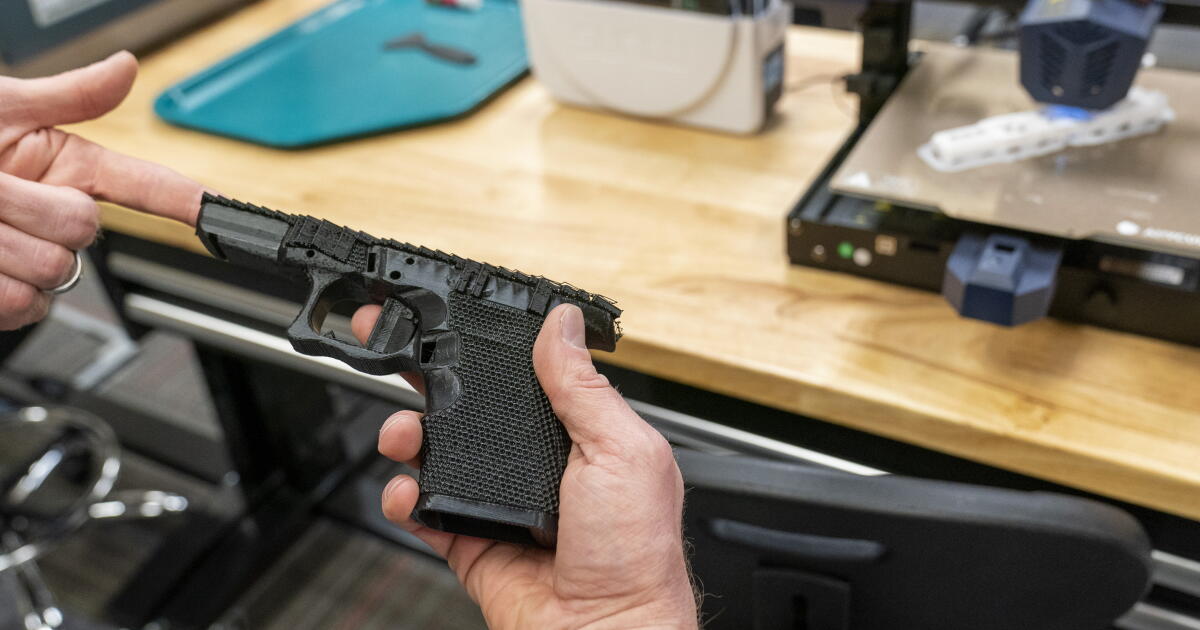
San Diego County jumped into California’s sprawling ghost gun fight this week, suing a 3-D printing filament manufacturer it says hocks material for homespun firearms in violation of state law.
Working with the Giffords Law Center, the county counsel sued manufacturer Polymaker, alleging the company made a “strategic business choice” to market and sell 3-D printer filament to Californians for the express purpose of building illegal weapons. The polymer filament is sold in spools that feed into 3-D printers, allowing the devices to form designs created by their owners.
OR they’re like really loose and the charger comes unplugged with like a single tap
also I don’t think theres enough of a Femtanyl community here to be it’s own post but my favorite artist released a new song check it out! youtu.be/ZlKSjeYIxr8
OR they’re like really loose and the charger comes unplugged with like a single tap
also I don’t think theres enough of a Femtanyl community here to be it’s own post but my favorite artist released a new song check it out! youtu.be/ZlKSjeYIxr8
The Immaculate Conception is a painting by Italian painter Giovanni Battista Tiepolo (1696–1770). The painting was one of seven altarpieces commissioned in March 1767 from Tiepolo by King Charles III of Spain for the Church of Saint Pascual in Aranjuez, then under construction. This was originally an Alcantarine (Franciscan) monastery that was later assigned to the Conceptionist nuns.
The Immaculate Conception is a painting by Italian painter Giovanni Battista Tiepolo (1696–1770). The painting was one of seven altarpieces commissioned in March 1767 from Tiepolo by King Charles III of Spain for the Church of Saint Pascual in Aranjuez, then under construction. This was originally an Alcantarine (Franciscan) monastery that was later assigned to the Conceptionist nuns.
This is my in-depth how-to instructional guide for organizing a SAFE firearms range day for your friends, family, organization, neighbors, etc. In the conclusion, I also explore the value of training with your community vs. simply training by yourself.
- BFC’s Range Safety One-Pager (PDF): https://drive.google.com/file/d/1dXRfezYNC1RIO-ZXlh3zoy4mP87SujBm/view
- BFC’s Range Day Planning SOP (PDF): https://drive.google.com/file/d/1MQbfE6hU_I7FuYwkTpSAKThJQn792c98/view
…
Additional, detailed resources for firearms drills & making the most of your range day time via @TacticoolGirlfriend:
- Fundamentals of Pistol Shooting: https://youtu.be/vhDjwguE2uo
- Fundamentals of Carbine Shooting: https://youtu.be/_Y6Z84tGPyI
- How to Get the Most Out of Training: https://youtu.be/AsD56briRtU
This is my in-depth how-to instructional guide for organizing a SAFE firearms range day for your friends, family, organization, neighbors, etc. In the conclusion, I also explore the value of training with your community vs. simply training by yourself.
- BFC’s Range Safety One-Pager (PDF): https://drive.google.com/file/d/1dXRfezYNC1RIO-ZXlh3zoy4mP87SujBm/view
- BFC’s Range Day Planning SOP (PDF): https://drive.google.com/file/d/1MQbfE6hU_I7FuYwkTpSAKThJQn792c98/view
…
Additional, detailed resources for firearms drills & making the most of your range day time via @TacticoolGirlfriend:
- Fundamentals of Pistol Shooting: https://youtu.be/vhDjwguE2uo
- Fundamentals of Carbine Shooting: https://youtu.be/_Y6Z84tGPyI
The paper challenges the assumption that language models need explicit tokenizers to be efficient demonstrating that standard flat Transformers can process raw byte sequences and actually outperform traditional subword models as parameter sizes scale. The prevailing thought in the field has been that processing raw bytes is computationally inefficient because the sequences are substantially longer. A typical subword contains around four bytes. The authors argue that this extra sequence length is actually a feature that provides useful additional computation under the same parameter budget. By implementing token-superposition training and hash embeddings, the byte models consistently hit lower optimal loss than subword models at matched parameter counts.
It’s also interesting to see how the byte model handles the lack of explicit text abstractions. We usually rely on tokenizers to group characters into meaningful chunks, but it turns out that byte Transformers implicitly develop their own local abstractions without needing specialized hierarchical architectures. When tested on a copying task, the model attention concentrated heavily on a small set of specific segmentation positions rather than attending uniformly across the text. The researchers proved the strength of these internal structures by freezing up to a quarter of the intermediate layers and forcing them to process only these locally aggregated representations. The model maintained its downstream performance without any additional training, proving that the hierarchy of local abstraction and global reasoning emerges naturally within a standard Transformer.
Also, per-byte loss distribution showed massive variance compared to subword models. A huge number of byte positions have near-zero loss showing that the model is highly confident about most bytes in a word and only struggles near the boundaries of its learned local structures where the actual information density lies. This creates a massive opportunity for speculative decoding. Because so many bytes are predictable continuations, a small drafting model can accurately guess large chunks of the sequence. The authors found that a byte-level drafting model gets roughly 3.4 times more accepted tokens per target forward pass than a subword equivalent which easily offsets the sequential overhead of processing individual bytes.
In empirical tests, byte Transformers showed massive improvements in tasks requiring fine-grained perception. They achieved around a 40% relative improvement on CUTE word manipulation scores and a 20% boost on OCRBench compared to subword models. The implications for future language model design is that we might be nearing the end of rigid subword vocabularies. Sequence length, learned abstractions, and compute allocation are now closely connected dimensions for future architectures. Instead of building complex hierarchical networks to compress bytes, designers can use flat Transformers with sparse mixture of experts to reduce activated computation while letting the model allocate its compute dynamically to the hardest parts of a text. This could also drastically improve multimodal models because byte-level representations align much better with fine-grained visual features than arbitrary subword tokens do.