

0
0

TechCrunch
YouTube now requires creators to have twice as many watch hours to start earning money | TechCrunch
techcrunch.com




May you live in interesting times…
May you live in interesting times…




Post Office (my photo)
Post Office (my photo)


The Union of Southern Service Workers (USSW) is an organization of workers in the low-wage, high-turnover service industry of the U.S. South, with members in North Carolina, South Carolina, Alabama, and Georgia. From the beginning, the union has placed political education at the center of its strategic vision. USSW understands that to transform workplaces and communities, workers must understand the roots of the system that exploits them and develop the skills necessary to fight back. As with any union or community organization, USSW runs campaigns to win concrete, material victories. But the real fruit of the union’s organizing work lies in the constant political formation within an expanding base of dedicated worker militants. Unlike the traditional union model, USSW treats political education not as ancillary training, but as a core component of its method; it is a dimension of the union’s approach that makes victories durable and transforms workers into long-term leaders.
Having grown up in New York, Tahtebah “Tee” Gonzalez immediately felt the culture shock of working in the U.S. South. At Dunkin’, his pay was just $9 an hour, just barely above minimum wage and a third of Fulton County’s living wage. The conditions of low pay, overwork, and understaffing boiled over when Tee and his coworkers discovered that other workers in the same shopping center would be paid extra to work a busy weekend in downtown Atlanta during the Dragon-Con convention.
When a USSW organizer visited his store days later, Tee and his coworkers were already agitated and ready to act. Within a week, they had organized a weekend-long strike. The action won them a raise they had once considered impossible. More importantly, it proved to Tee that workers held real power: When they fight together, they can win.
That breakthrough—shifting from isolated frustration to collective action—was the spark of political consciousness. But in the USSW, the spark does not fade. Tee’s first strike was only the beginning of a longer process of formation, sustained by the union’s model of political education and leadership development. Through Worker Power Schools, collective study, and the discipline of organizing, Tee deepened his understanding of the system that exploits workers and gained the skills to lead others. What began as a fight over wages became a journey of transformation: from an exhausted service worker into a committed leader of a broader struggle for dignity and justice in the South.

This surge in discourse—like most other ongoing “debates” around trans people in politics and culture—is entirely manufactured, most recently sparked by Cunningham’s statements and egged on by a media ecosystem well versed in alienating trans people and stoking moral panic.
Let’s lay some facts out. There are currently no trans women athletes in any major women’s professional league or on track to enter the leagues any time soon. While research into human biology is always evolving, there is no “new” groundbreaking data that has broken open the conversation around hormones and physical advantage. And no, there is no trans woman dominating at professional—or any level, for that matter—women’s sports.
That’s all to say: There is no discernable reason for roughly half of the women’s sports stories on The Athletic to be related to trans people, as they were at one point last week, or for players, coaches, executives and owners to be expected to weigh in on how they feel about the prospect of a trans woman playing professional sports. And while some have met the moment with thoughtful shows of solidarity (see: Reeve’s shirt on the court) or clear statements of allyship (Valkyries player Gabby Williams, I see you), it’s frankly insulting to athletes and fans of all genders—trans and cis—that airtime continues to be devoted to this.


Mallards busy preening to waterproof themselves.
Mallards busy preening to waterproof themselves.
What’s your favorite brand of BIFL cookware for induction?
I’m looking to upgrade my kitchen with industrial-quality pots and pans. After about a month of searching, I came to the conclusion that the most important requirements are:
From what I’ve read, stainless steel isn’t a very good conductor (NIST says that aluminum transfers heat 16x better than aluminum). But stainless steel is a better surface to cook-on, because it’s less reactive and won’t absorb flavours. So, 3-ply sandwiches a thick aluminum layer between two different types of stainless steel (nickle-free [eg 18/0 or 200- or 400-grade] on the outside, which – though less corrosion resistant – is important for induction) and either 18/8 or 18/10 on the inside.
5-ply is also a thing, but my research suggests that it doesn’t really matter how many layers. What’s more important is the thickness of the material.
And that’s why I’m here. Because, confidingly, the manufacturers of these pots don’t seem to even know how thick the layers of their 3-ply cookware is!
Ideally I’d just find the technical specifications of their cookware on their website, make a spreadsheet, and then buy the one with the thickest material (or close to the thickest, depending on my trade-off between quality vs weight & cost).
But I’ve called maybe a dozen manufacturers, and none seem to know the specifications of their own cookware :(
So, fediverse, I ask you: does anyone know what the thickness of the layers in these manufacturer’s 3-ply cookware is? Otherwise, what’s been your experience? How do you feel about these brands? Is there some other one (not listed) that you prefer?
Edit: I should be clear that I’m specifically asking about 3-ply or 5-ply stainless steel cookware. This is for a community house, so I need something that can be (ab)used by housemates who don’t know or care for the seasonings on the pans. And I don’t want cast iron, because it’s more likely to break the glass-topped induction cooktop.

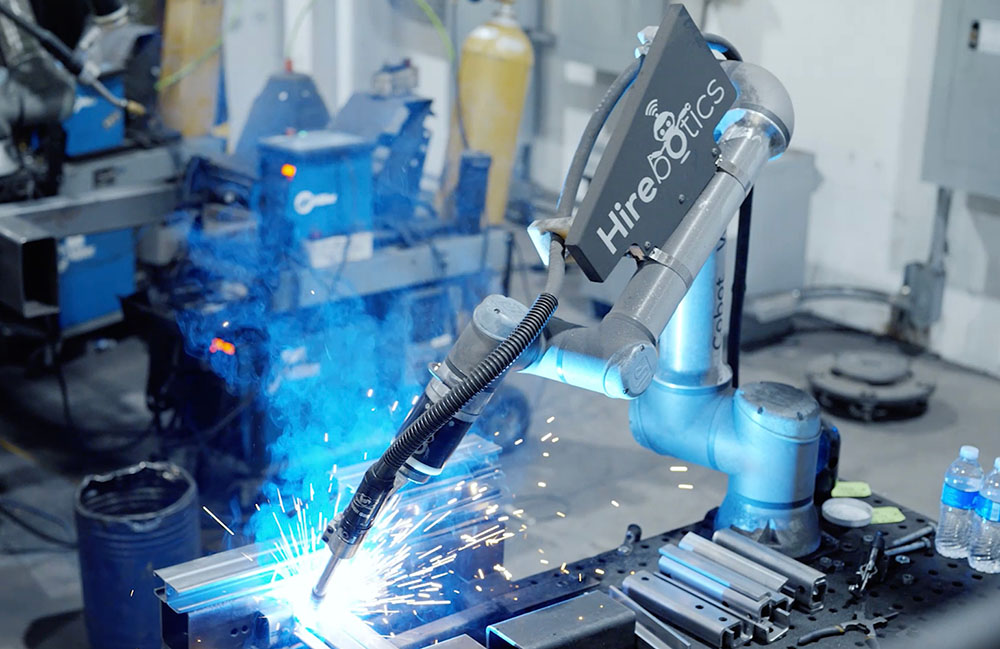
Hirebotics LLC last week announced that Tate Inc. has deployed 58 of its robotic welding systems. The data center infrastructure developer has deployed them across its manufacturing facilities in Arkansas, Virginia, and Kentucky.
For 120 years, Tate has supplied structural ceilings, containment systems, and airflow management products. The Columbia, Md.-based company now faces intense demand for large data centers and tight project timelines with zero tolerance for manufacturing errors.
Tate wanted to scale, but it didn’t want to lose out on precision. So, in 2024, it decided to transition from manual welding to an agile, cloud-connected automation network powered by Hirebotics and its cloud-based, no-code Beacon Pro control platform. Beacon Pro enables the company to program, run, and monitor the Cobot Welders from any smartphone or tablet.
Tate looked at about nine automation providers, according to Daniel Adams, director of sales at Hirebotics. He said a few factors contributed to Tate’s decision. First, when Tate brought specific parts to Hirebotics, the Nashville, Tenn.-based company‘s team was able to perform welds on the parts within 30 minutes of Tate’s arrival.
Next, ease of use was a top priority for Tate, said Abrams. The construction provider was able to program the robots while the Hirebotics team was still on site.
Finally, Hirebotics was willing to collaborate. Adams said the company worked closely with Tate to figure out how its process would change when it automated welding with force- and power-limited robot arms.
Hirebotics shipped Tate’s first two robots in September 2023. “Tate had pretty quick adoption,” Adams told The Robot Report. “They had a bunch of people on staff who had been welding by hand for their entire careers, but they were able to see the benefits to both the company and themselves.”
To train Tate’s employees, Hirebotics used a combination of self-training with tutorial videos and Hirebotics employees providing hands-on training onsite. It typically only took only 10 to 20 minutes to train the employees to use the robots, Adams said.
“The majority of users are surprised at how quickly they can become operational with the robot,” he recalled.
“It was a fantastic process to learn to manipulate not only the movements of the welder themselves, but [also] to control the amperage, the heat, and travel speed,” said Jonathon Cook, a cobot welding programmer at Tate. “We can manipulate and curate every single weld that we make here for Tate to be exactly how it’s supposed to be as by spec every single time. And that truly is a marvel within itself.”
In addition to traditional welding projects within all three facilities, Tate has pioneered a unique workflow in its Arkansas plant, where the cobot systems handle the upstream precision step of tacking and pre-assembling parts to feed downstream industrial robots. This helps to keep production moving at a steady pace.
Since implementing Hirebotics’ robots, Tate has reported a 12x increase in per-welder throughput on critical structural assemblies while simultaneously expanding its team of certified welders.
Tate also said the cobots eliminated costly rework caused by manual welder-to-welder variability. The team also encoded precision discipline directly into the Beacon Pro software. Certified programmers dial in exact torch angles and travel speeds, which enables floor operators to execute perfect welds with confidence.
With automation, Tate said its facilities operate as a single, unified ecosystem, sharing weld programs, parameters and enhanced playlists across company facilities in real time. This guarantees consistent production standards nationwide, Tate said.
“No production components are hand-welded anymore,” Adams said. “The consistency, quality, and speed improved significantly after installing the cobots. Previously, they had some quality issues with hand welding that led them to require automation. The flexibility of the cobots allows them to automate all their welding and get consistent parts.”
Having worked with the Cobot Welder for two years across these three facilities, Tate also has become one of the first operations to deploy Hirebotics’ new Cobot Painter. This system uses the same platform, role-based access, and operators with a new cobot also powered by the Beacon Pro platform.


“I think there is not only an interest in renewed ancestral recipes, but also there’s been this wonderful uptick in people figuring out their own way,” Terry said. “You know,
I don’t just have to eat wild rice with berries and maple syrup. I am capable of like elevating this or transforming it or there’s so much food science to be relearned about all of these ingredients. It’s actually an incredibly exciting time.”
The Indigenous food sovereignty movement has helped elevate awareness of the benefits and importance of traditional foods, Terry said.

In 2005, the statue was revealed and Po’pay became the first person represented in the National Statuary Hall Collection to be born on what would become American soil.
Fragua said each item near or on Po’pay symbolizes Pueblo culture and tradition.
“On his back are the scars that remain from the whipping he received for his participation and faith in the Pueblo ceremonies and religion,” Fragua wrote in the statue’s description.

Shoutout to Murphey, a resident at the shelter I work at, for letting me use his likeness to create this meme

Shoutout to Murphey, a resident at the shelter I work at, for letting me use his likeness to create this meme
Published in 1921, this book recounts the exploration of the Canadian Northwest and the history of the region’s fur trade. Drawing heavily on the firsthand accounts of the explorers themselves, the author also enriches the narrative with observations from his own extensive travels and with stories gathered from trappers and gold prospectors. In addition to describing the hardships and achievements of the explorers, the book offers glimpses of Indian life, including buffalo hunts, as well as the daily work and living conditions of the region’s trappers. - Summary by Ted Lienhart
Published in 1921, this book recounts the exploration of the Canadian Northwest and the history of the region’s fur trade. Drawing heavily on the firsthand accounts of the explorers themselves, the author also enriches the narrative with observations from his own extensive travels and with stories gathered from trappers and gold prospectors. In addition to describing the hardships and achievements of the explorers, the book offers glimpses of Indian life, including buffalo hunts, as well as the daily work and living conditions of the region’s trappers. - Summary by Ted Lienhart
Peder Victorious is the sequel to Giants in the Earth and follows the Norwegian immigrant community in the Dakota Territory. The novel centers on Peder, the son of Per Hansa and Beret Holm, following the loss of Per in a snowstorm twenty years earlier. The book continues the exploration of the frontier immigrant experience, as the first generation of settlers feels their home culture slipping away and the new generation, born in America, struggles to find their blended identities. This is a story of a boy’s growth into adulthood, and a mother’s gradual acceptance of the changes inevitably wrought by time and circumstance. - Summary by Tom Shoesmith
Peder Victorious is the sequel to Giants in the Earth and follows the Norwegian immigrant community in the Dakota Territory. The novel centers on Peder, the son of Per Hansa and Beret Holm, following the loss of Per in a snowstorm twenty years earlier. The book continues the exploration of the frontier immigrant experience, as the first generation of settlers feels their home culture slipping away and the new generation, born in America, struggles to find their blended identities. This is a story of a boy’s growth into adulthood, and a mother’s gradual acceptance of the changes inevitably wrought by time and circumstance. - Summary by Tom Shoesmith
Book 9 of the Adventure Stories for Girls Series.
Florence and Betty travel to France with their friend Madam Strosser. While visiting the forests and small villages in a simple wagon, they stumble upon an American soldier who had been wounded in the war ten years ago, and who was looking for a dugout that held a treasure. The treasure had been stolen by the Germans from a small town for whom it was their only source of tourist income.
While on this quest, they also come across several gypsies and a young blond-haired lady who seems to be mysteriously connected with them.
Travel with these young ladies as they see many of the wonders of France, and use their courage and creativity to succeed. (Summary by Keith Salis)

Published initially in 1958, the book is an ideological analysis of Communism and how it has impacted the world and is an important book, known today for his widely circulated “45 Goals of Communism” which are remarkably prescient. Skousen outlines and analyzes the political and economic systems of various Communist countries including the Soviet Union, Cuba, and China. He also highlights the tools and tactics used by the Communists to advance their goals such as subversion, infiltration, and propaganda. - Summary by Robert L. Morel
Published initially in 1958, the book is an ideological analysis of Communism and how it has impacted the world and is an important book, known today for his widely circulated “45 Goals of Communism” which are remarkably prescient. Skousen outlines and analyzes the political and economic systems of various Communist countries including the Soviet Union, Cuba, and China. He also highlights the tools and tactics used by the Communists to advance their goals such as subversion, infiltration, and propaganda. - Summary by Robert L. Morel
Inspired by the encyclical Rerum Novarum of Pope Leo XIII, Fr. John Ryan makes the case that employers must provide a living wage and cannot hide behind notions of free contract while highlighting that a living wage is an explicit principle of Catholic ethics. (Summary by progressingamerica)
Inspired by the encyclical Rerum Novarum of Pope Leo XIII, Fr. John Ryan makes the case that employers must provide a living wage and cannot hide behind notions of free contract while highlighting that a living wage is an explicit principle of Catholic ethics. (Summary by progressingamerica)
Looks like the retro illumos distro Tribblix got a small maintenance update. Haven’t used it before but I have tried openIndiana but it failed to boot for me at the time. Anyone else give Tribblix a go?
Looks like the retro illumos distro Tribblix got a small maintenance update. Haven’t used it before but I have tried openIndiana but it failed to boot for me at the time. Anyone else give Tribblix a go?



Author: Jeffrey Derevensky | Professor & Chair, Educational & Counselling Psychology, McGill University
Wealthsimple is launching a CIRO-approved prediction markets app soon. The evidence suggests most traders lose money, and the products look a lot like gambling.
Author: Jeffrey Derevensky | Professor & Chair, Educational & Counselling Psychology, McGill University
Wealthsimple is launching a CIRO-approved prediction markets app soon. The evidence suggests most traders lose money, and the products look a lot like gambling.

My toddler is obsessed with rockets at the moment, so I decided to use an extra length of dowel to make him a sturdy one.
I’m currently brainstorming the best way to attach the fins, figured I’d see if anyone here had any ideas
Currently, I’m thinking of cutting perpendicular grooves from the bottom that the fins will slot into, with each pair of fins being a solid piece. But keep in mind I haven’t made the fins yet, so that’s definitely not set in stone.
 Modeling after the v-2 because it looks as stereotypical as a rocket can
My toddler is obsessed with rockets at the moment, so I decided to use an extra length of dowel to make him a sturdy one.
I’m currently brainstorming the best way to attach the fins, figured I’d see if anyone here had any ideas
Currently, I’m thinking of cutting perpendicular grooves from the bottom that the fins will slot into, with each pair of fins being a solid piece. But keep in mind I haven’t made the fins yet, so that’s definitely not set in stone.
Modeling after the v-2 because it looks as stereotypical as a rocket can

A while back, I’d intended to post this to Reddit’s r/aliceinwonderland sub, but today I’m feeling… ah, the hell with Reddit. And yes, this isn’t quite “BD,” but Euro-related art, as supported in the sidebar. Just a fun little jaunt away from pure comics, for a moment.
The artist could probably be described as ’nightmare / horror-themed’ in focus, and I found this one of their most effective pieces, but they have other beauties.
You can check ‘em out here:
https://imginn.com/ruffneck.xd/

“The City of Medicine Hat has released a report detailing public feedback on proposed improvements to Third Street North in the historic Riverside neighbourhood.
The What We Heard Report concludes the second phase of public engagement for the Riverside Corridor Enhancement Project, which focuses on roadway renewal, deep utility upgrades and safety improvements along an approximately two-kilometre corridor.
The City says the 69-page report includes community input they received through the official engagement process, along with approximately 330 pages of comments collected through a survey…”
by Jesse Gill

artist: もろたで工藤
pixiv: 41029750
twitter: aiueobaio5
danbooru: morotade_kudou
artist: もろたで工藤
pixiv: 41029750
twitter: aiueobaio5
danbooru: morotade_kudou

artist: もろたで工藤
pixiv: 41029750
twitter: aiueobaio5
danbooru: morotade_kudou
artist: もろたで工藤
pixiv: 41029750
twitter: aiueobaio5
danbooru: morotade_kudou
I recently electrified my beloved steel tourer, and the extra speed combined with worsening road surface in my area is making me want a bit more comfort. Getting older might be a factor as well 😛
Has anyone tried suspension seatposts? Are they effective? Are there any downsides, besides a small amount of extra weight?


cross-posted from: ani.social/post/35450277
cross-posted from: ani.social/post/35450277

centurii-chan | XCancel
centurii-chan | XCancel