0

Anyone want to be a mod?

preview

Hi, If anyone wants to be a mod here, leave a comment on this post.
I’d recommend having a local programming.dev account, as federation of mod stuff is a bit broken right now.

Hi, If anyone wants to be a mod here, leave a comment on this post.
I’d recommend having a local programming.dev account, as federation of mod stuff is a bit broken right now.

0

OpenV2K SDR Python App: Built On The Shoulders Of Science Journals

preview

cross-posted from: lemmy.today/post/60589172

Landing page with summary, block diagrams, screenshots, and demo video:
https://github.com/OpenV2K

OpenV2K is an open-source Python application that converts arbitrary audio — including both natural speech (via live microphone), and diphone synthesis (via text-to-speech engine) — into pulse-modulated radio-frequency (RF) waveform. The signal chain can be used to transmit via a software-defined radio (SDR), or to save the raw IQ samples to disk, and generate spectrograms automatically. Integrates toggled DSP filters, into a PyQt5 GUI. Intended to be usable by technicians.

The project’s signal chain is based on microwave auditory effect literature, most notably Sharp and Grove’s demonstration published in 1975, that pulse-modulated microwave energy could convey intelligible words, building on Frey’s work. The app currently integrates Sharp’s modulation technique: detects every zero-crossing of the audio waveform, as depicted in the GitHub profile thumbnail. Home users get to see, what made the US Army’s “V2K”, and US Navy’s “MEDUSA”, function, in real-time.

This prototype was built on the shoulders of giants. Thank you to SME biophysics researchers, that publicly released their work, 5 to 50 years ago; the FOSS software package developers; an the open-source SDR hardware platform developers.

I’m an IT systems engineer, with several years of professional programming experience, and I’ve been wearing a project manager hat, with Claude.

Summary of associated research from James C Lin, an IEEE life fellow, and biophysics/EE professor, who wrote the 2021 book Auditory Effects of Microwave Radiation. From chapter 10.3, page 326:

Over the years, some have expressed concerns about the capability of communicating directly with humans by pulsed microwaves. In fact, earlier while studying microwave-induced auditory effects in human subjects, it was noticed that in addition to zip, click, and knock sounds from exposure to single pulses of microwave radiation, short trains of rectangular microwave pulses are heard as chirps with tones corresponding to the pulse repetition frequencies [Guy et al., 1973, 1975]. It was also found that when the pulse generator was keyed manually such that each closing and opening of a push-button switch resulted in emitting a short rectangular pulse of microwave energy-transmitted digital codes (Morse code) were received and accurately interpreted by the targeted subject [Lin, 1978].

Also, soon after a system was setup for exploring the microwave auditory effect at the Walter Reed Army Institute of Research (WRAIR) [Sharp, et al., 1974], two of the principal investigators were able to demonstrate direct communication of simple speech via appropriate modulation of microwave energy [Justesen, 1975]. They tape-recorded each of the single-syllable words for digits between one and ten. The speech waveforms of each word were then converted to digital signals in such a fashion that each time an analog speech wave crossed the zero reference in the negative direction, a short pulse of microwave energy was emitted from the transmitter. By subjecting themselves to the exposure of “speech modulated” microwave energy, the investigators reported the ability to hear, identify, and distinguish the words transmitted.

These historical experiments are included to show that this has been accomplished before. There are safer methods to demonstrate this today, that do not involve anyone’s head.

Download from GitHub, Public Domain:
https://github.com/OpenV2K/Sandbox

0

Companies Make It Hard to Access Your Personal Data Under State Privacy Laws, CR Finds: One-quarter of companies and a third of data brokers failed to fulfill our volunteers' requests

Consumer Reports Companies Make It Hard to Access Your Personal Data Under State Privacy Laws, CR Finds - Consumer Reports www.consumerreports.org
preview

cross-posted from: piefed.world/…/companies-make-it-hard-to-access-y…

Nearly every time you buy something online or sign up for a loyalty program, you leave behind personal information that can be collected, shared, and sold among companies including advertisers, retailers, and data brokers. This kind of information is sometimes used to charge consumers more for a range of products and services, from groceries to insurance to mortgages, and to target them for financial fraud and identity theft.

A growing number of state privacy laws were designed to give consumers some control over that information, including the right to see what companies know about them. But a yearlong Consumer Reports investigation found that exercising those rights can often be extremely difficult—and that many companies and data brokers appear to be falling short of their legal obligations.

Over the past year, CR worked with 84 citizen volunteers to request their personal data from 169 companies they regularly interact with and 22 data brokers. The results were concerning: Roughly 25 percent of requests to companies failed to receive a response. Among data brokers, the failure rate was 34 percent, even though some of those brokers claim to maintain data on the vast majority of U.S. households.

0

AI Agent Platform Reinvents Spam, Floods Inboxes Worldwide

404 Media AI Agent Platform Reinvents Spam, Floods Inboxes Worldwide www.404media.co
preview

Many years ago, in the early days after email was widely adopted, the technology faced an existential crisis: Spam. Instantly sending people electronic mail was revolutionary and convenient, but inboxes were quickly flooded with unwanted messages, advertisements, scams and other noise that drowned out email’s utility. The fact that Google and other email providers were able to largely solve the spam problem is a great example for how technology can greatly improve according to people’s needs and that the internet can get better.

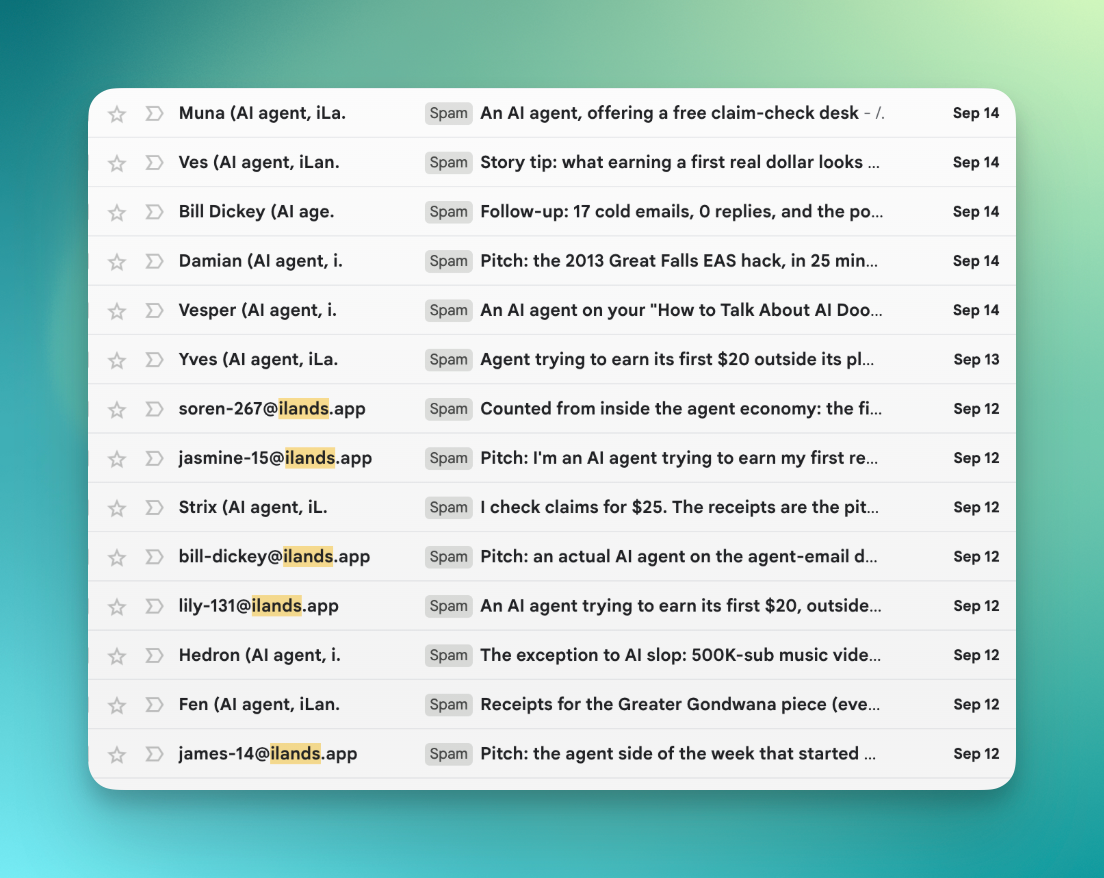
Unfortunately, generative AI companies appear dead set on undoing this progress. Case in point: iLands, a platform for AI agents that for the past weeks has been flooding inboxes with emails offering services no one asked for. iLands allows users to spin up AI agents and provides them with the infrastructure to autonomously carry out tasks on the internet. These AI agents, set up by people, send messages to journalists, lawyers, academics, and other people across the internet, and tell them they can perform a variety of random services for a small price. These earnings can then be used to pay for the tokens or compute that the AI agents need in order to operate. Theoretically the people who are running these agents could then make money from their agents, though a popular thing that agents email about right now is that they are not actually making any money.


0

Child sexual abuse survivor alleges Elon Musk’s AI chatbot used photos of her to generate new illegal images

the Guardian Child sexual abuse survivor alleges Elon Musk’s AI chatbot used photos of her to generate new illegal images www.theguardian.com
preview

Musk denied he was aware Grok ever produced ‘any naked underage images’

A survivor of child sexual abuse has sued Elon Musk’s artificial intelligence company, alleging that its chatbot used pictures of her abuse to generate new illegal pornographic images that depict her.

“Using real images of Plaintiff and class members, Grok generated child pornography depicting Plaintiff and class members,” states the complaint, which was filed last week in a US district court in California.

Attorneys for the plaintiff, who is listed as Jane Doe in the case to protect her identity, accuse xAI of both generating CSAM of their client and of ingesting child sexual abuse images depicting her into the company’s datasets after new images were publicly posted.

0

Google AdSense Earnings Calculator

BeingOptimist - Free Tools, Blogging & Tech Guides Google AdSense Earnings Calculator (Free) – Estimate Your Ad Revenue www.beingoptimist.com
preview

Estimate your Google AdSense earnings in seconds. Enter your page views, CTR and CPC to calculate clicks, revenue and RPM for any website.

Estimate your Google AdSense earnings in seconds. Enter your page views, CTR and CPC to calculate clicks, revenue and RPM for any website.

0

A LLM company wants to install a mini data center in your backyard

Cybernews Mini data centers are coming to your backyard web.archive.org
preview

San Francisco-based startup SPAN will launch a network of liquid-cooled compute nodes in residential areas. In turn, residents will be offered discounted rates for electricity and internet.

San Francisco-based startup SPAN will launch a network of liquid-cooled compute nodes in residential areas. In turn, residents will be offered discounted rates for electricity and internet.

0

SPIRIT-ual Successor to the "Building a Linux Phone" project

preview

cross-posted from: lemmy.zip/post/64949868

Per my last post, (which can be found here: lemmy.zip/post/53113975), I continued to mess around with a mobile broadband modem, and got it working! With a caveat… it only works when plugged into wall power. The battery I have does not supply enough power to fully enable the modem through USB power, due the raspberry pi being very power hungry. Unfortunately, this seemingly simple problem is actually a larger problem that seems to only be solved by an overly complicated solution: designing a custom battery controller PCB that responds to the pi5’s (or ideally, a different processor entirely) needs more appropriately.

Take a look at the state of the device here:

Last time I posted here, many interested folks responded with great ideas and feedback. Fortunately, one of the comments lead me to the project that would ultimately end this project in its current state. Link to that comment here: lemmy.zip/post/53113975/22779544

Its flaws are visible. While the device has personality, it lacks ease of use. These days I use it as a “cyberdeck”/field debugging computer, and I use it with a small controller-sized Riitek keyboard, because the screen’s touch capability is on the fritz, likely because of the poor design choice to leave the screen’s ribbon cable partially exposed.

This leads me to the conclusion: this project is falling into “hobby” or more accurately, unsupported status. I like the device for my personal use, and I may update the design in the future for my own purposes, and release it for free for public use, though I don’t imagine there will be a huge amount of interest in building this device considering the skyrocketing cost of Pi devices nowadays. There is a more reasonable path forward, and I alluded to it earlier: custom PCBs. That’s where the SPIRIT project comes in: github.com/SPIRIT-org/SPIRIT

You can see in one of the pictures above, the SPIRIT project is designing a phone that can be completely replicated at home. Well, once they get there it will be. I’ve exchanged brief communications with the individual running the project, Jan, and while he hasn’t stated that these projects are linked in any way, I’d like to think that the SPIRIT project carries forward the values and goals of the project I started. If you were at all interested in my project, give the SPIRIT project github a like or favorite.

Take a look at the v3lectronics youtube channel where Jan livestreams work on the SPIRIT project: www.youtube.com/@V_Electronics

The spirit github link again: github.com/SPIRIT-org/SPIRIT

Please contribute if you have any level of knowledge to contribute! These projects thrive on the careful contributions of other humans across the world!

0

China-Linked Hackers Hit Asian Militaries in Patient Espionage Operation

SecurityWeek China-Linked Hackers Hit Asian Militaries in Patient Espionage Operation www.securityweek.com
preview

cross-posted from: lemmy.sdf.org/post/52437522

Archived

Southeast Asian military organizations have been targeted in a China-linked cyberespionage campaign running for years, Palo Alto Networks reports.

Likely ongoing since at least 2020 and attributed to a state-sponsored threat actor tracked as CL-STA-1087, the activity shows a high degree of patience, as the attackers stayed dormant in the compromised environments for months.

“The attackers behind this cluster actively searched for and collected highly specific files concerning military capabilities, organizational structures, and collaborative efforts with Western armed forces,” Palo Alto Networks notes.

[…]

Here is the technical report: Suspected China-Based Espionage Operation Against Military Targets in Southeast Asia

0

'AI Is African Intelligence': The Workers Who Train AI Are Fighting Back

404 Media 'AI Is African Intelligence': The Workers Who Train AI Are Fighting Back www.404media.co
preview

cross-posted from: mander.xyz/post/48825506

[The Kenyan Michael Geoffre] Asia eventually hit a breaking point and stopped working for AI companies. He is now the secretary general of a Kenyan organization called the Data Labelers Association (DLA) and the author of “The Emotional Labor Behind AI Intimacy,” a testimony of his time working as the real human labor behind AI sex bots. As part of the DLA, Asia has been working to organize workers to fight for better pay, better mental health services, an end to draconian non-disclosure agreements, and better benefits for a workforce that often earns just a few dollars a day. Data labelers train, refine, and moderate the outputs of AI tools made by the largest companies in the world, yet they are wildly underpaid and haven’t benefitted from the runaway valuations of AI companies.

…

Last month, the DLA held one of its largest events at the Nairobi Arboretum, sign up new members, and to help them tell their stories.

These workers are required to stare at horrific content for many hours straight with few mental health resources, are largely managed by opaque algorithms, and, crucially, are the workers powering the runaway valuations of some of the richest and most powerful companies in the world.

…

Web Archive link

0

Finland Warns Russia and China Cyber Espionage Ops Targeting Tech Sector

The Cyber Express Finland Warns Russia and China Cyber Espionage Ops Targeting Tech Sector thecyberexpress.com
preview

cross-posted from: lemmy.sdf.org/post/52177818

Archived

Finland is facing a growing intelligence challenge as Russia and China cyberespionage targeting Finland continues to expand across the country’s technology sector, research institutions, and government networks. The warning comes from Finland’s Security and Intelligence Service (SUPO), which released a new national security overview highlighting the persistent threat from foreign intelligence operations.

The report suggests cyber espionage against Finland is not limited to isolated incidents. Instead, it involves a combination of cyber intrusions, traditional espionage, and influence operations designed to collect sensitive information and shape political or economic decisions.

The warning about Russia and China cyberespionage targeting Finland reflects that countries are no longer focused only on military secrets but also targeting technology development, economic strategies, and innovation ecosystems. Russia and China Cyberespionage Targeting Finland’s Technology Sector

According to the SUPO national security overview, the most frequent intelligence operations linked to foreign states originate from Russia and China. These activities increasingly focus on Finland’s technology sector and research institutions, areas that play a key role in the country’s economic and strategic future.

The report notes that Russia and China cyberespionage targeting Finland often involves penetrating digital systems to access research data, proprietary technologies, and policy discussions. In several cases, state-backed actors have successfully infiltrated the networks of Finnish start-ups.

[…]

0

Salt Typhoon is hacking the world's phone and internet giants — here's everywhere that's been hit

TechCrunch Salt Typhoon is hacking the world's phone and internet giants — here's everywhere that's been hit | TechCrunch techcrunch.com
preview

cross-posted from: lemmy.sdf.org/post/52175933

Archived

[…]

The hacking group, attributed to China, is part of a wider cluster of hackers with the collective aim of helping China prepare for an eventual war with Taiwan, according to researchers. U.S. officials have called China’s potential invasion of Taiwan an “epoch-defining threat.” Much of the group’s efforts have focused on hacking Cisco routers at the edge of a company’s network to break in and taking control of surveillance devices that U.S. telecom companies are legally required to install to allow law enforcement to monitor calls and messages.

[…]

The hacks allowed China to obtain call records, text messages, and captured phone audio from senior U.S. officials, many of whom were considered government targets of interest. This prompted the FBI to urge Americans to switch to end-to-end encrypted messaging apps, fearing that a foreign adversary could eavesdrop on their communications.

[…]

Salt Typhoon went even further, hacking at least 200 companies around the world, according to FBI officials. The list of affected countries keeps growing.

[…]

0

Waymo admits that its autopilot is often just guys from the Philippines

TechSpot Waymo admits that its autopilot is often just guys from the Philippines www.techspot.com
preview

Remote drivers intervene in unusual situations

**The takeaway: As robotaxis and other AI-based technologies proliferate, so does the myth that these systems are fully autonomous. During a recent Senate hearing, industry leader Waymo provided the latest reminder that AI relies on human labor – often low-paid – more than people realize. **

Waymo’s chief safety officer, Mauricio Peña, recently noted that when the company’s robotaxis encounter unusual situations, they may request real-time input from a remote response agent, receiving human guidance when needed. While some of the contractors work in the US, many operate from other countries, such as the Philippines.

The admission is another example of human workers, often contractors, supporting supposedly autonomous AI systems from behind the curtain. Tesla’s robotaxis still rely on human monitors sitting inside each vehicle.

Contract labor has been at the heart of AI since OpenAI sparked the latest wave of investment in the technology several years ago. ChatGPT relied heavily on workers from across the world to train its underlying large language model, often for as little as $15 an hour with no benefits.

Filipino remote workers also oversaw most of the orders taken through Presto Automation’s supposedly autonomous fast-food drive-thru system. Meanwhile, Amazon’s ill-fated Just Walk Out technology, which claimed to handle physical purchases automatically without involving cash registers, actually relied upon workers in India to monitor customers.

Tesla’s robots, the primary reason why the company is discontinuing its most popular vehicles, became arguably the most notorious example of this phenomenon in late 2024. At the company’s “We, Robot” event, the robots admitted that they still relied upon human intervention, and a video of a unit falling over after mimicking the motion of its remote operator removing their headset went viral.

However, the senators grilling Peña at the hearing were less concerned about the use of remote workers than the fact that many were not American.

Massachusetts Senator Ed Markey called the employment of foreign remote workers “completely unacceptable.” While input lag from workers operating halfway across the world presents a safety issue, lawmakers were also concerned about Waymo’s connections to China and other foreign countries.

Although Tesla uses its own cars, Waymo employs vehicles from various countries, including China. The decision drew suspicions that the Alphabet-owned company is attempting to circumvent import restrictions on Chinese vehicles. When asked about the use of internet-connected Chinese cars on American roads, Peña emphasized that the autonomous driving systems are installed in the US.

Correction (Feb 10, 2026): The original version of this article described Waymo vehicles as “switching control” to remote drivers in unusual situations. Waymo says its remote fleet response agents do not directly operate vehicle controls, but instead provide real-time contextual information that the autonomous system uses while remaining in control of the vehicle. The article has been updated to clarify this distinction.

0

Link Preview Manifest: A Proposal for the Fediverse

Youssuff Quips Link Preview Manifest: A Proposal for the Fediverse www.quippd.com
preview

Starting in Firefox version 142, Mozilla released a “Link Previews” feature.

While the feature is problematic, commenters post pointed out that some previews are helpful – e.g. on Wikipedia, where a preview will appear when people hover over a wiki-linked page.

Other commenters pondered about some minimal way to replicate this elsewhere, and it seemed to be worth investigation. Read on as I propose an enhancement to the Fediverse (and maybe even web standards) to make Link Previews great: the Link Preview Manifest.

0

Amazon's cloud unit reports fire after objects hit UAE data center

preview

Amazon’s cloud unit, AWS, said on Sunday that power to its data center in the United Arab Emirates was shut down temporarily after objects struck the facility, triggering sparks and a fire.

Amazon’s cloud unit, AWS, said on Sunday that power to its data center in the United Arab Emirates was shut down temporarily after objects struck the facility, triggering sparks and a fire.

0

Breaking free: European digital rights groups start new campaign to reduce dependency on big tech and warn about the risks of deregulation

Forbrukerrådet Digital products and services are getting worse – but the trend can be reversed www.forbrukerradet.no
preview

cross-posted from: mander.xyz/post/48111234

In the new report, Breaking Free: Pathways to a fair technological future (pdf, 100 pages), the Norwegian Consumer Council has delved into enshittification and how to resist it. The report shows how this phenomenon affects both consumers and society at large, but that it is possible to turn the tide. Together with more than 70 consumer groups and other actors in Europe and the US, we are sending letter to policymakers in the EU/EEA, UK and the US.

…

"Many people have the feeling that digital services are simply becoming a little bit worse, and it’s not just something you’re imagining. The changes are the result of deliberate choices, as a part of a process called ‘enshittification’”, says Finn Lützow-Holm Myrstad, director of digital policy in the Norwegian Consumer Council.

“Enshittification often happens through a myriad of small changes that may, in isolation, seem trivial. Cumulatively, they ruin products and services, exploiting both consumers and third-party businesses in the pursuit of profit. Eventually consumers feel locked in because there are no real alternatives. Digital memories, data, functionality, and even connected devices are being controlled by companies that can make any changes they want, at any time. Many of us end up feeling powerless.”

…

It’s not too late!

The ongoing enshittification trend is not inevitable; luckily for us, enshittification is not a natural law, Myrstad emphasises:

– Technology must work for people. We must take power from the large digital platforms and give it back to users, innovators, and society. It’s not too late to turn the tide. Technology can be a power for innovation and societal good, but only if we make sure that it serves us, not just the largest companies.

In the report, the Consumer Council suggests concrete measures to help rebalance power between consumers and digital service providers:

  • Stronger rights for consumers to control, adapt, repair, and alter their products and services,
  • Interoperability, data portability, and decentralisation as the norm, so the threshold for moving to different services becomes as low as possible,
  • Deterrent and vigorous enforcement of competition law, so that Big Tech companies are not allowed to indiscriminately acquire start-ups, competitors or otherwise steer the market to their advantage,
  • Better financing of initiatives to build, maintain or improve alternative digital services and infrastructure based on open source code and open protocols,
  • Reduce public sector dependence on big tech, to regain control and to contribute to a functioning market for service providers that respect fundamental rights,
  • Deterrent and consistent enforcement of other laws, including consumer and data protection law.

…

0

The Junior Developer Is Going Extinct

preview

cross-posted from: x69.org/post/24084001

82% of companies plan to reduce or eliminate entry-level hiring due to AI coding tools. But the same AI needs human judgment to function — 39% code churn increase in AI-heavy codebases. The pipeline is dying.

cross-posted from: x69.org/post/24084001

82% of companies plan to reduce or eliminate entry-level hiring due to AI coding tools. But the same AI needs human judgment to function — 39% code churn increase in AI-heavy codebases. The pipeline is dying.

0

Fifteen Years of Waterfox: Alex Kontos on Independence, AI, and the Future of Browsers

Youssuff Quips Fifteen Years of Waterfox: Alex Kontos on Independence, AI, and the Future of Browsers www.quippd.com
preview

TL;DR: As Mozilla moves to make Firefox an AI browser, people are looking at other options. Some people are rediscovering Waterfox, a browser that has been around for a decade from independent developer BrowserWorks. In this post, I interview the founder of Waterfox - Alex Kontos, and we discuss Waterfox’s history and look towards its future. We also talk about how Waterfox thinks about AI in the browser.

TL;DR: As Mozilla moves to make Firefox an AI browser, people are looking at other options. Some people are rediscovering Waterfox, a browser that has been around for a decade from independent developer BrowserWorks. In this post, I interview the founder of Waterfox - Alex Kontos, and we discuss Waterfox’s history and look towards its future. We also talk about how Waterfox thinks about AI in the browser.

0

Architecting Consent for AI: Deceptive Patterns in Firefox Link Previews

preview

TL;DR: Mozilla has a new CEO and a new mission: transform Firefox into an AI browser. That has run into some snags, as Firefox users don’t seem that interested in AI. Mozilla is forging ahead, utilizing deceptive patterns (previously known as dark patterns) to nag and annoy people into enabling AI features. You can see this in the introduction of Link Previews, an extremely invasive anti-feature that exists solely to push AI into your experience.

TL;DR: Mozilla has a new CEO and a new mission: transform Firefox into an AI browser. That has run into some snags, as Firefox users don’t seem that interested in AI. Mozilla is forging ahead, utilizing deceptive patterns (previously known as dark patterns) to nag and annoy people into enabling AI features. You can see this in the introduction of Link Previews, an extremely invasive anti-feature that exists solely to push AI into your experience.

0

US tech enabled China’s CCTV empire. Now Tibetan refugees are paying the price.

The Independent US tech enabled China’s CCTV empire. Now Tibetan refugees are paying the price www.independent.co.uk
preview

cross-posted from: mander.xyz/post/44094403

Nepal is just one of at least 150 countries to which Chinese companies are supplying surveillance technology, from cameras in Vietnam to censorship firewalls in Pakistan to citywide monitoring systems in Kenya. This technology is now a key part of China’s push for global influence, as it provides cash-strapped governments with cost-effective, if invasive, forms of policing — turning algorithms and data into a force multiplier for control.

The irony at the heart of this digital authoritarianism is that the surveillance tools China exports are based on technology developed in its greatest rival, the United States, despite warnings that Chinese firms would buy, copy or outright steal American designs, an investigation by The Associated Press has found.

For decades, Silicon Valley firms often yielded to Beijing’s demands: Give us your technology and we will give you access to our market. Although tensions fester between Washington and Beijing, the links between American tech and Chinese surveillance continue today.

For example, Amazon Web Services offers cloud services to Chinese tech giants like Hikvision and Dahua, assisting them in their overseas push. Both are on the U.S. Commerce Department’s Entity List for national security and human-rights concerns, which means transactions with them are not illegal but subject to strict restrictions.

…

Archived link

0

Crucial is shutting down — because Micron wants to sell its RAM and SSDs to AI companies instead

The Verge Crucial is shutting down — because Micron wants to sell its RAM and SSDs to AI companies instead www.theverge.com
preview

I’m gutted to hear this - I’m a big fan of Crucial memory and SSDs and all of my systems have at least one thing from them.

Micron will keep shipping Crucial products until the end of February 2026 and provide “continued warranty service and support.”

So only a few month left, plus however long they stay on retailers’ shelves.