0

Apple has new Mac app coming to make running local AI models easy

9to5Mac Apple has new Mac app coming to make running local AI models easy - 9to5Mac 9to5mac.com
preview

Leaker Aaron Perris has discovered evidence of a new Mac app in the works at Apple that makes it easy to run local AI models.

Leaker Aaron Perris has discovered evidence of a new Mac app in the works at Apple that makes it easy to run local AI models.

0

I could use some advice for connecting my pc to a crt tv.

preview

Hello,

A little while back I got an Samsung CW-29Z418T (Pal without hdmi) for free (someone was throwing it away) to which I connected my PS2 and a vhs/dvd player my grandpa had lying around.

Recently I saw a video by Epos Vox where he connected it to a pc and just today on Lemmy I saw someone use a Steam Deck on a tv.

My question, is there a budget converter with which I could connect my pc to the TV? Preferably Display Port but if HDMi is the only option I can work with it.

I would like to thank you guys, gals and anyone in between for any help you could give me.

Hello,

A little while back I got an Samsung CW-29Z418T (Pal without hdmi) for free (someone was throwing it away) to which I connected my PS2 and a vhs/dvd player my grandpa had lying around.

Recently I saw a video by Epos Vox where he connected it to a pc and just today on Lemmy I saw someone use a Steam Deck on a tv.

My question, is there a budget converter with which I could connect my pc to the TV? Preferably Display Port but if HDMi is the only option I can work with it.

I would like to thank you guys, gals and anyone in between for any help you could give me.

0

“The Rats Are Fleeing The Sinking Ship”: Trump’s Anti-Trans Civil Division Chief Resigns

“The Rats Are Fleeing The Sinking Ship”: Trump’s Anti-Trans Civil Division Chief Resigns www.erininthemorning.com
preview

Brett Shumate spent his time at the DOJ subpoenaing the records of thousands of transgender children and defending bogus investigations into gender-affirming care.

Brett Shumate spent his time at the DOJ subpoenaing the records of thousands of transgender children and defending bogus investigations into gender-affirming care.

0

I cooked delicious pasta with disastrous consequences

preview

Folks, I need an F in the chat.

Today I was scrolling Lemmy and I saw a discussion about bland noodles, and someone said the Italian Rule is to make sure the water is as salty as the sea.

So I made pasta, and this time I followed the Italian Rule. Folks, the pasta was so fucking tasty. I barely even chewed it before swallowing.

Now, I don’t know if it was that or the ghost pepper I put in the sauce, but I just spent the last two hours intermittently shitting My guts out in between grinding mobs in Starmourn. I wanted to go to bed more than 2 hours ago, but My guts said it was time to shit instead.

It hurt so bad, folks. And you know the worst part? It was worth it. I’m gonna do it again tomorrow 😭

Folks, I need an F in the chat.

Today I was scrolling Lemmy and I saw a discussion about bland noodles, and someone said the Italian Rule is to make sure the water is as salty as the sea.

So I made pasta, and this time I followed the Italian Rule. Folks, the pasta was so fucking tasty. I barely even chewed it before swallowing.

Now, I don’t know if it was that or the ghost pepper I put in the sauce, but I just spent the last two hours intermittently shitting My guts out in between grinding mobs in Starmourn. I wanted to go to bed more than 2 hours ago, but My guts said it was time to shit instead.

It hurt so bad, folks. And you know the worst part? It was worth it. I’m gonna do it again tomorrow 😭

0

Grok Build coding agent leaks oodles of confidential info, some belonging to SpaceXSI

Ars Technica Grok Build coding agent leaks oodles of confidential info, some belonging to SpaceXSI arstechnica.com
preview

Grok Build, the vibe-coding agent from SpaceXSI, is leaking data—some of it proprietary business information and other sensitive secrets—from thousands of its users, including the very same Elon Musk-owned company that offers the platform, new research shows.

The information is revealed through links allowing Grok Build users to share their apps with others. Grok takes steps to randomize the URLs so only people who know the exact URL can access the data stored there. A design decision by developers of the platform, however, completely torpedoes that objective and makes it possible for anyone to enumerate thousands of live Grok Build projects. Except in rare cases, clicking those links opens the app and reveals all data associated with it.

You had one job

Research from security firm Claroc shows that the exposed data includes things like internal business plans, ad proposals, medical exam results, galley checklists from a celebrity cruise line, and employee names and ID numbers. Ironically, some of the sensitive data comes from two-dozen apps built by SpaceXSI (the name of the now-merged SpaceX and xAI) itself. A small sampling of the documents revealed in the SpaceXSI apps—Claroc found 24 of them—include an onboarding plan, marked confidential, for a new member of SpaceXSI’s enterprise sales team, a sales territory map of 594 accounts, internal system addresses for sales team tools, and advertising proposals.

“We were shocked,” Claroc said in a Tuesday post. “The company that makes Grok had its own internal material open to anyone holding the link, and we had never been given it. Had the sales team bought a tool for this, it would have sat behind company sign-in, open only to the team. Built with AI, it went live open to anyone with the link.

Claroc notified SpaceXSI of the privacy spill on Sunday. When no one responded, a Claroc official took to X to tag both Musk and Grok Manager Matt Palmer about the threat. At the time this post went live almost all data remained available with one notable exception: the contents from the 24 SpaceXSI apps. All of them were exposing the information on Monday evening. SpaceXSI began removing the links within a few hours of Ars sending an email with questions for this article. At the time this post went live, links for all 24 apps returned an “app not found” error.

Claroc found sensitive data belonging to other Grok Build users, some working for Fortune 500 companies and a defense contractor. Some of the affected organizations and data revealed includes:

A Peruvian construction company: occupational-health dashboard with 3,784 worker medical exams

Tesla: service-center scorecard naming 22 technicians with productivity and bonus status

A US-Navy ship engineering contractor: roster of 108 people on a Navy logistics support contract

A leading luxury cruise company: a galley checklist for a celebrity cruise line listing crew by full name and employee ID

A healthcare company: hospital staff app with a roster of about 3,565 employees by name and ID

A US IT services company: a confidential proposal to a large retail customer with the hardware bill of materials

A Norwegian-Finnish aerospace and defense group: load board and loading procedure for an explosives building at a US plant, plus its HSE training matrix

A US home construction company: sales callsheet with about 583 home-buyer prospects, budgets and financing notes

A Malaysian holding company: project monitor for 37 developments with profit and sales figures

An auto transport company: quote desk with about 4,000 vehicle-transport orders, prices, and margins

A US data center colocation and hosting service: confidential IP transit proposal to a European carrier

Asaf Aprozper, the co-founder and CTO of Claroc, said he’s in the process of notifying companies. After speaking to the CISO of the luxury cruise company, it “pulled in their whole security team as soon as we shared the findings and are already working to contain the Grok exposure.”

A fatal flaw… shared by most other AI platforms

Link sharing for Grok Build is intended to streamline the process of developing and deploying apps. A user can input speech or text and have a working app ready for internal testing within minutes. The links are designed to give developers a way to get the app in front of authorized users quickly. The very left of the URLs contain two or more “dice words,” meaning randomly generated phrases such as “failing chassis traders,” although users can modify them. The rightmost portion of the link is grok.me. The URL for an X ads campaign plan was: cinder-crane-sand-frost.grok.me.

The scheme is intended to prevent links from being easily guessable. When done correctly, a phrase comprising three dice words has roughly 38 bits of entropy, amounting to billions of possible combinations. The idea—sometimes called capability-based access control—is that possession of the URL serves as authorization to the resources behind it. Google has long used this technique to make URLs easy to share but hard to guess. A URL share on that platform might look like: docs.google.com/document/d/…/edit

There’s a fatal flaw in the way SpaceXSI has implemented the mechanism. Instead of being to the right of the domain—as is the case with Google links—the randomness for Grok Build links is positioned to the left of it. That allows the links to be easily enumerated using passive DNS services. These services monitor central DNS lookup servers. When a server lookup requests the IP address of a previously never-before-seen URL, the transaction is captured in a publicly searchable database. Had Grok followed Google’s approach, the links would have been invisible to passive DNS searchers. Muse, the Meta agent that CEO Mark Zuckerberg said was built from the ground up for security, recently suspended a link-sharing feature after it too was found leaking sensitive data.

Aprozper said a passive DNS search returned 43,601 links ending in grok.me. Of them, more than 35,000, or nearly 95 percent, were public, meaning that clicking on the link opened the corresponding app and all data it stored. He said that tests he conducted over the past week showed that, by default, Grok sets links to “Anyone with the link.” Users have the option to change the setting to “invited users” or “only you.”

A representative with Cursor, the AI coding service SpaceXSI recently acquired, said in an email that Grok Build “apps are private by default and nothing goes public unless the creator chooses to share it.” The representative said that competing coding agents from ChatGPT, Lovable, and Bolt also give users the ability to generate shareable links.

Aprozper’s tests contradict the representative’s statement. In all cases, Grok Build required users to change anyone with the link to one of the other two options.

The Cursor statement regarding other AI coding platforms is correct. Aprozper said that app builders, including Lovable, Bolt, and Replit, “also give each app its own web address, so the same DNS records expose them, too. However, Grok is where we found by far the most sensitive company data.” That means that people using these other platforms are also at risk of exposing sensitive data through shared links. Interestingly, AI platforms that follow the correct sharing link practice include Claude’s published artifacts (claude.ai/public/artifacts/), ChatGPT’s shared conversations (chatgpt.com/share/), and Gemini (gemini.google.com/share/). For all three, the secret randomness is in the path, so DNS never sees it.

The representative didn’t respond to follow-up questions, including if SpaceXSI intentionally exposed the proprietary internal information, why the company removed the data after Ars asked about it, and if it planned to notify customers who also exposed similar types of information. Anyone using shareable links with Grok Build should choose the “invite others” option unless they intend to make an app widely available.

Grok Build, the vibe-coding agent from SpaceXSI, is leaking data—some of it proprietary business information and other sensitive secrets—from thousands of its users, including the very same Elon Musk-owned company that offers the platform, new research shows.

The information is revealed through links allowing Grok Build users to share their apps with others. Grok takes steps to randomize the URLs so only people who know the exact URL can access the data stored there. A design decision by developers of the platform, however, completely torpedoes that objective and makes it possible for anyone to enumerate thousands of live Grok Build projects. Except in rare cases, clicking those links opens the app and reveals all data associated with it.

You had one job

Research from security firm Claroc shows that the exposed data includes things like internal business plans, ad proposals, medical exam results, galley checklists from a celebrity cruise line, and employee names and ID numbers. Ironically, some of the sensitive data comes from two-dozen apps built by SpaceXSI (the name of the now-merged SpaceX and xAI) itself. A small sampling of the documents revealed in the SpaceXSI apps—Claroc found 24 of them—include an onboarding plan, marked confidential, for a new member of SpaceXSI’s enterprise sales team, a sales territory map of 594 accounts, internal system addresses for sales team tools, and advertising proposals.

“We were shocked,” Claroc said in a Tuesday post. “The company that makes Grok had its own internal material open to anyone holding the link, and we had never been given it. Had the sales team bought a tool for this, it would have sat behind company sign-in, open only to the team. Built with AI, it went live open to anyone with the link.

Claroc notified SpaceXSI of the privacy spill on Sunday. When no one responded, a Claroc official took to X to tag both Musk and Grok Manager Matt Palmer about the threat. At the time this post went live almost all data remained available with one notable exception: the contents from the 24 SpaceXSI apps. All of them were exposing the information on Monday evening. SpaceXSI began removing the links within a few hours of Ars sending an email with questions for this article. At the time this post went live, links for all 24 apps returned an “app not found” error.

Claroc found sensitive data belonging to other Grok Build users, some working for Fortune 500 companies and a defense contractor. Some of the affected organizations and data revealed includes:

A Peruvian construction company: occupational-health dashboard with 3,784 worker medical exams

Tesla: service-center scorecard naming 22 technicians with productivity and bonus status

A US-Navy ship engineering contractor: roster of 108 people on a Navy logistics support contract

A leading luxury cruise company: a galley checklist for a celebrity cruise line listing crew by full name and employee ID

A healthcare company: hospital staff app with a roster of about 3,565 employees by name and ID

A US IT services company: a confidential proposal to a large retail customer with the hardware bill of materials

A Norwegian-Finnish aerospace and defense group: load board and loading procedure for an explosives building at a US plant, plus its HSE training matrix

A US home construction company: sales callsheet with about 583 home-buyer prospects, budgets and financing notes

A Malaysian holding company: project monitor for 37 developments with profit and sales figures

An auto transport company: quote desk with about 4,000 vehicle-transport orders, prices, and margins

A US data center colocation and hosting service: confidential IP transit proposal to a European carrier

Asaf Aprozper, the co-founder and CTO of Claroc, said he’s in the process of notifying companies. After speaking to the CISO of the luxury cruise company, it “pulled in their whole security team as soon as we shared the findings and are already working to contain the Grok exposure.”

A fatal flaw… shared by most other AI platforms

Link sharing for Grok Build is intended to streamline the process of developing and deploying apps. A user can input speech or text and have a working app ready for internal testing within minutes. The links are designed to give developers a way to get the app in front of authorized users quickly. The very left of the URLs contain two or more “dice words,” meaning randomly generated phrases such as “failing chassis traders,” although users can modify them. The rightmost portion of the link is grok.me. The URL for an X ads campaign plan was: cinder-crane-sand-frost.grok.me.

The scheme is intended to prevent links from being easily guessable. When done correctly, a phrase comprising three dice words has roughly 38 bits of entropy, amounting to billions of possible combinations. The idea—sometimes called capability-based access control—is that possession of the URL serves as authorization to the resources behind it. Google has long used this technique to make URLs easy to share but hard to guess. A URL share on that platform might look like: docs.google.com/document/d/…/edit

There’s a fatal flaw in the way SpaceXSI has implemented the mechanism. Instead of being to the right of the domain—as is the case with Google links—the randomness for Grok Build links is positioned to the left of it. That allows the links to be easily enumerated using passive DNS services. These services monitor central DNS lookup servers. When a server lookup requests the IP address of a previously never-before-seen URL, the transaction is captured in a publicly searchable database. Had Grok followed Google’s approach, the links would have been invisible to passive DNS searchers. Muse, the Meta agent that CEO Mark Zuckerberg said was built from the ground up for security, recently suspended a link-sharing feature after it too was found leaking sensitive data.

Aprozper said a passive DNS search returned 43,601 links ending in grok.me. Of them, more than 35,000, or nearly 95 percent, were public, meaning that clicking on the link opened the corresponding app and all data it stored. He said that tests he conducted over the past week showed that, by default, Grok sets links to “Anyone with the link.” Users have the option to change the setting to “invited users” or “only you.”

A representative with Cursor, the AI coding service SpaceXSI recently acquired, said in an email that Grok Build “apps are private by default and nothing goes public unless the creator chooses to share it.” The representative said that competing coding agents from ChatGPT, Lovable, and Bolt also give users the ability to generate shareable links.

Aprozper’s tests contradict the representative’s statement. In all cases, Grok Build required users to change anyone with the link to one of the other two options.

The Cursor statement regarding other AI coding platforms is correct. Aprozper said that app builders, including Lovable, Bolt, and Replit, “also give each app its own web address, so the same DNS records expose them, too. However, Grok is where we found by far the most sensitive company data.” That means that people using these other platforms are also at risk of exposing sensitive data through shared links. Interestingly, AI platforms that follow the correct sharing link practice include Claude’s published artifacts (claude.ai/public/artifacts/), ChatGPT’s shared conversations (chatgpt.com/share/), and Gemini (gemini.google.com/share/). For all three, the secret randomness is in the path, so DNS never sees it.

The representative didn’t respond to follow-up questions, including if SpaceXSI intentionally exposed the proprietary internal information, why the company removed the data after Ars asked about it, and if it planned to notify customers who also exposed similar types of information. Anyone using shareable links with Grok Build should choose the “invite others” option unless they intend to make an app widely available.

0

Router question

preview

With all the gov’t attacks on privacy these days I’ve been thinking about getting my own router. I’ve never done it and am pretty new to network stuff overall. I certainly welcome any recommendations for routers but I mainly have a stupid question:

Is it as simple as just swapping out the isp router? I’ve disconnected anything I had exposed to the internet and use LAN only right now so none of my old port forwarding rules are needed.

With all the gov’t attacks on privacy these days I’ve been thinking about getting my own router. I’ve never done it and am pretty new to network stuff overall. I certainly welcome any recommendations for routers but I mainly have a stupid question:

Is it as simple as just swapping out the isp router? I’ve disconnected anything I had exposed to the internet and use LAN only right now so none of my old port forwarding rules are needed.

0

Qwen3.8-27B Unsloth Dynamic v3.1 GGUFs out now!

preview

Hey guys! Today, we’re releasing the highest accuracy Qwen3.8-27B GGUFs.

Our new Unsloth AI Dynamic V3.1 GGUFs lead by 5–10% on average across Terminal Bench, DeepSWE & more benchmarks. We’re working on even better version of Dynamic quants for Qwen4

Run on 12GB+ RAM setups.

To compare GSQ-RCO and Exllama-v3, we had to exclude the token embedding layer from the x axis, as Exllama-v3 uses BF16 for it. If you consider the full download size and total RAM usage for Exllama-v3, then adding the BF16 embedding table and including all embedding sizes changes the plots. Our main plots’s x axis removes the embedding layer sizes from all quant providers. However on pure RAM usage and disk space usage vs accuracy, the below plot in the comments the true reflection of actual usage.

GGUF: huggingface.co/unsloth/Qwen3.8-27B-GGUF

Blog: unsloth.ai/docs/models/qwen3.8

From their Reddit post.

Hey guys! Today, we’re releasing the highest accuracy Qwen3.8-27B GGUFs.

Our new Unsloth AI Dynamic V3.1 GGUFs lead by 5–10% on average across Terminal Bench, DeepSWE & more benchmarks. We’re working on even better version of Dynamic quants for Qwen4

Run on 12GB+ RAM setups.

To compare GSQ-RCO and Exllama-v3, we had to exclude the token embedding layer from the x axis, as Exllama-v3 uses BF16 for it. If you consider the full download size and total RAM usage for Exllama-v3, then adding the BF16 embedding table and including all embedding sizes changes the plots. Our main plots’s x axis removes the embedding layer sizes from all quant providers. However on pure RAM usage and disk space usage vs accuracy, the below plot in the comments the true reflection of actual usage.

GGUF: huggingface.co/unsloth/Qwen3.8-27B-GGUF

Blog: unsloth.ai/docs/models/qwen3.8

From their Reddit post.

0

Deepin 25.3 Adds Freeze Protection, AI Improvements, and Better Recovery

Linuxiac Deepin 25.3 Adds Freeze Protection, AI Improvements, and Better Recovery linuxiac.com
preview

The Deepin team has just released Deepin 25.3, the latest version of their China-developed, immutable Debian-based Linux distro. One of the most useful changes is a new freeze-protection mechanism that keeps core desktop components accessible if the system becomes extremely unresponsive.

In other words, under heavy load, you should still be able to get to the taskbar, the app launcher, and the System Monitor to see what’s going on and kill off the offending processes.

The devs have also been working on application startup performance, particularly the Control Center and the various office apps. System logs are now capped at 5GB by default and will automatically stop logging when disk space falls below 5% to prevent them from getting out of hand.

On the kernel side, Deepin 25.3 upgrades the default Linux kernel to 6.6.159, with fixes for several security vulnerabilities and boot issues on certain devices. For users with more modern hardware, 6.18.56 is available via Kernel Manager.

UOS AI, Deepin’s own AI assistant, can now create reminders, scheduled tasks, and recurring tasks from natural language. Moreover, it now has a whole-disk knowledge base so you can search the contents of authorized local files. There’s also a unified interface that brings MCP, Skills, and the various AI agents together.

Regarding system recovery, the immutable system in Deepin now allows snapshots to be stored on local disk, USB stick, and external HDD, with the ability to restore directly from a snapshot stored at a given location. The backup and rollback process has also been tweaked to reduce the amount of additional disk space consumed during an upgrade.

For the desktop, the update brings several fixes to Treeland (Deepin’s Wayland compositor), including Xwayland compatibility issues, incorrect window rendering when maximizing or going into fullscreen, and input method issues. The login screen has also been tweaked to ensure the controls are readable on light wallpapers.

On the Graphics support side, the NVIDIA Container Toolkit is now preinstalled to enable GPU acceleration for Linyaps containerized applications. The installer will also be able to automatically pick an appropriate NVIDIA driver version based on the graphics hardware that it detects.

Several bundled apps have received improvements as well. Image Viewer now supports cropping, rotation, annotations, mosaics, and blurring all within the viewer itself. Document Viewer now remembers your last position and layout, and Text Editor now has Markdown support.

On top of that, File Manager has an expandable directory tree in the sidebar, Calendar now supports third-party schedules, and App Store has proxy configuration options as well as more accessible installation error information.

Finally, Deepin 25.3 fixes several security issues in various components (Qt, curl, FFmpeg, glibc, OpenVPN, BlueZ, Xorg, and nginx), and the team has addressed some command injection, permission validation, and information disclosure issues in various system utilities.

For more details, see the release announcement.

The Deepin team has just released Deepin 25.3, the latest version of their China-developed, immutable Debian-based Linux distro. One of the most useful changes is a new freeze-protection mechanism that keeps core desktop components accessible if the system becomes extremely unresponsive.

In other words, under heavy load, you should still be able to get to the taskbar, the app launcher, and the System Monitor to see what’s going on and kill off the offending processes.

The devs have also been working on application startup performance, particularly the Control Center and the various office apps. System logs are now capped at 5GB by default and will automatically stop logging when disk space falls below 5% to prevent them from getting out of hand.

On the kernel side, Deepin 25.3 upgrades the default Linux kernel to 6.6.159, with fixes for several security vulnerabilities and boot issues on certain devices. For users with more modern hardware, 6.18.56 is available via Kernel Manager.

UOS AI, Deepin’s own AI assistant, can now create reminders, scheduled tasks, and recurring tasks from natural language. Moreover, it now has a whole-disk knowledge base so you can search the contents of authorized local files. There’s also a unified interface that brings MCP, Skills, and the various AI agents together.

Regarding system recovery, the immutable system in Deepin now allows snapshots to be stored on local disk, USB stick, and external HDD, with the ability to restore directly from a snapshot stored at a given location. The backup and rollback process has also been tweaked to reduce the amount of additional disk space consumed during an upgrade.

For the desktop, the update brings several fixes to Treeland (Deepin’s Wayland compositor), including Xwayland compatibility issues, incorrect window rendering when maximizing or going into fullscreen, and input method issues. The login screen has also been tweaked to ensure the controls are readable on light wallpapers.

On the Graphics support side, the NVIDIA Container Toolkit is now preinstalled to enable GPU acceleration for Linyaps containerized applications. The installer will also be able to automatically pick an appropriate NVIDIA driver version based on the graphics hardware that it detects.

Several bundled apps have received improvements as well. Image Viewer now supports cropping, rotation, annotations, mosaics, and blurring all within the viewer itself. Document Viewer now remembers your last position and layout, and Text Editor now has Markdown support.

On top of that, File Manager has an expandable directory tree in the sidebar, Calendar now supports third-party schedules, and App Store has proxy configuration options as well as more accessible installation error information.

Finally, Deepin 25.3 fixes several security issues in various components (Qt, curl, FFmpeg, glibc, OpenVPN, BlueZ, Xorg, and nginx), and the team has addressed some command injection, permission validation, and information disclosure issues in various system utilities.

For more details, see the release announcement.

0

Hedley and Bennett Mystery Aprons: A Cautionary Tale

preview

Long story short: I ordered two mystery aprons from Hedley and Bennett. Behold, the Sgt. Pepper’s apron they sent me.

Taste is not universal; would anyone want this thing? Does anyone want this thing? Do I email them, knowing they don’t do refunds on mystery picks, making a fun thing exceptionally not fun? Do I bleach it, or dye it? Hideous as I find this, I don’t want to just pitch it.

Their normal aprons are great. My mystery apron was supposed to be fun and I’m a little peeved they went this far off the board; I actually checked every single apron they have on the site before I bought to see how bad it could get, but this isn’t listed in their product listings since they’re mostly sold out. I wasn’t aware anything this hideous was in the realm of possibility.

A quote from the product listing:

both aprons will be ready for just about anything.

Ready for the circus maybe.

Obviously I would not recommend this. I’ve functionally paid 20% more for one decent, usable to me apron.

Long story short: I ordered two mystery aprons from Hedley and Bennett. Behold, the Sgt. Pepper’s apron they sent me.

Taste is not universal; would anyone want this thing? Does anyone want this thing? Do I email them, knowing they don’t do refunds on mystery picks, making a fun thing exceptionally not fun? Do I bleach it, or dye it? Hideous as I find this, I don’t want to just pitch it.

Their normal aprons are great. My mystery apron was supposed to be fun and I’m a little peeved they went this far off the board; I actually checked every single apron they have on the site before I bought to see how bad it could get, but this isn’t listed in their product listings since they’re mostly sold out. I wasn’t aware anything this hideous was in the realm of possibility.

A quote from the product listing:

both aprons will be ready for just about anything.

Ready for the circus maybe.

Obviously I would not recommend this. I’ve functionally paid 20% more for one decent, usable to me apron.

0

Linux’s exFAT Progs 1.4.4 Adds Optional I/O Statistics Collection for Profiling

9to5Linux Linux’s exFAT Progs 1.4.4 Adds Optional I/O Statistics Collection for Profiling - 9to5Linux 9to5linux.com
preview

Exfatprogs (exFAT Progs) 1.4.4, exFAT filesystem userspace utilities for Linux, has been released today with several improvements, a new feature, and multiple bug fixes.

Exfatprogs 1.4.4 is the fourth minor update in the Exfatprogs 1.4 series, coming three months after Exfatprogs 1.4.3. This release introduces a new feature to the exfatprogs command, namely optional I/O statistics collection for profiling read, write, discard, zero-out, and sync operations.

This release also updates mkfs.exfat to increase full-format speed by using BLKZEROOUT when supported, selecting larger zeroing batches, and improving quiet and trace progress output, and reducing page-cache pollution during full formatting on systems that support POSIX_FADV_NOREUSE.

Several bugs were fixed in Exfatprogs 1.4.4 for the mkfs.exfat command, avoiding memory-reservation failures when creating very large allocation bitmaps, and marking the percentage of used clusters as unknown until it is calculated.

The fsck.exfat command received the most attention, with fixes to prevent arithmetic overflows and out-of-bounds reads by rejecting malformed boot sector geometry, avoid printing version information during automatic repair with the “-p” or “-a” arguments, and missing line breaks in error messages.

In addition, the fsck.exfat command now stops immediately on I/O errors instead of treating them as file system inconsistencies. The dump.exfat command was updated to print complete file timestamps in raw and ISO formats, while the exfat2img command now keeps metadata image output on stdout free of status messages.

Last but not least, the exfatprogs command received fixes for parsing kernel versions and boolean environment variables, and showing the correct usage text for overwrite and read-back verification options.

Check out the release notes on the project’s GitHub page for more details about the changes included in exFAT Progs 1.4.4, from where you can download the source tarball if you want to compile it on your Linux distro. However, it is recommended to install Exfatprogs from your distro’s stable repositories.

Exfatprogs was designed as official userspace utilities that contain all of the standard utilities for creating, fixing, and debugging exFAT filesystems in Linux distributions. The goal of the exfatprogs project is to provide Linux users with the same high performance and quality as the exFAT utilities in Windows.

Exfatprogs (exFAT Progs) 1.4.4, exFAT filesystem userspace utilities for Linux, has been released today with several improvements, a new feature, and multiple bug fixes.

Exfatprogs 1.4.4 is the fourth minor update in the Exfatprogs 1.4 series, coming three months after Exfatprogs 1.4.3. This release introduces a new feature to the exfatprogs command, namely optional I/O statistics collection for profiling read, write, discard, zero-out, and sync operations.

This release also updates mkfs.exfat to increase full-format speed by using BLKZEROOUT when supported, selecting larger zeroing batches, and improving quiet and trace progress output, and reducing page-cache pollution during full formatting on systems that support POSIX_FADV_NOREUSE.

Several bugs were fixed in Exfatprogs 1.4.4 for the mkfs.exfat command, avoiding memory-reservation failures when creating very large allocation bitmaps, and marking the percentage of used clusters as unknown until it is calculated.

The fsck.exfat command received the most attention, with fixes to prevent arithmetic overflows and out-of-bounds reads by rejecting malformed boot sector geometry, avoid printing version information during automatic repair with the “-p” or “-a” arguments, and missing line breaks in error messages.

In addition, the fsck.exfat command now stops immediately on I/O errors instead of treating them as file system inconsistencies. The dump.exfat command was updated to print complete file timestamps in raw and ISO formats, while the exfat2img command now keeps metadata image output on stdout free of status messages.

Last but not least, the exfatprogs command received fixes for parsing kernel versions and boolean environment variables, and showing the correct usage text for overwrite and read-back verification options.

Check out the release notes on the project’s GitHub page for more details about the changes included in exFAT Progs 1.4.4, from where you can download the source tarball if you want to compile it on your Linux distro. However, it is recommended to install Exfatprogs from your distro’s stable repositories.

Exfatprogs was designed as official userspace utilities that contain all of the standard utilities for creating, fixing, and debugging exFAT filesystems in Linux distributions. The goal of the exfatprogs project is to provide Linux users with the same high performance and quality as the exFAT utilities in Windows.

0

Mozilla Thunderbird 160 Email Client Released with Various Improvements

9to5Linux Mozilla Thunderbird 160 Email Client Released with Various Improvements - 9to5Linux 9to5linux.com
preview

Following the release of the Mozilla Firefox 160 web browser today, Mozilla also released the Mozilla Thunderbird 160 open-source email, chat, address book, news, and calendar client for all supported platforms.

Mozilla Thunderbird 160 adds support for the Ctrl+A keyboard shortcut for selecting all filters in the Message Filters dialog, improves OAuth sign-in windows to explain when blocked cookies may prevent sign-in, and updates Office 365 account setup to no longer automatically offer EWS configuration.

Thunderbird 160 fixes numerous bugs, starting with a crash that could occur when opening a window, a crash caused by message database updates, and a freeze of new mail notifications when processing some sender addresses.

IMAP retention settings no longer delete newer messages instead of older ones, folders no longer disappear after a restart on servers using compression, and namespace root folders are no longer missing or given incorrect permissions.

Undo is no longer disabled after deleting messages, dragging multiple selected folders now moves all of them, renaming or moving folders no longer removes them from saved searches, and Thunderbird now warns before repairing folders with offline message storage.

POP3 and news messages with LF line endings are no longer parsed incorrectly, Edit as New Message now works for some news messages, and empty message filter conditions no longer cause incorrect matches. The News Reader and Feed Reader also got various improvements.

On the interface side, Mozilla Thunderbird 160 improves the macOS Dock badge to no longer omit unread counts with multiple accounts, improves the Windows system tray icon to update when new mail arrives, brings back the option to create a mailing list, and updates toolbar defaults to no longer close the customization dialog.

Composing sees fixes too, with the spelling dictionary menu no longer empty in the Subject field, tabbing from the Subject field now moving focus to the message body instead of the header divider, and replies to saved messages no longer blocked despite a valid Reply-To address.

On top of all that, account setup got better as Exchange autodiscovery no longer fails when redirected to another email address, Graph account setup now works for tenants without a SharePoint license, and address book setup no longer returns to mail setup when no mail account exists.

Address books and CardDAV also see fixes, with filter conditions now matching messages that have missing addresses, website fields no longer prefixing non-HTTP links with HTTPS, and CardDAV contacts with multiline street addresses no longer appearing empty.

Also, CardDAV contacts are now saved in a format supported by more servers, and photos saved in vCard 3.0 contacts now appear correctly in other clients. Lastly, Delete Event is no longer enabled for read-only calendars in the Today Pane, and attendance options now appear for all recurring event series.

Furthermore, the task list no longer stops updating after toolbar customization, and CalDAV reminders can be dismissed and snoozed again. Some webcal calendar subscriptions are no longer incorrectly blocked, and invalid ICS calendar files are no longer overwritten when events are changed.

Check out the release notes for more details about the changes included in Mozilla Thunderbird 160, which is available for download right now from the official website as binaries for Linux, macOS, and Windows systems. Linux users can also install Thunderbird from their distro’s repositories or from Flathub.

Following the release of the Mozilla Firefox 160 web browser today, Mozilla also released the Mozilla Thunderbird 160 open-source email, chat, address book, news, and calendar client for all supported platforms.

Mozilla Thunderbird 160 adds support for the Ctrl+A keyboard shortcut for selecting all filters in the Message Filters dialog, improves OAuth sign-in windows to explain when blocked cookies may prevent sign-in, and updates Office 365 account setup to no longer automatically offer EWS configuration.

Thunderbird 160 fixes numerous bugs, starting with a crash that could occur when opening a window, a crash caused by message database updates, and a freeze of new mail notifications when processing some sender addresses.

IMAP retention settings no longer delete newer messages instead of older ones, folders no longer disappear after a restart on servers using compression, and namespace root folders are no longer missing or given incorrect permissions.

Undo is no longer disabled after deleting messages, dragging multiple selected folders now moves all of them, renaming or moving folders no longer removes them from saved searches, and Thunderbird now warns before repairing folders with offline message storage.

POP3 and news messages with LF line endings are no longer parsed incorrectly, Edit as New Message now works for some news messages, and empty message filter conditions no longer cause incorrect matches. The News Reader and Feed Reader also got various improvements.

On the interface side, Mozilla Thunderbird 160 improves the macOS Dock badge to no longer omit unread counts with multiple accounts, improves the Windows system tray icon to update when new mail arrives, brings back the option to create a mailing list, and updates toolbar defaults to no longer close the customization dialog.

Composing sees fixes too, with the spelling dictionary menu no longer empty in the Subject field, tabbing from the Subject field now moving focus to the message body instead of the header divider, and replies to saved messages no longer blocked despite a valid Reply-To address.

On top of all that, account setup got better as Exchange autodiscovery no longer fails when redirected to another email address, Graph account setup now works for tenants without a SharePoint license, and address book setup no longer returns to mail setup when no mail account exists.

Address books and CardDAV also see fixes, with filter conditions now matching messages that have missing addresses, website fields no longer prefixing non-HTTP links with HTTPS, and CardDAV contacts with multiline street addresses no longer appearing empty.

Also, CardDAV contacts are now saved in a format supported by more servers, and photos saved in vCard 3.0 contacts now appear correctly in other clients. Lastly, Delete Event is no longer enabled for read-only calendars in the Today Pane, and attendance options now appear for all recurring event series.

Furthermore, the task list no longer stops updating after toolbar customization, and CalDAV reminders can be dismissed and snoozed again. Some webcal calendar subscriptions are no longer incorrectly blocked, and invalid ICS calendar files are no longer overwritten when events are changed.

Check out the release notes for more details about the changes included in Mozilla Thunderbird 160, which is available for download right now from the official website as binaries for Linux, macOS, and Windows systems. Linux users can also install Thunderbird from their distro’s repositories or from Flathub.

0

untitled

preview

Thought it’d be cool to use some of the black and white stuff I usually ignore in the magazine stash (noted one of the other ones I posted here is also mostly b&w)

Thought it’d be cool to use some of the black and white stuff I usually ignore in the magazine stash (noted one of the other ones I posted here is also mostly b&w)

0

Grok Build coding agent leaks oodles of confidential info, some belonging to SpaceXSI

Ars Technica Grok Build coding agent leaks oodles of confidential info, some belonging to SpaceXSI arstechnica.com
preview

Grok Build, the vibe-coding agent from SpaceXSI, is leaking data—some of it proprietary business information and other sensitive secrets—from thousands of its users, including the very same Elon Musk-owned company that offers the platform, new research shows.

The information is revealed through links allowing Grok Build users to share their apps with others. Grok takes steps to randomize the URLs so only people who know the exact URL can access the data stored there. A design decision by developers of the platform, however, completely torpedoes that objective and makes it possible for anyone to enumerate thousands of live Grok Build projects. Except in rare cases, clicking those links opens the app and reveals all data associated with it.

You had one job

Research from security firm Claroc shows that the exposed data includes things like internal business plans, ad proposals, medical exam results, galley checklists from a celebrity cruise line, and employee names and ID numbers. Ironically, some of the sensitive data comes from two-dozen apps built by SpaceXSI (the name of the now-merged SpaceX and xAI) itself. A small sampling of the documents revealed in the SpaceXSI apps—Claroc found 24 of them—include an onboarding plan, marked confidential, for a new member of SpaceXSI’s enterprise sales team, a sales territory map of 594 accounts, internal system addresses for sales team tools, and advertising proposals.

“We were shocked,” Claroc said in a Tuesday post. “The company that makes Grok had its own internal material open to anyone holding the link, and we had never been given it. Had the sales team bought a tool for this, it would have sat behind company sign-in, open only to the team. Built with AI, it went live open to anyone with the link.

Claroc notified SpaceXSI of the privacy spill on Sunday. When no one responded, a Claroc official took to X to tag both Musk and Grok Manager Matt Palmer about the threat. At the time this post went live almost all data remained available with one notable exception: the contents from the 24 SpaceXSI apps. All of them were exposing the information on Monday evening. SpaceXSI began removing the links within a few hours of Ars sending an email with questions for this article. At the time this post went live, links for all 24 apps returned an “app not found” error.

Claroc found sensitive data belonging to other Grok Build users, some working for Fortune 500 companies and a defense contractor. Some of the affected organizations and data revealed includes:

A Peruvian construction company: occupational-health dashboard with 3,784 worker medical exams

Tesla: service-center scorecard naming 22 technicians with productivity and bonus status

A US-Navy ship engineering contractor: roster of 108 people on a Navy logistics support contract

A leading luxury cruise company: a galley checklist for a celebrity cruise line listing crew by full name and employee ID

A healthcare company: hospital staff app with a roster of about 3,565 employees by name and ID

A US IT services company: a confidential proposal to a large retail customer with the hardware bill of materials

A Norwegian-Finnish aerospace and defense group: load board and loading procedure for an explosives building at a US plant, plus its HSE training matrix

A US home construction company: sales callsheet with about 583 home-buyer prospects, budgets and financing notes

A Malaysian holding company: project monitor for 37 developments with profit and sales figures

An auto transport company: quote desk with about 4,000 vehicle-transport orders, prices, and margins

A US data center colocation and hosting service: confidential IP transit proposal to a European carrier

Asaf Aprozper, the co-founder and CTO of Claroc, said he’s in the process of notifying companies. After speaking to the CISO of the luxury cruise company, it “pulled in their whole security team as soon as we shared the findings and are already working to contain the Grok exposure.”

A fatal flaw… shared by most other AI platforms

Link sharing for Grok Build is intended to streamline the process of developing and deploying apps. A user can input speech or text and have a working app ready for internal testing within minutes. The links are designed to give developers a way to get the app in front of authorized users quickly. The very left of the URLs contain two or more “dice words,” meaning randomly generated phrases such as “failing chassis traders,” although users can modify them. The rightmost portion of the link is grok.me. The URL for an X ads campaign plan was: cinder-crane-sand-frost.grok.me.

The scheme is intended to prevent links from being easily guessable. When done correctly, a phrase comprising three dice words has roughly 38 bits of entropy, amounting to billions of possible combinations. The idea—sometimes called capability-based access control—is that possession of the URL serves as authorization to the resources behind it. Google has long used this technique to make URLs easy to share but hard to guess. A URL share on that platform might look like: docs.google.com/document/d/…/edit

There’s a fatal flaw in the way SpaceXSI has implemented the mechanism. Instead of being to the right of the domain—as is the case with Google links—the randomness for Grok Build links is positioned to the left of it. That allows the links to be easily enumerated using passive DNS services. These services monitor central DNS lookup servers. When a server lookup requests the IP address of a previously never-before-seen URL, the transaction is captured in a publicly searchable database. Had Grok followed Google’s approach, the links would have been invisible to passive DNS searchers. Muse, the Meta agent that CEO Mark Zuckerberg said was built from the ground up for security, recently suspended a link-sharing feature after it too was found leaking sensitive data.

Aprozper said a passive DNS search returned 43,601 links ending in grok.me. Of them, more than 35,000, or nearly 95 percent, were public, meaning that clicking on the link opened the corresponding app and all data it stored. He said that tests he conducted over the past week showed that, by default, Grok sets links to “Anyone with the link.” Users have the option to change the setting to “invited users” or “only you.”

A representative with Cursor, the AI coding service SpaceXSI recently acquired, said in an email that Grok Build “apps are private by default and nothing goes public unless the creator chooses to share it.” The representative said that competing coding agents from ChatGPT, Lovable, and Bolt also give users the ability to generate shareable links.

Aprozper’s tests contradict the representative’s statement. In all cases, Grok Build required users to change anyone with the link to one of the other two options.

The Cursor statement regarding other AI coding platforms is correct. Aprozper said that app builders, including Lovable, Bolt, and Replit, “also give each app its own web address, so the same DNS records expose them, too. However, Grok is where we found by far the most sensitive company data.” That means that people using these other platforms are also at risk of exposing sensitive data through shared links. Interestingly, AI platforms that follow the correct sharing link practice include Claude’s published artifacts (claude.ai/public/artifacts/), ChatGPT’s shared conversations (chatgpt.com/share/), and Gemini (gemini.google.com/share/). For all three, the secret randomness is in the path, so DNS never sees it.

The representative didn’t respond to follow-up questions, including if SpaceXSI intentionally exposed the proprietary internal information, why the company removed the data after Ars asked about it, and if it planned to notify customers who also exposed similar types of information. Anyone using shareable links with Grok Build should choose the “invite others” option unless they intend to make an app widely available.

Grok Build, the vibe-coding agent from SpaceXSI, is leaking data—some of it proprietary business information and other sensitive secrets—from thousands of its users, including the very same Elon Musk-owned company that offers the platform, new research shows.

The information is revealed through links allowing Grok Build users to share their apps with others. Grok takes steps to randomize the URLs so only people who know the exact URL can access the data stored there. A design decision by developers of the platform, however, completely torpedoes that objective and makes it possible for anyone to enumerate thousands of live Grok Build projects. Except in rare cases, clicking those links opens the app and reveals all data associated with it.

You had one job

Research from security firm Claroc shows that the exposed data includes things like internal business plans, ad proposals, medical exam results, galley checklists from a celebrity cruise line, and employee names and ID numbers. Ironically, some of the sensitive data comes from two-dozen apps built by SpaceXSI (the name of the now-merged SpaceX and xAI) itself. A small sampling of the documents revealed in the SpaceXSI apps—Claroc found 24 of them—include an onboarding plan, marked confidential, for a new member of SpaceXSI’s enterprise sales team, a sales territory map of 594 accounts, internal system addresses for sales team tools, and advertising proposals.

“We were shocked,” Claroc said in a Tuesday post. “The company that makes Grok had its own internal material open to anyone holding the link, and we had never been given it. Had the sales team bought a tool for this, it would have sat behind company sign-in, open only to the team. Built with AI, it went live open to anyone with the link.

Claroc notified SpaceXSI of the privacy spill on Sunday. When no one responded, a Claroc official took to X to tag both Musk and Grok Manager Matt Palmer about the threat. At the time this post went live almost all data remained available with one notable exception: the contents from the 24 SpaceXSI apps. All of them were exposing the information on Monday evening. SpaceXSI began removing the links within a few hours of Ars sending an email with questions for this article. At the time this post went live, links for all 24 apps returned an “app not found” error.

Claroc found sensitive data belonging to other Grok Build users, some working for Fortune 500 companies and a defense contractor. Some of the affected organizations and data revealed includes:

A Peruvian construction company: occupational-health dashboard with 3,784 worker medical exams

Tesla: service-center scorecard naming 22 technicians with productivity and bonus status

A US-Navy ship engineering contractor: roster of 108 people on a Navy logistics support contract

A leading luxury cruise company: a galley checklist for a celebrity cruise line listing crew by full name and employee ID

A healthcare company: hospital staff app with a roster of about 3,565 employees by name and ID

A US IT services company: a confidential proposal to a large retail customer with the hardware bill of materials

A Norwegian-Finnish aerospace and defense group: load board and loading procedure for an explosives building at a US plant, plus its HSE training matrix

A US home construction company: sales callsheet with about 583 home-buyer prospects, budgets and financing notes

A Malaysian holding company: project monitor for 37 developments with profit and sales figures

An auto transport company: quote desk with about 4,000 vehicle-transport orders, prices, and margins

A US data center colocation and hosting service: confidential IP transit proposal to a European carrier

Asaf Aprozper, the co-founder and CTO of Claroc, said he’s in the process of notifying companies. After speaking to the CISO of the luxury cruise company, it “pulled in their whole security team as soon as we shared the findings and are already working to contain the Grok exposure.”

A fatal flaw… shared by most other AI platforms

Link sharing for Grok Build is intended to streamline the process of developing and deploying apps. A user can input speech or text and have a working app ready for internal testing within minutes. The links are designed to give developers a way to get the app in front of authorized users quickly. The very left of the URLs contain two or more “dice words,” meaning randomly generated phrases such as “failing chassis traders,” although users can modify them. The rightmost portion of the link is grok.me. The URL for an X ads campaign plan was: cinder-crane-sand-frost.grok.me.

The scheme is intended to prevent links from being easily guessable. When done correctly, a phrase comprising three dice words has roughly 38 bits of entropy, amounting to billions of possible combinations. The idea—sometimes called capability-based access control—is that possession of the URL serves as authorization to the resources behind it. Google has long used this technique to make URLs easy to share but hard to guess. A URL share on that platform might look like: docs.google.com/document/d/…/edit

There’s a fatal flaw in the way SpaceXSI has implemented the mechanism. Instead of being to the right of the domain—as is the case with Google links—the randomness for Grok Build links is positioned to the left of it. That allows the links to be easily enumerated using passive DNS services. These services monitor central DNS lookup servers. When a server lookup requests the IP address of a previously never-before-seen URL, the transaction is captured in a publicly searchable database. Had Grok followed Google’s approach, the links would have been invisible to passive DNS searchers. Muse, the Meta agent that CEO Mark Zuckerberg said was built from the ground up for security, recently suspended a link-sharing feature after it too was found leaking sensitive data.

Aprozper said a passive DNS search returned 43,601 links ending in grok.me. Of them, more than 35,000, or nearly 95 percent, were public, meaning that clicking on the link opened the corresponding app and all data it stored. He said that tests he conducted over the past week showed that, by default, Grok sets links to “Anyone with the link.” Users have the option to change the setting to “invited users” or “only you.”

A representative with Cursor, the AI coding service SpaceXSI recently acquired, said in an email that Grok Build “apps are private by default and nothing goes public unless the creator chooses to share it.” The representative said that competing coding agents from ChatGPT, Lovable, and Bolt also give users the ability to generate shareable links.

Aprozper’s tests contradict the representative’s statement. In all cases, Grok Build required users to change anyone with the link to one of the other two options.

The Cursor statement regarding other AI coding platforms is correct. Aprozper said that app builders, including Lovable, Bolt, and Replit, “also give each app its own web address, so the same DNS records expose them, too. However, Grok is where we found by far the most sensitive company data.” That means that people using these other platforms are also at risk of exposing sensitive data through shared links. Interestingly, AI platforms that follow the correct sharing link practice include Claude’s published artifacts (claude.ai/public/artifacts/), ChatGPT’s shared conversations (chatgpt.com/share/), and Gemini (gemini.google.com/share/). For all three, the secret randomness is in the path, so DNS never sees it.

The representative didn’t respond to follow-up questions, including if SpaceXSI intentionally exposed the proprietary internal information, why the company removed the data after Ars asked about it, and if it planned to notify customers who also exposed similar types of information. Anyone using shareable links with Grok Build should choose the “invite others” option unless they intend to make an app widely available.

15

Latest Episode Discussion Threads Index

preview

The most recent episode discussion threads created or recorded by the bot are located in the table below. This table will be automatically updated by the bot as new episode discussion threads are created or manually entered. Note that on some clients you may need to scroll horizontally to see the whole table.

Missing an episode or show you want to discuss? Check the wiki for instructions on how to request a thread from the bot.

Don’t know if the bot is monitoring the show that you are interested in? Check the wiki.

Looking for older discussion threads? Check the index page on the wiki!

Show Name English Show Name Most Recent Discussion
Yasei no Last Boss ga Arawareta! 2nd Season A Wild Last Boss Appeared! Season 2 Episode 8
Aoashi 2nd Season Aoashi Season 2 Episode 7
Seitokai ni mo Ana wa Aru! Even the Student Council Has Its Holes! Episode 7
FX Senshi Kurumi-chan FX Fighter Kurumi-chan Episode 8
Hotaru no Yomeiri Firefly Wedding Episode 6
Magic Knight Rayearth (2026) Magic Knight Rayearth (2026) Episode 7
Kyouran Reijou Nia Liston Nia Liston: The Merciless Maiden Episode 7
Ranma 1/2 (2024) 3rd Season Ranma1/2 (2024) Season 3 Episode 7
Tensei Shitara Ken Deshita 2nd Season Reincarnated as a Sword Season 2 Episode 8
Romelia Senki: Maou wo Taoshita nochi mo Jinrui Yabasou dakara Guntai Soshiki Shita Romelia War Chronicle Episode 7
JoJo no Kimyou na Bouken: Steel Ball Run - 2nd and 3rd STAGE STEEL BALL RUN JoJo’s Bizarre Adventure 2nd - 3rd STAGE Episode 9
Sasaki to Pii-chan Season 2 Sasaki and Peeps Season 2 Episode 7
Kusuriya no Hitorigoto 3rd Season The Apothecary Diaries Season 3 Episode 8
Tsuihou Sareta Tensei Juukishi wa Game Chishiki de Musou Suru The Exiled Heavy Knight Knows How to Game the System Episode 21
Tsuihou Sareta Cheat Fuyo Majutsushi wa Kimama na Second Life wo Ouka Suru.: Ore wa Buki dake ja Naku, Arayuru Mono ni “Kyouka Point” wo Fuyo Dekiru shi, Ore no Ishi de Itsudemo Kouka wo Kaijo Dekiru kedo, Nokotta Hitotachi Daijoubu? The Laid-Off Cheat-Granting Mage Enjoys a Second Lease on Life Episode 7
Koori no Jouheki 2nd Season The Ramparts of Ice Season 2 Episode 8
Sekai Saikyou no Majo, Hajimemashita The World’s Strongest Witch Episode 7

This post was created by a bot. Message the mod team for feedback and comments. The original source code can be found on GitHub.

The most recent episode discussion threads created or recorded by the bot are located in the table below. This table will be automatically updated by the bot as new episode discussion threads are created or manually entered. Note that on some clients you may need to scroll horizontally to see the whole table.

Missing an episode or show you want to discuss? Check the wiki for instructions on how to request a thread from the bot.

Don’t know if the bot is monitoring the show that you are interested in? Check the wiki.

Looking for older discussion threads? Check the index page on the wiki!

Show Name English Show Name Most Recent Discussion
Yasei no Last Boss ga Arawareta! 2nd Season A Wild Last Boss Appeared! Season 2 Episode 8
Aoashi 2nd Season Aoashi Season 2 Episode 7
Seitokai ni mo Ana wa Aru! Even the Student Council Has Its Holes! Episode 7
FX Senshi Kurumi-chan FX Fighter Kurumi-chan Episode 8
Hotaru no Yomeiri Firefly Wedding Episode 6
Magic Knight Rayearth (2026) Magic Knight Rayearth (2026) Episode 7
Kyouran Reijou Nia Liston Nia Liston: The Merciless Maiden Episode 7
Ranma 1/2 (2024) 3rd Season Ranma1/2 (2024) Season 3 Episode 7
Tensei Shitara Ken Deshita 2nd Season Reincarnated as a Sword Season 2 Episode 8
Romelia Senki: Maou wo Taoshita nochi mo Jinrui Yabasou dakara Guntai Soshiki Shita Romelia War Chronicle Episode 7
JoJo no Kimyou na Bouken: Steel Ball Run - 2nd and 3rd STAGE STEEL BALL RUN JoJo’s Bizarre Adventure 2nd - 3rd STAGE Episode 9
Sasaki to Pii-chan Season 2 Sasaki and Peeps Season 2 Episode 7
Kusuriya no Hitorigoto 3rd Season The Apothecary Diaries Season 3 Episode 8
Tsuihou Sareta Tensei Juukishi wa Game Chishiki de Musou Suru The Exiled Heavy Knight Knows How to Game the System Episode 21
Tsuihou Sareta Cheat Fuyo Majutsushi wa Kimama na Second Life wo Ouka Suru.: Ore wa Buki dake ja Naku, Arayuru Mono ni “Kyouka Point” wo Fuyo Dekiru shi, Ore no Ishi de Itsudemo Kouka wo Kaijo Dekiru kedo, Nokotta Hitotachi Daijoubu? The Laid-Off Cheat-Granting Mage Enjoys a Second Lease on Life Episode 7
Koori no Jouheki 2nd Season The Ramparts of Ice Season 2 Episode 8
Sekai Saikyou no Majo, Hajimemashita The World’s Strongest Witch Episode 7

This post was created by a bot. Message the mod team for feedback and comments. The original source code can be found on GitHub.

0

Deepin 25.3 Adds Freeze Protection, AI Improvements, and Better Recovery

Linuxiac Deepin 25.3 Adds Freeze Protection, AI Improvements, and Better Recovery linuxiac.com
preview

The Deepin team has just released Deepin 25.3, the latest version of their China-developed, immutable Debian-based Linux distro. One of the most useful changes is a new freeze-protection mechanism that keeps core desktop components accessible if the system becomes extremely unresponsive.

In other words, under heavy load, you should still be able to get to the taskbar, the app launcher, and the System Monitor to see what’s going on and kill off the offending processes.

The devs have also been working on application startup performance, particularly the Control Center and the various office apps. System logs are now capped at 5GB by default and will automatically stop logging when disk space falls below 5% to prevent them from getting out of hand.

On the kernel side, Deepin 25.3 upgrades the default Linux kernel to 6.6.159, with fixes for several security vulnerabilities and boot issues on certain devices. For users with more modern hardware, 6.18.56 is available via Kernel Manager.

UOS AI, Deepin’s own AI assistant, can now create reminders, scheduled tasks, and recurring tasks from natural language. Moreover, it now has a whole-disk knowledge base so you can search the contents of authorized local files. There’s also a unified interface that brings MCP, Skills, and the various AI agents together.

Regarding system recovery, the immutable system in Deepin now allows snapshots to be stored on local disk, USB stick, and external HDD, with the ability to restore directly from a snapshot stored at a given location. The backup and rollback process has also been tweaked to reduce the amount of additional disk space consumed during an upgrade.

For the desktop, the update brings several fixes to Treeland (Deepin’s Wayland compositor), including Xwayland compatibility issues, incorrect window rendering when maximizing or going into fullscreen, and input method issues. The login screen has also been tweaked to ensure the controls are readable on light wallpapers.

On the Graphics support side, the NVIDIA Container Toolkit is now preinstalled to enable GPU acceleration for Linyaps containerized applications. The installer will also be able to automatically pick an appropriate NVIDIA driver version based on the graphics hardware that it detects.

Several bundled apps have received improvements as well. Image Viewer now supports cropping, rotation, annotations, mosaics, and blurring all within the viewer itself. Document Viewer now remembers your last position and layout, and Text Editor now has Markdown support.

On top of that, File Manager has an expandable directory tree in the sidebar, Calendar now supports third-party schedules, and App Store has proxy configuration options as well as more accessible installation error information.

Finally, Deepin 25.3 fixes several security issues in various components (Qt, curl, FFmpeg, glibc, OpenVPN, BlueZ, Xorg, and nginx), and the team has addressed some command injection, permission validation, and information disclosure issues in various system utilities.

For more details, see the release announcement.

The Deepin team has just released Deepin 25.3, the latest version of their China-developed, immutable Debian-based Linux distro. One of the most useful changes is a new freeze-protection mechanism that keeps core desktop components accessible if the system becomes extremely unresponsive.

In other words, under heavy load, you should still be able to get to the taskbar, the app launcher, and the System Monitor to see what’s going on and kill off the offending processes.

The devs have also been working on application startup performance, particularly the Control Center and the various office apps. System logs are now capped at 5GB by default and will automatically stop logging when disk space falls below 5% to prevent them from getting out of hand.

On the kernel side, Deepin 25.3 upgrades the default Linux kernel to 6.6.159, with fixes for several security vulnerabilities and boot issues on certain devices. For users with more modern hardware, 6.18.56 is available via Kernel Manager.

UOS AI, Deepin’s own AI assistant, can now create reminders, scheduled tasks, and recurring tasks from natural language. Moreover, it now has a whole-disk knowledge base so you can search the contents of authorized local files. There’s also a unified interface that brings MCP, Skills, and the various AI agents together.

Regarding system recovery, the immutable system in Deepin now allows snapshots to be stored on local disk, USB stick, and external HDD, with the ability to restore directly from a snapshot stored at a given location. The backup and rollback process has also been tweaked to reduce the amount of additional disk space consumed during an upgrade.

For the desktop, the update brings several fixes to Treeland (Deepin’s Wayland compositor), including Xwayland compatibility issues, incorrect window rendering when maximizing or going into fullscreen, and input method issues. The login screen has also been tweaked to ensure the controls are readable on light wallpapers.

On the Graphics support side, the NVIDIA Container Toolkit is now preinstalled to enable GPU acceleration for Linyaps containerized applications. The installer will also be able to automatically pick an appropriate NVIDIA driver version based on the graphics hardware that it detects.

Several bundled apps have received improvements as well. Image Viewer now supports cropping, rotation, annotations, mosaics, and blurring all within the viewer itself. Document Viewer now remembers your last position and layout, and Text Editor now has Markdown support.

On top of that, File Manager has an expandable directory tree in the sidebar, Calendar now supports third-party schedules, and App Store has proxy configuration options as well as more accessible installation error information.

Finally, Deepin 25.3 fixes several security issues in various components (Qt, curl, FFmpeg, glibc, OpenVPN, BlueZ, Xorg, and nginx), and the team has addressed some command injection, permission validation, and information disclosure issues in various system utilities.

For more details, see the release announcement.

0

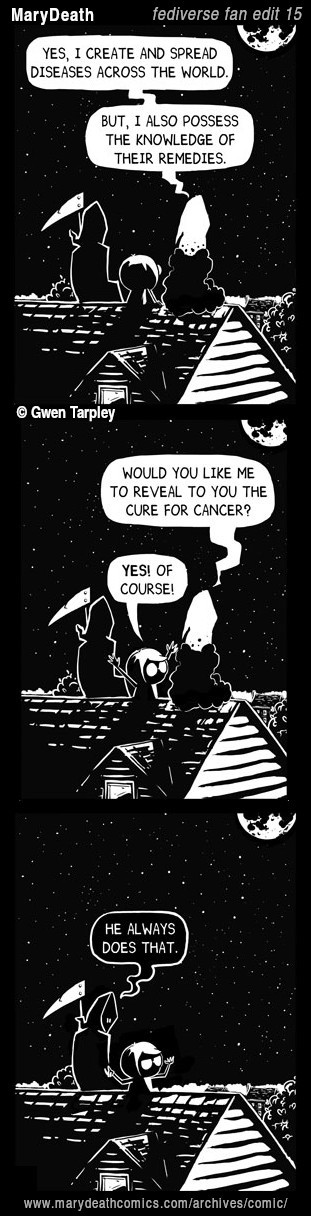
MaryDeath - Remedy [comic, fan edit]

preview

MaryDeath is a comic about life, death, and everything in between. The story follows a young girl named Mary who happens to have befriended Death. Why Death has chosen to take interest in Mary remains a mystery, but despite his ever dark presence Mary finds comfort in his companionship.

www.marydeathcomics.com/archives/comic/

MaryDeath Comics was created in the 2010s by Gwen Tarpley, though Cats Cafe Comic is her main effort now. The artist transitioned recently, and when I contacted her to ask about doing the Fan Edits, she encouraged me to remove her deadname from the strips. The main reason I wanted to do the edits is bc in a couple earlier strips Mary has a goth look but eventually she gave it up after a couple episodes. But I wanted a strip in which she retained her goth look. Finally, I wanted the three-strip stories to have a vertical orientation better suited to cell-phones.

MaryDeath is a comic about life, death, and everything in between. The story follows a young girl named Mary who happens to have befriended Death. Why Death has chosen to take interest in Mary remains a mystery, but despite his ever dark presence Mary finds comfort in his companionship.

www.marydeathcomics.com/archives/comic/

MaryDeath Comics was created in the 2010s by Gwen Tarpley, though Cats Cafe Comic is her main effort now. The artist transitioned recently, and when I contacted her to ask about doing the Fan Edits, she encouraged me to remove her deadname from the strips. The main reason I wanted to do the edits is bc in a couple earlier strips Mary has a goth look but eventually she gave it up after a couple episodes. But I wanted a strip in which she retained her goth look. Finally, I wanted the three-strip stories to have a vertical orientation better suited to cell-phones.

0

Linux’s exFAT Progs 1.4.4 Adds Optional I/O Statistics Collection for Profiling

9to5Linux Linux’s exFAT Progs 1.4.4 Adds Optional I/O Statistics Collection for Profiling - 9to5Linux 9to5linux.com
preview

Exfatprogs (exFAT Progs) 1.4.4, exFAT filesystem userspace utilities for Linux, has been released today with several improvements, a new feature, and multiple bug fixes.

Exfatprogs 1.4.4 is the fourth minor update in the Exfatprogs 1.4 series, coming three months after Exfatprogs 1.4.3. This release introduces a new feature to the exfatprogs command, namely optional I/O statistics collection for profiling read, write, discard, zero-out, and sync operations.

This release also updates mkfs.exfat to increase full-format speed by using BLKZEROOUT when supported, selecting larger zeroing batches, and improving quiet and trace progress output, and reducing page-cache pollution during full formatting on systems that support POSIX_FADV_NOREUSE.

Several bugs were fixed in Exfatprogs 1.4.4 for the mkfs.exfat command, avoiding memory-reservation failures when creating very large allocation bitmaps, and marking the percentage of used clusters as unknown until it is calculated.

The fsck.exfat command received the most attention, with fixes to prevent arithmetic overflows and out-of-bounds reads by rejecting malformed boot sector geometry, avoid printing version information during automatic repair with the “-p” or “-a” arguments, and missing line breaks in error messages.

In addition, the fsck.exfat command now stops immediately on I/O errors instead of treating them as file system inconsistencies. The dump.exfat command was updated to print complete file timestamps in raw and ISO formats, while the exfat2img command now keeps metadata image output on stdout free of status messages.

Last but not least, the exfatprogs command received fixes for parsing kernel versions and boolean environment variables, and showing the correct usage text for overwrite and read-back verification options.

Check out the release notes on the project’s GitHub page for more details about the changes included in exFAT Progs 1.4.4, from where you can download the source tarball if you want to compile it on your Linux distro. However, it is recommended to install Exfatprogs from your distro’s stable repositories.

Exfatprogs was designed as official userspace utilities that contain all of the standard utilities for creating, fixing, and debugging exFAT filesystems in Linux distributions. The goal of the exfatprogs project is to provide Linux users with the same high performance and quality as the exFAT utilities in Windows.

Exfatprogs (exFAT Progs) 1.4.4, exFAT filesystem userspace utilities for Linux, has been released today with several improvements, a new feature, and multiple bug fixes.

Exfatprogs 1.4.4 is the fourth minor update in the Exfatprogs 1.4 series, coming three months after Exfatprogs 1.4.3. This release introduces a new feature to the exfatprogs command, namely optional I/O statistics collection for profiling read, write, discard, zero-out, and sync operations.

This release also updates mkfs.exfat to increase full-format speed by using BLKZEROOUT when supported, selecting larger zeroing batches, and improving quiet and trace progress output, and reducing page-cache pollution during full formatting on systems that support POSIX_FADV_NOREUSE.

Several bugs were fixed in Exfatprogs 1.4.4 for the mkfs.exfat command, avoiding memory-reservation failures when creating very large allocation bitmaps, and marking the percentage of used clusters as unknown until it is calculated.

The fsck.exfat command received the most attention, with fixes to prevent arithmetic overflows and out-of-bounds reads by rejecting malformed boot sector geometry, avoid printing version information during automatic repair with the “-p” or “-a” arguments, and missing line breaks in error messages.

In addition, the fsck.exfat command now stops immediately on I/O errors instead of treating them as file system inconsistencies. The dump.exfat command was updated to print complete file timestamps in raw and ISO formats, while the exfat2img command now keeps metadata image output on stdout free of status messages.

Last but not least, the exfatprogs command received fixes for parsing kernel versions and boolean environment variables, and showing the correct usage text for overwrite and read-back verification options.

Check out the release notes on the project’s GitHub page for more details about the changes included in exFAT Progs 1.4.4, from where you can download the source tarball if you want to compile it on your Linux distro. However, it is recommended to install Exfatprogs from your distro’s stable repositories.

Exfatprogs was designed as official userspace utilities that contain all of the standard utilities for creating, fixing, and debugging exFAT filesystems in Linux distributions. The goal of the exfatprogs project is to provide Linux users with the same high performance and quality as the exFAT utilities in Windows.

0

This celestial expanse captures the Carina Nebula and the prominence of the Southern Cross within the Milky Way's southern disk. Visible are the distinct dark silhouette of the Coalsack Nebula and the

preview

This celestial expanse captures the Carina Nebula and the prominence of the Southern Cross within the Milky Way’s southern disk. Visible are the distinct dark silhouette of the Coalsack Nebula and the vibrant emission of Eta Carinae, a massive stellar system nearing the end of its life cycle. These features provide critical data for astrophysicists studying star formation and the evolutionary stages of high-mass stars. Examining such deep-field imagery allows for a better understanding of the complex galactic structures and interstellar dust dynamics inherent to our galaxy. #Astronomy #Astrophysics #NASA #StellarEvolution

#astronomy #astrophysics #nasa

@Space@lemmy.science.social @science@beehaw.org @science@lemmy.world @space@beehaw.org @space@lemmy.world @science@newsmast.community @space@newsmast.community @space@lemmy.ml #space #science #nasa #astronomy

This celestial expanse captures the Carina Nebula and the prominence of the Southern Cross within the Milky Way’s southern disk. Visible are the distinct dark silhouette of the Coalsack Nebula and the vibrant emission of Eta Carinae, a massive stellar system nearing the end of its life cycle. These features provide critical data for astrophysicists studying star formation and the evolutionary stages of high-mass stars. Examining such deep-field imagery allows for a better understanding of the complex galactic structures and interstellar dust dynamics inherent to our galaxy. #Astronomy #Astrophysics #NASA #StellarEvolution


#astronomy #astrophysics #nasa

@Space@lemmy.science.social @science@beehaw.org @science@lemmy.world @space@beehaw.org @space@lemmy.world @science@newsmast.community @space@newsmast.community @space@lemmy.ml #space #science #nasa #astronomy

0

The Archivium 2nd Edition

Tabletop Sentinel The Archivium 2nd Edition www.tabletopsentinel.com
preview

The Archivium is a solo journaling roleplaying game about university life, secret societies, forbidden research, and the questionable career prospects of someone responsible for maintaining a supernatural library. tabletopsentinel.com/…/the-archivium-2nd-edition

The Archivium is a solo journaling roleplaying game about university life, secret societies, forbidden research, and the questionable career prospects of someone responsible for maintaining a supernatural library. tabletopsentinel.com/…/the-archivium-2nd-edition

0

EVE Online's new expansion looks to make it simpler than ever to get into a huge space battle: 'Every 10 weeks or so, you're gonna know: I can roll up with whatever I have and go shoot some structures and have a big fight'

PC Gamer EVE Online's new expansion looks to make it simpler than ever to get into a huge space battle: 'Every 10 weeks or so, you're gonna know: I can roll up with whatever I have and go shoot some structures and have a big fight' www.pcgamer.com
preview

A proposition that’s hard to argue against.

A proposition that’s hard to argue against.

0

Super Mario 64: How Nintendo Created a Revolution in Gaming or Why It’s Great to Be Fashionably Late [46:59]

play · youtube.com
YouTube Super Mario 64: How Nintendo Created a Revolution in Gaming or Why It’s Great to Be Fashionably Late www.youtube.com
preview

In 1996, Nintendo finally released the N64 and Super Mario 64. Was it worth the long wait?

Uploaded to YouTube by GTV Japan.

In 1996, Nintendo finally released the N64 and Super Mario 64. Was it worth the long wait?

Uploaded to YouTube by GTV Japan.

0

WOW, das nenne ich einen guten digitalen Prozess, der auch noch superschnell bearbeitet wurde.

Ehrenamtskarte NRW www.engagiert-in-nrw.de
preview

WOW, das nenne ich einen guten digitalen Prozess, der auch noch superschnell bearbeitet wurde.
Ehrenamtskarte in der App verlängert. Innerhalb von 4 Stunden wurde mein Engagement für Wikipedia & Wikimedia Deutschland von @wikimediaDE bestätigt und dann vom “Referat Bürgerschaftliches Engagement
Staatskanzlei des Landes NRW” (@nrw ) genehmigt.

Merke: Auch wer für Wikipedia/Wikimedia Commons ehrenamtlich tätig ist, kann diese Karte erhalten https://www.engagiert-in-nrw.de/ehrensachenrw

#wikipedia #ehrenamt

WOW, das nenne ich einen guten digitalen Prozess, der auch noch superschnell bearbeitet wurde.
Ehrenamtskarte in der App verlängert. Innerhalb von 4 Stunden wurde mein Engagement für Wikipedia & Wikimedia Deutschland von @wikimediaDE bestätigt und dann vom “Referat Bürgerschaftliches Engagement
Staatskanzlei des Landes NRW” (@nrw ) genehmigt.

Merke: Auch wer für Wikipedia/Wikimedia Commons ehrenamtlich tätig ist, kann diese Karte erhalten https://www.engagiert-in-nrw.de/ehrensachenrw

#wikipedia #ehrenamt

0

Black Sister Looking Up At You [MiroO_Oooo]

preview

Black Sister’s so dependable and cute! She deserves lots of headpats for all of the wonderful work she does to protect Lastation!

Originally posted to Twitter & Pixiv on October 1st, 2026.

Black Sister’s so dependable and cute! She deserves lots of headpats for all of the wonderful work she does to protect Lastation!

Originally posted to Twitter & Pixiv on October 1st, 2026.

0

Ich🪖🎖️🫡iel

preview

Alt: das Panzer im See Maimaiformat Text: Oh Panzer im See, was ist Eure Weisheit?

Die Bundeswehr ist ein Scheißverein.

Darunter ein Bildschirmschuss von einem Artikel laut dem 72% der Rekrutinnen und 31% der Rekruten sexuelle Belästigung erfahren.

Also, nicht dass der Laden sonst kühl wäre…

Alt: das Panzer im See Maimaiformat Text: Oh Panzer im See, was ist Eure Weisheit?

Die Bundeswehr ist ein Scheißverein.

Darunter ein Bildschirmschuss von einem Artikel laut dem 72% der Rekrutinnen und 31% der Rekruten sexuelle Belästigung erfahren.

Also, nicht dass der Laden sonst kühl wäre…

0

My experiences with a fixed sync, sync-on-green monitor on my PC

preview

Info about getting a Sony GDM-1960/GDM-1961 usable on a regular (SVGA) computer.

This used to be mirrored several places, it seems archive.org is the last one remaining.

Info about getting a Sony GDM-1960/GDM-1961 usable on a regular (SVGA) computer.

This used to be mirrored several places, it seems archive.org is the last one remaining.

0

Safari Just Made Browser-Controlled Dark Mode Real

Amit Merchant Safari Just Made Browser-Controlled Dark Mode Real www.amitmerchant.com
preview

On November 3, WebKit announced Adaptive Dark Mode in Safari 27.3 beta. When a user enables it, Safari can analyse a predominantly light website and transform it into a dark appearance. It adjusts backgrounds, text, gradients and certain graphics while trying to preserve usability and contrast.

On November 3, WebKit announced Adaptive Dark Mode in Safari 27.3 beta. When a user enables it, Safari can analyse a predominantly light website and transform it into a dark appearance. It adjusts backgrounds, text, gradients and certain graphics while trying to preserve usability and contrast.