0

TV tonight: how three rockstar chefs sparked a foodie revolution

the Guardian TV tonight: how three rockstar chefs sparked a foodie revolution www.theguardian.com
preview

A riveting documentary following the rise of Marco Pierre White, Gordon Ramsay and Heston Blumenthal. Plus: the live final of Big Brother. Here’s what to watch this evening

9pm, BBC Two“Gastronomy is the French Foreign Legion,” says Marco Pierre White. “They don’t question you too much.” In the 1980s, the culinary desert of the UK saw the rise of three difficult, brilliant chefs (Pierre White was joined by Gordon Ramsay and Heston Blumenthal) who triggered a foodie revolution. This three-parter doesn’t quite avoid presentational, era-specific cliches, but it does capture the energy generated by the trio’s rise. Phil Harrison

Continue reading…

0

Linee guida sulla sicurezza nella gestione della rete stradale e autostradale

preview

Linee guida sulla sicurezza nella gestione della rete stradale e autostradale
@lavoro
https://www.puntosicuro.it/cantieri-stradali-C-112/linee-guida-sulla-sicurezza-nella-gestione-della-rete-stradale-autostradale-AR-26905/
Pubblicate nuove linee di indirizzo per la salute e sicurezza nelle attività di potenziamento e gestione della rete stradale/autostradale. Focus sulla sezione relativa all’accesso, allestimento e disallestimento delle aree di lavoro.

0

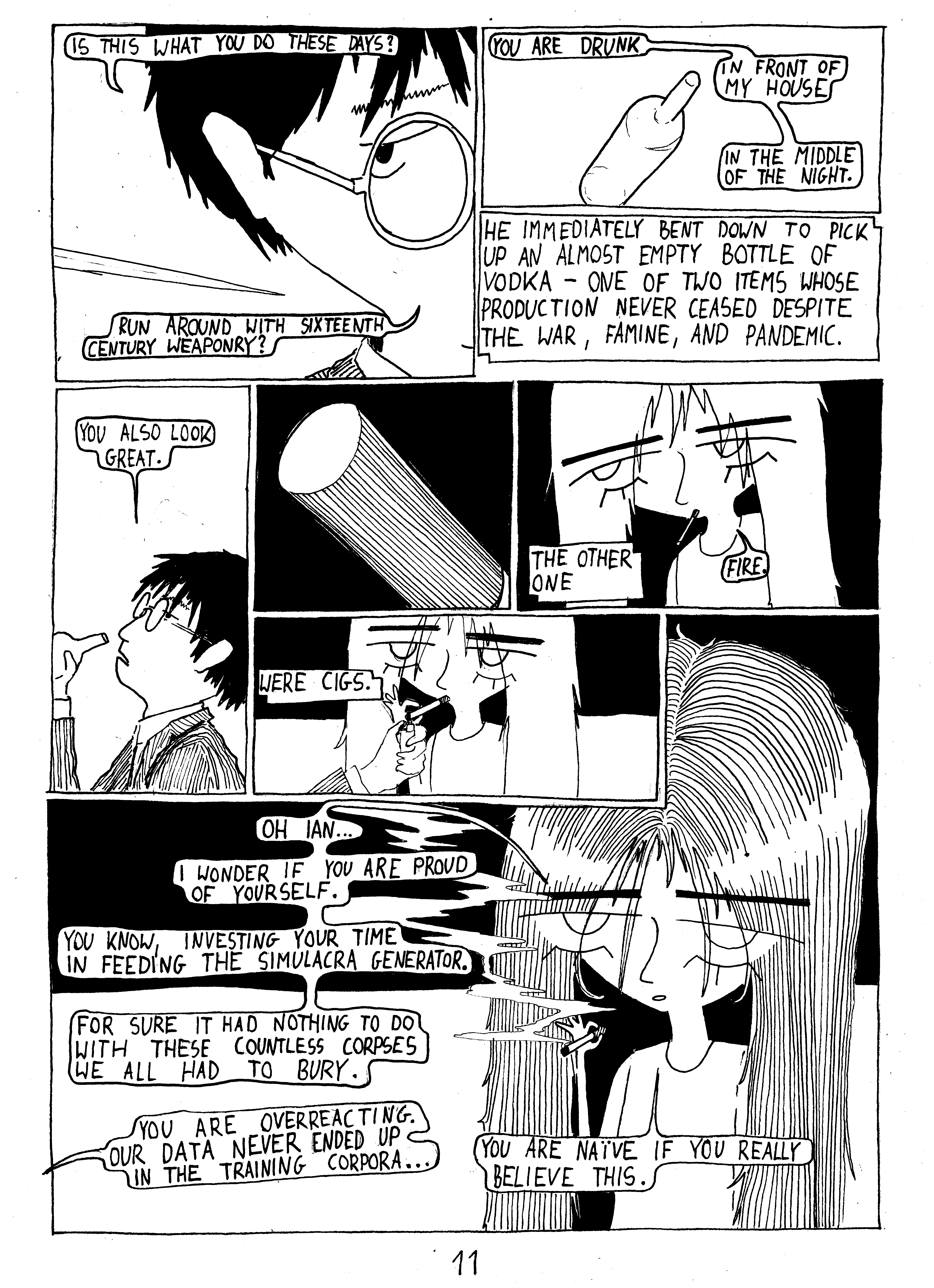
Entropy’s Rotoscope Issue II [page 11/24]

person: "is this what you do these days? run around with sixteenth century weaponry?"; zalma: "you are drunk .. in front of my house .. in the middle of the night."; he immediately bent down to pick up an almost empty bottle of vodka - one of two items whose production never ceased despite the war, famine, and pandemic.; person: "you also look great."; the other one; zalma: "fire"; were cigs.; zalma: "oh ian... i wonder if you are proud of yourself. you know, investing your time in feeding the simulacra generator. for sure it had nothing to do with these countless corpses we all had to bury."; ian: "you are overreacting. our data never ended up in the training corpora..."; zalma: "you are naive if you really believe this."
preview

next page tomorrow

full comic: kamiokan.de/entropysrotoscope/issue2

all issues: kamiokan.de/entropysrotoscope

RSS: kamiokan.de/entropysrotoscope/rss.xml

draw me something if you like this.

CC0 / Public Domain

if you have ever donated me money, you can have your nick/name on the last page of printed version of thiss, just send me an email (er2 <at> kamiokan <dot> de) with nick you want to be printed and info how did you donate (i won’t be checking that, just don’t lie ok.)

0

How to stay logged in through RSS?

preview

Sometimes I use RSS for Lemmy, bit easier. However, I noticed it logs me out or sees me as not logged in when the link doesn’t go to the instance I’m on.

Any idea how to solve this or at least why it happens?

Sometimes I use RSS for Lemmy, bit easier. However, I noticed it logs me out or sees me as not logged in when the link doesn’t go to the instance I’m on.

Any idea how to solve this or at least why it happens?

0

Justiz prüft Übergriffe und Doping im Sanitätsregiment

nd-aktuell.de Justiz prüft Übergriffe und Doping im Sanitätsregiment www.nd-aktuell.de
preview

Wegen Steroiden und sexualisierten Fehlverhaltens wird gegen zehn Soldaten in Weißenfels ermittelt. Die Rede ist auch von Führungsversagen.

Wegen Steroiden und sexualisierten Fehlverhaltens wird gegen zehn Soldaten in Weißenfels ermittelt. Die Rede ist auch von Führungsversagen.

0

The Three Alls Policy: The Strategy of Total Destruction

preview

In the occupied territories of China, World War II was waged using methods that went far beyond conventional military confrontation. In the headquarters of the Japanese North China Area Army, a strategy was formulated that aimed not just to defeat enemy troops, but to totally scorch the very human environment itself.

This doctrine entered history under the name “The Three Alls Policy” (Japanese: 三光作戦 — Sankō Sakusen), which literally translates to: “Kill All, Loot All, Burn All.”

History

Prior to 1940, the Japanese command attempted to use classical counter-insurgency methods but was met with fierce resistance. Chinese guerrillas literally “dissolved” among the peasantry, receiving food, shelter, and intelligence from them. For the Imperial Army, the answer became obvious: if you cannot catch the fish, you must drain the ocean.

General Yasuji Okamura (pictured) authorized the transition to scorched-earth tactics. Officially, in Japanese documents, this was called the “Strategy of Clean-up and Destruction,” but soldiers on the ground knew it by three simple verbs:

  1. “Kill All” (Satsu-kō): Any resident of a village in the operation zone—be it an elderly person, a woman, or an infant—was automatically equated to a guerrilla or their accomplice. Populations were often exterminated preemptively and entirely.

  2. “Loot All” (Raku-kō): From those peasants who were not killed, absolutely everything was seized: food, livestock, clothing, and seed grain. Entire regions were condemned to man-made famine to deprive the guerrillas of any means of supply.

  3. “Burn All” (Shō-kō): Residential houses, barns, Buddhist temples, and other structures were committed to the flames. The land outside Japanese fortifications was to be turned into a lifeless wasteland.

The Mechanics of the Void

The implementation of this policy bore little resemblance to the Nazi “death conveyor” (industrialized killing); it more closely resembled a locust raid. Japanese punitive detachments would surround villages, herd the residents into one place, and carry out mass executions—burying people alive, machine-gunning them, or locking them in barns and setting them on fire. Those who managed to flee into the forests died of cold and hunger, as their homes and food supplies had been turned to ash.

Furthermore, the “Three Alls Policy” was actively combined with the use of biological and chemical weapons. Special units (including the infamous “Unit 731” and its branches) poisoned wells with cholera and typhoid pathogens and dropped plague-infested fleas over agricultural lands to permanently establish “dead zone” status for rebellious provinces.

The Price of Silence

According to historians’ estimates, more than 2.7 million civilians were killed during the implementation of the Sankō Sakusen policy in the northern provinces of China alone. Millions more became refugees, and the economic infrastructure of entire regions was wiped off the face of the earth.

The tragedy of the “Three Alls” policy also lies in the fact that, for a long time after the war, these crimes remained in the shadows. The Tokyo Trials focused primarily on the Nanjing Massacre and crimes against Western Allies. Many officers who planned and carried out the scorched-earth tactics in China safely returned to civilian life in postwar Japan.

The Geography of Terror

The Sankō Sakusen policy was officially and purposefully applied by the Japanese mainly in Northern China (in provinces like Hebei, Shanxi, and Shandong), where the guerrilla movement was strongest. This means that the 2.7 million deaths were the result of extermination within a relatively localized territory, rather than across the entire country.


In the occupied territories of China, World War II was waged using methods that went far beyond conventional military confrontation. In the headquarters of the Japanese North China Area Army, a strategy was formulated that aimed not just to defeat enemy troops, but to totally scorch the very human environment itself.

This doctrine entered history under the name “The Three Alls Policy” (Japanese: 三光作戦 — Sankō Sakusen), which literally translates to: “Kill All, Loot All, Burn All.”

History

Prior to 1940, the Japanese command attempted to use classical counter-insurgency methods but was met with fierce resistance. Chinese guerrillas literally “dissolved” among the peasantry, receiving food, shelter, and intelligence from them. For the Imperial Army, the answer became obvious: if you cannot catch the fish, you must drain the ocean.

General Yasuji Okamura (pictured) authorized the transition to scorched-earth tactics. Officially, in Japanese documents, this was called the “Strategy of Clean-up and Destruction,” but soldiers on the ground knew it by three simple verbs:

  1. “Kill All” (Satsu-kō): Any resident of a village in the operation zone—be it an elderly person, a woman, or an infant—was automatically equated to a guerrilla or their accomplice. Populations were often exterminated preemptively and entirely.

  2. “Loot All” (Raku-kō): From those peasants who were not killed, absolutely everything was seized: food, livestock, clothing, and seed grain. Entire regions were condemned to man-made famine to deprive the guerrillas of any means of supply.

  3. “Burn All” (Shō-kō): Residential houses, barns, Buddhist temples, and other structures were committed to the flames. The land outside Japanese fortifications was to be turned into a lifeless wasteland.

The Mechanics of the Void

The implementation of this policy bore little resemblance to the Nazi “death conveyor” (industrialized killing); it more closely resembled a locust raid. Japanese punitive detachments would surround villages, herd the residents into one place, and carry out mass executions—burying people alive, machine-gunning them, or locking them in barns and setting them on fire. Those who managed to flee into the forests died of cold and hunger, as their homes and food supplies had been turned to ash.

Furthermore, the “Three Alls Policy” was actively combined with the use of biological and chemical weapons. Special units (including the infamous “Unit 731” and its branches) poisoned wells with cholera and typhoid pathogens and dropped plague-infested fleas over agricultural lands to permanently establish “dead zone” status for rebellious provinces.

The Price of Silence

According to historians’ estimates, more than 2.7 million civilians were killed during the implementation of the Sankō Sakusen policy in the northern provinces of China alone. Millions more became refugees, and the economic infrastructure of entire regions was wiped off the face of the earth.

The tragedy of the “Three Alls” policy also lies in the fact that, for a long time after the war, these crimes remained in the shadows. The Tokyo Trials focused primarily on the Nanjing Massacre and crimes against Western Allies. Many officers who planned and carried out the scorched-earth tactics in China safely returned to civilian life in postwar Japan.

The Geography of Terror

The Sankō Sakusen policy was officially and purposefully applied by the Japanese mainly in Northern China (in provinces like Hebei, Shanxi, and Shandong), where the guerrilla movement was strongest. This means that the 2.7 million deaths were the result of extermination within a relatively localized territory, rather than across the entire country.

0

Imparare dagli errori: infortuni con macchine e attrezzature in metalmeccanica

preview

Imparare dagli errori: infortuni con macchine e attrezzature in metalmeccanica
@lavoro
https://www.puntosicuro.it/imparare-dagli-errori-C-99/imparare-dagli-errori-infortuni-con-macchine-attrezzature-in-metalmeccanica-AR-26902/
Esempi di infortuni che avvengono nell’industria metalmeccanica. Un infortunio ad un addetto alla conduzione di una pressa per estrusione e a ad un pensionato, fondatore dell’azienda. Gli strumenti per migliorare le misure di prevenzione.

0

Picture-inpicture videos pause when over connect.

preview

Bug Report

Describe the issue:

When I have a PIP video from another app open over Connect, the video’s audio will fade out and the video will pause despite no media playing within Connect. This behavior makes sense if I play a video with audio in Connect but shouldn’t happen if I’m only interacting with text, images, or silent videos.

Steps to reproduce:

  1. Open Connect and a video app that supports picture-in-picture.
  2. With a video open in the video app, tap home to create a PIP video overlay and switch to connect.
  3. Within Connect, view a video that pauses the video (expected).
  4. Navigate away from the video in connect to non-audio media. Try to play the video again while browsing text. The video will pause.

Device Information

  • App Version: 1.0.486 (486)

  • Platform: android

  • OS Version: CP3A.261005.005

  • Migration: n/a (attempts: 0)

Modified Settings

The following settings have been changed from defaults:

  • cardType: listReverse (default: card)
  • imageDomainRewrites: {} (default: {})
0

Scottsdale and Paradise Valley provided the full experience.

preview

Let’s imagine for a moment that you’re in the house of the owner of Arizona’s first Rolls Royce dealer, and after his 89-year-old wife has adequately prepared a bolognese, he wants help getting into his email, as Anthony skipped lunch.

My life is a fucking dichotomy at this point. I have rejected capitalism and am planning a commune, yet I have a soft spot for a multimillionaire who provided a chilled white from the Valais.

Oh, he’s also the honorary Swiss consul. Just another day at the office.

Returning to Arizona has always felt weird because I know why and how I was raised, but it simply isn’t me. Elsbeth asked some question about the artistic director of the Phoenix Boys Choir when I was the soprano soloist, and I ask if she knows Herbie is now running it. Max jumps in and asks what happened to the Austrian, and I’m like “Georg Stangelberger? He was a disaster for the choir.”

Because, you see, I am actually that guy.

I am back in Texas tonight, having negotiated Phoenix roads without actually thinking. I don’t drive in Austin on autopilot, but drop me in fucking Scottsdale and I can debate fine policy points while also knowing I need to be one lane to the left in 1,000 feet.

I don’t like that Paradise Valley is where I simply need no directions. It’s a terribly uppity place now, but it wasn’t when I was growing up.

A.J.'s was not A.J.'s in the '80s. It was A.J. Bayless, and simply a small grocery store, not the absurd monstrosity of expensive food it currently is.

But, you see, that’s where I grew up. It’s just home. It looks really high-end, but the Bentleys are in the garage.

When Elsbeth asked to see where we’d deposited Pop, we had to go up the road a bit to get her a decent view. Via the garage, where of course there’s a Volvo as the daily driver and two Bentleys and a Jag.

Because that’s who I was. And I fall back into it easily. But it’s not at all who I am now.

Let’s imagine for a moment that you’re in the house of the owner of Arizona’s first Rolls Royce dealer, and after his 89-year-old wife has adequately prepared a bolognese, he wants help getting into his email, as Anthony skipped lunch.

My life is a fucking dichotomy at this point. I have rejected capitalism and am planning a commune, yet I have a soft spot for a multimillionaire who provided a chilled white from the Valais.

Oh, he’s also the honorary Swiss consul. Just another day at the office.

Returning to Arizona has always felt weird because I know why and how I was raised, but it simply isn’t me. Elsbeth asked some question about the artistic director of the Phoenix Boys Choir when I was the soprano soloist, and I ask if she knows Herbie is now running it. Max jumps in and asks what happened to the Austrian, and I’m like “Georg Stangelberger? He was a disaster for the choir.”

Because, you see, I am actually that guy.

I am back in Texas tonight, having negotiated Phoenix roads without actually thinking. I don’t drive in Austin on autopilot, but drop me in fucking Scottsdale and I can debate fine policy points while also knowing I need to be one lane to the left in 1,000 feet.

I don’t like that Paradise Valley is where I simply need no directions. It’s a terribly uppity place now, but it wasn’t when I was growing up.

A.J.'s was not A.J.'s in the '80s. It was A.J. Bayless, and simply a small grocery store, not the absurd monstrosity of expensive food it currently is.

But, you see, that’s where I grew up. It’s just home. It looks really high-end, but the Bentleys are in the garage.

When Elsbeth asked to see where we’d deposited Pop, we had to go up the road a bit to get her a decent view. Via the garage, where of course there’s a Volvo as the daily driver and two Bentleys and a Jag.

Because that’s who I was. And I fall back into it easily. But it’s not at all who I am now.

0

Requesting c/astronomy, current moderator inactive

preview

Requesting !astronomy@lemmy.world.

The community is a candidate replacement for !astronomy@mander.xyz: sh.itjust.works/post/69398727

Current moderator @slashzero@lemmy.world has been inactive for 3 years.

Link to a post made on the community from my local account: lemmy.world/post/54009431

Requesting !astronomy@lemmy.world.

The community is a candidate replacement for !astronomy@mander.xyz: sh.itjust.works/post/69398727

Current moderator @slashzero@lemmy.world has been inactive for 3 years.

Link to a post made on the community from my local account: lemmy.world/post/54009431

0

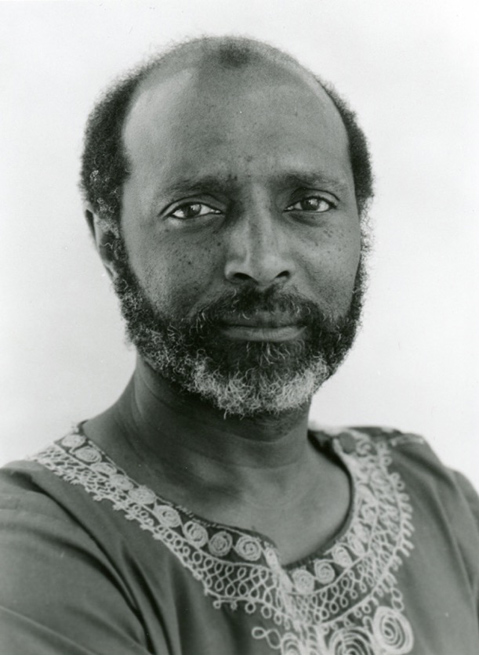
Cedric Robinson (1940 - 2016) Cedric Robinson, born on this day in 1940, was the author of "Black Marxism: The Making of the Black Radical Tradition" and a professor of Black Studies and Political...

preview

Cedric Robinson (1940 - 2016)

Tue Nov 05, 1940

Image

Image: **


Cedric Robinson, born on this day in 1940, was the author of “Black Marxism: The Making of the Black Radical Tradition” and a professor of Black Studies and Political Science at the University of California, Santa Barbara (UCSB).

Robinson’s areas of interest included political philosophy, radical social theory in the African diaspora, comparative politics, and the relationships between and among media and politics.

According to Professor Robin D.G. Kelley, “[Robinson’s] monumental Black Marxism: The Making of the Black Radical Tradition (1983) takes Karl Marx to task for failing to comprehend radical movements outside of Europe. He rewrites the history of the West from ancient times to the mid-twentieth century, scrutinizing the idea that Marx’s categories of class can be universally applied outside of Europe. Instead he characterized black rebellions as expressions of what he called the ‘Black Radical Tradition’, movements whose objectives and aspirations confounded Western social analysis. Marxism also failed to account for the racial character of capitalism.”

In a critical review of the work, authors William I. Robinson, Salvador Rangel and Hilbourne A. Watson state “Black Marxism has become a favored text with which to badger radical intellectuals and activists who place a premium on proletarian struggle. This has led some among left organizers to fear they may be condemned as Eurocentric, as ‘class reductionists’, and as ‘ignoring race’ should they place a premium on class analysis, should they insist that racism is an outcome of class exploitation, and that its eradication involves a transnational and pan-ethnic proletarian struggle against capitalism…At a time when global capital is on an all-out rampage against the global working and popular classes and when our very survival is under threat, we need more than ever a transnational revolutionary proletarian politics. We won’t find that in Black Marxism.”

“Racism, I maintain, was not simply a convention for ordering the relations of European to non-European peoples but has its genesis in the ‘internal’ relations of European peoples.”

- Cedric Robinson


0

A NASA space telescope plunged back to Earth after a mission that lasted 11 times longer than planned

PBS News A NASA space telescope plunged back to Earth after a mission that lasted 11 times longer than planned www.pbs.org
preview

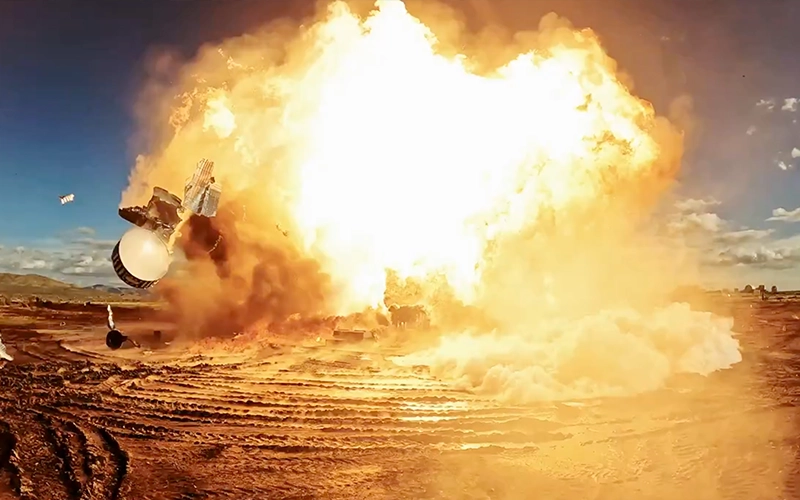
The Swift Observatory’s demise came less than three months after a long-shot rescue mission failed.

The U.S. Space Force confirmed Swift’s reentry near Indonesia after tracking its sinking orbit, the result of intense solar activity the past few years.

NASA hired a private company to whip together an orbit-boosting effort, but Katalyst Space’s three-armed robotic craft ran into trouble following its July launch and came crashing down in September.

It was not immediately known how much of the 1 ½-ton spacecraft burned up in the atmosphere. NASA anticipated some of the denser pieces surviving.