0

As public backlash grows against AI, politicians have launched a new PR push

The Breach As public backlash grows against AI, politicians have launched a new PR push  ⋆ The Breach breachmedia.ca
preview

As the public backlash to AI and data centres swells, pro-AI politicians are trying to anxiously spin.

Marcus Werner debunks the PR push underway to justify public handouts to tech oligarchs.

As the public backlash to AI and data centres swells, pro-AI politicians are trying to anxiously spin.

Marcus Werner debunks the PR push underway to justify public handouts to tech oligarchs.

0

Angelo and the Tombstone

preview

A boy stood in front of a tombstone. The narrow gray slab jutted out of the ground like an enormous wall that would have cleaved the sun in half if not for the sea of clouds already shaking their raindrops out over the earth. Dozens of people came and went, offering their roses and goodbyes to the tomb, sliding their condolences and checks to the widow, dropping their smiles and hair ruffles to the boy. They all came up with something to say. “He was a good man” this or “He would be proud” that, like the silence between sobs had to be filled with words before it went on too long. The boy shrugged.

A snail snuck up the side of the stone. The boy spotted it while some older man was speaking about tough times and raising yourself. He traced the path it took, watched it carve its way through the waterfalls streaming down the slab. The widow thanked the man as he left. Another came to replace him. The snail trudged on, slinking higher and higher, tracing the indented lettering out. Someone asked him a question, rested a hand on his shoulder. He shrugged. The hand let go. The snail climbed higher, running from whatever snail mafia it owed money to on the ground. Did it leave its family behind, crying in the rain like the giants above? Its name was Angelo, the boy decided, and he had a wife and two kids. Angelo was on the run from the mob and the cops; he played both sides and lost twice as hard, and fled up a mountain to save his own life.

Another person. Another question. Another shrug. Platitudes, then goodbyes, then Angelo was halfway up, the fuzz climbing up behind him, but it was time to go. The widow took the boy’s shoulder and steered him away, towards a black car. She bawled and sobbed and cried, blowing her snot into a tissue and wiping her eyes with it. The boy sidled into the seat as the widow took out another tissue and wiped his nonexistent tears. “You’re so strong,” and he turned his head away, and tried to spy the snail at the top as the grave shrank into the distance.

0

Us & Them: Exclusion isn't good for the team.

The Reframe Us and Them www.the-reframe.com
preview

In distancing himself from his earlier support of trans people, James Talarico may have thought he’d keep himself from being cast as Them, but he participated in the exact story that casts him that way.

He could have said “exclusion isn’t good for our team. I will always stand with trans kids and all trans people, and that’s how you know I’m going to stand for all of you. Texas is for everyone in Texas, and the United States is for everyone in the United States. We don’t harass kids in my Texas. In fact, we don’t harass anyone. I hope to earn everyone’s support, but if taking away kids’ health care is what I need to do to get it, then I’ll work for the basic human rights of trans kids without your support, and I’ll work for your basic human rights without your support, too.”

Instead, he did what he has done. Talarico very likely has persuaded the bullies that he will back down to pressure, and persuaded trans people that he’d rather be liked by Republican bigots than by trans people in Texas, and that even if he wins in November, they’ll be on their own.

0

Intuitive explanation for conductor diameter v. electrical length?

preview

The Extra exam asks:

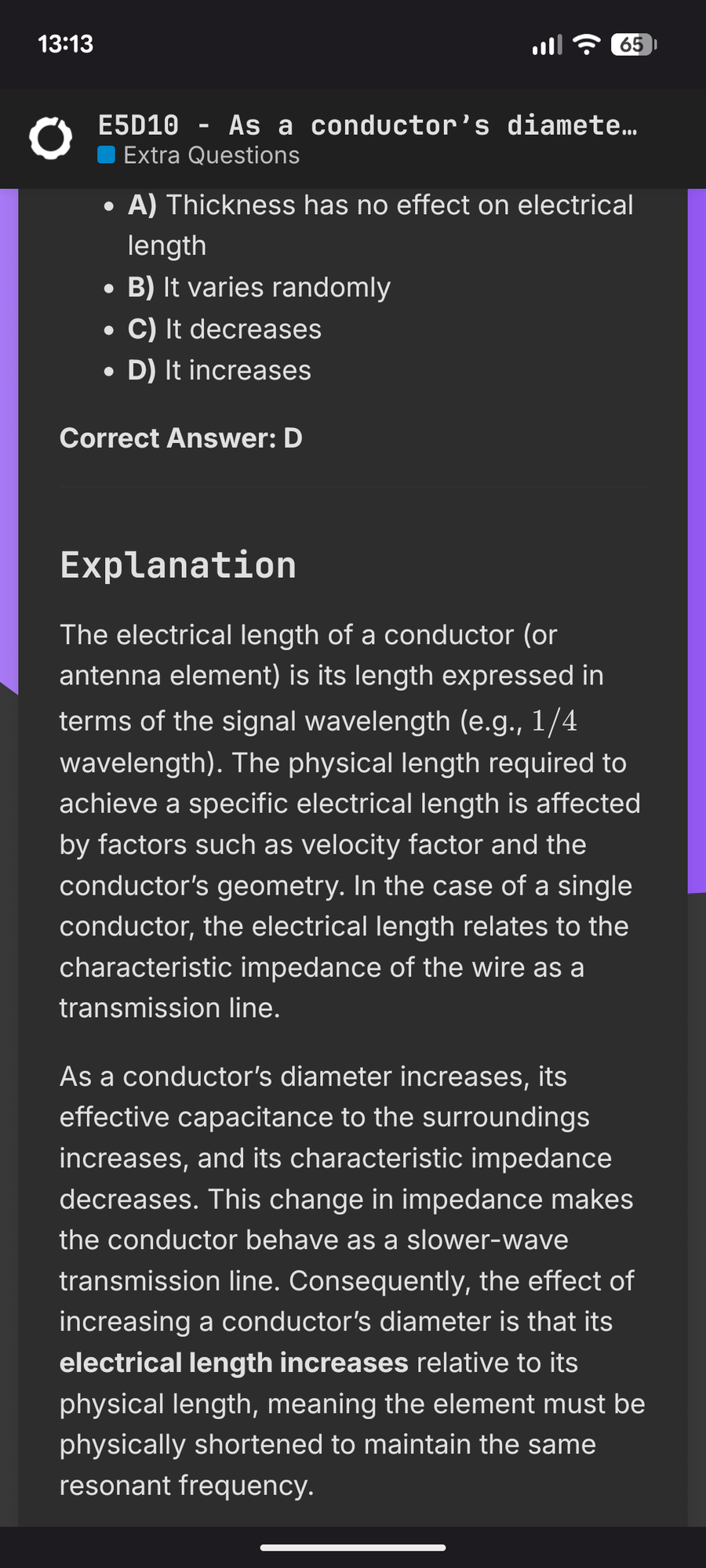
E5D10 - As a conductor’s diameter increases, what is the effect on its electrical length?

HamStudy has this explanation:

From the ARRL Antenna book:

the electrical length of a linear circuit such as an antenna wire is not necessarily the same as its physical length in wavelengths or fractions of a wavelength. Rather, the electrical length is measured by the time taken for the completion of a specified phenomenon.

As the diameter increases the resistance decreases, which in effect lengthens the effective “electrical length” of the wire. Thus you could have two wires of differing physical length which are both electrically e.g. “12 wavelength” at the same frequency because the shorter one has a larger diameter.

So, to restate again: the electrical length increases as the diameter increases.

OpenHamPrep explains with (sorry, seems to block copying text):

explanation text

I’m having trouble internalizing the explanations though.

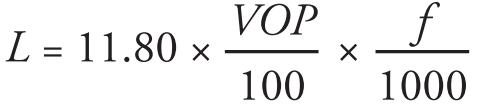
Electrical length: How does this relate to velocity factor? I’m picturing how one wavelength at a given frequency fits in the conductor. Compared to velocity factor of 1 (speed of light in a vacuum), if the wire had VF 0.8, I’m picturing that the wave in the wire would oscillate at the same rate but not get as far, so the wave would complete in a shorter physical distance. This matches an equation from picwire:

L = 11.8 * f/1000 * VOP/100

From HamStudy’s explanation, how would decreased resistance mean increased electrical length?

OpenHamPrep seems to make more sense (bigger diameter = more capacitance). But why does that reduce characteristic impedence, and why would lower impedence mean “slower wave”?

0

Getting over the listening hump?

preview

How do you improve your listening skills to get to listening to native content with ease, assuming vocabulary and grammar are not the issue?

Here’s what I’ve found does not work:

  • Slow/easy language podcasts. Yes, it’s important to get started with stuff like that, but it’s extremely boring and limited, and it does not get me over the listening hump. The listening hump is all the phonetic and semantic and grammatical changes made to language when it is spoken at speed. By definition, I am NOT exposed to that in slow language podcasts and so listening to an infinite amount of slow podcasts will not teach me.

  • Re-listening to work I know. I’ve found working from transcribed shows that I can understand them all, but it’s from a freaky ability to recall the dialogue, not from a newfound ability to DECODE the dialogue. The flip side of that is if there is something I don’t understand the first time through, it doesn´t become more intelligible on multiple passthroughs. So I read the transcript and then it becomes yet another thing I remember.

So I’m wondering if there’s an entirely different approach. Like, maybe if I tried reading aloud more often, I’d naturally fall into these elisions and ways of speaking, and having produced them naturally myself, I would hear them better? Because right now, my language production is zero. In fact, my language consumption is entirely passive.

Tell me what you did to get over the hump.

0

YSK that you can make any flavor of cereal you want

preview

I bought pumpkin pie spice because I couldn’t find pumpkin spice. I made a pumpkin latte last night.

I made a simple recipe of oatmeal, pumpkin pie spice,milk and honey. It came out alright all the flavor was in certain chunks of the oatmeal. Need to brainstorm on how to distribute the flavor. Probably need to stir well

This is what the outcome of my first pumpkin pie spice cereal

0

Current progress on my Vihuela de Mano

preview

CNC-cutting the sides to shape before bending worked surprisingly well. I had left 10mm extra at each end, but that turned out to be unnecessary. The back will have a 3000mm radius and the top will be bent slightly inwards for stability.

CNC-cutting the sides to shape before bending worked surprisingly well. I had left 10mm extra at each end, but that turned out to be unnecessary. The back will have a 3000mm radius and the top will be bent slightly inwards for stability.

0

How's your week been?

preview
Resources

If you are thinking about harming yourself — get immediate crisis support. Connect to a crisis counselor 24/7, 365 days a year, from anywhere in the U.S via text, chat, www.thetrevorproject.org/get-help/

Resources

If you are thinking about harming yourself — get immediate crisis support. Connect to a crisis counselor 24/7, 365 days a year, from anywhere in the U.S via text, chat, www.thetrevorproject.org/get-help/

0

Went to lift with my wife today

preview

I had been showing her some basic excercises using soup cans like some shit in the cabin in Rocky IV. But we went to the gym together this morning and she used 5 lb dumbbells and I’m really proud she got started!

What we did together (I just used heavier dumbbells)

  1. Shoulder press
  2. Curls
  3. Skull crushers
  4. Bent row
  5. Squats
  6. Lat raises
0

Wk 1!

preview

Graphic showing Ravens’ week 1 inactive players: WR Elijah Sarrat, CB Chandler Rivers, ILB Teddye Buchanan, G Emery Jones, WR Devontez Walker, DT Nnamdi Madubuike, QB3 Joe Fagnano.

Can’t wait til Madubuike is actually back!

May we start off this regular season with a win!

And may Lamar, Zay, and our D get many points for my fantasy team! :)

0

RSL Grand Final at Blizzcon starting now!

preview

Twitch Streams: www.twitch.tv/starcraft

Or: www.twitch.tv/tastelesstv

YouTube Streams: www.youtube.com/live/tNkq3BkiW8c

Or: www.youtube.com/live/rvGdUfDoCoY

Bracket: liquipedia.net/starcraft2/RSL_Revival/Season_6

Twitch Streams: www.twitch.tv/starcraft

Or: www.twitch.tv/tastelesstv

YouTube Streams: www.youtube.com/live/tNkq3BkiW8c

Or: www.youtube.com/live/rvGdUfDoCoY

Bracket: liquipedia.net/starcraft2/RSL_Revival/Season_6

0

Ordeal by Innocence 🔎 Nerano Manor, by Ignas, Lord Zircon and Oskari Ahde

preview

Located in the heart of Balmora’s High Town, Nerano Manor boasts a grand dining hall, many bedrooms, staff to attend its esteemed guests, and a painting collection the envy of Vvardenfell! Does anyone know where the owner is? And who spilled all this red paint over the carpet?

Located in the heart of Balmora’s High Town, Nerano Manor boasts a grand dining hall, many bedrooms, staff to attend its esteemed guests, and a painting collection the envy of Vvardenfell! Does anyone know where the owner is? And who spilled all this red paint over the carpet?

0

The end times fascists are plotting their escape from our world. Our mission is clear

the Guardian The end times fascists are plotting their escape from our world. Our mission is clear | Naomi Klein and Astra Taylor www.theguardian.com
preview

cross-posted from: lemmy.ca/post/70841923

And among tech oligarchs, Bezos is all too typical. Peter Thiel, for one, once revealed that his three best ideas for achieving true freedom are “cyberspace”, “outerspace” and “seasteading” (the idea of building new countries on floating oil rigs). In other words, this man, whose enormous wealth affords him access to the most spectacular settings our planet has to offer, actually believes these three cold, dead places are superior to the Earth we have, verdant and alive.

Something similar seems amiss with Elon Musk, a man who seems to look up at the wonders of the night sky and see only opportunities to fill that inky unknown with his own space junk. The venerable novelist Joyce Carol Oates highlighted these apparent limits in the fall of 2025 when she roasted him ruthlessly on his own platform, X.

“So curious,” she wrote, “that such a wealthy man never posts anything that indicates that he enjoys or is even aware of what virtually everyone appreciates – scenes from nature, pet dog or cat, praise for a movie, music, a book (but doubt that he reads); pride in a friend’s or relative’s accomplishment; condolences for someone who has died; pleasure in sports, acclaim for a favorite team; references to history. In fact he seems totally uneducated, uncultured. The poorest persons on Twitter [X] may have access to more beauty & meaning in life than the ‘most wealthy person in the world.’”

The observation clearly got under the tech baron’s notoriously thin skin: he called her “a lazy liar” and began posting approvingly about various movies to prove Oates wrong.

0

Soweto mourns fallen officer killed in devastating pit bull attack

KAYA 959 Soweto mourns fallen officer killed in devastating pit bull attack www.kaya959.co.za
preview

A devastating tragedy has struck the South African police service after a dedicated female officer was mauled to death by pit bulls in Soweto on 11 September 2026.

A devastating tragedy has struck the South African police service after a dedicated female officer was mauled to death by pit bulls in Soweto on 11 September 2026.

0

𝑻𝒐𝒍𝒔𝒕𝒐𝒚'𝒔 𝑭𝒊𝒓𝒔𝒕 𝑷𝒂𝒓𝒕 𝒐𝒇 𝒕𝒉𝒆 𝑷𝒓𝒆𝒇𝒂𝒄𝒆 𝒕𝒐 𝒉𝒊𝒔 𝑰𝒏𝒕𝒆𝒓𝒑𝒓𝒆𝒕𝒂𝒕𝒊𝒐𝒏 𝒐𝒇 𝒉𝒊𝒔 𝑻𝒓𝒂𝒏𝒔𝒍𝒂𝒕𝒊𝒐𝒏 𝒐𝒇 𝒕𝒉𝒆 𝑮𝒐𝒔𝒑𝒆𝒍𝒔 "𝑻𝒉𝒆 𝑮𝒐𝒔𝒑𝒆𝒍 𝒊𝒏 𝑩𝒓𝒊𝒆𝒇"

preview

When Tolstoy speaks of Christianity, he’s referring to his more objective, philosophical, less supernatural interpretation of his translation of the Gospels, The Gospel in Brief. For context: Tolstoy’s Personal, Social, and Divine Conceptions of Life.


This short account of the Gospel is my own synthesis of the four Gospels, organized according to the meaning of the teaching. While making this synthesis, it was mostly unnecessary for me to depart from the order in which the Gospels have already been laid out, so that in my synthesis one should not expect more but actually considerably fewer transpositions [cause (two or more things) to change places with each other] of Gospel verses than are found in the majority of concordances of which I am aware. In the Gospel of John, as it appears in my synthesis, there are no transpositions whatsoever; it is all laid out in the exact order as the original. The division of the Gospel into twelve or six chapters (if we were to count each thematic pair of two chapters as one) came about naturally from the meaning of the teaching. This is the meaning behind these chapters:

  1. Man is the son [reflection] of an infinite source, the son of this father not by the flesh, but by the spirit [“I can’t change rocks to food, but I can abstain from eating food”].
  2. And therefore man should serve this source in spirit.
  3. The life of all people has a divine source. It alone is holy.
  4. And therefore man should serve this source in the life of all people. That is the father’s will.
  5. Only serving the father’s will can bring truth, i.e., a life of reason.
  6. And therefore the satisfaction of one’s own will is not necessary for true life.
  7. Temporal, mortal life is the food of the true life — it is the material for a life of reason.
  8. And therefore the true life is outside of time, it exists only in the present.
  9. Life’s deception with time: the life of the past or the future hides the true life of the present from people.
  10. And therefore man should strive to destroy the deception of the temporal life of the past and the future.
  11. The true life is not just life outside of time — the present — but is also a life outside of the individual. Life is common to all people and expresses itself in love.
  12. And therefore, the person who lives in the present, in the common life of all people, unites himself with the father — with the source and foundation of life.

Each two chapters share a connection of effect and cause. Besides these twelve chapters, the following is appended to the account: the introduction from the first chapter of John, in which the writer speaks, on his own authority, about the meaning of the teaching as a whole, as well as the conclusion from the same writer’s Epistle (written, likely, before the Gospel), containing some general conclusions on all that came before. The introduction and conclusion do not represent an essential part of this teaching. They are simply general views on the teaching as a whole. Although the introduction and the conclusion both could have been omitted with no loss to the meaning of the teaching (especially since they were both written by John and do not come from Jesus), I held on to them for their simple and reasoned understanding of Jesus’s teachings, and because these sections, unlike the church’s strange interpretations, confirm one another and confirm the teaching as a whole while presenting the simplest articulation of meaning that could be attached to the teachings.

At the beginning of every chapter, apart from a short summary of its contents, I also present corresponding words from the prayer that Jesus used as a model to teach his students how to pray. When I came to the completion of this work, I found, to my surprise and joy, that the so-called Lord’s Prayer is nothing other than Jesus’s whole teaching expressed in its most distilled form in the very order that I had already laid out the chapters, and that each expression in the prayer corresponds to the sense and order of the chapters.

  1. Our father — Man is the Son [reflection] of God.
  2. Who art in heaven. — God is the eternal, spiritual source of life.
  3. Hallowed be thy name. — Let this source of life be holy.
  4. Thy kingdom come. — Let his power be manifest in all people.
  5. Thy will be done in heaven — And let the eternal source’s will come to be, both in and of itself
  6. as it is on earth. — as well as in the flesh.
  7. Give us our daily bread —Temporal life is the food of true life.
  8. this day — The true life is in the present.
  9. And forgive us our debts, as we forgive our debtors. — Let not the mistakes and delusions [the images we create in our heads via our imaginations] of the past hide the true life from us.
  10. And lead us not into temptation. — And let them not lead us into deception.
  11. But deliver us from evil. — And then there will be no evil.
  12. For thine is the kingdom and the power and the glory. — And it will be your power and strength and reason.

In the third section of the more comprehensive account, which is still in manuscript form, the Gospels according to the four Evangelists are thoroughly explicated [analyze and develop (an idea or principle) in detail], without the slightest omission. In this current account, the following verses are omitted: the conception, the birth of John the Baptist, his imprisonment and death, the birth of Jesus, his lineage, the flight with his mother into Egypt, Jesus’s miracles in Canaan and Capernaum, the casting out of demons, walking on water, the withering of the fig tree, healing of the sick, the resurrection of the dead, Christ’s own resurrection and all references to prophecies fulfilled in Christ’s life. These verses are omitted in the current short account because, since they do not contain any teaching but only describe events that occurred before, during or after Jesus’s ministry without adding anything, they only complicate and burden the account. These verses, no matter how they are understood, do not contain contradictions to the teaching, nor do they contain support for it. The only value these verses held for Christianity was that they proved the divinity of Jesus to those who did not believe in it. For someone who perceives the flimsiness of a story about miracles, but still does not doubt Jesus’s divinity because of the strength of his teaching, these verses fall away by themselves; they are unnecessary.

In the larger account, each departure from the standard translation, each interjected clarification, each omission is explained and justified by a collation [collect and combine (texts, information, or sets of figures) in proper order] of the different versions of the Gospel, contexts, philological and other considerations. In this short account, all of these proofs and refutations of the church’s false understandings, as well as the detailed annotations with references, have been left out on the basis that no matter how exact and correct the reasoning of each individual section may be, such reasoning cannot serve to convince anyone that this reading of the teaching is true. The proof that this reading is correct lies not in reasoning out separate passages, but in the unity, clarity, simplicity and fullness of the teaching itself and on its correspondence with the internal feelings of every person who seeks truth.

Concerning all general deviations in my account from the accepted church texts, the reader should not forget that our quite customary concept about how the Gospels, all four, with all of their verses and letters are essentially holy books is, from one perspective, the most vulgar delusion, and from the other perspective, the most vulgar and harmful deception. The reader should understand that at no point did Jesus himself ever write a book as did Plato, Philo or Marcus Aurelius, that he did not even present his teachings to literate and educated people, as Socrates did, but spoke with the illiterate whom he met in the course of daily life, and that only long after his death did it occur to people that what he had said was very important and that it really wouldn’t be a bad idea to write down a little of what he had said and done, and so almost one hundred years later they began to write down what they had heard about him.

The reader should remember that such writings were very, very numerous, that many were lost, many were very bad, and that the Christians used all of them before little by little picking out the ones that seemed to them best and most sensible, and that in choosing these best Gospels, to refer to the adage ‘every branch has its knots,’ the churches inevitably took in a lot of knots with what they had cut out from the entire massive body of literature on Christ. There are many passages in the canonical Gospels that are as bad as those in the rejected apocryphal ones, and many places in the apocryphal ones are good. The reader should remember that Christ’s teaching may be holy, but that there is no way for some set number of verses and letters to be holy, and that no book can be holy from its first line to its last simply because people say that it is holy.

Of all educated people, only our Russian reader, thanks to Russia’s censorship, can ignore the last one hundred years of labor by historical critics and continue to speak naively about how the Gospels of Matthew, Mark and Luke, as we currently have them, were each written completely and independently by the respective Evangelist. The reader should remember that to make this claim in the year 1880, ignoring all that has been developed on this subject by science, is the same as it would have been to say last century that the sun orbits the earth. The reader should remember that the Synoptic Gospels, as they have come down to us, are the fruit of a slow accumulation of elisions [an omission of a passage in a book, speech, or film], ascriptions and the imaginations of thousands of different human minds and hands, and in no way a work of revelation directly from the Holy Ghost to the Evangelists. Remember that the attribution of the Gospels to the apostles is a fable that not only does not stand up to criticism, but has no foundation whatsoever, other than the desire of devout people that it were so.

The Gospels were selected, added to, and interpreted over the centuries; all of the Gospels that have come down to us from the fourth century are written in continuous script, without punctuation. Since the fourth and fifth century they have been subject to the most varied readings, and such variants of the books of the Gospel can be numbered as high as fifty thousand. All of this should remind the reader not to become blinded by the customary view, that the Gospels, as they are now understood, came to us exactly as they are from the Holy Ghost. The reader should remember that not only is there no harm in throwing out the unnecessary parts of the Gospels and illuminating some passages with others, but that, on the contrary, it is reprehensible and godless not to do that, and continue considering some fixed number of verses and letters to be holy. Only people who do not seek for truth and do not love the teachings of Christ can maintain such a view of the Gospels. - Leo Tolstoy, The Gospel in Brief, Preface
0

𝑻𝒐𝒍𝒔𝒕𝒐𝒚'𝒔 "𝑻𝒉𝒆 𝑰𝒏𝒕𝒐𝒙𝒊𝒄𝒂𝒕𝒊𝒐𝒏 𝒐𝒇 𝑷𝒐𝒘𝒆𝒓"

preview

“The intoxication produced by such stimulants as parades, reviews, religious solemnities, and coronations, is, however, an acute and temporary condition; but there are other forms of chronic, permanent intoxication, to which those are liable who have any kind of authority, from that of the Tzar to that of the lowest police officer at the street corner, and also those who are in subjection to authority and in a state of stupefied servility. The latter, like all slaves, always find a justification for their own servility, in ascribing the greatest possible dignity and importance to those they serve. It is principally through this false idea of inequality, and the intoxication of power and of servility resulting from it, that men associated in a state organization are enabled to commit acts opposed to their conscience without the least scruple or remorse.

Under the influence of this intoxication, men imagine themselves no longer simply men as they are, but some special beings — noblemen, merchants, governors, judges, officers, tzars, ministers, or soldiers — no longer bound by ordinary human duties, but by other duties far more weighty — the peculiar duties of a nobleman, merchant, governor, judge, officer, tzar, minister, or soldier. Thus the landowner, who claimed the forest, acted as he did only because he fancied himself not a simple man, having the same rights to life as the peasants living beside him and everyone else, but a great landowner, a member of the nobility, and under the influence of the intoxication of power he felt his dignity offended by the peasants’ claims. It was only through this feeling that, without considering the consequences that might follow, he sent in a claim to be reinstated in his pretended rights.

In the same way the judges, who wrongfully adjudged the forest to the proprietor, did so simply because they fancied themselves not simply men like everyone else, and so bound to be guided in everything only by what they consider right, but, under the intoxicating influence of power, imagined themselves the representatives of the justice which cannot err; while under the intoxicating influence of servility they imagined themselves bound to carry out to the letter the instructions inscribed in a certain book, the so-called law. In the same way who take part in such an affair, from the highest representative of authority who signs his assent to the report, from the superintendent presiding at recruiting sessions, and the priest who deludes the recruits, to the lowest soldier who is ready now to fire on his own brothers, imagine, in the intoxication of power or of servility, that they are some conventional characters. They do not face the question that is presented to them, whether or not they ought to take part in what their conscience judges an evil act, but fancy themselves various conventional personages — one as the Tzar, God’s anointed, an exceptional being, called to watch over the happiness of one hundred millions of men; another as the representative of nobility; another as a priest, who has received special grace by his ordination; another as a soldier, bound by his military oath to carry out all he is commanded without reflection. Only under the intoxication of the power or the servility of their imagined positions could all these people act as they do. Were not they all firmly convinced that their respective vocations of tzar, minister, governor, judge, nobleman, landowner, superintendent, officer, and soldier are something real and important, not one of them would even think without horror and aversion of taking part in what they do now.

The conventional positions, established hundreds of years, recognized for centuries and by everyone, distinguished by special names and dresses, and, moreover, confirmed by every kind of solemnity, have so penetrated into men’s minds through their senses, that, forgetting the ordinary conditions of life common to all, they look at themselves and everyone only from conventional point of view, and are guided in their estimation of their own actions and those of others by this conventional standard.

Thus we see a man of perfect sanity and ripe age, simply because he is decked out with some fringe, or embroidered keys on his coat tails, or a colored ribbon only fit for some gayly dressed girl, and is told that he is a general, a chamberlain, a knight of the order of St. Andrew, or some similar nonsense, suddenly become self-important, proud, and even happy, or, on the contrary, grow melancholy and unhappy to the point of falling ill, because he has failed to obtain the expected decoration or title. Or what is still more striking, a young man, perfectly sane in every other matter, independent and beyond the fear of want, simply because he has been appointed judicial prosecutor or district commander, separates a poor widow from her little children, and shuts her up in prison, leaving her children uncared for, all because the unhappy woman carried on a secret trade in spirits, and so deprived the revenue of twenty-five rubles, and he does not feel the least pang of remorse. Or what is still more amazing; a man, otherwise sensible and good-hearted, simply because he is given a badge or a uniform to wear, and told that he is a guard or customs officer, is ready to fire on people, and neither he nor those around him regard him as to blame for it, but, on the contrary, would regard him as to blame if he did not fire. To say nothing of judges and juries who condemn men to death, and soldiers who kill men by thousands without the slightest scruple merely because it has been instilled into them that they are not simply men, but jurors, judges, generals, and soldiers.

This strange and abnormal condition of men under state organization is usually expressed in the following words: ‘As a man, I pity him; but as guard, judge, general, governor, tzar, or soldier, it is my duty to kill or torture him.’ Just as though there were some positions conferred and recognized, which would exonerate us from the obligations laid on each of us by the fact of our common humanity.” - Leo Tolstoy, The Kingdom of God Is Within You, Chapter Twelve: “Conclusion — Repent Ye, for the Kingdom of Heaven Is at Hand”

“The intoxication produced by such stimulants as parades, reviews, religious solemnities, and coronations, is, however, an acute and temporary condition; but there are other forms of chronic, permanent intoxication, to which those are liable who have any kind of authority, from that of the Tzar to that of the lowest police officer at the street corner, and also those who are in subjection to authority and in a state of stupefied servility. The latter, like all slaves, always find a justification for their own servility, in ascribing the greatest possible dignity and importance to those they serve. It is principally through this false idea of inequality, and the intoxication of power and of servility resulting from it, that men associated in a state organization are enabled to commit acts opposed to their conscience without the least scruple or remorse.

Under the influence of this intoxication, men imagine themselves no longer simply men as they are, but some special beings — noblemen, merchants, governors, judges, officers, tzars, ministers, or soldiers — no longer bound by ordinary human duties, but by other duties far more weighty — the peculiar duties of a nobleman, merchant, governor, judge, officer, tzar, minister, or soldier. Thus the landowner, who claimed the forest, acted as he did only because he fancied himself not a simple man, having the same rights to life as the peasants living beside him and everyone else, but a great landowner, a member of the nobility, and under the influence of the intoxication of power he felt his dignity offended by the peasants’ claims. It was only through this feeling that, without considering the consequences that might follow, he sent in a claim to be reinstated in his pretended rights.

In the same way the judges, who wrongfully adjudged the forest to the proprietor, did so simply because they fancied themselves not simply men like everyone else, and so bound to be guided in everything only by what they consider right, but, under the intoxicating influence of power, imagined themselves the representatives of the justice which cannot err; while under the intoxicating influence of servility they imagined themselves bound to carry out to the letter the instructions inscribed in a certain book, the so-called law. In the same way who take part in such an affair, from the highest representative of authority who signs his assent to the report, from the superintendent presiding at recruiting sessions, and the priest who deludes the recruits, to the lowest soldier who is ready now to fire on his own brothers, imagine, in the intoxication of power or of servility, that they are some conventional characters. They do not face the question that is presented to them, whether or not they ought to take part in what their conscience judges an evil act, but fancy themselves various conventional personages — one as the Tzar, God’s anointed, an exceptional being, called to watch over the happiness of one hundred millions of men; another as the representative of nobility; another as a priest, who has received special grace by his ordination; another as a soldier, bound by his military oath to carry out all he is commanded without reflection. Only under the intoxication of the power or the servility of their imagined positions could all these people act as they do. Were not they all firmly convinced that their respective vocations of tzar, minister, governor, judge, nobleman, landowner, superintendent, officer, and soldier are something real and important, not one of them would even think without horror and aversion of taking part in what they do now.

The conventional positions, established hundreds of years, recognized for centuries and by everyone, distinguished by special names and dresses, and, moreover, confirmed by every kind of solemnity, have so penetrated into men’s minds through their senses, that, forgetting the ordinary conditions of life common to all, they look at themselves and everyone only from conventional point of view, and are guided in their estimation of their own actions and those of others by this conventional standard.

Thus we see a man of perfect sanity and ripe age, simply because he is decked out with some fringe, or embroidered keys on his coat tails, or a colored ribbon only fit for some gayly dressed girl, and is told that he is a general, a chamberlain, a knight of the order of St. Andrew, or some similar nonsense, suddenly become self-important, proud, and even happy, or, on the contrary, grow melancholy and unhappy to the point of falling ill, because he has failed to obtain the expected decoration or title. Or what is still more striking, a young man, perfectly sane in every other matter, independent and beyond the fear of want, simply because he has been appointed judicial prosecutor or district commander, separates a poor widow from her little children, and shuts her up in prison, leaving her children uncared for, all because the unhappy woman carried on a secret trade in spirits, and so deprived the revenue of twenty-five rubles, and he does not feel the least pang of remorse. Or what is still more amazing; a man, otherwise sensible and good-hearted, simply because he is given a badge or a uniform to wear, and told that he is a guard or customs officer, is ready to fire on people, and neither he nor those around him regard him as to blame for it, but, on the contrary, would regard him as to blame if he did not fire. To say nothing of judges and juries who condemn men to death, and soldiers who kill men by thousands without the slightest scruple merely because it has been instilled into them that they are not simply men, but jurors, judges, generals, and soldiers.

This strange and abnormal condition of men under state organization is usually expressed in the following words: ‘As a man, I pity him; but as guard, judge, general, governor, tzar, or soldier, it is my duty to kill or torture him.’ Just as though there were some positions conferred and recognized, which would exonerate us from the obligations laid on each of us by the fact of our common humanity.” - Leo Tolstoy, The Kingdom of God Is Within You, Chapter Twelve: “Conclusion — Repent Ye, for the Kingdom of Heaven Is at Hand”

0

𝑻𝒐𝒍𝒔𝒕𝒐𝒚'𝒔 "𝑻𝒉𝒆 𝑰𝒏𝒕𝒐𝒙𝒊𝒄𝒂𝒕𝒊𝒐𝒏 𝒐𝒇 𝑷𝒐𝒘𝒆𝒓"

preview

“The intoxication produced by such stimulants as parades, reviews, religious solemnities, and coronations, is, however, an acute and temporary condition; but there are other forms of chronic, permanent intoxication, to which those are liable who have any kind of authority, from that of the Tzar to that of the lowest police officer at the street corner, and also those who are in subjection to authority and in a state of stupefied servility. The latter, like all slaves, always find a justification for their own servility, in ascribing the greatest possible dignity and importance to those they serve. It is principally through this false idea of inequality, and the intoxication of power and of servility resulting from it, that men associated in a state organization are enabled to commit acts opposed to their conscience without the least scruple or remorse.

Under the influence of this intoxication, men imagine themselves no longer simply men as they are, but some special beings — noblemen, merchants, governors, judges, officers, tzars, ministers, or soldiers — no longer bound by ordinary human duties, but by other duties far more weighty — the peculiar duties of a nobleman, merchant, governor, judge, officer, tzar, minister, or soldier. Thus the landowner, who claimed the forest, acted as he did only because he fancied himself not a simple man, having the same rights to life as the peasants living beside him and everyone else, but a great landowner, a member of the nobility, and under the influence of the intoxication of power he felt his dignity offended by the peasants’ claims. It was only through this feeling that, without considering the consequences that might follow, he sent in a claim to be reinstated in his pretended rights.

In the same way the judges, who wrongfully adjudged the forest to the proprietor, did so simply because they fancied themselves not simply men like everyone else, and so bound to be guided in everything only by what they consider right, but, under the intoxicating influence of power, imagined themselves the representatives of the justice which cannot err; while under the intoxicating influence of servility they imagined themselves bound to carry out to the letter the instructions inscribed in a certain book, the so-called law. In the same way who take part in such an affair, from the highest representative of authority who signs his assent to the report, from the superintendent presiding at recruiting sessions, and the priest who deludes the recruits, to the lowest soldier who is ready now to fire on his own brothers, imagine, in the intoxication of power or of servility, that they are some conventional characters. They do not face the question that is presented to them, whether or not they ought to take part in what their conscience judges an evil act, but fancy themselves various conventional personages — one as the Tzar, God’s anointed, an exceptional being, called to watch over the happiness of one hundred millions of men; another as the representative of nobility; another as a priest, who has received special grace by his ordination; another as a soldier, bound by his military oath to carry out all he is commanded without reflection. Only under the intoxication of the power or the servility of their imagined positions could all these people act as they do. Were not they all firmly convinced that their respective vocations of tzar, minister, governor, judge, nobleman, landowner, superintendent, officer, and soldier are something real and important, not one of them would even think without horror and aversion of taking part in what they do now.

The conventional positions, established hundreds of years, recognized for centuries and by everyone, distinguished by special names and dresses, and, moreover, confirmed by every kind of solemnity, have so penetrated into men’s minds through their senses, that, forgetting the ordinary conditions of life common to all, they look at themselves and everyone only from conventional point of view, and are guided in their estimation of their own actions and those of others by this conventional standard.

Thus we see a man of perfect sanity and ripe age, simply because he is decked out with some fringe, or embroidered keys on his coat tails, or a colored ribbon only fit for some gayly dressed girl, and is told that he is a general, a chamberlain, a knight of the order of St. Andrew, or some similar nonsense, suddenly become self-important, proud, and even happy, or, on the contrary, grow melancholy and unhappy to the point of falling ill, because he has failed to obtain the expected decoration or title. Or what is still more striking, a young man, perfectly sane in every other matter, independent and beyond the fear of want, simply because he has been appointed judicial prosecutor or district commander, separates a poor widow from her little children, and shuts her up in prison, leaving her children uncared for, all because the unhappy woman carried on a secret trade in spirits, and so deprived the revenue of twenty-five rubles, and he does not feel the least pang of remorse. Or what is still more amazing; a man, otherwise sensible and good-hearted, simply because he is given a badge or a uniform to wear, and told that he is a guard or customs officer, is ready to fire on people, and neither he nor those around him regard him as to blame for it, but, on the contrary, would regard him as to blame if he did not fire. To say nothing of judges and juries who condemn men to death, and soldiers who kill men by thousands without the slightest scruple merely because it has been instilled into them that they are not simply men, but jurors, judges, generals, and soldiers.

This strange and abnormal condition of men under state organization is usually expressed in the following words: ‘As a man, I pity him; but as guard, judge, general, governor, tzar, or soldier, it is my duty to kill or torture him.’ Just as though there were some positions conferred and recognized, which would exonerate us from the obligations laid on each of us by the fact of our common humanity.” - Leo Tolstoy, The Kingdom of God Is Within You, Chapter Twelve: “Conclusion — Repent Ye, for the Kingdom of Heaven Is at Hand”

“The intoxication produced by such stimulants as parades, reviews, religious solemnities, and coronations, is, however, an acute and temporary condition; but there are other forms of chronic, permanent intoxication, to which those are liable who have any kind of authority, from that of the Tzar to that of the lowest police officer at the street corner, and also those who are in subjection to authority and in a state of stupefied servility. The latter, like all slaves, always find a justification for their own servility, in ascribing the greatest possible dignity and importance to those they serve. It is principally through this false idea of inequality, and the intoxication of power and of servility resulting from it, that men associated in a state organization are enabled to commit acts opposed to their conscience without the least scruple or remorse.

Under the influence of this intoxication, men imagine themselves no longer simply men as they are, but some special beings — noblemen, merchants, governors, judges, officers, tzars, ministers, or soldiers — no longer bound by ordinary human duties, but by other duties far more weighty — the peculiar duties of a nobleman, merchant, governor, judge, officer, tzar, minister, or soldier. Thus the landowner, who claimed the forest, acted as he did only because he fancied himself not a simple man, having the same rights to life as the peasants living beside him and everyone else, but a great landowner, a member of the nobility, and under the influence of the intoxication of power he felt his dignity offended by the peasants’ claims. It was only through this feeling that, without considering the consequences that might follow, he sent in a claim to be reinstated in his pretended rights.

In the same way the judges, who wrongfully adjudged the forest to the proprietor, did so simply because they fancied themselves not simply men like everyone else, and so bound to be guided in everything only by what they consider right, but, under the intoxicating influence of power, imagined themselves the representatives of the justice which cannot err; while under the intoxicating influence of servility they imagined themselves bound to carry out to the letter the instructions inscribed in a certain book, the so-called law. In the same way who take part in such an affair, from the highest representative of authority who signs his assent to the report, from the superintendent presiding at recruiting sessions, and the priest who deludes the recruits, to the lowest soldier who is ready now to fire on his own brothers, imagine, in the intoxication of power or of servility, that they are some conventional characters. They do not face the question that is presented to them, whether or not they ought to take part in what their conscience judges an evil act, but fancy themselves various conventional personages — one as the Tzar, God’s anointed, an exceptional being, called to watch over the happiness of one hundred millions of men; another as the representative of nobility; another as a priest, who has received special grace by his ordination; another as a soldier, bound by his military oath to carry out all he is commanded without reflection. Only under the intoxication of the power or the servility of their imagined positions could all these people act as they do. Were not they all firmly convinced that their respective vocations of tzar, minister, governor, judge, nobleman, landowner, superintendent, officer, and soldier are something real and important, not one of them would even think without horror and aversion of taking part in what they do now.

The conventional positions, established hundreds of years, recognized for centuries and by everyone, distinguished by special names and dresses, and, moreover, confirmed by every kind of solemnity, have so penetrated into men’s minds through their senses, that, forgetting the ordinary conditions of life common to all, they look at themselves and everyone only from conventional point of view, and are guided in their estimation of their own actions and those of others by this conventional standard.

Thus we see a man of perfect sanity and ripe age, simply because he is decked out with some fringe, or embroidered keys on his coat tails, or a colored ribbon only fit for some gayly dressed girl, and is told that he is a general, a chamberlain, a knight of the order of St. Andrew, or some similar nonsense, suddenly become self-important, proud, and even happy, or, on the contrary, grow melancholy and unhappy to the point of falling ill, because he has failed to obtain the expected decoration or title. Or what is still more striking, a young man, perfectly sane in every other matter, independent and beyond the fear of want, simply because he has been appointed judicial prosecutor or district commander, separates a poor widow from her little children, and shuts her up in prison, leaving her children uncared for, all because the unhappy woman carried on a secret trade in spirits, and so deprived the revenue of twenty-five rubles, and he does not feel the least pang of remorse. Or what is still more amazing; a man, otherwise sensible and good-hearted, simply because he is given a badge or a uniform to wear, and told that he is a guard or customs officer, is ready to fire on people, and neither he nor those around him regard him as to blame for it, but, on the contrary, would regard him as to blame if he did not fire. To say nothing of judges and juries who condemn men to death, and soldiers who kill men by thousands without the slightest scruple merely because it has been instilled into them that they are not simply men, but jurors, judges, generals, and soldiers.

This strange and abnormal condition of men under state organization is usually expressed in the following words: ‘As a man, I pity him; but as guard, judge, general, governor, tzar, or soldier, it is my duty to kill or torture him.’ Just as though there were some positions conferred and recognized, which would exonerate us from the obligations laid on each of us by the fact of our common humanity.” - Leo Tolstoy, The Kingdom of God Is Within You, Chapter Twelve: “Conclusion — Repent Ye, for the Kingdom of Heaven Is at Hand”

0

[OC] The Stray Cat's Feast

preview

cross-posted from: lemmy.world/post/51875470

Story: This cat hung out with us while our daughter was in Future soldier training (FST). Even though there was a caretaker watching over the feral colony, this one chose to be friendly and have a meal near the car with us weekly.


I saw you stop. You thought I’d hide, like shadows always do, but something warm and gentle stayed the moment I saw you.

You didn’t call, you didn’t chase, you didn’t cross my line, you placed a feast upon a cloth as if this world were kind.

A napkin laid on roughened street, a table set for me, no throne was ever dressed so well as that small courtesy.

I kept my face the way I must— composed and still and wise— but gratitude was spilling out behind my careful eyes.

For I am just a passing thing the daylight seldom keeps, a life that moves through parking lots and learns the night in leaps.

Yet you, today, with quiet hands and nothing asked in claim, made one small curb feel less like chance and more like somewhere named.

So if you felt me watching you before you walked away, it wasn’t fear that held me still— it was the need to stay.

To memorize that simple act, that kindness left so neat: a human heart that paused long enough to set a cat a feast.

0

THE STAR TREK FRANCHISE REWATCH PARTY #72: "Day of the Dove"

preview

WARNING: This thread WILL contain unhidden spoilers for this entry. Because this re-watch is in a slightly-subjective chronological order and not in production order, please refrain from talking about the content of other episodes or movies in this thread. If you do, please put that content inside spoiler tags. Some people here may be watching Star Trek for the first time.

#72: Star Trek: The Original Series, season 3, episode 7 “Day of the Dove”

Written by Jerome Bixby, directed by Marvin Chomsky.

Stardate unknown (early 2269)

“What power supports our battle yet starves our victory?” - Commander Kang

After responding to a distress call from a colony of over 100 people, that now seems to no longer exist, a damaged Klingon Battlecruiser led by Commander Kang enters the system demanding Captain Kirk pay for what they’ve done to his ship. Kang claims he responded to a distress call as well, and neither side are aware of what happened to the other. Kirk tricks Kang and his men aboard the Enterprise into the waiting arms of security and Commander Spock evacuates the bleeding batlecruiser before destroying it. At first, Kirk tries to reason with the Klingons. But primitive weapons magically appear, which replaces diplomacy with combat and leaves parts of the Enterprise under Klingon control. Communications stop working, a majority of the crew becomes trapped, and the Enterprise goes to high warp on its own while the crew starts to become uncharacteristically bloodthirsty. With the ship speeding out of the galaxy, everyone fights the urge to surrender to blind hatred while fighting for control of the ship.

Originally released: 1 November 1968

“Day of the Dove” on Memory Alpha (mirror)

THE STAR TREK FRANCHISE REWATCH PARTY MASTER LIST

Check here to find out where you can stream or digitally purchase Star Trek: The Original Series in your country. Star Trek: The Original Series is also available on DVD & BluRay.

What did you think?

0

(UK) Section 28 2.0: A complex web of anti-trans guidance that will make it vastly harder to overturn

QueerAF Section 28 2.0: A complex web of anti-trans guidance that will make it vastly harder to overturn www.wearequeeraf.com
preview

Anti-trans rhetoric has been spread across a growing myriad of guidance and documents, with Trans+ children headed back to school facing segregation and teachers banned from “encouraging” them to question their gender.

Anti-trans rhetoric has been spread across a growing myriad of guidance and documents, with Trans+ children headed back to school facing segregation and teachers banned from “encouraging” them to question their gender.

0

Asshole instance name has emerged in our free world: lemmy.pleasestopfaxing.social

preview

There is a fucking annoying “s” in that name. If the name were lemmy.pleasetopfaxing.social, it would be sensible because there would be nothing wrong with asking for improvement over faxing.

But until something comes along that actually improves on faxing, this whole instance is inherently a stain of ignorance.

(edit) we need a counter domain: lemmy.plzstoplickingboots.social for fax users who refuse to feed gmail, MS, and other surveillance advertisers who have converted email into a technofeudal network of oppressive fiefdoms.

0

Wizard (software)

Wizard (software) - Wikipedia en.wikipedia.org
preview

A software wizard or setup assistant or multi-step form is a user interface that leads a user through a sequence of small steps,[1][2] such as a dialog box to configure a program for the first time. They are used to make complex, unfamiliar tasks easier by breaking them into smaller pieces.

A software wizard or setup assistant or multi-step form is a user interface that leads a user through a sequence of small steps,[1][2] such as a dialog box to configure a program for the first time. They are used to make complex, unfamiliar tasks easier by breaking them into smaller pieces.

0

Why are dark parts flickering?

preview

I’m using mpv to play some FHD Bluray Remuxes on a 4K TV with all “smart” enchantments turned off (smoothing and whatever). Any darker colors flicker. Let me know if the uploaded video doesn’t clearly show what I mean. Is there a fix for this?

I’m using mpv to play some FHD Bluray Remuxes on a 4K TV with all “smart” enchantments turned off (smoothing and whatever). Any darker colors flicker. Let me know if the uploaded video doesn’t clearly show what I mean. Is there a fix for this?

0

Statler and Waldorf movable figures as seen at Portland's Rose City Comic Con (more in post & comments)

preview

I believe this is from this year’s show, which ends later today.

Statler and Waldorf of course are two geriatric cranks who’ve been jeering the Muppet Show since 1975, safely ensconced in their upper-level box seats. They were named after two landmark NYC hotels, the Statler Hilton and the Waldorf-Astoria.


mediaproxy.tvtropes.org/…/statler_waldorf_1.jpg

You can probably approximate the piece’s overall dimensions from this closeup:
gaGDDSj5RXDI4jk.jpg


Credit to builder Caleb Sheard. Here’s a video interview in which you can see all the great work he put in to the lighting:

www.youtube.com/watch?v=kNKAjIgVpks

0

Emisje Google wzrosły o 48% od 2019 r. z powodu sztucznej inteligencji!

Gadget Review Google's Emissions Climbed 48% Since 2019. AI Is Why. www.gadgetreview.com
preview

cross-postowane z: szmer.info/post/16142924

Google obiecywało zerową emisję netto do 2030 roku. Tymczasem ślad węglowy giganta skoczył o 48% od 2019 roku.

cross-postowane z: szmer.info/post/16142924

Google obiecywało zerową emisję netto do 2030 roku. Tymczasem ślad węglowy giganta skoczył o 48% od 2019 roku.