

0

yardwork

preview

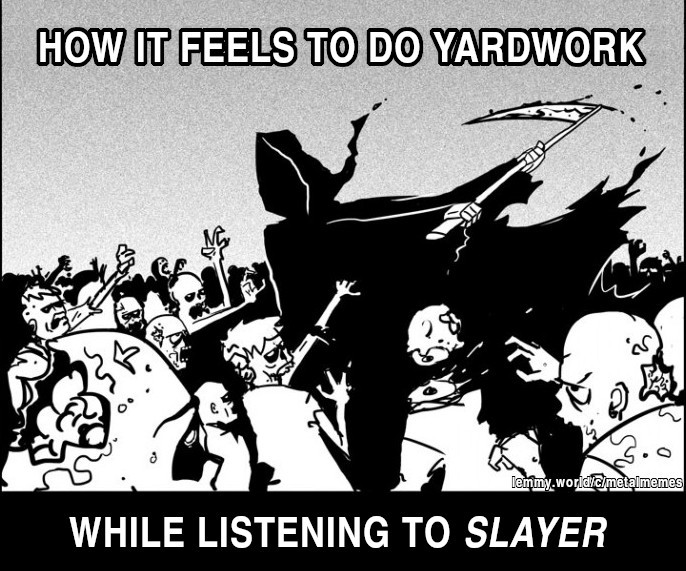
Making of / behind the meme: a couple weeks ago I had to do some yardwork so, being a loyal citizen of !gothindustrial@lemmy.world , I put on some aggrotech (which is basically harsh electro industrial) and I was swinging around my sickle and saying things like “DIE BEFORE THE BLADE OF THE REAPER” and it reminded me of a scene from the comic “MaryDeath” and so I made a meme about it: piefed.social/c/…/mow-em-down-meme Then like a week later I had to do some more yardwork but I wasn’t really feeling like more aggrotech bc it’s kinda machinelike and I wanted something more, idk, fast and metal. So naturally my mind turned to Slayer. So I cued up Reign in Blood, South of Heaven, and Seasons in the Abyss and went for it. Many plants died that day. And thus the meme was born anew.

Making of / behind the meme: a couple weeks ago I had to do some yardwork so, being a loyal citizen of !gothindustrial@lemmy.world , I put on some aggrotech (which is basically harsh electro industrial) and I was swinging around my sickle and saying things like “DIE BEFORE THE BLADE OF THE REAPER” and it reminded me of a scene from the comic “MaryDeath” and so I made a meme about it: piefed.social/c/…/mow-em-down-meme Then like a week later I had to do some more yardwork but I wasn’t really feeling like more aggrotech bc it’s kinda machinelike and I wanted something more, idk, fast and metal. So naturally my mind turned to Slayer. So I cued up Reign in Blood, South of Heaven, and Seasons in the Abyss and went for it. Many plants died that day. And thus the meme was born anew.

0

As Western countries start to crack down on Internet freedoms, the experience of Russians, Chinese, Iranians, Indians will become more valuable

preview

As policies all around the Western world are pushed to curtail the Internet freedoms, more emphasis is made on reaching Internet freedom in an era of surveillance and control.

Some people, particularly those living under authoritarian regimes for a while, have developed strong culture and technology of censorship circumvention.

Russians creatively develop state-of-the-art and heavily battle-tested VPN protocols and routing strategies that are near impossible to restrict. Chinese develop creative trafficking to overcome the Great Firewall. Iranians come up with strong proxying tools and offline communication. Indians are catching up as well.

Considering the current political course, and without giving up on political action, people will need this experience to stay informed and free around the Web and elsewhere. Might be worth it to start taking notes, instead of blindly relying on what worked so far.

Alt text: protesters standing under Russian flag; the protester has a sign with words “Save Internet; Save Russia”. Another protester holds a sign with an index finger and the word “Resist”.

0

Study: Businesses perform better in states that legalize medical marijuana

preview

A new study from the University of Iowa suggests businesses do better in states that legalize medicinal marijuana.

Professor Tong Yao says it’s not likely the result of offices full of potheads helping their employers be more productive. Mr. Yao, a professor of finance, said legalizing medical marijuana instead sends a signal about the state’s culture that attracts creative and productive people to live and work there.

“In addition to providing a host of medical benefits, legalizing marijuana can also give the state a ‘cool image,'” Mr. Yao said, in a Tippie College of Business blog post. “Highly skilled and creative human capital is especially appreciative of open, new, and divergent policies, such as legalized medical marijuana, and that can potentially help states retain and attract more productive and creative workers.”

Mr. Yao said the study looked only at states that legalized marijuana for medical use and not for recreational use.

Mr. Yao is the Keith L. Cook Professor of Finance at the University of Iowa’s Tippie College of Business.

The Study

Mr. Yao looked at the financial results of more than 13,000 publicly traded companies between 2001 and 2022 and found that when states legalized medical marijuana:

  • Corporate valuation increased in 21 of 38 states. * Gross profit per employee and gross sales per employee each increased by more than $8,000.
  • Patents increased by 10.4% across all 38 states, and the economic value of those patents increased by 22%, as states with legalized medical marijuana were more likely to retain existing inventors and attract new inventors from other states who are productive and create more value.

He said party politics seemed to play little role in the results, as the findings applied to states regardless of whether they had a Democrat or Republican governor.

Mr. Yao said that California, the first state to legalize medical marijuana in 1996, had a burst of creativity and business growth in the years that followed. The effect has become weaker over time, however. As more states legalize weed for medical purposes, the benefits are less dramatic.

Mr. Yao’s study, “Do firms get high? The impact of medical marijuana legalization on firm performance and corporate innovation,” was published in the journal Financial Management. His co-authors are Jue Wang, a former Tippie doctoral student now at Nankai University in China, and Shagun Pant of the University of Illinois.

Abstract

“We find that state-level medical marijuana legalization has a positive financial impact on firms, likely by affecting firms’ human capital. Firms headquartered in marijuana-legalizing states receive higher market valuations, improve employee productivity, and increase innovation. Exploiting inventor mobility data, we directly test the human capital channel and find that states legalizing marijuana are able to retain inventors who become more productive and recruit more innovative talents from out of state.”


A new study from the University of Iowa suggests businesses do better in states that legalize medicinal marijuana.

Professor Tong Yao says it’s not likely the result of offices full of potheads helping their employers be more productive. Mr. Yao, a professor of finance, said legalizing medical marijuana instead sends a signal about the state’s culture that attracts creative and productive people to live and work there.

“In addition to providing a host of medical benefits, legalizing marijuana can also give the state a ‘cool image,'” Mr. Yao said, in a Tippie College of Business blog post. “Highly skilled and creative human capital is especially appreciative of open, new, and divergent policies, such as legalized medical marijuana, and that can potentially help states retain and attract more productive and creative workers.”

Mr. Yao said the study looked only at states that legalized marijuana for medical use and not for recreational use.

Mr. Yao is the Keith L. Cook Professor of Finance at the University of Iowa’s Tippie College of Business.

The Study

Mr. Yao looked at the financial results of more than 13,000 publicly traded companies between 2001 and 2022 and found that when states legalized medical marijuana:

  • Corporate valuation increased in 21 of 38 states. * Gross profit per employee and gross sales per employee each increased by more than $8,000.
  • Patents increased by 10.4% across all 38 states, and the economic value of those patents increased by 22%, as states with legalized medical marijuana were more likely to retain existing inventors and attract new inventors from other states who are productive and create more value.

He said party politics seemed to play little role in the results, as the findings applied to states regardless of whether they had a Democrat or Republican governor.

Mr. Yao said that California, the first state to legalize medical marijuana in 1996, had a burst of creativity and business growth in the years that followed. The effect has become weaker over time, however. As more states legalize weed for medical purposes, the benefits are less dramatic.

Mr. Yao’s study, “Do firms get high? The impact of medical marijuana legalization on firm performance and corporate innovation,” was published in the journal Financial Management. His co-authors are Jue Wang, a former Tippie doctoral student now at Nankai University in China, and Shagun Pant of the University of Illinois.

Abstract

“We find that state-level medical marijuana legalization has a positive financial impact on firms, likely by affecting firms’ human capital. Firms headquartered in marijuana-legalizing states receive higher market valuations, improve employee productivity, and increase innovation. Exploiting inventor mobility data, we directly test the human capital channel and find that states legalizing marijuana are able to retain inventors who become more productive and recruit more innovative talents from out of state.”

0

Amazon's Zoox wins first US approval for paid robotaxis without human controls - Reuters [full text inside]

preview

cross-posted from: hexbear.net/post/9167021

Full text

- Zoox’s exemption to rules requiring human controls comes with added reporting requirements - Company allowed to deploy 2,500 vehicles annually for two years - NHTSA aiming for new autonomous vehicle safety standards by end of Trump administration SAN DIEGO, July 30 (Reuters) - Amazon’s, opens new tab Zoox unit won ​U.S. approval on Wednesday for limited commercial deployment of its novel steering-wheel-free robotaxis, a first for the autonomous ride industry, ‌the U.S. auto safety agency said Thursday. The exemption from National Highway Traffic Safety Administration rules requiring human controls, first reported by Reuters, marks a milestone for companies developing robotaxis from the ground up, rather than modifying conventional cars under safety regulations written long before self-driving technology emerged. The Reuters Daily Briefing newsletter provides all the news you need to start your day. Sign up here. Along with Zoox, whose electric carriage-style vehicle has two rows of inward-facing ​seats and a top speed of 75 miles per hour, others such as Tesla , opens new tab and Alphabet’s , opens new tab Waymo are racing to expand autonomous ​ride-hailing services in the United States. NHTSA Administrator Jonathan Morrison told Reuters that Zoox had received clearance to commercially deploy up to 2,500 vehicles in each of the next two years. ADDITIONAL REPORTING REQUIREMENTS The agency said it determined the vehicle is as safe as an ​equivalent vehicle meeting federal motor vehicle safety standards that are being waived. Zoox cannot sell any of the vehicles to the public. “We can say pretty ​clearly that the systems in place on the Zoox exceed the equivalent performance requirements of a compliant vehicle,” he said in an interview. “But we still want to make sure that the automated driving system will operate appropriately.” As part of the exemption, NHTSA is placing additional reporting requirements on Zoox for issues such as crashes or stopping inappropriately on ​roads, and the regulator will adjust the conditions based on how the vehicles behave. “We have the ability to pull the exemption if we see ​major safety issues,” Morrison said. All remote operators must be located in the United States, NHTSA said. Zoox must publish maps of areas indicating where the vehicles are operating. Zoox ‌currently carries passengers in parts of Las Vegas and San Francisco as part of testing. The exemption would allow Zoox to charge them fees, subject to state and local approvals. Morrison said NHTSA expects to develop the first federal safety standards for automated driving systems by the end of the Trump administration. It is also proposing to overhaul some existing rules written with human drivers in mind such as requiring brake pedals and rear-view mirrors. SAFETY CONCERNS Zoox’s approval caps ​its years-long effort to commercialise its robotaxi ​under regulations developed before self-driving technology emerged. Tesla has started producing a Cybercab that lacks human controls, but it has not outlined its path for regulatory approvals. Regulators are trying to change rules to allow more self-driving technology while maintaining safety. This month, Morrison issued a ​strongly worded letter telling autonomous vehicle (AV) developers to “immediately focus” on fixing what NHTSA identified as “a clear pattern ​of driverless AVs interfering with law enforcement and other first responders.” That, along with issues such as robotaxis driving around stopped school buses or into construction zones, freezing on water-flooded roads or busy intersections and breaking traffic laws, has raised public concerns around safety and led to recalls. “If we continue seeing issues, we will not hesitate to use the full ​extent of our enforcement authority,” Morrison said. Following the letter, Zoox recalled its fleet of 105 autonomous ​vehicles to update the software, saying they might not detect heavy smoke, particularly in active emergencies. Morrison will speak on Thursday about some of the agency’s safety efforts at SAE International’s Automated ​Transportation Symposium in San Diego.

cross-posted from: hexbear.net/post/9167021

Full text

- Zoox’s exemption to rules requiring human controls comes with added reporting requirements - Company allowed to deploy 2,500 vehicles annually for two years - NHTSA aiming for new autonomous vehicle safety standards by end of Trump administration SAN DIEGO, July 30 (Reuters) - Amazon’s, opens new tab Zoox unit won ​U.S. approval on Wednesday for limited commercial deployment of its novel steering-wheel-free robotaxis, a first for the autonomous ride industry, ‌the U.S. auto safety agency said Thursday. The exemption from National Highway Traffic Safety Administration rules requiring human controls, first reported by Reuters, marks a milestone for companies developing robotaxis from the ground up, rather than modifying conventional cars under safety regulations written long before self-driving technology emerged. The Reuters Daily Briefing newsletter provides all the news you need to start your day. Sign up here. Along with Zoox, whose electric carriage-style vehicle has two rows of inward-facing ​seats and a top speed of 75 miles per hour, others such as Tesla , opens new tab and Alphabet’s , opens new tab Waymo are racing to expand autonomous ​ride-hailing services in the United States. NHTSA Administrator Jonathan Morrison told Reuters that Zoox had received clearance to commercially deploy up to 2,500 vehicles in each of the next two years. ADDITIONAL REPORTING REQUIREMENTS The agency said it determined the vehicle is as safe as an ​equivalent vehicle meeting federal motor vehicle safety standards that are being waived. Zoox cannot sell any of the vehicles to the public. “We can say pretty ​clearly that the systems in place on the Zoox exceed the equivalent performance requirements of a compliant vehicle,” he said in an interview. “But we still want to make sure that the automated driving system will operate appropriately.” As part of the exemption, NHTSA is placing additional reporting requirements on Zoox for issues such as crashes or stopping inappropriately on ​roads, and the regulator will adjust the conditions based on how the vehicles behave. “We have the ability to pull the exemption if we see ​major safety issues,” Morrison said. All remote operators must be located in the United States, NHTSA said. Zoox must publish maps of areas indicating where the vehicles are operating. Zoox ‌currently carries passengers in parts of Las Vegas and San Francisco as part of testing. The exemption would allow Zoox to charge them fees, subject to state and local approvals. Morrison said NHTSA expects to develop the first federal safety standards for automated driving systems by the end of the Trump administration. It is also proposing to overhaul some existing rules written with human drivers in mind such as requiring brake pedals and rear-view mirrors. SAFETY CONCERNS Zoox’s approval caps ​its years-long effort to commercialise its robotaxi ​under regulations developed before self-driving technology emerged. Tesla has started producing a Cybercab that lacks human controls, but it has not outlined its path for regulatory approvals. Regulators are trying to change rules to allow more self-driving technology while maintaining safety. This month, Morrison issued a ​strongly worded letter telling autonomous vehicle (AV) developers to “immediately focus” on fixing what NHTSA identified as “a clear pattern ​of driverless AVs interfering with law enforcement and other first responders.” That, along with issues such as robotaxis driving around stopped school buses or into construction zones, freezing on water-flooded roads or busy intersections and breaking traffic laws, has raised public concerns around safety and led to recalls. “If we continue seeing issues, we will not hesitate to use the full ​extent of our enforcement authority,” Morrison said. Following the letter, Zoox recalled its fleet of 105 autonomous ​vehicles to update the software, saying they might not detect heavy smoke, particularly in active emergencies. Morrison will speak on Thursday about some of the agency’s safety efforts at SAE International’s Automated ​Transportation Symposium in San Diego.

0

New maps from July 28th

A share-pic showing a small map of rivers and canals in southern vietnam and a "update maps" screenshot, text reads: "new maps from July 28st. press check for updates"
preview

New maps with #OpenStreetMap data from July 28th are out now. Press “check for updates” in the map download screen to see them!

If you’re getting CoMaps via Google Play: Make sure you’re already on release 2026.07.16 that only came out there yesterday!

New maps with #OpenStreetMap data from July 28th are out now. Press “check for updates” in the map download screen to see them!

If you’re getting CoMaps via Google Play: Make sure you’re already on release 2026.07.16 that only came out there yesterday!

0

[WIP] MKAL Chameleonic socks (spoilers)

preview

I started Westknit’s 2026 surprise sock along this week with clue 1 of 4. Images are at the end, so if you’re also making these and don’t want spoilers skip the rest.

I used some yarn I already had. The Drops I was planning on making a different pattern with, but it went well with the Undercover Otter. After just finishing his Delectable Collectible socks and all those color changes, I was relieved to see this pattern only uses 2 colors.

The cast on and all of clue 1 was very interesting. It doesn’t look like a sock yet. I had a lot of fun taking pictures of all the non-sock things it looked like. Maybe clue 2 will move it more in a sock direction.

A SSAL is a new pattern that’s never been released before, and the pattern designer sends you 1/4 of the pattern every week for 4 weeks. No pictures of the completed sock are available until after week 4, so you have no idea what your sock is going to look like when finished.

Pattern: Chameleonic Socks Yarns: Undercover Otter in citadel, Drops Fabel in green turquoise

IMG-2022.jpg

IMG-2026.jpg

IMG-2029.jpg

IMG-2032.jpg

0

Disco Bambino & Nile Rodgers - Dancing Without You feat. Sophie Ellis Bextor (Visualizer) Helix

play · youtube.com
YouTube Disco Bambino & Nile Rodgers - Dancing Without You feat. Sophie Ellis Bextor (Visualizer) Helix www.youtube.com
preview

A new song featuring the British star Sophie Ellis-Bextor.

A new song featuring the British star Sophie Ellis-Bextor.

0

Ron Gilbert ha annunciato Thimbleweed Park 2 per il 2028!

Immagine promozionale pixel-art per il videogioco "Thimbleweed Park 2". In primo piano due personaggi stilizzati in abiti da detective — uno con completo blu, l'altro con completo nero — in piedi davanti a un cartello stradale verde che indica "Thimbleweed Park / CITY LIMIT / ELEVIS". Il titolo principale in caratteri bianchi sgretolati domina la parte superiore. Una grande cifra rossa "2" stilizzata come sangue cola sul lato destro. Sfondo notturno stellato con colline e recinzione in legno. In basso a destra: "Coming in 2028". Stile grafico retrò anni '80/'90 con atmosfera misteriosa e accenni horror.
preview

Ron Gilbert ha annunciato Thimbleweed Park 2 per il 2028!

@videogiochi

Non so quanti di voi ci abbiano giocato, ma Thimbleweed Park è una bellissima avventura grafica uscita qualche anno fa e creata dal mitico Ron Gilbert (Monkey Island, Maniac Mansion e molto altro).

Dal suo blog (grazie @grumpygamer per avere ancora un blog e non lasciare a qualche social proprietario le tue parole! 💜 ) ha annunciato il prossimo arrivo di Thimbleweed Park 2!

https://www.grumpygamer.com/twp2/_announce/

#videogames #videogiochi

0

old.lemmy.today is now behind Anubis for bot protection (edit: not anymore)

preview

Hi guys,

We are now trying out Anubis in front of old.lemmy.today to see if we can block many of the bots scraping lemmy content.

You will notice an image saying Anubis is checking if you are a bot, and then things should work normally after that.

There are many millions of ips trying to scrape lemmy content so blocking on ip level is difficult. Hopefully this improves the situation somewhat. :)

Thanks to @db0@lemmy.dbzer0.com for sharing info about Anubis!

Edit: It was a lot better to just turn off public access of posts on old.lemmy.today, so we are actually not using Anunis anymore. Just log in to old.lemmy.today and things will work as normal.

0

[c/d] DAB radio by Karcher has a Wi-Fi SSID that cannot be disabled.. wtf? Seems shitty for infosec and also likely violates the GDPR.

preview

cross-posted from: infosec.pub/post/50218987

Karcher DAB radios are broadcasting an SSID for open Wi-Fi access. It doubles as an Internet radio, but AFAICT from the manual it’s only expected to act as a client.

So WTF is going on?

It seems like a really bad idea for consumers to connect this radio to their LANs to use to play Internet radio and podcasts when there is an always available Wi-Fi AP that enables anyone in proxity to connect to the radio. What’s the point? There is no way to disable the SSID broadcasting and it remains on even when the radio is “off” (but plugged in).

The manual shows that there is a remote control. Is the remote using wi-fi? I don’t have the remote so I have no way of verifying. In any case, this design seems like a recipe for disaster. Karcher should perhaps just stick to making pressure washers.

Google and Apple use Wi-Fi SSIDs for navigation. I boycott both companies. As such, I prefer not to have any wi-fi APs. And when I decide to run an AP, I ensure the SSID ends in _optout_nomap to opt-out of giving uncompensated help to the nav systems of Apple and Google.

Does this violate the GDPR? I cannot change the SSID, so it’s like I am being forced to share with the general public the fact that there is a Karcher radio in my home. That does not respect data minimisation.

0

Review: ein Gebet für die achtsam Schreitenden von Becky Chambers

preview

Obligatorische Spoilerwarnung

Mir hat das Buch wieder sehr gefallen. Ich würde die beiden Bände zusammen als Teil meiner top 5 Bücher betrachten. Nachdem vieles unverändert ist, habe ich es nicht nochmal aufgegriffen.

Band zwei knüpft relativ direkt an Band 1 an

Helmling “tourt” mit Dex durch verschiedene Dörfer und lernt diverse Menschen kennen, um herauszufinden was die Menschen brauchen. Höhepunkt ist ein Besuch bei Dex Familie.

Helmling ist dabei genauso an den Menschen wie am ihren Gegenständen und den Tieren in den Siedlungen interessiert (es ist ihm beim Besuch des ersten Dorfes enorm wichtig den Hund zu beruhigen, der Helmling gegenüber erst einmal skeptisch ist. So sehr dass er die Menschen um sich herum temporär mehr oder weniger vergisst.)

Dex ist immer noch nicht danach als Teemönchin zu arbeiten. They beschränkt sich darauf Helmling zu begleiten und für diesen (ich finde es etwas merkwürdig dass sie deutsche Version it zu er gewandelt hat, gehe aber für diese Review einfach Mal mit) sozial zu dolmetschen bzw Eisbrecherin zu spielen. Die beiden sind für die Menschheit eine große Sache. Dex mag den Trubel um die beiden nicht wirklich, Helmling saugt einfach alles über menschliche Kultur in sich auf.

Das äußert sich auch darin, dass er in Teilen roboteruntypische Dinge tut. Er hat Besitztümer und sogar! eine Tasche um diese aufzubewahren. Er nimmt am Währungssystem der Menschen teil. Gleichzeitig zieht er Grenzen. Als ein Teil in seinem Torso bricht (er geht davon aus, dass dies ein baldiges Lebensende bedeutet, weil Roboter sich nicht reparieren (können)), soll dieses repariert werden. Er kann sich mit dem ursprünglichen Plan das Plastikteil neu aus einem Bioplastik herzustellen aber nicht anfreunden, erstens weil er nicht mit dem Lebewesen von dem die organische Ausgangsmaterie stammt nicht interagieren kann. Zum anderen weil er eine Sache ist und dies für ihn die Grenze zwischen Roboter und menschlicher Kultur verwischen würde. Die Lösung ist letztendlich sein altes Ölplastikteil einzuschmelzen und daraus ein Ersatzteil herzustellen.

Mit dem Währungssystem kann ich nicht so viel anfangen. Man “erwirbt” Kiesel, indem man Dinge für andere Menschen tut oder ihnen etwas gibt. Wenn man etwas bekommt gibt man dafür Kiesel. Die Übergabe der Kiesel (Digitalwährung, keine echten Steine) ist dabei ein symbolischer Akt, der Wertschätzung ausdrücken soll. Gleichzeitig wird niemandem etwas verwehrt, nur weil diese Person nicht genug Kiesel besitzt. Gleichzeitig ist die Erwartungshaltung zu versuchen mit den eigenen Kieseln im Plus zu sein, also mehr zu geben als man nimmt. Ist eine Person dauerhaft im Minus ist das z.B. ein Anzeichen für befreundete Personen sich nach dem Wohlergehen der Person zu erkundigen. Das knüpft für mich sehr an das “Zweckproblem” von Band 1 an. Klar ist eine Gesellschaft nicht dauerhaft zu erhalten wenn alle weniger geben als sie nehmen. Gleichzeitig wirkt es so als wäre dieser Aspekt etwas sehr stark im Fokus dafür, dass es eigentlich allen, zumindest was die Versorgungslage angeht, gut geht. “Sei frei, gestalte die Welt als Individuum, aber wehe du nimmst mehr als Du gibst!” (Zumal z.B. Dex in der Zeit, in der they andangs im Dorf über Kräuter etc gelernt hat, dick im Minus gewesen sein müsste und es wird nie zum Thema, dass das angesprochen wurde.)

Die Auswirkungen werden auch im Gespräch am Ende des Buches klar. Dex und Helmling haben beide keine Lust in die Stadt zu fahren, weil beide das als Endpunkt der gemeinsamen Reise betrachten und das beide nicht wollen. Sie fahren stattdessen an den Strand. Helmling hat auf seine Fragen nur zwei Arten von Antworten bekommen. Entweder sehr konkrete Einzeldinge (Alla “meine Tür ist kaputt und müsste repariert werden”) oder abstrakte Konzepte die Menschen entweder glauben zu brauchen oder bei denen sie dankbar sind sie zu haben (wie “Abenteuer”). Er hat also auf seine Frage keine universelle, “ausführbare” Antwort gefunden. Noch “schlimmer” ist es dadurch geworden, dass Dex Vater ihn gefragt hat was er braucht, worauf er auch keine Antwort hat. Helmling hat also auf seiner Reise mehr oder weniger gelernt, dass man nicht erschöpfend beantworten kann, was jemand braucht.

Man merkt, dass Dex weiterhin mental health struggles hat. They verschweigt deren Familie warum they in die Wildnis gezogen ist, weil they nicht will, dass diese sich Sorgen machen. They beschreibt es am Ende des Buches selbst gut. Bei jedem Teeservice sagt they anderen Menschen, dass diese nichts machen müssen um genug zu sein (hab die genaue Formulierung nicht mehr im Kopf), für sich selbst bekommt they das aber nicht hin. Auch hier zeigt sich meiner Meinung nach, dass der gesellschaftliche Fokus auf “Nützlichkeit” subtilen aber sehr starken Druck auf seine Mitglieder ausübt (es wäre spannend zu sehen wie eine solche Gemeinschaft reagieren würde, wenn man eine Gruppe heutiger Punks in ihr Dorf teleportiert).

Am Ende finden sowohl Dex als auch Helmling dieselbe “Lösung”/“Antwort” auf ihre Probleme. Beide stellen fest, dass sie sich jeweils in der Gegenwart des anderen und wohl fühlen und dass diese Gemeinschaft ihnen beiden hilft. Es gibt also nicht diese eine Sache die alles gut macht, aber es gibt Dinge die es besser machen. Und für die beiden ist eine dieser Sachen zusammen zu reisen.

(Auch hier wieder das kleine Gedankenexperiment: wenn Helmling aus gesellschaftlicher Sicht “egal” wäre (in Form von man interessiert sich einfach nicht wirklich dafür, dass ein Roboter die menschliche Gesellschaft erforscht), dann wären die Beiden fett im Minus. Wäre die Reise deshalb weniger sinnvoll? Sollte man nur “Fremde” herumführen, wenn ein gesellschaftliches Interesse an diesen besteht?)

Trotz aller Kritik am Kieselsystem und dem Fokus auf Nützlichkeit bin ich weiterhin Fan von diesem Gesellschaftsentwurf. Niemand sagt, dass eine Utopie perfekt sein muss und es nichts mehr geben darf an dem gedreht werden darf. Und in unserer Gesellschaft ist beides ja nochmal deutlich heftiger ausgeprägt (mit im Zweifelsfall landet man im Knast, wenn man zu viele “Kiesel” im Minus ist).

Ich bin ein bisschen traurig, dass es keinen Teil 3 gibt und muss Mal ganz dringend schauen ob es andere Becky Chambers Bücher gibt, die interessant klingen.

So oder so waren diese beiden Bücher eines meiner Highlights unseres Buchclubs (mein Beileid an unser nächstes Buch^^)

Ich freue mich eure Reviews/Meinungen zu lesen :)

0

Powstanie Warszawskie pod czarno-czerwonym sztandarem anarchosyndykalizmu

preview

Czarno-czerwone opaski na powstańczych barykadach. Kim byli warszawscy anarchosyndykaliści?

Powstanie Warszawskie kojarzy się nam dziś głównie z biało-czerwonymi opaskami, rygorem Armii Krajowej i walką o powrót przedwojennego porządku. Mało kto jednak wie, że na barykadach Starówki i Śródmieścia walczyli ludzie, którzy nad polskim orłem przypinali czarno-czerwone rozetki, a zamiast powrotu dawnego rządu żądali oddania fabryk w ręce robotników. Warszawscy anarchosyndykaliści i wolnościowcy zbrojnie udowodnili, że miłość do wolności nie miała wówczas jednego koloru. Oto historia zapomnianych bohaterów 1944 roku, którzy rzucili wyzwanie dwóm totalitaryzmom, walcząc o Polskę bez panów, władców i dyktatorów.

Czarno-czerwony świt na Starówce

Gdy 1 sierpnia 1944 roku wybucha powstanie, do walki ruszają nie tylko oddziały podległe rządowi w Londynie. W strukturach konspiracyjnych od lat działają radykalni wolnościowcy z przedwojennej Anarchistycznej Federacji Polski (AFP) oraz Związku Syndykalistów Polskich (ZSP). Ich cel? Pokonać Niemców, ale nie po to, by przywrócić dawną, przedwrześniową Polskę. Chcą rewolucji społecznej, samorządów pracowniczych i oddolnej demokracji. Najważniejszą siłą bojową syndykalistów staje się 104. Kompania ZSP, sformowana na Starym Mieście. To nie był zwykły oddział. Żołnierze zamiast regulaminowych białoczerwonych barw noszą na rękawach czarno-czerwone opaski – tradycyjny symbol międzynarodowego ruchu anarchosyndykalistycznego. Kompania szybko zyskuje sławę jednej z najwaleczniejszych formacji na Starówce. To oni zdobywają Pałac Krasińskich, a potem przez długie dni krwawo bronią strategicznego gmachu Państwowej Wytwórni Papierów Wartościowych (PWPW). Walczą z fanatyczną odwagą, płacąc za to straszliwą cenę – w toku walk oddział traci ponad połowę swojego stanu osobowego.

Wojna o opaski, czyli konflikt z dowództwem AK

Niezależność syndykalistów szybko zaczyna kłuć w oczy powstańczą żandarmerię AK. Dla wychowanych w wojskowym drylu oficerów, widok uzbrojonych oddziałów z czarno-czerwonymi barwami, które otwarcie mówią o rewolucji i zniesieniu klas społecznych, jest nie do zaakceptowania. Dochodzi do ostrych sporów. Żandarmeria AK żąda kategorycznego zdjęcia czarno-czerwonych opasek i zmiany nazwy oddziału na standardowo-wojskową. Wolnościowcy stawiają jednak twardy opór. Świadomi swojej siły i faktu, że są niezbędni na pierwszej linii frontu, odmawiają wykonania rozkazu. Ostatecznie, dzięki autorytetowi bojowemu, syndykaliści wygrywają ten symboliczny proces – czarno-czerwone barwy zostają na rękawach do ostatniego dnia walk na Starówce.

Śródmieście: Brygada Syndykalistyczna

Podczas gdy Starówka krwawi, w Śródmieściu formuje się kolejna jednostka – Brygada Syndykalistyczna. Jej dowódcą zostaje por. Edward Wołonciej ps. „Czemier”, przedwojenny działacz syndykalistyczny. W jej szeregi wstępują starzy anarchiści, tacy jak Władysław Głuchowski, którzy pamiętają jeszcze przedwojenne walki robotnicze. Brygada formalnie i operacyjnie sprzymierza się z Polską Armią Ludową (PAL), ale zachowuje kompletną autonomię ideową. Dla nich karabin to narzędzie obrony wolności, a nie ślepego wykonywania rozkazów płynących odgórnie z politycznych gabinetów. Ich obecność w Śródmieściu oraz na Powiślu daje schronienie i przestrzeń dla każdego, dla kogo wolność osobista i społeczna były wartościami najwyższymi.

Powstanie to nie tylko karabiny. Anarchizm w praktyce

Dla warszawskich anarchosyndykalistów walka z Niemcami była tylko połową sukcesu. Drugą, równie ważną misją, było codzienne budowanie nowego społeczeństwa – nawet pod gradem bomb. Tam, gdzie państwo przestało istnieć, syndykaliści wprowadzali w życie swoje idee samopomocy i solidarności lokatorskiej. W huku wystrzałów wydają regularne pismo „Syndykalista”, w którym analizują sytuację geopolityczną i kreślą plany wolnej, bezklasowej Polski po wojnie. Organizują życie codzienne cywilów w kamienicach, pomagając im przetrwać w ekstremalnych warunkach. Syndykaliści dzielą się żywnością, organizują darmowe jadłodajnie dla najuboższych mieszkańców zrujnowanej stolicy oraz otwierają autonomiczne punkty pomocy medycznej. Pokazali, że anarchizm to nie chaos, ale doskonała, oddolna organizacja oparta na empatii i wzajemnej pomocy.

Zapomniani przez historię

Po 63 dniach heroicznego oporu Warszawa kapituluje. Ocalali syndykaliści dzielą los reszty powstańców – trafiają do niemieckich stalagów lub wtapiają się w tłum wypędzanej ludności cywilnej. Po 1945 roku, w nowej, komunistycznej rzeczywistości PRL-u, pamięć o nich miała zostać całkowicie wymazana. Dla komunistów wolnościowi syndykaliści byli śmiertelnym zagrożeniem ideologicznym – pokazywali bowiem, że można być radykalnym lewicowcem, a jednocześnie nienawidzić sowieckiego totalitaryzmu i państwowej dyktatury. Przez dekady cenzura dbała o to, by czarno-czerwony epizod Powstania Warszawskiego nigdy nie ujrzał światła dziennego. Dziś, po latach milczenia, historia ta wraca na swoje miejsce. Warszawscy anarchosyndykaliści udowodnili, że w godzinie próby potrafili połączyć bezkompromisową walkę z najeźdźcą z obroną ludzkiej godności, wolności i robotniczej solidarności. Ich czarno-czerwone opaski na trwałe wpisały się w heroiczną historię Warszawy.

0

Your AI chat history is locked in someone else's silo - here's how to get a local copy out

preview

Whatever you’ve built up in ChatGPT/Claude/Gemini/Grok - research, code, drafts - lives on their servers, in their format, searchable only by their weak built-in search. If the account goes away, so does all of it. That bothers me, so I want to share the workflow I use to keep a local copy.

The approach:

  • Export conversations to open formats - Markdown, JSON, plain text not a locked-in format. Markdown drops straight into Obsidian/Logseq; JSON is there if you want to process it yourself.
  • Bulk-export to a ZIP instead of copy-pasting one chat at a time.
  • Keep the archive in a folder you control (or your own cloud), so it’s yours regardless of what the provider does.

Full disclosure so I’m not being sneaky: I build a browser extension (AI Toolbox) that does this, including local full-text search over your own history so you’re not dependent on their search. I’m mentioning it because it’s relevant, not to pitch - the export idea stands on its own, and you can do a lot of it by hand or with other tools too.

How do you all handle AI chat backups? Curious if anyone’s got a fully FOSS pipeline for it.

0

Why French and Dutch ATMs quit dispensing banknotes bigger than €50

preview

cross-posted from: slrpnk.net/post/40908017

Banknote serial numbers are being tracked from ATMs as an unwarranted mass surveillance scheme, which bypasses the GDPR.

At the same time, Dutch and French ATMs have unilaterally nationwide quit dispensing banknotes larger than €50. I’ve heard lots of unconvincing reasons for forced-small denominations. Does anyone have a more convincing theory than the fact that each banknote is a tracking opportunity?

0

The Sinking City 2 - Extended Gameplay (Meat for the Grindmaws) | PS5 Games

play · youtube.com
YouTube The Sinking City 2 - Extended Gameplay (Meat for the Grindmaws) | PS5 Games www.youtube.com
preview

Explore the flooded city of Arkham in this Lovecraftian survival horror as you search for a way to undo the effects of a dreaming ritual gone wrong that has left your soulmate trapped between our world and a world of unfathomable monsters.

Experience a heart-pounding survival horror as you explore the festering city of Arkham and fight eldritch monsters beyond human comprehension.