preview
| Team |
Total |
 CBJ |
4 |
 PHI |
3 |
| Team |
Shots |
Hits |
Blocked |
FO Wins |
Giveaways |
Takeaways |
Power Plays |
| CBJ |
15 |
18 |
19 |
56.0% |
13 |
5 |
0/1 |
| PHI |
31 |
15 |
12 |
44.0% |
15 |
1 |
0/2 |
| Period |
Time |
Team |
Strength |
Description |
| OT |
02:22 |
CBJ |
Even Strength |
Kent Johnson (6) snap shot, assists: Adam Fantilli (2), Zach Werenski (8) |
| 3rd |
19:49 |
PHI |
Even Strength |
Jamie Drysdale (1) deflected shot, assists: Tyson Foerster (1), Trevor Zegras (8) |
| 3rd |
15:04 |
PHI |
Even Strength |
Trevor Zegras (4) wrist shot, assists: Christian Dvorak (3), Travis Sanheim (4) |
| 2nd |
09:59 |
PHI |
Even Strength |
Noah Cates (1) poke shot, assists: Porter Martone (3), Oliver Bonk (5) |
| 1st |
13:44 |
CBJ |
Even Strength |
Denton Mateychuk (3) snap shot, assists: Mathieu Olivier (1), Matthew Knies (3) |
| 1st |
12:54 |
CBJ |
Even Strength |
Kent Johnson (5) deflected shot, assists: Zach Werenski (7), Valeri Nichushkin (5) |
| 1st |
10:58 |
CBJ |
Even Strength |
Adam Fantilli (4) wrist shot, assists: Kent Johnson (4), Jake Christiansen (1) |
| Period |
Time |
Team |
Type |
Min |
Description |
| 3rd |
10:56 |
CBJ |
Minor |
2 |
Jake Christiansen interference against Trevor Zegras |
| 1st |
19:06 |
PHI |
Minor |
2 |
Christian Dvorak holding against Charlie Coyle |
| 1st |
14:03 |
CBJ |
Minor |
2 |
Sean Monahan hooking against Hunter McDonald |
| 1st |
09:03 |
CBJ |
Minor |
2 |
Conor Garland roughing against Matvei Michkov |
| 1st |
09:03 |
PHI |
Minor |
2 |
Matvei Michkov roughing against Conor Garland |
Start Times
| PT |
MT |
CT |
ET |
AT |
| 04:00PM |
05:00PM |
06:00PM |
07:00PM |
08:00PM |
I am open source! Report issues and contribute on my GitHub page!
| Team |
Total |
| CBJ |
4 |
| PHI |
3 |
| Team |
Shots |
Hits |
Blocked |
FO Wins |
Giveaways |
Takeaways |
Power Plays |
| CBJ |
15 |
18 |
19 |
56.0% |
13 |
5 |
0/1 |
| PHI |
31 |
15 |
12 |
44.0% |
15 |
1 |
0/2 |
| Period |
Time |
Team |
Strength |
Description |
| OT |
02:22 |
CBJ |
Even Strength |
Kent Johnson (6) snap shot, assists: Adam Fantilli (2), Zach Werenski (8) |
| 3rd |
19:49 |
PHI |
Even Strength |
Jamie Drysdale (1) deflected shot, assists: Tyson Foerster (1), Trevor Zegras (8) |
| 3rd |
15:04 |
PHI |
Even Strength |
Trevor Zegras (4) wrist shot, assists: Christian Dvorak (3), Travis Sanheim (4) |
| 2nd |
09:59 |
PHI |
Even Strength |
Noah Cates (1) poke shot, assists: Porter Martone (3), Oliver Bonk (5) |
| 1st |
13:44 |
CBJ |
Even Strength |
Denton Mateychuk (3) snap shot, assists: Mathieu Olivier (1), Matthew Knies (3) |
| 1st |
12:54 |
CBJ |
Even Strength |
Kent Johnson (5) deflected shot, assists: Zach Werenski (7), Valeri Nichushkin (5) |
| 1st |
10:58 |
CBJ |
Even Strength |
Adam Fantilli (4) wrist shot, assists: Kent Johnson (4), Jake Christiansen (1) |
| Period |
Time |
Team |
Type |
Min |
Description |
| 3rd |
10:56 |
CBJ |
Minor |
2 |
Jake Christiansen interference against Trevor Zegras |
| 1st |
19:06 |
PHI |
Minor |
2 |
Christian Dvorak holding against Charlie Coyle |
| 1st |
14:03 |
CBJ |
Minor |
2 |
Sean Monahan hooking against Hunter McDonald |
| 1st |
09:03 |
CBJ |
Minor |
2 |
Conor Garland roughing against Matvei Michkov |
| 1st |
09:03 |
PHI |
Minor |
2 |
Matvei Michkov roughing against Conor Garland |
Start Times
| PT |
MT |
CT |
ET |
AT |
| 04:00PM |
05:00PM |
06:00PM |
07:00PM |
08:00PM |
I am open source! Report issues and contribute on my GitHub page!
preview
As a longtime University of Utah football fan, I have to say I’m disappointed in the way some students chose to mock Pat McAfee.
They should have mocked him WAY harder than that.
#utah #football #cfb @cfb
As a longtime University of Utah football fan, I have to say I’m disappointed in the way some students chose to mock Pat McAfee.
They should have mocked him WAY harder than that.
#utah #football #cfb @cfb
preview
preview
We just need a ship to get stuck in the Suez and it’ll be the collapse of civilization.
We just need a ship to get stuck in the Suez and it’ll be the collapse of civilization.
preview
Social virtual reality often relies on visual avatar behaviors such as head orientation, spatial arrangement, and turn-taking cues, creating barriers for blind and low vision users in small-group interaction. This project explores private non-visual addressivity cues that help BLV users perceive when attention is directed toward them without publicly marking assistance needs. Through formative co-design with BLV participants and VR designers, we identified breakdowns around speaker attention, turn readiness, and being acknowledged. We then implemented orientation-based cues delivered through either haptic feedback or spatial audio and evaluated them in an exploratory within-subject study with 11 BLV participants. Both cue conditions improved perceived access to conversational attention relative to baseline. Audio cues appeared useful for conversational flow and synchrony, while haptic cues more consistently supported perceived inclusion and social presence. These findings suggest that accessible social VR should treat modality, privacy, density, and user control as core design dimensions.
…
Recent accessibility work has begun to examine how BLV users perceive other people in social VR. VRBubble focuses on proxemic awareness by using audio to convey nearby avatars and their movement [7]. Sighted guidance systems support navigation and contextual interpretation through assistance from another person, while raising questions about agency and scalability [4]. Jung et al. translate several nonverbal behaviors, including eye contact, head nodding, and head shaking, into audio and haptic representations [8]. SocialCueSwitch further emphasizes user-configurable mappings of social cues across sensory modalities [12]. These systems do not necessarily make assistance publicly visible, and we do not characterize them as public cueing systems.
Our distinction instead concerns their primary design focus. Prior work has largely examined proximity awareness, general translation of nonverbal behavior, human guidance, or cross-modal configurability. We examine the narrower interactional problem of privately informing a BLV user that attention is being directed specifically toward them during mixed-ability group conversation. Privacy in this study therefore refers not only to the sensory channel used, but also to reducing reliance on explicit verbal nomination, visible intervention, or assistance initiated by sighted participants.
This project examines private non-visual addressivity cues as one way to support social coordination, addressivity, and participation in mixed-ability social VR conversation. We use private to describe cues that are delivered to the BLV user without requiring other participants to verbally nominate them, explicitly provide assistance, or make the cue visible as a special accommodation in the group interaction. In social settings, such design choices matter because cues can also shape how attention, disability, assistance, and participation are disclosed or noticed by others [9]. Accessibility research likewise emphasizes designing around users’ abilities and preferences rather than forcing users to adapt to a single interaction model [13]. We therefore focus on orientation-based cues that preserve the social function of addressivity, turn readiness, and being noticed in a way that can be perceived non-visually [10].
Whatever you feel about VR I think there is something beautiful about this!
preview
I’m deprived of solarpunk memes since slrpnk.net is down, so I’m posting here instead. I’m so hyped thinking about all the growth that’s happening underground with the new plants! Rainy season is always so cool in Southern California, and being here for a big El Niño is exciting (since I’m not in a flood plain or landslide area!), I can’t wait for things to get lush!
I’m deprived of solarpunk memes since slrpnk.net is down, so I’m posting here instead. I’m so hyped thinking about all the growth that’s happening underground with the new plants! Rainy season is always so cool in Southern California, and being here for a big El Niño is exciting (since I’m not in a flood plain or landslide area!), I can’t wait for things to get lush!
preview
Dalla visione alla tecnologia: il contributo di newcleo al nucleare di quarta generazione - da Associazione Italiana Nucleare
https://www.youtube.com/watch?v=BguCHhbZvbw
@energia
Dalla visione alla tecnologia: il contributo di newcleo al nucleare di quarta generazione - da Associazione Italiana Nucleare
https://www.youtube.com/watch?v=BguCHhbZvbw
@energia
preview
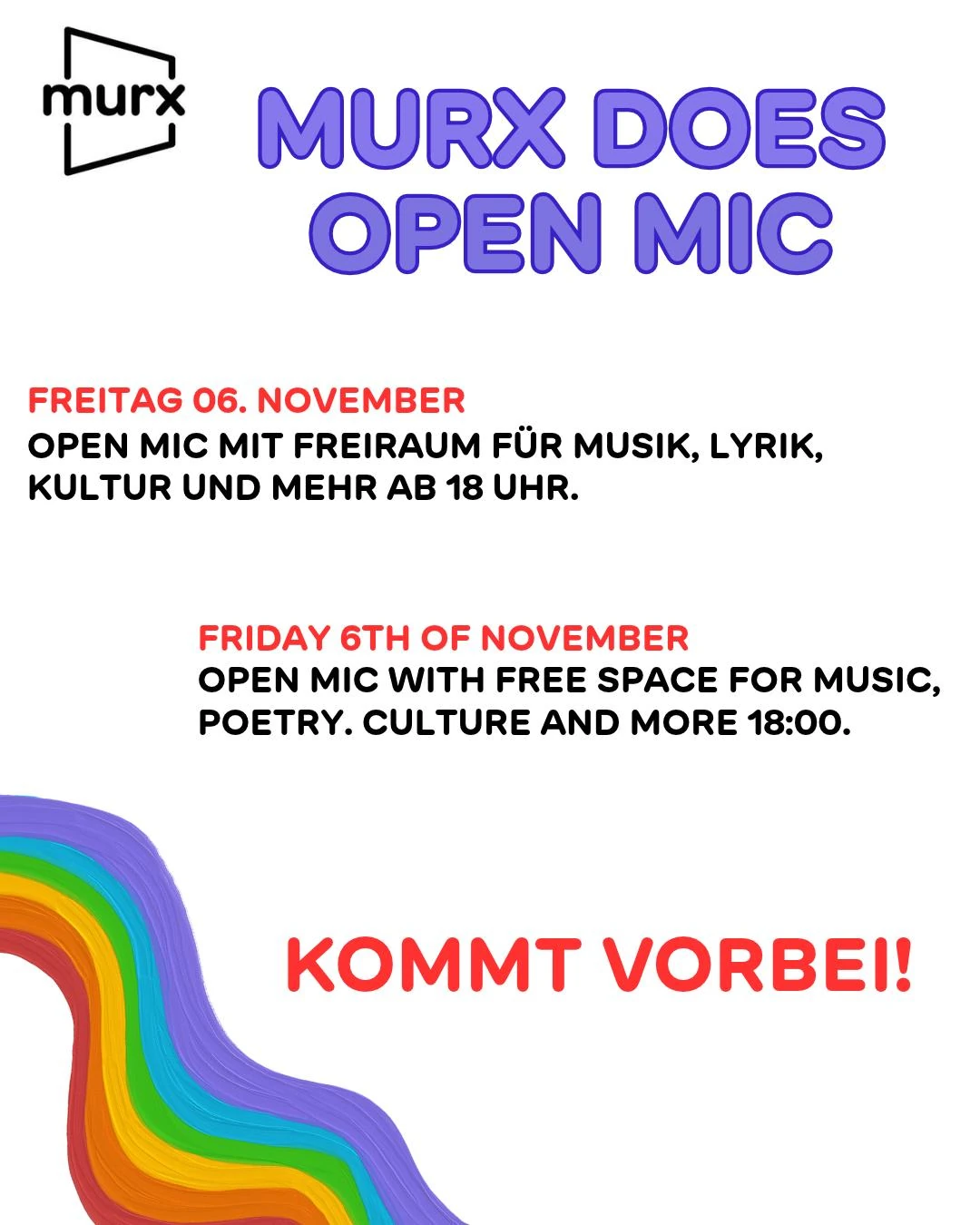
Murx does Open Mic
Am 06.11. um *18 Uhr** ist es wieder soweit: Murx does Open Mic, zum zweiten Mal.
Wie beim letzten Mal dürft ihr wieder eure Kunst, Musik, Poetry, Schauspiel oder euer Was-auch-Immer zum besten geben… dieses mal vielleicht etwas strukturierter als beim letzten Mal.
🗓️ Wann/When: 07. November 2026, 18:00
📍 Wo/Where: Murx, Oberbadgasse 6, 69117 Heidelberg
🚆 ÖPNV/Public transport: Rathaus/Bergbahn, Heidelberg oder Alte Brücke, Heidelberg
♿ Barrierefreiheit/Accessibility: Weitgehend barrierearm für Menschen im Rollstuhl/Largely accessible for people in wheelchairs
#Murx #OpenMic #Freiraum #Openspace #Freiraum #Musik #Lyrik #Kunst #Kultur #Heidelberg #Altstadt @heidelberg
preview
A horn- or bell-shaped device that plays it would also be acceptable.
A horn- or bell-shaped device that plays it would also be acceptable.

preview
First, thanks for the community, it was really needed after the slop hell that was the Steam Next Fest.
I have a lot of weird games but if I posted them all I would get kicked out for too much self-promotion, so I decided to show the one that’s more fun to play, and free: Sayonara Sigil Sentry.
This game is a bullet hell boss rush with a twist: instead of shooting, you have to draw a magic rune by marking points on the battle arena:

You know that moment on bullet hell games in which you find a sweet spot you can camp on safely and mash the “shoot” button? That doesn’t happen in S3. You will have to be moving constantly and planning ahead to get the rune right.

The insanity doesn’t end at the gameplay. Screw high-end Unreal Engine graphics, we have collage art made from free stock images. The game also has a bizarre lore mashing up Costa Rican and Galician folklore with eldritch horror, conspiracies… and a subtle, elegant critique of genAI itself…
Ok, maybe it’s not that subtle.
Who the hell am I kidding, this is straight up Luddite Midwest Angelica.
Available for free on Steam and Itch.
First, thanks for the community, it was really needed after the slop hell that was the Steam Next Fest.
I have a lot of weird games but if I posted them all I would get kicked out for too much self-promotion, so I decided to show the one that’s more fun to play, and free: Sayonara Sigil Sentry.
This game is a bullet hell boss rush with a twist: instead of shooting, you have to draw a magic rune by marking points on the battle arena:
You know that moment on bullet hell games in which you find a sweet spot you can camp on safely and mash the “shoot” button? That doesn’t happen in S3. You will have to be moving constantly and planning ahead to get the rune right.
The insanity doesn’t end at the gameplay. Screw high-end Unreal Engine graphics, we have collage art made from free stock images. The game also has a bizarre lore mashing up Costa Rican and Galician folklore with eldritch horror, conspiracies… and a subtle, elegant critique of genAI itself…
Ok, maybe it’s not that subtle.
Who the hell am I kidding, this is straight up Luddite Midwest Angelica.
Available for free on Steam and Itch.
preview
It’s not my software, and I didn’t see anything against this on the rules… they’re “SanDisk Rescue Pro Deluxe” 1-yr codes off SD card packaging.
- All keys were legitimately purchased
- We won’t use them, they’re trashed at work (packaging)
- there’s no other “giveaway” type community with a big outreach so I thought I’d try my luck here.
I’ve seen this done on Reddit, but I was banned, so… Y’all can benefit.