0

RetroLemmy forum. Powered by lemmybb

preview

cross-posted from: retrolemmy.com/post/41739779

cross-posted from: retrolemmy.com/post/41731951

Hi,

A little while back we introduced old.retrolemmy.com. This is not really interesting on its own, but I wondered if we could also get it running on Retrofed. And this was successful by way of a proxy. The cool side effect the proxy had is that lemmy-only apps now also work if you enter old.retrofed.com in your preferred app.

This made the idea of preservation come up, and @Die4Ever@retrolemmy.com wondered if the proxy could be modified to also work on lemmybb and translate to older API versions. And after a while I got forum.retrolemmy.com to work with lemmybb - an old software for lemmy last updated 3 years ago - that makes the fediverse look and work like an old phpbb forum of older days. Most functions are working and functioning as intended, but there can still be some bugs here and there. Some we could probably fix, but some can also be attributed to the older software and it’s quirks.

If you notice any bugs, you can message me, or reply here.

Also, this project got pretty big, but if you want to use it yourself, its at Github. It has full 0.17, limited 0.18 and full 0.19 support for the frontend, and lemmy(current) or piefed for the backend.

This thread is posted via forum.retrolemmy.com

Edit: Known limitations:

  • No 2fa. As this was only added in lemmy version 0.18.x
  • No last reply date/time. This can be enabled, but will call a ton of API calls for every page load, making the site unusable.

If you want to better interact with people that are using LemmyBB, remember to occasionally sort your front page by “New Comments” (in PieFed it’s just called “Active”). Otherwise the BB users might start bumping threads without other people knowing :(

cross-posted from: retrolemmy.com/post/41739779

cross-posted from: retrolemmy.com/post/41731951

Hi,

A little while back we introduced old.retrolemmy.com. This is not really interesting on its own, but I wondered if we could also get it running on Retrofed. And this was successful by way of a proxy. The cool side effect the proxy had is that lemmy-only apps now also work if you enter old.retrofed.com in your preferred app.

This made the idea of preservation come up, and @Die4Ever@retrolemmy.com wondered if the proxy could be modified to also work on lemmybb and translate to older API versions. And after a while I got forum.retrolemmy.com to work with lemmybb - an old software for lemmy last updated 3 years ago - that makes the fediverse look and work like an old phpbb forum of older days. Most functions are working and functioning as intended, but there can still be some bugs here and there. Some we could probably fix, but some can also be attributed to the older software and it’s quirks.

If you notice any bugs, you can message me, or reply here.

Also, this project got pretty big, but if you want to use it yourself, its at Github. It has full 0.17, limited 0.18 and full 0.19 support for the frontend, and lemmy(current) or piefed for the backend.

This thread is posted via forum.retrolemmy.com

Edit: Known limitations:

  • No 2fa. As this was only added in lemmy version 0.18.x
  • No last reply date/time. This can be enabled, but will call a ton of API calls for every page load, making the site unusable.

If you want to better interact with people that are using LemmyBB, remember to occasionally sort your front page by “New Comments” (in PieFed it’s just called “Active”). Otherwise the BB users might start bumping threads without other people knowing :(

0

Anyone recognize this caterpillar? (Solved)

preview

This little guy was crawling across a pedestrian bridge. The front had what looked like a shield-shaped cover over it in the same color as the body, and it has a light blue spike on its rear.

This little guy was crawling across a pedestrian bridge. The front had what looked like a shield-shaped cover over it in the same color as the body, and it has a light blue spike on its rear.

0

I’m Begging You: Never Write With A.I.

Opinion | I’m Begging You: Never Write With A.I. www.nytimes.com
preview

duckduckgo.com/?ia=web&origin=funnel_home_website…

The problem with writing with A.I. is that it’s mentally enfeebling — an escalator toward a result when you really need to make a daily habit of taking the stairs. As it becomes ubiquitous, it undermines not only our individual ability to write but also a society’s collective ability to reason, a culture’s inner capacity to create and everyone’s reason to care. We’re already reckoning with the well-documented decline of reading; A.I. is accelerating the decline of writing, ushering us further into what The Atlantic’s Rose Horowitch calls our “postliterate age.”

What, uniquely, does writing do? It compels thought. It compels thinking in ways that silent contemplation or spoken language rarely can. It compels us to subject our thinking to the effort of articulation, the rigor of grammar, the tests of intelligibility and coherence, the inspection of others. In doing so, it also enjoins us to be clear, logical, accurate — and accountable. People may easily forgive a word said in anger but not so easily one written in anger, precisely because the fact that it was written tells us that it was considered.

The considered word matters. It has staying power and moral weight. We use the expression “I want that in writing” not only so there’s no mistaking the exact words that have been agreed upon but also as proof that the words are meaningful in the first place.

But what happens when the words aren’t considered because they were written by (or with the help of) a machine?

Words become hollow. Imagine the father of the bride turning to A.I. to help him write his daughter’s wedding toast: What the A.I. can supply in eloquence it subtracts in effort and authenticity. Now imagine that the daughter learns that the speech was written by A.I.: Wouldn’t she be right to be disappointed, if not insulted?

The link between broad-based literacy and the rise of democracy is well known: People who can read and write for themselves have, historically, also been good at choosing and advocating for themselves. What happens when the process goes into reverse? When people lack the patience to absorb arguments more than a few pages or sentences long? When they lack the ability to contradict those arguments because they’ve never honed, through daily practice, the most essential skill for clear thinking?

The next time you’re tempted to just adopt an automated response for a text message or an email, don’t. Type out a response that’s your own. Think of it as an act of free will. Or a vote against Trump. What takes you a few additional seconds is an act of resistance against an ever-dumber world.

0

Why my Steam games use 80% of my gpu?

preview

I have Arch linux with kde plasma. Now the problem is, i play Ark survival ascended, and its wery demanding game. But for some reason only 80% of my gpu is used. In cs go 2 its also using 80% of my gpu in game but thats fine because it gives me 300+ fps so i dont complain about not using my gpu to the max. But in menus and settings of cs go it ramps up to 99% usage, while in ark it stays to 80% even in menus before game starts. Pc specs: Radeon rx 6800xt Ryzen 9 5950x Ddr4 64GB 3200MHz Ssd 2TB PS Corsair 1000W

I have Arch linux with kde plasma. Now the problem is, i play Ark survival ascended, and its wery demanding game. But for some reason only 80% of my gpu is used. In cs go 2 its also using 80% of my gpu in game but thats fine because it gives me 300+ fps so i dont complain about not using my gpu to the max. But in menus and settings of cs go it ramps up to 99% usage, while in ark it stays to 80% even in menus before game starts. Pc specs: Radeon rx 6800xt Ryzen 9 5950x Ddr4 64GB 3200MHz Ssd 2TB PS Corsair 1000W

0

I built a tiny browser MMO and could use a few patient humans to playtest it

preview

Hey! I’m Fortisq, the solo developer of Bitiverse.

It’s a small, free, persistent browser MMORPG that has somehow grown far beyond my original sensible plans. You can fight monsters, gather resources, craft equipment, trade, join guilds, build a permanent homestead and eventually excavate a personal dungeon beneath your house.

The game is fully playable, but I know it’s rough in places. Some systems are surprisingly deep; other parts may be held together by one pixel and a nervous goblin.

I’m not going to promise that Bitiverse will become your new forever MMO. I’d just love a few patient players to wander in, try it honestly and tell me where they become confused, bored, stuck or unexpectedly entertained.

There’s no download or mandatory account wall. Press Play, make a guest character and only create an account later if you decide the little fellow is worth keeping.

fortisq.itch.io/bitiverse

If you try it, even ten honest minutes and one useful observation would mean a lot. If you build a house, tell me where, I enjoy watching actual neighborhoods appear in this ridiculous little world.

0

OSM Skeleton: Addressing the Heterogeneity of Fundamental OpenStreetMap Objects to Build Consolidated Geographic Reference Data - Les Libres Geographes

preview

From the WeeklyOSM article:

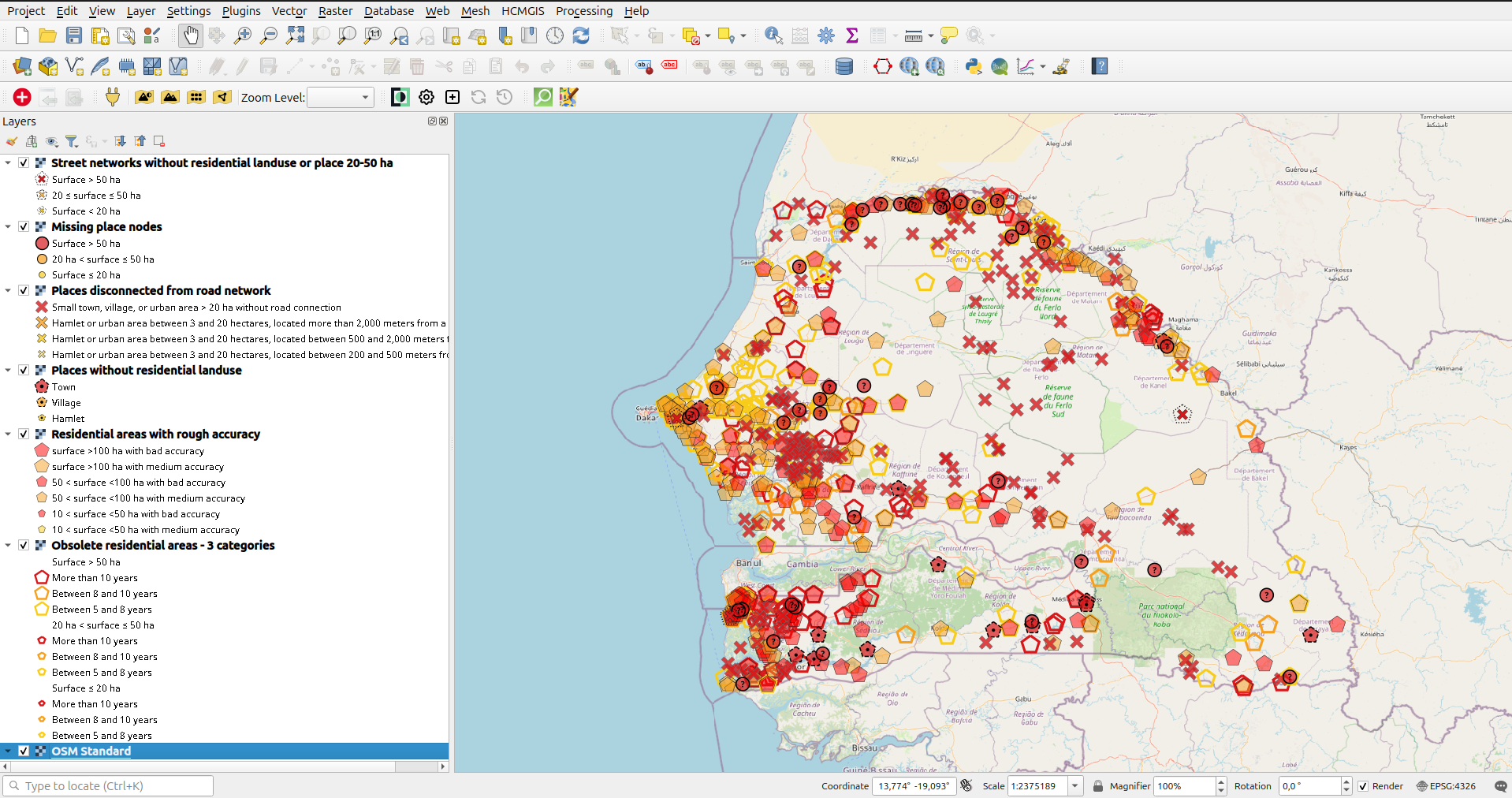
Les Libres Géographes has shared a methodology called OSM Skeleton, which aims to reduce the heterogeneity of OpenStreetMap data to create a coherent and locally maintainable common dataset of geographic references. The approach systematically identifies, on a national scale, missing, incomplete, inaccurate, or obsolete features among those considered fundamental: place nodes, road network, and residential areas. It uses a hybrid feature called ‘urban areas’ for analytical purposes. In particular, it generates WMS layers of alerts, instruction pages for easily correcting them in JOSM or iD, tracking statistics, and also a score for the density of POIs in towns. Séverin Ménard will present it at the upcoming SotM in Paris.

From the main article:

OpenStreetMap (OSM) relies on a wide variety of contributions in terms of mapped themes, areas covered, and levels of completeness. This flexibility is the key to its richness and success. However, it also results in a high degree of data heterogeneity, a point often cited by its critics or those who seek to downplay its value. OSM combines areas that are extremely detailed, sometimes even down to multiple floors of a single building, with others where essential information is completely missing.

This heterogeneity applies equally to data extracted from aerial imagery and to data collected on the ground. Thus, the mere presence of a categorized settlement or the road connecting it to the rest of the road network is still missing in many areas, particularly in the Global South, where the number of OSM contributors is smaller.

0

OSM Skeleton: Addressing the Heterogeneity of Fundamental OpenStreetMap Objects to Build Consolidated Geographic Reference Data - Les Libres Geographes

Les Libres Geographes OSM Skeleton: Addressing the Heterogeneity of Fundamental OpenStreetMap Objects to Build Consolidated Geographic Reference Data - Les Libres Geographes leslibresgeographes.org
preview

From the WeeklyOSM article:

Les Libres Géographes has shared a methodology called OSM Skeleton, which aims to reduce the heterogeneity of OpenStreetMap data to create a coherent and locally maintainable common dataset of geographic references. The approach systematically identifies, on a national scale, missing, incomplete, inaccurate, or obsolete features among those considered fundamental: place nodes, road network, and residential areas. It uses a hybrid feature called ‘urban areas’ for analytical purposes. In particular, it generates WMS layers of alerts, instruction pages for easily correcting them in JOSM or iD, tracking statistics, and also a score for the density of POIs in towns. Séverin Ménard will present it at the upcoming SotM in Paris.

From the main article:

OpenStreetMap (OSM) relies on a wide variety of contributions in terms of mapped themes, areas covered, and levels of completeness. This flexibility is the key to its richness and success. However, it also results in a high degree of data heterogeneity, a point often cited by its critics or those who seek to downplay its value. OSM combines areas that are extremely detailed, sometimes even down to multiple floors of a single building, with others where essential information is completely missing.

This heterogeneity applies equally to data extracted from aerial imagery and to data collected on the ground. Thus, the mere presence of a categorized settlement or the road connecting it to the rest of the road network is still missing in many areas, particularly in the Global South, where the number of OSM contributors is smaller.

From the WeeklyOSM article:

Les Libres Géographes has shared a methodology called OSM Skeleton, which aims to reduce the heterogeneity of OpenStreetMap data to create a coherent and locally maintainable common dataset of geographic references. The approach systematically identifies, on a national scale, missing, incomplete, inaccurate, or obsolete features among those considered fundamental: place nodes, road network, and residential areas. It uses a hybrid feature called ‘urban areas’ for analytical purposes. In particular, it generates WMS layers of alerts, instruction pages for easily correcting them in JOSM or iD, tracking statistics, and also a score for the density of POIs in towns. Séverin Ménard will present it at the upcoming SotM in Paris.

From the main article:

OpenStreetMap (OSM) relies on a wide variety of contributions in terms of mapped themes, areas covered, and levels of completeness. This flexibility is the key to its richness and success. However, it also results in a high degree of data heterogeneity, a point often cited by its critics or those who seek to downplay its value. OSM combines areas that are extremely detailed, sometimes even down to multiple floors of a single building, with others where essential information is completely missing.

This heterogeneity applies equally to data extracted from aerial imagery and to data collected on the ground. Thus, the mere presence of a categorized settlement or the road connecting it to the rest of the road network is still missing in many areas, particularly in the Global South, where the number of OSM contributors is smaller.

0

A poem by Ziggy Ramo: ‘A Welcome to Country was booed on Anzac Day. The disrespect was blunt’

the Guardian A poem by Ziggy Ramo: ‘A Welcome to Country was booed on Anzac Day. The disrespect was blunt’ www.theguardian.com
preview

Each week during Australian Poetry Month, a poet walks us through one of their works. Here, rapper Ramo shares one about ‘being invited in and rejected at the same time’

Each week during Australian Poetry Month, a poet walks us through one of their works. Here, rapper Ramo shares one about ‘being invited in and rejected at the same time’

0

Ethnic Minorities and People of Color Bi-Weekly Thread for the 9th of August 2026

preview

The Treaty of Fort Jackson (also known as the Treaty with the Creeks) was signed on this day in 1814 at Fort Jackson in Alabama. The treaty was agreed upon in the aftermath of the defeat of Red Stick (Upper Creek) resistance by U.S. forces at the Battle of Horseshoe Bend.

The treaty was the “largest single Indian cession of southern American land”, according to historian Michael Rogin - around 23 million acres in Alabama and Georgia. The U.S. forces won with the battle with the help of allied Cherokee and Lower Creek forces friendly to the American side.

The terms of various treaties with the Creek nation would go on to be consistently violated by Americans colonizing the south.

I hope you nerds have a good month of August cuddle

Remember no crackers

anti-cracker-aktionqin-shi-huangdi-fireball

0

Sometimes cleaning chemicals are called by one name even if they have different formulas and that can lead to hazards

preview

There was an Ask Lemmy post about descaler and it reminded me of an experience from my own household adventures.

I use both Iron Out and Barkeepers Friend at home to deal with my foundation drains. Both products have different formulas with different mechanisms and they are not compatible. I’m thankful I am so paranoid or else I might not have realized and potentially created a harmful situation in my basement (a particularly bad place for the heavy gas that forms!).

Iron Out

Liquid forms are called Super Iron Out and Super Iron Out Outdoors.

Both have oxalic acid as the active ingredients although the SDS for Super Iron Out says Oxalic acid and the Iron Out Outdoors says Ethanedioic acid, dihydrate.

Both Oxalic acid and Ethanedioic acid, dihydrate are powders, not solutions. On the surface this probably seems extremely autistic of me and it is, but it’s also really important.

Let’s look at the CAS number given on the SDS. Oxalic Acid is given CAS 144-62-7 Ethanedioic acid, dihydrate is given 6153-56-6. Ethanedioic acid is another name for Oxalic acid and the reason for the different CAS number is the “dihydrate”. This distinction only matters in solid form. If it’s in a solution it’s the same damn thing (except for the fact that it ionizes into two forms and the relative abundance of each depends on pH). Therefore it is needlessly confusing and wrong and I hate that lol. That’s not the point of the post but I needed to get that out.

The solid form of Iron Out is a mixture of different compounds, none of which are any powdered version of Oxalic acid.

It contains Sodium hydrosulfite, Sodium metabisulfite, Sodium sulfite, Sodium Carbonate and Citric acid. It’s super tempting to break these out into what they do but they can perform multiple roles and that will come up later.

Barkeeper’s Friend

Barkeepers Friend also has solid and liquid versions.

The solid version is called Cleaner and Polish or Cookware.

The active ingredients are Oxalic Acid (CAS #144-62-7), a surfactant and an abrasive. The difference in the two formulas are the surfactant and abrasive, but neither of these are involved in why the two formulas are not compatible so I’ll gloss over that.

The liquid versions are called Soft or Multipurpose.

They still use oxalic acid as the main ingredient but again different quantities (or no) abrasives and different surfactants.

What’s your point?

You should not mix Oxalic acid and sulfites. Sulfides can react with acids (even weak ones) and form hydrogen sulfide gas. I have more experience with SO2 than I want and I can give you my professional option that it fucking sucks.

So if you are not careful and assume Iron Out and Barkeepers friend are interchangable you may have a bad time. Or, if you are using them for different purposes (powder iron out to remove iron deposits and oxalic acid to control biofilm growth) you may also have a bad time.

Don’t they do the same thing? Why are they not compatible?

Kinda but not really.

Rust is stupid complicated actually. It’s often simplified as Iron(III) Oxide but that’s absolutely not the whole story even though it sounds super technical. It’s useful because if the three oxidation states of iron this is the one that flakes off most easily.

There are probably multiple reasons but intended use of both products is likely why the formulas are different.

Barkeepers friend is primarily used on metal surfaces which might have corrosion and to remove the resultant rust. The reaction between oxalic acid and rust isn’t one step and it isn’t simple because both the iron oxide and the oxalic acid exist in different states in solution, largely dependent on pH.

I think the easiest way to explain is to contrast with Muriatic acid (HCl). HCl is a strong acid (It’s got an estimated pKa of -5.9) and will brute force the insoluble iron oxide apart and form a soluble Iron chloride. The iron oxide is acting as the base in the acid-base reaction. If the acid then goes on to contact more iron in the metal it will oxidize it so that the formation of oxides will occur more readily. So it can remove rust and encourage new rust. Neat.

Oxalic acid is a weak acid. The two forms have pKa of 1.2 and 4.2. Oxalic acid is not doing an acid-base reaction with the oxides. It reacts with Iron(III) oxides to form a soluble complex. This is called chelation. It’s more complicated than that of course but what is important to remember is that it is reductive not oxidative. It’s not absolutely safe for stainless steel but it’s way less aggressive than Muriatic acid.

Iron Out on the other hand is more focused on removing iron deposits on non metallic surfaces. The combo of sodium hydrosulfite and sodium metabisulfite was patented by Hach as a rust remover from non metallic surfaces. They are stable powders that when made into solution form soluble iron sulfite from iron oxide via reduction.

Citric acid and sodium carbonate also work together. Sodium carbonate raises the pH of the solution so the citrates can still do chelation without the level of attacks on metal metal what would occur at lower pH.

Sodium sulfite is probably there as an oxygen scavenger and corrosion inhibitor so that any oxidized iron that exists does not as easily form an oxide. Again this is likely related to the use of both products as iron out powder isn’t always rinsed off right away like barkeepers friend is.

So while Iron Out also considers risk to metallic surfaces, the cleating agents likely selected knowing use on metal is not the main intent. Cost is probably also a factor.

TL;DR:

Maybe just don’t mix cleaning chemicals ever. Even if they have the same “purpose” or even the same name they might use different, incompatible active ingredients.

0

Beth, the Beloved Vacuum of a 92-Year-Old Iowa Senator, Has Died

Beth, the Beloved Vacuum of a 92-Year-Old Iowa Senator, Has Died www.nytimes.com
preview

duckduckgo.com/?ia=web&origin=funnel_home_website…

Beth, a trusty tan Hoover vacuum cleaner with a burgundy cloth dust bag that for years tended to the floors of the Iowa farmhouse of Senator Chuck Grassley, earning admirers in both parties, has died. She was believed to be 49.

The cause was apparently an electrical problem, said Mr. Grassley, a Republican who often admiringly posted images of his cleaning companion on social media around Christmas, Thanksgiving, Easter and family reunions.

“U willl see Beth no more,” Mr. Grassley, 92 and the oldest senator, wrote on social media on Saturday, attaching an image that showed Beth’s electrical cord connector scarred by sparks. “See black that’s from electrical sparks. It’s not safe to use anymore. GOOD BYE BETH.”

He declared it a “sad day at Grassley household” and recalled that Beth had worked “dependably” for 34 years at his home, and for 15 years before that at his mother-in-law’s house. He wrote of Beth, “U hv been a real workhorse,” adding, “I will miss u.”

Within hours of Mr. Grassley’s announcement, others in politics had begun to take note, and to offer condolences.

“Sorry for your loss, Senator,” Josh Turek, a Democratic state representative in Iowa running for the state’s other Senate seat, wrote Saturday evening on social media. “Sounds like Beth had a heck of a run.”

Year after year, around the holidays and during other occasions when cleaning was in order, Mr. Grassley would fire up Beth. The vacuum, he said, allowed him to make a contribution to the festivities as others in the family prepared food.

At roughly 49, Beth had been at work since before Mr. Grassley, a corn and soybean farmer, reached the Senate in 1981. The vacuum was also older than several U.S. senators.


xcancel.com/ChuckGrassley/…/2086178745191133662

0

Games with beautiful pixel art

preview

Just browsing the Steam store (original intention to gift a game to my friend, got sidetracked), and fell upon Cast and Chill. Fishing isn’t my thing but man if I’m not considering trying the game just because the pixel art is gorgeous… got me wondering about other games with beautiful pixel art.

Just browsing the Steam store (original intention to gift a game to my friend, got sidetracked), and fell upon Cast and Chill. Fishing isn’t my thing but man if I’m not considering trying the game just because the pixel art is gorgeous… got me wondering about other games with beautiful pixel art.

0

Why an idempotency key doesn't stop a double charge

preview

Most of us implement idempotency the same way the first time. Check whether you’ve seen the key, and if not, do the work and store the key so the next request knows:

app.post("/charge", async (req, res) => {
  const key = req.get("Idempotency-Key");
  if (await redis.get(key)) { 
      return res.json(JSON.parse(await redis.get(`${key}:result`)));
  }

  const result = await chargeCard(req.body);      // real money leaves here
  await redis.set(key, "done");
  await redis.set(`${key}:result`, JSON.stringify(result));
  res.json(result);
});

It reviews fine. Then two things happen in production.

Two retries arrive at the same moment. Both reach the get before either reaches the set, so both charge the card. A load test finds this one if you go looking.

The process dies after chargeCard and before redis.set. The money moved, the key was never written, and the retry charges again. This one you can’t easily reproduce on purpose, and it happens on its own during any deploy.

Fixing the first properly means the check and the write have to be one atomic operation, so exactly one caller wins. That creates the next problem: the winner can die holding the key, so the claim needs a lease that expires. Which creates another: the “dead” worker might just be slow, wake up, and overwrite the real result with its stale one. So the write needs a fencing token that the reclaimer invalidates.

I got tired of rewriting that, so it’s a library now:

import express from "express";
import { idempotency } from "idemkit/express";
import { RedisBackend } from "idemkit/redis";

const app = express();
app.use(idempotency({ backend: await RedisBackend.fromUrl(process.env.REDIS_URL) }));

app.post("/charge", async (req, res) => {
  res.status(201).json(await chargeCard(req.body));   // runs once per Idempotency-Key
});

Same thing works for queue consumers (SQS, Kafka, RabbitMQ, BullMQ) and plain function calls. Redis, Postgres, Mongo, DynamoDB or in memory. Zero dependencies, Apache-2.0.

github.com/idemkit/idemkit

If you find it useful, a star would be much appreciated.

0

Vancouver Island public urged to be vigilant of invasive species

Parksville Qualicum News Vancouver Island public urged to be vigilant of invasive species - Parksville Qualicum News pqbnews.com
preview

Considered one of the 10 most unwanted species in the world, the European Green Crab is said to have the ability to alter B.C. shoreline ecosystems and negatively impact economically and culturally important species and habitats.

Considered one of the 10 most unwanted species in the world, the European Green Crab is said to have the ability to alter B.C. shoreline ecosystems and negatively impact economically and culturally important species and habitats.

0

Canada’s biggest taxonomy lab to call Esquimalt home

Parksville Qualicum News Canada’s biggest taxonomy lab to call Esquimalt home - Parksville Qualicum News pqbnews.com
preview

Their primary service is to receive samples from aquatic habitats that are being monitored, and to identify and count the critters such as worms, clams, insects or other species.

Their primary service is to receive samples from aquatic habitats that are being monitored, and to identify and count the critters such as worms, clams, insects or other species.

0

Trading Cards - convert to gems or sell them?

preview

What do you guys do with these cards I seem to randomly get?

I’ve sold like 3 to get 18 cents or so, but this seems to be really inefficient when it comes to time.

What do you guys do with these cards I seem to randomly get?

I’ve sold like 3 to get 18 cents or so, but this seems to be really inefficient when it comes to time.

0

How's your week been?

preview

If you are thinking about harming yourself — get immediate crisis support. Connect to a crisis counselor 24/7, 365 days a year, from anywhere in the U.S via text, chat, or phone. The Trevor Project is 100% confidential and 100% free.

www.thetrevorproject.org/get-help/

If you are thinking about harming yourself — get immediate crisis support. Connect to a crisis counselor 24/7, 365 days a year, from anywhere in the U.S via text, chat, or phone. The Trevor Project is 100% confidential and 100% free.

www.thetrevorproject.org/get-help/

0

A coffee shop in Singapore invented the "Sweet Little Rain."

preview

A coffee shop in Singapore invented the “Sweet Little Rain.” This coffee or tea is served with a puff of cotton candy.

The steam from the coffee rises to dissolve the cotton candy, and the puff begins to “rain” onto the coffee cup.

A coffee shop in Singapore invented the “Sweet Little Rain.” This coffee or tea is served with a puff of cotton candy.

The steam from the coffee rises to dissolve the cotton candy, and the puff begins to “rain” onto the coffee cup.

0

RetroLemmy forum. Powered by lemmybb

preview

Hi,

A little while back we introduced old.retrolemmy.com. This is not really interesting on its own, but I wondered if we could also get it running on Retrofed. And this was successful by way of a proxy. The cool side effect the proxy had is that lemmy-only apps now also work if you enter old.retrofed.com in your preferred app.

This made the idea of preservation come up, and @Die4Ever@retrolemmy.com wondered if the proxy could be modified to also work on lemmybb and translate to older API versions. And after a while I got forum.retrolemmy.com to work with lemmybb - an old software for lemmy last updated 3 years ago - that makes the fediverse look and work like an old phpbb forum of older days. Most functions are working and functioning as intended, but there can still be some bugs here and there. Some we could probably fix, but some can also be attributed to the older software and it’s quirks.

If you notice any bugs, you can message me, or reply here.

Also, this project got pretty big, but if you want to use it yourself, its at Github. It has full 0.17, limited 0.18 and full 0.19 support for the frontend, and lemmy(current) or piefed for the backend.

This thread is posted via forum.retrolemmy.com

Edit: Known limitations:

  • No 2fa. As this was only added in lemmy version 0.18.x
  • No last reply date/time. This can be enabled, but will call a ton of API calls for every page load, making the site unusable.
  • 500: Internal Server Error -There is a real, pre-existing bug in lemmyBB’s own code, where it makes a direct fetch, but doesnt handle a missing header gracefully. Unfortunately unfixable without changing the lemmyBB code (and that’s against the idea of this project)
  • Old posts are at the top instead of new ones - This is because the posts are stickied in the community, making them always be on top. This is especially visible in the “General” community. The new posts are under the stickied posts.
0

The Wind-Ups at Bottom of the Hill, San Francisco, 8/7/26

preview

First exposure to this local (Oakland) band and they’re quite the churning piledriver: Ramones hooks and harmonies crossed with an overdriven wall of fuzz and hum. I’m reminded of the bottom-heavy attack of Pampers, the oblique lyrics of the Spits, and (strangely) Spacemen 3 (when they digress into drone-heavy extendo-grooves).

Their 2025 LP is pretty good - please don’t construe this as an ad.

thewind-ups.bandcamp.com/album/confection

0

Radio-Book - The Future of Education! c. 1924

preview

New tech has a habit of arriving with big promises for education. For more than a century, each generation has had its own machine that seemed ready to reinvent the classroom.

In the 1930s, some futurists imagined television delivering university courses directly into the home. By the 1950s, videophones and early computer systems were being discussed as possible answers to crowded schools during the baby boom.

In the 1920s, though, the breakthrough technology was radio!

Educators and inventors saw broadcasting as a way to send lessons far beyond the walls of a school.

The November 1924 issue of Science and Invention captured that optimism.

From the article:

With the everyday added perfections in the transmission and reception of radio, such a remark as the above will soon be a thing commonplace. Little Mary Jane will enjoy her radio lessons as much as she now enjoys her bedtime stories. Everything will be an “open book” to her. A complete set in the shape of a leatherette covered book will take the place of bulky primers and readers. Home work will now be a great joy to the kiddies and lesson will be learned with much greater facility.

0

Ils ne veulent pas que vous sachiez la vérité

preview

[un personnage jaune énervé pointe du doigt un personnage bleu]
HÉ ! Ces haricots ne sont pas vegan !
Ils sont couverts de SANG DE HARICOT !

[bleu s’apprête à dévorer une cuiller de haricots juteux issus d’un bol dégoulinant, révélant de longues canines]

thebad.website/…/they_dont_want_you_to_know_the_t…

0

The Mecca pact is not just another regional alliance

Al Jazeera The Mecca pact is not just another regional alliance www.aljazeera.com
preview

A state can buy tens of billions worth of US weapons, host bases and troops, and cultivate deep ties with Washington — then discover in a crisis that the decision to act is determined by American domestic politics and geopolitical calculations largely unrelated to allied security.

Gulf capitals have now concluded that partnership, however deep, is not an automatic guarantee of protection.

0

LW Backend Resources experiencing major outage

FHF Lemmy World Status FHF Lemmy World Status - Status fhf-lemmyworld.instatus.com
preview

Backend Resources cannot be accessed at the moment. This incident was created by an automated monitoring service.

Figured I’d post this in case anyone else came by trying to figure out what the heck was going on…

Backend Resources cannot be accessed at the moment. This incident was created by an automated monitoring service.

Figured I’d post this in case anyone else came by trying to figure out what the heck was going on…

0

lemmy world intermittent api 503 errors - using selfhosted photon instance

preview

Experiencing intermittent 503 errors from lemmy world using from photon frontend.

These urls return 503: lemmy.world/api/v3/site? lemmy.world/api/v3/user/mention?limit=20&page=1&u… lemmy.world/api/v3/private_message/list?limit=20&… lemmy.world/api/v3/user/replies?limit=20&page=1&u…

error body:

{“error”:“Offline”}

0

What now as Israel rejects Trump’s 15-point plan for Gaza?

Al Jazeera What now as Israel rejects Trump’s 15-point plan for Gaza? www.aljazeera.com
preview

Al Jazeera’s Nour Odeh, reporting from the occupied West Bank, said discussions around the 15-point plan, including Hamas’s disarmament and Israel’s potential withdrawal, “are extremely controversial for the [Netanyahu-led] right-wing government”.

“It seems that Netanyahu, so close to elections, has hit the reset button, saying that none of that will happen under his watch,” she said.

“This is extremely problematic for the Board of Peace and the mediators who have been working for months now to try to find a way to carry out the disarmament of Hamas and have Israel commit to a phased withdrawal from Gaza.”

Prepare for WW3

also see theguardian.com/…/israel-rejects-us-led-15-point-…

Israel had already signalled that it would reject the US-led plan. Soon after Trump announced it last month, Israel stepped up its bombing campaign in the Palestinian territory, with strikes killing 18 people last Sunday. Netanyahu’s office had previously indicated it would not back the plan, saying: “The version that has been made public does not reflect Israel’s positions.”

But Sunday’s rejection was far more forceful and direct, and appeared targeted at the Trump White House, as Trump and Netanyahu both face difficult upcoming elections. “Unlike all those who lecture us, we do what needs to be done for Israel’s security,” Netanyahu said, “and we can and know how to stand our ground, even against our best friends when necessary.”