0

preview
La nuova graphic novel firmata dal poliedrico autore italo brasiliano sbarca in libreria e online!
La nuova graphic novel firmata dal poliedrico autore italo brasiliano sbarca in libreria e online!
La nuova graphic novel firmata dal poliedrico autore italo brasiliano sbarca in libreria e online!
La nuova graphic novel firmata dal poliedrico autore italo brasiliano sbarca in libreria e online!

The experience of using a degoogled phone, both from the AOSP and Linux side of things.
The experience of using a degoogled phone, both from the AOSP and Linux side of things.
YouTube stream: www.youtube.com/@AusSpeedruns/streams
Twitch stream: www.twitch.tv/ausspeedruns
Schedule: ausspeedruns.com/ASM2026/schedule
YouTube stream: www.youtube.com/@AusSpeedruns/streams
Twitch stream: www.twitch.tv/ausspeedruns
Schedule: ausspeedruns.com/ASM2026/schedule

Crossposted from lemmy.world/post/49408041
Crossposted from lemmy.world/post/49408041


First, anyone who wants to harvest shellfish — clams, oysters, crab, prawn — needs a tidal waters sport fishing licence. An annual licence for a B.C. resident is under $26.
Erin Milligan, shellfish sanitation program coordinator for Fisheries and Oceans Canada, said it’s important to read and understand the conditions of the licence.

St. Andrews Lodge in Qualicum Beach, B.C., is a Tudor-style, waterfront home with three bedrooms that opened in 1938 to become a popular vacation destination on the east coast of Vancouver Island.
St. Andrews Lodge in Qualicum Beach, B.C., is a Tudor-style, waterfront home with three bedrooms that opened in 1938 to become a popular vacation destination on the east coast of Vancouver Island.

The Town of Qualicum Beach, B.C., released a statement on Tuesday saying it was aware of online posts that claimed the council would vote on whether to close the airport the following day.
“There is no intent to close the airport,” the statement said.
The Town of Qualicum Beach, B.C., released a statement on Tuesday saying it was aware of online posts that claimed the council would vote on whether to close the airport the following day.
“There is no intent to close the airport,” the statement said.
… for there being no flavour text at all on Chapter 5’s weird route? or chapter 4’s end where for a sec it goes red and there are no options visible either?
… for there being no flavour text at all on Chapter 5’s weird route? or chapter 4’s end where for a sec it goes red and there are no options visible either?


Made the Rockies the new Smokies. Hope y’all had a good weekend!
Made the Rockies the new Smokies. Hope y’all had a good weekend!
For those unfamiliar with r/place, the canvas event presents all fediverse users with a giant blank canvas, which is then collectively drawn on. Each user can place down a single pixel every 30 seconds anywhere on the canvas for the duration of the event, which is 48 hours.
You can see a timelapse of last year’s Canvas event here.
This limitation means the only way to assemble a larger piece of art is for people to come together in groups to collectively decide what they’ll be drawing (usually with a pixel art template someone proposes), where it will be on the canvas, and communicate with other groups working on neighboring artworks so as not to impede their efforts, or even to negotiate mutual aid treaties to help maintain each other’s art from potential hit-and-run attacks.
The Canvas Event will take place at this link, and here is their official post about it for more details.
Mastodon users can follow #Canvas2026 for more updates :)
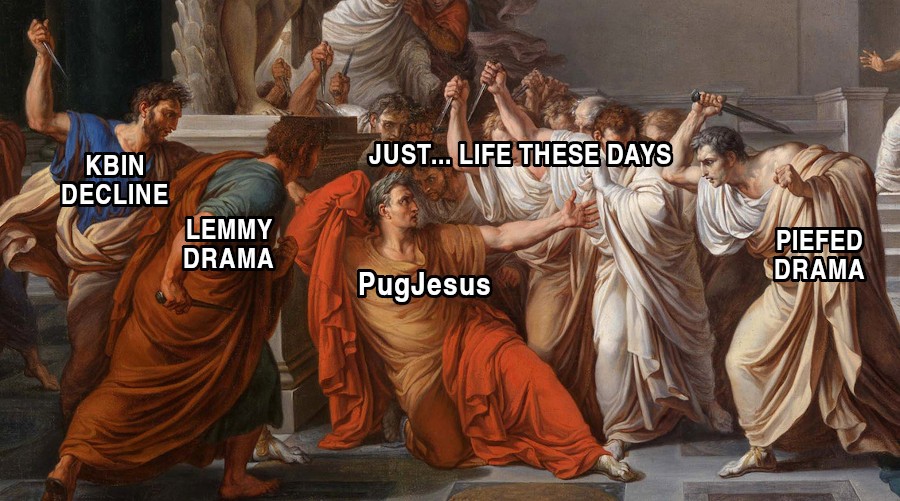
Friends, Lemmings, Piefeeders, lend me your ears. I come to bury @PugJesus@piefed.social not to praise him… Well, no, I DO come to praise him and I’m not burying him, I’m just wishing him goodbye and good luck on whatever he spends his (newly copious amounts of free) time on next. I always liked history since I was a kid. It was really awesome seeing this… this… FLOOD of posts about history here every day without fail, realizing that history was important to other people and that it could be fun and enlightening and half the time I wouldn’t know wtf a post was about and I’d end up spending half an hour on wikipedia reading up on it and I’d post a link in comments and it’d feel like I was taking part in things. Anyway I’d disagree with PugJ once in a while about various things, but PugJ always struck me as sincere and passionate regarding things they cared about, which is admirable.
PugJesus, it’s too bad that you’re cutting away from the threadiverse. Your posts greatly improved life here over the past couple years. I hope you will consider staying around in some capacity, perhaps even under a different name. But if not, that’s cool, I can understand that sometimes things are too much and you just have to step away.
My friend! May the spirit of a hundred Romans travel with you!

In 2022, an illegal road cutting the length of a full marathon through two strictly protected areas in the Brazilian Amazon threatened to do what conservationists feared most: Split the Xingu Socioenvironmental Corridor, a mosaic of Indigenous territories and conservation units covering some 26 million hectares (64 million acres), in half. Four years later, satellite images reveal the 42.8-kilometer (26.6-mile) road is gone, swallowed by regrowing forest — something rarely seen in the region. Its disappearance runs counter to everything that typically happens when a road appears in the Amazon. “Here, the road is the beginning of everything, the beginning of the devastation,” Bruno Ferreira, a researcher at the conservation nonprofit Imazon, part of the MapBiomas mapping network, told Mongabay. Usually, roads give birth to a set of new roads (legal or illegal) that spawn from the main one, creating a fishbone pattern in satellite images. Imazon research suggests that 95% of deforestation in the Amazon happens within 5 km (3 mi) of a road, meaning that illegal cattle ranching and logging would have been virtually unstoppable had this one road been consolidated. For the organizations monitoring the region around the Xingu, a key tributary of the Amazon, the now dead road is proof that the alliance between civil society and a willing government can reverse destruction that once seemed irreversible — and a reminder of what is at stake as Brazil heads into a tightly contested presidential election in October. Uncovered in 2022, the 42-kilometer-long illegal road ran along…This article was originally published on Mongabay
In 2022, an illegal road cutting the length of a full marathon through two strictly protected areas in the Brazilian Amazon threatened to do what conservationists feared most: Split the Xingu Socioenvironmental Corridor, a mosaic of Indigenous territories and conservation units covering some 26 million hectares (64 million acres), in half. Four years later, satellite images reveal the 42.8-kilometer (26.6-mile) road is gone, swallowed by regrowing forest — something rarely seen in the region. Its disappearance runs counter to everything that typically happens when a road appears in the Amazon. “Here, the road is the beginning of everything, the beginning of the devastation,” Bruno Ferreira, a researcher at the conservation nonprofit Imazon, part of the MapBiomas mapping network, told Mongabay. Usually, roads give birth to a set of new roads (legal or illegal) that spawn from the main one, creating a fishbone pattern in satellite images. Imazon research suggests that 95% of deforestation in the Amazon happens within 5 km (3 mi) of a road, meaning that illegal cattle ranching and logging would have been virtually unstoppable had this one road been consolidated. For the organizations monitoring the region around the Xingu, a key tributary of the Amazon, the now dead road is proof that the alliance between civil society and a willing government can reverse destruction that once seemed irreversible — and a reminder of what is at stake as Brazil heads into a tightly contested presidential election in October. Uncovered in 2022, the 42-kilometer-long illegal road ran along…This article was originally published on Mongabay

The Smith family referred to the back part of their property as “the wasteland.” It opens up to the North Fork Toutle River in the U.S. state of Washington, which was swamped with volcanic sediment and runoff from the 1980 eruption of Mount St. Helens. The sediment was further backed up when the U.S. Army Corps of Engineers constructed a sediment retention structure, or SRS, in 1989, and then raised it again in 2013, less than a mile, or a kilometer and a half, downstream from the Smiths. The goal of the project was to hold back sediment that would otherwise threaten the Columbia River’s shipping routes and southwest Washington communities. But it created a backlog of volcanic material that filled the stretch of the North Fork Toutle River that ran beside the Smiths’ property and to the dam. After the SRS was raised the first time, Mark Smith and his wife, Dawn, watched over the next few years as volcanic material accumulated for miles along the riverside portion of the Eco Park Resort: “So if you can imagine seeing a big gray sediment dune of no life, just ash, sediment from Mount St. Helens, volcanic material,” Smith told Mongabay by phone. Smith runs the nearly 80-acre (32-hectare) resort, a lodging and campground site alongside the Spirit Lake Memorial Highway. It offers the closest overnight accommodations to the volcano, so he often hosts groups of restoration ecologists and scientists. Through these researchers, and his family’s involvement in local environmental advocacy…This article was originally published on Mongabay
The Smith family referred to the back part of their property as “the wasteland.” It opens up to the North Fork Toutle River in the U.S. state of Washington, which was swamped with volcanic sediment and runoff from the 1980 eruption of Mount St. Helens. The sediment was further backed up when the U.S. Army Corps of Engineers constructed a sediment retention structure, or SRS, in 1989, and then raised it again in 2013, less than a mile, or a kilometer and a half, downstream from the Smiths. The goal of the project was to hold back sediment that would otherwise threaten the Columbia River’s shipping routes and southwest Washington communities. But it created a backlog of volcanic material that filled the stretch of the North Fork Toutle River that ran beside the Smiths’ property and to the dam. After the SRS was raised the first time, Mark Smith and his wife, Dawn, watched over the next few years as volcanic material accumulated for miles along the riverside portion of the Eco Park Resort: “So if you can imagine seeing a big gray sediment dune of no life, just ash, sediment from Mount St. Helens, volcanic material,” Smith told Mongabay by phone. Smith runs the nearly 80-acre (32-hectare) resort, a lodging and campground site alongside the Spirit Lake Memorial Highway. It offers the closest overnight accommodations to the volcano, so he often hosts groups of restoration ecologists and scientists. Through these researchers, and his family’s involvement in local environmental advocacy…This article was originally published on Mongabay
app.frontend() seems really handy!
app.frontend() seems really handy!
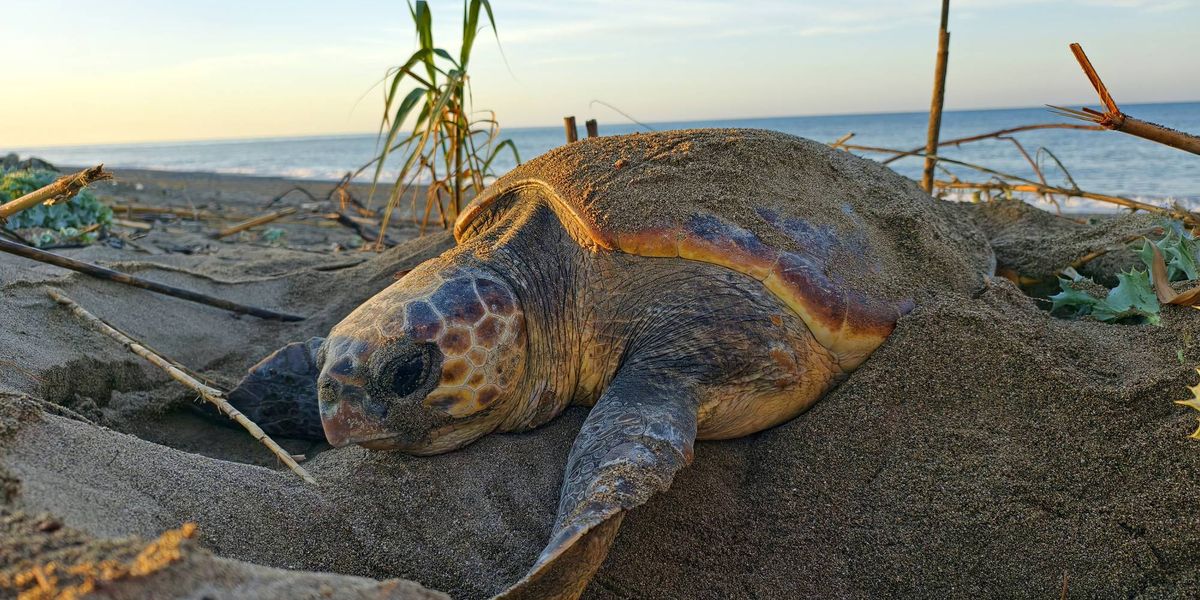
President Donald Trump’s administration on Friday paved the way for letting US corporations destroy the habitats of endangered species by rescinding a longtime interpretation of the Endangered Species Act.
As reported by The New York Times, the Interior Department and the Commerce Department announced that they were narrowing the law’s definition of what constitutes harming endangered species.
Whereas the law has for decades been interpreted as protecting endangered animals’ habitats from significant “modification or degradation,” the administration said that offenders would have to directly injure or kill an endangered animal to be considered in violation of the law.
“The change could open the door for fossil fuel companies, agricultural interests, land developers, and others,” wrote the Times, “to disturb or even destroy the habitats of vulnerable species.”
The Endangered Species Act has been interpreted as protecting animals’ habitats for decades, and that interpretation upheld by the US Supreme Court in 1995.
Environmental advocates expressed horror in response to the rule change, which they said would put endangered species at unprecedented risk.
Kristen Boyles, attorney for Earthjustice, vowed that the administration would face legal challenges for its rule change, which she said would jeopardize endangered animals’ ability to “raise their young, or search for food.”
“Let’s be clear: There is no support for the Trump Administration’s rule—no scientific support, no legal support, no public support,” Boyles said. “We will see the Trump Administration in court.”
Ben Greuel, wildlife campaign manager at the Sierra Club, called the rule changed “a direct attack on the foundation of the Endangered Species Act” that, if kept in place, would put species “on a path to extinction.”
“This rule ignores that reality in an unlawful attempt to open the door for corporate polluters to degrade vitally important habitats, wildlife be damned,” Greuel emphasized. “The Endangered Species Act is a bedrock law that must be followed.”
Tara Zuardo, a senior campaigner at the Center for Biological Diversity, pointed out that “habitat destruction is the number one threat to endangered species,” while calling the Trump administration’s new policy “a death knell for America’s wildlife.”
“If animals don’t have a place to live, they can’t live,” Zuardo said. “Spotted owls, Atlantic salmon, Florida panthers, and thousands of other species need protections for the wild places where they make their homes.”
Andrew Bowman, president and CEO of Defenders of Wildlife, accused the Trump administration of embracing an “erroneous and nonsensical interpretation” of the Endangered Species Act that he vowed to challenge in court.
“We intend to fight back with the full force of the law,” said Bowman, “to defeat this attack and innumerable others by the administration on the statutes and regulations that protect America’s cherished wildlife.”
cross-posted from: hexbear.net/post/8942417
cross-posted from: news.abolish.capital/post/61427
In 2022, an illegal road cutting the length of a full marathon through two strictly protected areas in the Brazilian Amazon threatened to do what conservationists feared most: Split the Xingu Socioenvironmental Corridor, a mosaic of Indigenous territories and conservation units covering some 26 million hectares (64 million acres), in half. Four years later, satellite images reveal the 42.8-kilometer (26.6-mile) road is gone, swallowed by regrowing forest — something rarely seen in the region. Its disappearance runs counter to everything that typically happens when a road appears in the Amazon. “Here, the road is the beginning of everything, the beginning of the devastation,” Bruno Ferreira, a researcher at the conservation nonprofit Imazon, part of the MapBiomas mapping network, told Mongabay. Usually, roads give birth to a set of new roads (legal or illegal) that spawn from the main one, creating a fishbone pattern in satellite images. Imazon research suggests that 95% of deforestation in the Amazon happens within 5 km (3 mi) of a road, meaning that illegal cattle ranching and logging would have been virtually unstoppable had this one road been consolidated. For the organizations monitoring the region around the Xingu, a key tributary of the Amazon, the now dead road is proof that the alliance between civil society and a willing government can reverse destruction that once seemed irreversible — and a reminder of what is at stake as Brazil heads into a tightly contested presidential election in October. Uncovered in 2022, the 42-kilometer-long illegal road ran along…This article was originally published on Mongabay
From Conservation news via This RSS Feed.
cross-posted from: hexbear.net/post/8970001
cross-posted from: news.abolish.capital/post/62851
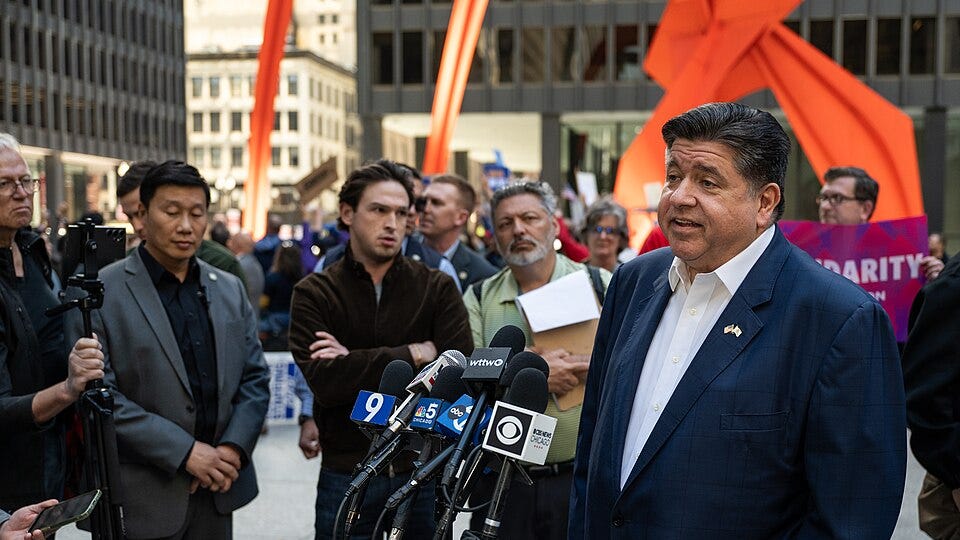
Wikimedia Commons // Paul Goyette
Erin In The Morning is a reader-supported publication. To receive new posts and support my work, consider becoming a subscriber.
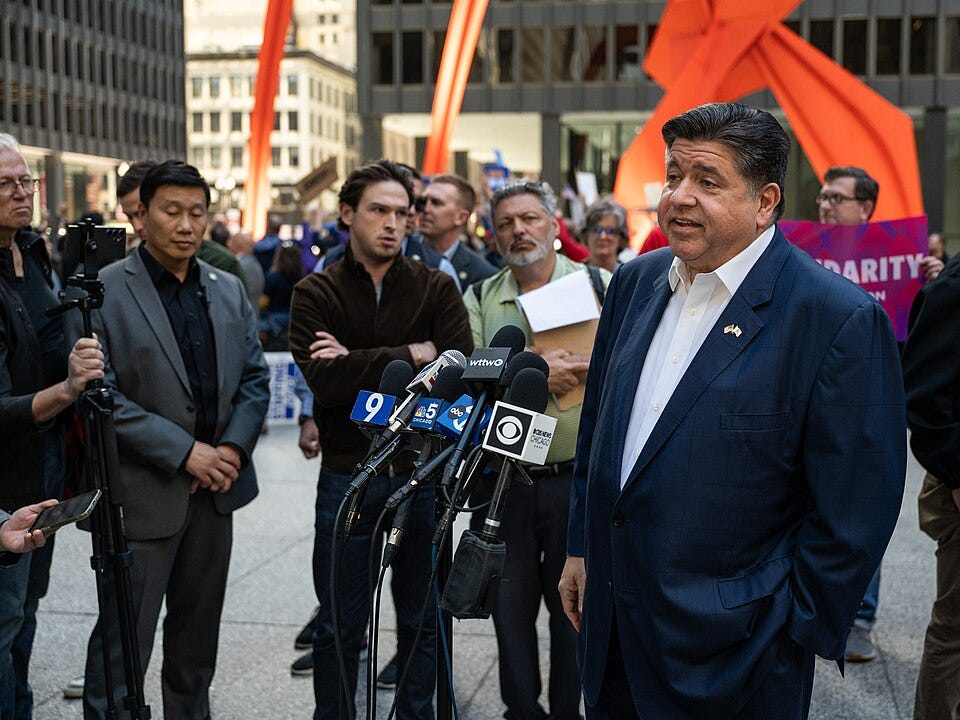
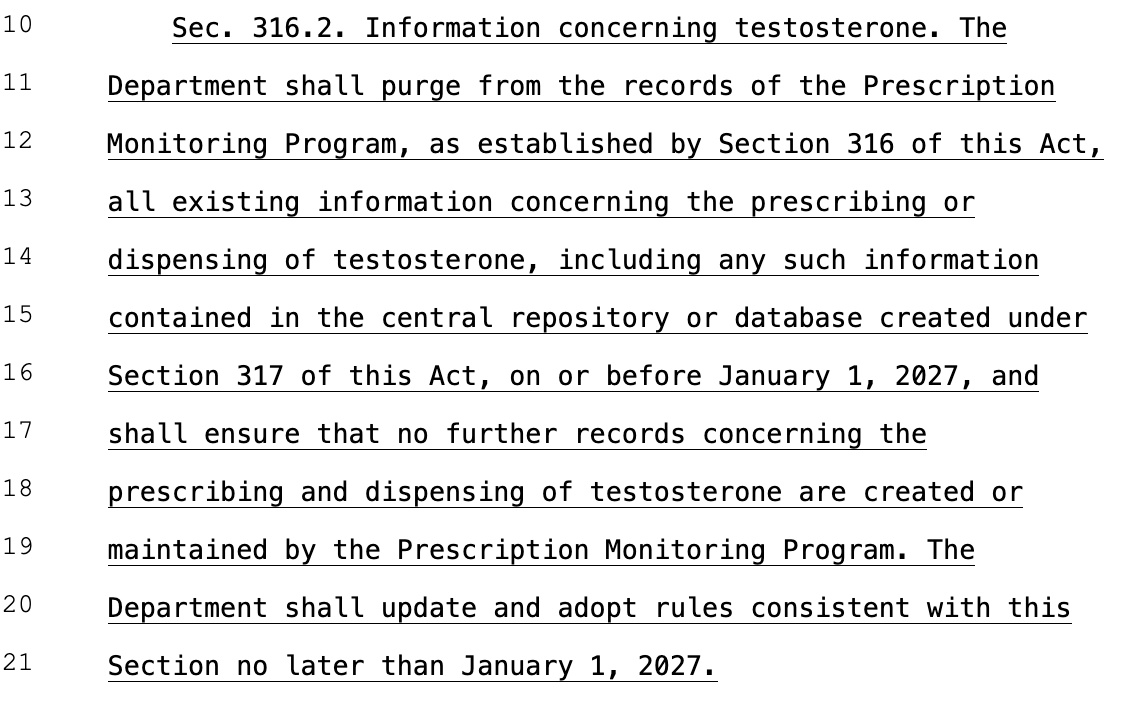
Governor Pritzker rounded out Pride Month by signing a trio of bills that will protect transgender people’s privacy from out-of-state attacks—most notably, by removing testosterone from the list of prescriptions required by law to be added to a government database.
“The work will continue until all Illinoisans are safe, healthy, and free to express their truest selves,” said Governor JB Pritzker in a June 28 press release.
The Illinois Prescription Monitoring Program (ILPMP) is a longstanding interstate database that enables health care providers to track the prescription of certain substances, in order to curb drug abuse. Transgender people are often prescribed testosterone for hormone replacement therapy—it is most notably associated with trans men, but it may also be prescribed to any trans person who receives gender-affirming surgery impacting their hormone production.
The bill, HB 4834, also preemptively banned adding certain drugs to the program in the future—such as estrogen or mifepristone and misoprostol, a pair of medications used for at-home abortions.
EXCERPT FROM HB 4834
Policies like this “protect trans people from invasive surveillance over their health care,” Alejandra Caraballo, a Harvard law instructor and privacy expert, told Erin in the Morning. In a 2025 report she penned for this newsletter, she explained how similar systems, called Prescription Drug Monitoring Programs (PDMPs), could be exploited to carry out anti-trans attacks.
“The database enabling this crackdown was never billed as a tool for political persecution,” she wrote. “PDMPs were originally established in the 2000s to combat the opioid epidemic and ‘doctor shopping’ for narcotics. Every U.S. state and territory now maintains a PDMP—an electronic registry of controlled substance prescriptions, typically Schedules II through V, that doctors and pharmacies are required to report.”
The ubiquity of this system means it could give bad actors from other states access to someone’s personal medical records, even without a warrant from the state where this care was rendered.
The signing of the law comes as a response to increased efforts by the federal government and red states across the country to reach into trans-friendly jurisdictions to prosecute providers. However, there are currently no public reports of a transgender person or a health care provider being successfully, directly prosecuted with information from a PDMP simply for providing, receiving, or being the parent of someone receiving gender-affirming care.
Hospital systems have comparatively faced more blowback from the Trump Administration, but it’s still important to remember they, too, have managed to avoid any sort of criminal convictions simply for offering gender-affirming care.
But that hasn’t stopped the Trump Administration from antagonizing them anyway, underscoring the importance of laws like this around the country as a protective measure. For example, NYU Langone received a criminal subpoena from the Northern District of Texas, a federal court, demanding information about trans youth care. The move is widely considered to be an act of judge-shopping from the Department of Justice; this district court, though thousands of miles away from New York City, is considered among the most conservative in the country.
It has continued to hang over the heads of trans people and their doctors everywhere.
“No one should fear being monitored or tracked for receiving hormone replacement therapy prescribed by their healthcare provider,” said Illinois State Senator Adriane Johnson, a Democrat. “Protecting medical information is essential to ensuring patients feel safe seeking care, asking questions, and making personal health care decisions.”
Cisgender men and cisgender women may also be prescribed the hormone for anything from cancer treatments to menopause symptom relief. Compared to other hormones associated with gender-affirming care (such as estrogen, progesterone, or spironolactone), testosterone access is especially scrutinized because it’s also heavily associated with drug abuse among cisgender athletes.
It’s also not the only protective law Pritzker signed that day. HB 5492 expands access to hormone therapy by mandating insurance companies cover up to a six-month supply of prescription hormone therapy when a pharmacist or health care provider deems it appropriate.
“In a time when gender affirming care is under constant attack by the federal government, dispensing prescriptions in bulk will give patients from Illinois and others traveling from out of state for care the assurance that they will have access to needed medications,” Pritzker’s press release says.
There was also HB 5095. This takes existing policy by Illinois’ Secretary of State, which makes it easier for people to choose their preferred gender marker on state IDs, and codifies it into law—making it a more permanent fixture, rather than a rule that can be changed on a whim by the next gubernatorial administration.
“Across the country, lawmakers are attempting to strip rights, erase identities, and target our most vulnerable community members,” said Channyn Lynne Parker, CEO of Equality Illinois.
“But here in Illinois, we are fighting back and winning,” Parker continued. “HB5095 preserves gender markers on state IDs; HB5492 expands access to hormone therapy; and HB4834 shields our most private medical information from surveillance. These are not small victories. They are a declaration that in this state, LGBTQ+ lives matter.”
HB 4834 went into effect upon Pritzker’s signing, and agencies have until the new year to transition to compliance. The other two laws will take effect on January 1, 2027.
Erin In The Morning is a reader-supported publication. To receive new posts and support my work, consider becoming a subscriber.
From Erin In The Morning via This RSS Feed.
cross-posted from: hexbear.net/post/8995275
cross-posted from: news.abolish.capital/post/63708
President Donald Trump’s administration on Friday paved the way for letting US corporations destroy the habitats of endangered species by rescinding a longtime interpretation of the Endangered Species Act.
As reported by The New York Times, the Interior Department and the Commerce Department announced that they were narrowing the law’s definition of what constitutes harming endangered species.
Whereas the law has for decades been interpreted as protecting endangered animals’ habitats from significant “modification or degradation,” the administration said that offenders would have to directly injure or kill an endangered animal to be considered in violation of the law.
“The change could open the door for fossil fuel companies, agricultural interests, land developers, and others,” wrote the Times, “to disturb or even destroy the habitats of vulnerable species.”
The Endangered Species Act has been interpreted as protecting animals’ habitats for decades, and that interpretation upheld by the US Supreme Court in 1995.
Environmental advocates expressed horror in response to the rule change, which they said would put endangered species at unprecedented risk.
Kristen Boyles, attorney for Earthjustice, vowed that the administration would face legal challenges for its rule change, which she said would jeopardize endangered animals’ ability to “raise their young, or search for food.”
“Let’s be clear: There is no support for the Trump Administration’s rule—no scientific support, no legal support, no public support,” Boyles said. “We will see the Trump Administration in court.”
Ben Greuel, wildlife campaign manager at the Sierra Club, called the rule changed “a direct attack on the foundation of the Endangered Species Act” that, if kept in place, would put species “on a path to extinction.”
“This rule ignores that reality in an unlawful attempt to open the door for corporate polluters to degrade vitally important habitats, wildlife be damned,” Greuel emphasized. “The Endangered Species Act is a bedrock law that must be followed.”
Tara Zuardo, a senior campaigner at the Center for Biological Diversity, pointed out that “habitat destruction is the number one threat to endangered species,” while calling the Trump administration’s new policy “a death knell for America’s wildlife.”
“If animals don’t have a place to live, they can’t live,” Zuardo said. “Spotted owls, Atlantic salmon, Florida panthers, and thousands of other species need protections for the wild places where they make their homes.”
Andrew Bowman, president and CEO of Defenders of Wildlife, accused the Trump administration of embracing an “erroneous and nonsensical interpretation” of the Endangered Species Act that he vowed to challenge in court.
“We intend to fight back with the full force of the law,” said Bowman, “to defeat this attack and innumerable others by the administration on the statutes and regulations that protect America’s cherished wildlife.”
From Common Dreams via This RSS Feed.

cross-posted from: hexbear.net/post/9013920
cross-posted from: news.abolish.capital/post/63630
The Smith family referred to the back part of their property as “the wasteland.” It opens up to the North Fork Toutle River in the U.S. state of Washington, which was swamped with volcanic sediment and runoff from the 1980 eruption of Mount St. Helens. The sediment was further backed up when the U.S. Army Corps of Engineers constructed a sediment retention structure, or SRS, in 1989, and then raised it again in 2013, less than a mile, or a kilometer and a half, downstream from the Smiths. The goal of the project was to hold back sediment that would otherwise threaten the Columbia River’s shipping routes and southwest Washington communities. But it created a backlog of volcanic material that filled the stretch of the North Fork Toutle River that ran beside the Smiths’ property and to the dam. After the SRS was raised the first time, Mark Smith and his wife, Dawn, watched over the next few years as volcanic material accumulated for miles along the riverside portion of the Eco Park Resort: “So if you can imagine seeing a big gray sediment dune of no life, just ash, sediment from Mount St. Helens, volcanic material,” Smith told Mongabay by phone. Smith runs the nearly 80-acre (32-hectare) resort, a lodging and campground site alongside the Spirit Lake Memorial Highway. It offers the closest overnight accommodations to the volcano, so he often hosts groups of restoration ecologists and scientists. Through these researchers, and his family’s involvement in local environmental advocacy…This article was originally published on Mongabay
From Conservation news via This RSS Feed.

cross-posted from: piefed.world/c/comicstrips/p/…/nancy-may-26-1948
cross-posted from: piefed.world/c/comicstrips/p/…/nancy-may-26-1948
ausgegeben am Montag, den 13.07.2026 um 08 UTC
GWL und markante Wettererscheinungen: GWL: Zunehmend HNz (Hoch Nordmeer zyklonal)
Auch zu Beginn der neuen Woche sehr warm bis heiß und meist trocken. Im Norden aber erste konvektive Störungen. Am Dienstag in der Mitte und im Süden vermehrt teils kräftige Gewitter mit Unwettergefahr durch (extremen?) Starkregen.
… neue Woche, neues Glück, neues Wetter, das ist hier die Frage. Und damit einen schönen guten Morgen zu einer neuerlichen Ausgabe dieses kostenlosen, weltweit in dieser Form wahrscheinlich einzigartigen Fachmagazins zum Thema “Synoptische Meteorologie”. Die für gewöhnlich gut informierte Leserschaft dieses Bulletins hat es natürlich mitbekommen, dass nach einigen Tagen trockener Hitze DAS Zauberwort der Meteorologie schlechthin in den diversen Wetterberichten auftaucht - Gewitter! Und ja, es ist was dran, es tut sich tatsächlich was in der Atmosphäre, was aber nicht bedeutet, dass Hitze, anhaltende Dürre und hohe Waldbrandgefahr mit einem Schlag eliminiert und Geschichte werden. So schnell schießen die Preußen nicht. Aber immerhin, ein Anfang wird bereits heute gemacht und mit Blick auf die Mittelfrist in Richtung nächstes Wochenende deutet sich sogar eine substanzielle Umstellung der GWL mit zurückgehenden Temperaturen usw. an (mehr dazu heute Mittag im weltweit einmaligen Fachmagazin über Synoptische Mittelfristmeteorologie).
Nun aber erstmal zur allgemeinen Lage, die Deutschland nach wie vor auf der Südostflanke des prominenten Hochdruckgebiets LAURENT mit 1030+X-hPa-Zentrum über der nördlichen Nordsee bzw. der südlichen Norwegischen See sieht. Davon ausgehend reicht ein wuchtiger Keil bis zu den Alpen bzw. noch etwas darüber hinaus. Weiterhin mit von der Partie auch der der korrespondierende Potenzialrücken, der sich von NW-Afrika bis hoch in den Raum Island erstreckt, wo er deutliche Fühlung zu einem weiteren Rücken über dem mittleren Nordatlantik aufgenommen hat. So potent der Rücken auf den ersten Blick wirkt - und in der Realität ist er das ja auch -, auch er hat Schwachstellen und diese werden in der Natur, man kennts aus der Tierwelt - in der Regel gnadenlos ausgenutzt. Im vorliegenden Fall ist die Rede von einem kleinen aber feinen Höhentief (HT), das als “Abfallprodukt” eines Cut-Offs über Nordeuropa den Weg zur Kimbrischen Halbinsel und den dänischen Inseln gefunden hat. Um von dort gaaaanz langsam südwärts zu ziehen. Mal abgesehen von der Labilisierung, die das HT bewirkt, ist die gealterte Subtropikluft (xSp) im Norden mittlerweile auch leidlich angefeuchtet (PPW 25 bis 30 mm, spezifische Grundschichtfeuchte bis 10 g/kg), so dass mit Hilfe solarer Einstrahlung gebietsweise bis zu 1500 bis 2000 J/kg CAPE zur Verfügung stehen. Nahezu ungehindert zur Verfügung stehen, sollte man vielleicht ergänzen, denn die Deckelung in der Vertikalsondierung ist relativ schwach. Zumindest ist anhand der Nachtaufstiege keine klar definierte Absinkinversion erkennbar, die es zu überwinden gilt.
Kurzum, mit Erreichen der Auslösetemperatur um 28°C bilden sich im Norden und der nördlichen Mitte nicht nur einige mächtige Quellungen. Es stehen auch einzelne Schauer oder Gewitter auf der Karte, wobei das Areal einzelner potenzieller Überentwicklungen in Form pulsierender Einzelzellen bei aller noch gegebenen Unschärfe etwa von SH/Westmecklenburg bis hinunter nach Ostwestfalen reicht. Der Vektor der mittleren Verlagerungsgeschwindigkeit ist sehr kurz, weshalb markanter Starkregen der Primus unter den begleitenden Parameter ist. Nicht ausgeschlossen, dass vereinzelt sogar das Unwetterkriterium >25 mm innert kurzer Zeit gerissen wird. Aufgrund der inversen V-Struktur in der unteren Troposphäre sind trotz fehlender Dynamik auch stürmische Böen 8 Bft, worst case Sturmböen 9 Bft möglich. Auch Hagel kann am Start sein, allerdings nicht allzu groß (die Zellen sind nicht gut genug organisiert) und am wahrscheinlichsten im Anfangsstadium.
Ansonsten bliebe zu konstatieren, dass ein Großteil des Landes einen trockenen, sonnenscheinreichen und sehr warmen bis heißen Montag erlebt. Anfänglich von Polen herüberdriftende Hochnebelfelder werden ebenso wie die im äußersten Norden und Nordwesten entweder von der gnadenlosen Sonne weggebruzzelt oder in flache Cum hum überführt. Auch die von Frankreich in den Westen und Südwesten ziehenden Wolkenfelder - Abgesandte der über dem Nachbarland auftretenden Gewitteraktivität - sorgen kaum mal für nennenswerte Schattenmomente. So steigt die Temperatur einmal mehr verbreitet auf 30 bis 35°C mit den höchsten Werten den Rhein entlang. Für den Südwesten und Westen wurde gebietsweise eine Hitzewarnung ausgegeben. Weniger aufgrund der Schwüle, die sich angesichts weiterhin niedriger Taupunkte sehr in Grenzen hält, sondern vielmehr wegen der anhaltend hohen Temperaturen, die sich freilich auch auf die Raumklimate auswirken. Etwas moderater der Norden und Nordosten mit 25 bis 29°C und noch moderater Küstenabschnitte mit auflandiger Windkomponente - 19 bis 24°C.
In der Nacht zum Dienstag kommt es nicht zur sonst häufig beobachteten Wetterberuhigung, auch wenn weite Landesteile freilich eine ruhige Nacht erleben werden. Nichtsdestotrotz tun sich zwei Baustellen auf, über die es zu reden respektive zu schreiben gilt. Bleiben wir zunächst im Norden bzw. in der Mitte, wo das kleine “Höhenei” nach Osten in Richtung MV abbiegt. Es sorgt dafür, dass auf seiner Südflanke weitere einzelne Schauer und Gewitter in Form abgehobener Konvektion generiert werden. Dabei ist weiterhin die Gefahr von Starkregen gegeben.
Baustelle #2 befindet sich in Süddeutschland, wo etwa gegen Mitternacht erste Gewitter bzw. gewittrige Regenfälle aus Frankreich in Empfang genommen werden. Sie stehen in Zusammenhang mit einer zonal exponierten Tiefdruckrinne, die sich langsam aber sicher bis zu uns ausweitet. Noch steht die genaue Struktur der Importgewitter/-regenfälle zwar nicht fest. Es deutet sich aber an, dass sich das Geschehen vom Oberrhein und dem Südschwarzwald ostwärts bis zum Alpenrand respektive dem südlichen Alpenvorland ausweitet, wobei eine zunehmende Verclusterung wahrscheinlich ist. Dabei steht ganz klar der Starkregen im Fokus, nicht großflächig, nicht zwingend gewittrig und wohl auch nur auf kurze Zeit fokussiert.
Während vielen West- und Südwestdeutschen gerade in den Ballungszentren oder aber in mittleren Hanglagen eine Tropennacht mit 20, 21 oder gar 22°C Minimum nicht erspart bleibt, geht die Temperatur im großen Rest der Republik auf 19 bis 13°C zurück. Am kühlsten dabei das nordostdeutsche Binnenland sowie die östlichen Mittelgebirge.
verbleibt das HT mit seinem Drehzentrum über dem Grenzbereich von Vorpommern zu Polen. Dabei zeigt es Expansionsbestrebungen sowohl nach Osten, vor allem aber nach Westen. Das geht soweit, dass der Rücken in seinem mittleren Teil erheblichen Schaden nimmt. Oder anders ausgedrückt, der vom HT westwärts abgehende Trog nimmt Verbindung zu einem weiteren, westlich der Biskaya positionierten Höhentief auf, was spätestens am Mittwoch die Abspaltung einer eigenständigen Höhenantizyklone über der nördlichen Nordsee/südlichem Nordmeer vom Südteil des Rückens zur Folge hat. Mit dieser Liaison wird nicht nur das Strömungssetup in der Höhe zyklonaler. Auch die weiter alternde Subtropikluft wird immer feuchter (PPW über 30, teils über 35 mm) und labiler, was weiten Landesteile ein ordentliches Quantum nahezu ungedeckelten ML-CAPEs beschert (verbreitet um 1500 J/kg). Einzig in den Norden wird am Rande des zwar etwas schwächelnden, aber weiter präsenten Bodenhoch mit Nordostwind deutlich trockenere und damit konvektiv untaugliche Luft eingesteuert. Dort scheint abgesehen von einigen lockeren Wolken die Sonne bei 25 bis 30°C, an Küstenabschnitten mit auflandigem Wind etwas darunter.
Ansonsten steht morgen nach längerer Zeit mal wieder ein unruhiger Tag auf der Agenda, auch wenn die letzten Feinheiten noch nicht abschließend geklärt sind. Zunächst mal deutet Vieles darauf hin, dass die nächtlichen Aktivitäten am Morgen sowie am Vormittag in eine Minimumphase treten, sprich, sich Regenfälle und Gewitter abschwächen oder ganz zum Erliegen kommen. Lange wird diese Erholungsphase aber nicht dauern, bevor es wohl erst in der Mitte, mit nur leichter Verzögerung dann auch im Süden losgeht mit den konvektiven Umlagerungen. Die meisten Impulse dürften dabei vom Bergland ausgehen, aber auch konfluente Windstrukturen in der ansonsten eher amorph anmutenden Rinne über der Südhälfte sowie Outflows bestehender Systeme können den entscheidenden Kick geben. Insgesamt sieht es nach langsam ziehenden Einzel- und Multizellen aus, die durchaus das Potenzial für Mehrfachtreffer bzw. rückwärtigen Anbau haben, was sie gefährlich für Starkregen macht. Und tatsächlich sind die Signale für unwetterartigen Starkregen (25-40 l/m² innert kurzer Zeit) gerade von ICON-D2-EPS schwerpunktmäßig von der Harzregion bis hinüber nach Ostsachsen recht deutlich, dass genau das passiert. Sogar extreme Unwetter (<40 l/m²) sind stellenweise möglich, insbesondere im Bergland, wenn´s mit dem Gewitter/den Gewittern nicht vor und zurück geht. Angesichts der noch immer gegebenen inversen V-Struktur im unteren Bereich der vertikalen Zustandskurven soll und darf auch das Thema Wind/Sturm nicht außer Acht gelassen werden. Auch wenn die Dynamik fehlt, sind doch thermisch induzierte Böen 8-9 Bft gut und schwere Sturmböen 10 Bft nicht unmöglich. Hagelkörner sollten den Durchmesser von 2-3 cm nicht überschreiten, dafür sind lokale Hagelansammlungen ins Kalkül zu ziehen.
Schauer hin, Gewitter her, nicht zuletzt im Zuge zeitweiliger Einstrahlung wird es gerade im Westen und Südwesten wieder ein heißer Tag mit 30 bis 35°C.
In der Nacht zum Mittwoch ändert sich nicht viel an der GWL, sieht man mal davon ab, dass das HT etwas nach Süden rutscht und möglichweise einen zweiten Kern bildet Die Schauer und Gewitter jedenfalls verclustern zusehends und ziehen sich als gewittriger Starkregen Richtung Alpenrand bzw. östliche Mitte zurück. Vor allem die Starkregengefahr bleibt bestehen und nimmt bis in die Frühstunden nur langsam ab. Ansonsten präsentiert sich die Nacht teils wolkig oder gering bewölkt, teils klar. Dort, wo es tagsüber geregnet hat und längere Zeit aufklart, kann sich (flacher) Nebel bilden. Tiefsttemperatur in der SW-Hälfte 21 bis 15°C, sonst 17 bis 12°C, direkt am Meer darüber.
verbleibt Deutschland unter einer Potenzialrinne zwischen dem kleinen Höhentief im deutsch-polnischen Grenzbereich (so ganz weiß das Tief noch nicht, wohin es sich orientieren soll) und dem Tief westlich der Biskaya. Auch bodennah bleiben die Druckgegensätze gering. Der Norden setzt weiter auf Hochrandlage mit trockener Nordostströmung, was sonniges Wetter bei 25 bis 30°C (Küste etwas darunter) zur Folge hat. Ansonsten kommt es insbesondere südlich der Donau bzw. im Raum Südschwarzwald sowie in der östlichen Mitte zu weiteren Gewittern respektive schauerartigen Regenfällen mit eingelagerten Gewittern. Zu viele Details verbieten sich an dieser Stelle, da die Vita des Höhenstiefs noch leicht erratisch daherkommt, was übrigens ganz normal ist. Auf alle Fälle zeichnet sich durch die vorherigen und auch am Mittwoch noch andauernden Hebungsprozesse eine Abnahme der 850-hPa-Temperatur auf rund 10°C im Norden und bis zu 16°C im Süden ab, so dass auch das Areal mit 30+X°C im 2m-Niveau kleiner wird. Vor allem nach Westen hin sind aber noch mal bis zu 32°C drin, während sonst weite Landesteile auf 24 bis 30°C kommen.
Im Grunde ist alles beschrieben inklusive der Unsicherheiten. Da meiste der bevorstehenden Konvektion wird sicherlich im Nowcasting abgearbeitet werden. Ob für morgen Dienstag evtl. eine Vorabinformation ausgegeben wird (aus jetziger Sicht würden sich Teile der östlichen Mitte anbieten, wo die Signale für (extremen) Starkregen am deutlichsten sind), kann in der Abendkonferenz noch diskutiert werden.
Vorhersage- und Beratungszentrale Offenbach
Dipl. Met. Jens Hoffmann

for the record, i’ve always been kind of a mess in terms of gender. i’m afab and was raised a girl until i discovered that i didn’t have to be a girl in 2020 with the boom in lgbtqia+ campaigns and visibility. i consider most of what i do as a girl a performance, and i don’t ever think being a woman fully stuck with me like cis people. add to that, my extreme loneliness and just isolation from being odd socially was suddenly cured when i started crossdressing on roblox. it felt nice to be referred to as a man, but over time it was really limiting my options because i was constantly scared of being outed or seen as gay. i also enjoyed being feminine from time to time and being restricted of that didn’t feel great. so i usually blocked all my roblox friends and lived in hyperfeminity for a while until the dysphoria hits me again. for me dysphoria feels like a vague sense of discontent and longing for something different. it feels like having to force a bland porridge down in order to not starve. when it was from a man’s perspective, i would look at women with jealousy for the freedom to be expressive, but i’m not sure if i wanted to be them for longer than a day or two. the dysphoria is different for each side. add to that, my internal sense of everything leaned more non binary. i liked gendered expression, but at my absolute core i am a being that can’t be described with words. i mean how can you explain what a soul’s flavor is like? anyway, i was cycling like that (i was non binary, genderfluid, genderflux, ftm, blah blah blah) from late elementary school till early-mid high school, for that matter.
i decided recently on going with an identity that’s transmasc and occasionally dresses/acts feminine. i figured i’ve gotten so used to being masculine i might as well just pick a gender “home” in masculinity, and venture out to feminity whenever being masculine wasn’t cutting it. i picked a name after thinking about it for a while (andrew) and i’ve kind of fully basked in this state of being.
the problem is i get a sense of foreboding when i think about my new name and a slight sense of being limiting. the foreboding could be explained that i actually have a lot of past names over the years from identifying as a guy online, and none of them sticked. maybe this is anxiety because i don’t fully believe it will stick based on past experience. limiting is because it’s a full-masc name. if i were to dress as a girl again i’d be outed by my name. could i just use my birth name (anna) in that case? i don’t know.
another problem is i’m looking at binders, boxers, and heavyweight cotton t-shirts for myself, and even thinking about T. i feel a bit caught off guard, and i’m starting to think that maybe i don’t really want to be a man but a woman with a man exterior (whatever that means…), or that i’m a girl in denial, or that i won’t be able to go back if i buy the binder. i don’t really want to have a full beard or be hairy for that matter. i’d rather look slightly feminine. maybe i’m modeling it too much based on what i’ve read in manhwas than reality, idk. i also “check” for feelings i get whenever i switch between the two names, and anna feels like i can breathe and warms me up a bit, but andrew feels slightly intoxicating and heavy (i have OCD, so sometimes i based things off their feelings as a decision). i don’t know if this means i should only live as a guy online, or if i should switch the two roles (be feminine in game, and irl be masculine). i’m just so confused and nervous.
i’m really scared that the name i seem to love so much will become my ball and chain, especially if i come out (planning on coming out soon) and they accept my new identity.
i guess only time will tell if it’s just a phase this time or not.


Video: imgur.com/a/nJ7LRgK
She has spawned from the depths of the nightmare.
The bloom is the oncoming storm that will consume
She manifests in the ether, towering over helpless victims.
The canopy of serene floral essence starts to sprout horror
A creature peers over and starts capturing the exposed souls.
Petunia Prime slowly inches closer to her prey.
Her offspring have bound the victims to the nightmare
They cannot escape as the bloom starts to envelope them.
The Dreameater feasts and spawns the next affliction for another night.
…bei falscher Verurteilung, habe ich heute im Radio gehört. Natürlich ist das kein Lohn sondern eine Entschädigung aber auf 8h gerechnet sind das starke 9,38€/h und da man ja den ganzen Tag dort ist sogar 3,13€/h. Irgendwie gruselig. Natürlich muss man nichts versteuern und hat auch keine Lebenserhaltungskosten, außerdem bekommt man zb etwaige Verdienstausfälle ersetzt.
…bei falscher Verurteilung, habe ich heute im Radio gehört. Natürlich ist das kein Lohn sondern eine Entschädigung aber auf 8h gerechnet sind das starke 9,38€/h und da man ja den ganzen Tag dort ist sogar 3,13€/h. Irgendwie gruselig. Natürlich muss man nichts versteuern und hat auch keine Lebenserhaltungskosten, außerdem bekommt man zb etwaige Verdienstausfälle ersetzt.


Interesting and short interview with the maintainer of frutigeraeroarchive.org.
A quote:
Does it feel more alive for me personally? I can say yes to that, as it comes from an era where we were all more optimistic about technology and what it would do in our lives. I would say our outlook in recent years has changed drastically, with companies becoming more and more greedy, more of our data being harvested, and the rise of AI. I have nothing against flat design itself however I have to admit it is more lazily done most of the time than even a basic skeuomorphic interface, and requires basically no effort to pull off correctly.


This is the first time I’m experiencing downtime for this instance, so I appreciate that a lot. Is anyone else currently experiencing troubles? Anyone know what is going on?
This is the first time I’m experiencing downtime for this instance, so I appreciate that a lot. Is anyone else currently experiencing troubles? Anyone know what is going on?

Post by kivo🍦 (kivonotbabu)
Socials: Twitter, Patreon
Post by kivo🍦 (kivonotbabu)
Socials: Twitter, Patreon
Sopuli gives me a bad gateway. Is it down or is it me? Does anyone has a way to get to Quentin Calaghan (however you write that) to inform him just in case he didn’t notice? He might be on holidays anyway…
Sopuli gives me a bad gateway. Is it down or is it me? Does anyone has a way to get to Quentin Calaghan (however you write that) to inform him just in case he didn’t notice? He might be on holidays anyway…

combined with gas shortages and fertilizer prices. going to be a lot of pain.
combined with gas shortages and fertilizer prices. going to be a lot of pain.
Everyone around me is veryyy sick but I’ve been fine so far wearing my Zimi N95. Sadly have to cohabit with my family and I’m just having relatives come over via plane and go to restaurants… I hope I’ll be fine it’s very stressful and I wish people took Covid seriously. Got harassed for masking in a hospital by the staff recently… :/
Everyone around me is veryyy sick but I’ve been fine so far wearing my Zimi N95. Sadly have to cohabit with my family and I’m just having relatives come over via plane and go to restaurants… I hope I’ll be fine it’s very stressful and I wish people took Covid seriously. Got harassed for masking in a hospital by the staff recently… :/


Autovelox, è ora di cambiare narrazione.
La posizione di RIME, Rete Italiana Mobilità Equa, di cui anche FIAB fa parte, è netta. È tempo di uscire dalla logica del “fare cassa”. I controlli sono salute pubblica:
Autovelox, è ora di cambiare narrazione.
La posizione di RIME, Rete Italiana Mobilità Equa, di cui anche FIAB fa parte, è netta. È tempo di uscire dalla logica del “fare cassa”. I controlli sono salute pubblica:


« Le dispositif nous a rappelé Sainte-Soline » : 900 policiers et gendarmes pour contrôler la mobilisation du canal Seine-Nord Europe
reporterre.net/Canal-Seine-Nor
Face à l’impressionnant dispositif policier qui a encadré les quatre jours de rassemblement contre le canal Seine-Nord Europe, dans le Pas-de-Calais, les manifestant·es ont conservé un mode opératoire festif et créatif.

From: universal-blue.org
Embed (this image): a.imagem.app/G14GyX.png
From: universal-blue.org
Embed (this image): a.imagem.app/G14GyX.png