0

preview
cross-posted from: lemmy.zip/post/73939581
Microsoft looking to remove 60,000 jobs, ~25% of the company
cross-posted from: lemmy.zip/post/73939581
Microsoft looking to remove 60,000 jobs, ~25% of the company
cross-posted from: lemmy.zip/post/73939581
Microsoft looking to remove 60,000 jobs, ~25% of the company
cross-posted from: lemmy.zip/post/73939581
Microsoft looking to remove 60,000 jobs, ~25% of the company




Their anti-Trump bromance is paying off politically. What Canadians get out of it is harder to say
Their anti-Trump bromance is paying off politically. What Canadians get out of it is harder to say
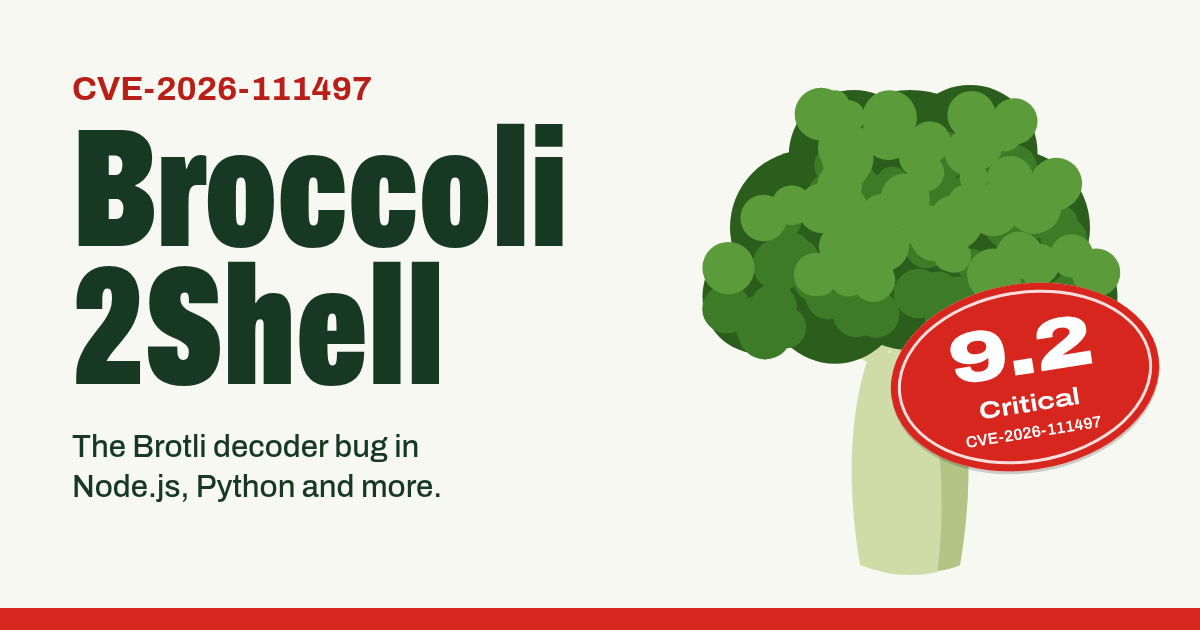
cross-posted from: nord.pub/…/broccoli2shell-the-brotli-decoder-bug-…
CVE-2026-111497 (Broccoli2Shell, aka Node2Shell): an out-of-bounds write in Google’s Brotli decoder affecting Node.js, Python Brotli/brotlicffi and anything built on the C decoder. Affected versions, how to check, and how to fix it.

Relationship that ‘reflects who we are’ today is ‘long overdue,’ Wab Kinew says
Relationship that ‘reflects who we are’ today is ‘long overdue,’ Wab Kinew says

The moment I erased the pencil sketch and started to go back with more ink … One of my boo-boos on my fingers (paper cut) started to act up.
So I have to shelf this for couple of hours. I will edit the post with the finished sketch.
The moment I erased the pencil sketch and started to go back with more ink … One of my boo-boos on my fingers (paper cut) started to act up.
So I have to shelf this for couple of hours. I will edit the post with the finished sketch.
LemmyNSFW(.com) down; gives 502: Bad Gateway error
LemmyNSFW(.com) down; gives 502: Bad Gateway error

cross-posted from: lemmy.ca/post/72946483
cross-posted from: lemmy.ca/post/72946483
hi, first post so im a bit nervous, just joined. anyways i need a digital artist for a profile picture in 16x16, it has to be something related to gay pride with a windows 3.x or 9x logo. im requesting this since i have no experience and a broken arm. thanks to anyone willing to make one! (send it to my email lulzroman1337@outlook.com)
hi, first post so im a bit nervous, just joined. anyways i need a digital artist for a profile picture in 16x16, it has to be something related to gay pride with a windows 3.x or 9x logo. im requesting this since i have no experience and a broken arm. thanks to anyone willing to make one! (send it to my email lulzroman1337@outlook.com)


Dopo aver sfidato le proiezioni, la crescita esponenziale dell’energia solare significa che ora sta superando il nucleare come fonte di energia globale. Ecco sette motivi del successo dell’energia solare e come potrebbe evolversi in futuro.
L’energia solare mondiale sta varcando una soglia. Dieci anni fa, la sua diffusione su scala mondiale era pressoché nulla, poiché forniva solo l’1% dell’energia mondiale. Nel 2026, quasi certamente aumenterà fino al 10% della potenza, superando il nucleare, pilastro dell’elettricità dalla fine degli anni '70.
Secondo le statistiche del think tank energetico britannico Ember, a livello globale la produzione di energia solare ha superato silenziosamente l’energia nucleare (di poco) nel 2025. E l’analisi dei dati Ember condotta dalla BBC negli ultimi 12 mesi fino a settembre 2026 mostra che ha nettamente superato il nucleare, producendo il 13% di energia in più.


Trevor Chandler, the firm’s senior director of public affairs, made the stunning revelation during a presentation earlier this month to a group of Suffolk County pols and conceded the cameras can help “reconstruct” people’s movements, which would include under circumstances involving abortion.
But he noted that states can opt out of the searches, which New York does.
“Every agency that utilizes Flock in New York has our reproductive-health search filter turned on,” Chandler said as he was grilled by legislators on how the controversial tech works.
“This prevents any searches related to reproductive health to make sure that no searches are made out of compliance with state law,” the representative insisted.
The company added in a statement, “Certain states have enacted laws restricting the use of [license-plate-reader] data in connection with immigration enforcement or reproductive health investigations.”
But otherwise, police departments in states that do not opt out can potentially pinpoint people seeking the procedure through a simple license-plate search.
And since departments can share Flock data with other police across the nation, officers in states with bans could potentially track women who cross state lines to get an abortion in states where it remains legal — and cops currently don’t need a warrant to look through Flock’s database.
Undertale & Deltarune got a fan port to the Wii!
#undertale_deltarune #homebrew #wii
Releases page:
github.com/Project-Sunshine-Native/…/releases
(Also just noticed as I wrote the post, there’s a Wii U release too.)
Undertale & Deltarune got a fan port to the Wii!
#undertale_deltarune #homebrew #wii
Releases page:
github.com/Project-Sunshine-Native/…/releases
(Also just noticed as I wrote the post, there’s a Wii U release too.)
Hello! When running any video game in Lutris (LMDE 7) it crashes. It doesn’t matter if they’re Windows (run via Wine) or ProtonDB based. It worked almost flawlessly some days before it suddenly stopped working. Maybe I did some configuration that broke it all. When using Steam, it runs flawlessly. It’s only Lutris and even Heroic.
The log when opening Metro 2033 Redux as reference:
Started initial process 19668 from gamescope -w 2560 -h 1440 -W 2560 -H 1440 -f – gamemoderun (…)/lutris/runners/wine/lutris-7.2-2-x86_64/bin/wine (…)/drive_c/GOG Games/Metro 2033 Redux/metro.exe Start monitoring process. No CAP_SYS_NICE, falling back to regular-priority compute and threads. Performance will be affected. wlserver: [backend/headless/backend.c:82] Creating headless backend vulkan: selecting physical device ‘NVIDIA GeForce RTX 3070 Ti’: queue family 2 vulkan: physical device supports DRM format modifiers vulkan: vkCreateDevice failed (VkResult: -7) Failed to initialize Vulkan Monitored process exited. Initial process has exited (return code: 256) All processes have quit Exit with return code 256
I have had no clue of how to solve this for at least one week.
For context: I’m a total beginner in Linux. Came from windows 10 just like 2 months ago. No background in programing or anything related.
If I’m missing any info of value let me know. Thanks!
EDIT:
Here’s the process I followed to solve it:
Disabled Gamescope. It made all games work except one that was installed via Bottles and linked to Lutris later. I have to fix gamescope.
Ran this script by u/dgdft and solved the gamescope issue:
echo 'options nvidia-drm modeset=1' | sudo tee /etc/modprobe.d/nvidia-drm-modeset.conf
sudo update-initramfs -u
sudo reboot
Tried installing another windows based game. It worked. The problem wasn’t Lutris or even windows games, just that one single game.
Added the game that was giving me trouble in Steam as a non steam game. To do that you make the new blank non steam game target the .exe of the game you want it to run. Then link the savefiles (located in “<Steam-folder>/steamapps/compatdata/{game’s app ID}/pfx”) and the game was working flawless.
Came back to Lutris and “Add locally installed game”: [Game info] Runner: Wine (bc I want to run a Windows game) [Game options] Executable: The same .exe as the steam game [Game options] Working directory: Same as steam game [Runner options] Wine version: Same as steam game (Proton Experimental)
Looked at the differences between the original Lutris game runner and the new I created and tested each one. Realised it was just the runner; I thought I tried each one I had available: totally wrong haha.
Extra non-related tip: Metro 2033 Redux made my GPU and fans go nuts. Enabled Vsync and solved it.
Summary: Turning on kernel mode setting (KMS) for NVIDIA’s DRM driver for the gamescope issue and using a different wine version (Proton Experimental in my case)
Thank you everybody and specially u/dgdft, u/LeighWeighTacoma, u/exupulosion@sh.itjust.works, u/yaroto98 for giving me the tips that helped me the most solve it.
Hey everyone! I’m pretty glad to have come across Lemmy haha. I was going to start looking into doing some self hosting stuff on Reddit and a lot of people seemed a bit… Opinionated. That said, I have an old base M1 Mac Mini that has been sitting in my closet for a while, and while I do have a simple proxmox setup in my own house for a couple small things, I was considering a fun side project to try to host something for my mom in her house. My main question is has anyone actually tried doing any self hosting stuff on a 8GB model of a Mac Mini with M1? It seems that Asahi linux supports it pretty well, but its all ARM. I have basically no experience with ARM on linux, especially not on a box made by apple. I have very light experience with a Pi 5 but outside of that not much.
Hey everyone! I’m pretty glad to have come across Lemmy haha. I was going to start looking into doing some self hosting stuff on Reddit and a lot of people seemed a bit… Opinionated. That said, I have an old base M1 Mac Mini that has been sitting in my closet for a while, and while I do have a simple proxmox setup in my own house for a couple small things, I was considering a fun side project to try to host something for my mom in her house. My main question is has anyone actually tried doing any self hosting stuff on a 8GB model of a Mac Mini with M1? It seems that Asahi linux supports it pretty well, but its all ARM. I have basically no experience with ARM on linux, especially not on a box made by apple. I have very light experience with a Pi 5 but outside of that not much.

Searched a question, clicked the damn link, and had a laugh! Has to be a lemming here who spoiled their account. Havnt seen one of these comments in the wild yet, but Ive sure heard about folks doing this from yall here on lemmy! :)
pretty boring, but I got a kick out of it
Searched a question, clicked the damn link, and had a laugh! Has to be a lemming here who spoiled their account. Havnt seen one of these comments in the wild yet, but Ive sure heard about folks doing this from yall here on lemmy! :)
pretty boring, but I got a kick out of it


Post by Lit For 20
Socials: Pixiv, Twitter
Post by Lit For 20
Socials: Pixiv, Twitter
[Maggie Sensei] How to combine particles: ~ + も ( = mo) (でも/にも/へも/とも/からも/までも)
#languagelearning #japaneselanguage
If the link doesn’t work (it’s a bit weird), copy and paste in your browser:
https://maggiesensei.com/2025/02/07/how-to-combine-particles-%EF%BD%9E-%E3%82%82-mo-%EF%BC%88%E3%81%A7%E3%82%82-%E3%81%AB%E3%82%82-%E3%81%B8%E3%82%82-%E3%81%A8%E3%82%82-%E3%81%8B%E3%82%89%E3%82%82-%E3%81%BE%E3%81%A7/

It’s the hope that kills you.
It’s the hope that kills you.
The usual thing where the contact between the inner battery tube and the outer PCB ring gets unreliable. Cleaning the tube end fixes it temporarily but then it acts up again soon. This is a TS10SG if that matters. The problem is apparently common with TS10’s and also (maybe less so?) with the Emisar KR1AA.
Is there a more permanent fix than cleaning? Like applying some kind of plating or coating? If they make a titanium body TS10v3, would that help, since it shouldn’t oxidize the way aluminum does? Should I give up and get a D3AA? I’m not that keen on the D3AA because of the larger head diameter. Hey Hank, a narrower, single emitter D3AA would appreciated ;).
Was there a titanium KR1AA at one point? I don’t see it listed now.
Thanks


I broke the clasp of the first one, so I went in an added the tiger’s eye + carnelian part that was just laying around. The earrings were made for the original chain, but fortunately they still work.
And because it took a whole mess to repair/face lift the wooden one, I decided to replace an other one that I misplaced. The funny thing that it is misplaced because when I tried to find the earrings, they were gone also.
This one is glass, quartz crystal and probably the tiny ones are just quartz also. Now I either find the missing one, or I have “no choice” and have to make some earrings also :)

This article/paper is a FASCINATING look at how people grow and share expertise in Craft Workflows at a granular/“grammatical” level. I didn’t know where to share it and interesting shares seems like the best place to given how wildly applicable and interesting this is.
“[Craftsmanship] means simply workmanship using any kind of technique or apparatus, in which the quality of the result is not predetermined, but depends on the judgment, dexterity and care which the maker exercises as he works. The essential idea is that the quality of the result is continually at risk during the process of making; and so I shall call this kind of workmanship ‘The workmanship of risk.’” — David Pye [79]
Craft, as defined by David Pye in the passage above, relies on evolving archives of skill and knowledge, continually shaped by material engagements and emerging tools [49]. As contributors to this growing and collaborative archive, craftspeople experiment with and share their designs, materials, and techniques with others [99]. This exchange is essential to craft’s dynamism: its perpetual practices of adjustment, improvisation, and reinvention establish craft as a living and continually evolving field of practice [5, 19, 20]. Through these practices, expert craftspeople develop not only procedural fluency, but also a supple and nuanced understanding of their craft — situated knowledge that is difficult to articulate yet central to their practice [78]. In many fields and settings, this learning is achieved through extended and embodied co-presence, often through formal and informal apprentice relations organized into wider communities of practice [19, 63]. After long periods of practice [29], expert craftspeople develop a deep understanding of the structure or rules of their craft — the techniques, processes, and procedures by which high-quality objects are produced. But they also understand the conditions under which rules are to be amended or broken and the interpretive freedom needed to navigate unique conditions, materials, and contexts.
A challenge however arises when craft knowledge is shared across distances (remotely) and time (asynchronously). In the absence of face-to-face interactions, craftspeople often rely on static documentation, such as written instructions, video tutorials, and design files, to share knowledge. While these formats convey mechanical procedures that may be useful for novices learning fundamentals, they fail to transmit the tacit knowledge, improvisational actions, and situated adaptations needed for other knowledgeable but non-master craftspeople to navigate similar contexts [96]. These deviations are not random; Goodwin [36] shows how situated actions stem from professional vision, where experts draw on experiential knowledge to interpret and respond to dynamic contexts. With this ability to discern patterns and contextual cues, experts adapt their responses fluidly in shared but distinctive ways through improvisation [11]. Capturing improvisations is challenging, as it requires representing implicit decisions and actions as structured and navigable documentation artifacts [32, 97] that support collaboration and the sharing of situated and tacit knowledge [2].
…
In this paper, we have explored how expert craftspeople capture and share tacit knowledge, improvisational actions, and situated adaptations within evolving communities of practice. Through interviews with expert craftspeople across diverse domains, we developed an elementary grammar that documents the non-linear, iterative, and improvisational nature of craft workflows. From our evaluation of the grammar with expert crocheters, we learned how experts navigate documentation to preserve a dialogue between craftsperson, material, and community. This dialogue emerges in distinct yet interconnected ways: through Reflective Loops where experts respond to material feedback, Branches where they deviate from established procedures, External Links where they reference other knowledge sources, and Revision Loops where they iterate and repair. In addition, practitioners extend and articulate their practice with Granularity Shifts, Segments, and Note-to-Self. With this framing, we argue for an expanded understanding of documentation tools for craft practices, not as static repositories of perfect instructions, but as dynamic scaffolding for craft knowledge to be extended, revised, and linked across distributed communities of craftspeople.
As with any computational system representing knowledge, grammars remain partial representations; Korzybski [61] reminds us, “the map is not the territory.” Documentation serves to augment (not substitute) the hands-on practice and direct material engagement essential to the learning and evolution of practice in craft communities. Nevertheless, computational tools such as CraftLink can make modest but meaningful contributions to these wider practices. Our evaluation revealed opportunities for future work: exploring interfaces more familiar to specific craft communities, investigating how the grammar might support practitioners with varied expertise levels, and studying how documentation artifacts evolve through revising and remixing over time. While our grammar may not capture the full territory of craft practices, it demonstrates how computational tools and techniques, suitably and sensitively deployed, can better support the distinctive conditions of sharing and learning found in craft communities. By formalizing patterns of improvisation, iteration, and repair, we can help make tacit knowledge visible and shareable, supporting craft communities in building distributed and evolving archives that preserve not just final outcomes but the expertise embedded in their creation.

@casualconversation @casualuk What is your opinion on this : sustainability.aboutamazon.com ??
@casualconversation @casualuk What is your opinion on this : sustainability.aboutamazon.com ??



just asking what is a good one
just asking what is a good one


cross-posted from: lemmy.ca/post/72942555
Meanwhile on reddit.
To get a project featured on the subreddit, developers now need to show it has been actively maintained for at least a year, has an established community, and has at least three contributors, give or take. Student projects such as note-taking apps and PDF viewers aren’t welcome either, and developers can no longer use the subreddit to find people willing to help maintain their software.
That creates a chicken-and-egg problem for independent developers, who apparently need an established community before they can use an open source forum to find one. Even projects with no AI involvement could fall foul of the rules. One Reddit user pointed out that their nine-year-old project, which has more than 300 GitHub stars and dozens of resolved issues, would no longer qualify because they’re its sole contributor.
The moderator also imposed a minimum Reddit account age of one year and requires significant prior contributions. Anyone who attempts to post and then contacts the moderators seeking an exception risks being permanently banned and muted.
Meanwhile on reddit.
Honestly kind of sounds like lemmy.world mods like Jordan Lund tho…
To get a project featured on the subreddit, developers now need to show it has been actively maintained for at least a year, has an established community, and has at least three contributors, give or take. Student projects such as note-taking apps and PDF viewers aren’t welcome either, and developers can no longer use the subreddit to find people willing to help maintain their software.
That creates a chicken-and-egg problem for independent developers, who apparently need an established community before they can use an open source forum to find one. Even projects with no AI involvement could fall foul of the rules. One Reddit user pointed out that their nine-year-old project, which has more than 300 GitHub stars and dozens of resolved issues, would no longer qualify because they’re its sole contributor.
The moderator also imposed a minimum Reddit account age of one year and requires significant prior contributions. Anyone who attempts to post and then contacts the moderators seeking an exception risks being permanently banned and muted.
2-4 Cowboys @ 2-4 Eagles 8:15pm ET
everyone gets sleep tonight!
2-4 Cowboys @ 2-4 Eagles 8:15pm ET
everyone gets sleep tonight!